EV Charger Installation in Brownsville, TX
Charging where you park, in Brownsville: the utility programs, state law, permit process and housing facts behind a home charger install, gathered in one place.
Homeowners in Brownsville tend to research the charger first and the circuit second; installers work the other way round. The circuit is the project — its capacity, its route, its paperwork — and the station is the appliance that hangs off the end of it. Brownsville itself is home to about 191,968 people, and Texas's roads carried 387,400 battery-electric vehicles and 79,900 plug-in hybrids by the end of 2025. This page is organised the installer's way: panel and housing realities first, then the utility's programs and tariffs, the law for shared properties, climate placement, and the permit that closes the job out properly.
PlugReady USA is a matching service, not the installer: you tell us the job, and we route the request to licensed local electricians and EV-installer companies who work in Brownsville. Use the local detail below to arrive at that conversation informed — the sections are ordered the way an installer will think about your project, from the panel outward.
The demand picture for the Brownsville–Harlingen metro, from the registration data this site is built on: Rio Grande Valley No. 2. Registration counts are the honest way to size a charging market — they count households, not headlines — and they are why Brownsville sits where it does in our build order (rank 146 of 300 metros, Tier C).
The Census Bureau's portrait of Brownsville — median household income $59,491, 64% of occupied homes owner-occupied, 70% of units in single-unit detached houses — is, read correctly, a charging forecast. Owners approve their own work; detached houses host their own circuits; the remaining share is where the interesting projects live.

Put the survey together and Brownsville's charging profile reads like this: a housing stock of mixed vintages, where both electrical eras appear on the same street; overwhelmingly a detached-house city, so most installs are the simple garage pattern; buildings of five or more units are a visible minority of the stock; and owners hold a working majority, with renters a significant minority. That combination — more than any single number — is what the installers working here plan around, and it is the lens for everything on this page.
In absolute terms, the survey counts 68,583 housing units in Brownsville — 65,105 occupied, 41,741 of them by their owners. The stock resolves into 48,101 single-unit detached houses, 19,948 homes standing since before 1980, and 10,882 units in larger buildings. Those six counts are the city's charging map drawn without percentages, and every section of this page is a consequence of one of them. The page's geography is equally concrete: 5 ZIP codes across Cameron, centred near 25.93 degrees north latitude. The city anchors the Brownsville–Harlingen metropolitan area, home to roughly 425,000 people on the research file's metro estimate — the wider labour and housing market this page's installers work across.
The same survey release fills in the household economics around the housing stock: a median home value of $176,300, median gross rent of $982, per-capita income of $25,959, and a median resident age of 32. The movement data matters as much as the money data: 76% of Brownsville workers drive to work alone — the commute pattern home charging is built around; 8% work from home, a population whose cars charge on daytime and overnight schedules alike; 1% commute by public transit; 28% of adults hold a bachelor's degree or higher. And the fleet in the driveways: 21,863 households in Brownsville have exactly one vehicle, 38,328 have two or more, and 4,914 have none.
Household structure, from the same release: 74% of Brownsville households are family households. The burden shares behind the housing stock: 45% of renting households are cost-burdened at the 30%-of-income line, as are 0% of mortgaged owners — context for why the overnight rate window, once set, is treated here as a household fixture rather than a hobby.
This is the context an installer works against, whether it is written down or not. The building booms left their fingerprints in the panel stock — each era's standard service size still legible in the directory cards of its streets. Single-family form factor means the approval chain has one link. The design conversation is about copper and placement, not about committees, covenants or common elements.
Neither renter-heavy nor owner-dominated, the market rewards installers who can work both sides of the tenure line: the domestic circuit and the negotiated one. Budget discipline shapes the specification — the circuit sized exactly, the management device considered wherever it defers a service upgrade, every scope line asked to justify itself. The commission's calendar quietly schedules the market: when a new time-of-use design is approved, installer phones ring in a pattern the docket predicted months earlier.
A large fleet normalises the paperwork: boards have seen the application before, landlords have a standard answer, permit counters process charger circuits as routine volume. At this scale the page's role sharpens — in a market without a crowd of specialists to interview, the household's own preparation carries more of the project's quality. The association dimension here runs on persuasion rather than statute — no state charging law frames the application, so the complete, professional proposal carries the whole argument, as the law section above explains.
The electrical reality in Brownsville homes
Four numbers organise everything an installer expects in Brownsville: median build year 1997; 29% of units built before 1980; 70% of the stock detached; 64% of occupied homes owner-occupied. Capacity, circuit routes and approval layers all correlate with those four. The paragraphs below are their commentary. A mixed-age stock like this splits installs into two camps: newer subdivisions where a 200-amp panel usually has planned capacity, and established neighbourhoods where the panel conversation comes first. Neither is a problem — but they are different jobs, and the estimate you get should say which camp your home falls into and why. Attics, basements and interior panel locations are common in this vintage of stock, which is why the run's route gets its own line in any serious quote: distance and finish decide labour more than the charger does.
The fuel table adds one more local fact: 53,613 Brownsville homes — 90% of the stock — heat with electricity. Those households already think in kilowatts through the winter, their panels carry the load to prove it, and a charger's overnight appetite joins a system that is, in the useful sense, already electrified.
The tenure split cuts the other way too: roughly 23,364 occupied homes in Brownsville are rented. For those households the charger question is a negotiation with a property owner — written proposal, licensed installer, metering clarity — and it succeeds often enough that installers here keep the pattern ready.
The city's stock is not all houses: 16% of units are in structures of five or more. Shared buildings mean shared panels, assigned parking and association process — the substance of the multifamily sections below.
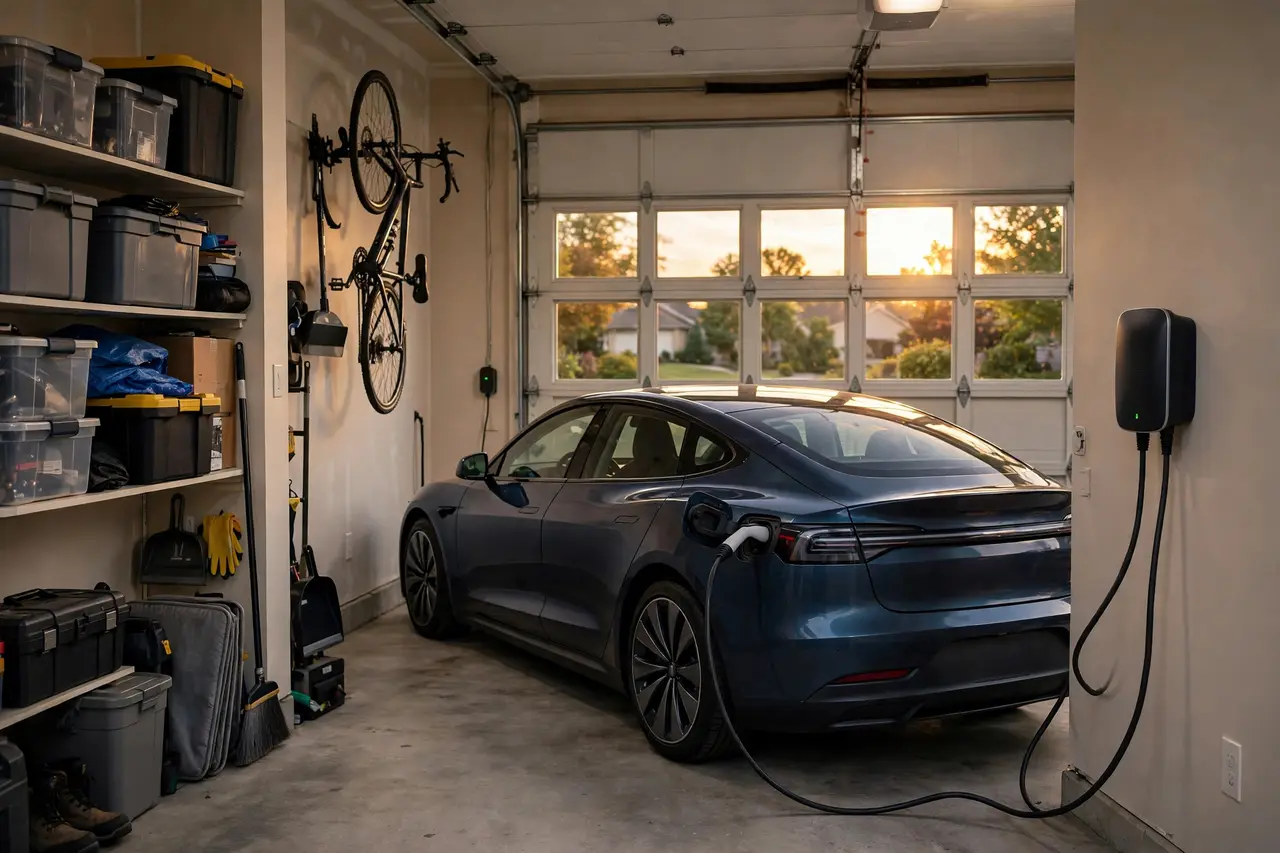
EV charging services in Brownsville
Installers in Brownsville book the same ten services as everywhere — but not in the same proportions. The three leading cards below are this city's pattern, set by its panels, its buildings and its statute book.
Home EV Charger Installation in Brownsville
Think of it as plumbing for electrons, done once: capacity checked, circuit run, station mounted and configured, inspection passed. The households that report the smoothest projects describe the same shape — a visit that measured, a quote that itemised, and a car that simply charged from the first night.
In Brownsville: the install Brownsville's new EV households book first, and the one the rest of this page keeps returning to.
Level 2 Charger Installation in Brownsville
Level 2 earns its keep on the worst week of the year: the cold snap, the back-to-back long days, the evening the car comes home empty with a dawn departure. A circuit sized for those weeks makes the ordinary ones invisible.
In Brownsville: 240 volts, sized honestly — the working definition of home charging in Brownsville.
Load Management & Smart Charging Setup in Brownsville
Load management is the code-recognised way to let a full panel tell the truth: the house's real load is spiky, not constant, and a managed charger lives in the valleys. The result reads like a bigger service on every ordinary night of the year.
In Brownsville: pairs with time-of-use rates in Brownsville: charge when rates are lowest and capacity is spare.
Utility programs and electricity in Brownsville
Electricity in Brownsville comes from Magic Valley Electric Coop Inc. Parts of the wider metro are served by Brownsville Public Utilities Board, AEP Texas Central Company. The utility matters twice over for a charger install: it sets the time-of-use rates that decide what overnight charging costs you, and it is the organisation that may — or may not — currently help pay for the equipment.
Do not budget for a rebate in Brownsville right now. As of the sources checked for this page, Magic Valley Electric Coop Inc publishes no residential charger rebate, Texas offers no state program for typical home installs, and the federal 30C credit ended on September 30, 2025. If that changes, the utility's program page will say so with an as-of date — and this page will be updated to match. Until then, judge quotes on the work itself.
Net-metering households — rooftop solar is common across the metro — should tell the installer: charging schedules and load management are planned differently when the house generates as well as consumes.
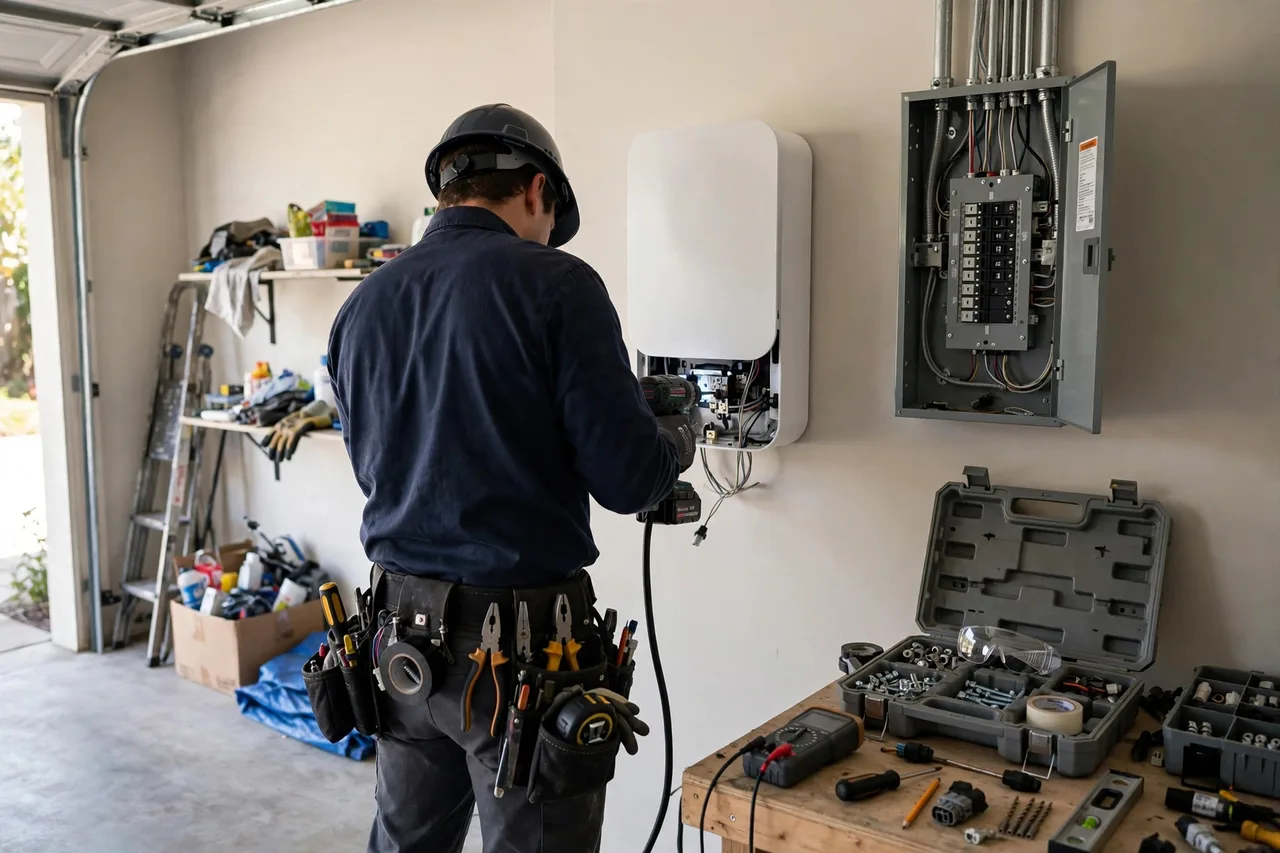
Condos, HOAs and the law in Texas
No statute promises a charger approval in Texas. Unlike the states that have enacted right-to-charge laws, Texas leaves the question entirely to each community's covenants and board discretion. For Brownsville owners that is not the end of the road — it is a sign that the negotiation, the metering design and the written application carry the weight a statute would otherwise carry.
Owners of single-family homes in HOA communities should also check the covenants before assuming the driveway is uncomplicated: exterior-equipment and architectural-approval clauses can apply to a visible wall-mounted station even where the garage interior is entirely the owner's business.
The negotiation playbook — application contents, metering options, the wording that answers boards' standard objections — is set out in our condo and HOA guide, read here as a persuasion manual rather than a rights manual.
Climate, garages and charger placement
Humidity does quiet electrical work of its own: connections in damp garages live harder lives than their desert counterparts, which is one more reason the installer's torque and the enclosure's seal deserve their moment at commissioning. The charger itself is sealed and rated for this climate; the discipline is in the joints.
Afternoon is the design hour: a station, a cable and a car that all sit in the day's peak heat age on the local schedule, not the brochure's. West-facing walls are the last choice here; the shaded side of the garage, the eave's shadow and the overnight schedule are the three cheap protections every local installer reaches for.

Permits and inspection in Brownsville
The permit trail also protects the next transaction: a charger circuit on the inspection record is an asset a buyer's inspector reads in one line, while an undocumented circuit is a question that follows the sale. Installers who work this metro treat the filing as part of the deliverable, not an errand.

Neighbourhoods and ZIP codes served
The page covers 5 ZIP codes in and around Brownsville — including 78520, 78521, 78522, 78523, 78526 — across Cameron. If your ZIP is not in the first set shown, ask anyway: installer coverage follows the metro, not a postcode fence.
The same working area takes in the neighbouring localities of Olmito, Los Fresnos, Port Isabel, Los Indios, San Benito, Lozano, Harlingen, Rio Hondo, Santa Maria, La Feria, Combes, South Padre Island, Santa Rosa — the county ring an installer based in Brownsville actually drives. Requests from those communities route exactly as city requests do: same services, same permit discipline, same local facts where they differ.
Cameron County accounts for 21 of the ZIP codes and 14 named postal localities in the research file, the nearest of them Olmito, Los Fresnos, Port Isabel, Los Indios, San Benito. The survey counts 426,120 residents in the county, with a median household income of $52,601 and a median home value of $136,500. Measured across its ZIP codes, the Brownsville footprint runs about 5 miles north to south and 4 east to west, from ZIP 78520 to 78526 — the ground an installer based here actually covers in a working week.
Beyond the county seats, the working area takes in Olmito, Los Fresnos, Port Isabel, Los Indios, San Benito, Lozano, Harlingen, Rio Hondo, Santa Maria, Combes, South Padre Island, Port Mansfield — the named localities for which Brownsville is the nearest metro in the network (neighbouring metros' pages cover their own ground), each routing to the same installer-matching service.
The wider working area also reaches La Feria, Progreso, Mercedes, Santa Rosa, Weslaco, Sebastian, Donna, La Villa, Lyford, Edcouch, La Blanca, San Perlita, San Juan, Pharr, Raymondville, Hidalgo, Lasara, Mcallen, Hargill, La Joya, Los Ebanos, Sullivan City, Linn, Armstrong, Grulla, Garciasville, Delmita, San Isidro, Encino, Sarita, Roma, Falfurrias, Salineno, Riviera, Falcon Heights — ground shared with neighbouring metros, where installers cross the same county lines in both directions.
ZIP codes in that shared ground include 78338, 78355, 78379, 78385, 78501, 78503, 78505, 78516, 78536, 78537, 78539, 78541, 78543, 78545, 78547, 78548, 78549, 78558, 78560, 78561, 78562, 78563, 78565, 78569, 78572, 78573, 78574, 78576, 78577, 78580, 78582, 78584, 78585, 78588, 78589, 78591, 78593, 78594, 78595, 78596.
The largest communities in that working area after Brownsville itself, by the GeoNames populated-place file: Harlingen (population 65,774), San Benito (population 24,496), La Feria (population 7,338), Cameron Park (population 6,963), Cameron Park Colonia (population 6,963), Los Fresnos (population 6,582), Port Isabel (population 5,016), Primera (population 4,626), Laureles (population 3,692), Laguna Heights (population 3,488), Laguna Vista (population 3,212), Combes (population 3,059), La Paloma (population 2,903), South Padre Island (population 2,884), Rancho Viejo (population 2,491), Rio Hondo (population 2,445), Encantada-Ranchito-El Calaboz (population 2,255), Las Palmas II (population 1,605), South Point (population 1,376), Palm Valley (population 1,294). Charging demand follows those populations — the subdivisions and town centres where the next driveways, and the next panels, are.
Willacy County reaches into the working area with 20,139 residents, a median household income of $54,180 and a median home value of $73,600; its localities on this page include Port Mansfield.
| ZIP | Locality | County |
|---|---|---|
| 78520 | Brownsville | Cameron |
| 78522 | Brownsville | Cameron |
| 78521 | Brownsville | Cameron |
| 78523 | Brownsville | Cameron |
| 78526 | Brownsville | Cameron |
| 78575 | Olmito | Cameron |
| 78566 | Los Fresnos | Cameron |
| 78578 | Port Isabel | Cameron |
| 78567 | Los Indios | Cameron |
| 78586 | San Benito | Cameron |
| 78568 | Lozano | Cameron |
| 78553 | Harlingen | Cameron |
| 78550 | Harlingen | Cameron |
| 78583 | Rio Hondo | Cameron |
| 78592 | Santa Maria | Cameron |
| 78552 | Harlingen | Cameron |
| 78551 | Harlingen | Cameron |
| 78535 | Combes | Cameron |
| 78597 | South Padre Island | Cameron |
| 78598 | Port Mansfield | Willacy |

Planning the install: from panel to parking
Homeowners sometimes ask why a job that looks like 'one outlet' needs a site visit at all. The visit exists because the three variables that set the scope — spare capacity, the run's route, and the property's approval layer — are all invisible from a photograph. In Brownsville an experienced installer reads them in minutes, in the panel's directory card, the garage's geometry and the community's documents. The quote that follows a visit is a different species from the quote that precedes one: it can be held to.
Finally, photograph the finished work — station, nameplate, panel directory with the new breaker labelled — and file it with the inspection record. When the car changes, the house sells or a second station joins the first, that folder is the difference between a five-minute answer and an archaeological dig.
Home charging know-how for Brownsville households
Charging with an accessory dwelling
Houses with a second unit — a garage apartment, a granny flat, a rented studio — add a cast member to the charging design: another household. The questions multiply politely. Whose panel carries the circuit? Whose meter records the energy? Does the tenancy agreement mention the charger at all? None are hard questions, and all are cheaper answered at design time than at the first shared bill. Where the second unit has its own meter and panel, the design is simply two small domestic installs sharing an address.
Whose meter? The metering designs
Every shared-parking install eventually asks the same question: whose electricity is this? The designs that answer it cleanly are few and known — a circuit from the owner's own meter where the geometry allows, a submeter on a shared supply with readings the association can audit, a networked station billing each user directly, or a flat arrangement the community's documents permit. The right choice is the one the building's wiring and its paperwork both support. What never works is leaving the question open: energy without an owner is the objection that sinks applications, so the metering design travels with the application, not after it.
Reading the bill after the charger arrives
The first bills after an install reward a careful read. Charging appears as consumption, not as a line item — the household's kilowatt-hours rise by roughly the car's appetite, and the rate applied to the new hours depends on when they happened. Owners who check the schedule actually ran — that the car charged inside the intended window — catch the one configuration mistake that costs money monthly. After that, the bill becomes the household's quietest document: the car simply costs what the overnight rate says it should.
Planning the second visit on the first
Nearly every install leaves a known future: a second car, a workshop circuit, a battery or a heat pump queuing for capacity. The first visit is when that future costs least to serve — conduit runs made while walls are open, panel positions reserved, the load study documented so the next calculation starts from evidence. Installers call it roughing in the future; households experience it, years later, as the second project that was mysteriously half done already.

Frequently asked questions
Can I still get the federal tax credit for a home charger in Brownsville, TX?
You cannot — it no longer exists. The 30C credit closed to equipment placed in service after September 30, 2025, and no Texas program replaced it for home installs. Nor did the sources checked for this page show a live Magic Valley Electric Coop Inc residential rebate. Treat any 'credit' mentioned in a quote as a request for paperwork.
Can my HOA or condo board in Brownsville, TX refuse my charger?
Possibly, yes. Texas has no statewide right-to-charge law in the authoritative indexes checked for this page, so your community's covenants govern. A complete written application — licensed installer, dedicated circuit, owner-paid metering and insurance — is the approach that gets approvals here.
Will my Brownsville, TX home need a panel upgrade for a Level 2 charger?
The answer lives in your panel's directory and its arithmetic, not in the car's requirements. With 29% of Brownsville's homes predating 1980 (median build 1997), local installers see both situations weekly: the 200-amp panel that takes the circuit directly, and the full 100-amp service that needs capacity work first. The site visit exists to sort your house into one of those two piles, on numbers.
How much faster is Level 2 charging at home in Brownsville, TX?
In parked hours: a Level 1 cord returns about 3–5 miles for each of them, and a Level 2 circuit returns roughly 25–40, set by its amperage and the car's acceptance. For a Brownsville household parking ten hours, that is the difference between recovering a short errand day and recovering any day the car can legally drive.
What happens after I request an installer through this page?
Three steps: the request routes to installers who work Brownsville, Texas; one contacts you to walk the property; the walk produces the written quote. Everything on this page — the utility position, the law, the housing data — is yours to check that quote against.
How long does a typical home charger installation take in Brownsville, TX?
Plan on a day of electrical work for the standard layout, plus the permit and inspection appointments that bracket it on the city's calendar. Capacity work — an upgrade or a subpanel — extends the electrical day; approvals in a condo or HOA extend the calendar, not the tools. Your site visit ends with all three durations stated separately.
Nearby cities in Texas
- EV charger installation in McAllen — about 44 miles from Brownsville, metro population 875,000
- EV charger installation in Corpus Christi — about 129 miles from Brownsville, metro population 425,000
- EV charger installation in Laredo — about 155 miles from Brownsville, metro population 270,000
- EV charger installation in Victoria — about 200 miles from Brownsville, metro population 100,000
- EV charger installation in San Antonio — about 250 miles from Brownsville, metro population 2,650,000
- EV charger installation in Houston — about 294 miles from Brownsville, metro population 7,300,000
- EV charger installation in Lake Charles, LA — about 381 miles from Brownsville, metro population 210,000
- EV charger installation in Lafayette, LA — about 425 miles from Brownsville, metro population 480,000
- EV charger installation in Houma, LA — about 451 miles from Brownsville, metro population 205,000
Ready to charge at home in Brownsville?
Tell us the job — service, ZIP and property type — and licensed local installers will take it from there.