EV Charger Installation in Houston, TX
Charging where you park, in Houston: the utility programs, state law, permit process and housing facts behind a home charger install, gathered in one place.
Charging at home is the version of EV ownership that actually works day to day, and in Houston it starts with a straightforward question: where will the car sleep, and what can the electrical panel behind that wall honestly support? Houston itself is home to about 2,387,910 people, and 387,400 battery-electric vehicles plus 79,900 plug-in hybrids were registered across Texas by the end of 2025 — every one of them a household that charges somewhere. This page gathers what a homeowner in Houston needs to know before booking an installer: the local utility and its current charger programs, the state law that applies in condos and HOA communities, the permit process, and the housing realities that decide how simple or involved an installation will be.
How to read this page in four minutes: the data band tells you what kind of housing city Houston is; the utility section tells you whether money is on the table; the law section tells you whether permission is a process or a negotiation; and the permit section tells you what proof the finished job leaves behind. The rest is elaboration.
Measured demand, not enthusiasm, put Houston in Tier A of this network: TX No. 2 metro; 387K state BEVs; Entergy/CenterPoint territories. For a homeowner the useful translation is simpler — installers here do this work weekly, know the local permit counter, and have seen your housing stock before.
The Census Bureau's portrait of Houston — median household income $64,361, 41% of occupied homes owner-occupied, 42% of units in single-unit detached houses — is, read correctly, a charging forecast. Owners approve their own work; detached houses host their own circuits; the remaining share is where the interesting projects live.

The composite picture matters more than any single statistic. In Houston: a housing stock of mixed vintages, where both electrical eras appear on the same street; a genuinely mixed city — houses, townhouses and larger buildings all carry weight; buildings of five or more units hold a substantial share of homes, which keeps the multifamily sections of this page in daily use; meanwhile, renters form a large share of households, so the landlord conversation is a first-class topic here. A page that ignored that profile would give the same advice everywhere; this one is ordered by it.
The counts behind the percentages, for the record: Houston has 1,070,556 housing units on the survey's count, 943,336 of them occupied, and 385,594 owner-occupied households making their own electrical decisions. Detached houses number 448,484; homes built before 1980 number 467,336; units in buildings of five or more number 494,228. An installer's week in this city is a walk through exactly that distribution. The page's geography is equally concrete: 178 ZIP codes across Harris, centred near 29.81 degrees north latitude. The city anchors the Houston–The Woodlands–Sugar Land metropolitan area, home to roughly 7,300,000 people on the research file's metro estimate — the wider labour and housing market this page's installers work across.
The same survey release fills in the household economics around the housing stock: a median home value of $301,200, median gross rent of $1,408, per-capita income of $42,181, and a median resident age of 34. And the daily rhythms behind the housing numbers: 69% of Houston workers drive to work alone — the commute pattern home charging is built around; 11% work from home, a population whose cars charge on daytime and overnight schedules alike; 3% commute by public transit; 38% of adults hold a bachelor's degree or higher. The survey's vehicle table is the one an EV page should quote first: 102,278 of Houston's households have no vehicle at all, while 429,548 have two or more — the multi-car households for whom the second circuit is a when, not an if.
Household structure, from the same release: 57% of Houston households are family households. The burden shares behind the housing stock: 54% of renting households are cost-burdened at the 30%-of-income line, as are 0% of mortgaged owners — context for why the overnight rate window, once set, is treated here as a household fixture rather than a hobby.
Read together, the local facts draw a recognisable picture. The layered stock produces a layered permit record — straightforward circuits in the newer rings, capacity conversations in the older core, and an installer workforce fluent in both dialects. Shared form means shared infrastructure decisions: a building that solves charging solves it for a generation of residents, which raises the stakes of the first design and the value of getting the metering right.
High renter share also means charging follows the lease cycle: applications cluster at move-in, installations at renewal leverage, and the whole market breathes on the rental calendar. Middle incomes discipline the specification toward the durable middle: not the minimum circuit that passes, not the maximal one that impresses — the one the load calculation actually indicates, documented. A large utility's scale cuts both ways — programme budgets that dwarf a small co-op's, and call-centre distance between a household and anyone who can decide anything. The published page rules; keep it bookmarked.
A large fleet normalises the paperwork: boards have seen the application before, landlords have a standard answer, permit counters process charger circuits as routine volume. Metropolitan scale means the page's general facts have street-level exceptions everywhere — micro-territories of other utilities, historic districts with their own rules, buildings with their own regimes — and the installer conversation is where the exception for your address surfaces. The association dimension here runs on persuasion rather than statute — no state charging law frames the application, so the complete, professional proposal carries the whole argument, as the law section above explains.
The electrical reality in Houston homes
Houston's housing, in Census Bureau survey numbers: a median build year of 1985, 44% of units predating 1980, a stock that is 42% single-unit detached, and 41% of occupied homes owned by their occupants. Everything in this section is commentary on those four facts. A mixed-age stock like this splits installs into two camps: newer subdivisions where a 200-amp panel usually has planned capacity, and established neighbourhoods where the panel conversation comes first. Neither is a problem — but they are different jobs, and the estimate you get should say which camp your home falls into and why. Attics, basements and interior panel locations are common in this vintage of stock, which is why the run's route gets its own line in any serious quote: distance and finish decide labour more than the charger does.
Heating fuel is the survey's quiet clue to panel life: in Houston, 64% of homes heat electrically (599,945 households), against 35% heating with gas. A house already heating electrically has a service sized with that load in its history; a gas-heated house may have capacity to spare — either way the fuel mix is part of what the installer is reading.
The tenure split cuts the other way too: roughly 557,742 occupied homes in Houston are rented. For those households the charger question is a negotiation with a property owner — written proposal, licensed installer, metering clarity — and it succeeds often enough that installers here keep the pattern ready.
The city's stock is not all houses: 46% of units are in structures of five or more. Shared buildings mean shared panels, assigned parking and association process — the substance of the multifamily sections below.
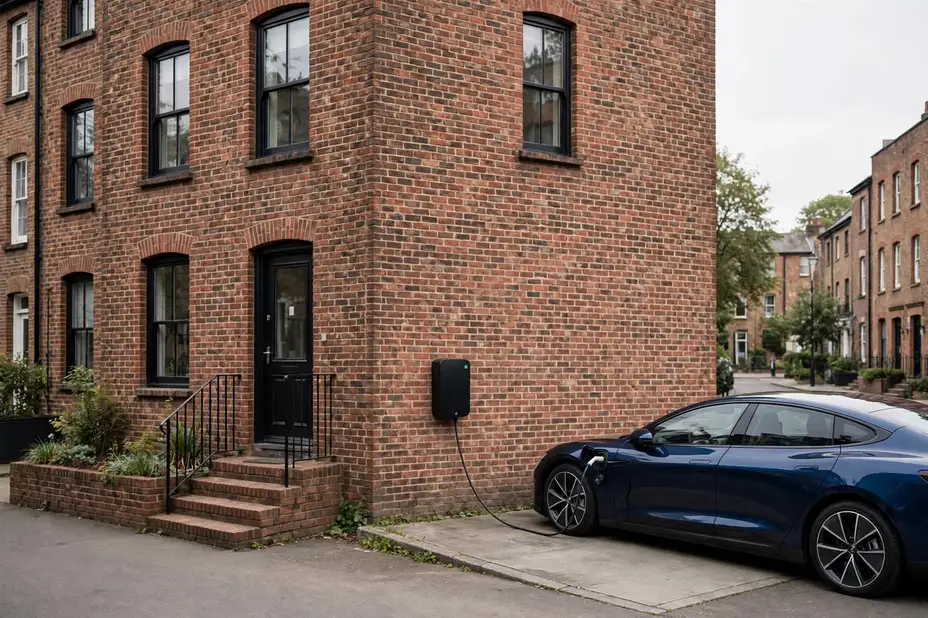
EV charging services in Houston
Installers in Houston book the same ten services as everywhere — but not in the same proportions. The three leading cards below are this city's pattern, set by its panels, its buildings and its statute book.
Home EV Charger Installation in Houston
Think of it as plumbing for electrons, with the same virtues: correct sizing, honest materials, tidy runs, tested joints. The installers who do it weekly follow a pattern — assess, calculate, route, mount, configure, document — and the pattern is why their installs rarely make news afterwards.
In Houston: usually the first job a new EV household in Houston books, scoped to the panel the house already has.
Dedicated Circuit & Electrical Panel Upgrade in Houston
The capacity project behind the charger project. A load calculation decides whether the answer is a service increase, a panel replacement, a subpanel or load management — and the work is sequenced with the utility and the inspector so the house is live again the same day in most cases.
In Houston: service work that turns 'no room' into a circuit with headroom in Houston homes.
Level 2 Charger Installation in Houston
A Level 2 circuit turns charging from a ration into a routine. The job is electrical rather than electronic — breaker and conductor sized at the continuous-load factor, the run routed to the parking position, and the station dialled to the circuit rather than to its own headline maximum.
In Houston: the circuit class behind nearly every home install in Houston, from first car to second.
Utility programs and electricity in Houston
Electricity in Houston comes from Entergy Texas Inc.. Parts of the wider metro are served by San Bernard Electric Coop, Inc, CenterPoint Energy. The utility matters twice over for a charger install: it sets the time-of-use rates that decide what overnight charging costs you, and it is the organisation that may — or may not — currently help pay for the equipment.
Why does this page labour the absence of a rebate? Because in Houston the phantom rebate is the most common distortion in charger quotes: a figure justified by money that is not, at present, claimable. The verified position: federal 30C ended September 30, 2025; no Texas replacement for typical home installs; no Entergy Texas Inc. residential charger rebate in the sources checked. If someone quotes you a rebate, the follow-up is one sentence — show me the program page — and its answer decides the quote's credibility.
Before the install, it is worth a two-minute look at your tariff. Many Entergy Texas Inc. customers can move to a time-of-use plan where overnight energy is charged at a lower rate, and a scheduled charger makes that saving automatic.
Condos, HOAs and the law in Texas
There is no Texas right-to-charge statute to lean on. Some national roundups list protection that does not exist in this state's code; the statute indexes checked for this page are clear. In Houston, a condo or HOA charger is approved — or not — under the community's own documents, which makes the quality of your application the whole ballgame.
If the board says no, ask for the refusal in writing with the covenant cited. Rules change — several states added right-to-charge laws in 2025 alone — and a documented refusal is what a future rule change, or a future board, works from.
For the full playbook — application contents, metering designs, the questions boards ask — see the condo and HOA charging guide. In Houston it should be read as a negotiation manual, because negotiation is what the absence of a statute leaves you.
Climate, garages and charger placement
Shade is a specification here, not a nicety. Outdoor stations belong under eaves or on the wall that escapes the afternoon sun; connectors left baking in a holder weather faster, and cables stiffen and crack on a shorter clock. The site walk should include a look at where the sun actually lands at four in the afternoon — that is the hour the equipment has to survive.
Shade structures — carports, pergolas, the live-oak side of the lot — are charging infrastructure in a hot climate whether they were built as such or not. A car that starts the session twenty degrees cooler spends its first charging hour on energy rather than on cooling itself.

Permits and inspection in Houston
If your install is part of a larger job — a panel upgrade, a garage build — the charger usually rides on the same permit set. Ask for the charger circuit to be listed explicitly so the inspection record shows it.

Neighbourhoods and ZIP codes served
The page covers 178 ZIP codes in and around Houston — including 77001, 77002, 77003, 77004, 77005, 77006, 77007, 77008, 77009, 77010, 77011, 77012, 77013, 77014, 77015, 77016, 77017, 77018, 77019, 77020, 77021, 77022, 77023, 77024, 77025, 77026, 77027, 77028, 77029, 77030, 77031, 77032, 77033, 77034, 77035, 77036, 77037, 77038, 77039, 77040, 77041, 77042, 77043, 77044, 77045, 77046, 77047, 77048, 77049, 77050, 77051, 77052, 77053, 77054, 77055, 77056, 77057, 77058, 77059, 77060 — across Harris. If your ZIP is not in the first set shown, ask anyway: installer coverage follows the metro, not a postcode fence.
The same working area takes in the neighbouring localities of Galena Park, North Houston, Bellaire, Humble, Pasadena, Channelview, South Houston, Deer Park, Highlands, Kingwood, Crosby, La Porte, Spring, Alief — the county ring an installer based in Houston actually drives. Requests from those communities route exactly as city requests do: same services, same permit discipline, same local facts where they differ.
Harris County accounts for 232 of the ZIP codes and 25 named postal localities in the research file, the nearest of them Galena Park, North Houston, Bellaire, Humble, Pasadena. The survey counts 4,838,303 residents in the county, with a median household income of $74,983 and a median home value of $276,600. Measured across its ZIP codes, the Houston footprint runs about 31 miles north to south and 37 east to west, from ZIP 77001 to 77299 — the ground an installer based here actually covers in a working week.
Beyond the county seats, the working area takes in Galena Park, North Houston, Bellaire, Humble, Pasadena, Channelview, South Houston, Deer Park, Highlands, Kingwood, Crosby, La Porte, Spring, Alief, Pearland, Missouri City, Baytown, Stafford, Webster, Huffman, Friendswood, Barker, Sugar Land, Cypress, Fresno, Porter, Seabrook, Mont Belvieu, Katy, League City, Manvel, New Caney, Tomball, Richmond, Kemah, Hufsmith, Conroe, Alvin, Dayton, Bacliff, Thompsons, Rosharon, Dickinson, Splendora, Santa Fe, Pinehurst, Magnolia, Rosenberg, Hockley, Fulshear, Texas City, La Marque, Brookshire, Hitchcock, Liverpool, Simonton, Waller, Pattison, Cleveland, Orchard, Needville, Danbury, Damon, Guy, Wallis, Beasley, Galveston, Port Bolivar, San Felipe, Willis, Angleton — the named localities for which Houston is the nearest metro in the network (neighbouring metros' pages cover their own ground), each routing to the same installer-matching service.
The wider working area also reaches Wallisville, Liberty, Raywood, Hardin, Hankamer, Anahuac, Prairie View, Daisetta, Devers, Montgomery, Hull, Dobbin, Plantersville — ground shared with neighbouring metros, where installers cross the same county lines in both directions.
ZIP codes in that shared ground include 77316, 77333, 77363, 77446, 77514, 77533, 77538, 77560, 77561, 77564, 77575, 77582, 77597.
The largest communities in that working area after Houston itself, by the GeoNames populated-place file: Cypress (population 200,839), Pasadena (population 153,784), Pearland (population 108,821), Alief (population 98,725), League City (population 98,312), The Woodlands (population 93,847), Sugar Land (population 88,156), Baytown (population 76,335). Charging demand follows those populations — the subdivisions and town centres where the next driveways, and the next panels, are.
| ZIP | Locality | County |
|---|---|---|
| 77001 | Houston | Harris |
| 77026 | Houston | Harris |
| 77028 | Houston | Harris |
| 77020 | Houston | Harris |
| 77016 | Houston | Harris |
| 77009 | Houston | Harris |
| 77093 | Houston | Harris |
| 77078 | Houston | Harris |
| 77022 | Houston | Harris |
| 77052 | Houston | Harris |
| 77201 | Houston | Harris |
| 77203 | Houston | Harris |
| 77208 | Houston | Harris |
| 77209 | Houston | Harris |
| 77210 | Houston | Harris |
| 77212 | Houston | Harris |
| 77252 | Houston | Harris |
| 77253 | Houston | Harris |
| 77297 | Houston | Harris |
| 77029 | Houston | Harris |
| 77002 | Houston | Harris |
| 77003 | Houston | Harris |
| 77013 | Houston | Harris |
| 77011 | Houston | Harris |
| 77292 | Houston | Harris |
| 77010 | Houston | Harris |
| 77076 | Houston | Harris |
| 77008 | Houston | Harris |
| 77007 | Houston | Harris |
| 77023 | Houston | Harris |
| 77050 | Houston | Harris |
| 77547 | Galena Park | Harris |
| 77018 | Houston | Harris |
| 77039 | Houston | Harris |
| 77006 | Houston | Harris |
| 77004 | Houston | Harris |
| 77019 | Houston | Harris |
| 77049 | Houston | Harris |
| 77012 | Houston | Harris |
| 77037 | Houston | Harris |
| 77202 | Houston | Harris |
| 77204 | Houston | Harris |
| 77205 | Houston | Harris |
| 77206 | Houston | Harris |
| 77207 | Houston | Harris |
| 77213 | Houston | Harris |
| 77215 | Houston | Harris |
| 77216 | Houston | Harris |
| 77217 | Houston | Harris |
| 77218 | Houston | Harris |
| 77219 | Houston | Harris |
| 77220 | Houston | Harris |
| 77221 | Houston | Harris |
| 77222 | Houston | Harris |
| 77223 | Houston | Harris |
| 77224 | Houston | Harris |
| 77225 | Houston | Harris |
| 77226 | Houston | Harris |
| 77227 | Houston | Harris |
| 77228 | Houston | Harris |
| 77229 | Houston | Harris |
| 77230 | Houston | Harris |
| 77231 | Houston | Harris |
| 77233 | Houston | Harris |
| 77234 | Houston | Harris |
| 77235 | Houston | Harris |
| 77236 | Houston | Harris |
| 77237 | Houston | Harris |
| 77238 | Houston | Harris |
| 77240 | Houston | Harris |
| 77241 | Houston | Harris |
| 77242 | Houston | Harris |
| 77243 | Houston | Harris |
| 77244 | Houston | Harris |
| 77245 | Houston | Harris |
| 77248 | Houston | Harris |
| 77249 | Houston | Harris |
| 77251 | Houston | Harris |
| 77254 | Houston | Harris |
| 77255 | Houston | Harris |
| 77256 | Houston | Harris |
| 77257 | Houston | Harris |
| 77258 | Houston | Harris |
| 77259 | Houston | Harris |
| 77261 | Houston | Harris |
| 77262 | Houston | Harris |
| 77263 | Houston | Harris |
| 77265 | Houston | Harris |
| 77266 | Houston | Harris |
| 77267 | Houston | Harris |

Planning the install: from panel to parking
Two decisions shape every Houston install, and both are made before any equipment is ordered. The first is electrical: the load calculation that decides between a straight circuit, a panel upgrade and load management. The second is physical: where the station lives — which wall, which side of the car the charge port sits on, and whether the cable reaches a second vehicle or a future one. Installers in Houston see the same housing patterns repeat street by street, which is why a ten-minute site visit produces a firmer quote than any online form: the form starts the conversation, the visit settles it.
Finally, photograph the finished work — station, nameplate, panel directory with the new breaker labelled — and file it with the inspection record. When the car changes, the house sells or a second station joins the first, that folder is the difference between a five-minute answer and an archaeological dig.
Home charging know-how for Houston households
Selling a house that charges
A documented charger has become a listing fact: the housing market's filters increasingly include charging, and the buyers behind them read a permitted, inspected installation as maintained infrastructure. The operative word is documented. The permit and inspection record, the panel schedule showing the circuit, and the station's manual together convert the charger from a question a buyer's inspector raises into a feature the listing can name. If a sale is anywhere on the horizon, the paperwork conversation with your installer is worth having at install time, while it is free.
Three cars, one driveway
Households with more vehicles than bays run a small nightly logistics operation, and charging joins the rotation. The patterns that work: the station positioned to serve two parking spots in sequence, a household habit about whose night it is, and — where two of the fleet are electric — power sharing that removes the rotation entirely. The design conversation should start from the household's actual parking choreography, observed on a normal evening, because the charger serves the pattern that exists, not the one the driveway promised.
Amps, volts and kilowatts without tears
Three numbers describe every charging session. Volts are the pressure — 240 of them on a Level 2 circuit. Amps are the flow — the circuit's rating, of which the car may continuously use eighty percent. Kilowatts are the product of the two and the speedometer of charging: volts times amps, divided by a thousand. A 40-amp circuit at 240 volts delivers 9.6 kilowatts; over a ten-hour night that is roughly 96 kilowatt-hours before losses — more than most batteries hold. Once the multiplication is familiar, every quote and specification sheet becomes readable.
Cable discipline: the daily five seconds
The connector and cable are the parts of the installation you touch twice a day, and they age by handling rather than by electricity. The habits that matter are small: the connector returns to its holster rather than the floor, the cable hangs in a loose loop rather than a kinked coil, the run never crosses the path of the other car's door swing or the bins' weekly journey. Drive-over is the cable's particular enemy — route so that tyres never cross it. Five seconds of discipline per park is the whole maintenance philosophy of the visible half of the system.
The charger among workshop loads
Garages that double as workshops put the charger in interesting company: welders, compressors, dust collectors — loads with appetites and opinions. The load calculation for such a house reads the whole tenancy, and the honest conversation includes which loads genuinely coincide. A station scheduled into the workshop's quiet hours lives peacefully; one competing with the table saw's startup surge teaches the household about breaker curves the experiential way.

Frequently asked questions
Can I still get the federal tax credit for a home charger in Houston, TX?
Nothing is currently on offer that you should plan around. The federal 30C credit ended on September 30, 2025; Texas operates no replacement for typical home installs; and the sources checked for this page showed no live residential rebate from Entergy Texas Inc.. Programs do reopen — on the utility's own pages, with dates. Until one does, the install stands or falls on its own merits.
Can my association in Houston, TX say no to a home charger?
In Houston, they can — there is no Texas statute stopping them. Right-to-charge protection simply has not been enacted here, so the board's own rules decide. Owners do still get approved regularly: the applications that succeed answer the board's concerns (metering, insurance, restoration, a licensed installer) before the meeting, in writing.
Does a Level 2 charger mean a panel upgrade for a Houston, TX home?
It hinges on two numbers you cannot read off the panel door: the service's rating, and what the load calculation says it already carries. The vintage of Houston's stock — median build year 1985, about 44% of homes from before 1980 — means both answers are common here. The charger enters the arithmetic at 125% of its draw; whatever room survives that entry decides between a circuit, a management device, and an upgrade.
How much faster is Level 2 charging at home in Houston, TX?
Level 2 is several-fold faster in the only unit that matters — miles back per hour parked: roughly 25–40 against Level 1's 3–5. The exact figure follows the circuit: a 40-amp circuit and a 60-amp circuit are both Level 2, and the car's onboard limit may sit below either. Your installer matches the three numbers at the site visit.
What happens after I request an installer through this page?
Your request — service, Houston ZIP, property type and timing — goes to licensed local installers who cover Houston. They contact you directly to arrange a site visit and quote. PlugReady USA is the matching service, not the installer, and the sections above exist so you can judge any quote against the local facts.
Does Entergy Texas Inc. offer a time-of-use rate for EV charging in Houston?
Many Entergy Texas Inc. customers can choose a time-of-use tariff; whether yours is one, and where its cheap window sits, decides how the charger should be scheduled from night one. Two minutes with your tariff sheet during the planning stage is the whole task — the installer sets the schedule to match while commissioning the station.
Nearby cities in Texas
- EV charger installation in Beaumont — about 69 miles from Houston, metro population 395,000
- EV charger installation in College Station — about 78 miles from Houston, metro population 275,000
- EV charger installation in Victoria — about 116 miles from Houston, metro population 100,000
- EV charger installation in Austin — about 140 miles from Houston, metro population 2,400,000
- EV charger installation in Waco — about 157 miles from Houston, metro population 285,000
- EV charger installation in Killeen — about 161 miles from Houston, metro population 500,000
- EV charger installation in Lake Charles, LA — about 121 miles from Houston, metro population 210,000
- EV charger installation in Lafayette, LA — about 185 miles from Houston, metro population 480,000
- EV charger installation in Alexandria, LA — about 187 miles from Houston, metro population 150,000
Ready to charge at home in Houston?
Two minutes of form, and the request is in front of licensed installers who cover this city — quotes follow site visits, in writing.