EV Charger Installation in Austin, TX
Charging where you park, in Austin: the utility programs, state law, permit process and housing facts behind a home charger install, gathered in one place.
There is a short list of things that never change about a charger install — it needs capacity, a route, a position and a permit — and a longer list of things that change with the ZIP code. This page is the longer list, for Austin. Austin itself is home to about 993,771 people. Texas's registered electric fleet reached 387,400 battery-electric vehicles and 79,900 plug-in hybrids through 2025, and the installers working this metro have local habits worth borrowing. The utility section states what is verified and what is not; the law section quotes the position as it stands; the housing section works from survey data rather than vibes.
How this page is organised matters less than what is in it: verified local facts, stated with their sources, so you can check them yourself. PlugReady USA matches homeowners in Austin with licensed local installers; the detail below is the homework we would want done before anyone quotes the job.
The registration ledger for the Austin–Round Rock–Georgetown metro reads: Austin Energy 50% rebate — strongest sourced utility offer in the US. Ledgers like this are what installer rounds are built from — they show where the cars already are, which is where the circuits get requested, permitted and inspected week after week.
Context from the Census Bureau's survey of Austin: median household income $90,430; 41% of occupied homes are owner-occupied; 41% of housing units are single-unit detached houses. It is the profile of a city where the typical charger job is a homeowner job — scoped by the panel and the wire run, not by permissions.

Every city charges differently, and Austin's difference is legible in the data: a housing stock of mixed vintages, where both electrical eras appear on the same street; a genuinely mixed city — houses, townhouses and larger buildings all carry weight; buildings of five or more units hold a substantial share of homes, which keeps the multifamily sections of this page in daily use; renters form a large share of households, so the landlord conversation is a first-class topic here. Read the sections below through that profile and the local advice resolves into specifics — which questions are routine here, and which are rare.
In absolute terms, the survey counts 518,574 housing units in Austin — 484,550 occupied, 199,801 of them by their owners. The stock resolves into 212,673 single-unit detached houses, 131,120 homes standing since before 1980, and 238,634 units in larger buildings. Those six counts are the city's charging map drawn without percentages, and every section of this page is a consequence of one of them. The page's geography is equally concrete: 74 ZIP codes across Travis, Williamson, centred near 30.33 degrees north latitude. The city anchors the Austin–Round Rock–Georgetown metropolitan area, home to roughly 2,400,000 people on the research file's metro estimate — the wider labour and housing market this page's installers work across.
The same survey release fills in the household economics around the housing stock: a median home value of $571,000, median gross rent of $1,770, per-capita income of $66,973, and a median resident age of 35. The movement data matters as much as the money data: 57% of Austin workers drive to work alone — the commute pattern home charging is built around; 25% work from home, a population whose cars charge on daytime and overnight schedules alike; 3% commute by public transit; 61% of adults hold a bachelor's degree or higher. The survey's vehicle table is the one an EV page should quote first: 35,915 of Austin's households have no vehicle at all, while 222,947 have two or more — the multi-car households for whom the second circuit is a when, not an if.
The cost-burden lines say who feels housing costs most in Austin: 47% of renters spend 30% or more of income on rent, and 0% of owners with mortgages spend the same share on housing costs. Family households are 47% of all households — the two-car, school-run demographic whose charging patterns this page's planning sections keep circling back to.
What follows is the city read as an electrical place rather than a dot on a map. The layered stock produces a layered permit record — straightforward circuits in the newer rings, capacity conversations in the older core, and an installer workforce fluent in both dialects. With this much of the stock in shared buildings, the city's charging map is drawn in boardrooms as much as in electrical rooms: deeded spaces, common services, metering subplots in every application.
High renter share also means charging follows the lease cycle: applications cluster at move-in, installations at renewal leverage, and the whole market breathes on the rental calendar. Middle incomes discipline the specification toward the durable middle: not the minimum circuit that passes, not the maximal one that impresses — the one the load calculation actually indicates, documented. A large utility's scale cuts both ways — programme budgets that dwarf a small co-op's, and call-centre distance between a household and anyone who can decide anything. The published page rules; keep it bookmarked.
A fleet this size changes the questions at the kerb: not whether the neighbours approve of EVs, but whose installer did their circuit and whether the panel needed work — consumer intelligence, traded over fences. Metropolitan scale means the page's general facts have street-level exceptions everywhere — micro-territories of other utilities, historic districts with their own rules, buildings with their own regimes — and the installer conversation is where the exception for your address surfaces. Without a state charging statute, shared-property approvals in this metro are won on paper quality: metering clarity, licensed installers, insurance, reversibility — the complete package the guides set out.
The electrical reality in Austin homes
Four numbers organise everything an installer expects in Austin: median build year 2000; 25% of units built before 1980; 41% of the stock detached; 41% of occupied homes owner-occupied. Capacity, circuit routes and approval layers all correlate with those four. The paragraphs below are their commentary. A mixed-age stock like this splits installs into two camps: newer subdivisions where a 200-amp panel usually has planned capacity, and established neighbourhoods where the panel conversation comes first. Neither is a problem — but they are different jobs, and the estimate you get should say which camp your home falls into and why. Porches, carports and parking pads carry a real share of this city's charging, because the stock predates the two-car garage as a standard feature — outdoor-rated equipment is a local staple, not an edge case.
Heating fuel is the survey's quiet clue to panel life: in Austin, 59% of homes heat electrically (284,115 households), against 40% heating with gas. A house already heating electrically has a service sized with that load in its history; a gas-heated house may have capacity to spare — either way the fuel mix is part of what the installer is reading.
The tenure split cuts the other way too: roughly 284,749 occupied homes in Austin are rented. For those households the charger question is a negotiation with a property owner — written proposal, licensed installer, metering clarity — and it succeeds often enough that installers here keep the pattern ready.
And 46% of Austin's homes are in buildings with five or more units — apartments and condominiums where charging is a building decision before it is an electrical one. If that is your situation, the law and multifamily sections of this page are the ones written for you.
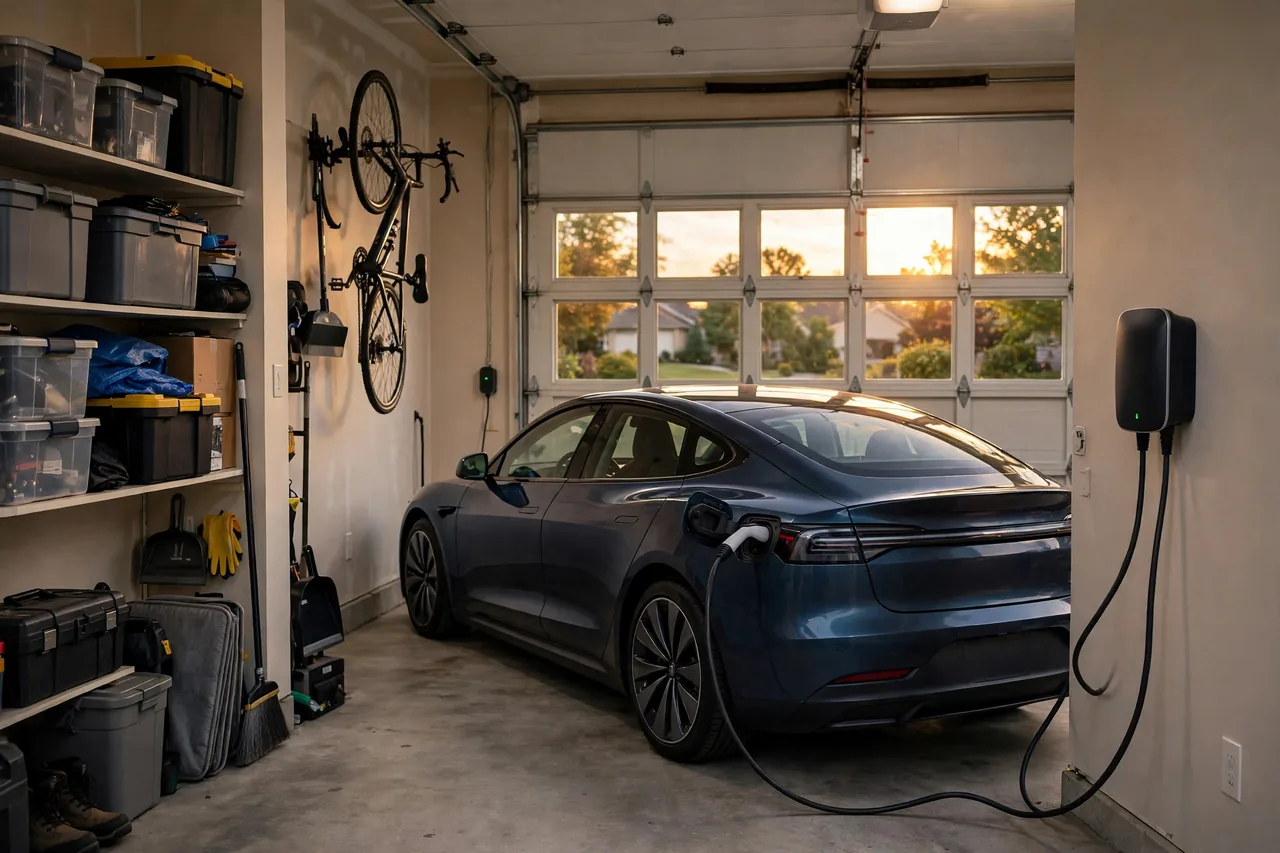
EV charging services in Austin
Three of the network's services lead this page because local conditions put them first; the remaining seven are one click away and equally available here. Each card states what the service involves — the matching itself is free of obligation until you accept an installer's quote.
Home EV Charger Installation in Austin
The core service, stated plainly: a dedicated 240-volt circuit run from your panel to your parking place, a station mounted and configured to that circuit, and the paperwork closed out with the permit office. Everything else in this section of the site exists to support or unblock this one job.
In Austin: usually the first job a new EV household in Austin books, scoped to the panel the house already has.
Level 2 Charger Installation in Austin
What is being bought is time: the hours between arriving home and leaving again, converted into range at 240 volts. The conversion hardware is ordinary — breaker, conductor, station — and the design work is matching the three to the household's miles and the panel's arithmetic.
In Austin: the circuit class behind nearly every home install in Austin, from first car to second.
Load Management & Smart Charging Setup in Austin
Smart scheduling pairs with smart limiting here — charge inside the cheap rate window, at whatever rate the house can spare at that moment. For many homes it converts an upgrade-sized problem into a device-sized one, with the same full battery by morning.
In Austin: letting a full Austin panel tell the truth about its valleys.
Utility programs and electricity in Austin
Electricity in Austin comes from Austin Energy. Parts of the wider metro are served by Pedernales Electric Coop, Inc, Bluebonnet Electric Coop, Inc, City of Georgetown. The utility matters twice over for a charger install: it sets the time-of-use rates that decide what overnight charging costs you, and it is the organisation that may — or may not — currently help pay for the equipment.
Current program (verified 2026-10-25): Austin Energy runs the Austin Energy Home EV Charger Rebate — 50% of charger purchase and installation, up to $1,200, for qualifying OCPP-compliant Level 2 stations; first-come, limited funds. Program terms and funding status are published by the utility; check the current status before you plan around it, because funded programs close when their budgets run out. Source: Austin Energy's published program terms, cross-checked against two national incentive listings in October 2026.
For businesses and multifamily properties in the metro, the same utility has also published: Commercial charging rebates up to $3,000 (Level 2) / $5,000 (DC fast charging) also published.
Net-metering households — rooftop solar is common across the metro — should tell the installer: charging schedules and load management are planned differently when the house generates as well as consumes.
Condos, HOAs and the law in Texas
No statute promises a charger approval in Texas. Unlike the states that have enacted right-to-charge laws, Texas leaves the question entirely to each community's covenants and board discretion. For Austin owners that is not the end of the road — it is a sign that the negotiation, the metering design and the written application carry the weight a statute would otherwise carry.
Timing helps too. Boards plan capital work annually; an application that arrives with the community's budget cycle, offering to coordinate with any planned electrical or repaving work, reads as a contribution rather than a demand.
Our condo and HOA guide was written for both kinds of state; the chapters on application packages, metering and cost allocation are the ones that matter in Austin, where no statute does the persuading for you.
Climate, garages and charger placement
Summer highs in Austin regularly exceed 100°F, and garage temperatures climb well above outdoor readings on July and August afternoons.
Texas grid demand peaks on summer evenings, which is why Austin Energy publishes off-peak charging guidance for EV owners.
Local notes: charging in Austin
Austin's charger culture is shaped by being a company town for technology and a capital city at once: early adoption is normal here, installers are booked out in waves that follow vehicle delivery cycles, and the municipal utility treats EV charging as a grid program, not a curiosity — hence the rebate, the off-peak guidance and the program rules that ask for connected, schedulable stations.
The city's growth pattern matters electrically. New subdivisions on the edges were built with modern 200-amp services and EV-ready garages increasingly written into the build; the older central neighbourhoods — bungalows and mid-century stock — are where panel conversations happen. Both are routine work for local installers, but they are different scopes, and your quote should say which one you are.

Permits and inspection in Austin
In Austin, the permitting authority for this work is the City of Austin Development Services Department. An electrical permit is required for a new 240-volt circuit in Austin, and the work is inspected before the case is closed. Austin Energy's charger rebate program requires the installed station to meet its published program rules, including OCPP compliance, and funds are first-come.
Expect the permit to name the circuit, the breaker and the equipment. An installer who suggests skipping it is saving an afternoon by spending your liability; the inspection is also your independent check that the continuous-load sizing was done properly.
Austin's sequence has a step most cities do not: the rebate paperwork runs alongside the permit, not after it. Austin Energy's program has historically required the station to meet its program rules and the application to be filed within its published window, so local installers photograph and document the install as they go. If the rebate matters to your decision, raise it before the site visit, not after the inspection — the order of the paperwork is the difference between a funded install and an identical unfunded one.

Neighbourhoods and ZIP codes served
- Downtown Austin
- Zilker
- Mueller
- Hyde Park
- Circle C Ranch
- West Lake Hills
- Tarrytown
- Allandale
- Cherrywood
- South Congress
- East Cesar Chavez
- North Burnet / The Domain area
- Round Rock
- Cedar Park
- Pflugerville
- Leander
The page covers 74 ZIP codes in and around Austin — including 73301, 73344, 78701, 78702, 78703, 78704, 78705, 78708, 78709, 78710, 78711, 78712, 78713, 78714, 78715, 78716, 78717, 78718, 78719, 78720, 78721, 78722, 78723, 78724, 78725, 78726, 78727, 78728, 78729, 78730, 78731, 78732, 78733, 78734, 78735, 78736, 78737, 78738, 78739, 78741, 78742, 78744, 78745, 78746, 78747, 78748, 78749, 78750, 78751, 78752, 78753, 78754, 78755, 78756, 78757, 78758, 78759, 78760, 78761, 78762 — across Travis, Williamson. If your ZIP is not in the first set shown, ask anyway: installer coverage follows the metro, not a postcode fence.
The same working area takes in the neighbouring localities of Mc Neil, Pflugerville, Cedar Park, Manor, Round Rock, Del Valle, Leander, Manchaca, Spicewood, Hutto, Georgetown, Liberty Hill, Coupland, Weir — the county ring an installer based in Austin actually drives. Requests from those communities route exactly as city requests do: same services, same permit discipline, same local facts where they differ.
The City of Austin is served by Austin Energy. Outer metro suburbs are split between Oncor, Pedernales Electric Cooperative and Bluebonnet Electric Cooperative — the utility block on this page is written for Austin itself.
Travis County accounts for 80 of the ZIP codes and 8 named postal localities in the research file, the nearest of them Mc Neil, Pflugerville, Manor, Del Valle, Leander. The survey counts 1,330,015 residents in the county, with a median household income of $99,611 and a median home value of $523,000. Williamson County accounts for 27 of the ZIP codes and 16 named postal localities in the research file, the nearest of them Cedar Park, Round Rock, Hutto, Leander, Georgetown. The survey counts 672,688 residents in the county, with a median household income of $111,340 and a median home value of $447,000. Measured across its ZIP codes, the Austin footprint runs about 27 miles north to south and 25 east to west, from ZIP 73301 to 78799 — the ground an installer based here actually covers in a working week.
Beyond the county seats, the working area takes in Mc Neil, Pflugerville, Cedar Park, Manor, Round Rock, Del Valle, Leander, Manchaca, Spicewood, Buda, Hutto, Dripping Springs, Driftwood, Georgetown, Cedar Creek, Elgin, San Marcos, Kyle, Liberty Hill, Coupland, Weir, Taylor, Dale, Wimberley, Bastrop, Mc Dade, Maxwell, Red Rock, Lockhart, Thrall, Marble Falls, Johnson City, Martindale, Fischer, Horseshoe Bay, Paige, Round Mountain, Rosanky, Thorndale, Staples, Blanco, Fentress, Lexington, Smithville, Prairie Lea, Hye, Kingsland, Luling — the named localities for which Austin is the nearest metro in the network (neighbouring metros' pages cover their own ground), each routing to the same installer-matching service.
The wider working area also reaches Walburg, Bertram, Florence, Granger, Jarrell, Schwertner, Bartlett, Canyon Lake, Burnet, Davilla, Briggs, Spring Branch, Holland, Lincoln, New Braunfels, Salado — ground shared with neighbouring metros, where installers cross the same county lines in both directions.
ZIP codes in that shared ground include 76511, 76523, 76527, 76530, 76534, 76537, 76571, 76573, 78070, 78130, 78133, 78605, 78608, 78611, 78673, 78948.
The largest communities in that working area after Austin itself, by the GeoNames populated-place file: Round Rock (population 115,997), Cedar Park (population 65,945), Georgetown (population 63,716), San Marcos (population 60,684), Leander (population 59,202), Pflugerville (population 57,122), University of Texas (population 53,082), Kyle (population 35,733), Hutto (population 22,722), Brushy Creek (population 21,764), Taylor (population 16,702), Jollyville (population 16,151), Lakeway (population 14,217), Buda (population 13,705), Lockhart (population 13,446), Wells Branch (population 12,120), Elgin (population 9,039), Anderson Mill (population 8,744), Bastrop (population 8,231), Manor (population 7,587). Charging demand follows those populations — the subdivisions and town centres where the next driveways, and the next panels, are.
Hays County reaches into the working area with 268,638 residents, a median household income of $89,097 and a median home value of $399,800; its localities on this page include Buda.
| ZIP | Locality | County |
|---|---|---|
| 73301 | Austin | Travis |
| 73344 | Austin | Travis |
| 78651 | Mc Neil | Travis |
| 78708 | Austin | Travis |
| 78709 | Austin | Travis |
| 78711 | Austin | Travis |
| 78718 | Austin | Travis |
| 78720 | Austin | Travis |
| 78755 | Austin | Travis |
| 78760 | Austin | Travis |
| 78761 | Austin | Travis |
| 78762 | Austin | Travis |
| 78765 | Austin | Travis |
| 78769 | Austin | Travis |
| 78772 | Austin | Travis |
| 78773 | Austin | Travis |
| 78774 | Austin | Travis |
| 78778 | Austin | Travis |
| 78779 | Austin | Travis |
| 78783 | Austin | Travis |
| 78731 | Austin | Travis |
| 78756 | Austin | Travis |
| 78703 | Austin | Travis |
| 78757 | Austin | Travis |
| 78751 | Austin | Travis |
| 78705 | Austin | Travis |
| 78746 | Austin | Travis |
| 78712 | Austin | Travis |
| 78710 | Austin | Travis |
| 78730 | Austin | Travis |
| 78752 | Austin | Travis |
| 78722 | Austin | Travis |
| 78701 | Austin | Travis |
| 78713 | Austin | Travis |
| 78714 | Austin | Travis |
| 78715 | Austin | Travis |
| 78766 | Austin | Travis |
| 78767 | Austin | Travis |
| 78768 | Austin | Travis |
| 78799 | Austin | Travis |
| 78716 | Austin | Travis |
| 78758 | Austin | Travis |
| 78723 | Austin | Travis |
| 78702 | Austin | Travis |
| 78733 | Austin | Travis |
| 78759 | Austin | Travis |
| 78753 | Austin | Travis |
| 78704 | Austin | Travis |
| 78754 | Austin | Travis |
| 78721 | Austin | Travis |
| 78735 | Austin | Travis |
| 78750 | Austin | Travis |
| 78741 | Austin | Travis |
| 78727 | Austin | Travis |
| 78724 | Austin | Travis |
| 78732 | Austin | Travis |
| 78726 | Austin | Travis |
| 78745 | Austin | Travis |
| 78742 | Austin | Travis |
| 78729 | Austin | Williamson |
| 78749 | Austin | Travis |
| 78728 | Austin | Travis |
| 78725 | Austin | Travis |
| 78744 | Austin | Travis |
| 78736 | Austin | Travis |
| 78734 | Austin | Travis |
| 78764 | Austin | Travis |
| 78748 | Austin | Travis |
| 78660 | Pflugerville | Travis |
| 78691 | Pflugerville | Travis |
| 78719 | Austin | Travis |
| 78738 | Austin | Travis |
| 78763 | Austin | Travis |
| 78739 | Austin | Travis |
| 78737 | Austin | Travis |
| 78717 | Austin | Williamson |
| 78613 | Cedar Park | Williamson |
| 78630 | Cedar Park | Williamson |
| 78653 | Manor | Travis |
| 78681 | Round Rock | Williamson |
| 78617 | Del Valle | Travis |
| 78645 | Leander | Travis |
| 78664 | Round Rock | Williamson |
| 78665 | Round Rock | Williamson |
| 78747 | Austin | Travis |
| 78652 | Manchaca | Travis |
| 78669 | Spicewood | Travis |
| 78610 | Buda | Hays |
| 78634 | Hutto | Williamson |
| 78646 | Leander | Williamson |

Planning the install: from panel to parking
The order of operations protects you. Load calculation before equipment choice, because the circuit sizes the station's settings. Route before purchase, because reach decides models. Permit before work, because inspection closes the file the insurer will one day read. In Austin the sequence is the same as everywhere — what varies is only how much of it your particular house asks for, and finding that out is the site visit's entire purpose.
Future-proofing, in this trade, is mostly conduit and capacity: an oversized conduit run costs little during the first install and everything later; a panel position reserved is a breaker that never has to move. If a second EV, a workshop or an electrified water heater is anywhere in your five-year picture, say so at the site visit.
Home charging know-how for Austin households
Historic homes, modern loads
A house can be historically significant and electrically contemporary at once, but the marriage takes choreography: circuits routed through secondary spaces, equipment kept off protected fabric, the panel's growth planned where the preservation easement permits. The installers who do this work well treat the house's rules as a design brief rather than an obstacle, and the result — a period street front, a thoroughly modern garage — is the quiet norm in historic districts now.
When protection trips, listen to it
Ground-fault protection and EV charging have a known friction: certain combinations of breaker protection and station electronics nuisance-trip each other, leaving a car uncharged by morning. The answers are design answers — a hardwired configuration, a breaker the station's manufacturer lists as compatible, protection delivered inside the equipment where the code allows — and they belong at install time, not after the third flat morning. A trip that begins months later is a different message: protection devices report faults, and a new trip pattern earns an electrician's visit, not a reset habit.
Charging on a shift worker's clock
Night-shift households run the tariff backwards: the car works while others charge and charges through the day while others work. Their design questions differ — daytime sessions against the household's sleeping hours, schedules that flip with the rota, and the second car's opposite rhythm. None of it is complicated, but all of it must be said at the site visit, because the default schedule baked into every station assumes a nine-to-five that this household does not live.
The charger among workshop loads
Garages that double as workshops put the charger in interesting company: welders, compressors, dust collectors — loads with appetites and opinions. The load calculation for such a house reads the whole tenancy, and the honest conversation includes which loads genuinely coincide. A station scheduled into the workshop's quiet hours lives peacefully; one competing with the table saw's startup surge teaches the household about breaker curves the experiential way.
Amps, volts and kilowatts without tears
Three numbers describe every charging session. Volts are the pressure — 240 of them on a Level 2 circuit. Amps are the flow — the circuit's rating, of which the car may continuously use eighty percent. Kilowatts are the product of the two and the speedometer of charging: volts times amps, divided by a thousand. A 40-amp circuit at 240 volts delivers 9.6 kilowatts; over a ten-hour night that is roughly 96 kilowatt-hours before losses — more than most batteries hold. Once the multiplication is familiar, every quote and specification sheet becomes readable.

Frequently asked questions
What charger rebates are currently running in Austin, TX?
Yes — Austin Energy's Austin Energy Home EV Charger Rebate currently offers 50% of charger purchase and installation, up to $1,200, for qualifying OCPP-compliant Level 2 stations; first-come, limited funds (program details verified 2026-10-25; funded programs can close, so confirm current status when you book). The old federal 30C charger credit ended on September 30, 2025, and is not part of any current offer.
Can my association in Austin, TX say no to a home charger?
They hold the stronger hand in Texas: with no right-to-charge statute on the books, a Austin association's covenants are the law of the car park. The applications that succeed anyway share a shape — owner-funded, licensed installer, metered energy, insured, reversible — because they answer the board's risk questions in advance and in writing.
Does a Level 2 charger mean a panel upgrade for a Austin, TX home?
It depends on the panel, and Austin's housing makes the question common: the median home here was built in 2000, and about 25% of housing units predate 1980. Homes with 100-amp service that is already well used often need an upgrade or a load-management device; homes with 200-amp service and spare breaker space usually do not. A load calculation during the site visit settles it — ask to see it.
Do I need a permit to install an EV charger in Austin, TX?
You do, and it is worth having: the permit filed with the City of Austin Development Services Department is what brings an inspector — someone who does not work for your installer — to verify the circuit, the protection and the station's settings. Keep the passed paperwork with the house documents.
Level 1 or Level 2 in Austin, TX — what is the real difference?
Level 2 is several-fold faster in the only unit that matters — miles back per hour parked: roughly 25–40 against Level 1's 3–5. The exact figure follows the circuit: a 40-amp circuit and a 60-amp circuit are both Level 2, and the car's onboard limit may sit below either. Your installer matches the three numbers at the site visit.
What happens next after I send a request?
Your request — service, Austin ZIP, property type and timing — goes to licensed local installers who cover Austin. They contact you directly to arrange a site visit and quote. PlugReady USA is the matching service, not the installer, and the sections above exist so you can judge any quote against the local facts.
Nearby cities in Texas
- EV charger installation in Killeen — about 55 miles from Austin, metro population 500,000
- EV charger installation in San Antonio — about 73 miles from Austin, metro population 2,650,000
- EV charger installation in College Station — about 83 miles from Austin, metro population 275,000
- EV charger installation in Waco — about 92 miles from Austin, metro population 285,000
- EV charger installation in Victoria — about 113 miles from Austin, metro population 100,000
- EV charger installation in Houston — about 140 miles from Austin, metro population 7,300,000
- EV charger installation in Lake Charles, LA — about 253 miles from Austin, metro population 210,000
- EV charger installation in Shreveport, LA — about 268 miles from Austin, metro population 395,000
- EV charger installation in Alexandria, LA — about 300 miles from Austin, metro population 150,000
Ready to charge at home in Austin?
Send the essentials — what you need, where, and what kind of property — and a licensed local installer will pick it up from there.