EV Charger Installation in Lafayette, LA
Everything a Lafayette homeowner needs before booking a charger install — the panel question, the utility's current programs, the HOA law and the permit — sourced, dated and local.
Every home charger installation is the same four decisions wearing local clothes: capacity in the panel, a route for the circuit, a position for the station, and paperwork that proves it was done properly. What changes from city to city is the content of those decisions — and in Lafayette the content is specific. Lafayette itself is home to about 122,273 people. Louisiana's registered fleet stood at 22,600 battery-electric vehicles and 5,700 plug-in hybrids at the end of 2025, and this page works through the local version of each decision: your utility and its programs, your state's association law, your permit counter, and your housing stock's electrical habits.
The sections that follow are deliberately unglamorous: statutes, survey data, permit counters, tariff habits. That is what a good install is made of. The car is the exciting part; this page is about the wall it plugs into.
The registration ledger for the Lafayette metro reads: Acadiana anchor. Ledgers like this are what installer rounds are built from — they show where the cars already are, which is where the circuits get requested, permitted and inspected week after week.
Three percentages describe the working conditions for charging in Lafayette: 54% owner-occupied, 64% single-unit detached, and a median household income of $59,445 standing behind both. Everything in the sections below — panels, permissions, metering — is commentary on those proportions.

Put the survey together and Lafayette's charging profile reads like this: an older housing fabric, where panel archaeology is a normal part of the first visit; a detached-house majority with a real attached and multifamily minority; buildings of five or more units hold a substantial share of homes, which keeps the multifamily sections of this page in daily use; and owners hold a working majority, with renters a significant minority. That combination — more than any single number — is what the installers working here plan around, and it is the lens for everything on this page.
The counts behind the percentages, for the record: Lafayette has 61,395 housing units on the survey's count, 54,716 of them occupied, and 29,368 owner-occupied households making their own electrical decisions. Detached houses number 39,574; homes built before 1980 number 29,348; units in buildings of five or more number 13,008. An installer's week in this city is a walk through exactly that distribution. The page's geography is equally concrete: 12 ZIP codes across Lafayette, centred near 30.24 degrees north latitude. The city anchors the Lafayette metropolitan area, home to roughly 480,000 people on the research file's metro estimate — the wider labour and housing market this page's installers work across.
The same survey release fills in the household economics around the housing stock: a median home value of $257,000, median gross rent of $1,100, per-capita income of $40,517, and a median resident age of 37. And the daily rhythms behind the housing numbers: 80% of Lafayette workers drive to work alone — the commute pattern home charging is built around; 10% work from home, a population whose cars charge on daytime and overnight schedules alike; 0% commute by public transit; 41% of adults hold a bachelor's degree or higher. The survey's vehicle table is the one an EV page should quote first: 5,348 of Lafayette's households have no vehicle at all, while 26,856 have two or more — the multi-car households for whom the second circuit is a when, not an if.
Two burden statistics frame the economics: in Lafayette, 44% of renters and 0% of mortgage-holding owners are housing-cost burdened at the standard 30% threshold. And 55% of households are family households, the segment most likely to run the two-vehicle, two-schedule pattern the second-vehicle planning notes address.
None of these facts is trivia; each one moves a real decision in the project. Where so much of the stock predates modern code cycles, the site visit doubles as a survey — grounding electrode, service entrance, panel provenance — before it is ever a quote. Where form is mixed, advice must be conditional — the honest page, like the honest installer, keeps asking which housing the reader actually lives in before prescribing.
Renter weight gives this metro's charging story a negotiation at its centre: the circuit is easy, the permission is the project, and the paperwork patterns in the guides matter as much as any load calculation. The install market that serves modest incomes runs on referrals and repetition: neighbourhoods where one good install, fairly scoped, produces the street's next five customers. Filed tariffs and public dockets give this territory a paper trail most markets lack: the diligent household can read the utility's own electrification plan and know which programmes are funded, piloted or merely proposed.
The state fleet is young, and Lafayette's charging story is being written by its first draft of households — the ones whose installs will be the precedents boards and neighbours cite for a decade. Smaller metros adopt on their own clock: the fleet follows the dealers and the demographics, and each install is a visible event a street notices. The association dimension here runs on persuasion rather than statute — no state charging law frames the application, so the complete, professional proposal carries the whole argument, as the law section above explains.
The electrical reality in Lafayette homes
Lafayette's housing, in Census Bureau survey numbers: a median build year of 1981, 48% of units predating 1980, a stock that is 64% single-unit detached, and 54% of occupied homes owned by their occupants. Everything in this section is commentary on those four facts. Age shows up electrically before it shows up anywhere else: services sized for a house with a third of today's appliances. Expect the first conversation to be about capacity — what the panel is, what it already feeds, and which of the three routes (circuit, management, upgrade) your numbers support. Attics, basements and interior panel locations are common in this vintage of stock, which is why the run's route gets its own line in any serious quote: distance and finish decide labour more than the charger does.
The fuel table adds one more local fact: 38,014 Lafayette homes — 72% of the stock — heat with electricity. Those households already think in kilowatts through the winter, their panels carry the load to prove it, and a charger's overnight appetite joins a system that is, in the useful sense, already electrified.
The tenure split cuts the other way too: roughly 25,348 occupied homes in Lafayette are rented. For those households the charger question is a negotiation with a property owner — written proposal, licensed installer, metering clarity — and it succeeds often enough that installers here keep the pattern ready.
The city's stock is not all houses: 21% of units are in structures of five or more. Shared buildings mean shared panels, assigned parking and association process — the substance of the multifamily sections below.
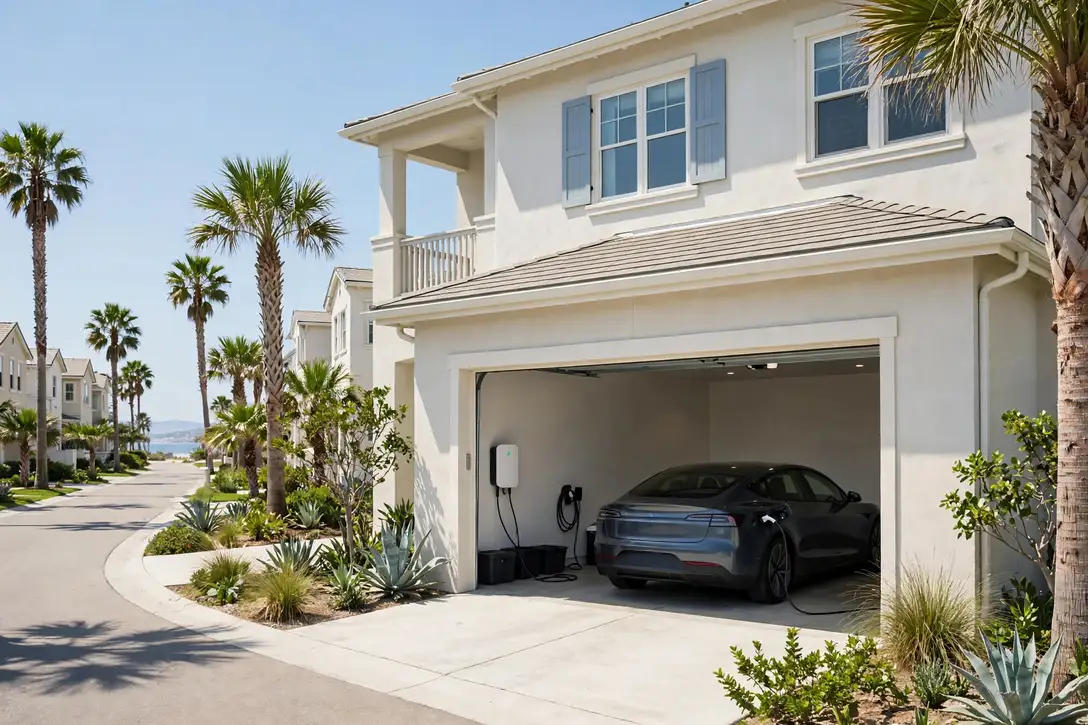
EV charging services in Lafayette
The services below are ordered by what Lafayette households most often need first, judged from the housing and fleet facts on this page. The full menu follows in the grid — every service is offered in this metro.
Home EV Charger Installation in Lafayette
The residential standard: a station where the car sleeps, on a circuit of its own, installed under permit. Variations are all local — the panel's spare room, the run's route through the house's fabric, and the parking pattern the cable has to serve.
In Lafayette: where most Lafayette projects start and finish: one circuit, one station, one inspection.
Dedicated Circuit & Electrical Panel Upgrade in Lafayette
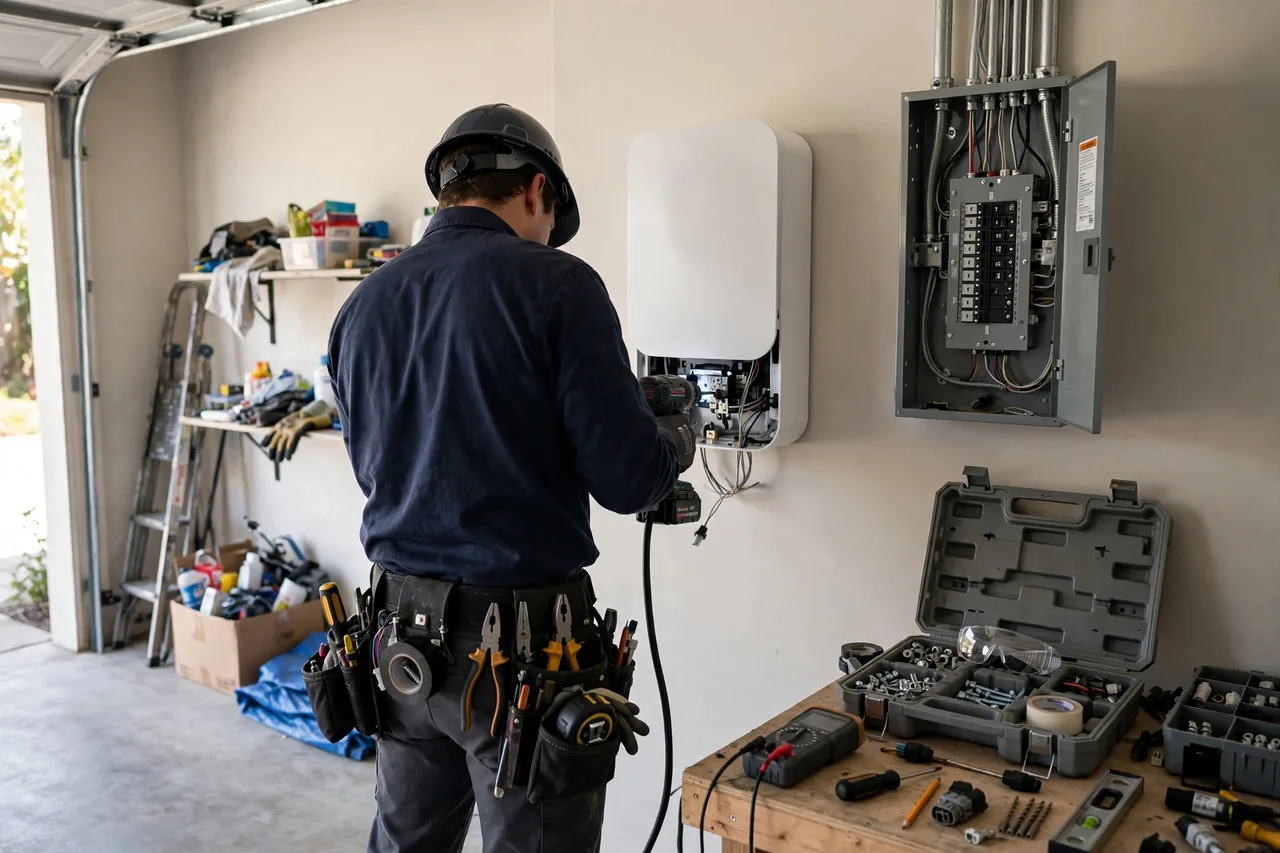
The capacity project behind the charger project. A load calculation decides whether the answer is a service increase, a panel replacement, a subpanel or load management — and the work is sequenced with the utility and the inspector so the house is live again the same day in most cases.
In Lafayette: the capacity fix that lets the charger circuit go in without the rest of the house living at its limit.
Level 2 Charger Installation in Lafayette
Level 2's numbers explain its dominance: several times the overnight recovery of a wall outlet, on equipment sized to the circuit by a factor the code fixes. The install is a circuit project with a station at the end of it, and it is quoted that way by anyone who does it weekly.
In Lafayette: the upgrade from a wall outlet to a dedicated 240-volt circuit, and the end of range arithmetic at bedtime.
Utility programs and electricity in Lafayette
Electricity in Lafayette comes from Entergy Louisiana LLC. Parts of the wider metro are served by Southwest Louisiana E M C, City of Lafayette. The utility matters twice over for a charger install: it sets the time-of-use rates that decide what overnight charging costs you, and it is the organisation that may — or may not — currently help pay for the equipment.
The honest incentive position in Lafayette is: nothing verified to claim. The federal charger credit (30C) ended on September 30, 2025; Louisiana runs no state replacement for typical home installs; and in the utility and state sources checked for this page, Entergy Louisiana LLC had no active residential charger rebate to point to. Programs reopen — when one does, it will be on the utility's own site with terms and dates. Anything an installer describes without that paper trail should be treated as conversation, not money.
Before the install, it is worth a two-minute look at your tariff. Many Entergy Louisiana LLC customers can move to a time-of-use plan where overnight energy is charged at a lower rate, and a scheduled charger makes that saving automatic.
Condos, HOAs and the law in Louisiana
There is no Louisiana right-to-charge statute to lean on. Some national roundups list protection that does not exist in this state's code; the statute indexes checked for this page are clear. In Lafayette, a condo or HOA charger is approved — or not — under the community's own documents, which makes the quality of your application the whole ballgame.
Timing helps too. Boards plan capital work annually; an application that arrives with the community's budget cycle, offering to coordinate with any planned electrical or repaving work, reads as a contribution rather than a demand.
Our condo and HOA guide was written for both kinds of state; the chapters on application packages, metering and cost allocation are the ones that matter in Lafayette, where no statute does the persuading for you.
Climate, garages and charger placement
The grid's evening peak and the house's cooling peak are the same peak here, which makes the charger's start time a small act of grid citizenship as well as thrift: after the air-conditioning army stands down, energy is cheaper and cooler-headed.
Thermal habits separate durable installs from tired ones in this region: connectors holstered out of the sun, enclosures with room to breathe, and charge sessions pushed past midnight when the air gives the equipment its easiest working conditions of the day.

Permits and inspection in Lafayette
Timelines are set by the city's counter, not the installer: the electrical work itself is typically a day, while permit issuance and the inspection visit follow the department's queue. A quote that promises a date should tell you which parts of that date the installer actually controls.

Neighbourhoods and ZIP codes served
The page covers 12 ZIP codes in and around Lafayette — including 70501, 70502, 70503, 70504, 70505, 70506, 70507, 70508, 70509, 70593, 70596, 70598 — across Lafayette. If your ZIP is not in the first set shown, ask anyway: installer coverage follows the metro, not a postcode fence.
The same working area takes in the neighbouring localities of Scott, Carencro, Broussard, Duson, Youngsville, Milton — the county ring an installer based in Lafayette actually drives. Requests from those communities route exactly as city requests do: same services, same permit discipline, same local facts where they differ.
Lafayette County accounts for 18 of the ZIP codes and 7 named postal localities in the research file, the nearest of them Scott, Carencro, Broussard, Duson, Youngsville. The survey counts 247,997 residents in the county, with a median household income of $67,451 and a median home value of $242,900. Measured across its ZIP codes, the Lafayette footprint runs about 9 miles north to south and 6 east to west, from ZIP 70501 to 70598 — the ground an installer based here actually covers in a working week.
Beyond the county seats, the working area takes in Scott, Carencro, Broussard, Duson, Youngsville, Milton, Breaux Bridge, Cecilia, Sunset, Cade, Arnaudville, Maurice, Saint Martinville, Grand Coteau, Rayne, Crowley, Church Point, Leonville, New Iberia, Abbeville, Erath, Opelousas, Delcambre, Branch, Perry, Lawtell, Port Barre, Loreauville, Avery Island, Kaplan, Lydia, Krotz Springs, Estherwood, Morse, Egan, Iota, Eunice, Chataignier, Jeanerette, Evangeline, Washington, Mermentau, Gueydan, Melville, Palmetto, Lebeau, Ville Platte, Charenton, Basile, Mamou, Baldwin, Reddell, Franklin — the named localities for which Lafayette is the nearest metro in the network (neighbouring metros' pages cover their own ground), each routing to the same installer-matching service.
The wider working area also reaches Lottie, Maringouin, Fordoche, Grosse Tete, Rosedale, Livonia, Jennings, Lake Arthur, Erwinville, Oscar, Lakeland, Roanoke, Morganza, Morrow, Elton, Plaquemine, Jarreau, Addis, Rougon, Brusly, Pine Prairie, Bunkie, Garden City, Batchelor, Port Allen, Welsh, New Roads — ground shared with neighbouring metros, where installers cross the same county lines in both directions.
ZIP codes in that shared ground include 70532, 70540, 70546, 70549, 70576, 70581, 70591, 70710, 70715, 70719, 70729, 70732, 70740, 70749, 70752, 70755, 70756, 70757, 70759, 70760, 70762, 70764, 70765, 70767, 70772, 70773, 71322, 71356.
The largest communities in that working area after Lafayette itself, by the GeoNames populated-place file: New Iberia (population 30,754), Opelousas (population 16,591), Crowley (population 13,144), Abbeville (population 12,434), Youngsville (population 11,961), Broussard (population 11,303), Eunice (population 10,310), Scott (population 9,018), Carencro (population 8,575), Breaux Bridge (population 8,395), Rayne (population 8,016), Franklin (population 7,302), Ville Platte (population 7,264), Saint Martinville (population 6,114), Jeanerette (population 5,527), Kaplan (population 4,617), Church Point (population 4,521), Mamou (population 3,181), Milton (population 3,030), Sunset (population 2,967). Charging demand follows those populations — the subdivisions and town centres where the next driveways, and the next panels, are.
St. Landry County reaches into the working area with 81,670 residents, a median household income of $44,462 and a median home value of $142,500; its localities on this page include Sunset, Arnaudville, Grand Coteau, Leonville, Opelousas. Acadia County reaches into the working area with 56,955 residents, a median household income of $45,562 and a median home value of $155,500; its localities on this page include Rayne, Crowley, Church Point, Branch. Vermilion County reaches into the working area with 57,123 residents, a median household income of $55,707 and a median home value of $163,300; its localities on this page include Maurice, Abbeville, Erath, Delcambre, Perry. Iberia County reaches into the working area with 68,599 residents, a median household income of $56,961 and a median home value of $164,500; its localities on this page include New Iberia, Loreauville, Avery Island. Evangeline County reaches into the working area with 32,060 residents, a median household income of $41,915 and a median home value of $124,600; its localities on this page include Chataignier, Ville Platte, Basile, Mamou, Reddell.
| ZIP | Locality | County |
|---|---|---|
| 70501 | Lafayette | Lafayette |
| 70502 | Lafayette | Lafayette |
| 70596 | Lafayette | Lafayette |
| 70504 | Lafayette | Lafayette |
| 70505 | Lafayette | Lafayette |
| 70507 | Lafayette | Lafayette |
| 70506 | Lafayette | Lafayette |
| 70503 | Lafayette | Lafayette |
| 70583 | Scott | Lafayette |
| 70593 | Lafayette | Lafayette |
| 70598 | Lafayette | Lafayette |
| 70508 | Lafayette | Lafayette |
| 70509 | Lafayette | Lafayette |
| 70520 | Carencro | Lafayette |
| 70518 | Broussard | Lafayette |
| 70529 | Duson | Lafayette |
| 70592 | Youngsville | Lafayette |
| 70558 | Milton | Lafayette |
| 70517 | Breaux Bridge | St. Martin |
| 70521 | Cecilia | St. Martin |
| 70584 | Sunset | St. Landry |
| 70519 | Cade | St. Martin |
| 70512 | Arnaudville | St. Landry |
| 70555 | Maurice | Vermilion |
| 70582 | Saint Martinville | St. Martin |
| 70541 | Grand Coteau | St. Landry |
| 70578 | Rayne | Acadia |
| 70527 | Crowley | Acadia |
| 70525 | Church Point | Acadia |
| 70551 | Leonville | St. Landry |
| 70562 | New Iberia | Iberia |
| 70560 | New Iberia | Iberia |
| 70511 | Abbeville | Vermilion |
| 70533 | Erath | Vermilion |
| 70570 | Opelousas | St. Landry |
| 70528 | Delcambre | Vermilion |
| 70516 | Branch | Acadia |
| 70563 | New Iberia | Iberia |
| 70526 | Crowley | Acadia |
| 70571 | Opelousas | St. Landry |
| 70575 | Perry | Vermilion |
| 70550 | Lawtell | St. Landry |
| 70577 | Port Barre | St. Landry |
| 70552 | Loreauville | Iberia |
| 70510 | Abbeville | Vermilion |
| 70513 | Avery Island | Iberia |
| 70548 | Kaplan | Vermilion |
| 70569 | Lydia | Iberia |
| 70750 | Krotz Springs | St. Landry |
| 70534 | Estherwood | Acadia |
| 70559 | Morse | Acadia |
| 70531 | Egan | Acadia |
| 70543 | Iota | Acadia |
| 70535 | Eunice | St. Landry |
| 70524 | Chataignier | Evangeline |
| 70544 | Jeanerette | Iberia |
| 70537 | Evangeline | Acadia |
| 70589 | Washington | St. Landry |
| 70556 | Mermentau | Acadia |
| 70542 | Gueydan | Vermilion |
| 71353 | Melville | St. Landry |
| 71358 | Palmetto | St. Landry |
| 71345 | Lebeau | St. Landry |
| 70586 | Ville Platte | Evangeline |
| 70523 | Charenton | St. Mary |
| 70515 | Basile | Evangeline |
| 70554 | Mamou | Evangeline |
| 70514 | Baldwin | St. Mary |
| 70580 | Reddell | Evangeline |
| 70538 | Franklin | St. Mary |

Planning the install: from panel to parking
Two decisions shape every Lafayette install, and both are made before any equipment is ordered. The first is electrical: the load calculation that decides between a straight circuit, a panel upgrade and load management. The second is physical: where the station lives — which wall, which side of the car the charge port sits on, and whether the cable reaches a second vehicle or a future one. Installers in Lafayette see the same housing patterns repeat street by street, which is why a ten-minute site visit produces a firmer quote than any online form: the form starts the conversation, the visit settles it.
Finally, photograph the finished work — station, nameplate, panel directory with the new breaker labelled — and file it with the inspection record. When the car changes, the house sells or a second station joins the first, that folder is the difference between a five-minute answer and an archaeological dig.
Home charging know-how for Lafayette households
Etiquette for shared stations
Shared stations run on norms before they run on rules. The norms that work: move the car when the session ends, coil the cable for the next driver, report a fault rather than stepping over it, and never unplug a stranger's session except under the building's posted arrangement. Buildings formalise this gradually — a group message thread, a simple rota in high season — and the households that start with courtesy rarely need the formal version. The equipment is shared; so is the goodwill it runs on.
The paperwork is part of the installation
A finished install leaves two legacies: a working charger and a file. The file — permit, passed inspection, the station's configuration recorded, the panel schedule updated, a photograph of the finished work — is what the future runs on. It answers the insurer's question, the buyer's question, the second installer's load calculation, and the warranty conversation, each in one page. Households that treat the paperwork as part of the deliverable never have to reconstruct it; households that do not, eventually do. Ask for the file at handover and keep it with the house documents.
Charging alongside rooftop solar
A house that generates as well as consumes plans its charging differently. The naive pattern — charge at night, export by day — is often fine; the refined pattern shifts some charging into the solar hours on home-working days, stores the commute in the car when the panels are producing, and leans on the overnight window only for the balance. None of this changes the circuit; it changes the schedule, and occasionally the case for a station whose output can follow the house's generation. Tell the installer the array exists — it belongs in the first conversation.
The landlord's side of the charger
For a landlord, a charger circuit is an amenity with unusual arithmetic: it is visible in listings, filterable in searches, and durable across tenancies in a way paint is not. The questions that decide it are practical rather than visionary — whose meter the circuit hangs from, how the cost is recovered, what the end-of-tenancy position is — and each has a standard answer the multifamily sections of this site describe. Landlords who run the numbers tenant by tenant usually conclude the circuit earns its wall space.

Frequently asked questions
Is the federal charger tax credit still available in Lafayette, LA?
Treat the answer as a standing no with a watching brief. The 30C credit is finished, Louisiana has not replaced it for homeowners, and no verified Entergy Louisiana LLC rebate was running in the sources checked for this page. Should that change, the utility's program page will say so first — and this page will be updated to match.
What can my HOA in Lafayette, LA do about a charger install?
Legally, yes — and it is better to know that before you buy the car. Louisiana has enacted no right-to-charge law, so an association in Lafayette may refuse, condition or delay a charger under its covenants. The counterweight is a complete, documented application and, if refused, a written refusal citing the covenant — the record a future board or a future statute works from.
Does a Level 2 charger mean a panel upgrade for a Lafayette, LA home?
Sometimes, and the honest route to the answer is arithmetic rather than opinion. Lafayette's median home was built in 1981; roughly 48% of the stock predates 1980, which is where the 100-amp panels concentrate. If yours is one, expect the upgrade-or-management conversation; if it is a modern 200-amp service with spare spaces, expect a circuit. The site visit's calculation decides, and you are entitled to see it.
How quickly will a Level 2 charger fill my car in Lafayette, LA?
A Level 1 cord on a household outlet adds roughly 3–5 miles of range per hour; a Level 2 station on a 240-volt circuit typically adds about 25–40 miles per hour depending on the circuit's amperage and the vehicle. For most drivers that is the difference between rationing the battery and never thinking about it.
What happens next after I send a request?
Three steps: the request routes to installers who work Lafayette, Louisiana; one contacts you to walk the property; the walk produces the written quote. Everything on this page — the utility position, the law, the housing data — is yours to check that quote against.
Does Entergy Louisiana LLC offer a time-of-use rate for EV charging in Lafayette?
Worth checking before the install, because it changes the setup rather than the circuit: if Entergy Louisiana LLC offers your address a time-of-use plan, the station's schedule is programmed to its overnight window at commissioning. The tariff pages or a call to the utility confirm your plan's windows; guessing from a neighbour's bill is how households end up charging at peak by default.
Nearby cities in Louisiana
- EV charger installation in Baton Rouge — about 48 miles from Lafayette, metro population 900,000
- EV charger installation in Lake Charles — about 65 miles from Lafayette, metro population 210,000
- EV charger installation in Alexandria — about 77 miles from Lafayette, metro population 150,000
- EV charger installation in Houma — about 82 miles from Lafayette, metro population 205,000
- EV charger installation in New Orleans — about 108 miles from Lafayette, metro population 1,250,000
- EV charger installation in Monroe — about 158 miles from Lafayette, metro population 205,000
- EV charger installation in Beaumont, TX — about 116 miles from Lafayette, metro population 395,000
- EV charger installation in Gulfport, MS — about 161 miles from Lafayette, metro population 420,000
- EV charger installation in Hattiesburg, MS — about 167 miles from Lafayette, metro population 175,000
Ready to charge at home in Lafayette?
Two minutes of form, and the request is in front of licensed installers who cover this city — quotes follow site visits, in writing.