EV Charger Installation in New Orleans, LA
Home Level 2 charging, panel upgrades and condo installs in New Orleans — matched to licensed local installers, with the local facts that shape the job set out below.
The overnight plug is the least glamorous and most consequential part of owning an electric car, and New Orleans households have been adopting it at pace: 22,600 battery-electric vehicles and 5,700 plug-in hybrids were registered across Louisiana by the end of 2025. New Orleans itself is home to about 371,853 people. What follows is the local field guide — utility programs as they actually stand, the association law as it actually reads, the permit as it is actually filed, and the housing numbers that predict your install before anyone opens the panel.
PlugReady USA is a matching service, not the installer: you tell us the job, and we route the request to licensed local electricians and EV-installer companies who work in New Orleans. Use the local detail below to arrive at that conversation informed — the sections are ordered the way an installer will think about your project, from the panel outward.
The demand picture for the New Orleans–Metairie metro, from the registration data this site is built on: LA 22.6K BEVs; Entergy territory. Registration counts are the honest way to size a charging market — they count households, not headlines — and they are why New Orleans sits where it does in our build order (rank 47 of 300 metros, Tier B).
Read the survey numbers as an installer reads them. A median household income of $56,631 and an owner-occupation rate of 51% describe a city where most charger decisions are made by the person who owns the panel — no landlord layer, no board layer for the typical job. The 46% of homes that are single-unit detached are the straightforward installs: garage or driveway, one owner, one circuit.

Put the survey together and New Orleans's charging profile reads like this: an older housing fabric, where panel archaeology is a normal part of the first visit; a genuinely mixed city — houses, townhouses and larger buildings all carry weight; buildings of five or more units hold a substantial share of homes, which keeps the multifamily sections of this page in daily use; and owners hold a working majority, with renters a significant minority. That combination — more than any single number — is what the installers working here plan around, and it is the lens for everything on this page.
The counts behind the percentages, for the record: New Orleans has 195,552 housing units on the survey's count, 155,821 of them occupied, and 79,744 owner-occupied households making their own electrical decisions. Detached houses number 89,990; homes built before 1980 number 144,096; units in buildings of five or more number 40,586. An installer's week in this city is a walk through exactly that distribution. The page's geography is equally concrete: 61 ZIP codes across Jefferson Parish, Orleans, centred near 29.96 degrees north latitude. The city anchors the New Orleans–Metairie metropolitan area, home to roughly 1,250,000 people on the research file's metro estimate — the wider labour and housing market this page's installers work across.
The same survey release fills in the household economics around the housing stock: a median home value of $305,100, median gross rent of $1,310, per-capita income of $42,674, and a median resident age of 40. The movement data matters as much as the money data: 64% of New Orleans workers drive to work alone — the commute pattern home charging is built around; 12% work from home, a population whose cars charge on daytime and overnight schedules alike; 4% commute by public transit; 43% of adults hold a bachelor's degree or higher. And the fleet in the driveways: 74,840 households in New Orleans have exactly one vehicle, 55,923 have two or more, and 26,772 have none.
The cost-burden lines say who feels housing costs most in New Orleans: 55% of renters spend 30% or more of income on rent, and 0% of owners with mortgages spend the same share on housing costs. Family households are 48% of all households — the two-car, school-run demographic whose charging patterns this page's planning sections keep circling back to.
None of these facts is trivia; each one moves a real decision in the project. Where so much of the stock predates modern code cycles, the site visit doubles as a survey — grounding electrode, service entrance, panel provenance — before it is ever a quote. Mixed form means mixed timelines: a homeowner's install is a fortnight's scheduling, a condo's is a season's governance; the metro's charging growth arrives on both clocks at once.
Where renting dominates, the successful install is a document before it is a device — installer licence, insurance, metering clarity, end-of-tenancy position — assembled to make a landlord's yes the path of least resistance. The install market that serves modest incomes runs on referrals and repetition: neighbourhoods where one good install, fairly scoped, produces the street's next five customers. Scale brings a call centre, but it also brings published everything — interconnection standards, programme terms, complaint statistics — and the published page, not the phone call, is where this utility is most honest.
Youth in the fleet also means the used-EV wave has not arrived; adoption here is new-car led, and charging installs follow the dealer map more than the classifieds. The diary economics differ from the biggest metros: good installers book in weeks, not months, and the household that calls in spring is rarely queueing behind a season of work. Boards here decide without a statutory script, which makes precedent the currency: the first well-built application in a community quietly writes the policy for everyone after it.
The electrical reality in New Orleans homes
The Census Bureau's latest American Community Survey puts the median New Orleans home's build year at 1960: about 74% of the city's housing units were built before 1980, 46% are single-unit detached houses, and 51% of occupied homes are owner-occupied. Those three numbers predict most of what an installer will find. A housing stock this age leans on smaller electrical services — 100-amp panels are common, and fuse-era equipment still turns up in the oldest streets. For many of those homes the honest answer is a panel upgrade or a load-management device before the charger circuit goes in, and a good installer will show you the load calculation rather than asking you to take it on faith. Housing age also tracks wire-run reality: older homes more often place the panel in a basement or interior wall far from the garage, and distance is copper, conduit and labour.
One further survey line belongs in any New Orleans install conversation: 62% of the city's homes heat with electricity — 97,755 households whose panels already carry a major winter load before a charger is contemplated. Electric heat and EV charging are the two largest discretionary loads a house can host, and where they coincide, the load calculation stops being a formality.
The tenure split cuts the other way too: roughly 76,077 occupied homes in New Orleans are rented. For those households the charger question is a negotiation with a property owner — written proposal, licensed installer, metering clarity — and it succeeds often enough that installers here keep the pattern ready.
The city's stock is not all houses: 21% of units are in structures of five or more. Shared buildings mean shared panels, assigned parking and association process — the substance of the multifamily sections below.
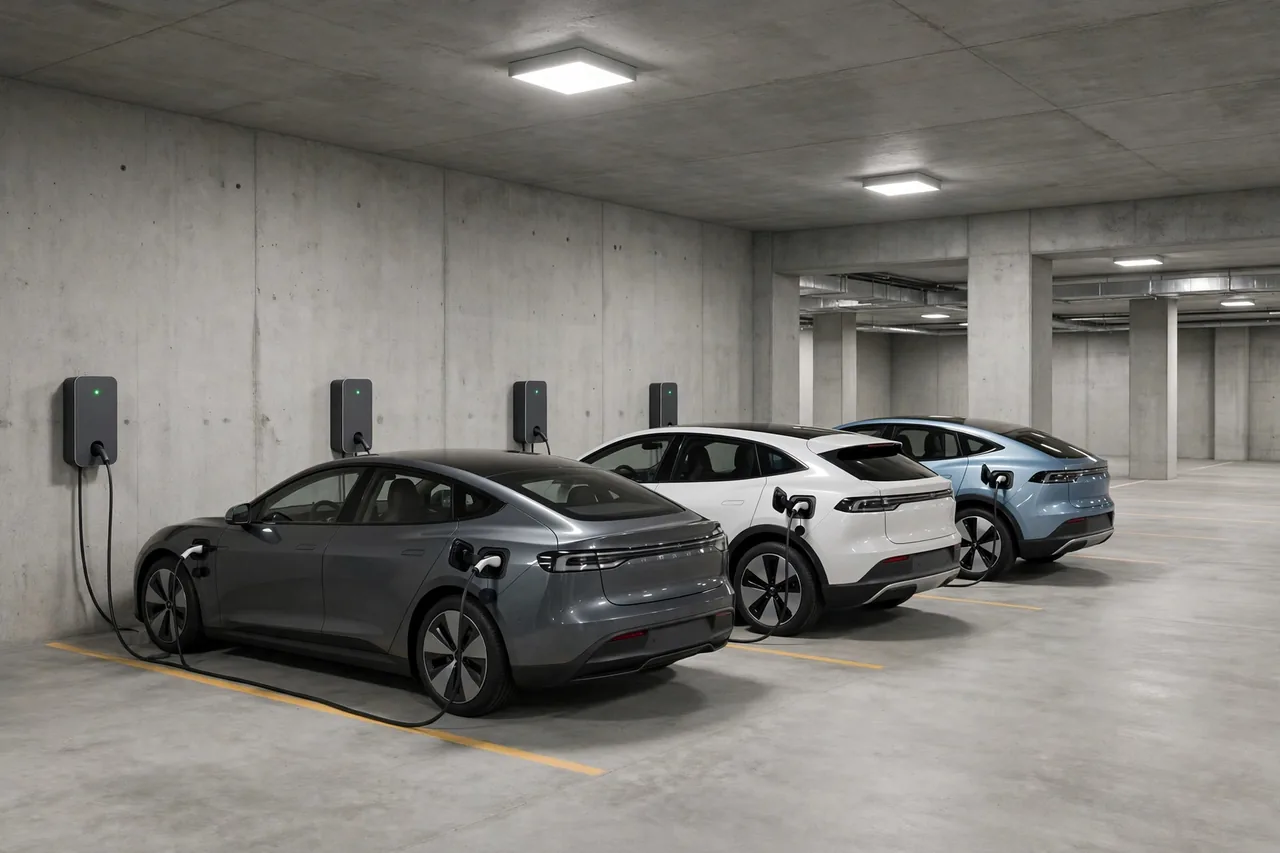
EV charging services in New Orleans
The services below are ordered by what New Orleans households most often need first, judged from the housing and fleet facts on this page. The full menu follows in the grid — every service is offered in this metro.
Home EV Charger Installation in New Orleans
The standard first install: a dedicated circuit from the panel to the parking space, a station mounted and configured to that circuit, and a passed inspection to close it out. What changes from house to house is never the recipe — it is the panel's spare capacity, the length of the run, and how the car actually parks.
In New Orleans: usually the first job a new EV household in New Orleans books, scoped to the panel the house already has.
Dedicated Circuit & Electrical Panel Upgrade in New Orleans
Some homes meet the charger at the panel door: the service is already spoken for by cooking, heating and hot water. This service is the honest fix — capacity added properly, grounding brought current, and a panel schedule that finally matches the house it feeds.
In New Orleans: the job that surfaces wherever housing is older — and New Orleans's stock makes it a routine conversation, settled by a load calculation.
Level 2 Charger Installation in New Orleans
Level 2's numbers explain its dominance: several times the overnight recovery of a wall outlet, on equipment sized to the circuit by a factor the code fixes. The install is a circuit project with a station at the end of it, and it is quoted that way by anyone who does it weekly.
In New Orleans: the circuit class behind nearly every home install in New Orleans, from first car to second.
Utility programs and electricity in New Orleans
Electricity in New Orleans comes from Entergy Louisiana LLC. Parts of the wider metro are served by Entergy New Orleans, LLC. The utility matters twice over for a charger install: it sets the time-of-use rates that decide what overnight charging costs you, and it is the organisation that may — or may not — currently help pay for the equipment.
Rebate status in New Orleans: none verified. The utility and state sources checked for this page list no active residential charger rebate from Entergy Louisiana LLC, no Louisiana replacement program for home installs, and the federal 30C credit ended on September 30, 2025. When a funded round opens it appears on the utility's own program pages with terms and dates; until one does, the honest budget for a charger install here is the install itself.
If your service includes a demand component, the charger's start time matters more than its size: staggered against the house's other big loads, the same circuit costs noticeably less to run across a year.
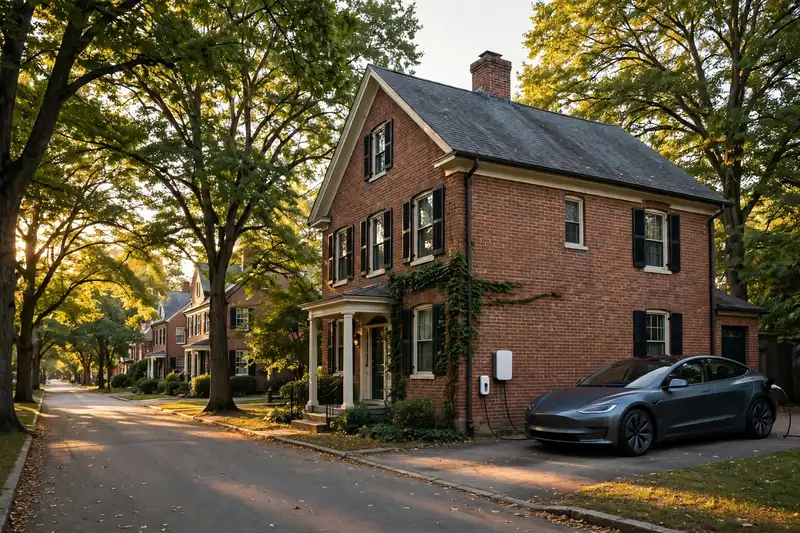
Condos, HOAs and the law in Louisiana
Louisiana has no statewide right-to-charge law. That needs saying plainly, because roundups on the internet sometimes claim otherwise: in the authoritative statute indexes checked for this page, no Louisiana law prevents a homeowners association or condominium from refusing a charger in a common or assigned space. Your community's own covenants and board govern the question in New Orleans.
No law does not mean no path. Boards approve chargers every week when the proposal answers their real concerns in advance: a licensed installer, a dedicated circuit that touches nothing shared, metering that keeps the electricity cost on the owner, insurance, and a commitment to restore the space on removal. Bring that package, in writing, before the meeting — not during it.
For the full playbook — application contents, metering designs, the questions boards ask — see the condo and HOA charging guide. In New Orleans it should be read as a negotiation manual, because negotiation is what the absence of a statute leaves you.
Climate, garages and charger placement
Parking orientation is a thermal decision in this metro: a car that bakes in western sun all afternoon starts its session hot, and both the car and the station manage heat before they manage charging. The overnight schedule is partly a shade strategy executed by clock.
In this climate the overnight window does double duty — rates are kinder and so are temperatures. Scheduling the charge for the small hours lets the car and the station work in the coolest air the day offers, which is easier on both. An installer who raises scheduling unprompted during the site visit is telling you they install in this heat regularly.

Permits and inspection in New Orleans
Expect the permit to name the circuit, the breaker and the equipment. An installer who suggests skipping it is saving an afternoon by spending your liability; the inspection is also your independent check that the continuous-load sizing was done properly.

Neighbourhoods and ZIP codes served
The page covers 61 ZIP codes in and around New Orleans — including 70112, 70113, 70114, 70115, 70116, 70117, 70118, 70119, 70121, 70122, 70123, 70124, 70125, 70126, 70127, 70128, 70129, 70130, 70131, 70139, 70141, 70142, 70143, 70145, 70146, 70148, 70150, 70151, 70152, 70153, 70154, 70156, 70157, 70158, 70159, 70160, 70161, 70162, 70163, 70164, 70165, 70166, 70167, 70170, 70172, 70174, 70175, 70176, 70177, 70178, 70179, 70181, 70182, 70183, 70184, 70185, 70186, 70187, 70189, 70190 — across Jefferson Parish, Orleans. If your ZIP is not in the first set shown, ask anyway: installer coverage follows the metro, not a postcode fence.
The same working area takes in the neighbouring localities of Gretna, Harvey, Metairie, Marrero, Westwego, Kenner, Lafitte, Barataria, Grand Isle — the county ring an installer based in New Orleans actually drives. Requests from those communities route exactly as city requests do: same services, same permit discipline, same local facts where they differ.
Orleans County accounts for 56 of the ZIP codes in the research file. The survey counts 371,853 residents in the county, with a median household income of $56,631 and a median home value of $315,700. Jefferson Parish County accounts for 34 of the ZIP codes and 10 named postal localities in the research file, the nearest of them Gretna, Harvey, Metairie, Marrero, Westwego. The survey counts 430,920 residents in the county, with a median household income of $65,252 and a median home value of $251,400. Measured across its ZIP codes, the New Orleans footprint runs about 28 miles north to south and 22 east to west, from ZIP 70112 to 70195 — the ground an installer based here actually covers in a working week.
Beyond the county seats, the working area takes in Gretna, Harvey, Metairie, Arabi, Marrero, Westwego, Chalmette, Belle Chasse, Meraux, Kenner, Violet, Ama, Saint Rose, Saint Bernard, Destrehan, Luling, Lafitte, New Sarpy, Braithwaite, Boutte, Barataria, Hahnville, Norco, Paradis, Des Allemands, La Place, Lacombe, Slidell, Reserve, Mandeville, Edgard, Akers, Garyville, Mount Airy, Madisonville, Pointe A La Hache, Pearl River, Covington, Abita Springs, Ponchatoula, Saint Benedict, Port Sulphur, Robert, Talisheek — the named localities for which New Orleans is the nearest metro in the network (neighbouring metros' pages cover their own ground), each routing to the same installer-matching service.
The wider working area also reaches Gheens, Kraemer, Lockport, Larose, Mathews, Pearlington, Raceland, Cut Off, Gramercy, Lutcher, Vacherie, Paulina, Galliano, Lakeshore, Hester, Uncle Sam, Maurepas, Bourg, Bay Saint Louis, Golden Meadow, Convent, Springfield, Thibodaux, Montegut, Houma, Hammond, Gray, Saint James, Stennis Space Center, Waveland, Chauvin — ground shared with neighbouring metros, where installers cross the same county lines in both directions.
ZIP codes in that shared ground include 39520, 39521, 39522, 39529, 39558, 39572, 39576, 70052, 70071, 70086, 70090, 70301, 70302, 70310, 70343, 70344, 70345, 70354, 70355, 70357, 70359, 70361, 70363, 70364, 70371, 70373, 70374, 70375, 70377, 70394, 70401, 70402, 70403, 70404, 70449, 70462, 70723, 70743, 70763, 70792.
The largest communities in that working area after New Orleans itself, by the GeoNames populated-place file: Metairie Terrace (population 142,489), Metairie (population 138,481), Kenner (population 67,091), Marrero (population 33,141), Laplace (population 29,872), Slidell (population 27,942), Terrytown (population 23,319), Harvey (population 20,348), Gretna (population 17,880), Chalmette (population 16,751), Estelle (population 16,377), River Ridge (population 13,494), Belle Chasse (population 12,679), Mandeville (population 12,345), Luling (population 12,119), Woodmere (population 12,080), Destrehan (population 11,535), Jefferson (population 11,193), Timberlane (population 10,243), Waggaman (population 10,015). Charging demand follows those populations — the subdivisions and town centres where the next driveways, and the next panels, are.
| ZIP | Locality | County |
|---|---|---|
| 70112 | New Orleans | Orleans |
| 70141 | New Orleans | Jefferson Parish |
| 70183 | New Orleans | Jefferson Parish |
| 70139 | New Orleans | Orleans |
| 70142 | New Orleans | Orleans |
| 70143 | New Orleans | Orleans |
| 70145 | New Orleans | Orleans |
| 70146 | New Orleans | Orleans |
| 70150 | New Orleans | Orleans |
| 70151 | New Orleans | Orleans |
| 70152 | New Orleans | Orleans |
| 70153 | New Orleans | Orleans |
| 70154 | New Orleans | Orleans |
| 70156 | New Orleans | Orleans |
| 70157 | New Orleans | Orleans |
| 70159 | New Orleans | Orleans |
| 70160 | New Orleans | Orleans |
| 70161 | New Orleans | Orleans |
| 70162 | New Orleans | Orleans |
| 70164 | New Orleans | Orleans |
| 70165 | New Orleans | Orleans |
| 70166 | New Orleans | Orleans |
| 70167 | New Orleans | Orleans |
| 70170 | New Orleans | Orleans |
| 70172 | New Orleans | Orleans |
| 70174 | New Orleans | Orleans |
| 70175 | New Orleans | Orleans |
| 70176 | New Orleans | Orleans |
| 70177 | New Orleans | Orleans |
| 70178 | New Orleans | Orleans |
| 70179 | New Orleans | Orleans |
| 70182 | New Orleans | Orleans |
| 70184 | New Orleans | Orleans |
| 70185 | New Orleans | Orleans |
| 70186 | New Orleans | Orleans |
| 70187 | New Orleans | Orleans |
| 70189 | New Orleans | Orleans |
| 70190 | New Orleans | Orleans |
| 70195 | New Orleans | Orleans |
| 70163 | New Orleans | Orleans |
| 70116 | New Orleans | Orleans |
| 70119 | New Orleans | Orleans |
| 70113 | New Orleans | Orleans |
| 70125 | New Orleans | Orleans |
| 70130 | New Orleans | Orleans |
| 70117 | New Orleans | Orleans |
| 70115 | New Orleans | Orleans |
| 70158 | New Orleans | Orleans |
| 70118 | New Orleans | Orleans |
| 70114 | New Orleans | Orleans |
| 70126 | New Orleans | Orleans |
| 70122 | New Orleans | Orleans |
| 70054 | Gretna | Jefferson Parish |
| 70053 | Gretna | Jefferson Parish |
| 70124 | New Orleans | Orleans |
| 70059 | Harvey | Jefferson Parish |
| 70005 | Metairie | Jefferson Parish |
| 70032 | Arabi | St. Bernard |
| 70073 | Marrero | Jefferson Parish |
| 70121 | New Orleans | Jefferson Parish |
| 70004 | Metairie | Jefferson Parish |
| 70009 | Metairie | Jefferson Parish |
| 70010 | Metairie | Jefferson Parish |
| 70011 | Metairie | Jefferson Parish |
| 70033 | Metairie | Jefferson Parish |
| 70055 | Metairie | Jefferson Parish |
| 70060 | Metairie | Jefferson Parish |
| 70148 | New Orleans | Orleans |
| 70096 | Westwego | Jefferson Parish |
| 70131 | New Orleans | Orleans |
| 70001 | Metairie | Jefferson Parish |
| 70056 | Gretna | Jefferson Parish |
| 70002 | Metairie | Jefferson Parish |
| 70058 | Harvey | Jefferson Parish |
| 70043 | Chalmette | St. Bernard |
| 70044 | Chalmette | St. Bernard |
| 70072 | Marrero | Jefferson Parish |
| 70123 | New Orleans | Jefferson Parish |
| 70127 | New Orleans | Orleans |
| 70006 | Metairie | Jefferson Parish |
| 70003 | Metairie | Jefferson Parish |
| 70094 | Westwego | Jefferson Parish |
| 70093 | Belle Chasse | Plaquemines Parish |
| 70075 | Meraux | St. Bernard |
| 70128 | New Orleans | Orleans |
| 70063 | Kenner | Jefferson Parish |
| 70064 | Kenner | Jefferson Parish |
| 70037 | Belle Chasse | Plaquemines Parish |
| 70062 | Kenner | Jefferson Parish |
| 70097 | Kenner | Jefferson Parish |

Planning the install: from panel to parking
Consider the two households inside every New Orleans install. The first owns the panel, the parking and the decision; the second — a partner, a teenager with the next car, a future buyer — inherits all three. Designing for the second household is the difference between an install and an asset: capacity reserved, conduit honest, paperwork filed. The first conversation with an installer should name both households explicitly.
Plan for the household you will be, not just the car you have. A second EV is the most common reason a charger circuit gets revisited, and the cheap moment to prepare for it — conduit sized up, panel capacity reserved, station placement that serves two bays — is during the first install, while the permit is open and the electrician is already in the panel.
Home charging know-how for New Orleans households
The charger among workshop loads
Garages that double as workshops put the charger in interesting company: welders, compressors, dust collectors — loads with appetites and opinions. The load calculation for such a house reads the whole tenancy, and the honest conversation includes which loads genuinely coincide. A station scheduled into the workshop's quiet hours lives peacefully; one competing with the table saw's startup surge teaches the household about breaker curves the experiential way.
The paperwork is part of the installation
A finished install leaves two legacies: a working charger and a file. The file — permit, passed inspection, the station's configuration recorded, the panel schedule updated, a photograph of the finished work — is what the future runs on. It answers the insurer's question, the buyer's question, the second installer's load calculation, and the warranty conversation, each in one page. Households that treat the paperwork as part of the deliverable never have to reconstruct it; households that do not, eventually do. Ask for the file at handover and keep it with the house documents.
Charging on a shift worker's clock
Night-shift households run the tariff backwards: the car works while others charge and charges through the day while others work. Their design questions differ — daytime sessions against the household's sleeping hours, schedules that flip with the rota, and the second car's opposite rhythm. None of it is complicated, but all of it must be said at the site visit, because the default schedule baked into every station assumes a nine-to-five that this household does not live.
Surge protection and the connected house
A charging station is a computer that drinks from the service entrance, and it shares that entrance with everything else the house owns. Whole-home surge protection at the panel — increasingly a code expectation in new work — is the standard companion recommendation when a panel is opened for a charger circuit: one device, guarding the charger, the appliances and the electronics alike. In regions with serious lightning seasons the conversation is routine; everywhere, it is a small line item riding on work already happening, and installers raise it in that spirit.
Vehicles that work from home
A growing class of households runs a business from the drive: trades vans, delivery vehicles, a car that is also the office. Their charging arithmetic differs from the commuter's — higher daily miles, tighter morning deadlines, and a vehicle whose readiness is revenue. The design answers scale accordingly: capacity with headroom, a schedule set against the working day rather than the night, and occasionally the second circuit sooner than a private household would need it. If the vehicle earns, say so at the site visit; it changes the specification.

Frequently asked questions
What happened to the federal home-charger credit in New Orleans, LA?
Nothing is currently on offer that you should plan around. The federal 30C credit ended on September 30, 2025; Louisiana operates no replacement for typical home installs; and the sources checked for this page showed no live residential rebate from Entergy Louisiana LLC. Programs do reopen — on the utility's own pages, with dates. Until one does, the install stands or falls on its own merits.
Can my association in New Orleans, LA say no to a home charger?
As the law stands, yes: without a Louisiana right-to-charge statute, an association in New Orleans may refuse or condition a charger under its own documents. The practical counterweight is preparation — a complete written package, a metering answer, and a request that the refusal, if it comes, be issued in writing with the covenant cited.
Will my New Orleans, LA home need a panel upgrade for a Level 2 charger?
It depends on the panel, and New Orleans's housing makes the question common: the median home here was built in 1960, and about 74% of housing units predate 1980. Homes with 100-amp service that is already well used often need an upgrade or a load-management device; homes with 200-amp service and spare breaker space usually do not. A load calculation during the site visit settles it — ask to see it.
Level 1 or Level 2 in New Orleans, LA — what is the real difference?
Think of it in parked hours. Level 1 gives you back 3–5 miles for each of them; Level 2 gives back about 25–40, set by the circuit's amperage and what the car can accept. Overnight, that is the gap between 'enough for tomorrow' and 'full, every morning'.
What happens after I request an installer through this page?
Send the request and it is matched against installers covering New Orleans — your service, ZIP, property type and timing travel with it. An installer then arranges the site visit and quotes in writing. Our role ends at the introduction; your contract, permit and paperwork are with the installer.
Do installers cover the communities around New Orleans, LA?
They do. Coverage follows the metro: Gretna, Harvey, Metairie, Marrero, Westwego and their neighbouring communities are worked by the same installers who cover New Orleans itself, and a request from those ZIP codes routes identically — service, property type and timing are all the form asks for.
Nearby cities in Louisiana
- EV charger installation in Houma — about 45 miles from New Orleans, metro population 205,000
- EV charger installation in Baton Rouge — about 70 miles from New Orleans, metro population 900,000
- EV charger installation in Lafayette — about 108 miles from New Orleans, metro population 480,000
- EV charger installation in Alexandria — about 161 miles from New Orleans, metro population 150,000
- EV charger installation in Lake Charles — about 173 miles from New Orleans, metro population 210,000
- EV charger installation in Monroe — about 210 miles from New Orleans, metro population 205,000
- EV charger installation in Gulfport, MS — about 61 miles from New Orleans, metro population 420,000
- EV charger installation in Hattiesburg, MS — about 103 miles from New Orleans, metro population 175,000
- EV charger installation in Mobile, AL — about 123 miles from New Orleans, metro population 425,000
Ready to charge at home in New Orleans?
Tell us the job — service, ZIP and property type — and licensed local installers will take it from there.