EV Charger Installation in State College, PA
Charging where you park, in State College: the utility programs, state law, permit process and housing facts behind a home charger install, gathered in one place.
There is a short list of things that never change about a charger install — it needs capacity, a route, a position and a permit — and a longer list of things that change with the ZIP code. This page is the longer list, for State College. State College itself is home to about 41,050 people. Pennsylvania's registered electric fleet reached 113,400 battery-electric vehicles and 55,900 plug-in hybrids through 2025, and the installers working this metro have local habits worth borrowing. The utility section states what is verified and what is not; the law section quotes the position as it stands; the housing section works from survey data rather than vibes.
A note on what PlugReady USA is and is not: we publish the local research and run the matching; the installation itself belongs to licensed electricians and installer companies working in State College. Everything below is written so you can hold your own in that conversation — numbers first, sales language nowhere.
What the Experian and AFDC registration data say about State College: Penn State market. Translated out of market language: your neighbours are already charging at home, the permit office already knows the paperwork, and the installers already know the housing stock.
Three percentages describe the working conditions for charging in State College: 26% owner-occupied, 26% single-unit detached, and a median household income of $45,424 standing behind both. Everything in the sections below — panels, permissions, metering — is commentary on those proportions.

Put the survey together and State College's charging profile reads like this: an older housing fabric, where panel archaeology is a normal part of the first visit; a genuinely mixed city — houses, townhouses and larger buildings all carry weight; buildings of five or more units hold a substantial share of homes, which keeps the multifamily sections of this page in daily use; and renters form a large share of households, so the landlord conversation is a first-class topic here. That combination — more than any single number — is what the installers working here plan around, and it is the lens for everything on this page.
Keep six figures and you keep State College's whole electrical character: 13,261 housing units; 11,257 occupied homes; 2,943 owner-occupied; 3,431 detached houses; 8,853 pre-1980 homes; 7,727 homes in buildings of five or more units. Percentages elsewhere on this page are these numbers in disguise — the counts are the originals, and they are the numbers a local installer's experience is actually made of. The page's geography is equally concrete: 4 ZIP codes across Centre, centred near 40.79 degrees north latitude. The city anchors the State College metropolitan area, home to roughly 160,000 people on the research file's metro estimate — the wider labour and housing market this page's installers work across.
The same survey release fills in the household economics around the housing stock: a median home value of $437,800, median gross rent of $1,273, per-capita income of $24,746, and a median resident age of 21. And the daily rhythms behind the housing numbers: 38% of State College workers drive to work alone — the commute pattern home charging is built around; 15% work from home, a population whose cars charge on daytime and overnight schedules alike; 6% commute by public transit; 68% of adults hold a bachelor's degree or higher. Vehicle ownership, from the same release: 3,423 households in State College run two or more vehicles, and 2,674 run none — the two ends of the market this page serves and does not serve.
Two burden statistics frame the economics: in State College, 62% of renters and 0% of mortgage-holding owners are housing-cost burdened at the standard 30% threshold. And 31% of households are family households, the segment most likely to run the two-vehicle, two-schedule pattern the second-vehicle planning notes address.
None of these facts is trivia; each one moves a real decision in the project. Where so much of the stock predates modern code cycles, the site visit doubles as a survey — grounding electrode, service entrance, panel provenance — before it is ever a quote. Shared form means shared infrastructure decisions: a building that solves charging solves it for a generation of residents, which raises the stakes of the first design and the value of getting the metering right.
Renter weight gives this metro's charging story a negotiation at its centre: the circuit is easy, the permission is the project, and the paperwork patterns in the guides matter as much as any load calculation. Budget discipline shapes the specification — the circuit sized exactly, the management device considered wherever it defers a service upgrade, every scope line asked to justify itself. Filed tariffs and public dockets give this territory a paper trail most markets lack: the diligent household can read the utility's own electrification plan and know which programmes are funded, piloted or merely proposed.
A large fleet normalises the paperwork: boards have seen the application before, landlords have a standard answer, permit counters process charger circuits as routine volume. Smaller metros adopt on their own clock: the fleet follows the dealers and the demographics, and each install is a visible event a street notices. Boards here decide without a statutory script, which makes precedent the currency: the first well-built application in a community quietly writes the policy for everyone after it.
The electrical reality in State College homes
The survey's housing portrait for State College opens with its median: a home built in 1971, in a stock where 67% of units predate 1980 and 26% stand detached on their own lots. 26% of occupied homes are owner-occupied. An installer reads those lines as a weather forecast: mostly settled conditions, with older wiring fronts moving through the pre-1980 districts. A housing stock this age leans on smaller electrical services — 100-amp panels are common, and fuse-era equipment still turns up in the oldest streets. For many of those homes the honest answer is a panel upgrade or a load-management device before the charger circuit goes in, and a good installer will show you the load calculation rather than asking you to take it on faith. Housing age also tracks wire-run reality: older homes more often place the panel in a basement or interior wall far from the garage, and distance is copper, conduit and labour.
Heating fuel is the survey's quiet clue to panel life: in State College, 55% of homes heat electrically (6,161 households), against 38% heating with gas. A house already heating electrically has a service sized with that load in its history; a gas-heated house may have capacity to spare — either way the fuel mix is part of what the installer is reading.
One further split matters for how this page is organised: about 8,314 of State College's occupied homes are renter-occupied. Everything above assumes you can approve your own electrical work; where you cannot, the approval layer — landlord or association — becomes part of the job, which is why the law section carries unusual weight here.
One more structural fact shapes State College's charging map: 58% of the city's housing units sit in buildings of five or more units. Those households cannot simply book a circuit — their charger runs through a building, a board and a shared electrical service, which is why the multifamily service and the law section below carry unusual weight on this page.
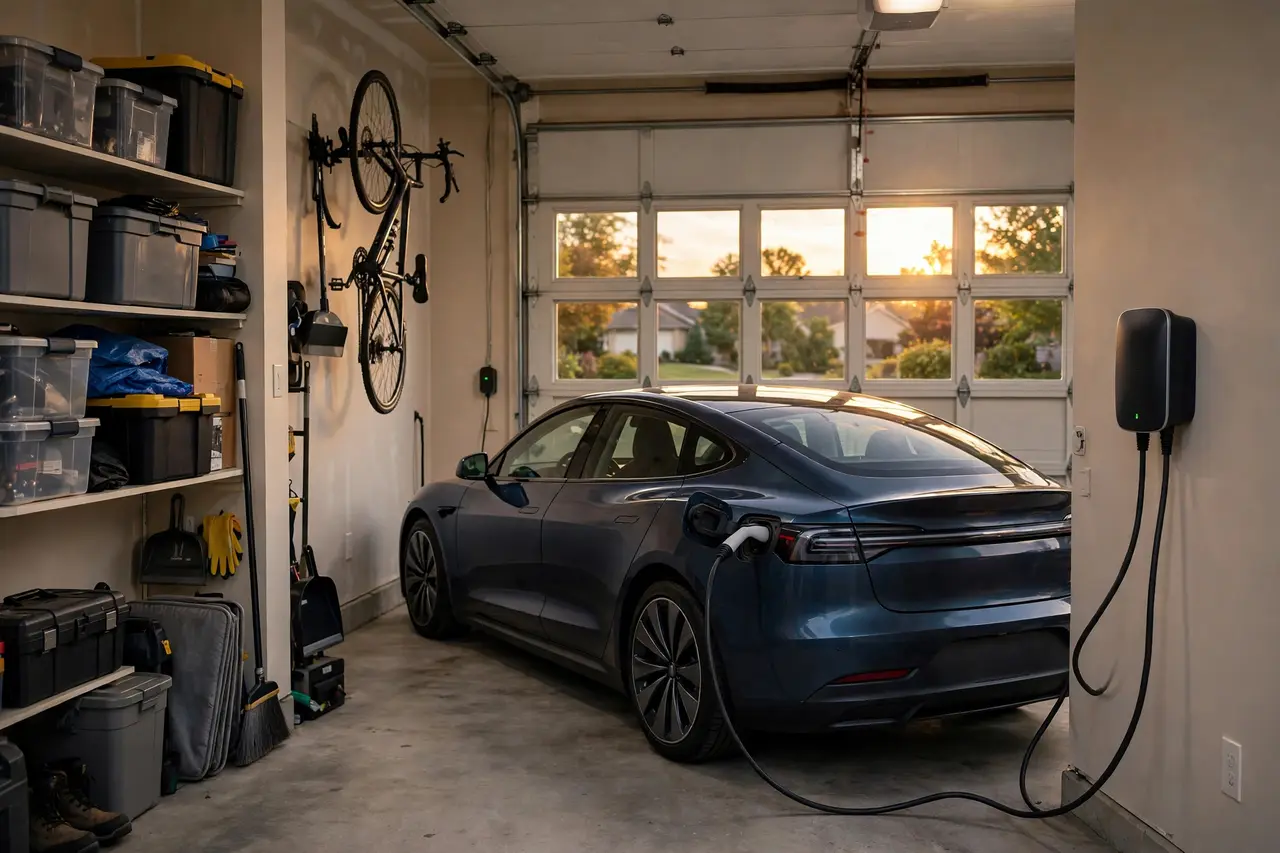
EV charging services in State College
An installer's work in State College usually starts with one of the three lead services below. The cards describe the job as it is actually scoped; the grid underneath carries the rest of the menu.
Home EV Charger Installation in State College
Start to finish, the domestic install is a half-day of electrical work wrapped in a week of scheduling: the survey, the circuit, the mounting, the configuration, the inspection. What the household experiences is simpler — a car that is full every morning and a cable that lives where the car does.
In State College: where most State College projects start and finish: one circuit, one station, one inspection.
Dedicated Circuit & Electrical Panel Upgrade in State College
Where the load calculation fails the existing service, the upgrade is not an upsell — it is the finding. Done under permit with the utility's meter work coordinated, it converts the charger project into the house's electrical reset, and every later project inherits the headroom.
In State College: the job that surfaces wherever housing is older — and State College's stock makes it a routine conversation, settled by a load calculation.
Level 2 Charger Installation in State College
Level 2's numbers explain its dominance: several times the overnight recovery of a wall outlet, on equipment sized to the circuit by a factor the code fixes. The install is a circuit project with a station at the end of it, and it is quoted that way by anyone who does it weekly.
In State College: the 240-volt step that turns overnight charging in State College from a trickle into a full battery by morning.
Utility programs and electricity in State College
Electricity in State College comes from PPL Electric Utilities Corp. Parts of the wider metro are served by West Penn Power Company, Pennsylvania Electric Co, Valley Rural Electric Coop Inc. The utility matters twice over for a charger install: it sets the time-of-use rates that decide what overnight charging costs you, and it is the organisation that may — or may not — currently help pay for the equipment.
Plan on no rebate in State College at the moment. In the sources checked for this page, PPL Electric Utilities Corp publishes no residential charger rebate, Pennsylvania runs no state scheme for typical home installs, and the federal credit that once filled this gap closed on September 30, 2025. Installers quote the work; utilities fund programs; the second list is currently empty here, and any quote that implies otherwise should come with the program's published terms attached.
One more utility habit worth copying from State College's EV owners: charge on the overnight rate window if your plan has one. The charger itself can usually be scheduled from the car or the station, so the habit costs nothing once it is set.
Condos, HOAs and the law in Pennsylvania
There is no Pennsylvania right-to-charge statute to lean on. Some national roundups list protection that does not exist in this state's code; the statute indexes checked for this page are clear. In State College, a condo or HOA charger is approved — or not — under the community's own documents, which makes the quality of your application the whole ballgame.
Strategy, then, is the local substitute for statute. In State College the applications that succeed tend to share a shape: they arrive before the meeting rather than at it, they answer metering and insurance in the first paragraph, and they offer the board a design it can approve once and reuse for the next owner who asks.
Our condo and HOA guide was written for both kinds of state; the chapters on application packages, metering and cost allocation are the ones that matter in State College, where no statute does the persuading for you.
Climate, garages and charger placement
Mixed-climate households discover the schedule twice a year: the winter window that suits the battery's warming and the summer window that dodges the afternoon peak are different settings, and the households that thrive change them with the clocks. It is the entire seasonal maintenance programme of a home charger.
Leaf-fall and pollen sound beneath an electrician's notice until they are inside a connector left lying open. The holster habit — connector docked, cap where the design provides one — is the entire countermeasure, and it is free.

Permits and inspection in State College
What the inspector is checking, in plain terms: conductor size against breaker size, the continuous-load calculation, terminations torqued, protection where the code wants it, and a station whose settings match the circuit it landed on. It is a short visit that validates everything you cannot see.

Neighbourhoods and ZIP codes served
The page covers 4 ZIP codes in and around State College — including 16801, 16803, 16804, 16805 — across Centre. If your ZIP is not in the first set shown, ask anyway: installer coverage follows the metro, not a postcode fence.
The same working area takes in the neighbouring localities of University Park, Lemont, Boalsburg, Pine Grove Mills, Fleming, Julian, Bellefonte, Pennsylvania Furnace, Centre Hall, Milesburg, Port Matilda, Orviston, Mingoville, Spring Mills — the county ring an installer based in State College actually drives. Requests from those communities route exactly as city requests do: same services, same permit discipline, same local facts where they differ.
Centre County accounts for 31 of the ZIP codes and 28 named postal localities in the research file, the nearest of them University Park, Lemont, Boalsburg, Pine Grove Mills, Fleming. The survey counts 158,576 residents in the county, with a median household income of $74,291 and a median home value of $323,500. Measured across its ZIP codes, the State College footprint runs about 1 miles north to south and 2 east to west, from ZIP 16801 to 16805 — the ground an installer based here actually covers in a working week.
Beyond the county seats, the working area takes in University Park, Lemont, Boalsburg, Pine Grove Mills, Fleming, Julian, Bellefonte, Pennsylvania Furnace, Centre Hall, Milesburg, Port Matilda, Warriors Mark, Orviston, Belleville, Mingoville, Petersburg, Reedsville, Spring Mills, Milroy, Snow Shoe, Yeagertown, Lanse, Howard, Moshannon, Clarence, Burnham, Allensville, Lewistown, Grassflat, Winburne, Munson, Granville, Mc Veytown, Philipsburg, Drifting, Hawk Run, Sandy Ridge, Mattawana, Huntingdon, Madisonburg, Millheim, Kylertown, Coburn, Mill Creek, Allport, Aaronsburg, Blanchard, Lamar, Osceola Mills, Beech Creek, Morrisdale, Karthaus, Wallaceton, Mc Clure, Rebersburg, Newton Hamilton, West Decatur, Mount Union, Mackeyville, Bigler, Mill Hall, Pottersdale, Woodward, Mifflin, Honey Grove, Woodland, Frenchville, Port Royal, Mifflintown, Weikert, Lecontes Mills, Mineral Springs, Oakland Mills, East Waterford, Castanea, Lock Haven, Westport, Loganton, Shawville, Beaver Springs, Mc Elhattan, Troxelville, Laurelton, New Germantown, Millmont, Blairs Mills, Beavertown, Renovo, Woolrich, Hartleton, Concord, Avis, Swengel, Sinnamahoning, North Bend, Driftwood, Antes Fort, Jersey Shore, Waterville — the named localities for which State College is the nearest metro in the network (neighbouring metros' pages cover their own ground), each routing to the same installer-matching service.
The wider working area also reaches Spruce Creek, Alexandria, Tyrone, Tipton, Mapleton Depot, Bellwood, Ramey, Smithmill, Madera, Blandburg, Beccaria, Shirleysburg, Smokerun, Cassville, Clearfield, Fallentimber, Hyde, Entriken, Coalport, Irvona, Flinton, Dysart, Duncansville, Dry Run, Grampian, Martinsburg, Newport, Roaring Spring, Chest Springs, La Jose, Penns Creek, Dudley, Curryville, Patton, Saxton — ground shared with neighbouring metros, where installers cross the same county lines in both directions.
ZIP codes in that shared ground include 15753, 16601, 16602, 16603, 16613, 16617, 16620, 16627, 16631, 16640, 16645, 16648, 16660, 16661, 16663, 16674, 16678, 16680, 16683, 16685, 16693, 16830, 16837, 16838, 16843, 16861, 16863, 17006, 17014, 17037, 17040, 17047, 17049, 17074, 17219, 17249, 17253, 17264, 17861, 17862.
The largest communities in that working area after State College itself, by the GeoNames populated-place file: Williamsport (population 29,201), Saint Marys (population 13,070), Shiloh (population 11,217), Park Forest Village (population 9,660), Lock Haven (population 9,604), Lewistown (population 8,271), South Williamsport (population 6,281), Bellefonte (population 6,248). Charging demand follows those populations — the subdivisions and town centres where the next driveways, and the next panels, are.
Clearfield County reaches into the working area with 78,635 residents, a median household income of $62,152 and a median home value of $137,000; its localities on this page include Lanse, Grassflat, Winburne, Munson, Drifting. Mifflin County reaches into the working area with 46,041 residents, a median household income of $63,953 and a median home value of $156,700; its localities on this page include Belleville, Reedsville, Milroy, Yeagertown, Burnham. Clinton County reaches into the working area with 37,798 residents, a median household income of $60,816 and a median home value of $175,900; its localities on this page include Lamar, Beech Creek, Mackeyville, Mill Hall, Castanea.
| ZIP | Locality | County |
|---|---|---|
| 16801 | State College | Centre |
| 16804 | State College | Centre |
| 16805 | State College | Centre |
| 16802 | University Park | Centre |
| 16851 | Lemont | Centre |
| 16803 | State College | Centre |
| 16827 | Boalsburg | Centre |
| 16868 | Pine Grove Mills | Centre |
| 16835 | Fleming | Centre |
| 16844 | Julian | Centre |
| 16823 | Bellefonte | Centre |
| 16865 | Pennsylvania Furnace | Centre |
| 16828 | Centre Hall | Centre |
| 16853 | Milesburg | Centre |
| 16870 | Port Matilda | Centre |
| 16877 | Warriors Mark | Huntingdon |
| 16864 | Orviston | Centre |
| 17004 | Belleville | Mifflin |
| 16856 | Mingoville | Centre |
| 16669 | Petersburg | Huntingdon |
| 17084 | Reedsville | Mifflin |
| 16875 | Spring Mills | Centre |
| 17063 | Milroy | Mifflin |
| 16874 | Snow Shoe | Centre |
| 17099 | Yeagertown | Mifflin |
| 16849 | Lanse | Clearfield |
| 16841 | Howard | Centre |
| 16859 | Moshannon | Centre |
| 16829 | Clarence | Centre |
| 17009 | Burnham | Mifflin |
| 17002 | Allensville | Mifflin |
| 17044 | Lewistown | Mifflin |
| 16839 | Grassflat | Clearfield |
| 16879 | Winburne | Clearfield |
| 16860 | Munson | Clearfield |
| 17029 | Granville | Mifflin |
| 17051 | Mc Veytown | Mifflin |
| 16866 | Philipsburg | Centre |
| 16834 | Drifting | Clearfield |
| 16840 | Hawk Run | Clearfield |
| 16677 | Sandy Ridge | Centre |
| 17054 | Mattawana | Mifflin |
| 16652 | Huntingdon | Huntingdon |
| 16852 | Madisonburg | Centre |
| 16854 | Millheim | Centre |
| 16847 | Kylertown | Clearfield |
| 16832 | Coburn | Centre |
| 17060 | Mill Creek | Huntingdon |
| 16821 | Allport | Clearfield |
| 16820 | Aaronsburg | Centre |
| 16826 | Blanchard | Centre |
| 16848 | Lamar | Clinton |
| 16666 | Osceola Mills | Clearfield |
| 16822 | Beech Creek | Clinton |
| 16858 | Morrisdale | Clearfield |
| 16845 | Karthaus | Clearfield |
| 16876 | Wallaceton | Clearfield |
| 17841 | Mc Clure | Snyder |
| 16872 | Rebersburg | Centre |
| 17075 | Newton Hamilton | Mifflin |
| 16878 | West Decatur | Clearfield |
| 17066 | Mount Union | Huntingdon |
| 17750 | Mackeyville | Clinton |
| 16825 | Bigler | Clearfield |
| 17751 | Mill Hall | Clinton |
| 16871 | Pottersdale | Clearfield |
| 16882 | Woodward | Centre |
| 17058 | Mifflin | Juniata |
| 17035 | Honey Grove | Juniata |
| 16881 | Woodland | Clearfield |
| 16836 | Frenchville | Clearfield |
| 17082 | Port Royal | Juniata |
| 17059 | Mifflintown | Juniata |
| 17885 | Weikert | Union |
| 16850 | Lecontes Mills | Clearfield |
| 16855 | Mineral Springs | Clearfield |
| 17076 | Oakland Mills | Juniata |
| 17021 | East Waterford | Juniata |
| 17726 | Castanea | Clinton |
| 17745 | Lock Haven | Clinton |
| 17778 | Westport | Clinton |
| 17747 | Loganton | Clinton |
| 16873 | Shawville | Clearfield |
| 17812 | Beaver Springs | Snyder |
| 17748 | Mc Elhattan | Clinton |
| 17843 | Beaver Springs | Snyder |
| 17882 | Troxelville | Snyder |
| 17835 | Laurelton | Union |
| 17071 | New Germantown | Perry |
| 17845 | Millmont | Union |

Planning the install: from panel to parking
Walk the route before anyone quotes the route. Between State College's panels and its parking spaces lie the job's real variables: a finished ceiling or an open one, a straight shot through a shared wall or a tour of the attic, forty feet of conductor or a hundred and forty. Installers who quote from photographs quote the average of all routes; installers who walk yours quote the one you actually have. The site visit is where the quote stops being a genre and becomes a document.
Plan for the household you will be, not just the car you have. A second EV is the most common reason a charger circuit gets revisited, and the cheap moment to prepare for it — conduit sized up, panel capacity reserved, station placement that serves two bays — is during the first install, while the permit is open and the electrician is already in the panel.
Home charging know-how for State College households
Planning the second visit on the first
Nearly every install leaves a known future: a second car, a workshop circuit, a battery or a heat pump queuing for capacity. The first visit is when that future costs least to serve — conduit runs made while walls are open, panel positions reserved, the load study documented so the next calculation starts from evidence. Installers call it roughing in the future; households experience it, years later, as the second project that was mysteriously half done already.
Charging while you travel
Cars left for weeks prefer a middle state of charge and a quiet life: plugged in, scheduled modestly, neither brimmed nor starved. The home station makes this effortless — the car sips as it wants, the household returns to a vehicle that is ready rather than recovered. Tell a housesitter nothing at all; there is nothing to do. It is one of home charging's under-sold virtues: the car manages its own storage, from your wall, while the house is empty.
Getting onto the board's agenda
Association decisions happen inside a procedure, and the procedure has a door: the agenda. Applications that miss the submission deadline wait a full cycle regardless of merit, so the first question for any board is clerical — when do items close for the next meeting, and in what format. Arrive inside the procedure with a complete package and the discussion is about your design; arrive outside it and the discussion is about process, and process always wins the evening. Property managers, asked politely, will tell you the format they prefer applications in.
Whose meter? The metering designs
Every shared-parking install eventually asks the same question: whose electricity is this? The designs that answer it cleanly are few and known — a circuit from the owner's own meter where the geometry allows, a submeter on a shared supply with readings the association can audit, a networked station billing each user directly, or a flat arrangement the community's documents permit. The right choice is the one the building's wiring and its paperwork both support. What never works is leaving the question open: energy without an owner is the objection that sinks applications, so the metering design travels with the application, not after it.

Frequently asked questions
What happened to the federal home-charger credit in State College, PA?
Checked and dated: in the sources reviewed for this page, PPL Electric Utilities Corp runs no residential charger rebate, Pennsylvania runs no home-charger programme, and the federal credit that once filled the gap ended on September 30, 2025. If a salesperson's spreadsheet shows a rebate line for a State College install, the published programme page is the only acceptable evidence.
What can my HOA in State College, PA do about a charger install?
In State College the honest answer is yes, they can refuse: Pennsylvania gives owners no statutory charging right, so the board's discretion governs. What changes outcomes is the quality of the file in front of them — drawings, metering, insurance, a named licensed installer — and a growing number of boards here approve exactly that file.
Will my State College, PA home need a panel upgrade for a Level 2 charger?
The answer lives in your panel's directory and its arithmetic, not in the car's requirements. With 67% of State College's homes predating 1980 (median build 1971), local installers see both situations weekly: the 200-amp panel that takes the circuit directly, and the full 100-amp service that needs capacity work first. The site visit exists to sort your house into one of those two piles, on numbers.
How much faster is Level 2 charging at home in State College, PA?
Level 1 — the cord in the boot, on a normal outlet — returns about 3–5 miles of range an hour. Level 2 on its own 240-volt circuit returns roughly 25–40. A State College commuter who parks at seven and leaves at seven stops doing battery arithmetic entirely.
What happens after I request an installer through this page?
Three steps: the request routes to installers who work State College, Pennsylvania; one contacts you to walk the property; the walk produces the written quote. Everything on this page — the utility position, the law, the housing data — is yours to check that quote against.
How long does a typical home charger installation take in State College, PA?
Separate the three clocks. The installer's clock: typically a day of electrical work for the standard layout. The permit office's clock: issuance on the department's queue. The inspector's clock: a visit scheduled after the work. A realistic quote in State College, Pennsylvania names all three; the total is usually days to a few weeks, dominated by the two clocks nobody on the crew controls.
Nearby cities in Pennsylvania
- EV charger installation in Altoona — about 36 miles from State College, metro population 125,000
- EV charger installation in Harrisburg — about 65 miles from State College, metro population 600,000
- EV charger installation in Johnstown — about 67 miles from State College, metro population 130,000
- EV charger installation in York — about 84 miles from State College, metro population 455,000
- EV charger installation in Lebanon — about 86 miles from State College, metro population 145,000
- EV charger installation in Lancaster — about 98 miles from State College, metro population 575,000
- EV charger installation in Hagerstown, MD — about 80 miles from State College, metro population 295,000
- EV charger installation in Winchester, VA — about 112 miles from State College, metro population 135,000
- EV charger installation in Baltimore, MD — about 124 miles from State College, metro population 2,850,000
Ready to charge at home in State College?
Send the essentials — what you need, where, and what kind of property — and a licensed local installer will pick it up from there.