EV Charger Installation in Salem, OR
Charging where you park, in Salem: the utility programs, state law, permit process and housing facts behind a home charger install, gathered in one place.
Every home charger installation is the same four decisions wearing local clothes: capacity in the panel, a route for the circuit, a position for the station, and paperwork that proves it was done properly. What changes from city to city is the content of those decisions — and in Salem the content is specific. Salem itself is home to about 180,389 people. Oregon's registered fleet stood at 98,000 battery-electric vehicles and 38,900 plug-in hybrids at the end of 2025, and this page works through the local version of each decision: your utility and its programs, your state's association law, your permit counter, and your housing stock's electrical habits.
How this page is organised matters less than what is in it: verified local facts, stated with their sources, so you can check them yourself. PlugReady USA matches homeowners in Salem with licensed local installers; the detail below is the homework we would want done before anyone quotes the job.
Why Salem ranks 104 in this network's 300-metro build order: OR capital; right-to-charge. Those are registration figures, not projections, and they translate directly into installation work — every newly registered plug-in vehicle is a household deciding where it will charge.
The Census Bureau's portrait of Salem — median household income $79,638, 54% of occupied homes owner-occupied, 57% of units in single-unit detached houses — is, read correctly, a charging forecast. Owners approve their own work; detached houses host their own circuits; the remaining share is where the interesting projects live.

The composite picture matters more than any single statistic. In Salem: an older housing fabric, where panel archaeology is a normal part of the first visit; a detached-house majority with a real attached and multifamily minority; buildings of five or more units hold a substantial share of homes, which keeps the multifamily sections of this page in daily use; meanwhile, owners hold a working majority, with renters a significant minority. A page that ignored that profile would give the same advice everywhere; this one is ordered by it.
Keep six figures and you keep Salem's whole electrical character: 72,661 housing units; 67,518 occupied homes; 36,544 owner-occupied; 41,685 detached houses; 35,079 pre-1980 homes; 16,850 homes in buildings of five or more units. Percentages elsewhere on this page are these numbers in disguise — the counts are the originals, and they are the numbers a local installer's experience is actually made of. The page's geography is equally concrete: 14 ZIP codes across Marion, Polk, centred near 44.95 degrees north latitude. The city anchors the Salem metropolitan area, home to roughly 450,000 people on the research file's metro estimate — the wider labour and housing market this page's installers work across.
The same survey release fills in the household economics around the housing stock: a median home value of $416,900, median gross rent of $1,400, per-capita income of $38,066, and a median resident age of 36. How the city moves completes the picture: 65% of Salem workers drive to work alone — the commute pattern home charging is built around; 16% work from home, a population whose cars charge on daytime and overnight schedules alike; 2% commute by public transit; 32% of adults hold a bachelor's degree or higher. The survey's vehicle table is the one an EV page should quote first: 5,760 of Salem's households have no vehicle at all, while 34,587 have two or more — the multi-car households for whom the second circuit is a when, not an if.
The cost-burden lines say who feels housing costs most in Salem: 53% of renters spend 30% or more of income on rent, and 0% of owners with mortgages spend the same share on housing costs. Family households are 60% of all households — the two-car, school-run demographic whose charging patterns this page's planning sections keep circling back to.
This is the context an installer works against, whether it is written down or not. A stock this old wires its history into the walls: cloth-wrapped conductors in the deepest streets, fuse boxes that outlived their century, panels added in layers by generations of electricians each solving their own decade's problem. The housing variety shows up in the permit data as variety: single-family circuits in volume, building projects in ones and twos, each teaching the local workforce a different half of the trade.
Renter weight gives this metro's charging story a negotiation at its centre: the circuit is easy, the permission is the project, and the paperwork patterns in the guides matter as much as any load calculation. Households here run the numbers — which is why the honest sections of this page, the ones that say what is verified and what is not, earn their keep. Tariff design is the quiet policy: the shape of the overnight window, the demand charges commercial customers face, the interconnection queue's pace — all set in dockets the diligent can read.
In a growing market the installer you want is bookable but not yet booked out; the diaries fill as the fleet does, and the household that plans a season ahead keeps its choice of firms. At this scale the city's charging infrastructure is legible — a household can learn the whole local system, its programmes, precedents and people, in an evening's reading. This page is most of that evening. Where the state's statute speaks, the local conversation changes register: installers quote the framework, boards keep counsel's template, and approvals become administrative.
The electrical reality in Salem homes
The Census Bureau counts Salem's housing in ways that turn out to be an installer's briefing: the median home dates to 1982, 48% of units stood before 1980, 57% are detached single-unit houses, and 54% of occupied homes belong to their occupants. Panel sizes, wire routes and even permit histories track those proportions street by street. Age shows up electrically before it shows up anywhere else: services sized for a house with a third of today's appliances. Expect the first conversation to be about capacity — what the panel is, what it already feeds, and which of the three routes (circuit, management, upgrade) your numbers support. Detached houses matter for a practical reason: a garage or driveway on your own lot means the charger, the car and the circuit are all under one roof and one owner's control, which is the simplest configuration there is.
One further survey line belongs in any Salem install conversation: 51% of the city's homes heat with electricity — 34,144 households whose panels already carry a major winter load before a charger is contemplated. Electric heat and EV charging are the two largest discretionary loads a house can host, and where they coincide, the load calculation stops being a formality.
The tenure split cuts the other way too: roughly 30,974 occupied homes in Salem are rented. For those households the charger question is a negotiation with a property owner — written proposal, licensed installer, metering clarity — and it succeeds often enough that installers here keep the pattern ready.
And 23% of Salem's homes are in buildings with five or more units — apartments and condominiums where charging is a building decision before it is an electrical one. If that is your situation, the law and multifamily sections of this page are the ones written for you.

EV charging services in Salem
The full menu runs to ten services; the three cards at the top are the ones Salem's housing stock and state law push to the front. Everything links to its national service page for scope and process in full.
Home EV Charger Installation in Salem
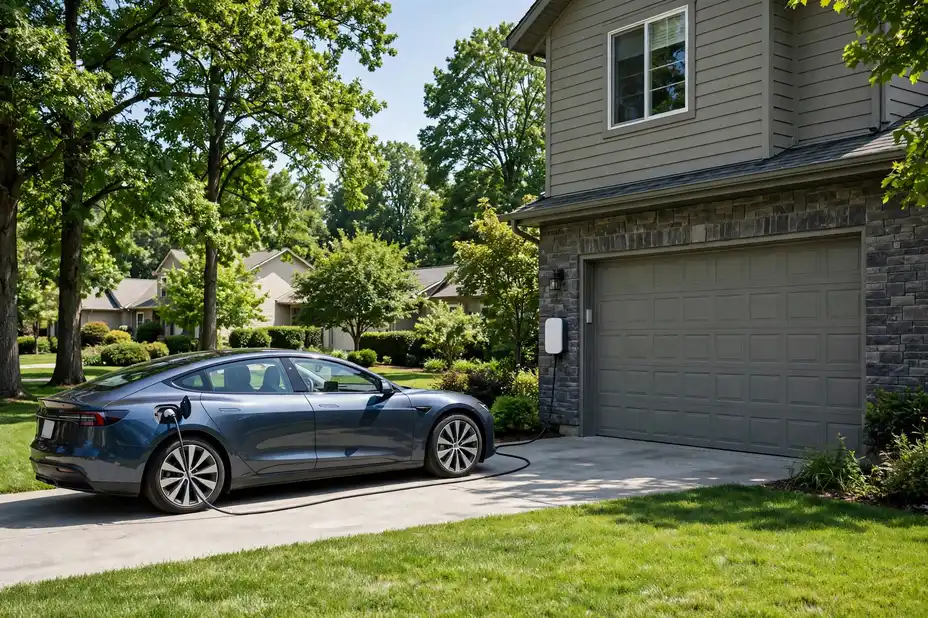
One circuit, one station, one inspection: the residential install in its usual form. An installer sizes the circuit to the household's driving, mounts the station where the cable reaches the port without drama, sets its output to the circuit it landed on, and leaves the paperwork filed with the house.
In Salem: the install Salem's new EV households book first, and the one the rest of this page keeps returning to.
Dedicated Circuit & Electrical Panel Upgrade in Salem
When the arithmetic says the service is full, this is the enabling job: a larger panel, or a new dedicated circuit with capacity planned in, done under the same permit umbrella as the charger it feeds. It is also the upgrade the rest of the house quietly benefits from for decades.
In Salem: the capacity answer when Salem's older panels meet a continuous load.
Multifamily & Condo EV Charging in Salem
The building version of the home job, with a governance layer on top. Boards approve complete applications; residents pay for their own energy through the metering design; the building's capacity is shared by management rather than by argument. That system is what this service installs.
In Salem: constitutions for shared charging in Salem buildings: metering, load and approvals.
Utility programs and electricity in Salem
Electricity in Salem comes from Portland General Electric Co. Parts of the wider metro are served by PacifiCorp, Consumers Power, Inc, Salem Electric. The utility matters twice over for a charger install: it sets the time-of-use rates that decide what overnight charging costs you, and it is the organisation that may — or may not — currently help pay for the equipment.
Program status is a snapshot, and this page dates its snapshot: sources checked at build time found no Portland General Electric Co residential charger rebate, no Oregon home-charger program, and a federal credit that ended September 30, 2025. Salem households should treat that as the position until a utility announcement changes it — utilities publish openings prominently when budgets exist, because unspent program money is a problem for them too.
One more utility habit worth copying from Salem's EV owners: charge on the overnight rate window if your plan has one. The charger itself can usually be scheduled from the car or the station, so the habit costs nothing once it is set.
Condos, HOAs and the law in Oregon
Oregon law protects an owner's charger. ORS 94.762 (HOA); §100.627 (condo); §90.462 (renters) gives owners in association communities a statutory route to a charging station in their own space: the association may set reasonable conditions on how the installation looks, where exactly it sits, and how it is insured, but a flat prohibition is not one of its options. Owners fund the work, use licensed installers, and remain responsible for the equipment — the statute allocates the burdens; it does not remove them.
The statute is the floor, not the whole negotiation: associations in Oregon can still set reasonable conditions on placement, appearance and insurance. In Salem, the installers who do multifamily work regularly are the ones who arrive with the application already drafted.
Read the full process in our guide to installing an EV charger in a condo or HOA community, and the multifamily and condo charging service page for how shared and assigned-space installs are designed.
Climate, garages and charger placement
The shoulder seasons deserve a mention: freeze-thaw cycles work on exterior conduit and enclosures, and the connector that was easy in October can be stiff company in February. Equipment listed for the exposure, mounted where the melt does not drip across it, is the whole answer — local installers apply it without being asked.
Ice discipline is the third local habit: a cable route that never crosses the shovelled path's landing zone, a holster at a height the snowbank does not reach, and a station position the roof does not shed onto. Winter rewards the installs that were designed in it.

Permits and inspection in Salem
Bring the panel schedule up to date while the electrician is in it — the new circuit labelled, in the directory, in pen. Inspectors notice; future electricians bless you for it; and the load calculation for any second circuit starts from that card.

Neighbourhoods and ZIP codes served
The page covers 14 ZIP codes in and around Salem — including 97301, 97302, 97303, 97304, 97305, 97306, 97308, 97309, 97310, 97311, 97312, 97313, 97314, 97317 — across Marion, Polk. If your ZIP is not in the first set shown, ask anyway: installer coverage follows the metro, not a postcode fence.
The same working area takes in the neighbouring localities of Keizer, Turner, Aumsville, Rickreall, Independence, Gervais, Sublimity, Silverton, Jefferson, Mount Angel, Monmouth, Woodburn, Stayton, Saint Paul — the county ring an installer based in Salem actually drives. Requests from those communities route exactly as city requests do: same services, same permit discipline, same local facts where they differ.
Marion County accounts for 33 of the ZIP codes and 21 named postal localities in the research file, the nearest of them Keizer, Turner, Aumsville, Gervais, Sublimity. The survey counts 349,244 residents in the county, with a median household income of $77,351 and a median home value of $416,400. Polk County accounts for 7 of the ZIP codes and 7 named postal localities in the research file, the nearest of them Rickreall, Independence, Monmouth, Dallas, Falls City. The survey counts 89,662 residents in the county, with a median household income of $85,118 and a median home value of $454,700. Measured across its ZIP codes, the Salem footprint runs about 9 miles north to south and 8 east to west, from ZIP 97301 to 97317 — the ground an installer based here actually covers in a working week.
Beyond the county seats, the working area takes in Keizer, Turner, Aumsville, Rickreall, Independence, Gervais, Sublimity, Silverton, Mount Angel, Amity, Woodburn, Stayton, Saint Paul, Dallas, Dayton, Hubbard, Donald, Mcminnville, Lafayette, Scotts Mills, Dundee, Mehama, Sheridan, Carlton, Lyons, Molalla, Yamhill, Willamina, Saint Benedict, Mill City, Grand Ronde, Gates — the named localities for which Salem is the nearest metro in the network (neighbouring metros' pages cover their own ground), each routing to the same installer-matching service.
The wider working area also reaches Jefferson, Monmouth, Scio, Albany, Aurora, Crabtree, Falls City, Canby, Tangent, Corvallis, Sherwood, Lebanon, Mulino, Tualatin, Portland, Shedd, West Linn, Philomath, Colton, Gaston, Beaverton, Lake Oswego, Oregon City, Beavercreek, Marylhurst, Gladstone, Halsey, Brownsville, Cornelius, Sweet Home, Crawfordsville, Clackamas, Happy Valley, Estacada, Damascus — ground shared with neighbouring metros, where installers cross the same county lines in both directions.
ZIP codes in that shared ground include 97003, 97007, 97013, 97034, 97042, 97045, 97070, 97076, 97078, 97086, 97089, 97119, 97201, 97202, 97205, 97206, 97208, 97221, 97223, 97225, 97228, 97238, 97240, 97242, 97250, 97266, 97281, 97283, 97286, 97290, 97291, 97292, 97294, 97296, 97331, 97333, 97335, 97355, 97361, 97374.
The largest communities in that working area after Salem itself, by the GeoNames populated-place file: Keizer (population 37,895), McMinnville (population 33,892), Woodburn (population 25,173), Hayesville (population 19,936), Four Corners (population 15,947), Dallas (population 15,277), Monmouth (population 10,032), Silverton (population 9,753), Independence (population 9,227), Stayton (population 7,969), Sheridan (population 6,094), Tillamook (population 4,997), Aumsville (population 4,013), Lafayette (population 3,969), Mount Angel (population 3,437), Hubbard (population 3,299), Dundee (population 3,200), Sublimity (population 2,870), Gervais (population 2,631), Dayton (population 2,575). Charging demand follows those populations — the subdivisions and town centres where the next driveways, and the next panels, are.
Yamhill County reaches into the working area with 108,734 residents, a median household income of $90,063 and a median home value of $471,700; its localities on this page include Amity, Dayton, Mcminnville, Lafayette, Dundee. Linn County reaches into the working area with 130,706 residents, a median household income of $76,329 and a median home value of $376,400; its localities on this page include Lyons, Mill City. Clackamas County reaches into the working area with 423,975 residents, a median household income of $103,517 and a median home value of $611,000; its localities on this page include Molalla.
| ZIP | Locality | County |
|---|---|---|
| 97301 | Salem | Marion |
| 97314 | Salem | Marion |
| 97311 | Salem | Marion |
| 97308 | Salem | Marion |
| 97309 | Salem | Marion |
| 97310 | Salem | Marion |
| 97312 | Salem | Marion |
| 97313 | Salem | Marion |
| 97307 | Keizer | Marion |
| 97303 | Salem | Marion |
| 97302 | Salem | Marion |
| 97304 | Salem | Polk |
| 97306 | Salem | Marion |
| 97305 | Salem | Marion |
| 97317 | Salem | Marion |
| 97392 | Turner | Marion |
| 97325 | Aumsville | Marion |
| 97371 | Rickreall | Polk |
| 97351 | Independence | Polk |
| 97026 | Gervais | Marion |
| 97385 | Sublimity | Marion |
| 97381 | Silverton | Marion |
| 97362 | Mount Angel | Marion |
| 97101 | Amity | Yamhill |
| 97071 | Woodburn | Marion |
| 97383 | Stayton | Marion |
| 97137 | Saint Paul | Marion |
| 97338 | Dallas | Polk |
| 97114 | Dayton | Yamhill |
| 97032 | Hubbard | Marion |
| 97020 | Donald | Marion |
| 97128 | Mcminnville | Yamhill |
| 97127 | Lafayette | Yamhill |
| 97375 | Scotts Mills | Marion |
| 97115 | Dundee | Yamhill |
| 97384 | Mehama | Marion |
| 97378 | Sheridan | Yamhill |
| 97111 | Carlton | Yamhill |
| 97358 | Lyons | Linn |
| 97038 | Molalla | Clackamas |
| 97148 | Yamhill | Yamhill |
| 97396 | Willamina | Yamhill |
| 97373 | Saint Benedict | Marion |
| 97360 | Mill City | Linn |
| 97347 | Grand Ronde | Polk |
| 97346 | Gates | Marion |

Planning the install: from panel to parking
Experienced Salem installers talk about 'the tell': the small observation that predicts the job. A panel directory in pencil with three generations of handwriting. A garage converted, then converted back. A charger-shaped hole in the household's plans — the second car already ordered. Mention your own tells at the visit; they are scope information, and scope named early is scope settled fairly.
Finally, photograph the finished work — station, nameplate, panel directory with the new breaker labelled — and file it with the inspection record. When the car changes, the house sells or a second station joins the first, that folder is the difference between a five-minute answer and an archaeological dig.
Home charging know-how for Salem households
Getting onto the board's agenda
Association decisions happen inside a procedure, and the procedure has a door: the agenda. Applications that miss the submission deadline wait a full cycle regardless of merit, so the first question for any board is clerical — when do items close for the next meeting, and in what format. Arrive inside the procedure with a complete package and the discussion is about your design; arrive outside it and the discussion is about process, and process always wins the evening. Property managers, asked politely, will tell you the format they prefer applications in.
Whose meter? The metering designs
Every shared-parking install eventually asks the same question: whose electricity is this? The designs that answer it cleanly are few and known — a circuit from the owner's own meter where the geometry allows, a submeter on a shared supply with readings the association can audit, a networked station billing each user directly, or a flat arrangement the community's documents permit. The right choice is the one the building's wiring and its paperwork both support. What never works is leaving the question open: energy without an owner is the objection that sinks applications, so the metering design travels with the application, not after it.
Amps, volts and kilowatts without tears
Three numbers describe every charging session. Volts are the pressure — 240 of them on a Level 2 circuit. Amps are the flow — the circuit's rating, of which the car may continuously use eighty percent. Kilowatts are the product of the two and the speedometer of charging: volts times amps, divided by a thousand. A 40-amp circuit at 240 volts delivers 9.6 kilowatts; over a ten-hour night that is roughly 96 kilowatt-hours before losses — more than most batteries hold. Once the multiplication is familiar, every quote and specification sheet becomes readable.
Breaker spaces are not capacity
Two different shortages hide inside the phrase 'my panel is full'. A panel can run out of breaker spaces while its service still has honest capacity — answered with a subpanel or, where the listing permits, tandem breakers. Or it can run out of capacity while spaces remain — answered with a service increase or a management system. The load calculation distinguishes the two in minutes, and the distinction is worth real scope: one answer is an afternoon's work, the other is a project. Any quote that treats them as the same problem has skipped the arithmetic.
A receptacle is not a station
The portable cord in the car's boot and a wall-mounted station both deliver Level 2 energy, and the resemblance ends there. The fixed station is torqued, configured, weather-sealed and holstered as a permanent appliance; the receptacle route asks a domestic outlet and plug to sustain a continuous load for a decade of nightly cycles. Both are legitimate in the code's eyes when done properly — but the daily-living difference, and the wear pattern on the receptacle, are why permanent parking places graduate to permanent equipment.

Frequently asked questions
Is the federal charger tax credit still available in Salem, OR?
You cannot — it no longer exists. The 30C credit closed to equipment placed in service after September 30, 2025, and no Oregon program replaced it for home installs. Nor did the sources checked for this page show a live Portland General Electric Co residential rebate. Treat any 'credit' mentioned in a quote as a request for paperwork.
Can my association in Salem, OR say no to a home charger?
Oregon law (ORS 94.762 (HOA); §100.627 (condo); §90.462 (renters)) limits that: associations cannot prohibit an owner's charger outright, though they can impose reasonable conditions on placement, insurance and restoration, and the owner pays for the installation. The process section above walks through it.
Will my Salem, OR home need a panel upgrade for a Level 2 charger?
It hinges on two numbers you cannot read off the panel door: the service's rating, and what the load calculation says it already carries. The vintage of Salem's stock — median build year 1982, about 48% of homes from before 1980 — means both answers are common here. The charger enters the arithmetic at 125% of its draw; whatever room survives that entry decides between a circuit, a management device, and an upgrade.
How much faster is Level 2 charging at home in Salem, OR?
A Level 1 cord on a household outlet adds roughly 3–5 miles of range per hour; a Level 2 station on a 240-volt circuit typically adds about 25–40 miles per hour depending on the circuit's amperage and the vehicle. For most drivers that is the difference between rationing the battery and never thinking about it.
What happens next after I send a request?
Three steps: the request routes to installers who work Salem, Oregon; one contacts you to walk the property; the walk produces the written quote. Everything on this page — the utility position, the law, the housing data — is yours to check that quote against.
How long does a typical home charger installation take in Salem, OR?
For the common layout — panel near parking, capacity available — the hands-on work in Salem, Oregon is a half day to a day. Panel upgrades add a coordinated day of their own, and association approvals add meetings rather than labour. The date an installer can honestly promise is the electrical day; the rest is calendar, and a good quote says so.
Nearby cities in Oregon
- EV charger installation in Albany — about 22 miles from Salem, metro population 135,000
- EV charger installation in Corvallis — about 29 miles from Salem, metro population 100,000
- EV charger installation in Portland — about 42 miles from Salem, metro population 2,500,000
- EV charger installation in Eugene — about 61 miles from Salem, metro population 400,000
- EV charger installation in Bend — about 111 miles from Salem, metro population 205,000
- EV charger installation in Medford — about 184 miles from Salem, metro population 220,000
- EV charger installation in Longview, WA — about 83 miles from Salem, metro population 115,000
- EV charger installation in Olympia, WA — about 143 miles from Salem, metro population 300,000
- EV charger installation in Yakima, WA — about 179 miles from Salem, metro population 255,000
Ready to charge at home in Salem?
Send the essentials — what you need, where, and what kind of property — and a licensed local installer will pick it up from there.