EV Charger Installation in Albany, OR
Charging where you park, in Albany: the utility programs, state law, permit process and housing facts behind a home charger install, gathered in one place.
The charger is the visible tenth of the project. Below it sit a load calculation, a wire run, a statute, a tariff and a permit — and in Albany each of those has a local answer. Albany itself is home to about 56,839 people. Oregon's fleet stood at 98,000 battery-electric vehicles plus 38,900 plug-in hybrids through 2025, so the local answers are no longer theoretical: installers here run this job weekly. What follows gathers the Albany version of each layer — utility programs as they actually stand, condo and HOA law as written, permit practice, and the survey data on the housing stock — so the one conversation that matters, the site visit, starts informed.
Treat what follows as the site visit in written form. Each section is one of the stops a thorough installer makes — panel, tariff, property rules, permit — written out with Albany's facts in place, so that when the visit happens for real you can follow the reasoning and question it where it matters.
The demand picture for the Albany–Lebanon metro, from the registration data this site is built on: Willamette Valley. Registration counts are the honest way to size a charging market — they count households, not headlines — and they are why Albany sits where it does in our build order (rank 196 of 300 metros, Tier C).
Survey context for Albany, in the three lines installers actually use: median household income $78,114; owner-occupation at 59%; single-unit detached homes at 60%. Income tracks adoption pace, tenure decides whose signature a job needs, and structure decides whether the answer is a garage circuit or a building negotiation.

Every city charges differently, and Albany's difference is legible in the data: an older housing fabric, where panel archaeology is a normal part of the first visit; a detached-house majority with a real attached and multifamily minority; buildings of five or more units are a visible minority of the stock; owners hold a working majority, with renters a significant minority. Read the sections below through that profile and the local advice resolves into specifics — which questions are routine here, and which are rare.
The counts behind the percentages, for the record: Albany has 22,768 housing units on the survey's count, 21,933 of them occupied, and 12,927 owner-occupied households making their own electrical decisions. Detached houses number 13,624; homes built before 1980 number 10,942; units in buildings of five or more number 3,395. An installer's week in this city is a walk through exactly that distribution. The page's geography is equally concrete: 2 ZIP codes across Linn, centred near 44.65 degrees north latitude. The city anchors the Albany–Lebanon metropolitan area, home to roughly 135,000 people on the research file's metro estimate — the wider labour and housing market this page's installers work across.
The same survey release fills in the household economics around the housing stock: a median home value of $389,200, median gross rent of $1,372, per-capita income of $37,281, and a median resident age of 38. How the city moves completes the picture: 72% of Albany workers drive to work alone — the commute pattern home charging is built around; 14% work from home, a population whose cars charge on daytime and overnight schedules alike; 0% commute by public transit; 29% of adults hold a bachelor's degree or higher. The survey's vehicle table is the one an EV page should quote first: 1,204 of Albany's households have no vehicle at all, while 13,905 have two or more — the multi-car households for whom the second circuit is a when, not an if.
Two burden statistics frame the economics: in Albany, 55% of renters and 0% of mortgage-holding owners are housing-cost burdened at the standard 30% threshold. And 65% of households are family households, the segment most likely to run the two-vehicle, two-schedule pattern the second-vehicle planning notes address.
What follows is the city read as an electrical place rather than a dot on a map. Pre-war and immediate post-war streets dominate the map, and their electrical fabric is stratified — original services beneath mid-century additions beneath modern subpanels, an archaeology the load calculation reads layer by layer. Mixed form means mixed timelines: a homeowner's install is a fortnight's scheduling, a condo's is a season's governance; the metro's charging growth arrives on both clocks at once.
The balance also shapes the housing-turnover effect: chargers installed by owners stay as amenities, chargers negotiated by tenants test what the tenancy paperwork said, and both patterns are live here. The specification pattern at this income band is disciplined: capacity for today's car and a conduit sized for tomorrow's, the upgrade deferred until the load calculation insists. Filed tariffs and public dockets give this territory a paper trail most markets lack: the diligent household can read the utility's own electrification plan and know which programmes are funded, piloted or merely proposed.
In the growth chapter, every institution is drafting: associations their rules, landlords their standard clauses, utilities their programme business cases — and complete applications help write all three drafts well. At this scale the page's role sharpens — in a market without a crowd of specialists to interview, the household's own preparation carries more of the project's quality. The association dimension, at least, comes with a statutory frame in this state — the law section above sets out what boards may and may not do, and applications written inside that frame travel noticeably faster.
The electrical reality in Albany homes
Four numbers organise everything an installer expects in Albany: median build year 1983; 48% of units built before 1980; 60% of the stock detached; 59% of occupied homes owner-occupied. Capacity, circuit routes and approval layers all correlate with those four. The paragraphs below are their commentary. Age shows up electrically before it shows up anywhere else: services sized for a house with a third of today's appliances. Expect the first conversation to be about capacity — what the panel is, what it already feeds, and which of the three routes (circuit, management, upgrade) your numbers support. Garages here earn their keep across the year — workshop, storage and storm shelter by turns — so a station position that survives the household's real parking pattern matters more than the technically neatest wall.
The fuel table adds one more local fact: 10,439 Albany homes — 48% of the stock — heat with electricity. Those households already think in kilowatts through the winter, their panels carry the load to prove it, and a charger's overnight appetite joins a system that is, in the useful sense, already electrified.
The tenure split cuts the other way too: roughly 9,006 occupied homes in Albany are rented. For those households the charger question is a negotiation with a property owner — written proposal, licensed installer, metering clarity — and it succeeds often enough that installers here keep the pattern ready.
The city's stock is not all houses: 15% of units are in structures of five or more. Shared buildings mean shared panels, assigned parking and association process — the substance of the multifamily sections below.
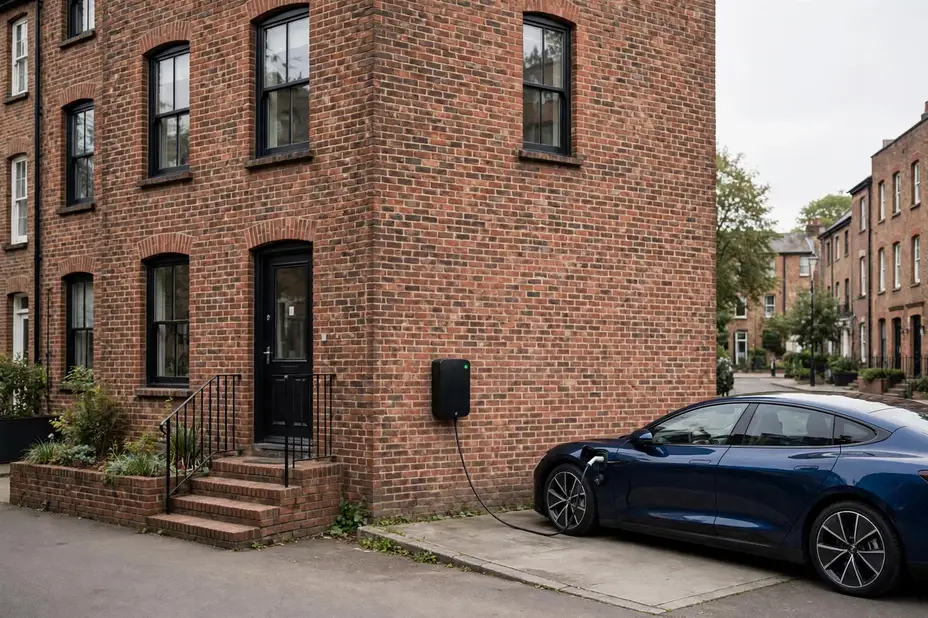
EV charging services in Albany
Ten services cover the work installers do in Albany. Three lead the list here because of what this city's housing and law actually look like — each links to its national service page, where scope and process are set out in full.
Home EV Charger Installation in Albany
Think of it as plumbing for electrons, with the same virtues: correct sizing, honest materials, tidy runs, tested joints. The installers who do it weekly follow a pattern — assess, calculate, route, mount, configure, document — and the pattern is why their installs rarely make news afterwards.
In Albany: the default first install for Albany's EV households — a station where the car already parks.
Dedicated Circuit & Electrical Panel Upgrade in Albany
Capacity work wears three costumes — more amps, a fresh panel, or management electronics that make the existing amps behave like more. The load calculation is the fitting room: it shows which costume your house actually needs, and a trustworthy quote names the calculation before the costume.
In Albany: the job that surfaces wherever housing is older — and Albany's stock makes it a routine conversation, settled by a load calculation.
Multifamily & Condo EV Charging in Albany
Buildings that solve charging solve it as infrastructure: a backbone capacity decision, a fair cost-allocation rule, and spaces that can be electrified in ones as residents arrive. The first installation is the constitution; the rest are amendments.
In Albany: constitutions for shared charging in Albany buildings: metering, load and approvals.
Utility programs and electricity in Albany
Electricity in Albany comes from PacifiCorp. Parts of the wider metro are served by Central Electric Coop Inc, Emerald People's Utility Dist, Consumers Power, Inc. The utility matters twice over for a charger install: it sets the time-of-use rates that decide what overnight charging costs you, and it is the organisation that may — or may not — currently help pay for the equipment.
Program status is a snapshot, and this page dates its snapshot: sources checked at build time found no PacifiCorp residential charger rebate, no Oregon home-charger program, and a federal credit that ended September 30, 2025. Albany households should treat that as the position until a utility announcement changes it — utilities publish openings prominently when budgets exist, because unspent program money is a problem for them too.
While you are reading your tariff, check how your plan treats the evening peak. A charger scheduled to start after the peak window is the single easiest saving in home charging, and it is set once, in the car or the station, then forgotten.
Condos, HOAs and the law in Oregon
An association in Oregon cannot simply say no. The right-to-charge law recorded for this state (ORS 94.762 (HOA); §100.627 (condo); §90.462 (renters)) entitles an owner to install charging equipment for their own vehicle in their own parking space, subject to reasonable association conditions on placement, insurance and eventual restoration. For a Albany owner, the practical consequence is that the application is a compliance exercise — equipment, circuit, paperwork — rather than a popularity contest at a board meeting.
The statute is the floor, not the whole negotiation: associations in Oregon can still set reasonable conditions on placement, appearance and insurance. In Albany, the installers who do multifamily work regularly are the ones who arrive with the application already drafted.
The step-by-step version lives in our guide to installing an EV charger in a condo or HOA community — the application sequence, the metering designs and the questions boards ask, in order.
Climate, garages and charger placement
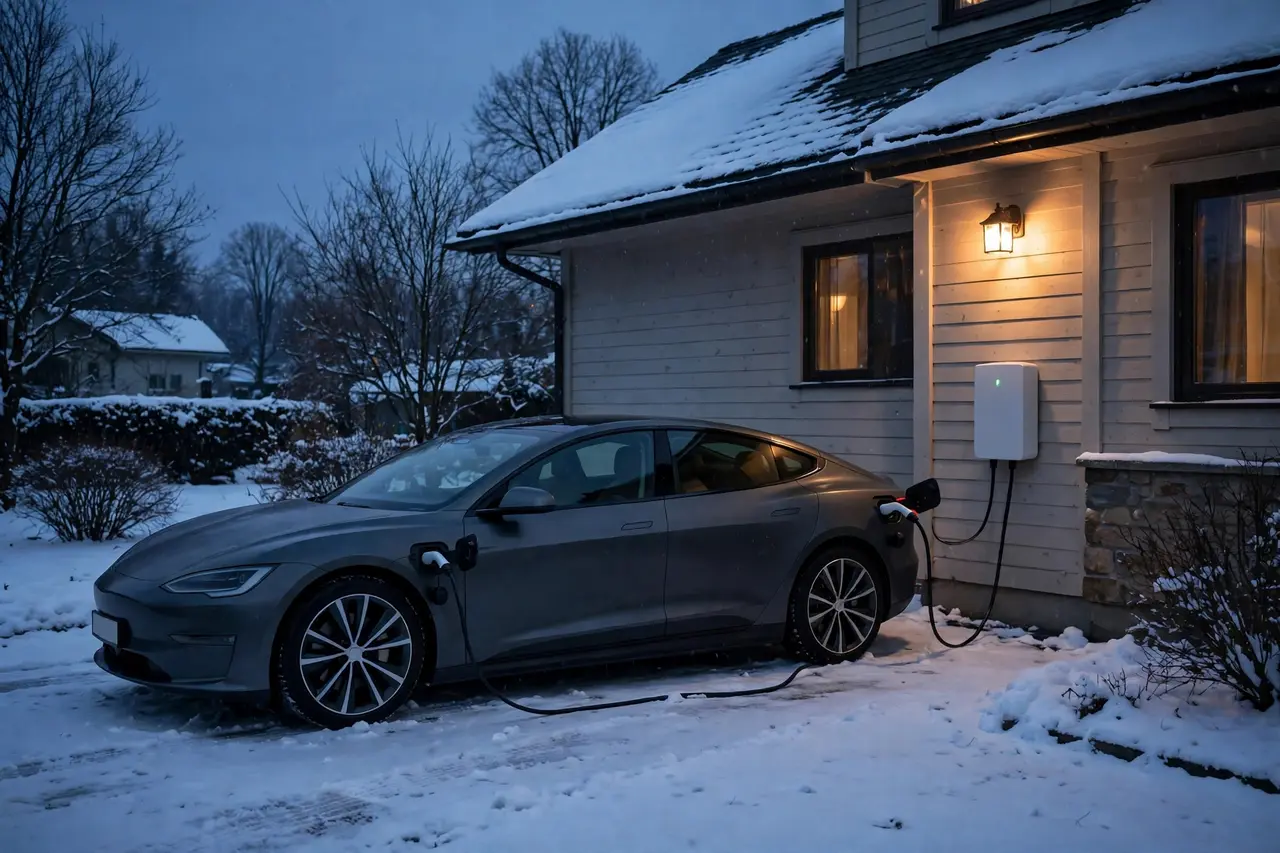
Ice discipline is the third local habit: a cable route that never crosses the shovelled path's landing zone, a holster at a height the snowbank does not reach, and a station position the roof does not shed onto. Winter rewards the installs that were designed in it.
Garages here earn their insulation twice: once for the house, and once for the battery that prefers its nights merely cold rather than arctic. A plugged-in car sips what it needs to stay ready; the building's job is to narrow the gap it sips against.

Permits and inspection in Albany
Timelines are set by the city's counter, not the installer: the electrical work itself is typically a day, while permit issuance and the inspection visit follow the department's queue. A quote that promises a date should tell you which parts of that date the installer actually controls.

Neighbourhoods and ZIP codes served
The page covers 2 ZIP codes in and around Albany — including 97321, 97322 — across Linn. If your ZIP is not in the first set shown, ask anyway: installer coverage follows the metro, not a postcode fence.
The same working area takes in the neighbouring localities of Tangent, Crabtree, Shedd, Lebanon, Halsey, Scio, Brownsville, Crawfordsville, Harrisburg, Sweet Home, Lyons, Mill City, Foster, Cascadia — the county ring an installer based in Albany actually drives. Requests from those communities route exactly as city requests do: same services, same permit discipline, same local facts where they differ.
Linn County accounts for 16 of the ZIP codes and 15 named postal localities in the research file, the nearest of them Tangent, Crabtree, Shedd, Lebanon, Halsey. The survey counts 130,706 residents in the county, with a median household income of $76,329 and a median home value of $376,400. Measured across its ZIP codes, the Albany footprint runs about 2 miles north to south and 4 east to west, from ZIP 97321 to 97322 — the ground an installer based here actually covers in a working week.
Beyond the county seats, the working area takes in Tangent, Jefferson, Crabtree, Monmouth, Lebanon, Scio, Brownsville, Sweet Home, Cascadia — the named localities for which Albany is the nearest metro in the network (neighbouring metros' pages cover their own ground), each routing to the same installer-matching service.
The wider working area also reaches Shedd, Salem, Philomath, Turner, Crawfordsville, Harrisburg, Lyons, Silverton, Junction City, Marcola, Mill City, Alvadore, Saint Paul, Elmira, Noti, Siletz, Saint Benedict, Newberg, Canby, Walton, Mulino, Creswell, Otter Rock, Gleneden Beach, Colton, Neotsu, Dexter, Gaston, Yachats, Cloverdale, Mapleton, Gladstone, Hillsboro, Eagle Creek, Drain — ground shared with neighbouring metros, where installers cross the same county lines in both directions.
ZIP codes in that shared ground include 97003, 97007, 97016, 97017, 97018, 97026, 97027, 97051, 97055, 97060, 97062, 97070, 97075, 97076, 97079, 97080, 97107, 97111, 97114, 97118, 97119, 97124, 97128, 97129, 97135, 97204, 97209, 97218, 97223, 97224, 97225, 97228, 97229, 97250, 97254, 97280, 97286, 97292, 97294, 97301.
The largest communities in that working area after Albany itself, by the GeoNames populated-place file: Lebanon (population 16,324), Sweet Home (population 9,270), Jefferson (population 3,247), Brownsville (population 1,738), Millersburg (population 1,539), Tangent (population 1,220), South Lebanon (population 1,005), Scio (population 882), Adair Village (population 818), Lacomb (population 546). Charging demand follows those populations — the subdivisions and town centres where the next driveways, and the next panels, are.
Marion County reaches into the working area with 349,244 residents, a median household income of $77,351 and a median home value of $416,400; its localities on this page include Jefferson. Polk County reaches into the working area with 89,662 residents, a median household income of $85,118 and a median home value of $454,700; its localities on this page include Monmouth.
| ZIP | Locality | County |
|---|---|---|
| 97321 | Albany | Linn |
| 97322 | Albany | Linn |
| 97389 | Tangent | Linn |
| 97352 | Jefferson | Marion |
| 97335 | Crabtree | Linn |
| 97361 | Monmouth | Polk |
| 97355 | Lebanon | Linn |
| 97374 | Scio | Linn |
| 97327 | Brownsville | Linn |
| 97386 | Sweet Home | Linn |
| 97329 | Cascadia | Linn |

Planning the install: from panel to parking
A useful way to read any Albany quote is to ask which of three jobs it describes. Job one: the panel has room and the run is short — a circuit and a station. Job two: the panel is full — capacity work joins the quote, as an upgrade or as load management. Job three: the property adds people — an HOA, a landlord, a building's shared service — and the approvals timeline joins the electrical one. None of the three is a bad job; they are simply different scopes, and a clear quote says which one you are in.
Finally, photograph the finished work — station, nameplate, panel directory with the new breaker labelled — and file it with the inspection record. When the car changes, the house sells or a second station joins the first, that folder is the difference between a five-minute answer and an archaeological dig.
Home charging know-how for Albany households
Outdoor and carport positions
Plenty of charging happens without a garage at all — on driveway walls, posts and carports. The outdoor version of the job adds its own discipline: equipment listed for the exposure, an enclosure that sheds rather than traps water, cable reach checked against the car's real nose-in position, and protection from the ordinary impacts of a working driveway. A pedestal adds a foundation and a conduit approach below grade. None of it is exotic, and all of it is cheaper decided on paper than corrected in concrete.
Conduit, finishes and the neatness question
Runs of conduit across a finished garage divide households: some want them invisible, some want them honest. The options are a spectrum — in-wall runs where framing allows, surface conduit painted to the wall, or a route through the ceiling line where neither shows. Each step toward invisible costs labour and sometimes access for future work. Decide at the design stage with the route in view, because the time to care about the charger's industrial look is before it is screwed to the wall, not in the first photograph afterwards.
Bidirectional charging, honestly framed
Vehicles that can return energy to a house or the grid exist, and the standards enabling them are settling — but for most households today it is a horizon technology, not a purchase category: it needs a compatible vehicle, bidirectional equipment, utility interconnection approval and a tariff that rewards it. None of that changes today's installation advice, except in one detail: conduit and panel capacity installed generously now are the same provisions a future bidirectional setup would want. Buy for the car you have; leave room for the one the industry is promising.
A word about the word 'charger'
Strictly speaking, the charger lives in the car: the onboard unit that converts alternating current from the wall into the direct current the battery stores. The box on your wall is supply equipment — it negotiates, switches and protects, but the conversion happens in the vehicle. The distinction explains two practical things: why the car's acceptance rate caps every circuit conversation, and why the same wall equipment serves different cars at different speeds. Installers use 'charger' for the wall box anyway, as does this page — but the mental model is worth owning.

Frequently asked questions
Can I still get the federal tax credit for a home charger in Albany, OR?
That credit is finished: 30C ended on September 30, 2025. What about locally? In the utility and state sources checked for this page, nothing verified was running for Albany homeowners — no PacifiCorp rebate, no state scheme. If one opens, it will appear on the utility's site with dates; plan your install without it meanwhile.
Can my association in Albany, OR say no to a home charger?
Not outright. Under ORS 94.762 (HOA); §100.627 (condo); §90.462 (renters), Oregon associations cannot prohibit an owner's charger; they can condition it — reasonably — on placement, insurance and restoration, with the owner funding the work. The disputes that do arise are usually about conditions, and they settle fastest when the application answers them in advance.
Will my Albany, OR home need a panel upgrade for a Level 2 charger?
Sometimes — and Albany's housing stock is exactly why the question is worth asking properly. With a median build year of 1983 and roughly 48% of homes predating 1980, plenty of local panels are 100-amp units already carrying a full modern load. Those homes choose between an upgrade and load management; newer 200-amp homes usually just add the circuit. The site visit's load calculation is the decider.
How quickly will a Level 2 charger fill my car in Albany, OR?
Level 2 is several-fold faster in the only unit that matters — miles back per hour parked: roughly 25–40 against Level 1's 3–5. The exact figure follows the circuit: a 40-amp circuit and a 60-amp circuit are both Level 2, and the car's onboard limit may sit below either. Your installer matches the three numbers at the site visit.
What happens after I request an installer through this page?
Send the request and it is matched against installers covering Albany — your service, ZIP, property type and timing travel with it. An installer then arranges the site visit and quotes in writing. Our role ends at the introduction; your contract, permit and paperwork are with the installer.
Does PacifiCorp offer a time-of-use rate for EV charging in Albany?
Many PacifiCorp customers can choose a time-of-use tariff; whether yours is one, and where its cheap window sits, decides how the charger should be scheduled from night one. Two minutes with your tariff sheet during the planning stage is the whole task — the installer sets the schedule to match while commissioning the station.
Nearby cities in Oregon
- EV charger installation in Corvallis — about 9 miles from Albany, metro population 100,000
- EV charger installation in Salem — about 22 miles from Albany, metro population 450,000
- EV charger installation in Eugene — about 40 miles from Albany, metro population 400,000
- EV charger installation in Portland — about 64 miles from Albany, metro population 2,500,000
- EV charger installation in Bend — about 109 miles from Albany, metro population 205,000
- EV charger installation in Medford — about 164 miles from Albany, metro population 220,000
- EV charger installation in Longview, WA — about 104 miles from Albany, metro population 115,000
- EV charger installation in Olympia, WA — about 164 miles from Albany, metro population 300,000
- EV charger installation in Yakima, WA — about 198 miles from Albany, metro population 255,000
Ready to charge at home in Albany?
Tell us the job — service, ZIP and property type — and licensed local installers will take it from there.