EV Charger Installation in Bend, OR
Everything a Bend homeowner needs before booking a charger install — the panel question, the utility's current programs, the HOA law and the permit — sourced, dated and local.
Every home charger installation is the same four decisions wearing local clothes: capacity in the panel, a route for the circuit, a position for the station, and paperwork that proves it was done properly. What changes from city to city is the content of those decisions — and in Bend the content is specific. Bend itself is home to about 106,925 people. Oregon's registered fleet stood at 98,000 battery-electric vehicles and 38,900 plug-in hybrids at the end of 2025, and this page works through the local version of each decision: your utility and its programs, your state's association law, your permit counter, and your housing stock's electrical habits.
How PlugReady USA works, in one breath: you describe the job once, licensed local installers who cover Bend receive it, and the conversations happen with them directly. The rest of this page exists so those conversations start from facts — yours about the house, ours about the metro — rather than from a sales script.
Why Bend ranks 194 in this network's 300-metro build order: High-adoption outdoor market. Those are registration figures, not projections, and they translate directly into installation work — every newly registered plug-in vehicle is a household deciding where it will charge.
Context from the Census Bureau's survey of Bend: median household income $104,031; 60% of occupied homes are owner-occupied; 68% of housing units are single-unit detached houses. It is the profile of a city where the typical charger job is a homeowner job — scoped by the panel and the wire run, not by permissions.

The composite picture matters more than any single statistic. In Bend: a comparatively young housing fabric, where modern services are the default; a detached-house majority with a real attached and multifamily minority; buildings of five or more units are a visible minority of the stock; meanwhile, owners hold a working majority, with renters a significant minority. A page that ignored that profile would give the same advice everywhere; this one is ordered by it.
Keep six figures and you keep Bend's whole electrical character: 51,443 housing units; 47,408 occupied homes; 28,264 owner-occupied; 34,989 detached houses; 10,802 pre-1980 homes; 6,834 homes in buildings of five or more units. Percentages elsewhere on this page are these numbers in disguise — the counts are the originals, and they are the numbers a local installer's experience is actually made of. The page's geography is equally concrete: 6 ZIP codes across Deschutes, centred near 44.09 degrees north latitude. The city anchors the Bend–Redmond metropolitan area, home to roughly 205,000 people on the research file's metro estimate — the wider labour and housing market this page's installers work across.
The same survey release fills in the household economics around the housing stock: a median home value of $718,400, median gross rent of $1,883, per-capita income of $58,652, and a median resident age of 41. How the city moves completes the picture: 64% of Bend workers drive to work alone — the commute pattern home charging is built around; 25% work from home, a population whose cars charge on daytime and overnight schedules alike; 0% commute by public transit; 53% of adults hold a bachelor's degree or higher. The survey's vehicle table is the one an EV page should quote first: 2,204 of Bend's households have no vehicle at all, while 30,963 have two or more — the multi-car households for whom the second circuit is a when, not an if.
Two burden statistics frame the economics: in Bend, 44% of renters and 0% of mortgage-holding owners are housing-cost burdened at the standard 30% threshold. And 57% of households are family households, the segment most likely to run the two-vehicle, two-schedule pattern the second-vehicle planning notes address.
None of these facts is trivia; each one moves a real decision in the project. A young stock standardises the install conversation — the variables narrow to run length, station position and the household's second-car horizon, because the capacity question was answered by the builder years ago. Where form is mixed, advice must be conditional — the honest page, like the honest installer, keeps asking which housing the reader actually lives in before prescribing.
The balance of tenure keeps both crafts alive locally: firms that run domestic circuits all week, and firms whose week is landlord letters and board packs — with the good ones fluent in both. At these incomes the binding constraint is rarely money; it is scheduling — installer diaries, permit queues and the household's own calendar. The commission's calendar quietly schedules the market: when a new time-of-use design is approved, installer phones ring in a pattern the docket predicted months earlier.
Visibility is the growth engine: every driveway install is a demonstration, and the metro's adoption curve is being drawn one cul-de-sac at a time. The permit counter in a smaller city is a conversation, not a queue: applications are read by people who may know the street, and complete paperwork is remembered kindly. The association dimension, at least, comes with a statutory frame in this state — the law section above sets out what boards may and may not do, and applications written inside that frame travel noticeably faster.
The electrical reality in Bend homes
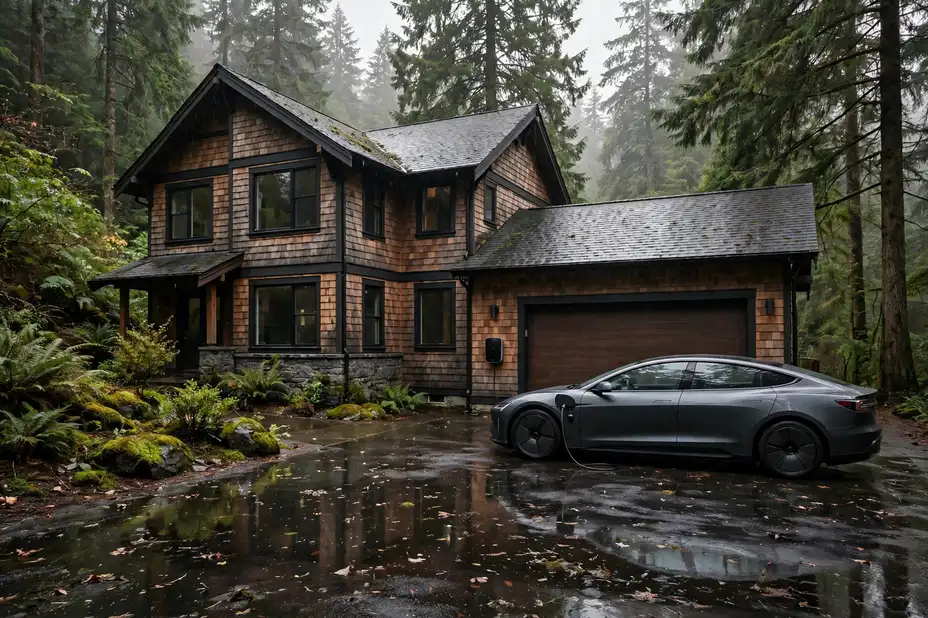
The Census Bureau's latest American Community Survey puts the median Bend home's build year at 2001: about 21% of the city's housing units were built before 1980, 68% are single-unit detached houses, and 60% of occupied homes are owner-occupied. Those three numbers predict most of what an installer will find. Newer stock, newer services: 200-amp panels are the norm in the recent subdivisions, and the charger conversation moves quickly from 'can we' to 'where exactly'. The variables left are the run's length and the station's position relative to the car's port. Porches, carports and parking pads carry a real share of this city's charging, because the stock predates the two-car garage as a standard feature — outdoor-rated equipment is a local staple, not an edge case.
Heating fuel is the survey's quiet clue to panel life: in Bend, 38% of homes heat electrically (16,950 households), against 58% heating with gas. A house already heating electrically has a service sized with that load in its history; a gas-heated house may have capacity to spare — either way the fuel mix is part of what the installer is reading.
Renters are the other constituency in these numbers: about 19,144 of Bend's occupied homes are rented rather than owned. Their charging route runs through a landlord conversation instead of a panel they control — a different project, covered by the rentals guide and the law section below, but a routine one in a city with this many renting households.
The city's stock is not all houses: 13% of units are in structures of five or more. Shared buildings mean shared panels, assigned parking and association process — the substance of the multifamily sections below.
EV charging services in Bend
Three of the network's services lead this page because local conditions put them first; the remaining seven are one click away and equally available here. Each card states what the service involves — the matching itself is free of obligation until you accept an installer's quote.
Home EV Charger Installation in Bend
Think of it as plumbing for electrons, with the same virtues: correct sizing, honest materials, tidy runs, tested joints. The installers who do it weekly follow a pattern — assess, calculate, route, mount, configure, document — and the pattern is why their installs rarely make news afterwards.
In Bend: usually the first job a new EV household in Bend books, scoped to the panel the house already has.
Multifamily & Condo EV Charging in Bend
Shared buildings convert charging from a purchase into a policy, and the installers fluent here speak both languages — amperage and agenda items. The electrical design that wins approval is the one whose metering and load answers arrive attached to the application.
In Bend: the approvals-plus-wiring job for Bend's condos and HOA communities, where the process matters as much as the circuit.
Level 2 Charger Installation in Bend
What is being bought is time: the hours between arriving home and leaving again, converted into range at 240 volts. The conversion hardware is ordinary — breaker, conductor, station — and the design work is matching the three to the household's miles and the panel's arithmetic.
In Bend: what most Bend drivers mean when they say they want 'a real charger' — 240 volts, sized to the circuit.
Utility programs and electricity in Bend
Electricity in Bend comes from PacifiCorp. Parts of the wider metro are served by Central Electric Coop Inc, Midstate Electric Coop, Inc, Harney Electric Coop, Inc. The utility matters twice over for a charger install: it sets the time-of-use rates that decide what overnight charging costs you, and it is the organisation that may — or may not — currently help pay for the equipment.
Rebate status in Bend: none verified. The utility and state sources checked for this page list no active residential charger rebate from PacifiCorp, no Oregon replacement program for home installs, and the federal 30C credit ended on September 30, 2025. When a funded round opens it appears on the utility's own program pages with terms and dates; until one does, the honest budget for a charger install here is the install itself.
If your service includes a demand component, the charger's start time matters more than its size: staggered against the house's other big loads, the same circuit costs noticeably less to run across a year.
Condos, HOAs and the law in Oregon
Oregon law protects an owner's charger. ORS 94.762 (HOA); §100.627 (condo); §90.462 (renters) gives owners in association communities a statutory route to a charging station in their own space: the association may set reasonable conditions on how the installation looks, where exactly it sits, and how it is insured, but a flat prohibition is not one of its options. Owners fund the work, use licensed installers, and remain responsible for the equipment — the statute allocates the burdens; it does not remove them.
If your board is stalling, the sequence that works in Bend is boring and effective: cite the statute, submit a complete application (equipment, circuit, installer licence, insurance), and keep everything in writing.
For the design side — shared versus assigned spaces, load management across a building, billing per owner — see the multifamily and condo charging service page.
Climate, garages and charger placement
Winter hardware habits are simple and worth copying: a holster the connector returns to every night (a connector left in a snowbank is a connector full of ice), a cable route that survives the snow-clearing line, and a station position the plough's output does not bury. Installers here raise all three without being asked.
The first cold morning is the audit: cable flexibility, connector seating with gloved hands, the holster reachable without crossing the ice zone by the door. Installs designed in spring are graded in January, and local installers design for the grade.

Permits and inspection in Bend
What the inspector is checking, in plain terms: conductor size against breaker size, the continuous-load calculation, terminations torqued, protection where the code wants it, and a station whose settings match the circuit it landed on. It is a short visit that validates everything you cannot see.

Neighbourhoods and ZIP codes served
The page covers 6 ZIP codes in and around Bend — including 97701, 97702, 97703, 97707, 97708, 97709 — across Deschutes. If your ZIP is not in the first set shown, ask anyway: installer coverage follows the metro, not a postcode fence.
The same working area takes in the neighbouring localities of Redmond, Sisters, Terrebonne, La Pine, Brothers — the county ring an installer based in Bend actually drives. Requests from those communities route exactly as city requests do: same services, same permit discipline, same local facts where they differ.
Deschutes County accounts for 11 of the ZIP codes and 6 named postal localities in the research file, the nearest of them Redmond, Sisters, Terrebonne, La Pine, Brothers. The survey counts 206,334 residents in the county, with a median household income of $92,758 and a median home value of $650,900. Measured across its ZIP codes, the Bend footprint runs about 17 miles north to south and 14 east to west, from ZIP 97701 to 97709 — the ground an installer based here actually covers in a working week.
Beyond the county seats, the working area takes in Redmond, Powell Butte, Sisters, Terrebonne, Culver, La Pine, Prineville, Camp Sherman, Madras, Warm Springs, Blue River, Gilchrist, Brothers, Crescent, Fort Rock, Ashwood, Post, Antelope, Silver Lake, Maupin, Christmas Valley, Shaniko, Chemult, Mitchell, Kent, Tygh Valley, Paulina, Summer Lake, Fossil, Grass Valley, Riley, Spray — the named localities for which Bend is the nearest metro in the network (neighbouring metros' pages cover their own ground), each routing to the same installer-matching service.
The wider working area also reaches Idanha, Vida, Oakridge, Cascadia, Foster, Walterville, Mill City, Sweet Home, Lowell, Marcola, Lyons, Dexter, Government Camp, Mehama, Crawfordsville, Saint Benedict, Springfield, Dufur, Pleasant Hill, Dorena, Scio, Lebanon, Rhododendron, Brownsville, Welches, Stayton, Scotts Mills, Crabtree, Brightwood, Colton, Creswell, Eugene, Sublimity, Mount Hood Parkdale, Cottage Grove — ground shared with neighbouring metros, where installers cross the same county lines in both directions.
ZIP codes in that shared ground include 97011, 97017, 97021, 97049, 97067, 97325, 97327, 97329, 97336, 97342, 97345, 97346, 97350, 97355, 97360, 97373, 97375, 97384, 97385, 97386, 97401, 97403, 97405, 97408, 97424, 97426, 97431, 97434, 97440, 97452, 97454, 97455, 97463, 97475, 97478, 97488, 97489, 97492, 97604, 97823.
The largest communities in that working area after Bend itself, by the GeoNames populated-place file: Redmond (population 28,654), Prineville (population 9,530), Madras (population 6,662), Deschutes River Woods (population 5,077), Three Rivers (population 3,014), Warm Springs (population 2,945), Sisters (population 2,472), La Pine (population 1,777), Culver (population 1,442), Sunriver (population 1,393), Terrebonne (population 1,257), Metolius (population 743), Fossil (population 449). Charging demand follows those populations — the subdivisions and town centres where the next driveways, and the next panels, are.
Jefferson County reaches into the working area with 25,203 residents, a median household income of $76,260 and a median home value of $374,200; its localities on this page include Culver, Camp Sherman, Madras, Warm Springs, Ashwood. Crook County reaches into the working area with 26,277 residents, a median household income of $81,965 and a median home value of $467,000; its localities on this page include Powell Butte, Prineville, Post, Paulina. Lake County reaches into the working area with 8,267 residents, a median household income of $62,787 and a median home value of $219,500; its localities on this page include Fort Rock, Silver Lake, Christmas Valley, Summer Lake. Wasco County reaches into the working area with 26,552 residents, a median household income of $64,175 and a median home value of $367,400; its localities on this page include Antelope, Maupin, Shaniko, Tygh Valley. Klamath County reaches into the working area with 70,247 residents, a median household income of $58,830 and a median home value of $280,400; its localities on this page include Gilchrist, Crescent, Chemult.
| ZIP | Locality | County |
|---|---|---|
| 97701 | Bend | Deschutes |
| 97708 | Bend | Deschutes |
| 97709 | Bend | Deschutes |
| 97702 | Bend | Deschutes |
| 97703 | Bend | Deschutes |
| 97756 | Redmond | Deschutes |
| 97753 | Powell Butte | Crook |
| 97759 | Sisters | Deschutes |
| 97760 | Terrebonne | Deschutes |
| 97707 | Bend | Deschutes |
| 97734 | Culver | Jefferson |
| 97739 | La Pine | Deschutes |
| 97754 | Prineville | Crook |
| 97730 | Camp Sherman | Jefferson |
| 97741 | Madras | Jefferson |
| 97761 | Warm Springs | Jefferson |
| 97413 | Blue River | Lane |
| 97737 | Gilchrist | Klamath |
| 97712 | Brothers | Deschutes |
| 97733 | Crescent | Klamath |
| 97735 | Fort Rock | Lake |
| 97711 | Ashwood | Jefferson |
| 97752 | Post | Crook |
| 97001 | Antelope | Wasco |
| 97638 | Silver Lake | Lake |
| 97037 | Maupin | Wasco |
| 97641 | Christmas Valley | Lake |
| 97057 | Shaniko | Wasco |
| 97731 | Chemult | Klamath |
| 97750 | Mitchell | Wheeler |
| 97033 | Kent | Sherman |
| 97063 | Tygh Valley | Wasco |
| 97751 | Paulina | Crook |
| 97640 | Summer Lake | Lake |
| 97830 | Fossil | Wheeler |
| 97029 | Grass Valley | Sherman |
| 97758 | Riley | Harney |
| 97874 | Spray | Wheeler |

Planning the install: from panel to parking
Two decisions shape every Bend install, and both are made before any equipment is ordered. The first is electrical: the load calculation that decides between a straight circuit, a panel upgrade and load management. The second is physical: where the station lives — which wall, which side of the car the charge port sits on, and whether the cable reaches a second vehicle or a future one. Installers in Bend see the same housing patterns repeat street by street, which is why a ten-minute site visit produces a firmer quote than any online form: the form starts the conversation, the visit settles it.
One more piece of sequencing advice Bend installers give consistently: if the panel is being opened anyway, settle the other electrical maybes in the same visit — the circuit you will want next year costs least while the permit and the electrician are already in the house.
Home charging know-how for Bend households
Light, reach and the midnight plug-in
Most charging happens in the dark, in winter clothes, carrying something. The installations that feel effortless share three traits: light where the connector lives, a mounting height that asks no stretching or crouching, and a cable path with nothing to trip over between the car door and the wall. Households with mobility limits in the family should say so at the site visit — height, reach and holster style are all adjustable at install time and awkward afterwards. Design for the worst trip, not the easiest one.
Retrofitting the older apartment building
Older multifamily buildings meet charging with a capacity question before any other: the service was sized for another era's loads. The professional answer is a load study — what the building actually draws across its day — followed by a managed design that fits charging into the valleys, with make-ready capacity for the applicants who have not yet appeared. It is slower than a house install and more deliberate, and it is the reason experienced multifamily installers start with the building's electrical room rather than its car park.
Getting onto the board's agenda
Association decisions happen inside a procedure, and the procedure has a door: the agenda. Applications that miss the submission deadline wait a full cycle regardless of merit, so the first question for any board is clerical — when do items close for the next meeting, and in what format. Arrive inside the procedure with a complete package and the discussion is about your design; arrive outside it and the discussion is about process, and process always wins the evening. Property managers, asked politely, will tell you the format they prefer applications in.
Single-phase, three-phase, and your house
Home charging runs on the same single-phase service as the rest of the house — the 240 volts between the two legs of a standard residential service — and everything in the domestic sections of this site assumes exactly that. Three-phase power belongs to commercial and industrial buildings, where it changes the design of larger installations and the arithmetic of their load management. The distinction matters only when a quote crosses the two worlds: a household needs no three-phase anything, and a depot cannot plan without it. Knowing which world your property lives in keeps the conversation honest in both directions.

Frequently asked questions
What happened to the federal home-charger credit in Bend, OR?
The three possible pots are all, at present, empty for a Bend homeowner: no PacifiCorp residential rebate in current published sources, no Oregon home programme, and a federal credit that closed on September 30, 2025. Programmes do relaunch — on the utility's site, with dates — and until one does, the honest quote is the one with no rebate line at all.
What can my HOA in Bend, OR do about a charger install?
Not outright. Under ORS 94.762 (HOA); §100.627 (condo); §90.462 (renters), Oregon associations cannot prohibit an owner's charger; they can condition it — reasonably — on placement, insurance and restoration, with the owner funding the work. The disputes that do arise are usually about conditions, and they settle fastest when the application answers them in advance.
Will my Bend, OR home need a panel upgrade for a Level 2 charger?
It hinges on two numbers you cannot read off the panel door: the service's rating, and what the load calculation says it already carries. The vintage of Bend's stock — median build year 2001, about 21% of homes from before 1980 — means both answers are common here. The charger enters the arithmetic at 125% of its draw; whatever room survives that entry decides between a circuit, a management device, and an upgrade.
How much faster is Level 2 charging at home in Bend, OR?
Level 2 is several-fold faster in the only unit that matters — miles back per hour parked: roughly 25–40 against Level 1's 3–5. The exact figure follows the circuit: a 40-amp circuit and a 60-amp circuit are both Level 2, and the car's onboard limit may sit below either. Your installer matches the three numbers at the site visit.
How does the installer matching on this page work?
Send the request and it is matched against installers covering Bend — your service, ZIP, property type and timing travel with it. An installer then arranges the site visit and quotes in writing. Our role ends at the introduction; your contract, permit and paperwork are with the installer.
Does PacifiCorp offer a time-of-use rate for EV charging in Bend?
Check your tariff before the install rather than after: time-of-use plans are common, and an overnight window changes nothing about the circuit but everything about what charging costs across a year. Your installer can set the station's schedule to the window during commissioning — after that the habit is automatic.
Nearby cities in Oregon
- EV charger installation in Eugene — about 99 miles from Bend, metro population 400,000
- EV charger installation in Albany — about 109 miles from Bend, metro population 135,000
- EV charger installation in Salem — about 111 miles from Bend, metro population 450,000
- EV charger installation in Corvallis — about 114 miles from Bend, metro population 100,000
- EV charger installation in Portland — about 124 miles from Bend, metro population 2,500,000
- EV charger installation in Medford — about 153 miles from Bend, metro population 220,000
- EV charger installation in Longview, WA — about 169 miles from Bend, metro population 115,000
- EV charger installation in Yakima, WA — about 179 miles from Bend, metro population 255,000
- EV charger installation in Kennewick, WA — about 187 miles from Bend, metro population 315,000
Ready to charge at home in Bend?
Two minutes of form, and the request is in front of licensed installers who cover this city — quotes follow site visits, in writing.