EV Charger Installation in Portland, OR
Home Level 2 charging, panel upgrades and condo installs in Portland — matched to licensed local installers, with the local facts that shape the job set out below.
There is a reason most charging happens at home: it is the most convenient fuelling an EV owner will ever use, and it happens while the car sits idle anyway. In Portland, getting set up means answering a handful of local questions first. Portland itself is home to about 636,958 people, inside a state that registered 98,000 battery-electric vehicles and 38,900 plug-in hybrids through 2025. Which utility serves your address, whether it currently funds part of a charger install, what your panel can carry, and what your HOA or condo board can and cannot say no to — this page covers each of them for Portland specifically.
PlugReady USA is a matching service, not the installer: you tell us the job, and we route the request to licensed local electricians and EV-installer companies who work in Portland. Use the local detail below to arrive at that conversation informed — the sections are ordered the way an installer will think about your project, from the panel outward.
Measured demand, not enthusiasm, put Portland in Tier A of this network: OR 98K BEVs, top-5 share; right-to-charge incl. renters. For a homeowner the useful translation is simpler — installers here do this work weekly, know the local permit counter, and have seen your housing stock before.
Context from the Census Bureau's survey of Portland: median household income $91,478; 51% of occupied homes are owner-occupied; 51% of housing units are single-unit detached houses. It is the profile of a city where the typical charger job is a homeowner job — scoped by the panel and the wire run, not by permissions.

The composite picture matters more than any single statistic. In Portland: an older housing fabric, where panel archaeology is a normal part of the first visit; a detached-house majority with a real attached and multifamily minority; buildings of five or more units hold a substantial share of homes, which keeps the multifamily sections of this page in daily use; meanwhile, owners hold a working majority, with renters a significant minority. A page that ignored that profile would give the same advice everywhere; this one is ordered by it.
Keep six figures and you keep Portland's whole electrical character: 315,899 housing units; 294,419 occupied homes; 149,322 owner-occupied; 161,773 detached houses; 196,931 pre-1980 homes; 112,655 homes in buildings of five or more units. Percentages elsewhere on this page are these numbers in disguise — the counts are the originals, and they are the numbers a local installer's experience is actually made of. The page's geography is equally concrete: 60 ZIP codes across Clackamas, Multnomah, Washington, centred near 45.51 degrees north latitude. The city anchors the Portland–Vancouver–Hillsboro metropolitan area, home to roughly 2,500,000 people on the research file's metro estimate — the wider labour and housing market this page's installers work across.
The same survey release fills in the household economics around the housing stock: a median home value of $588,200, median gross rent of $1,648, per-capita income of $57,668, and a median resident age of 39. How the city moves completes the picture: 52% of Portland workers drive to work alone — the commute pattern home charging is built around; 25% work from home, a population whose cars charge on daytime and overnight schedules alike; 7% commute by public transit; 55% of adults hold a bachelor's degree or higher. And the fleet in the driveways: 128,672 households in Portland have exactly one vehicle, 125,177 have two or more, and 40,570 have none.
The cost-burden lines say who feels housing costs most in Portland: 51% of renters spend 30% or more of income on rent, and 0% of owners with mortgages spend the same share on housing costs. Family households are 46% of all households — the two-car, school-run demographic whose charging patterns this page's planning sections keep circling back to.
What follows is the city read as an electrical place rather than a dot on a map. The oldest housing throws the longest shadows over an install: knob-and-tube remnants in the attic, ungrounded receptacles, services sized for iceboxes and radios that now feed induction ranges and heat pumps. The renter-and-condo share makes the law section of this page load-bearing: statutory rights, application windows and metering rules are not fine print here, they are the project's first phase.
Property managers are the metro's charging gatekeepers at this tenure mix, and the installers who thrive are the ones whose proposals arrive manager-shaped: standardised, insured, reversible on paper. Here the tariff conversation is a budget conversation: the overnight window's arithmetic, done honestly once, pays out every night of the car's life without further attention. A large utility's scale cuts both ways — programme budgets that dwarf a small co-op's, and call-centre distance between a household and anyone who can decide anything. The published page rules; keep it bookmarked.
The growth market's households are researchers by necessity: fewer neighbours to copy, thinner local precedent, and pages like this one carrying more of the orientation load. In a market this size the matching problem inverts: not finding an installer, but filtering — licence, charging specialism, diary, and references from your own quadrant of the metro. The association dimension, at least, comes with a statutory frame in this state — the law section above sets out what boards may and may not do, and applications written inside that frame travel noticeably faster.
The electrical reality in Portland homes
Four numbers organise everything an installer expects in Portland: median build year 1966; 62% of units built before 1980; 51% of the stock detached; 51% of occupied homes owner-occupied. Capacity, circuit routes and approval layers all correlate with those four. The paragraphs below are their commentary. A housing stock this age leans on smaller electrical services — 100-amp panels are common, and fuse-era equipment still turns up in the oldest streets. For many of those homes the honest answer is a panel upgrade or a load-management device before the charger circuit goes in, and a good installer will show you the load calculation rather than asking you to take it on faith. Porches, carports and parking pads carry a real share of this city's charging, because the stock predates the two-car garage as a standard feature — outdoor-rated equipment is a local staple, not an edge case.
One further survey line belongs in any Portland install conversation: 51% of the city's homes heat with electricity — 149,175 households whose panels already carry a major winter load before a charger is contemplated. Electric heat and EV charging are the two largest discretionary loads a house can host, and where they coincide, the load calculation stops being a formality.
One further split matters for how this page is organised: about 145,097 of Portland's occupied homes are renter-occupied. Everything above assumes you can approve your own electrical work; where you cannot, the approval layer — landlord or association — becomes part of the job, which is why the law section carries unusual weight here.
And 36% of Portland's homes are in buildings with five or more units — apartments and condominiums where charging is a building decision before it is an electrical one. If that is your situation, the law and multifamily sections of this page are the ones written for you.
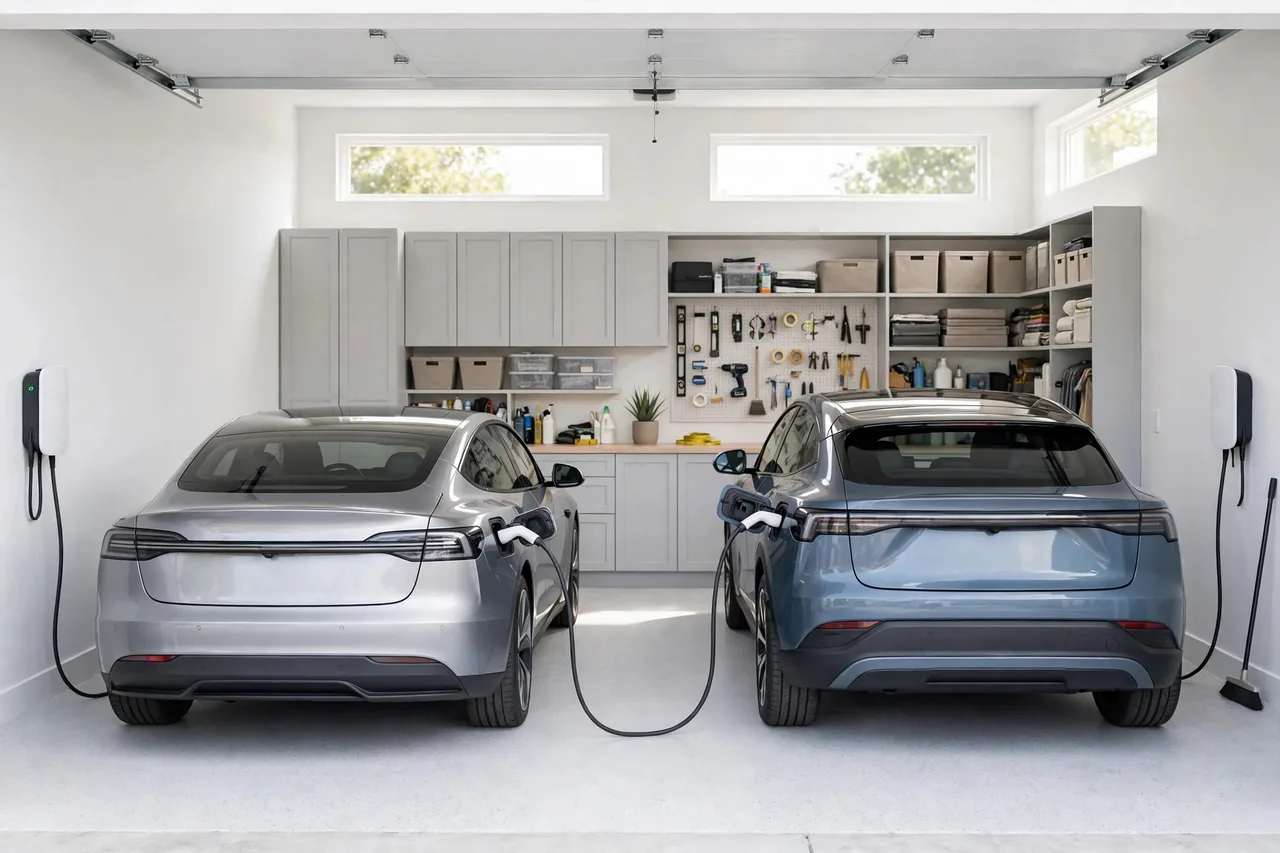
EV charging services in Portland
Ten services cover the work installers do in Portland. Three lead the list here because of what this city's housing and law actually look like — each links to its national service page, where scope and process are set out in full.
Home EV Charger Installation in Portland
The core service, stated plainly: a dedicated 240-volt circuit run from your panel to your parking place, a station mounted and configured to that circuit, and the paperwork closed out with the permit office. Everything else in this section of the site exists to support or unblock this one job.
In Portland: the core residential job in Portland: circuit, mounting, configuration and inspection in one visit pattern.
Dedicated Circuit & Electrical Panel Upgrade in Portland
The upgrade is unglamorous and transformative: a modern panel with honest capacity, labelled circuits, and room for the decade's next three electrical ideas after the charger. Houses rarely regret capacity; they regret its absence annually.
In Portland: the capacity fix that lets the charger circuit go in without the rest of the house living at its limit.
Multifamily & Condo EV Charging in Portland
In shared buildings the deliverable is a system, not a socket: an approved application, a metering design the treasurer can audit, capacity shared by rule rather than by argument, and only then conduit and copper. Firms fluent in the sequence are worth their diary time.
In Portland: the route from board agenda to working charger in Portland's communities.
Utility programs and electricity in Portland
Electricity in Portland comes from Portland General Electric Co. Parts of the wider metro are served by PacifiCorp, Columbia River Peoples Ut Dist, City of Forest Grove. The utility matters twice over for a charger install: it sets the time-of-use rates that decide what overnight charging costs you, and it is the organisation that may — or may not — currently help pay for the equipment.
The honest incentive position in Portland is: nothing verified to claim. The federal charger credit (30C) ended on September 30, 2025; Oregon runs no state replacement for typical home installs; and in the utility and state sources checked for this page, Portland General Electric Co had no active residential charger rebate to point to. Programs reopen — when one does, it will be on the utility's own site with terms and dates. Anything an installer describes without that paper trail should be treated as conversation, not money.
Solar households should read the export terms alongside the charging ones: the pair decides whether midday charging on home-working days beats the overnight window, and the answer is written in your tariff, not in general advice.
Condos, HOAs and the law in Oregon
Oregon has a right-to-charge law. Under ORS 94.762 (HOA); §100.627 (condo); §90.462 (renters), a homeowners association or condominium cannot simply prohibit an owner from installing a charging station in their own parking space. The law does not make the process free or instant — owners typically carry the cost, must use a licensed installer, carry any insurance the statute specifies, and can be required to restore the space if they remove the equipment — but it converts the conversation from a request for permission into a defined process with rules on both sides.
Two practical corollaries follow for Portland owners. First, assigned spaces are the clean case: the statute's protection is clearest where the parking is deeded or exclusively assigned. Second, insurance conditions are real but bounded — if a board's requirement looks invented, asking for its basis in the statute is a reasonable, usually decisive, question.
The step-by-step version lives in our guide to installing an EV charger in a condo or HOA community — the application sequence, the metering designs and the questions boards ask, in order.
Climate, garages and charger placement
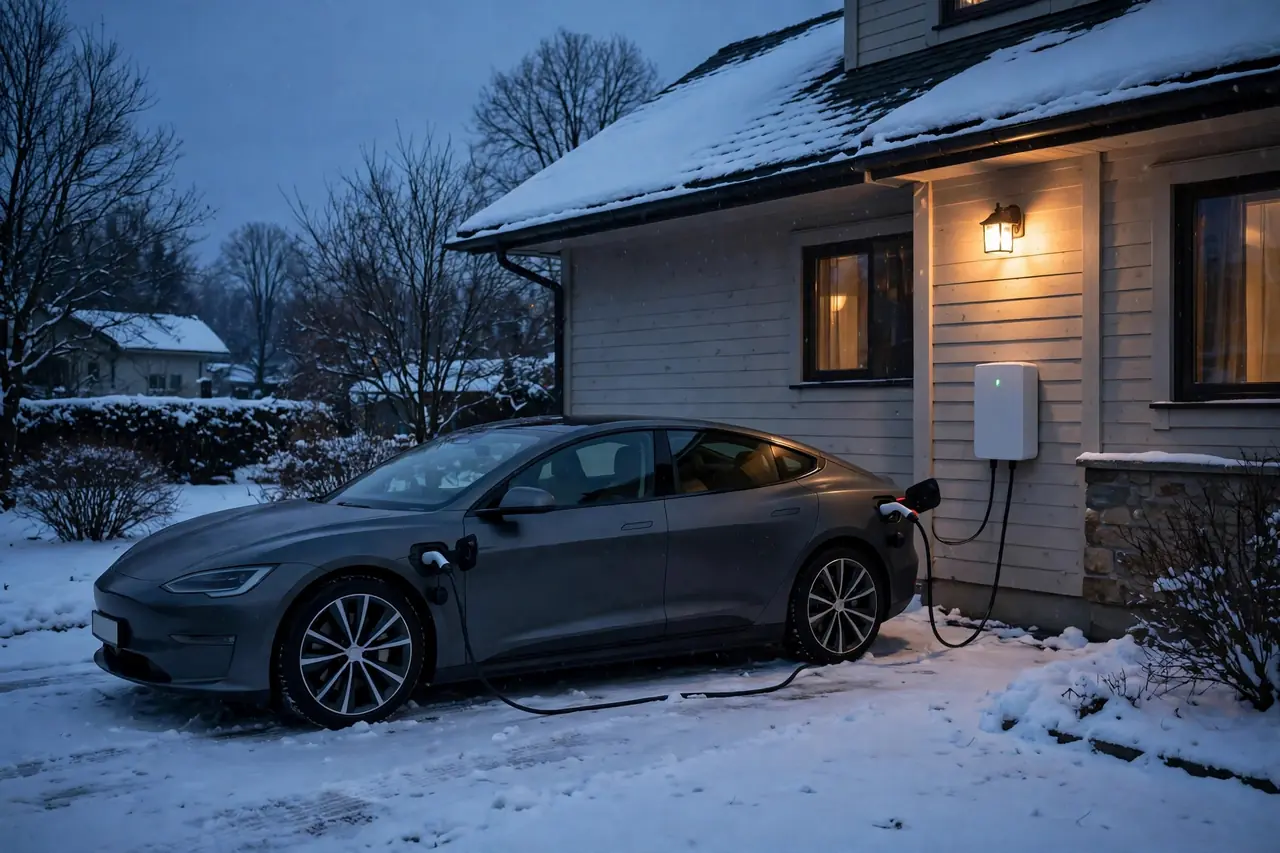
Cold rewrites the charging routine in this part of the country. Batteries accept charge more slowly when they are cold, range falls, and the car's own systems spend energy on warmth — so the overnight window matters more, not less. A Level 2 circuit sized generously is the household's answer: it restores the day's driving with hours to spare even in the slow weeks of January.
Ice discipline is the third local habit: a cable route that never crosses the shovelled path's landing zone, a holster at a height the snowbank does not reach, and a station position the roof does not shed onto. Winter rewards the installs that were designed in it.

Permits and inspection in Portland
Timelines are set by the city's counter, not the installer: the electrical work itself is typically a day, while permit issuance and the inspection visit follow the department's queue. A quote that promises a date should tell you which parts of that date the installer actually controls.

Neighbourhoods and ZIP codes served
The page covers 60 ZIP codes in and around Portland — including 97201, 97202, 97203, 97204, 97205, 97206, 97207, 97208, 97209, 97210, 97211, 97212, 97213, 97214, 97215, 97216, 97217, 97218, 97219, 97220, 97221, 97222, 97223, 97224, 97225, 97227, 97228, 97229, 97230, 97231, 97232, 97233, 97236, 97238, 97239, 97240, 97242, 97250, 97251, 97252, 97253, 97254, 97256, 97258, 97266, 97267, 97268, 97269, 97280, 97281, 97282, 97283, 97286, 97290, 97291, 97292, 97293, 97294, 97296, 97298 — across Clackamas, Multnomah, Washington. If your ZIP is not in the first set shown, ask anyway: installer coverage follows the metro, not a postcode fence.
The same working area takes in the neighbouring localities of Beaverton, Lake Oswego, Marylhurst, Happy Valley, Gladstone, West Linn, Tualatin, Clackamas, Oregon City, Fairview, Damascus, Sherwood, Hillsboro, Gresham — the county ring an installer based in Portland actually drives. Requests from those communities route exactly as city requests do: same services, same permit discipline, same local facts where they differ.
Multnomah County accounts for 56 of the ZIP codes and 7 named postal localities in the research file, the nearest of them Happy Valley, Fairview, Gresham, Troutdale, Corbett. The survey counts 801,477 residents in the county, with a median household income of $88,766 and a median home value of $552,700. Washington County accounts for 31 of the ZIP codes and 14 named postal localities in the research file, the nearest of them Beaverton, Tualatin, Sherwood, Hillsboro, Cornelius. The survey counts 603,947 residents in the county, with a median household income of $107,772 and a median home value of $588,000. Clackamas County accounts for 26 of the ZIP codes and 22 named postal localities in the research file, the nearest of them Lake Oswego, Marylhurst, Gladstone, West Linn, Clackamas. The survey counts 423,975 residents in the county, with a median household income of $103,517 and a median home value of $611,000. Measured across its ZIP codes, the Portland footprint runs about 16 miles north to south and 16 east to west, from ZIP 97201 to 97298 — the ground an installer based here actually covers in a working week.
Beyond the county seats, the working area takes in Beaverton, Lake Oswego, Marylhurst, Vancouver, Happy Valley, Gladstone, West Linn, Tualatin, Clackamas, Oregon City, Fairview, Damascus, Sherwood, Hillsboro, Gresham, Wilsonville, Camas, Troutdale, Canby, Boring, Brush Prairie, Ridgefield, Cornelius, Aurora, Newberg, Beavercreek, Scappoose, Battle Ground, North Plains, Washougal, Eagle Creek, Mulino, Heisson, Corbett, Estacada, Banks, La Center, Gaston, Sandy, Forest Grove, Colton, Manning, Yacolt, Gales Creek, Amboy, Bridal Veil, Brightwood, North Bonneville, Welches, Rhododendron, Stevenson — the named localities for which Portland is the nearest metro in the network (neighbouring metros' pages cover their own ground), each routing to the same installer-matching service.
The wider working area also reaches Donald, Hubbard, Warren, Dundee, Saint Helens, Saint Paul, Woodburn, Molalla, Columbia City, Woodland, Lafayette, Carlton, Gervais, Dayton, Mount Angel, Yamhill, Deer Island, Buxton, Mcminnville, Kalama, Ariel, Silverton, Scotts Mills, Vernonia, Salem, Timber, Amity, Saint Benedict, Carrolls, Keizer, Rainier, Cougar, Rickreall — ground shared with neighbouring metros, where installers cross the same county lines in both directions.
ZIP codes in that shared ground include 97020, 97026, 97032, 97038, 97048, 97051, 97053, 97054, 97071, 97101, 97109, 97111, 97114, 97115, 97127, 97128, 97137, 97144, 97148, 97301, 97303, 97304, 97305, 97307, 97308, 97309, 97310, 97311, 97312, 97313, 97314, 97317, 97362, 97371, 97373, 97375, 97381, 98603, 98609, 98674.
The largest communities in that working area after Portland itself, by the GeoNames populated-place file: Vancouver (population 196,442), Gresham (population 110,553), Hillsboro (population 102,347), Beaverton (population 96,577), Tigard (population 51,253), Aloha (population 49,425), Lake Oswego (population 38,496), Oregon City (population 35,831), Tualatin (population 27,154), West Linn (population 26,593), Forest Grove (population 24,457), Newberg (population 22,780), Wilsonville (population 22,729), Camas (population 21,846), Milwaukie (population 20,830), Bethany (population 20,646), Lents (population 20,156), Salmon Creek (population 19,686), Orchards (population 19,556), Hazel Dell (population 19,435). Charging demand follows those populations — the subdivisions and town centres where the next driveways, and the next panels, are.
| ZIP | Locality | County |
|---|---|---|
| 97201 | Portland | Multnomah |
| 97239 | Portland | Multnomah |
| 97205 | Portland | Multnomah |
| 97204 | Portland | Multnomah |
| 97268 | Portland | Clackamas |
| 97269 | Portland | Clackamas |
| 97207 | Portland | Multnomah |
| 97208 | Portland | Multnomah |
| 97228 | Portland | Multnomah |
| 97238 | Portland | Multnomah |
| 97240 | Portland | Multnomah |
| 97242 | Portland | Multnomah |
| 97250 | Portland | Multnomah |
| 97251 | Portland | Multnomah |
| 97252 | Portland | Multnomah |
| 97253 | Portland | Multnomah |
| 97256 | Portland | Multnomah |
| 97258 | Portland | Multnomah |
| 97280 | Portland | Multnomah |
| 97282 | Portland | Multnomah |
| 97283 | Portland | Multnomah |
| 97286 | Portland | Multnomah |
| 97290 | Portland | Multnomah |
| 97292 | Portland | Multnomah |
| 97293 | Portland | Multnomah |
| 97294 | Portland | Multnomah |
| 97296 | Portland | Multnomah |
| 97281 | Portland | Washington |
| 97291 | Portland | Washington |
| 97298 | Portland | Washington |
| 97209 | Portland | Multnomah |
| 97210 | Portland | Multnomah |
| 97221 | Portland | Multnomah |
| 97214 | Portland | Multnomah |
| 97227 | Portland | Multnomah |
| 97232 | Portland | Multnomah |
| 97202 | Portland | Multnomah |
| 97219 | Portland | Multnomah |
| 97212 | Portland | Multnomah |
| 97217 | Portland | Multnomah |
| 97211 | Portland | Multnomah |
| 97225 | Portland | Washington |
| 97215 | Portland | Multnomah |
| 97206 | Portland | Multnomah |
| 97213 | Portland | Multnomah |
| 97218 | Portland | Multnomah |
| 97203 | Portland | Multnomah |
| 97005 | Beaverton | Washington |
| 97222 | Portland | Clackamas |
| 97075 | Beaverton | Washington |
| 97076 | Beaverton | Washington |
| 97077 | Beaverton | Washington |
| 97035 | Lake Oswego | Clackamas |
| 97078 | Beaverton | Washington |
| 97079 | Beaverton | Washington |
| 97223 | Portland | Washington |
| 97034 | Lake Oswego | Clackamas |
| 97008 | Beaverton | Washington |
| 97216 | Portland | Multnomah |
| 97266 | Portland | Multnomah |
| 97036 | Marylhurst | Clackamas |
| 97220 | Portland | Multnomah |
| 97254 | Portland | Multnomah |
| 97229 | Portland | Washington |
| 97267 | Portland | Clackamas |
| 98666 | Vancouver | Clark |
| 98668 | Vancouver | Clark |
| 98687 | Vancouver | Clark |
| 97224 | Portland | Washington |
| 98660 | Vancouver | Clark |
| 97003 | Beaverton | Washington |
| 97006 | Beaverton | Washington |
| 97086 | Happy Valley | Multnomah |
| 97027 | Gladstone | Clackamas |
| 98661 | Vancouver | Clark |
| 97068 | West Linn | Clackamas |
| 98663 | Vancouver | Clark |
| 97236 | Portland | Multnomah |
| 98664 | Vancouver | Clark |
| 97062 | Tualatin | Washington |
| 97007 | Beaverton | Washington |
| 97233 | Portland | Multnomah |
| 97230 | Portland | Multnomah |
| 97015 | Clackamas | Clackamas |
| 98683 | Vancouver | Clark |
| 97231 | Portland | Multnomah |
| 98665 | Vancouver | Clark |
| 98684 | Vancouver | Clark |
| 97045 | Oregon City | Clackamas |
| 97024 | Fairview | Multnomah |

Planning the install: from panel to parking
Experienced Portland installers talk about 'the tell': the small observation that predicts the job. A panel directory in pencil with three generations of handwriting. A garage converted, then converted back. A charger-shaped hole in the household's plans — the second car already ordered. Mention your own tells at the visit; they are scope information, and scope named early is scope settled fairly.
Future-proofing, in this trade, is mostly conduit and capacity: an oversized conduit run costs little during the first install and everything later; a panel position reserved is a breaker that never has to move. If a second EV, a workshop or an electrified water heater is anywhere in your five-year picture, say so at the site visit.
Home charging know-how for Portland households
Timing the install with other work
The least disruptive charger circuit is the one installed while other electrical work is already open. A renovation, a panel project, a garage build — each already carries the mobilisation, the permit process and the opened walls that a standalone charger job must pay for alone. The sequencing conversation costs nothing: tell the installer what else the house has planned in the next two years, and let the scope absorb the charger while the house is already a building site. The same logic in reverse — roughing in during this project for a charger planned later — is the EV-ready idea, and it belongs in the same sentence.
The paperwork is part of the installation
A finished install leaves two legacies: a working charger and a file. The file — permit, passed inspection, the station's configuration recorded, the panel schedule updated, a photograph of the finished work — is what the future runs on. It answers the insurer's question, the buyer's question, the second installer's load calculation, and the warranty conversation, each in one page. Households that treat the paperwork as part of the deliverable never have to reconstruct it; households that do not, eventually do. Ask for the file at handover and keep it with the house documents.
The landlord's side of the charger
For a landlord, a charger circuit is an amenity with unusual arithmetic: it is visible in listings, filterable in searches, and durable across tenancies in a way paint is not. The questions that decide it are practical rather than visionary — whose meter the circuit hangs from, how the cost is recovered, what the end-of-tenancy position is — and each has a standard answer the multifamily sections of this site describe. Landlords who run the numbers tenant by tenant usually conclude the circuit earns its wall space.
Charging through the winter
Winter changes the arithmetic of home charging without changing its logic. A cold battery accepts energy more slowly and spends some of it on staying warm, so the same commute consumes more of the overnight window in January than in June. The household answers are unglamorous: park plugged in every night rather than in long sessions twice a week, let the car precondition from the wall before departure, and keep the connector holstered out of the weather. A Level 2 circuit with headroom absorbs all of this invisibly — which is precisely why northern households tend to size the circuit generously at install time rather than return to the question later.
Whose schedule? The car's or the station's
Two schedulers can govern a charging session — the vehicle's own charge timer and the station's app — and households inherit confusion when both are set at once. The discipline is simple: choose one governor. The car's timer travels with the car and knows its departure settings; the station's knows the tariff windows and the household's other loads. Either works; both together produce the 6 am mystery of the half-charged battery and a debugging session nobody enjoys.

Frequently asked questions
Can I still get the federal tax credit for a home charger in Portland, OR?
You cannot — it no longer exists. The 30C credit closed to equipment placed in service after September 30, 2025, and no Oregon program replaced it for home installs. Nor did the sources checked for this page show a live Portland General Electric Co residential rebate. Treat any 'credit' mentioned in a quote as a request for paperwork.
Can my HOA or condo board in Portland, OR refuse my charger?
Only within limits the statute sets. Oregon law (ORS 94.762 (HOA); §100.627 (condo); §90.462 (renters)) protects an owner's right to install in their own space; associations may regulate placement, appearance and insurance and require restoration on removal, but a blanket refusal is not theirs to give. If a board stalls, a complete written application citing the statute is the standard remedy.
Will my Portland, OR home need a panel upgrade for a Level 2 charger?
The answer lives in your panel's directory and its arithmetic, not in the car's requirements. With 62% of Portland's homes predating 1980 (median build 1966), local installers see both situations weekly: the 200-amp panel that takes the circuit directly, and the full 100-amp service that needs capacity work first. The site visit exists to sort your house into one of those two piles, on numbers.
How much faster is Level 2 charging at home in Portland, OR?
Think of it in parked hours. Level 1 gives you back 3–5 miles for each of them; Level 2 gives back about 25–40, set by the circuit's amperage and what the car can accept. Overnight, that is the gap between 'enough for tomorrow' and 'full, every morning'.
How does the installer matching on this page work?
Send the request and it is matched against installers covering Portland — your service, ZIP, property type and timing travel with it. An installer then arranges the site visit and quotes in writing. Our role ends at the introduction; your contract, permit and paperwork are with the installer.
Does Portland General Electric Co offer a time-of-use rate for EV charging in Portland?
Many utilities do — a tariff where overnight energy carries a lower rate, designed for exactly this load. Whether your current plan includes such a window is a two-minute check on your tariff or the utility's rate pages. If it does, the charger's schedule is set once, at commissioning, and the saving runs itself from then on.
Nearby cities in Oregon
- EV charger installation in Salem — about 42 miles from Portland, metro population 450,000
- EV charger installation in Albany — about 64 miles from Portland, metro population 135,000
- EV charger installation in Corvallis — about 71 miles from Portland, metro population 100,000
- EV charger installation in Eugene — about 102 miles from Portland, metro population 400,000
- EV charger installation in Bend — about 124 miles from Portland, metro population 205,000
- EV charger installation in Medford — about 223 miles from Portland, metro population 220,000
- EV charger installation in Longview, WA — about 47 miles from Portland, metro population 115,000
- EV charger installation in Olympia, WA — about 104 miles from Portland, metro population 300,000
- EV charger installation in Yakima, WA — about 142 miles from Portland, metro population 255,000
Ready to charge at home in Portland?
Two minutes of form, and the request is in front of licensed installers who cover this city — quotes follow site visits, in writing.