EV Charger Installation in Olympia, WA
Charging where you park, in Olympia: the utility programs, state law, permit process and housing facts behind a home charger install, gathered in one place.
Ask EV owners in Olympia what changed their routine and most give the same answer: the car charges where it parks. Olympia itself is home to about 55,951 people. Statewide, Washington counted 236,400 battery-electric vehicles and 57,100 plug-in hybrids on the road through 2025, and the metro's share of that fleet keeps growing. A home charger installation is not complicated, but it is local — the utility that serves your street, the age of your panel, your community's rules and your city's permit office all shape the job. This page pulls those Olympia specifics together in one place, with the numbers sourced rather than rounded into slogans.
One honest note before the detail: PlugReady USA does not install chargers. We collect your requirements and pass them to licensed installers who cover Olympia, and this page exists so that you can judge those conversations with the local facts already in hand.
The registration ledger for the Olympia–Lacey–Tumwater metro reads: WA capital. Ledgers like this are what installer rounds are built from — they show where the cars already are, which is where the circuits get requested, permitted and inspected week after week.
The Census Bureau's portrait of Olympia — median household income $81,302, 50% of occupied homes owner-occupied, 52% of units in single-unit detached houses — is, read correctly, a charging forecast. Owners approve their own work; detached houses host their own circuits; the remaining share is where the interesting projects live.

The composite picture matters more than any single statistic. In Olympia: an older housing fabric, where panel archaeology is a normal part of the first visit; a detached-house majority with a real attached and multifamily minority; buildings of five or more units hold a substantial share of homes, which keeps the multifamily sections of this page in daily use; meanwhile, renters form a large share of households, so the landlord conversation is a first-class topic here. A page that ignored that profile would give the same advice everywhere; this one is ordered by it.
In absolute terms, the survey counts 26,795 housing units in Olympia — 25,451 occupied, 12,685 of them by their owners. The stock resolves into 14,002 single-unit detached houses, 12,730 homes standing since before 1980, and 8,438 units in larger buildings. Those six counts are the city's charging map drawn without percentages, and every section of this page is a consequence of one of them. The page's geography is equally concrete: 11 ZIP codes across Thurston, centred near 47.01 degrees north latitude. The city anchors the Olympia–Lacey–Tumwater metropolitan area, home to roughly 300,000 people on the research file's metro estimate — the wider labour and housing market this page's installers work across.
The same survey release fills in the household economics around the housing stock: a median home value of $486,200, median gross rent of $1,599, per-capita income of $45,674, and a median resident age of 40. How the city moves completes the picture: 59% of Olympia workers drive to work alone — the commute pattern home charging is built around; 26% work from home, a population whose cars charge on daytime and overnight schedules alike; 2% commute by public transit; 52% of adults hold a bachelor's degree or higher. And the fleet in the driveways: 11,137 households in Olympia have exactly one vehicle, 12,376 have two or more, and 1,938 have none.
Two burden statistics frame the economics: in Olympia, 57% of renters and 0% of mortgage-holding owners are housing-cost burdened at the standard 30% threshold. And 51% of households are family households, the segment most likely to run the two-vehicle, two-schedule pattern the second-vehicle planning notes address.
What follows is the city read as an electrical place rather than a dot on a map. Where so much of the stock predates modern code cycles, the site visit doubles as a survey — grounding electrode, service entrance, panel provenance — before it is ever a quote. The renter-and-condo share makes the law section of this page load-bearing: statutory rights, application windows and metering rules are not fine print here, they are the project's first phase.
Where renting dominates, the successful install is a document before it is a device — installer licence, insurance, metering clarity, end-of-tenancy position — assembled to make a landlord's yes the path of least resistance. Middle incomes discipline the specification toward the durable middle: not the minimum circuit that passes, not the maximal one that impresses — the one the load calculation actually indicates, documented. A large utility's scale cuts both ways — programme budgets that dwarf a small co-op's, and call-centre distance between a household and anyone who can decide anything. The published page rules; keep it bookmarked.
A fleet this size changes the questions at the kerb: not whether the neighbours approve of EVs, but whose installer did their circuit and whether the panel needed work — consumer intelligence, traded over fences. A smaller metro runs on relationships: the electrical firms are few, known, and booked through reputations maintained across decades of local work. The association dimension, at least, comes with a statutory frame in this state — the law section above sets out what boards may and may not do, and applications written inside that frame travel noticeably faster.
The electrical reality in Olympia homes
Read the stock the way a panel schedule reads it. Median build year 1982 means half of Olympia's homes were wired to codes of that era or earlier; 48% predate 1980 entirely. 52% of units are detached houses, and 50% of occupied homes are owned by their occupants — so most charger conversations here happen between a homeowner and an electrician, with no third party at the table. A housing stock this age leans on smaller electrical services — 100-amp panels are common, and fuse-era equipment still turns up in the oldest streets. For many of those homes the honest answer is a panel upgrade or a load-management device before the charger circuit goes in, and a good installer will show you the load calculation rather than asking you to take it on faith. Housing age also tracks wire-run reality: older homes more often place the panel in a basement or interior wall far from the garage, and distance is copper, conduit and labour.
The fuel table adds one more local fact: 15,467 Olympia homes — 61% of the stock — heat with electricity. Those households already think in kilowatts through the winter, their panels carry the load to prove it, and a charger's overnight appetite joins a system that is, in the useful sense, already electrified.
Renters are the other constituency in these numbers: about 12,766 of Olympia's occupied homes are rented rather than owned. Their charging route runs through a landlord conversation instead of a panel they control — a different project, covered by the rentals guide and the law section below, but a routine one in a city with this many renting households.
The city's stock is not all houses: 31% of units are in structures of five or more. Shared buildings mean shared panels, assigned parking and association process — the substance of the multifamily sections below.
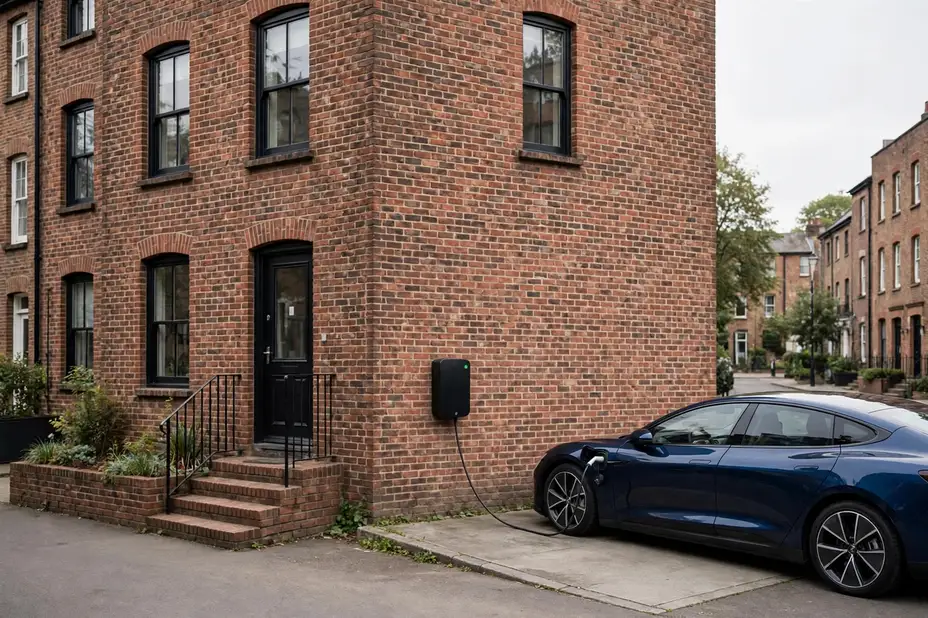
EV charging services in Olympia
Ten services cover the work installers do in Olympia. Three lead the list here because of what this city's housing and law actually look like — each links to its national service page, where scope and process are set out in full.
Home EV Charger Installation in Olympia
Think of it as plumbing for electrons, done once: capacity checked, circuit run, station mounted and configured, inspection passed. The households that report the smoothest projects describe the same shape — a visit that measured, a quote that itemised, and a car that simply charged from the first night.
In Olympia: the core residential job in Olympia: circuit, mounting, configuration and inspection in one visit pattern.
Dedicated Circuit & Electrical Panel Upgrade in Olympia
Some homes meet the charger at the panel door: the service is already spoken for by cooking, heating and hot water. This service is the honest fix — capacity added properly, grounding brought current, and a panel schedule that finally matches the house it feeds.
In Olympia: the capacity fix that lets the charger circuit go in without the rest of the house living at its limit.
Multifamily & Condo EV Charging in Olympia
Shared buildings convert charging from a purchase into a policy, and the installers fluent here speak both languages — amperage and agenda items. The electrical design that wins approval is the one whose metering and load answers arrive attached to the application.
In Olympia: the route from board agenda to working charger in Olympia's communities.
Utility programs and electricity in Olympia
Electricity in Olympia comes from Puget Sound Energy Inc. Parts of the wider metro are served by PUD No 1 of Grays Harbor County, PUD No 1 of Lewis County, Tanner Electric Coop. The utility matters twice over for a charger install: it sets the time-of-use rates that decide what overnight charging costs you, and it is the organisation that may — or may not — currently help pay for the equipment.
No verified residential charger rebate was in place for Puget Sound Energy Inc in the sources checked for this page (the federal Alternative Fuel Refueling Property Credit ended on September 30, 2025, and no Washington state program replaced it for typical home installs). That can change — utilities open and close funded rounds — so an installer quoting you today should be able to name any current program precisely, with its published terms. If they cannot name it, it is not part of your job.
While you are in the tariff pages, look at how the plan values the evening ramp — the hours when cooking, cooling and charging would otherwise stack. A charger that starts after the ramp is the simplest scheduling decision in home charging, and it is set once.
Condos, HOAs and the law in Washington
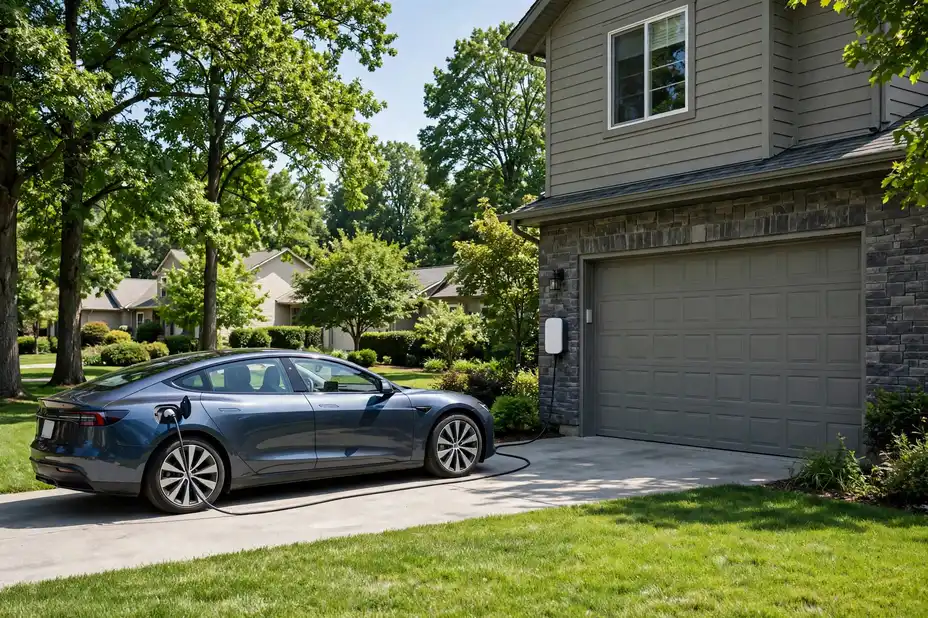
Charging is a protected right for association owners in Washington. The state's right-to-charge statute (RCW 64.90.510 and related association statutes) stops a homeowners association or condominium from banning an owner's charging station outright. Conditions still exist — placement, appearance, insurance and restoration can all be regulated, and the owner pays — yet the starting position is yes-with-rules rather than no-unless-persuaded, and that difference decides most applications before they are written.
Owners in Olympia should also know the statute travels with the space, not the car: a documented installation, permitted and recorded, stays an asset of the unit when it sells — one more reason the paperwork deserves the same care as the wiring.
The step-by-step version lives in our guide to installing an EV charger in a condo or HOA community — the application sequence, the metering designs and the questions boards ask, in order.
Climate, garages and charger placement
Cord flexibility is a rated property, and January is when the rating is read. Cables specified for cold service coil and uncoil at temperatures that make lesser jackets crack; where the station is chosen locally, this line of the specification has already been read for you — one of the quieter values of a local installer.
The plugged-in car is the winter-ready car: battery held at a kinder temperature by the wall, cabin preconditioned without draining the pack, departure on schedule regardless of the night's low. Households in cold metros describe the home charger less as fuelling than as winter equipment outright.

Permits and inspection in Olympia
Expect the permit to name the circuit, the breaker and the equipment. An installer who suggests skipping it is saving an afternoon by spending your liability; the inspection is also your independent check that the continuous-load sizing was done properly.

Neighbourhoods and ZIP codes served
The page covers 11 ZIP codes in and around Olympia — including 98501, 98502, 98504, 98505, 98506, 98507, 98508, 98512, 98513, 98516, 98599 — across Thurston. If your ZIP is not in the first set shown, ask anyway: installer coverage follows the metro, not a postcode fence.
The same working area takes in the neighbouring localities of Lacey, Tumwater, East Olympia, Tenino, Littlerock, Rainier, Bucoda, Rochester, Yelm — the county ring an installer based in Olympia actually drives. Requests from those communities route exactly as city requests do: same services, same permit discipline, same local facts where they differ.
Thurston County accounts for 21 of the ZIP codes and 10 named postal localities in the research file, the nearest of them Lacey, Tumwater, East Olympia, Tenino, Littlerock. The survey counts 299,067 residents in the county, with a median household income of $96,563 and a median home value of $480,300. Measured across its ZIP codes, the Olympia footprint runs about 11 miles north to south and 15 east to west, from ZIP 98501 to 98599 — the ground an installer based here actually covers in a working week.
Beyond the county seats, the working area takes in Lacey, Tumwater, East Olympia, Tenino, Littlerock, Anderson Island, Rainier, Longbranch, Dupont, Bucoda, Rochester, Yelm, Tacoma, Mckenna, Shelton, Steilacoom, Lakebay, Galvin, Centralia, Lakewood, Fox Island, University Place, Grapeview, Mccleary, Oakville, Roy, Union, Malone, Chehalis, Mcchord Afb, Spanaway, Adna, Elma, Puyallup, Onalaska, Graham, La Grande, Satsop, Doty, Cinebar, Montesano, Eatonville, Matlock, Kapowsin, Elbe, Mineral — the named localities for which Olympia is the nearest metro in the network (neighbouring metros' pages cover their own ground), each routing to the same installer-matching service.
The wider working area also reaches Vaughn, Allyn, Belfair, Napavine, Tahuya, Burley, Hoodsport, Olalla, Port Orchard, Ethel, Burton, Milton, Federal Way, Winlock, Salkum, Lilliwaup, Sumner, Pe Ell, Orting, Curtis, Pacific, Auburn, Retsil, Seabeck, Southworth, Bonney Lake, Seattle, Paradise Inn, Camp Murray, Seahurst, Manchester, Vader, South Prairie, Tracyton, Ryderwood — ground shared with neighbouring metros, where installers cross the same county lines in both directions.
ZIP codes in that shared ground include 98001, 98003, 98013, 98023, 98032, 98063, 98148, 98158, 98188, 98198, 98312, 98314, 98322, 98335, 98337, 98352, 98353, 98359, 98366, 98371, 98380, 98384, 98391, 98393, 98394, 98407, 98412, 98415, 98430, 98431, 98471, 98481, 98524, 98528, 98555, 98564, 98582, 98588, 98591, 98593.
The largest communities in that working area after Olympia itself, by the GeoNames populated-place file: Lakewood (population 59,829), Lacey (population 46,409), Parkland (population 35,803), University Place (population 32,842), Spanaway (population 27,227), Graham (population 23,491), Tumwater (population 19,190), Frederickson (population 18,719), Centralia (population 16,753), Aberdeen (population 16,276), Elk Plain (population 14,205), Joint Base Lewis McChord (population 11,046), Shelton (population 9,834), DuPont (population 9,356), Midland (population 8,962), Yelm (population 8,434), Hoquiam (population 8,405), Summit (population 7,985), Chehalis (population 7,391), Summit View (population 7,236). Charging demand follows those populations — the subdivisions and town centres where the next driveways, and the next panels, are.
Pierce County reaches into the working area with 930,319 residents, a median household income of $99,564 and a median home value of $526,600; its localities on this page include Anderson Island, Longbranch, Dupont, Tacoma, Mckenna. Lewis County reaches into the working area with 85,154 residents, a median household income of $74,796 and a median home value of $385,800; its localities on this page include Galvin, Centralia, Chehalis, Adna, Onalaska. Grays Harbor County reaches into the working area with 77,053 residents, a median household income of $64,414 and a median home value of $314,000; its localities on this page include Mccleary, Oakville, Malone, Elma, Satsop. Mason County reaches into the working area with 67,982 residents, a median household income of $83,270 and a median home value of $411,800; its localities on this page include Shelton, Grapeview, Union, Matlock.
| ZIP | Locality | County |
|---|---|---|
| 98501 | Olympia | Thurston |
| 98504 | Olympia | Thurston |
| 98507 | Olympia | Thurston |
| 98508 | Olympia | Thurston |
| 98599 | Olympia | Thurston |
| 98503 | Lacey | Thurston |
| 98506 | Olympia | Thurston |
| 98505 | Olympia | Thurston |
| 98513 | Olympia | Thurston |
| 98516 | Olympia | Thurston |
| 98511 | Tumwater | Thurston |
| 98512 | Olympia | Thurston |
| 98509 | Lacey | Thurston |
| 98540 | East Olympia | Thurston |
| 98589 | Tenino | Thurston |
| 98556 | Littlerock | Thurston |
| 98502 | Olympia | Thurston |
| 98303 | Anderson Island | Pierce |
| 98576 | Rainier | Thurston |
| 98351 | Longbranch | Pierce |
| 98327 | Dupont | Pierce |
| 98530 | Bucoda | Thurston |
| 98579 | Rochester | Thurston |
| 98597 | Yelm | Thurston |
| 98433 | Tacoma | Pierce |
| 98558 | Mckenna | Pierce |
| 98584 | Shelton | Mason |
| 98388 | Steilacoom | Pierce |
| 98349 | Lakebay | Pierce |
| 98544 | Galvin | Lewis |
| 98531 | Centralia | Lewis |
| 98498 | Lakewood | Pierce |
| 98333 | Fox Island | Pierce |
| 98467 | University Place | Pierce |
| 98439 | Lakewood | Pierce |
| 98546 | Grapeview | Mason |
| 98557 | Mccleary | Grays Harbor |
| 98497 | Lakewood | Pierce |
| 98496 | Lakewood | Pierce |
| 98499 | Lakewood | Pierce |
| 98568 | Oakville | Grays Harbor |
| 98466 | Tacoma | Pierce |
| 98580 | Roy | Pierce |
| 98592 | Union | Mason |
| 98444 | Tacoma | Pierce |
| 98559 | Malone | Grays Harbor |
| 98409 | Tacoma | Pierce |
| 98417 | Tacoma | Pierce |
| 98419 | Tacoma | Pierce |
| 98448 | Tacoma | Pierce |
| 98490 | Tacoma | Pierce |
| 98447 | Tacoma | Pierce |
| 98532 | Chehalis | Lewis |
| 98438 | Mcchord Afb | Pierce |
| 98387 | Spanaway | Pierce |
| 98445 | Tacoma | Pierce |
| 98408 | Tacoma | Pierce |
| 98522 | Adna | Lewis |
| 98446 | Tacoma | Pierce |
| 98541 | Elma | Grays Harbor |
| 98375 | Puyallup | Pierce |
| 98373 | Puyallup | Pierce |
| 98570 | Onalaska | Lewis |
| 98338 | Graham | Pierce |
| 98348 | La Grande | Pierce |
| 98583 | Satsop | Grays Harbor |
| 98539 | Doty | Lewis |
| 98533 | Cinebar | Lewis |
| 98563 | Montesano | Grays Harbor |
| 98328 | Eatonville | Pierce |
| 98560 | Matlock | Mason |
| 98344 | Kapowsin | Pierce |
| 98330 | Elbe | Pierce |
| 98355 | Mineral | Lewis |

Planning the install: from panel to parking
Homeowners sometimes ask why a job that looks like 'one outlet' needs a site visit at all. The visit exists because the three variables that set the scope — spare capacity, the run's route, and the property's approval layer — are all invisible from a photograph. In Olympia an experienced installer reads them in minutes, in the panel's directory card, the garage's geometry and the community's documents. The quote that follows a visit is a different species from the quote that precedes one: it can be held to.
Finally, photograph the finished work — station, nameplate, panel directory with the new breaker labelled — and file it with the inspection record. When the car changes, the house sells or a second station joins the first, that folder is the difference between a five-minute answer and an archaeological dig.
Home charging know-how for Olympia households
Charging for guests
A home charger quietly becomes hospitality infrastructure: the visiting family's EV, the friend's road-trip top-up, the neighbour mid-renovation. Households handle it with varying ceremony — a standing offer, a holster left accessible, a note in the guest room. The electrical system does not care; the point is social. The charger joins the spare bed and the good coffee in the category of things a house offers the people it likes.
Older wiring, honestly assessed
Homes from the early electrical eras sometimes carry wiring methods — knob-and-tube runs, early cloth-insulated cable, fused services — that change an installer's reading of a house. None of it automatically disqualifies a charger: the new circuit is new work, run to current code from the panel. What the older fabric changes is the assessment — the panel's condition, the grounding system's state, and occasionally a recommendation that some inherited work be corrected while the electricians are in the house. A candid survey at the site visit is the whole answer; surprises belong to houses whose installers did not look.
Selling a house that charges
A documented charger has become a listing fact: the housing market's filters increasingly include charging, and the buyers behind them read a permitted, inspected installation as maintained infrastructure. The operative word is documented. The permit and inspection record, the panel schedule showing the circuit, and the station's manual together convert the charger from a question a buyer's inspector raises into a feature the listing can name. If a sale is anywhere on the horizon, the paperwork conversation with your installer is worth having at install time, while it is free.
Historic districts and exterior rules
In a designated historic district, the charger's exterior footprint can need a second audience: the preservation commission, whose concern is the streetscape rather than the circuit. The designs that pass keep faith with that concern — equipment inside the garage where possible, conduit routed away from the principal facade, nothing mounted on historic fabric. It adds a step, not a saga, and local installers know their commission's habits the way they know their permit counter's.

Frequently asked questions
What happened to the federal home-charger credit in Olympia, WA?
That credit is finished: 30C ended on September 30, 2025. What about locally? In the utility and state sources checked for this page, nothing verified was running for Olympia homeowners — no Puget Sound Energy Inc rebate, no state scheme. If one opens, it will appear on the utility's site with dates; plan your install without it meanwhile.
What can my HOA in Olympia, WA do about a charger install?
Only within limits the statute sets. Washington law (RCW 64.90.510 and related association statutes) protects an owner's right to install in their own space; associations may regulate placement, appearance and insurance and require restoration on removal, but a blanket refusal is not theirs to give. If a board stalls, a complete written application citing the statute is the standard remedy.
Panel upgrade or not — how do Olympia, WA homeowners find out?
The answer lives in your panel's directory and its arithmetic, not in the car's requirements. With 48% of Olympia's homes predating 1980 (median build 1982), local installers see both situations weekly: the 200-amp panel that takes the circuit directly, and the full 100-amp service that needs capacity work first. The site visit exists to sort your house into one of those two piles, on numbers.
How much faster is Level 2 charging at home in Olympia, WA?
Level 1 — the cord in the boot, on a normal outlet — returns about 3–5 miles of range an hour. Level 2 on its own 240-volt circuit returns roughly 25–40. A Olympia commuter who parks at seven and leaves at seven stops doing battery arithmetic entirely.
What happens next after I send a request?
Send the request and it is matched against installers covering Olympia — your service, ZIP, property type and timing travel with it. An installer then arranges the site visit and quotes in writing. Our role ends at the introduction; your contract, permit and paperwork are with the installer.
My Olympia home has no garage — where does the charger go?
Outdoor mounting is a standard configuration, not a compromise: stations listed for exterior use mount on the house wall by the drive or on a post at the pad. Your installer will check enclosure rating, drainage, cable reach to the port, and clearance from vehicle swing — the four things that decide whether an outdoor install feels designed or improvised.
Nearby cities in Washington
- EV charger installation in Bremerton — about 43 miles from Olympia, metro population 275,000
- EV charger installation in Seattle — about 51 miles from Olympia, metro population 4,000,000
- EV charger installation in Longview — about 60 miles from Olympia, metro population 115,000
- EV charger installation in Mount Vernon — about 105 miles from Olympia, metro population 130,000
- EV charger installation in Bellingham — about 122 miles from Olympia, metro population 240,000
- EV charger installation in Yakima — about 134 miles from Olympia, metro population 255,000
- EV charger installation in Portland, OR — about 104 miles from Olympia, metro population 2,500,000
- EV charger installation in Salem, OR — about 143 miles from Olympia, metro population 450,000
- EV charger installation in Albany, OR — about 164 miles from Olympia, metro population 135,000
Ready to charge at home in Olympia?
Send the essentials — what you need, where, and what kind of property — and a licensed local installer will pick it up from there.