EV Charger Installation in South Bend, IN
Charging where you park, in South Bend: the utility programs, state law, permit process and housing facts behind a home charger install, gathered in one place.
There is a reason most charging happens at home: it is the most convenient fuelling an EV owner will ever use, and it happens while the car sits idle anyway. In South Bend, getting set up means answering a handful of local questions first. South Bend itself is home to about 102,944 people, inside a state that registered 47,200 battery-electric vehicles and 19,400 plug-in hybrids through 2025. Which utility serves your address, whether it currently funds part of a charger install, what your panel can carry, and what your HOA or condo board can and cannot say no to — this page covers each of them for South Bend specifically.
A note on what PlugReady USA is and is not: we publish the local research and run the matching; the installation itself belongs to licensed electricians and installer companies working in South Bend. Everything below is written so you can hold your own in that conversation — numbers first, sales language nowhere.
The demand picture for the South Bend–Mishawaka metro, from the registration data this site is built on: Notre Dame market. Registration counts are the honest way to size a charging market — they count households, not headlines — and they are why South Bend sits where it does in our build order (rank 133 of 300 metros, Tier C).
The same survey puts median household income in South Bend at $53,006, with 62% of occupied homes owner-occupied and 71% of the housing stock single-unit detached. For charging, those are the operative facts: owners can approve their own electrical work, and detached homes put the car, the panel and the parking under one roof.

Every city charges differently, and South Bend's difference is legible in the data: an older housing fabric, where panel archaeology is a normal part of the first visit; overwhelmingly a detached-house city, so most installs are the simple garage pattern; buildings of five or more units are a visible minority of the stock; owners hold a working majority, with renters a significant minority. Read the sections below through that profile and the local advice resolves into specifics — which questions are routine here, and which are rare.
In absolute terms, the survey counts 49,377 housing units in South Bend — 41,967 occupied, 25,835 of them by their owners. The stock resolves into 35,133 single-unit detached houses, 38,066 homes standing since before 1980, and 8,978 units in larger buildings. Those six counts are the city's charging map drawn without percentages, and every section of this page is a consequence of one of them. The page's geography is equally concrete: 16 ZIP codes across St. Joseph, centred near 41.67 degrees north latitude. The city anchors the South Bend–Mishawaka metropolitan area, home to roughly 325,000 people on the research file's metro estimate — the wider labour and housing market this page's installers work across.
The same survey release fills in the household economics around the housing stock: a median home value of $159,400, median gross rent of $1,113, per-capita income of $29,948, and a median resident age of 37. And the daily rhythms behind the housing numbers: 73% of South Bend workers drive to work alone — the commute pattern home charging is built around; 10% work from home, a population whose cars charge on daytime and overnight schedules alike; 1% commute by public transit; 26% of adults hold a bachelor's degree or higher. Vehicle ownership, from the same release: 19,520 households in South Bend run two or more vehicles, and 3,758 run none — the two ends of the market this page serves and does not serve.
Two burden statistics frame the economics: in South Bend, 48% of renters and 0% of mortgage-holding owners are housing-cost burdened at the standard 30% threshold. And 56% of households are family households, the segment most likely to run the two-vehicle, two-schedule pattern the second-vehicle planning notes address.
This is the context an installer works against, whether it is written down or not. Where so much of the stock predates modern code cycles, the site visit doubles as a survey — grounding electrode, service entrance, panel provenance — before it is ever a quote. The detached-house majority keeps the geometry simple: lot, driveway, garage, panel — four elements under one ownership, arranged by the household rather than negotiated with a building.
Tenure splits the readership cleanly down the middle: owners reading for circuits, renters reading for proposals, both arriving at the same page with different first questions. Modest incomes make the overnight tariff the headline act: the difference between peak and off-peak charging, compounded nightly for years, is the largest single number in the ownership equation. A large utility's scale cuts both ways — programme budgets that dwarf a small co-op's, and call-centre distance between a household and anyone who can decide anything. The published page rules; keep it bookmarked.
In a growing market the installer you want is bookable but not yet booked out; the diaries fill as the fleet does, and the household that plans a season ahead keeps its choice of firms. The permit counter in a smaller city is a conversation, not a queue: applications are read by people who may know the street, and complete paperwork is remembered kindly. The association dimension here runs on persuasion rather than statute — no state charging law frames the application, so the complete, professional proposal carries the whole argument, as the law section above explains.
The electrical reality in South Bend homes
The survey's housing portrait for South Bend opens with its median: a home built in 1954, in a stock where 77% of units predate 1980 and 71% stand detached on their own lots. 62% of occupied homes are owner-occupied. An installer reads those lines as a weather forecast: mostly settled conditions, with older wiring fronts moving through the pre-1980 districts. A housing stock this age leans on smaller electrical services — 100-amp panels are common, and fuse-era equipment still turns up in the oldest streets. For many of those homes the honest answer is a panel upgrade or a load-management device before the charger circuit goes in, and a good installer will show you the load calculation rather than asking you to take it on faith. Detached houses matter for a practical reason: a garage or driveway on your own lot means the charger, the car and the circuit are all under one roof and one owner's control, which is the simplest configuration there is.
The fuel table adds one more local fact: 6,829 South Bend homes — 16% of the stock — heat with electricity. Those households already think in kilowatts through the winter, their panels carry the load to prove it, and a charger's overnight appetite joins a system that is, in the useful sense, already electrified.
One further split matters for how this page is organised: about 16,132 of South Bend's occupied homes are renter-occupied. Everything above assumes you can approve your own electrical work; where you cannot, the approval layer — landlord or association — becomes part of the job, which is why the law section carries unusual weight here.
And 18% of South Bend's homes are in buildings with five or more units — apartments and condominiums where charging is a building decision before it is an electrical one. If that is your situation, the law and multifamily sections of this page are the ones written for you.
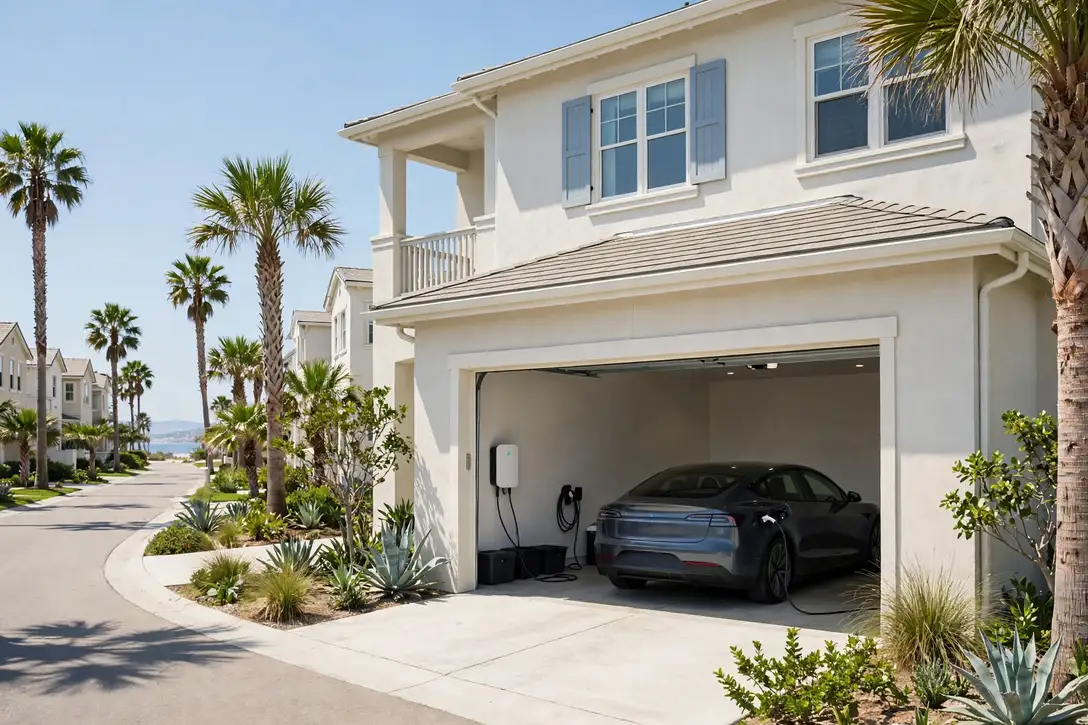
EV charging services in South Bend
An installer's work in South Bend usually starts with one of the three lead services below. The cards describe the job as it is actually scoped; the grid underneath carries the rest of the menu.
Home EV Charger Installation in South Bend
The standard first install: a dedicated circuit from the panel to the parking space, a station mounted and configured to that circuit, and a passed inspection to close it out. What changes from house to house is never the recipe — it is the panel's spare capacity, the length of the run, and how the car actually parks.
In South Bend: the core residential job in South Bend: circuit, mounting, configuration and inspection in one visit pattern.
Dedicated Circuit & Electrical Panel Upgrade in South Bend
Where the load calculation fails the existing service, the upgrade is not an upsell — it is the finding. Done under permit with the utility's meter work coordinated, it converts the charger project into the house's electrical reset, and every later project inherits the headroom.
In South Bend: service work that turns 'no room' into a circuit with headroom in South Bend homes.
Level 2 Charger Installation in South Bend
What is being bought is recovery rate. A Level 2 circuit returns in one overnight session what a household receptacle returns in a day and a half, and that margin is the difference between planning around the car and forgetting about it.
In South Bend: the upgrade from a wall outlet to a dedicated 240-volt circuit, and the end of range arithmetic at bedtime.
Utility programs and electricity in South Bend
Electricity in South Bend comes from Northern Indiana Pub Serv Co. Parts of the wider metro are served by Indiana Michigan Power Co, City of Mishawaka, Kankakee Valley Rural E M C. The utility matters twice over for a charger install: it sets the time-of-use rates that decide what overnight charging costs you, and it is the organisation that may — or may not — currently help pay for the equipment.
There is a strategic consequence to the empty incentive shelf in South Bend: the install decision reduces to the work itself and the tariff it runs on. With no rebate distorting the comparison, quotes compete on scope, licensing and the load calculation's honesty — which is the competition homeowners should want. And the overnight rate window, where Northern Indiana Pub Serv Co offers one, quietly returns more over the car's life than most one-off rebates ever did.
While you are reading your tariff, check how your plan treats the evening peak. A charger scheduled to start after the peak window is the single easiest saving in home charging, and it is set once, in the car or the station, then forgotten.
Condos, HOAs and the law in Indiana
Indiana has no statewide right-to-charge law. That needs saying plainly, because roundups on the internet sometimes claim otherwise: in the authoritative statute indexes checked for this page, no Indiana law prevents a homeowners association or condominium from refusing a charger in a common or assigned space. Your community's own covenants and board govern the question in South Bend.
There is also a longer game available to South Bend owners: associations revise their documents, boards turn over, and state legislatures have been adding right-to-charge laws year after year. A written application — and, if it comes to it, a written refusal — is the record that each of those futures works from.
Our condo and HOA guide was written for both kinds of state; the chapters on application packages, metering and cost allocation are the ones that matter in South Bend, where no statute does the persuading for you.
Climate, garages and charger placement
Seasonal scheduling is the quiet optimisation here: summer peaks and winter range loss both argue for charging deep in the overnight window, when rates and temperatures are kindest. Set the schedule once, in the car or the station, and the seasons stop appearing in the household's charging routine at all.
Four-season metros ask the install to be two things: kind to a battery in January and indifferent to a thunderstorm in July. The equipment is rated for both out of the box; the local craft is in the details — cable jacket chosen for cold flexibility, mounting placed with drainage in mind, a schedule that follows the seasons' rate windows.

Permits and inspection in South Bend
Bring the panel schedule up to date while the electrician is in it — the new circuit labelled, in the directory, in pen. Inspectors notice; future electricians bless you for it; and the load calculation for any second circuit starts from that card.

Neighbourhoods and ZIP codes served
The page covers 16 ZIP codes in and around South Bend — including 46601, 46613, 46614, 46615, 46616, 46617, 46619, 46624, 46626, 46628, 46634, 46635, 46637, 46660, 46680, 46699 — across St. Joseph. If your ZIP is not in the first set shown, ask anyway: installer coverage follows the metro, not a postcode fence.
The same working area takes in the neighbouring localities of Notre Dame, Mishawaka, Granger, Osceola, Lakeville, Wyatt, North Liberty, New Carlisle, Walkerton — the county ring an installer based in South Bend actually drives. Requests from those communities route exactly as city requests do: same services, same permit discipline, same local facts where they differ.
St. Joseph County accounts for 27 of the ZIP codes and 10 named postal localities in the research file, the nearest of them Notre Dame, Mishawaka, Granger, Osceola, Lakeville. The survey counts 273,040 residents in the county, with a median household income of $66,868 and a median home value of $192,800. Measured across its ZIP codes, the South Bend footprint runs about 9 miles north to south and 6 east to west, from ZIP 46601 to 46699 — the ground an installer based here actually covers in a working week.
Beyond the county seats, the working area takes in Notre Dame, Mishawaka, Granger, Osceola, Lakeville, Niles, Wyatt, North Liberty, Buchanan, New Carlisle, Edwardsburg, Lapaz, Elkhart, Wakarusa, Bremen, Mill Creek, Galien, Rolling Prairie, Walkerton, Berrien Center, Berrien Springs, Tyner, Nappanee, Cassopolis, New Troy, Plymouth, Three Oaks, Goshen, Baroda, Dowagiac, Union, Sawyer, Eau Claire, Bristol, Donaldson, Bridgman, Harbert, La Porte, Vandalia, Lakeside, Bourbon, New Paris, Union Pier, Kingsbury, Grovertown, Hamlet, Sodus, Kingsford Heights, Stevensville, New Buffalo, Jones, Milford, Etna Green, Saint Joseph, Middlebury, Argos, Benton Harbor, Millersburg, Decatur, Tippecanoe, Culver, Atwood, White Pigeon, Knox, Leesburg, Michigan City, Hanna, Warsaw, Syracuse, Constantine, Marcellus, Union Mills, Riverside, Watervliet, Shipshewana, Coloma, Westville, Hartford, Mentone, Delong, North Webster, Ora, Lawrence, Hagar Shores, Leiters Ford, Burket, Three Rivers, Winona Lake, Monterey, Wanatah, Topeka, Lawton, Rochester, La Crosse, Covert, North Judson, Howe, Athens, Paw Paw, Claypool — the named localities for which South Bend is the nearest metro in the network (neighbouring metros' pages cover their own ground), each routing to the same installer-matching service.
The wider working area also reaches Ligonier, Beverly Shores, Cromwell, Kimmell, Pierceton, Chesterton — ground shared with neighbouring metros, where installers cross the same county lines in both directions.
The largest communities in that working area after South Bend itself, by the GeoNames populated-place file: Elkhart (population 52,348), Mishawaka (population 48,261), Portage (population 48,177), Goshen (population 32,983), Michigan City (population 31,459), Granger (population 30,465), La Porte (population 21,916), Warsaw (population 14,472). Charging demand follows those populations — the subdivisions and town centres where the next driveways, and the next panels, are.
Elkhart County reaches into the working area with 207,132 residents, a median household income of $68,561 and a median home value of $210,400; its localities on this page include Elkhart, Wakarusa. Marshall County reaches into the working area with 46,284 residents, a median household income of $71,808 and a median home value of $204,900; its localities on this page include Lapaz, Bremen, Tyner, Plymouth, Donaldson. Cass County reaches into the working area with 37,680 residents, a median household income of $56,403 and a median home value of $133,800; its localities on this page include Edwardsburg, Cassopolis, Dowagiac, Union, Vandalia.
| ZIP | Locality | County |
|---|---|---|
| 46601 | South Bend | St. Joseph |
| 46626 | South Bend | St. Joseph |
| 46613 | South Bend | St. Joseph |
| 46617 | South Bend | St. Joseph |
| 46616 | South Bend | St. Joseph |
| 46556 | Notre Dame | St. Joseph |
| 46615 | South Bend | St. Joseph |
| 46628 | South Bend | St. Joseph |
| 46614 | South Bend | St. Joseph |
| 46619 | South Bend | St. Joseph |
| 46635 | South Bend | St. Joseph |
| 46637 | South Bend | St. Joseph |
| 46624 | South Bend | St. Joseph |
| 46545 | Mishawaka | St. Joseph |
| 46544 | Mishawaka | St. Joseph |
| 46546 | Mishawaka | St. Joseph |
| 46634 | South Bend | St. Joseph |
| 46660 | South Bend | St. Joseph |
| 46680 | South Bend | St. Joseph |
| 46699 | South Bend | St. Joseph |
| 46530 | Granger | St. Joseph |
| 46561 | Osceola | St. Joseph |
| 46536 | Lakeville | St. Joseph |
| 49120 | Niles | Berrien |
| 46595 | Wyatt | St. Joseph |
| 46554 | North Liberty | St. Joseph |
| 49107 | Buchanan | Berrien |
| 46552 | New Carlisle | St. Joseph |
| 49112 | Edwardsburg | Cass |
| 46537 | Lapaz | Marshall |
| 46515 | Elkhart | Elkhart |
| 46517 | Elkhart | Elkhart |
| 46514 | Elkhart | Elkhart |
| 46573 | Wakarusa | Elkhart |
| 46506 | Bremen | Marshall |
| 46516 | Elkhart | Elkhart |
| 46365 | Mill Creek | LaPorte |
| 49113 | Galien | Berrien |
| 46371 | Rolling Prairie | LaPorte |
| 46574 | Walkerton | St. Joseph |
| 49102 | Berrien Center | Berrien |
| 49104 | Berrien Springs | Berrien |
| 49103 | Berrien Springs | Berrien |
| 46572 | Tyner | Marshall |
| 46550 | Nappanee | Elkhart |
| 49031 | Cassopolis | Cass |
| 49119 | New Troy | Berrien |
| 46563 | Plymouth | Marshall |
| 49128 | Three Oaks | Berrien |
| 46527 | Goshen | Elkhart |
| 46526 | Goshen | Elkhart |
| 46528 | Goshen | Elkhart |
| 49101 | Baroda | Berrien |
| 49047 | Dowagiac | Cass |
| 49130 | Union | Cass |
| 49125 | Sawyer | Berrien |
| 49111 | Eau Claire | Berrien |
| 46507 | Bristol | Elkhart |
| 46513 | Donaldson | Marshall |
| 49106 | Bridgman | Berrien |
| 49115 | Harbert | Berrien |
| 46350 | La Porte | LaPorte |
| 49095 | Vandalia | Cass |
| 49116 | Lakeside | Berrien |
| 46504 | Bourbon | Marshall |
| 46553 | New Paris | Elkhart |
| 49129 | Union Pier | Berrien |
| 46345 | Kingsbury | LaPorte |
| 46531 | Grovertown | Starke |
| 46532 | Hamlet | Starke |
| 49126 | Sodus | Berrien |
| 46346 | Kingsford Heights | LaPorte |
| 46352 | La Porte | LaPorte |
| 49127 | Stevensville | Berrien |
| 49117 | New Buffalo | Berrien |
| 49061 | Jones | Cass |
| 46542 | Milford | Kosciusko |
| 46524 | Etna Green | Kosciusko |
| 49085 | Saint Joseph | Berrien |
| 46540 | Middlebury | Elkhart |
| 46501 | Argos | Marshall |
| 49022 | Benton Harbor | Berrien |
| 46543 | Millersburg | Elkhart |
| 49045 | Decatur | Van Buren |
| 46570 | Tippecanoe | Marshall |
| 49023 | Benton Harbor | Berrien |
| 46511 | Culver | Marshall |
| 46502 | Atwood | Kosciusko |
| 49099 | White Pigeon | St. Joseph |
| 46534 | Knox | Starke |

Planning the install: from panel to parking
Think of the project as a chain with four links: capacity, route, placement, paperwork. Capacity is the load calculation. Route is the path copper takes from panel to parking — through a shared wall if you are lucky, across a ceiling or a trench if you are not. Placement is the unglamorous decision that governs daily life with the car for a decade: reach, cable slack, and which side the port is on. Paperwork is the permit and the passed inspection, the proof that outlives the installer's visit.
One more piece of sequencing advice South Bend installers give consistently: if the panel is being opened anyway, settle the other electrical maybes in the same visit — the circuit you will want next year costs least while the permit and the electrician are already in the house.
Home charging know-how for South Bend households
Orientation: the garage's compass
A garage's orientation decides its microclimate: south- and west-facing doors take the day's heat load, north-facing ones hold the cold. The charger inherits the microclimate — electronics ageing in the hot wall's summer, cables stiffening in the cold one's January. Orientation is nobody's choice by install time, but it informs placement inside the room: the interior wall over the door wall, the shaded corner over the sun line, decided by someone who has read the room's compass.
Charging on a shift worker's clock
Night-shift households run the tariff backwards: the car works while others charge and charges through the day while others work. Their design questions differ — daytime sessions against the household's sleeping hours, schedules that flip with the rota, and the second car's opposite rhythm. None of it is complicated, but all of it must be said at the site visit, because the default schedule baked into every station assumes a nine-to-five that this household does not live.
Charging for guests
A home charger quietly becomes hospitality infrastructure: the visiting family's EV, the friend's road-trip top-up, the neighbour mid-renovation. Households handle it with varying ceremony — a standing offer, a holster left accessible, a note in the guest room. The electrical system does not care; the point is social. The charger joins the spare bed and the good coffee in the category of things a house offers the people it likes.
Timing the install with other work
The least disruptive charger circuit is the one installed while other electrical work is already open. A renovation, a panel project, a garage build — each already carries the mobilisation, the permit process and the opened walls that a standalone charger job must pay for alone. The sequencing conversation costs nothing: tell the installer what else the house has planned in the next two years, and let the scope absorb the charger while the house is already a building site. The same logic in reverse — roughing in during this project for a charger planned later — is the EV-ready idea, and it belongs in the same sentence.

Frequently asked questions
What happened to the federal home-charger credit in South Bend, IN?
The three possible pots are all, at present, empty for a South Bend homeowner: no Northern Indiana Pub Serv Co residential rebate in current published sources, no Indiana home programme, and a federal credit that closed on September 30, 2025. Programmes do relaunch — on the utility's site, with dates — and until one does, the honest quote is the one with no rebate line at all.
Can my HOA or condo board in South Bend, IN refuse my charger?
They hold the stronger hand in Indiana: with no right-to-charge statute on the books, a South Bend association's covenants are the law of the car park. The applications that succeed anyway share a shape — owner-funded, licensed installer, metered energy, insured, reversible — because they answer the board's risk questions in advance and in writing.
Does a Level 2 charger mean a panel upgrade for a South Bend, IN home?
It depends on the panel, and South Bend's housing makes the question common: the median home here was built in 1954, and about 77% of housing units predate 1980. Homes with 100-amp service that is already well used often need an upgrade or a load-management device; homes with 200-amp service and spare breaker space usually do not. A load calculation during the site visit settles it — ask to see it.
Level 1 or Level 2 in South Bend, IN — what is the real difference?
In parked hours: a Level 1 cord returns about 3–5 miles for each of them, and a Level 2 circuit returns roughly 25–40, set by its amperage and the car's acceptance. For a South Bend household parking ten hours, that is the difference between recovering a short errand day and recovering any day the car can legally drive.
What happens next after I send a request?
Your request is matched to licensed installers covering South Bend, Indiana — service, ZIP, property type and timing travel with it. The installer who takes it arranges the site visit and quotes in writing; PlugReady USA's part is the research on this page and the introduction, and your contract is with the installer throughout.
Can a charger be added to a detached garage in South Bend?
Yes — the charger itself is the same; the route to it is the project. From the house panel, a buried conduit run reaches the garage, or a subpanel goes in out there where distance and future loads argue for it. In South Bend, with about 71% of homes detached, local installers quote this shape routinely — the trench and the run, settled from a site walk, are the substance of it.
Nearby cities in Indiana
- EV charger installation in Fort Wayne — about 77 miles from South Bend, metro population 425,000
- EV charger installation in Lafayette — about 93 miles from South Bend, metro population 225,000
- EV charger installation in Indianapolis — about 131 miles from South Bend, metro population 2,100,000
- EV charger installation in Terre Haute — about 165 miles from South Bend, metro population 170,000
- EV charger installation in Evansville — about 264 miles from South Bend, metro population 360,000
- EV charger installation in Chicago, IL — about 77 miles from South Bend, metro population 9,450,000
- EV charger installation in Grand Rapids, MI — about 97 miles from South Bend, metro population 1,100,000
- EV charger installation in Lansing, MI — about 119 miles from South Bend, metro population 550,000
Ready to charge at home in South Bend?
Tell us the job — service, ZIP and property type — and licensed local installers will take it from there.