EV Charger Installation in Terre Haute, IN
Charging where you park, in Terre Haute: the utility programs, state law, permit process and housing facts behind a home charger install, gathered in one place.
The overnight plug is the least glamorous and most consequential part of owning an electric car, and Terre Haute households have been adopting it at pace: 47,200 battery-electric vehicles and 19,400 plug-in hybrids were registered across Indiana by the end of 2025. Terre Haute itself is home to about 58,427 people. What follows is the local field guide — utility programs as they actually stand, the association law as it actually reads, the permit as it is actually filed, and the housing numbers that predict your install before anyone opens the panel.
How this page is organised matters less than what is in it: verified local facts, stated with their sources, so you can check them yourself. PlugReady USA matches homeowners in Terre Haute with licensed local installers; the detail below is the homework we would want done before anyone quotes the job.
The registration ledger for the Terre Haute metro reads: IN coverage. Ledgers like this are what installer rounds are built from — they show where the cars already are, which is where the circuits get requested, permitted and inspected week after week.
Three survey lines do most of the predictive work on this page. Income — a median of $43,126 per household — tracks the pace at which Terre Haute households adopt EVs at all. Tenure — 52% owner-occupied — decides whose signature the work needs. And structure — 67% single-unit detached — decides how often the answer is a simple garage circuit rather than a building negotiation.

Put the survey together and Terre Haute's charging profile reads like this: an older housing fabric, where panel archaeology is a normal part of the first visit; a detached-house majority with a real attached and multifamily minority; buildings of five or more units are a visible minority of the stock; and owners hold a working majority, with renters a significant minority. That combination — more than any single number — is what the installers working here plan around, and it is the lens for everything on this page.
Keep six figures and you keep Terre Haute's whole electrical character: 26,372 housing units; 23,220 occupied homes; 12,120 owner-occupied; 17,542 detached houses; 18,609 pre-1980 homes; 4,668 homes in buildings of five or more units. Percentages elsewhere on this page are these numbers in disguise — the counts are the originals, and they are the numbers a local installer's experience is actually made of. The page's geography is equally concrete: 8 ZIP codes across Vigo, centred near 39.47 degrees north latitude. The city anchors the Terre Haute metropolitan area, home to roughly 170,000 people on the research file's metro estimate — the wider labour and housing market this page's installers work across.
The same survey release fills in the household economics around the housing stock: a median home value of $115,700, median gross rent of $922, per-capita income of $25,369, and a median resident age of 33. The movement data matters as much as the money data: 74% of Terre Haute workers drive to work alone — the commute pattern home charging is built around; 6% work from home, a population whose cars charge on daytime and overnight schedules alike; 1% commute by public transit; 25% of adults hold a bachelor's degree or higher. And the fleet in the driveways: 10,040 households in Terre Haute have exactly one vehicle, 10,698 have two or more, and 2,482 have none.
Household structure, from the same release: 50% of Terre Haute households are family households. The burden shares behind the housing stock: 57% of renting households are cost-burdened at the 30%-of-income line, as are 0% of mortgaged owners — context for why the overnight rate window, once set, is treated here as a household fixture rather than a hobby.
What follows is the city read as an electrical place rather than a dot on a map. A stock this old wires its history into the walls: cloth-wrapped conductors in the deepest streets, fuse boxes that outlived their century, panels added in layers by generations of electricians each solving their own decade's problem. The housing variety shows up in the permit data as variety: single-family circuits in volume, building projects in ones and twos, each teaching the local workforce a different half of the trade.
High renter share also means charging follows the lease cycle: applications cluster at move-in, installations at renewal leverage, and the whole market breathes on the rental calendar. Budget discipline shapes the specification — the circuit sized exactly, the management device considered wherever it defers a service upgrade, every scope line asked to justify itself. Investor-owned utility territory runs on published tariffs and regulator-approved programmes: everything material about charging economics here exists in a filed document with an effective date, findable by anyone who reads filings.
In the growth chapter, every institution is drafting: associations their rules, landlords their standard clauses, utilities their programme business cases — and complete applications help write all three drafts well. The permit counter in a smaller city is a conversation, not a queue: applications are read by people who may know the street, and complete paperwork is remembered kindly. Without a state charging statute, shared-property approvals in this metro are won on paper quality: metering clarity, licensed installers, insurance, reversibility — the complete package the guides set out.
The electrical reality in Terre Haute homes
Tenure first, because tenure allocates the decisions: 52% of Terre Haute's occupied homes are owner-occupied, free to commission electrical work outright. The stock they occupy has a median build year of 1957; 71% predates 1980; 67% is detached single-unit. For the owner-occupied majority, the charger question is purely electrical, and these are the electrical facts. Age shows up electrically before it shows up anywhere else: services sized for a house with a third of today's appliances. Expect the first conversation to be about capacity — what the panel is, what it already feeds, and which of the three routes (circuit, management, upgrade) your numbers support. Owner-occupiers can plan on their own timeline; renters and condo owners have an extra approval layer, which the law section below covers for this state.
One further survey line belongs in any Terre Haute install conversation: 43% of the city's homes heat with electricity — 10,012 households whose panels already carry a major winter load before a charger is contemplated. Electric heat and EV charging are the two largest discretionary loads a house can host, and where they coincide, the load calculation stops being a formality.
Renters are the other constituency in these numbers: about 11,100 of Terre Haute's occupied homes are rented rather than owned. Their charging route runs through a landlord conversation instead of a panel they control — a different project, covered by the rentals guide and the law section below, but a routine one in a city with this many renting households.
The city's stock is not all houses: 18% of units are in structures of five or more. Shared buildings mean shared panels, assigned parking and association process — the substance of the multifamily sections below.
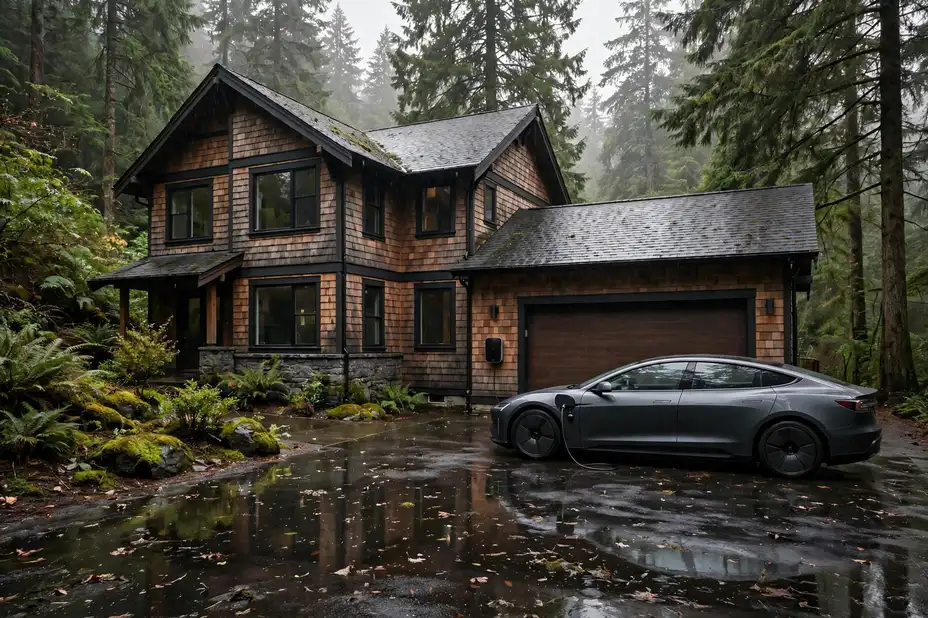
EV charging services in Terre Haute
The services below are ordered by what Terre Haute households most often need first, judged from the housing and fleet facts on this page. The full menu follows in the grid — every service is offered in this metro.
Home EV Charger Installation in Terre Haute
Think of it as plumbing for electrons, done once: capacity checked, circuit run, station mounted and configured, inspection passed. The households that report the smoothest projects describe the same shape — a visit that measured, a quote that itemised, and a car that simply charged from the first night.
In Terre Haute: the default first install for Terre Haute's EV households — a station where the car already parks.
Dedicated Circuit & Electrical Panel Upgrade in Terre Haute
A service change is the least reversible and most enabling job on this page: it re-bases the whole house's electrical life. Done inside the charger project, it shares the permit, the utility visit and the electrician's day with the circuit it makes room for.
In Terre Haute: service work that turns 'no room' into a circuit with headroom in Terre Haute homes.
Level 2 Charger Installation in Terre Haute
What is being bought is recovery rate. A Level 2 circuit returns in one overnight session what a household receptacle returns in a day and a half, and that margin is the difference between planning around the car and forgetting about it.
In Terre Haute: the circuit class behind nearly every home install in Terre Haute, from first car to second.
Utility programs and electricity in Terre Haute
Electricity in Terre Haute comes from Duke Energy Indiana, LLC. Parts of the wider metro are served by Utilities Dist-Western IN REMC, Western Indiana Energy REMC, Parke County Rural E M C. The utility matters twice over for a charger install: it sets the time-of-use rates that decide what overnight charging costs you, and it is the organisation that may — or may not — currently help pay for the equipment.
There is a strategic consequence to the empty incentive shelf in Terre Haute: the install decision reduces to the work itself and the tariff it runs on. With no rebate distorting the comparison, quotes compete on scope, licensing and the load calculation's honesty — which is the competition homeowners should want. And the overnight rate window, where Duke Energy Indiana, LLC offers one, quietly returns more over the car's life than most one-off rebates ever did.
Renters and condo owners should note the metering question early: whose meter the charger hangs off decides who pays for the energy, and Duke Energy Indiana, LLC's options for submetering are part of the multifamily conversation below.
Condos, HOAs and the law in Indiana
Indiana has no statewide right-to-charge law. That needs saying plainly, because roundups on the internet sometimes claim otherwise: in the authoritative statute indexes checked for this page, no Indiana law prevents a homeowners association or condominium from refusing a charger in a common or assigned space. Your community's own covenants and board govern the question in Terre Haute.
Timing helps too. Boards plan capital work annually; an application that arrives with the community's budget cycle, offering to coordinate with any planned electrical or repaving work, reads as a contribution rather than a demand.
The general process, minus the statute, is still covered in our guide to installing an EV charger in a condo or HOA community — most of its application-package advice applies in Terre Haute exactly as written.
Climate, garages and charger placement
Garages in this region do double duty across the year — summer's workshop, winter's storage — and the charger competes for wall space with all of it. Mounting height, cable reach and a holster placed for the car's real parking position decide whether the station is used daily or negotiated with. The installer who measures the car in place is designing for the household you actually are.
Seasonal scheduling is the quiet optimisation here: summer peaks and winter range loss both argue for charging deep in the overnight window, when rates and temperatures are kindest. Set the schedule once, in the car or the station, and the seasons stop appearing in the household's charging routine at all.

Permits and inspection in Terre Haute
The normal sequence is the same across the metro: the installer files the electrical permit, installs to the current National Electrical Code (a charger is a continuous load, so the circuit is sized at 125% of the draw), and the city inspects before the job is signed off. Keep the passed inspection record — insurers, future buyers and warranty claims all ask for it.

Neighbourhoods and ZIP codes served
The page covers 8 ZIP codes in and around Terre Haute — including 47801, 47802, 47803, 47804, 47805, 47807, 47808, 47809 — across Vigo. If your ZIP is not in the first set shown, ask anyway: installer coverage follows the metro, not a postcode fence.
The same working area takes in the neighbouring localities of West Terre Haute, Saint Mary Of The Woods, Prairieton, Riley, New Goshen, Seelyville, Shepardsville, Fontanet, Pimento, Prairie Creek, Lewis — the county ring an installer based in Terre Haute actually drives. Requests from those communities route exactly as city requests do: same services, same permit discipline, same local facts where they differ.
Vigo County accounts for 19 of the ZIP codes and 12 named postal localities in the research file, the nearest of them West Terre Haute, Saint Mary Of The Woods, Prairieton, Riley, New Goshen. The survey counts 106,109 residents in the county, with a median household income of $52,976 and a median home value of $148,500. Measured across its ZIP codes, the Terre Haute footprint runs about 9 miles north to south and 5 east to west, from ZIP 47801 to 47809 — the ground an installer based here actually covers in a working week.
Beyond the county seats, the working area takes in West Terre Haute, Saint Mary Of The Woods, Prairieton, Riley, New Goshen, Seelyville, Shepardsville, Dennison, Universal, Fontanet, Rosedale, Vermilion, Staunton, Pimento, Clinton, Prairie Creek, Farmersburg, Cory, Blanford, Marshall, Lewis, Brazil, Bridgeton, Mecca, Centerpoint, Knightsville, Paris, Carbon, Harmony, Shelburn, West Union, Fairbanks, Hymera, Hillsdale, Coalmont, Clay City, Montezuma, Bowling Green, Jasonville, Rockville, Bellmore, Poland, West York, Sullivan, Dana, Coal City, Reelsville, Chrisman, Graysville, Midland, Bloomingdale, Martinsville, Patricksburg, Redmon, Saint Bernice, Hutsonville, Dugger, Newport, Kansas, Merom, Paxton, Putnamville, Metcalf, Linton, Cayuga, Westfield, Annapolis, Brocton, Greencastle, Worthington, Ridge Farm, Casey, Palestine, Carlisle, Cloverdale, Ashmore, Russellville, Freedom, Switz City, Robinson, Spencer, Lyons, Koleen, Yale, Stoy, Flat Rock, Greenup, Oblong, Sandborn, Oaktown, Freelandville, Charleston, Bloomfield, Westphalia, Newberry, Stinesville, Solsberry, Elnora — the named localities for which Terre Haute is the nearest metro in the network (neighbouring metros' pages cover their own ground), each routing to the same installer-matching service.
The wider working area also reaches Hume, Oakland, Indianola, Waveland, Georgetown, Sidell, Wallace, Fillmore, Bainbridge, Kingman, Newman, Alamo, Quincy, Westville, Perrysville, Allerton, Gosport, Roachdale, Eminence, New Market, Murdock, Hindsboro, Coatesville, Broadlands, Catlin, Hillsboro — ground shared with neighbouring metros, where installers cross the same county lines in both directions.
ZIP codes in that shared ground include 46105, 46121, 46125, 46128, 46172, 47433, 47456, 47916, 47949, 47952, 47965, 47974, 47988, 47989, 61810, 61816, 61817, 61846, 61850, 61876, 61883, 61930, 61932, 61941, 61942, 61943.
The largest communities in that working area after Terre Haute itself, by the GeoNames populated-place file: Charleston (population 21,196), Effingham (population 12,604), Greencastle (population 10,401), Paris (population 8,432), Brazil (population 8,109), Robinson (population 7,631), Ellettsville (population 6,544), Linton (population 5,284). Charging demand follows those populations — the subdivisions and town centres where the next driveways, and the next panels, are.
Clay County reaches into the working area with 26,409 residents, a median household income of $70,010 and a median home value of $153,000; its localities on this page include Staunton, Cory, Brazil, Centerpoint, Knightsville. Sullivan County reaches into the working area with 20,780 residents, a median household income of $56,204 and a median home value of $131,100; its localities on this page include Farmersburg, Shelburn, Fairbanks, Hymera, Sullivan. Vermillion County reaches into the working area with 15,421 residents, a median household income of $60,200 and a median home value of $113,100; its localities on this page include Universal, Clinton, Blanford, Hillsdale, Dana.
| ZIP | Locality | County |
|---|---|---|
| 47801 | Terre Haute | Vigo |
| 47809 | Terre Haute | Vigo |
| 47807 | Terre Haute | Vigo |
| 47804 | Terre Haute | Vigo |
| 47808 | Terre Haute | Vigo |
| 47803 | Terre Haute | Vigo |
| 47885 | West Terre Haute | Vigo |
| 47802 | Terre Haute | Vigo |
| 47876 | Saint Mary Of The Woods | Vigo |
| 47805 | Terre Haute | Vigo |
| 47870 | Prairieton | Vigo |
| 47871 | Riley | Vigo |
| 47863 | New Goshen | Vigo |
| 47878 | Seelyville | Vigo |
| 47880 | Shepardsville | Vigo |
| 62423 | Dennison | Clark |
| 47884 | Universal | Vermillion |
| 47851 | Fontanet | Vigo |
| 47874 | Rosedale | Parke |
| 61955 | Vermilion | Edgar |
| 47881 | Staunton | Clay |
| 47866 | Pimento | Vigo |
| 47842 | Clinton | Vermillion |
| 47869 | Prairie Creek | Vigo |
| 47850 | Farmersburg | Sullivan |
| 47846 | Cory | Clay |
| 47831 | Blanford | Vermillion |
| 62441 | Marshall | Clark |
| 47858 | Lewis | Vigo |
| 47834 | Brazil | Clay |
| 47836 | Bridgeton | Parke |
| 47860 | Mecca | Parke |
| 47840 | Centerpoint | Clay |
| 47857 | Knightsville | Clay |
| 61944 | Paris | Edgar |
| 47837 | Carbon | Clay |
| 47853 | Harmony | Clay |
| 47879 | Shelburn | Sullivan |
| 62477 | West Union | Clark |
| 47849 | Fairbanks | Sullivan |
| 47855 | Hymera | Sullivan |
| 47854 | Hillsdale | Vermillion |
| 47845 | Coalmont | Clay |
| 47841 | Clay City | Clay |
| 47862 | Montezuma | Parke |
| 47833 | Bowling Green | Clay |
| 47438 | Jasonville | Greene |
| 47872 | Rockville | Parke |
| 47830 | Bellmore | Parke |
| 47868 | Poland | Clay |
| 62478 | West York | Crawford |
| 47882 | Sullivan | Sullivan |
| 47847 | Dana | Vermillion |
| 47427 | Coal City | Owen |
| 46171 | Reelsville | Putnam |
| 61924 | Chrisman | Edgar |
| 47852 | Graysville | Sullivan |
| 47445 | Midland | Greene |
| 47832 | Bloomingdale | Parke |
| 62442 | Martinsville | Clark |
| 47455 | Patricksburg | Owen |
| 61949 | Redmon | Edgar |
| 47875 | Saint Bernice | Vermillion |
| 62433 | Hutsonville | Crawford |
| 47848 | Dugger | Sullivan |
| 47966 | Newport | Vermillion |
| 61933 | Kansas | Edgar |
| 47861 | Merom | Sullivan |
| 47865 | Paxton | Sullivan |
| 46170 | Putnamville | Putnam |
| 61940 | Metcalf | Edgar |
| 47441 | Linton | Greene |
| 47928 | Cayuga | Vermillion |
| 62474 | Westfield | Clark |
| 62413 | Annapolis | Crawford |
| 61917 | Brocton | Edgar |
| 46135 | Greencastle | Putnam |
| 47471 | Worthington | Greene |
| 47859 | Marshall | Parke |
| 61870 | Ridge Farm | Vermilion |
| 62420 | Casey | Clark |
| 62451 | Palestine | Crawford |
| 47838 | Carlisle | Sullivan |
| 46120 | Cloverdale | Putnam |
| 61912 | Ashmore | Coles |
| 46175 | Russellville | Putnam |
| 47431 | Freedom | Owen |
| 47465 | Switz City | Greene |
| 62454 | Robinson | Crawford |
| 47460 | Spencer | Owen |

Planning the install: from panel to parking
Experienced Terre Haute installers talk about 'the tell': the small observation that predicts the job. A panel directory in pencil with three generations of handwriting. A garage converted, then converted back. A charger-shaped hole in the household's plans — the second car already ordered. Mention your own tells at the visit; they are scope information, and scope named early is scope settled fairly.
Plan for the household you will be, not just the car you have. A second EV is the most common reason a charger circuit gets revisited, and the cheap moment to prepare for it — conduit sized up, panel capacity reserved, station placement that serves two bays — is during the first install, while the permit is open and the electrician is already in the panel.
Home charging know-how for Terre Haute households
Retrofitting the older apartment building
Older multifamily buildings meet charging with a capacity question before any other: the service was sized for another era's loads. The professional answer is a load study — what the building actually draws across its day — followed by a managed design that fits charging into the valleys, with make-ready capacity for the applicants who have not yet appeared. It is slower than a house install and more deliberate, and it is the reason experienced multifamily installers start with the building's electrical room rather than its car park.
The autumn checklist
Households in seasonal country develop a small autumn ritual around the charger: the connector and holster checked before the weather turns, the cable's route confirmed clear of the snow-storage corner and the plough's line, the schedule revisited against winter tariffs and winter range. Ten minutes, once a year, timed with the rest of the house's changeover. It belongs to the same family as the inspection file — the unglamorous habits that make an installation feel, five winters later, like it was designed by someone who had met the climate before.
The new owner's first week
Week one with a home charger is about building the reflex: park, plug, forget. Set the schedule once, against your rate window; confirm the car wakes to the charge level your commute wants; learn where the station's indicator confirms a session at a glance from the door. By the second week the public-charging arithmetic of the old routine — detours, queues, weather — is already hard to remember. The households that struggle are the ones still treating the wall like a petrol station: sessions are not events, they are the background of parking.
The sounds a station makes
A charging station is mostly silent, but not entirely: a contactor's clunk when a session starts, a faint hum under load, occasionally a small fan in warm weather. These are the sounds of switching and cooling, and they are normal. The sounds that earn attention are changes — buzzing that was not there last month, clicking cycles, a hum that grows. Electricity should be boring to listen to; when it stops being boring, that is information, and the correct response is an electrician rather than a search engine.

Frequently asked questions
What happened to the federal home-charger credit in Terre Haute, IN?
Treat the answer as a standing no with a watching brief. The 30C credit is finished, Indiana has not replaced it for homeowners, and no verified Duke Energy Indiana, LLC rebate was running in the sources checked for this page. Should that change, the utility's program page will say so first — and this page will be updated to match.
What can my HOA in Terre Haute, IN do about a charger install?
In Terre Haute the honest answer is yes, they can refuse: Indiana gives owners no statutory charging right, so the board's discretion governs. What changes outcomes is the quality of the file in front of them — drawings, metering, insurance, a named licensed installer — and a growing number of boards here approve exactly that file.
Panel upgrade or not — how do Terre Haute, IN homeowners find out?
It depends on the panel, and Terre Haute's housing makes the question common: the median home here was built in 1957, and about 71% of housing units predate 1980. Homes with 100-amp service that is already well used often need an upgrade or a load-management device; homes with 200-amp service and spare breaker space usually do not. A load calculation during the site visit settles it — ask to see it.
How much faster is Level 2 charging at home in Terre Haute, IN?
In parked hours: a Level 1 cord returns about 3–5 miles for each of them, and a Level 2 circuit returns roughly 25–40, set by its amperage and the car's acceptance. For a Terre Haute household parking ten hours, that is the difference between recovering a short errand day and recovering any day the car can legally drive.
How does the installer matching on this page work?
Your request — service, Terre Haute ZIP, property type and timing — goes to licensed local installers who cover Terre Haute. They contact you directly to arrange a site visit and quote. PlugReady USA is the matching service, not the installer, and the sections above exist so you can judge any quote against the local facts.
Can a charger be added to a detached garage in Terre Haute?
Yes — the charger itself is the same; the route to it is the project. From the house panel, a buried conduit run reaches the garage, or a subpanel goes in out there where distance and future loads argue for it. In Terre Haute, with about 67% of homes detached, local installers quote this shape routinely — the trench and the run, settled from a site walk, are the substance of it.
Nearby cities in Indiana
- EV charger installation in Lafayette — about 72 miles from Terre Haute, metro population 225,000
- EV charger installation in Indianapolis — about 75 miles from Terre Haute, metro population 2,100,000
- EV charger installation in Evansville — about 102 miles from Terre Haute, metro population 360,000
- EV charger installation in South Bend — about 165 miles from Terre Haute, metro population 325,000
- EV charger installation in Fort Wayne — about 171 miles from Terre Haute, metro population 425,000
- EV charger installation in Champaign, IL — about 64 miles from Terre Haute, metro population 210,000
- EV charger installation in Bloomington, IL — about 112 miles from Terre Haute, metro population 190,000
- EV charger installation in Springfield, IL — about 126 miles from Terre Haute, metro population 210,000
Ready to charge at home in Terre Haute?
Two minutes of form, and the request is in front of licensed installers who cover this city — quotes follow site visits, in writing.