EV Charger Installation in Lafayette, IN
Charging where you park, in Lafayette: the utility programs, state law, permit process and housing facts behind a home charger install, gathered in one place.
A decade of EV adoption has quietly sorted Lafayette's streets into two kinds: the ones where charging already happens behind garage doors, and the ones where the first charger on the block is about to arrive. Either way, the questions are identical and local. Lafayette itself is home to about 73,124 people. Across Indiana, 47,200 battery-electric vehicles and 19,400 plug-in hybrids were registered through 2025. Which utility serves the address and what it currently offers, what the panel can honestly carry, what an association may and may not refuse, what the permit office expects — this page answers each for Lafayette, from sources, with the dates attached.
A note on what PlugReady USA is and is not: we publish the local research and run the matching; the installation itself belongs to licensed electricians and installer companies working in Lafayette. Everything below is written so you can hold your own in that conversation — numbers first, sales language nowhere.
Rank 154 of 300 in this network, Tier C — the placement is arithmetic, and the arithmetic is: Purdue market. For the homeowner reading, the consequence is a mature local market: electricians who quote this work from experience rather than from a manual.
Survey context for Lafayette, in the three lines installers actually use: median household income $57,003; owner-occupation at 43%; single-unit detached homes at 55%. Income tracks adoption pace, tenure decides whose signature a job needs, and structure decides whether the answer is a garage circuit or a building negotiation.

Every city charges differently, and Lafayette's difference is legible in the data: an older housing fabric, where panel archaeology is a normal part of the first visit; a detached-house majority with a real attached and multifamily minority; buildings of five or more units hold a substantial share of homes, which keeps the multifamily sections of this page in daily use; renters form a large share of households, so the landlord conversation is a first-class topic here. Read the sections below through that profile and the local advice resolves into specifics — which questions are routine here, and which are rare.
Keep six figures and you keep Lafayette's whole electrical character: 35,100 housing units; 33,907 occupied homes; 14,467 owner-occupied; 19,283 detached houses; 19,268 pre-1980 homes; 9,643 homes in buildings of five or more units. Percentages elsewhere on this page are these numbers in disguise — the counts are the originals, and they are the numbers a local installer's experience is actually made of. The page's geography is equally concrete: 6 ZIP codes across Tippecanoe, centred near 40.42 degrees north latitude. The city anchors the Lafayette–West Lafayette metropolitan area, home to roughly 225,000 people on the research file's metro estimate — the wider labour and housing market this page's installers work across.
The same survey release fills in the household economics around the housing stock: a median home value of $172,800, median gross rent of $1,079, per-capita income of $30,390, and a median resident age of 33. How the city moves completes the picture: 80% of Lafayette workers drive to work alone — the commute pattern home charging is built around; 8% work from home, a population whose cars charge on daytime and overnight schedules alike; 2% commute by public transit; 28% of adults hold a bachelor's degree or higher. And the fleet in the driveways: 14,875 households in Lafayette have exactly one vehicle, 15,186 have two or more, and 3,846 have none.
The cost-burden lines say who feels housing costs most in Lafayette: 50% of renters spend 30% or more of income on rent, and 0% of owners with mortgages spend the same share on housing costs. Family households are 51% of all households — the two-car, school-run demographic whose charging patterns this page's planning sections keep circling back to.
This is the context an installer works against, whether it is written down or not. The oldest housing throws the longest shadows over an install: knob-and-tube remnants in the attic, ungrounded receptacles, services sized for iceboxes and radios that now feed induction ranges and heat pumps. Shared form means shared infrastructure decisions: a building that solves charging solves it for a generation of residents, which raises the stakes of the first design and the value of getting the metering right.
Property managers are the metro's charging gatekeepers at this tenure mix, and the installers who thrive are the ones whose proposals arrive manager-shaped: standardised, insured, reversible on paper. The install market that serves modest incomes runs on referrals and repetition: neighbourhoods where one good install, fairly scoped, produces the street's next five customers. Investor-owned utility territory runs on published tariffs and regulator-approved programmes: everything material about charging economics here exists in a filed document with an effective date, findable by anyone who reads filings.
The state fleet is in its growth chapter: registrations climbing from a modest base, installer capacity being built ahead of demand, and early local precedents carrying outsized weight. At this scale the page's role sharpens — in a market without a crowd of specialists to interview, the household's own preparation carries more of the project's quality. Boards here decide without a statutory script, which makes precedent the currency: the first well-built application in a community quietly writes the policy for everyone after it.
The electrical reality in Lafayette homes
The Census Bureau counts Lafayette's housing in ways that turn out to be an installer's briefing: the median home dates to 1976, 55% of units stood before 1980, 55% are detached single-unit houses, and 43% of occupied homes belong to their occupants. Panel sizes, wire routes and even permit histories track those proportions street by street. Age shows up electrically before it shows up anywhere else: services sized for a house with a third of today's appliances. Expect the first conversation to be about capacity — what the panel is, what it already feeds, and which of the three routes (circuit, management, upgrade) your numbers support. Attics, basements and interior panel locations are common in this vintage of stock, which is why the run's route gets its own line in any serious quote: distance and finish decide labour more than the charger does.
The fuel table adds one more local fact: 11,742 Lafayette homes — 36% of the stock — heat with electricity. Those households already think in kilowatts through the winter, their panels carry the load to prove it, and a charger's overnight appetite joins a system that is, in the useful sense, already electrified.
Renters are the other constituency in these numbers: about 19,440 of Lafayette's occupied homes are rented rather than owned. Their charging route runs through a landlord conversation instead of a panel they control — a different project, covered by the rentals guide and the law section below, but a routine one in a city with this many renting households.
And 27% of Lafayette's homes are in buildings with five or more units — apartments and condominiums where charging is a building decision before it is an electrical one. If that is your situation, the law and multifamily sections of this page are the ones written for you.
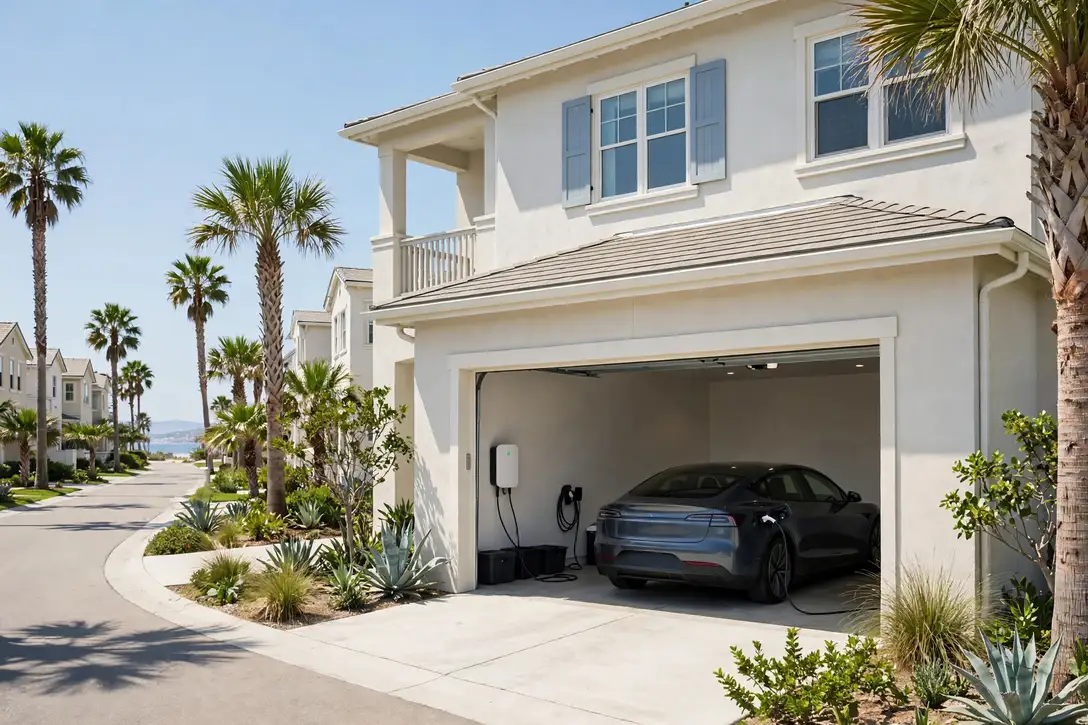
EV charging services in Lafayette
The services below are ordered by what Lafayette households most often need first, judged from the housing and fleet facts on this page. The full menu follows in the grid — every service is offered in this metro.
Home EV Charger Installation in Lafayette
Think of it as plumbing for electrons, done once: capacity checked, circuit run, station mounted and configured, inspection passed. The households that report the smoothest projects describe the same shape — a visit that measured, a quote that itemised, and a car that simply charged from the first night.
In Lafayette: the core residential job in Lafayette: circuit, mounting, configuration and inspection in one visit pattern.
Dedicated Circuit & Electrical Panel Upgrade in Lafayette
Capacity work wears three costumes — more amps, a fresh panel, or management electronics that make the existing amps behave like more. The load calculation is the fitting room: it shows which costume your house actually needs, and a trustworthy quote names the calculation before the costume.
In Lafayette: the job that surfaces wherever housing is older — and Lafayette's stock makes it a routine conversation, settled by a load calculation.
Level 2 Charger Installation in Lafayette
Level 2 is where home charging becomes effortless: a dedicated 240-volt circuit returning a full battery overnight instead of a partial one by morning. The installer's work is the circuit itself — breaker, conductor, connection type — and the station's settings matched to it.
In Lafayette: the 240-volt step that turns overnight charging in Lafayette from a trickle into a full battery by morning.
Utility programs and electricity in Lafayette
Electricity in Lafayette comes from Duke Energy Indiana, LLC. Parts of the wider metro are served by Tipmont Rural Elec Member Corp, Carroll-White REMC, Warren County Rural E M C. The utility matters twice over for a charger install: it sets the time-of-use rates that decide what overnight charging costs you, and it is the organisation that may — or may not — currently help pay for the equipment.
The honest incentive position in Lafayette is: nothing verified to claim. The federal charger credit (30C) ended on September 30, 2025; Indiana runs no state replacement for typical home installs; and in the utility and state sources checked for this page, Duke Energy Indiana, LLC had no active residential charger rebate to point to. Programs reopen — when one does, it will be on the utility's own site with terms and dates. Anything an installer describes without that paper trail should be treated as conversation, not money.
One more utility habit worth copying from Lafayette's EV owners: charge on the overnight rate window if your plan has one. The charger itself can usually be scheduled from the car or the station, so the habit costs nothing once it is set.
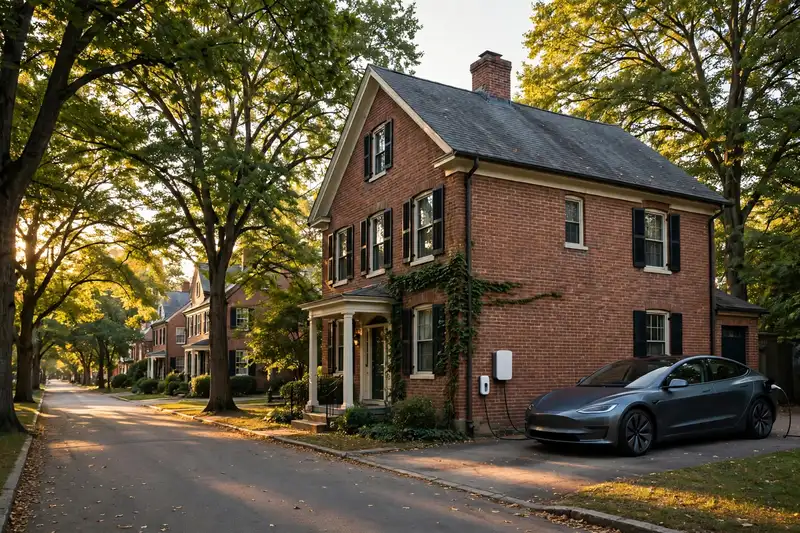
Condos, HOAs and the law in Indiana
No statute promises a charger approval in Indiana. Unlike the states that have enacted right-to-charge laws, Indiana leaves the question entirely to each community's covenants and board discretion. For Lafayette owners that is not the end of the road — it is a sign that the negotiation, the metering design and the written application carry the weight a statute would otherwise carry.
Timing helps too. Boards plan capital work annually; an application that arrives with the community's budget cycle, offering to coordinate with any planned electrical or repaving work, reads as a contribution rather than a demand.
Our condo and HOA guide was written for both kinds of state; the chapters on application packages, metering and cost allocation are the ones that matter in Lafayette, where no statute does the persuading for you.
Climate, garages and charger placement
Leaf-fall and pollen sound beneath an electrician's notice until they are inside a connector left lying open. The holster habit — connector docked, cap where the design provides one — is the entire countermeasure, and it is free.
Storm seasons punctuate the year here, and the installation's weather manners are set at mounting time: enclosures sealed as listed, exterior runs pitched so water travels away from entries, and a station position that the roof's drip line does not cross. Five minutes of the site visit, decades of consequence.

Permits and inspection in Lafayette
Inspection day itself is undramatic by design: access to the panel and the station, the calculation on hand, the equipment's settings matching the circuit. Jobs fail inspection on paperwork mismatches far more often than on wiring — a fact that quietly grades installers.

Neighbourhoods and ZIP codes served
The page covers 6 ZIP codes in and around Lafayette — including 47901, 47902, 47903, 47904, 47905, 47909 — across Tippecanoe. If your ZIP is not in the first set shown, ask anyway: installer coverage follows the metro, not a postcode fence.
The same working area takes in the neighbouring localities of West Lafayette, Dayton, Battle Ground, Buck Creek, Montmorenci, Westpoint, Romney, Stockwell, Clarks Hill — the county ring an installer based in Lafayette actually drives. Requests from those communities route exactly as city requests do: same services, same permit discipline, same local facts where they differ.
Tippecanoe County accounts for 17 of the ZIP codes and 10 named postal localities in the research file, the nearest of them West Lafayette, Dayton, Battle Ground, Buck Creek, Montmorenci. The survey counts 189,071 residents in the county, with a median household income of $60,636 and a median home value of $239,300. Measured across its ZIP codes, the Lafayette footprint runs about 9 miles north to south and 4 east to west, from ZIP 47901 to 47909 — the ground an installer based here actually covers in a working week.
Beyond the county seats, the working area takes in West Lafayette, Dayton, Battle Ground, Buck Creek, Montmorenci, Westpoint, Romney, Stockwell, Brookston, Mulberry, Otterbein, Clarks Hill, Rossville, Delphi, Linden, New Richmond, Chalmers, Templeton, Pine Village, Yeoman, Colfax, Wingate, Newtown, Sedalia, Attica, Oxford, Bringhurst, Darlington, Mellott, Flora, Rockfield, Reynolds, Camden, Wolcott, Frankfort, Waynetown, Cutler, Monticello, Crawfordsville, Thorntown, Fowler, Idaville, Hillsboro, Burrows, Boswell, Burlington, Remington, Burnettsville, Veedersburg, Michigantown, Williamsport, New Ross, Monon, Alamo, Forest, Young America, Talbot, West Lebanon, New Market, Ambia, Wallace, Buffalo, Goodland, Covington, Russiaville, Kingman, Ladoga, Earl Park, Lake Cicott, Waveland, West Middleton, Royal Center, Logansport, Walton, Francesville, State Line, Perrysville, Galveston, Kentland, Brook, Lucerne, Stockland, Kokomo, Rensselaer, Star City, Onward, Wellington, Mount Ayr, Oakford, Grissom Arb — the named localities for which Lafayette is the nearest metro in the network (neighbouring metros' pages cover their own ground), each routing to the same installer-matching service.
The wider working area also reaches Advance, Kirklin, Lebanon, Jamestown, Kempton, Marshall, Russellville, North Salem, Alvin, Roachdale, Whitestown, Lizton, Bismarck, Sheridan, Goldsmith, Hoopeston, Sharpsville, Danville, Pittsboro — ground shared with neighbouring metros, where installers cross the same county lines in both directions.
ZIP codes in that shared ground include 46045, 46049, 46050, 46052, 46068, 46069, 46075, 46102, 46147, 46149, 46165, 46167, 46172, 46175, 47859, 60942, 60963, 61811, 61814, 61832.
The largest communities in that working area after Lafayette itself, by the GeoNames populated-place file: Kokomo (population 57,995), West Lafayette (population 45,550), Logansport (population 17,793), Frankfort (population 16,060), Crawfordsville (population 16,024), Peru (population 11,060), Rensselaer (population 5,927), Grissom Air Force Base (population 5,537). Charging demand follows those populations — the subdivisions and town centres where the next driveways, and the next panels, are.
Montgomery County reaches into the working area with 38,312 residents, a median household income of $71,479 and a median home value of $171,800; its localities on this page include Linden, New Richmond, Wingate, Darlington, Waynetown. White County reaches into the working area with 24,717 residents, a median household income of $67,303 and a median home value of $175,900; its localities on this page include Brookston, Chalmers, Reynolds, Wolcott, Monticello. Carroll County reaches into the working area with 20,535 residents, a median household income of $65,645 and a median home value of $180,900; its localities on this page include Delphi, Yeoman, Bringhurst, Flora, Rockfield.
| ZIP | Locality | County |
|---|---|---|
| 47901 | Lafayette | Tippecanoe |
| 47904 | Lafayette | Tippecanoe |
| 47907 | West Lafayette | Tippecanoe |
| 47905 | Lafayette | Tippecanoe |
| 47902 | Lafayette | Tippecanoe |
| 47996 | West Lafayette | Tippecanoe |
| 47906 | West Lafayette | Tippecanoe |
| 47909 | Lafayette | Tippecanoe |
| 47941 | Dayton | Tippecanoe |
| 47920 | Battle Ground | Tippecanoe |
| 47924 | Buck Creek | Tippecanoe |
| 47903 | Lafayette | Tippecanoe |
| 47962 | Montmorenci | Tippecanoe |
| 47992 | Westpoint | Tippecanoe |
| 47981 | Romney | Tippecanoe |
| 47983 | Stockwell | Tippecanoe |
| 47923 | Brookston | White |
| 46058 | Mulberry | Clinton |
| 47970 | Otterbein | Benton |
| 47930 | Clarks Hill | Tippecanoe |
| 46065 | Rossville | Clinton |
| 46923 | Delphi | Carroll |
| 47955 | Linden | Montgomery |
| 47967 | New Richmond | Montgomery |
| 47929 | Chalmers | White |
| 47986 | Templeton | Benton |
| 47975 | Pine Village | Warren |
| 47997 | Yeoman | Carroll |
| 46035 | Colfax | Clinton |
| 47994 | Wingate | Montgomery |
| 47969 | Newtown | Fountain |
| 46067 | Sedalia | Clinton |
| 47918 | Attica | Fountain |
| 47971 | Oxford | Benton |
| 46913 | Bringhurst | Carroll |
| 47940 | Darlington | Montgomery |
| 47958 | Mellott | Fountain |
| 46929 | Flora | Carroll |
| 46977 | Rockfield | Carroll |
| 47980 | Reynolds | White |
| 46917 | Camden | Carroll |
| 47995 | Wolcott | White |
| 46041 | Frankfort | Clinton |
| 47990 | Waynetown | Montgomery |
| 46920 | Cutler | Carroll |
| 47960 | Monticello | White |
| 47933 | Crawfordsville | Montgomery |
| 46071 | Thorntown | Boone |
| 47944 | Fowler | Benton |
| 47950 | Idaville | White |
| 47949 | Hillsboro | Fountain |
| 46916 | Burrows | Carroll |
| 47921 | Boswell | Benton |
| 46915 | Burlington | Carroll |
| 47977 | Remington | Jasper |
| 47926 | Burnettsville | White |
| 47987 | Veedersburg | Fountain |
| 46057 | Michigantown | Clinton |
| 47993 | Williamsport | Warren |
| 47968 | New Ross | Montgomery |
| 47959 | Monon | White |
| 47916 | Alamo | Montgomery |
| 46039 | Forest | Clinton |
| 46998 | Young America | Cass |
| 47984 | Talbot | Benton |
| 47991 | West Lebanon | Warren |
| 47965 | New Market | Montgomery |
| 47917 | Ambia | Benton |
| 47988 | Wallace | Fountain |
| 47925 | Buffalo | White |
| 47948 | Goodland | Newton |
| 47932 | Covington | Fountain |
| 46979 | Russiaville | Howard |
| 47952 | Kingman | Fountain |
| 47954 | Ladoga | Montgomery |
| 47942 | Earl Park | Benton |
| 46942 | Lake Cicott | Cass |
| 47989 | Waveland | Montgomery |
| 46995 | West Middleton | Howard |
| 46978 | Royal Center | Cass |
| 46947 | Logansport | Cass |
| 46994 | Walton | Cass |
| 47946 | Francesville | Pulaski |
| 47982 | State Line | Warren |
| 47974 | Perrysville | Vermillion |
| 46932 | Galveston | Cass |
| 47951 | Kentland | Newton |
| 47922 | Brook | Newton |
| 46950 | Lucerne | Cass |
| 60967 | Stockland | Iroquois |

Planning the install: from panel to parking
Think of the project as a chain with four links: capacity, route, placement, paperwork. Capacity is the load calculation. Route is the path copper takes from panel to parking — through a shared wall if you are lucky, across a ceiling or a trench if you are not. Placement is the unglamorous decision that governs daily life with the car for a decade: reach, cable slack, and which side the port is on. Paperwork is the permit and the passed inspection, the proof that outlives the installer's visit.
Future-proofing, in this trade, is mostly conduit and capacity: an oversized conduit run costs little during the first install and everything later; a panel position reserved is a breaker that never has to move. If a second EV, a workshop or an electrified water heater is anywhere in your five-year picture, say so at the site visit.
Home charging know-how for Lafayette households
When the garage is detached
A detached garage changes the install's centre of gravity: the circuit must travel. The route is usually a buried conduit run from the house panel, with depth, conduit type and the trench's path past roots, irrigation and paving all settled at the design stage — or, where the run is long and the loads justify it, a subpanel in the garage that also serves the workshop the building inevitably becomes. The charger at the end of that run behaves exactly like any other; it is the journey, measured in copper and digging, that defines the job.
Bidirectional charging, honestly framed
Vehicles that can return energy to a house or the grid exist, and the standards enabling them are settling — but for most households today it is a horizon technology, not a purchase category: it needs a compatible vehicle, bidirectional equipment, utility interconnection approval and a tariff that rewards it. None of that changes today's installation advice, except in one detail: conduit and panel capacity installed generously now are the same provisions a future bidirectional setup would want. Buy for the car you have; leave room for the one the industry is promising.
Protecting the station from the car
The most likely assailant of a garage charger is the car itself: a misjudged nose-in, a bicycle's handlebar, a ladder's fall. Placement is the first defence — out of the door swing, off the parking line's edge — and a simple bollard or wheel stop is the second where the geometry is tight. Outdoor pedestals earn the same thought against the snowplough's line and the delivery van's arc. It is carpentry, not electronics, and it belongs in the install conversation because the right time to protect a station is the day it is mounted.
Charging through the summer
Summer's version of the same lesson runs through temperature rather than ice. Batteries and charging electronics both prefer the cool hours, and a car that has baked in a driveway all afternoon will manage its own charging rate until its pack settles. Scheduling the session for after midnight hands the car the mildest air of the day; placing the station out of the sun line and keeping the garage ventilated does the rest. None of it requires attention once set — summer-proofing a home charger is a configuration, not a chore.

Frequently asked questions
What happened to the federal home-charger credit in Lafayette, IN?
You cannot — it no longer exists. The 30C credit closed to equipment placed in service after September 30, 2025, and no Indiana program replaced it for home installs. Nor did the sources checked for this page show a live Duke Energy Indiana, LLC residential rebate. Treat any 'credit' mentioned in a quote as a request for paperwork.
Can my HOA or condo board in Lafayette, IN refuse my charger?
They hold the stronger hand, and it is better to plan with that admitted. Indiana has enacted no right-to-charge law, so in Lafayette the covenants and the board govern. Owners who treat the application as a design submission — circuit, metering, insurance, restoration — rather than a request for a favour are the ones charging by the following quarter.
Will my Lafayette, IN home need a panel upgrade for a Level 2 charger?
Nobody can answer that from a photograph of your panel's door, and you should be suspicious of anyone who tries. In a city where the median home dates to 1976 and about 55% of units predate 1980, the honest answer is a load calculation: what your service is, what it already carries, and what a continuous charger load does to the total. Then the options — circuit, load management, or upgrade — compare on paper.
Level 1 or Level 2 in Lafayette, IN — what is the real difference?
Level 1 — the cord in the boot, on a normal outlet — returns about 3–5 miles of range an hour. Level 2 on its own 240-volt circuit returns roughly 25–40. A Lafayette commuter who parks at seven and leaves at seven stops doing battery arithmetic entirely.
What happens after I request an installer through this page?
Send the request and it is matched against installers covering Lafayette — your service, ZIP, property type and timing travel with it. An installer then arranges the site visit and quotes in writing. Our role ends at the introduction; your contract, permit and paperwork are with the installer.
Do installers cover the communities around Lafayette, IN?
They do. Coverage follows the metro: West Lafayette, Dayton, Battle Ground, Buck Creek, Montmorenci and their neighbouring communities are worked by the same installers who cover Lafayette itself, and a request from those ZIP codes routes identically — service, property type and timing are all the form asks for.
Nearby cities in Indiana
- EV charger installation in Indianapolis — about 62 miles from Lafayette, metro population 2,100,000
- EV charger installation in Terre Haute — about 72 miles from Lafayette, metro population 170,000
- EV charger installation in South Bend — about 93 miles from Lafayette, metro population 325,000
- EV charger installation in Fort Wayne — about 111 miles from Lafayette, metro population 425,000
- EV charger installation in Evansville — about 171 miles from Lafayette, metro population 360,000
- EV charger installation in Champaign, IL — about 78 miles from Lafayette, metro population 210,000
- EV charger installation in Chicago, IL — about 109 miles from Lafayette, metro population 9,450,000
- EV charger installation in Bloomington, IL — about 116 miles from Lafayette, metro population 190,000
Ready to charge at home in Lafayette?
Two minutes of form, and the request is in front of licensed installers who cover this city — quotes follow site visits, in writing.