EV Charger Installation in Fort Wayne, IN
Home Level 2 charging, panel upgrades and condo installs in Fort Wayne — matched to licensed local installers, with the local facts that shape the job set out below.
Every home charger installation is the same four decisions wearing local clothes: capacity in the panel, a route for the circuit, a position for the station, and paperwork that proves it was done properly. What changes from city to city is the content of those decisions — and in Fort Wayne the content is specific. Fort Wayne itself is home to about 273,425 people. Indiana's registered fleet stood at 47,200 battery-electric vehicles and 19,400 plug-in hybrids at the end of 2025, and this page works through the local version of each decision: your utility and its programs, your state's association law, your permit counter, and your housing stock's electrical habits.
How PlugReady USA works, in one breath: you describe the job once, licensed local installers who cover Fort Wayne receive it, and the conversations happen with them directly. The rest of this page exists so those conversations start from facts — yours about the house, ours about the metro — rather than from a sales script.
The demand picture for the Fort Wayne metro, from the registration data this site is built on: IN No. 2. Registration counts are the honest way to size a charging market — they count households, not headlines — and they are why Fort Wayne sits where it does in our build order (rank 137 of 300 metros, Tier C).
Survey context for Fort Wayne, in the three lines installers actually use: median household income $61,436; owner-occupation at 63%; single-unit detached homes at 67%. Income tracks adoption pace, tenure decides whose signature a job needs, and structure decides whether the answer is a garage circuit or a building negotiation.

Put the survey together and Fort Wayne's charging profile reads like this: an older housing fabric, where panel archaeology is a normal part of the first visit; a detached-house majority with a real attached and multifamily minority; buildings of five or more units are a visible minority of the stock; and owners hold a working majority, with renters a significant minority. That combination — more than any single number — is what the installers working here plan around, and it is the lens for everything on this page.
The counts behind the percentages, for the record: Fort Wayne has 120,521 housing units on the survey's count, 112,191 of them occupied, and 70,514 owner-occupied households making their own electrical decisions. Detached houses number 81,242; homes built before 1980 number 74,844; units in buildings of five or more number 23,487. An installer's week in this city is a walk through exactly that distribution. The page's geography is equally concrete: 43 ZIP codes across Allen, centred near 41.09 degrees north latitude. The city anchors the Fort Wayne metropolitan area, home to roughly 425,000 people on the research file's metro estimate — the wider labour and housing market this page's installers work across.
The same survey release fills in the household economics around the housing stock: a median home value of $219,900, median gross rent of $1,051, per-capita income of $35,220, and a median resident age of 35. And the daily rhythms behind the housing numbers: 77% of Fort Wayne workers drive to work alone — the commute pattern home charging is built around; 7% work from home, a population whose cars charge on daytime and overnight schedules alike; 0% commute by public transit; 31% of adults hold a bachelor's degree or higher. The survey's vehicle table is the one an EV page should quote first: 10,722 of Fort Wayne's households have no vehicle at all, while 56,746 have two or more — the multi-car households for whom the second circuit is a when, not an if.
The cost-burden lines say who feels housing costs most in Fort Wayne: 45% of renters spend 30% or more of income on rent, and 0% of owners with mortgages spend the same share on housing costs. Family households are 57% of all households — the two-car, school-run demographic whose charging patterns this page's planning sections keep circling back to.
Taken as one portrait, the numbers describe a specific charging market. Where so much of the stock predates modern code cycles, the site visit doubles as a survey — grounding electrode, service entrance, panel provenance — before it is ever a quote. Installers here run two trades in one van — domestic circuits in the morning, a building's shared-service design in the afternoon — and the city's pages, this one included, have to serve both readers.
The balance of tenure keeps both crafts alive locally: firms that run domestic circuits all week, and firms whose week is landlord letters and board packs — with the good ones fluent in both. Households at this band comparison-shop on scope rather than on slogans, which rewards the installer whose quote shows its working — the load study, the route, the permit, itemised. Investor-owned utility territory runs on published tariffs and regulator-approved programmes: everything material about charging economics here exists in a filed document with an effective date, findable by anyone who reads filings.
Visibility is the growth engine: every driveway install is a demonstration, and the metro's adoption curve is being drawn one cul-de-sac at a time. The permit counter in a smaller city is a conversation, not a queue: applications are read by people who may know the street, and complete paperwork is remembered kindly. Without a state charging statute, shared-property approvals in this metro are won on paper quality: metering clarity, licensed installers, insurance, reversibility — the complete package the guides set out.
The electrical reality in Fort Wayne homes
Read the stock the way a panel schedule reads it. Median build year 1971 means half of Fort Wayne's homes were wired to codes of that era or earlier; 62% predate 1980 entirely. 67% of units are detached houses, and 63% of occupied homes are owned by their occupants — so most charger conversations here happen between a homeowner and an electrician, with no third party at the table. Age shows up electrically before it shows up anywhere else: services sized for a house with a third of today's appliances. Expect the first conversation to be about capacity — what the panel is, what it already feeds, and which of the three routes (circuit, management, upgrade) your numbers support. Porches, carports and parking pads carry a real share of this city's charging, because the stock predates the two-car garage as a standard feature — outdoor-rated equipment is a local staple, not an edge case.
The fuel table adds one more local fact: 29,408 Fort Wayne homes — 26% of the stock — heat with electricity. Those households already think in kilowatts through the winter, their panels carry the load to prove it, and a charger's overnight appetite joins a system that is, in the useful sense, already electrified.
Renters are the other constituency in these numbers: about 41,677 of Fort Wayne's occupied homes are rented rather than owned. Their charging route runs through a landlord conversation instead of a panel they control — a different project, covered by the rentals guide and the law section below, but a routine one in a city with this many renting households.
One more structural fact shapes Fort Wayne's charging map: 19% of the city's housing units sit in buildings of five or more units. Those households cannot simply book a circuit — their charger runs through a building, a board and a shared electrical service, which is why the multifamily service and the law section below carry unusual weight on this page.
EV charging services in Fort Wayne
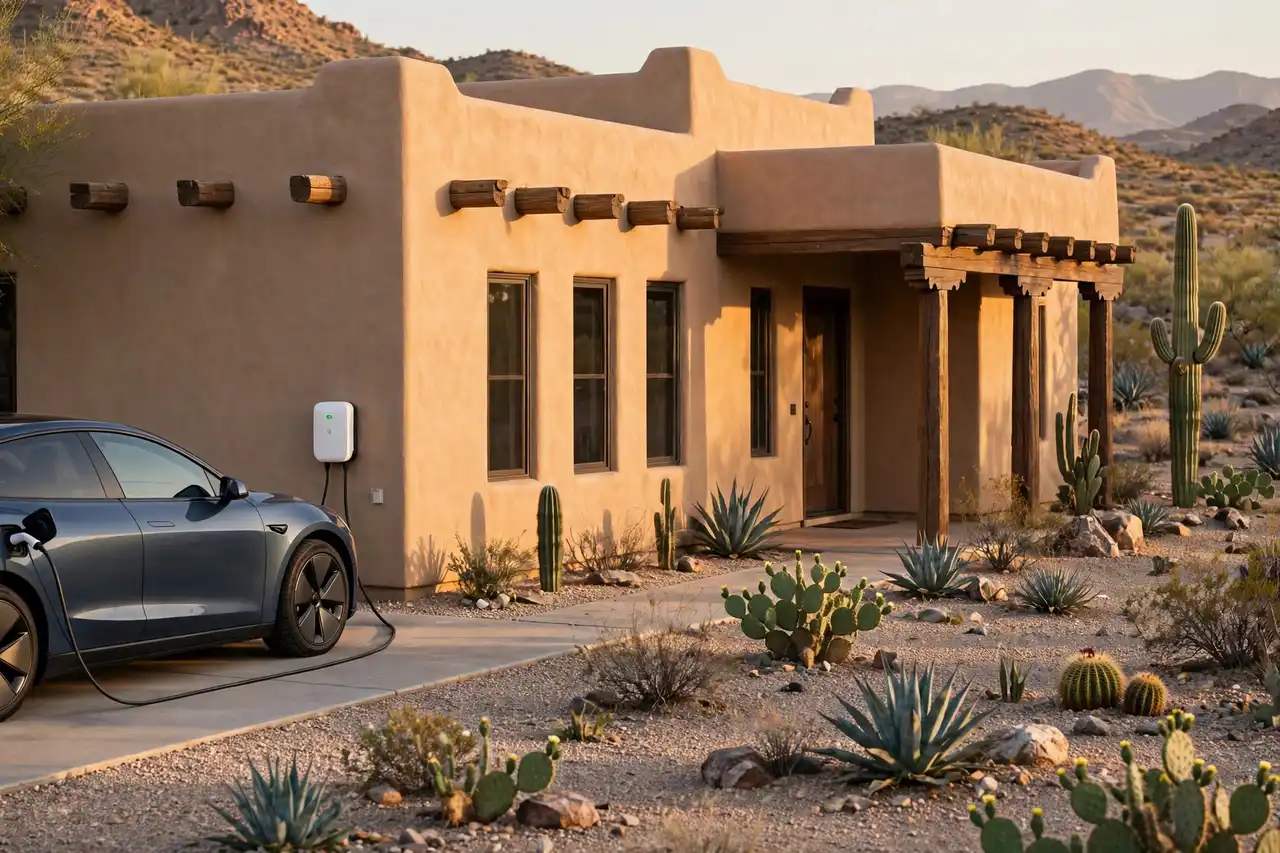
An installer's work in Fort Wayne usually starts with one of the three lead services below. The cards describe the job as it is actually scoped; the grid underneath carries the rest of the menu.
Home EV Charger Installation in Fort Wayne
The residential standard: a station where the car sleeps, on a circuit of its own, installed under permit. Variations are all local — the panel's spare room, the run's route through the house's fabric, and the parking pattern the cable has to serve.
In Fort Wayne: the core residential job in Fort Wayne: circuit, mounting, configuration and inspection in one visit pattern.
Dedicated Circuit & Electrical Panel Upgrade in Fort Wayne
Capacity work wears three costumes — more amps, a fresh panel, or management electronics that make the existing amps behave like more. The load calculation is the fitting room: it shows which costume your house actually needs, and a trustworthy quote names the calculation before the costume.
In Fort Wayne: the job that surfaces wherever housing is older — and Fort Wayne's stock makes it a routine conversation, settled by a load calculation.
Level 2 Charger Installation in Fort Wayne
A Level 2 circuit turns charging from a ration into a routine. The job is electrical rather than electronic — breaker and conductor sized at the continuous-load factor, the run routed to the parking position, and the station dialled to the circuit rather than to its own headline maximum.
In Fort Wayne: the 240-volt step that turns overnight charging in Fort Wayne from a trickle into a full battery by morning.
Utility programs and electricity in Fort Wayne
Electricity in Fort Wayne comes from Indiana Michigan Power Co. Parts of the wider metro are served by Northeastern Rural E M C, Heartland REMC, Noble County R E M C. The utility matters twice over for a charger install: it sets the time-of-use rates that decide what overnight charging costs you, and it is the organisation that may — or may not — currently help pay for the equipment.
Do not budget for a rebate in Fort Wayne right now. As of the sources checked for this page, Indiana Michigan Power Co publishes no residential charger rebate, Indiana offers no state program for typical home installs, and the federal 30C credit ended on September 30, 2025. If that changes, the utility's program page will say so with an as-of date — and this page will be updated to match. Until then, judge quotes on the work itself.
Solar households should read the export terms alongside the charging ones: the pair decides whether midday charging on home-working days beats the overnight window, and the answer is written in your tariff, not in general advice.
Condos, HOAs and the law in Indiana
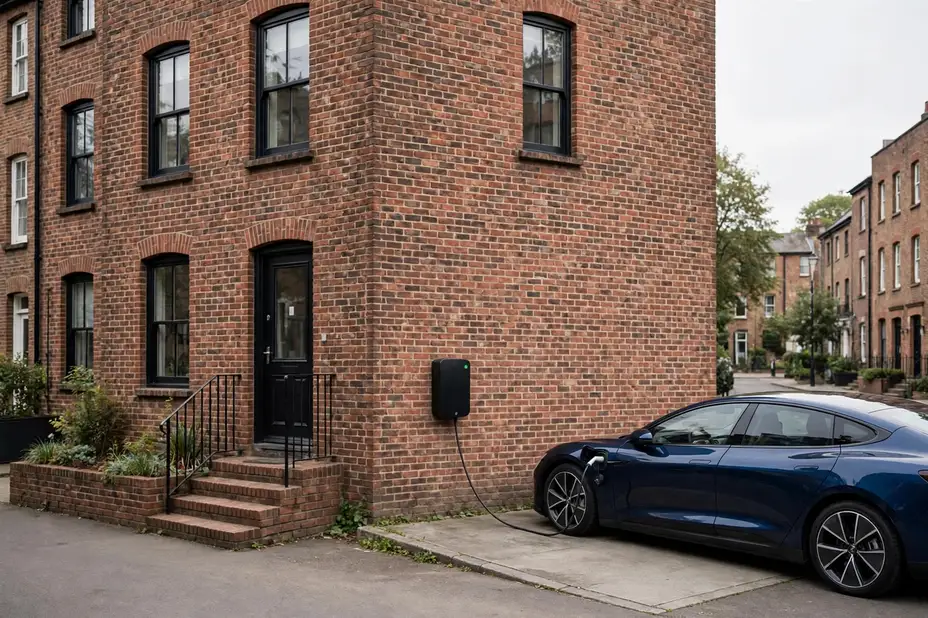
Indiana has no statewide right-to-charge law. That needs saying plainly, because roundups on the internet sometimes claim otherwise: in the authoritative statute indexes checked for this page, no Indiana law prevents a homeowners association or condominium from refusing a charger in a common or assigned space. Your community's own covenants and board govern the question in Fort Wayne.
Strategy, then, is the local substitute for statute. In Fort Wayne the applications that succeed tend to share a shape: they arrive before the meeting rather than at it, they answer metering and insurance in the first paragraph, and they offer the board a design it can approve once and reuse for the next owner who asks.
The negotiation playbook — application contents, metering options, the wording that answers boards' standard objections — is set out in our condo and HOA guide, read here as a persuasion manual rather than a rights manual.
Climate, garages and charger placement
The seasons rotate the charging advice: precondition from the wall in winter, dodge the afternoon peak in summer, and let the shoulder months do what they like. Households here learn the two settings and change them with the clocks.
A four-season climate asks the installation to be boring in every month: cable that stays flexible in January, an enclosure untroubled by August humidity, and drainage that keeps spring melt away from the connector. None of this is exotic — it is the standard outdoor discipline, and it is why station placement gets a full minute of the site visit rather than a wave at the nearest wall.

Permits and inspection in Fort Wayne
The normal sequence is the same across the metro: the installer files the electrical permit, installs to the current National Electrical Code (a charger is a continuous load, so the circuit is sized at 125% of the draw), and the city inspects before the job is signed off. Keep the passed inspection record — insurers, future buyers and warranty claims all ask for it.

Neighbourhoods and ZIP codes served
The page covers 43 ZIP codes in and around Fort Wayne — including 46801, 46802, 46803, 46804, 46805, 46806, 46807, 46808, 46809, 46814, 46815, 46816, 46818, 46819, 46825, 46835, 46845, 46850, 46851, 46852, 46853, 46854, 46855, 46856, 46857, 46858, 46859, 46860, 46861, 46862, 46863, 46864, 46865, 46866, 46867, 46868, 46869, 46885, 46895, 46896, 46897, 46898, 46899 — across Allen. If your ZIP is not in the first set shown, ask anyway: installer coverage follows the metro, not a postcode fence.
The same working area takes in the neighbouring localities of New Haven, Leo, Hoagland, Grabill, Huntertown, Woodburn, Monroeville, Arcola, Yoder, Harlan, Zanesville — the county ring an installer based in Fort Wayne actually drives. Requests from those communities route exactly as city requests do: same services, same permit discipline, same local facts where they differ.
Allen County accounts for 54 of the ZIP codes and 12 named postal localities in the research file, the nearest of them New Haven, Leo, Hoagland, Grabill, Huntertown. The survey counts 392,378 residents in the county, with a median household income of $70,737 and a median home value of $214,900. Measured across its ZIP codes, the Fort Wayne footprint runs about 13 miles north to south and 13 east to west, from ZIP 46801 to 46899 — the ground an installer based here actually covers in a working week.
Beyond the county seats, the working area takes in New Haven, Leo, Hoagland, Grabill, Huntertown, Woodburn, Monroeville, Arcola, Yoder, Spencerville, Ossian, Laotto, Harlan, Zanesville, Churubusco, Garrett, Roanoke, Auburn, Saint Joe, Preble, Payne, Antwerp, Decatur, Uniondale, Craigville, Avilla, Convoy, Hicksville, Markle, Columbia City, Waterloo, Corunna, Bluffton, Pleasant Mills, Butler, Haviland, Cecil, Albion, Wren, Kendallville, Latty, Paulding, Scott, Mark Center, Huntington, Wolflake, Liberty Center, Willshire, Monroe, South Whitley, Berne, Hudson, Edgerton, Larwill, Ashley, Ohio City, Van Wert, Linn Grove, Farmer, Rome City, Grover Hill, Bippus, South Milford, Sherwood, Poneto, Hamilton, Kimmell, Petroleum, Andrews, Wawaka, Warren, Pleasant Lake, Geneva, Stroh, Wolcottville, Blakeslee, Cromwell, Melrose, Ney, Pierceton, Rockford, Middle Point, Keystone, Liberty Mills, Oakwood, Edon, Servia, Montpelier, Bryan, Ligonier, Bryant, Angola, Urbana, North Manchester, Venedocia, Lagro, Pennville, Elgin, Van Buren, Defiance, Dupont, Ottoville, Mendon, Mongo, Lagrange, Cloverdale, Laketon, Evansport, Orland, La Fontaine, Celina, Silver Lake, Fremont, Delphos — the named localities for which Fort Wayne is the nearest metro in the network (neighbouring metros' pages cover their own ground), each routing to the same installer-matching service.
The wider working area also reaches North Webster, Topeka, Syracuse, Winona Lake, Claypool, Leesburg, Warsaw — ground shared with neighbouring metros, where installers cross the same county lines in both directions.
The largest communities in that working area after Fort Wayne itself, by the GeoNames populated-place file: Lima (population 37,873), Marion (population 29,081), Huntington (population 17,095), Defiance (population 16,776), New Haven (population 15,709), Auburn (population 12,979), Coldwater (population 10,844), Van Wert (population 10,798). Charging demand follows those populations — the subdivisions and town centres where the next driveways, and the next panels, are.
DeKalb County reaches into the working area with 43,807 residents, a median household income of $74,331 and a median home value of $194,100; its localities on this page include Spencerville, Garrett, Auburn, Saint Joe, Waterloo. Wells County reaches into the working area with 28,420 residents, a median household income of $71,957 and a median home value of $197,600; its localities on this page include Ossian, Uniondale, Craigville, Bluffton, Liberty Center. Noble County reaches into the working area with 47,495 residents, a median household income of $71,723 and a median home value of $196,800; its localities on this page include Laotto, Avilla, Albion, Kendallville, Wolflake.
| ZIP | Locality | County |
|---|---|---|
| 46801 | Fort Wayne | Allen |
| 46850 | Fort Wayne | Allen |
| 46851 | Fort Wayne | Allen |
| 46852 | Fort Wayne | Allen |
| 46853 | Fort Wayne | Allen |
| 46854 | Fort Wayne | Allen |
| 46855 | Fort Wayne | Allen |
| 46856 | Fort Wayne | Allen |
| 46857 | Fort Wayne | Allen |
| 46858 | Fort Wayne | Allen |
| 46859 | Fort Wayne | Allen |
| 46860 | Fort Wayne | Allen |
| 46861 | Fort Wayne | Allen |
| 46862 | Fort Wayne | Allen |
| 46863 | Fort Wayne | Allen |
| 46864 | Fort Wayne | Allen |
| 46866 | Fort Wayne | Allen |
| 46867 | Fort Wayne | Allen |
| 46868 | Fort Wayne | Allen |
| 46869 | Fort Wayne | Allen |
| 46885 | Fort Wayne | Allen |
| 46895 | Fort Wayne | Allen |
| 46896 | Fort Wayne | Allen |
| 46897 | Fort Wayne | Allen |
| 46898 | Fort Wayne | Allen |
| 46899 | Fort Wayne | Allen |
| 46815 | Fort Wayne | Allen |
| 46865 | Fort Wayne | Allen |
| 46803 | Fort Wayne | Allen |
| 46805 | Fort Wayne | Allen |
| 46835 | Fort Wayne | Allen |
| 46774 | New Haven | Allen |
| 46806 | Fort Wayne | Allen |
| 46825 | Fort Wayne | Allen |
| 46802 | Fort Wayne | Allen |
| 46808 | Fort Wayne | Allen |
| 46807 | Fort Wayne | Allen |
| 46816 | Fort Wayne | Allen |
| 46845 | Fort Wayne | Allen |
| 46819 | Fort Wayne | Allen |
| 46809 | Fort Wayne | Allen |
| 46818 | Fort Wayne | Allen |
| 46765 | Leo | Allen |
| 46745 | Hoagland | Allen |
| 46804 | Fort Wayne | Allen |
| 46741 | Grabill | Allen |
| 46748 | Huntertown | Allen |
| 46797 | Woodburn | Allen |
| 46773 | Monroeville | Allen |
| 46704 | Arcola | Allen |
| 46798 | Yoder | Allen |
| 46814 | Fort Wayne | Allen |
| 46788 | Spencerville | DeKalb |
| 46777 | Ossian | Wells |
| 46763 | Laotto | Noble |
| 46743 | Harlan | Allen |
| 46799 | Zanesville | Allen |
| 46723 | Churubusco | Whitley |
| 46738 | Garrett | DeKalb |
| 46783 | Roanoke | Huntington |
| 46706 | Auburn | DeKalb |
| 46785 | Saint Joe | DeKalb |
| 46782 | Preble | Adams |
| 45880 | Payne | Paulding |
| 45813 | Antwerp | Paulding |
| 46733 | Decatur | Adams |
| 46791 | Uniondale | Wells |
| 46731 | Craigville | Wells |
| 46710 | Avilla | Noble |
| 45832 | Convoy | Van Wert |
| 43526 | Hicksville | Defiance |
| 46770 | Markle | Huntington |
| 46725 | Columbia City | Whitley |
| 46793 | Waterloo | DeKalb |
| 46730 | Corunna | DeKalb |
| 46714 | Bluffton | Wells |
| 46780 | Pleasant Mills | Adams |
| 46721 | Butler | DeKalb |
| 45851 | Haviland | Paulding |
| 45821 | Cecil | Paulding |
| 46701 | Albion | Noble |
| 45899 | Wren | Van Wert |
| 46755 | Kendallville | Noble |
| 45855 | Latty | Paulding |
| 45879 | Paulding | Paulding |
| 45886 | Scott | Van Wert |
| 43536 | Mark Center | Defiance |
| 46750 | Huntington | Huntington |
| 46796 | Wolflake | Noble |
| 46766 | Liberty Center | Wells |

Planning the install: from panel to parking
A useful way to read any Fort Wayne quote is to ask which of three jobs it describes. Job one: the panel has room and the run is short — a circuit and a station. Job two: the panel is full — capacity work joins the quote, as an upgrade or as load management. Job three: the property adds people — an HOA, a landlord, a building's shared service — and the approvals timeline joins the electrical one. None of the three is a bad job; they are simply different scopes, and a clear quote says which one you are in.
One more piece of sequencing advice Fort Wayne installers give consistently: if the panel is being opened anyway, settle the other electrical maybes in the same visit — the circuit you will want next year costs least while the permit and the electrician are already in the house.
Home charging know-how for Fort Wayne households
Adapters and other false economies
Continuous loads forgive nothing, and adapters are where charging setups go to be forgiven anyway: a chain of plugs between the wall and a device that draws near its circuit's limit for eight hours is a chain of warm connections. The standing rule from installers is plain — the station connects as its listing intends, hardwired or into a receptacle rated and installed for the duty, and borrowed dryer outlets and travel adapters are emergency expedients, not a charging system. Households that need the car charged nightly should own the boring version of the setup: one circuit, one connection, no improvisation.
Two-storey houses and the vertical run
In a two-storey house the panel often lives in a utility room, a laundry or a ground-floor wall far from the garage, and the circuit's path becomes a vertical problem: chases, soffits and floor cavities are the route's vocabulary. Experienced installers read a house's structure the way a plumber does — where the stacked walls are, which cavities run uninterrupted — and the quote follows that reading. Expect the site visit to include a look upstairs; the ceiling above the garage is part of the job.
The school-run charge window
Households organised around school runs live on a distinctive charge curve: two short hops, a long parked day, an afternoon of activities. The car sits at home for the middle of the day — which, for solar households, is precisely the generation window, and for everyone else makes the overnight session almost an afterthought. Scheduling follows the family's actual day, not the tariff's assumption of one, and the installer who asks about the school run is designing, not chatting.
Shutoffs and sensible safety
Every charger installation contains its own off switch: the breaker in the panel, and, on larger circuits, a disconnect within sight of the equipment that the code requires. Knowing where both are — and that the station itself stops the session when the connector is unlatched — is the whole safety briefing, and a good installer gives it unprompted at handover. The equipment is listed, protected and designed to be operated daily by non-electricians; the homeowner's part is simply to know the two switches and to treat any change in behaviour — heat, noise, repeated trips — as a reason to call rather than to reset.

Frequently asked questions
What happened to the federal home-charger credit in Fort Wayne, IN?
That credit is finished: 30C ended on September 30, 2025. What about locally? In the utility and state sources checked for this page, nothing verified was running for Fort Wayne homeowners — no Indiana Michigan Power Co rebate, no state scheme. If one opens, it will appear on the utility's site with dates; plan your install without it meanwhile.
Can my HOA or condo board in Fort Wayne, IN refuse my charger?
Possibly, yes. Indiana has no statewide right-to-charge law in the authoritative indexes checked for this page, so your community's covenants govern. A complete written application — licensed installer, dedicated circuit, owner-paid metering and insurance — is the approach that gets approvals here.
Panel upgrade or not — how do Fort Wayne, IN homeowners find out?
It hinges on two numbers you cannot read off the panel door: the service's rating, and what the load calculation says it already carries. The vintage of Fort Wayne's stock — median build year 1971, about 62% of homes from before 1980 — means both answers are common here. The charger enters the arithmetic at 125% of its draw; whatever room survives that entry decides between a circuit, a management device, and an upgrade.
How quickly will a Level 2 charger fill my car in Fort Wayne, IN?
Think of it in parked hours. Level 1 gives you back 3–5 miles for each of them; Level 2 gives back about 25–40, set by the circuit's amperage and what the car can accept. Overnight, that is the gap between 'enough for tomorrow' and 'full, every morning'.
How does the installer matching on this page work?
Your request — service, Fort Wayne ZIP, property type and timing — goes to licensed local installers who cover Fort Wayne. They contact you directly to arrange a site visit and quote. PlugReady USA is the matching service, not the installer, and the sections above exist so you can judge any quote against the local facts.
Does Indiana Michigan Power Co offer a time-of-use rate for EV charging in Fort Wayne?
Many Indiana Michigan Power Co customers can choose a time-of-use tariff; whether yours is one, and where its cheap window sits, decides how the charger should be scheduled from night one. Two minutes with your tariff sheet during the planning stage is the whole task — the installer sets the schedule to match while commissioning the station.
Nearby cities in Indiana
- EV charger installation in South Bend — about 77 miles from Fort Wayne, metro population 325,000
- EV charger installation in Indianapolis — about 108 miles from Fort Wayne, metro population 2,100,000
- EV charger installation in Lafayette — about 111 miles from Fort Wayne, metro population 225,000
- EV charger installation in Terre Haute — about 171 miles from Fort Wayne, metro population 170,000
- EV charger installation in Evansville — about 254 miles from Fort Wayne, metro population 360,000
- EV charger installation in Dayton, OH — about 103 miles from Fort Wayne, metro population 825,000
- EV charger installation in Lansing, MI — about 117 miles from Fort Wayne, metro population 550,000
- EV charger installation in Columbus, OH — about 133 miles from Fort Wayne, metro population 2,150,000
Ready to charge at home in Fort Wayne?
Tell us the job — service, ZIP and property type — and licensed local installers will take it from there.