EV Charger Installation in Columbus, OH
Everything a Columbus homeowner needs before booking a charger install — the panel question, the utility's current programs, the HOA law and the permit — sourced, dated and local.
Every home charger installation is the same four decisions wearing local clothes: capacity in the panel, a route for the circuit, a position for the station, and paperwork that proves it was done properly. What changes from city to city is the content of those decisions — and in Columbus the content is specific. Columbus itself is home to about 931,551 people. Ohio's registered fleet stood at 94,200 battery-electric vehicles and 37,200 plug-in hybrids at the end of 2025, and this page works through the local version of each decision: your utility and its programs, your state's association law, your permit counter, and your housing stock's electrical habits.
A word on how to use the page: each section answers one of the questions an installer will ask you anyway — panel, utility, property rules, permits — with Columbus's actual answers. Read the two that apply to your house and you will start the quoting conversation several steps ahead.
What the Experian and AFDC registration data say about Columbus: Fast-growing OH capital. Translated out of market language: your neighbours are already charging at home, the permit office already knows the paperwork, and the installers already know the housing stock.
Context from the Census Bureau's survey of Columbus: median household income $67,084; 46% of occupied homes are owner-occupied; 44% of housing units are single-unit detached houses. It is the profile of a city where the typical charger job is a homeowner job — scoped by the panel and the wire run, not by permissions.

Every city charges differently, and Columbus's difference is legible in the data: an older housing fabric, where panel archaeology is a normal part of the first visit; a genuinely mixed city — houses, townhouses and larger buildings all carry weight; buildings of five or more units hold a substantial share of homes, which keeps the multifamily sections of this page in daily use; renters form a large share of households, so the landlord conversation is a first-class topic here. Read the sections below through that profile and the local advice resolves into specifics — which questions are routine here, and which are rare.
The counts behind the percentages, for the record: Columbus has 436,552 housing units on the survey's count, 396,650 of them occupied, and 181,936 owner-occupied households making their own electrical decisions. Detached houses number 192,785; homes built before 1980 number 206,844; units in buildings of five or more number 144,269. An installer's week in this city is a walk through exactly that distribution. The page's geography is equally concrete: 45 ZIP codes across Franklin, centred near 40.10 degrees north latitude. The city anchors the Columbus metropolitan area, home to roughly 2,150,000 people on the research file's metro estimate — the wider labour and housing market this page's installers work across.
The same survey release fills in the household economics around the housing stock: a median home value of $279,900, median gross rent of $1,383, per-capita income of $37,923, and a median resident age of 34. And the daily rhythms behind the housing numbers: 68% of Columbus workers drive to work alone — the commute pattern home charging is built around; 16% work from home, a population whose cars charge on daytime and overnight schedules alike; 2% commute by public transit; 39% of adults hold a bachelor's degree or higher. And the fleet in the driveways: 174,705 households in Columbus have exactly one vehicle, 186,980 have two or more, and 34,965 have none.
The cost-burden lines say who feels housing costs most in Columbus: 50% of renters spend 30% or more of income on rent, and 0% of owners with mortgages spend the same share on housing costs. Family households are 52% of all households — the two-car, school-run demographic whose charging patterns this page's planning sections keep circling back to.
What follows is the city read as an electrical place rather than a dot on a map. Where so much of the stock predates modern code cycles, the site visit doubles as a survey — grounding electrode, service entrance, panel provenance — before it is ever a quote. The renter-and-condo share makes the law section of this page load-bearing: statutory rights, application windows and metering rules are not fine print here, they are the project's first phase.
Where renting dominates, the successful install is a document before it is a device — installer licence, insurance, metering clarity, end-of-tenancy position — assembled to make a landlord's yes the path of least resistance. Here the tariff conversation is a budget conversation: the overnight window's arithmetic, done honestly once, pays out every night of the car's life without further attention. A large utility's scale cuts both ways — programme budgets that dwarf a small co-op's, and call-centre distance between a household and anyone who can decide anything. The published page rules; keep it bookmarked.
Growth-phase markets reward the prepared household: boards writing their first charging policy, landlords forming their first standard answer — a complete, professional application shapes the precedent it will be judged by. At this scale the city's charging infrastructure is legible — a household can learn the whole local system, its programmes, precedents and people, in an evening's reading. This page is most of that evening. Without a state charging statute, shared-property approvals in this metro are won on paper quality: metering clarity, licensed installers, insurance, reversibility — the complete package the guides set out.
The electrical reality in Columbus homes
Four numbers organise everything an installer expects in Columbus: median build year 1982; 47% of units built before 1980; 44% of the stock detached; 46% of occupied homes owner-occupied. Capacity, circuit routes and approval layers all correlate with those four. The paragraphs below are their commentary. A housing stock this age leans on smaller electrical services — 100-amp panels are common, and fuse-era equipment still turns up in the oldest streets. For many of those homes the honest answer is a panel upgrade or a load-management device before the charger circuit goes in, and a good installer will show you the load calculation rather than asking you to take it on faith. Detached houses matter for a practical reason: a garage or driveway on your own lot means the charger, the car and the circuit are all under one roof and one owner's control, which is the simplest configuration there is.
The fuel table adds one more local fact: 136,289 Columbus homes — 34% of the stock — heat with electricity. Those households already think in kilowatts through the winter, their panels carry the load to prove it, and a charger's overnight appetite joins a system that is, in the useful sense, already electrified.
The tenure split cuts the other way too: roughly 214,714 occupied homes in Columbus are rented. For those households the charger question is a negotiation with a property owner — written proposal, licensed installer, metering clarity — and it succeeds often enough that installers here keep the pattern ready.
One more structural fact shapes Columbus's charging map: 33% of the city's housing units sit in buildings of five or more units. Those households cannot simply book a circuit — their charger runs through a building, a board and a shared electrical service, which is why the multifamily service and the law section below carry unusual weight on this page.
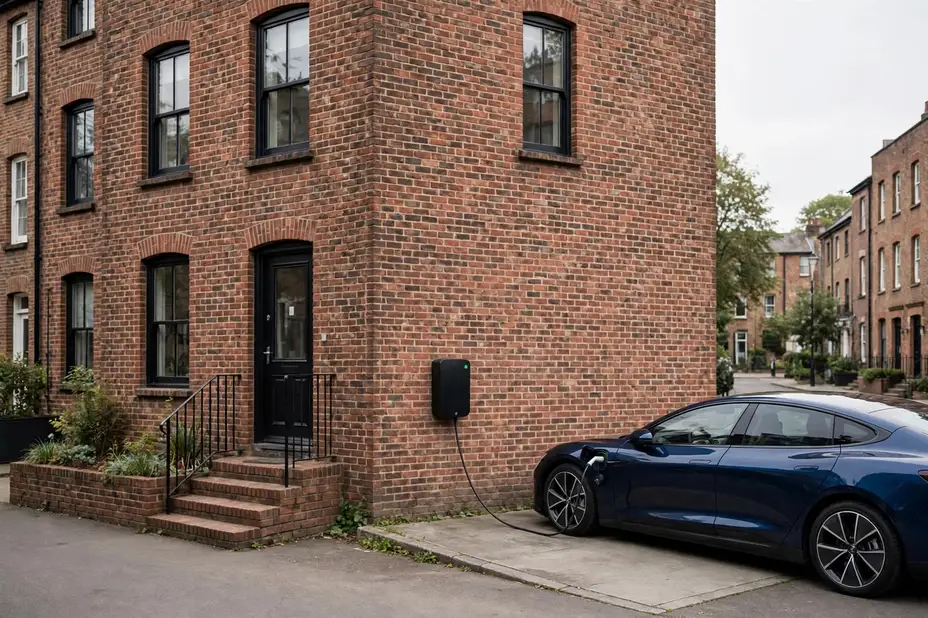
EV charging services in Columbus
Three of the network's services lead this page because local conditions put them first; the remaining seven are one click away and equally available here. Each card states what the service involves — the matching itself is free of obligation until you accept an installer's quote.
Home EV Charger Installation in Columbus
The residential standard: a station where the car sleeps, on a circuit of its own, installed under permit. Variations are all local — the panel's spare room, the run's route through the house's fabric, and the parking pattern the cable has to serve.
In Columbus: where most Columbus projects start and finish: one circuit, one station, one inspection.
Dedicated Circuit & Electrical Panel Upgrade in Columbus
Some homes meet the charger at the panel door: the service is already spoken for by cooking, heating and hot water. This service is the honest fix — capacity added properly, grounding brought current, and a panel schedule that finally matches the house it feeds.
In Columbus: service work that turns 'no room' into a circuit with headroom in Columbus homes.
Level 2 Charger Installation in Columbus
Level 2 is where home charging becomes effortless: a dedicated 240-volt circuit returning a full battery overnight instead of a partial one by morning. The installer's work is the circuit itself — breaker, conductor, connection type — and the station's settings matched to it.
In Columbus: what most Columbus drivers mean when they say they want 'a real charger' — 240 volts, sized to the circuit.
Utility programs and electricity in Columbus
Electricity in Columbus comes from Ohio Power Co. Parts of the wider metro are served by Ohio Edison Co, Duke Energy Ohio Inc, South Central Power Company. The utility matters twice over for a charger install: it sets the time-of-use rates that decide what overnight charging costs you, and it is the organisation that may — or may not — currently help pay for the equipment.
No verified residential charger rebate was in place for Ohio Power Co in the sources checked for this page (the federal Alternative Fuel Refueling Property Credit ended on September 30, 2025, and no Ohio state program replaced it for typical home installs). That can change — utilities open and close funded rounds — so an installer quoting you today should be able to name any current program precisely, with its published terms. If they cannot name it, it is not part of your job.
If your service includes a demand component, the charger's start time matters more than its size: staggered against the house's other big loads, the same circuit costs noticeably less to run across a year.
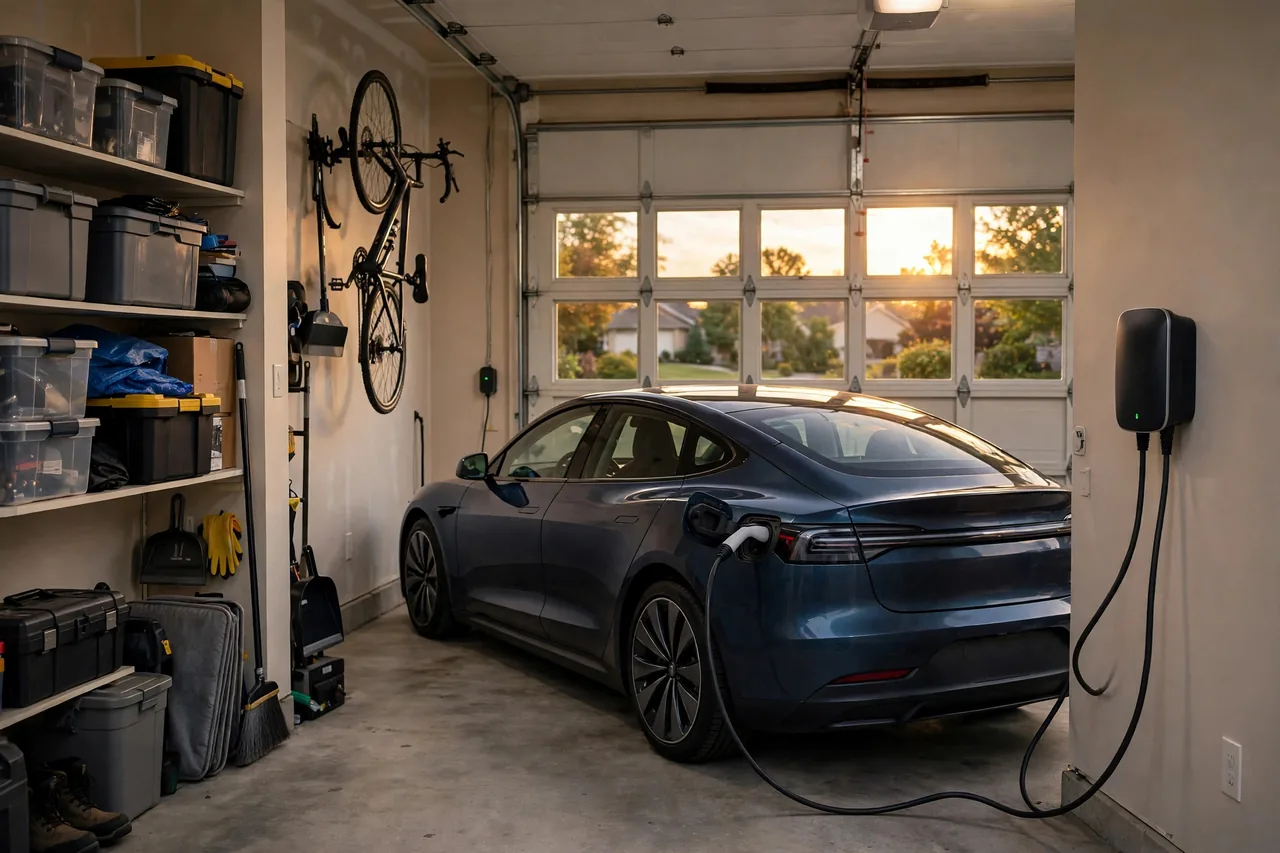
Condos, HOAs and the law in Ohio
Ohio has no statewide right-to-charge law. That needs saying plainly, because roundups on the internet sometimes claim otherwise: in the authoritative statute indexes checked for this page, no Ohio law prevents a homeowners association or condominium from refusing a charger in a common or assigned space. Your community's own covenants and board govern the question in Columbus.
Owners of single-family homes in HOA communities should also check the covenants before assuming the driveway is uncomplicated: exterior-equipment and architectural-approval clauses can apply to a visible wall-mounted station even where the garage interior is entirely the owner's business.
Our condo and HOA guide covers both kinds of state; in Columbus the chapters on complete applications and cost allocation are the operative ones.
Climate, garages and charger placement
Four-season metros ask the install to be two things: kind to a battery in January and indifferent to a thunderstorm in July. The equipment is rated for both out of the box; the local craft is in the details — cable jacket chosen for cold flexibility, mounting placed with drainage in mind, a schedule that follows the seasons' rate windows.
Humidity is the slow variable: it works on exterior connections across seasons rather than in a single event, which is why coastal-grade habits — protected terminations, sealed entries, a yearly glance at the connector — pay off even well inland in a four-season climate.

Permits and inspection in Columbus
Inspection day itself is undramatic by design: access to the panel and the station, the calculation on hand, the equipment's settings matching the circuit. Jobs fail inspection on paperwork mismatches far more often than on wiring — a fact that quietly grades installers.

Neighbourhoods and ZIP codes served
The page covers 45 ZIP codes in and around Columbus — including 43085, 43201, 43202, 43203, 43204, 43205, 43206, 43207, 43209, 43210, 43211, 43212, 43213, 43214, 43215, 43216, 43217, 43218, 43219, 43220, 43221, 43222, 43223, 43224, 43226, 43227, 43228, 43229, 43230, 43231, 43232, 43234, 43235, 43236, 43240, 43251, 43260, 43266, 43268, 43270, 43271, 43272, 43279, 43287, 43291 — across Franklin. If your ZIP is not in the first set shown, ask anyway: installer coverage follows the metro, not a postcode fence.
The same working area takes in the neighbouring localities of Dublin, Westerville, Hilliard, Groveport, Amlin, New Albany, Blacklick, Galloway, Reynoldsburg, Grove City, Brice, Lockbourne, Harrisburg — the county ring an installer based in Columbus actually drives. Requests from those communities route exactly as city requests do: same services, same permit discipline, same local facts where they differ.
Franklin County accounts for 63 of the ZIP codes and 14 named postal localities in the research file, the nearest of them Dublin, Westerville, Hilliard, Groveport, Amlin. The survey counts 1,333,048 residents in the county, with a median household income of $75,176 and a median home value of $288,400. Measured across its ZIP codes, the Columbus footprint runs about 22 miles north to south and 15 east to west, from ZIP 43085 to 43291 — the ground an installer based here actually covers in a working week.
Beyond the county seats, the working area takes in Dublin, Westerville, Lewis Center, Powell, Hilliard, Groveport, Amlin, Galena, New Albany, Blacklick, Delaware, Plain City, Galloway, Sunbury, Reynoldsburg, Grove City, Ostrander, Kilbourne, Summit Station, Brice, Johnstown, Unionville Center, West Jefferson, Pickerington, Lockbourne, Croton, Pataskala, Etna, Harrisburg, Marysville, Canal Winchester, Radnor, Ashley, Magnetic Springs, Orient, Alexandria, Centerburg, Commercial Point, Marengo, Lithopolis, Milford Center, Irwin, Kirkersville, Waldo, Derby, Ashville, Carroll, Baltimore, Fulton, Prospect, Mount Liberty, London, Granville, Broadway, Cardington, Richwood, Newark, Homer, Raymond, Woodstock, Mount Sterling, Millersport, Hebron, Mechanicsburg, North Lewisburg, Thurston, Sparta, Green Camp, Chesterville, Buckeye Lake, Mount Gilead, Middleburg, Pleasantville, Catawba, Marion, Williamsport, Edison, East Liberty, Jacksontown, Utica, South Vienna, Lancaster, Circleville, West Mansfield, Heath, Mount Vernon, Cable, Mingo, Stoutsville, Amanda, Sedalia, Fredericktown, Thornville, Caledonia, Saint Louisville, Zanesfield, Martinsburg, La Rue, New Bloomington, Bloomingburg, Mount Victory, New Holland, Martel, Rushville, Gambier, Tarlton, Iberia, Shauck, Sugar Grove, Ridgeway, West Liberty, Bladensburg, Morral, Glenford, Clarksburg, Brownsville, Howard, Rushsylvania, Bremen, Bellefontaine, Somerset, Bellville — the named localities for which Columbus is the nearest metro in the network (neighbouring metros' pages cover their own ground), each routing to the same installer-matching service.
The wider working area also reaches South Charleston, South Solon, Urbana, Jeffersonville, Springfield — ground shared with neighbouring metros, where installers cross the same county lines in both directions.
The largest communities in that working area after Columbus itself, by the GeoNames populated-place file: Newark (population 47,986), Mansfield (population 46,830), Dublin (population 45,098), Findlay (population 41,149), Lancaster (population 39,766), Grove City (population 39,388), Westerville (population 38,384), Delaware (population 37,995). Charging demand follows those populations — the subdivisions and town centres where the next driveways, and the next panels, are.
Delaware County reaches into the working area with 226,834 residents, a median household income of $133,540 and a median home value of $445,500; its localities on this page include Lewis Center, Powell, Westerville, Galena, Delaware. Licking County reaches into the working area with 181,837 residents, a median household income of $84,426 and a median home value of $275,200; its localities on this page include Summit Station, Johnstown, Croton, Pataskala, Etna. Union County reaches into the working area with 67,324 residents, a median household income of $112,322 and a median home value of $344,900; its localities on this page include Unionville Center, Marysville, Magnetic Springs.
| ZIP | Locality | County |
|---|---|---|
| 43085 | Columbus | Franklin |
| 43235 | Columbus | Franklin |
| 43236 | Columbus | Franklin |
| 43229 | Columbus | Franklin |
| 43214 | Columbus | Franklin |
| 43240 | Columbus | Franklin |
| 43231 | Columbus | Franklin |
| 43220 | Columbus | Franklin |
| 43224 | Columbus | Franklin |
| 43017 | Dublin | Franklin |
| 43202 | Columbus | Franklin |
| 43081 | Westerville | Franklin |
| 43035 | Lewis Center | Delaware |
| 43221 | Columbus | Franklin |
| 43211 | Columbus | Franklin |
| 43210 | Columbus | Franklin |
| 43065 | Powell | Delaware |
| 43201 | Columbus | Franklin |
| 43219 | Columbus | Franklin |
| 43016 | Dublin | Franklin |
| 43212 | Columbus | Franklin |
| 43082 | Westerville | Delaware |
| 43026 | Hilliard | Franklin |
| 43086 | Westerville | Franklin |
| 43199 | Groveport | Franklin |
| 43216 | Columbus | Franklin |
| 43218 | Columbus | Franklin |
| 43226 | Columbus | Franklin |
| 43234 | Columbus | Franklin |
| 43251 | Columbus | Franklin |
| 43260 | Columbus | Franklin |
| 43266 | Columbus | Franklin |
| 43268 | Columbus | Franklin |
| 43270 | Columbus | Franklin |
| 43271 | Columbus | Franklin |
| 43272 | Columbus | Franklin |
| 43279 | Columbus | Franklin |
| 43287 | Columbus | Franklin |
| 43291 | Columbus | Franklin |
| 43230 | Columbus | Franklin |
| 43215 | Columbus | Franklin |
| 43203 | Columbus | Franklin |
| 43002 | Amlin | Franklin |
| 43222 | Columbus | Franklin |
| 43205 | Columbus | Franklin |
| 43021 | Galena | Delaware |
| 43204 | Columbus | Franklin |
| 43206 | Columbus | Franklin |
| 43209 | Columbus | Franklin |
| 43228 | Columbus | Franklin |
| 43223 | Columbus | Franklin |
| 43054 | New Albany | Franklin |
| 43004 | Blacklick | Franklin |
| 43227 | Columbus | Franklin |
| 43213 | Columbus | Franklin |
| 43015 | Delaware | Delaware |
| 43207 | Columbus | Franklin |
| 43064 | Plain City | Madison |
| 43119 | Galloway | Franklin |
| 43074 | Sunbury | Delaware |
| 43232 | Columbus | Franklin |
| 43068 | Reynoldsburg | Franklin |
| 43123 | Grove City | Franklin |
| 43069 | Reynoldsburg | Franklin |
| 43061 | Ostrander | Delaware |
| 43032 | Kilbourne | Delaware |
| 43073 | Summit Station | Licking |
| 43109 | Brice | Franklin |
| 43195 | Groveport | Franklin |
| 43031 | Johnstown | Licking |
| 43077 | Unionville Center | Union |
| 43125 | Groveport | Franklin |
| 43162 | West Jefferson | Madison |
| 43217 | Columbus | Franklin |
| 43147 | Pickerington | Fairfield |
| 43137 | Lockbourne | Pickaway |
| 43013 | Croton | Licking |
| 43194 | Lockbourne | Franklin |
| 43062 | Pataskala | Licking |
| 43018 | Etna | Licking |
| 43126 | Harrisburg | Franklin |
| 43041 | Marysville | Union |
| 43040 | Marysville | Union |
| 43110 | Canal Winchester | Fairfield |
| 43066 | Radnor | Delaware |
| 43003 | Ashley | Delaware |
| 43036 | Magnetic Springs | Union |
| 43146 | Orient | Pickaway |
| 43001 | Alexandria | Licking |
| 43011 | Centerburg | Knox |

Planning the install: from panel to parking
Think of the project as a chain with four links: capacity, route, placement, paperwork. Capacity is the load calculation. Route is the path copper takes from panel to parking — through a shared wall if you are lucky, across a ceiling or a trench if you are not. Placement is the unglamorous decision that governs daily life with the car for a decade: reach, cable slack, and which side the port is on. Paperwork is the permit and the passed inspection, the proof that outlives the installer's visit.
Finally, photograph the finished work — station, nameplate, panel directory with the new breaker labelled — and file it with the inspection record. When the car changes, the house sells or a second station joins the first, that folder is the difference between a five-minute answer and an archaeological dig.
Home charging know-how for Columbus households
The charger among workshop loads
Garages that double as workshops put the charger in interesting company: welders, compressors, dust collectors — loads with appetites and opinions. The load calculation for such a house reads the whole tenancy, and the honest conversation includes which loads genuinely coincide. A station scheduled into the workshop's quiet hours lives peacefully; one competing with the table saw's startup surge teaches the household about breaker curves the experiential way.
The school-run charge window
Households organised around school runs live on a distinctive charge curve: two short hops, a long parked day, an afternoon of activities. The car sits at home for the middle of the day — which, for solar households, is precisely the generation window, and for everyone else makes the overnight session almost an afterthought. Scheduling follows the family's actual day, not the tariff's assumption of one, and the installer who asks about the school run is designing, not chatting.
Retrofitting the older apartment building
Older multifamily buildings meet charging with a capacity question before any other: the service was sized for another era's loads. The professional answer is a load study — what the building actually draws across its day — followed by a managed design that fits charging into the valleys, with make-ready capacity for the applicants who have not yet appeared. It is slower than a house install and more deliberate, and it is the reason experienced multifamily installers start with the building's electrical room rather than its car park.
Chargers and the flood line
Some garages flood — not catastrophically, just historically: the spring inch, the storm drain's bad day. The charger belongs above the line the water has actually reached, a fact the house knows and the install conversation should ask about. Mounting height, conduit entry points and the station's own listing all have flood-aware versions, and in the streets that need them, local installers raise the subject before the homeowner does.
Vehicles that work from home
A growing class of households runs a business from the drive: trades vans, delivery vehicles, a car that is also the office. Their charging arithmetic differs from the commuter's — higher daily miles, tighter morning deadlines, and a vehicle whose readiness is revenue. The design answers scale accordingly: capacity with headroom, a schedule set against the working day rather than the night, and occasionally the second circuit sooner than a private household would need it. If the vehicle earns, say so at the site visit; it changes the specification.

Frequently asked questions
Can I still get the federal tax credit for a home charger in Columbus, OH?
The three possible pots are all, at present, empty for a Columbus homeowner: no Ohio Power Co residential rebate in current published sources, no Ohio home programme, and a federal credit that closed on September 30, 2025. Programmes do relaunch — on the utility's site, with dates — and until one does, the honest quote is the one with no rebate line at all.
Can my association in Columbus, OH say no to a home charger?
Possibly, yes. Ohio has no statewide right-to-charge law in the authoritative indexes checked for this page, so your community's covenants govern. A complete written application — licensed installer, dedicated circuit, owner-paid metering and insurance — is the approach that gets approvals here.
Panel upgrade or not — how do Columbus, OH homeowners find out?
Sometimes — and Columbus's housing stock is exactly why the question is worth asking properly. With a median build year of 1982 and roughly 47% of homes predating 1980, plenty of local panels are 100-amp units already carrying a full modern load. Those homes choose between an upgrade and load management; newer 200-amp homes usually just add the circuit. The site visit's load calculation is the decider.
How quickly will a Level 2 charger fill my car in Columbus, OH?
In parked hours: a Level 1 cord returns about 3–5 miles for each of them, and a Level 2 circuit returns roughly 25–40, set by its amperage and the car's acceptance. For a Columbus household parking ten hours, that is the difference between recovering a short errand day and recovering any day the car can legally drive.
How does the installer matching on this page work?
Three steps: the request routes to installers who work Columbus, Ohio; one contacts you to walk the property; the walk produces the written quote. Everything on this page — the utility position, the law, the housing data — is yours to check that quote against.
Do installers cover the communities around Columbus, OH?
Yes — an installer's working area is the county ring, not the city limit. From this page the same request flow covers Dublin, Westerville, Hilliard, Groveport, Amlin and the rest of Columbus's surrounding localities, under the same permit discipline and the same local facts where they differ.
Nearby cities in Ohio
- EV charger installation in Dayton — about 73 miles from Columbus, metro population 825,000
- EV charger installation in Akron — about 105 miles from Columbus, metro population 700,000
- EV charger installation in Cincinnati — about 106 miles from Columbus, metro population 2,300,000
- EV charger installation in Cleveland — about 126 miles from Columbus, metro population 2,100,000
- EV charger installation in Fort Wayne, IN — about 133 miles from Columbus, metro population 425,000
- EV charger installation in Detroit, MI — about 155 miles from Columbus, metro population 4,350,000
- EV charger installation in Lexington, KY — about 165 miles from Columbus, metro population 525,000
Ready to charge at home in Columbus?
Tell us the job — service, ZIP and property type — and licensed local installers will take it from there.