EV Charger Installation in Akron, OH
Home Level 2 charging, panel upgrades and condo installs in Akron — matched to licensed local installers, with the local facts that shape the job set out below.
There is a short list of things that never change about a charger install — it needs capacity, a route, a position and a permit — and a longer list of things that change with the ZIP code. This page is the longer list, for Akron. Akron itself is home to about 189,669 people. Ohio's registered electric fleet reached 94,200 battery-electric vehicles and 37,200 plug-in hybrids through 2025, and the installers working this metro have local habits worth borrowing. The utility section states what is verified and what is not; the law section quotes the position as it stands; the housing section works from survey data rather than vibes.
How to read this page in four minutes: the data band tells you what kind of housing city Akron is; the utility section tells you whether money is on the table; the law section tells you whether permission is a process or a negotiation; and the permit section tells you what proof the finished job leaves behind. The rest is elaboration.
What the Experian and AFDC registration data say about Akron: OH stock. Translated out of market language: your neighbours are already charging at home, the permit office already knows the paperwork, and the installers already know the housing stock.
The same survey puts median household income in Akron at $48,521, with 54% of occupied homes owner-occupied and 67% of the housing stock single-unit detached. For charging, those are the operative facts: owners can approve their own electrical work, and detached homes put the car, the panel and the parking under one roof.

Every city charges differently, and Akron's difference is legible in the data: an older housing fabric, where panel archaeology is a normal part of the first visit; a detached-house majority with a real attached and multifamily minority; buildings of five or more units are a visible minority of the stock; owners hold a working majority, with renters a significant minority. Read the sections below through that profile and the local advice resolves into specifics — which questions are routine here, and which are rare.
In absolute terms, the survey counts 94,725 housing units in Akron — 86,815 occupied, 46,831 of them by their owners. The stock resolves into 63,761 single-unit detached houses, 77,831 homes standing since before 1980, and 16,950 units in larger buildings. Those six counts are the city's charging map drawn without percentages, and every section of this page is a consequence of one of them. The page's geography is equally concrete: 27 ZIP codes across Summit, centred near 41.04 degrees north latitude. The city anchors the Akron metropolitan area, home to roughly 700,000 people on the research file's metro estimate — the wider labour and housing market this page's installers work across.
The same survey release fills in the household economics around the housing stock: a median home value of $122,000, median gross rent of $955, per-capita income of $29,457, and a median resident age of 37. And the daily rhythms behind the housing numbers: 72% of Akron workers drive to work alone — the commute pattern home charging is built around; 11% work from home, a population whose cars charge on daytime and overnight schedules alike; 2% commute by public transit; 24% of adults hold a bachelor's degree or higher. The survey's vehicle table is the one an EV page should quote first: 12,736 of Akron's households have no vehicle at all, while 37,485 have two or more — the multi-car households for whom the second circuit is a when, not an if.
Two burden statistics frame the economics: in Akron, 53% of renters and 0% of mortgage-holding owners are housing-cost burdened at the standard 30% threshold. And 53% of households are family households, the segment most likely to run the two-vehicle, two-schedule pattern the second-vehicle planning notes address.
What follows is the city read as an electrical place rather than a dot on a map. The oldest housing throws the longest shadows over an install: knob-and-tube remnants in the attic, ungrounded receptacles, services sized for iceboxes and radios that now feed induction ranges and heat pumps. Where form is mixed, advice must be conditional — the honest page, like the honest installer, keeps asking which housing the reader actually lives in before prescribing.
Where renting dominates, the successful install is a document before it is a device — installer licence, insurance, metering clarity, end-of-tenancy position — assembled to make a landlord's yes the path of least resistance. The install market that serves modest incomes runs on referrals and repetition: neighbourhoods where one good install, fairly scoped, produces the street's next five customers. Filed tariffs and public dockets give this territory a paper trail most markets lack: the diligent household can read the utility's own electrification plan and know which programmes are funded, piloted or merely proposed.
Growth-phase markets reward the prepared household: boards writing their first charging policy, landlords forming their first standard answer — a complete, professional application shapes the precedent it will be judged by. At this scale the city's charging infrastructure is legible — a household can learn the whole local system, its programmes, precedents and people, in an evening's reading. This page is most of that evening. Without a state charging statute, shared-property approvals in this metro are won on paper quality: metering clarity, licensed installers, insurance, reversibility — the complete package the guides set out.
The electrical reality in Akron homes
Tenure first, because tenure allocates the decisions: 54% of Akron's occupied homes are owner-occupied, free to commission electrical work outright. The stock they occupy has a median build year of 1955; 82% predates 1980; 67% is detached single-unit. For the owner-occupied majority, the charger question is purely electrical, and these are the electrical facts. Age shows up electrically before it shows up anywhere else: services sized for a house with a third of today's appliances. Expect the first conversation to be about capacity — what the panel is, what it already feeds, and which of the three routes (circuit, management, upgrade) your numbers support. Detached houses matter for a practical reason: a garage or driveway on your own lot means the charger, the car and the circuit are all under one roof and one owner's control, which is the simplest configuration there is.
One further survey line belongs in any Akron install conversation: 17% of the city's homes heat with electricity — 14,431 households whose panels already carry a major winter load before a charger is contemplated. Electric heat and EV charging are the two largest discretionary loads a house can host, and where they coincide, the load calculation stops being a formality.
Renters are the other constituency in these numbers: about 39,984 of Akron's occupied homes are rented rather than owned. Their charging route runs through a landlord conversation instead of a panel they control — a different project, covered by the rentals guide and the law section below, but a routine one in a city with this many renting households.
And 18% of Akron's homes are in buildings with five or more units — apartments and condominiums where charging is a building decision before it is an electrical one. If that is your situation, the law and multifamily sections of this page are the ones written for you.
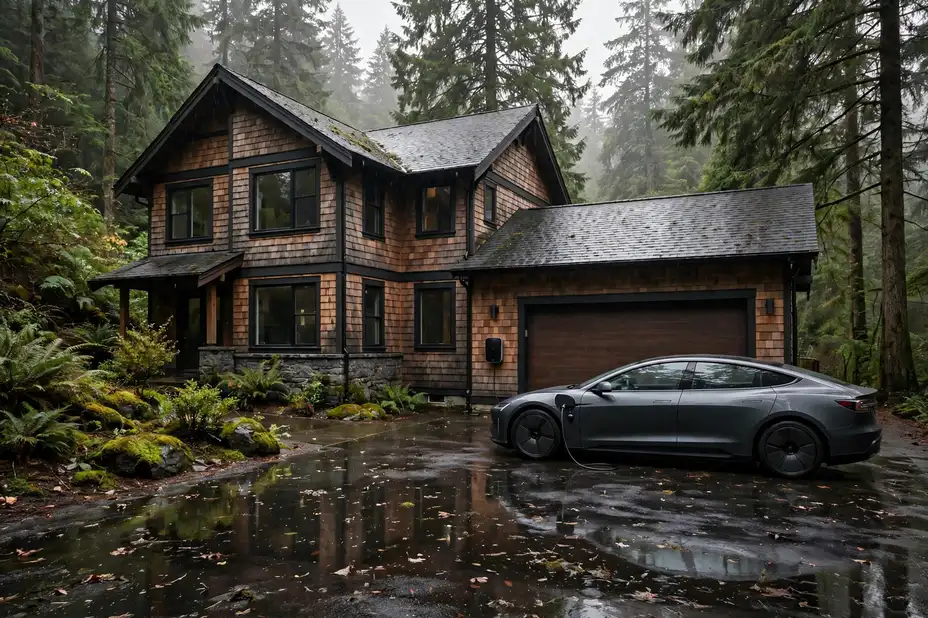
EV charging services in Akron
Installers in Akron book the same ten services as everywhere — but not in the same proportions. The three leading cards below are this city's pattern, set by its panels, its buildings and its statute book.
Home EV Charger Installation in Akron
For most households this is the whole project: a Level 2 station mounted where the car sleeps, fed by its own 240-volt circuit. The visit pattern is consistent — load calculation, route the run, mount and configure, inspect — and the variables are your panel, your parking and your permit office.
In Akron: the default first install for Akron's EV households — a station where the car already parks.
Dedicated Circuit & Electrical Panel Upgrade in Akron
A service change is the least reversible and most enabling job on this page: it re-bases the whole house's electrical life. Done inside the charger project, it shares the permit, the utility visit and the electrician's day with the circuit it makes room for.
In Akron: the job that surfaces wherever housing is older — and Akron's stock makes it a routine conversation, settled by a load calculation.
Level 2 Charger Installation in Akron
The step up from a household outlet to a real circuit: 240 volts, sized as a continuous load, delivering several times the overnight range of a Level 1 cord. The craft is in matching circuit, station configuration and vehicle acceptance so the three agree.
In Akron: the 240-volt step that turns overnight charging in Akron from a trickle into a full battery by morning.
Utility programs and electricity in Akron
Electricity in Akron comes from Ohio Power Co. Parts of the wider metro are served by Ohio Edison Co, Cleveland Electric Illum Co, City of Cuyahoga Falls. The utility matters twice over for a charger install: it sets the time-of-use rates that decide what overnight charging costs you, and it is the organisation that may — or may not — currently help pay for the equipment.
Frame the Akron incentive question correctly and it answers itself. Three pots could in principle fund part of a home charger: a federal credit, a Ohio program, a Ohio Power Co rebate. The first ended on September 30, 2025. The second does not exist for typical home installs. The third, in the sources checked for this page, is not currently offered for residential customers. Zero plus zero plus zero is the honest budget line — and any future change will arrive through the utility's own program page, with dates, which is where this page will take it from.
Renters and condo owners should note the metering question early: whose meter the charger hangs off decides who pays for the energy, and Ohio Power Co's options for submetering are part of the multifamily conversation below.
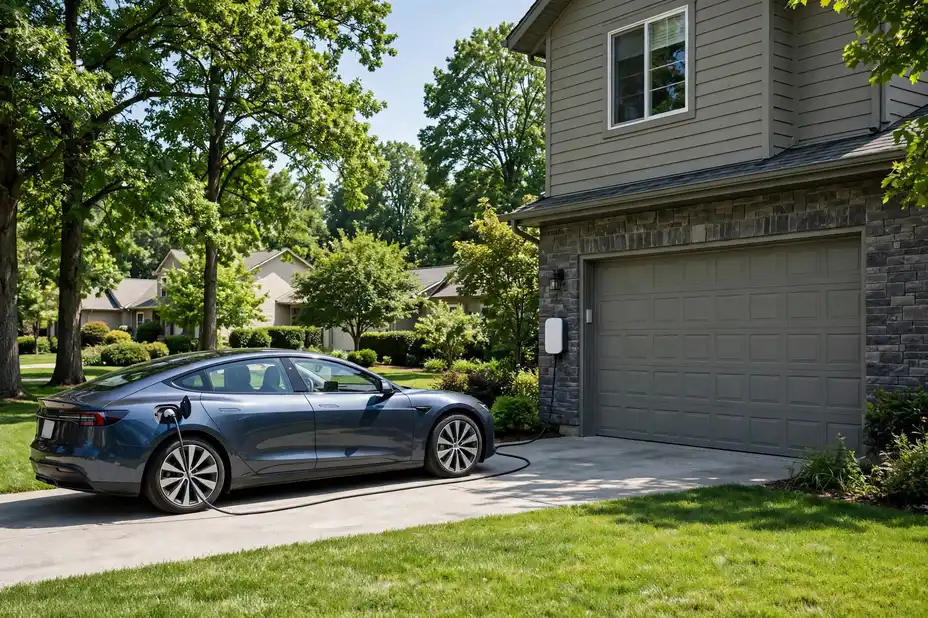
Condos, HOAs and the law in Ohio
Ohio has no statewide right-to-charge law. That needs saying plainly, because roundups on the internet sometimes claim otherwise: in the authoritative statute indexes checked for this page, no Ohio law prevents a homeowners association or condominium from refusing a charger in a common or assigned space. Your community's own covenants and board govern the question in Akron.
Owners of single-family homes in HOA communities should also check the covenants before assuming the driveway is uncomplicated: exterior-equipment and architectural-approval clauses can apply to a visible wall-mounted station even where the garage interior is entirely the owner's business.
Our condo and HOA guide covers both kinds of state; in Akron the chapters on complete applications and cost allocation are the operative ones.
Climate, garages and charger placement
Seasonal scheduling is the quiet optimisation here: summer peaks and winter range loss both argue for charging deep in the overnight window, when rates and temperatures are kindest. Set the schedule once, in the car or the station, and the seasons stop appearing in the household's charging routine at all.
Four-season metros ask the install to be two things: kind to a battery in January and indifferent to a thunderstorm in July. The equipment is rated for both out of the box; the local craft is in the details — cable jacket chosen for cold flexibility, mounting placed with drainage in mind, a schedule that follows the seasons' rate windows.

Permits and inspection in Akron
Bring the panel schedule up to date while the electrician is in it — the new circuit labelled, in the directory, in pen. Inspectors notice; future electricians bless you for it; and the load calculation for any second circuit starts from that card.

Neighbourhoods and ZIP codes served
The page covers 27 ZIP codes in and around Akron — including 44301, 44302, 44303, 44304, 44305, 44306, 44307, 44308, 44309, 44310, 44311, 44312, 44313, 44314, 44315, 44316, 44317, 44319, 44320, 44321, 44325, 44326, 44328, 44333, 44372, 44396, 44398 — across Summit. If your ZIP is not in the first set shown, ask anyway: installer coverage follows the metro, not a postcode fence.
The same working area takes in the neighbouring localities of Lakemore, Barberton, Hudson, Tallmadge, Cuyahoga Falls, Fairlawn, Uniontown, Munroe Falls, Clinton, Green, Mogadore, Stow, Bath, Peninsula — the county ring an installer based in Akron actually drives. Requests from those communities route exactly as city requests do: same services, same permit discipline, same local facts where they differ.
Summit County accounts for 48 of the ZIP codes and 19 named postal localities in the research file, the nearest of them Lakemore, Barberton, Hudson, Tallmadge, Cuyahoga Falls. The survey counts 537,864 residents in the county, with a median household income of $71,622 and a median home value of $208,700. Measured across its ZIP codes, the Akron footprint runs about 12 miles north to south and 11 east to west, from ZIP 44301 to 44398 — the ground an installer based here actually covers in a working week.
Beyond the county seats, the working area takes in Lakemore, Barberton, Hudson, Tallmadge, Cuyahoga Falls, Fairlawn, Uniontown, Munroe Falls, Clinton, Green, Mogadore, Stow, Greentown, Doylestown, Canal Fulton, Canton, Kent, Wadsworth, Bath, Hartville, Sharon Center, Peninsula, Brady Lake, Marshallville, Middlebranch, Richfield, Randolph, Rittman, North Lawrence, Massillon, Streetsboro, Atwater, Ravenna, Rootstown, Hinckley, Medina, Seville, North Canton, Sterling, Orrville, Louisville, Dalton, Limaville, Chippewa Lake, Brunswick, East Canton, Navarre, Maximo, Westfield Center, Creston, Smithville, Brewster, Mantua, Alliance, Kidron, East Sparta, Apple Creek, Deerfield, Valley City, Wayland, Mount Eaton, Paris, Diamond, Robertsville, Burbank, Beach City, Lodi, Wilmot, North Benton, Bolivar, Litchfield, Waynesburg, Wooster, Sebring, Sandyville, Windham, Magnolia, Zoar, Garrettsville, Lake Milton, Homeworth, Strasburg, Fredericksburg, Malvern, Beloit, Minerva, Winesburg, Dundee, Newton Falls, Spencer, Damascus, Berlin Center, Mount Hope, North Georgetown, West Salem, Homerville, East Rochester, Mineral City, Somerdale, Dover, Southington, Holmesville, Dellroy, North Jackson, Walnut Creek, Ellsworth, Berlin, Warren, Augusta, Shreve, Sugarcreek, Winona, Leavittsburg, Salem, Millersburg, Hanoverton, Sullivan, New Philadelphia, Polk, Kensington, Sherrodsville, Youngstown, Charm, Wellington, Jeromesville, Carrollton, Greenford, Baltic, Canfield, Big Prairie, Mechanicstown, Mineral Ridge, Midvale, Nankin, Washingtonville, Summitville, Niles, Leetonia, Lakeville, Mc Donald, Stone Creek, Leesville — the named localities for which Akron is the nearest metro in the network (neighbouring metros' pages cover their own ground), each routing to the same installer-matching service.
The wider working area also reaches Northfield, Twinsburg, Broadview Heights, Aurora, North Royalton, Bedford, Independence, Strongsville, Maple Heights, Cleveland, Chagrin Falls, Hiram, Beachwood, Olmsted Falls, Novelty, Grafton, Newbury, North Olmsted, Lakewood, Gates Mills, Chesterland, Westlake, Euclid, Lagrange, West Farmington, Middlefield, Wickliffe, Chardon, East Claridon, Willoughby, Eastlake, Mesopotamia, Oberlin, Bristolville, Mentor — ground shared with neighbouring metros, where installers cross the same county lines in both directions.
ZIP codes in that shared ground include 44011, 44017, 44022, 44024, 44033, 44039, 44040, 44050, 44054, 44056, 44061, 44062, 44065, 44067, 44074, 44092, 44095, 44097, 44103, 44105, 44106, 44110, 44111, 44112, 44114, 44126, 44128, 44131, 44132, 44133, 44134, 44136, 44137, 44144, 44145, 44146, 44149, 44202, 44402, 44439.
The largest communities in that working area after Akron itself, by the GeoNames populated-place file: Canton (population 71,885), Youngstown (population 64,628), Cuyahoga Falls (population 49,146), Warren (population 40,245), Boardman (population 35,376), Stow (population 34,797), Brunswick (population 34,689), Massillon (population 32,252), Kent (population 29,810), Austintown (population 29,677), Wooster (population 26,749), Medina (population 26,339), Barberton (population 26,234), Green (population 25,898), Hudson (population 22,437), Alliance (population 22,055), Wadsworth (population 21,860), Ashland (population 20,317), Niles (population 18,651), Tallmadge (population 17,512). Charging demand follows those populations — the subdivisions and town centres where the next driveways, and the next panels, are.
Stark County reaches into the working area with 373,713 residents, a median household income of $67,934 and a median home value of $186,400; its localities on this page include Greentown, Canal Fulton, Canton, Hartville. Portage County reaches into the working area with 161,956 residents, a median household income of $75,766 and a median home value of $227,000; its localities on this page include Kent, Brady Lake, Randolph. Medina County reaches into the working area with 183,660 residents, a median household income of $94,968 and a median home value of $287,000; its localities on this page include Wadsworth, Sharon Center, Hinckley, Medina. Wayne County reaches into the working area with 116,588 residents, a median household income of $73,574 and a median home value of $222,100; its localities on this page include Doylestown, Marshallville, Rittman, Sterling, Orrville.
| ZIP | Locality | County |
|---|---|---|
| 44301 | Akron | Summit |
| 44317 | Akron | Summit |
| 44311 | Akron | Summit |
| 44306 | Akron | Summit |
| 44328 | Akron | Summit |
| 44314 | Akron | Summit |
| 44325 | Akron | Summit |
| 44307 | Akron | Summit |
| 44308 | Akron | Summit |
| 44316 | Akron | Summit |
| 44304 | Akron | Summit |
| 44326 | Akron | Summit |
| 44315 | Akron | Summit |
| 44302 | Akron | Summit |
| 44309 | Akron | Summit |
| 44320 | Akron | Summit |
| 44305 | Akron | Summit |
| 44303 | Akron | Summit |
| 44310 | Akron | Summit |
| 44312 | Akron | Summit |
| 44319 | Akron | Summit |
| 44250 | Lakemore | Summit |
| 44203 | Barberton | Summit |
| 44237 | Hudson | Summit |
| 44372 | Akron | Summit |
| 44396 | Akron | Summit |
| 44398 | Akron | Summit |
| 44313 | Akron | Summit |
| 44278 | Tallmadge | Summit |
| 44222 | Cuyahoga Falls | Summit |
| 44221 | Cuyahoga Falls | Summit |
| 44223 | Cuyahoga Falls | Summit |
| 44334 | Fairlawn | Summit |
| 44685 | Uniontown | Summit |
| 44321 | Akron | Summit |
| 44262 | Munroe Falls | Summit |
| 44216 | Clinton | Summit |
| 44232 | Green | Summit |
| 44260 | Mogadore | Summit |
| 44333 | Akron | Summit |
| 44224 | Stow | Summit |
| 44630 | Greentown | Stark |
| 44230 | Doylestown | Wayne |
| 44614 | Canal Fulton | Stark |
| 44767 | Canton | Stark |
| 44240 | Kent | Portage |
| 44282 | Wadsworth | Medina |
| 44242 | Kent | Portage |
| 44210 | Bath | Summit |
| 44281 | Wadsworth | Medina |
| 44243 | Kent | Portage |
| 44632 | Hartville | Stark |
| 44274 | Sharon Center | Medina |
| 44264 | Peninsula | Summit |
| 44211 | Brady Lake | Portage |
| 44718 | Canton | Stark |
| 44236 | Hudson | Summit |
| 44645 | Marshallville | Wayne |
| 44652 | Middlebranch | Stark |
| 44286 | Richfield | Summit |
| 44265 | Randolph | Portage |
| 44721 | Canton | Stark |
| 44270 | Rittman | Wayne |
| 44666 | North Lawrence | Stark |
| 44709 | Canton | Stark |
| 44646 | Massillon | Stark |
| 44708 | Canton | Stark |
| 44647 | Massillon | Stark |
| 44241 | Streetsboro | Portage |
| 44714 | Canton | Stark |
| 44201 | Atwater | Portage |
| 44266 | Ravenna | Portage |
| 44272 | Rootstown | Portage |
| 44703 | Canton | Stark |
| 44705 | Canton | Stark |
| 44648 | Massillon | Stark |
| 44711 | Canton | Stark |
| 44735 | Canton | Stark |
| 44799 | Canton | Stark |
| 44710 | Canton | Stark |
| 44233 | Hinckley | Medina |
| 44702 | Canton | Stark |
| 44258 | Medina | Medina |
| 44273 | Seville | Medina |
| 44720 | North Canton | Stark |
| 44276 | Sterling | Wayne |
| 44750 | Canton | Stark |
| 44704 | Canton | Stark |
| 44667 | Orrville | Wayne |
| 44641 | Louisville | Stark |

Planning the install: from panel to parking
A useful way to read any Akron quote is to ask which of three jobs it describes. Job one: the panel has room and the run is short — a circuit and a station. Job two: the panel is full — capacity work joins the quote, as an upgrade or as load management. Job three: the property adds people — an HOA, a landlord, a building's shared service — and the approvals timeline joins the electrical one. None of the three is a bad job; they are simply different scopes, and a clear quote says which one you are in.
One more piece of sequencing advice Akron installers give consistently: if the panel is being opened anyway, settle the other electrical maybes in the same visit — the circuit you will want next year costs least while the permit and the electrician are already in the house.
Home charging know-how for Akron households
What an outage does and does not change
When the grid goes down, a standard home charging station goes quiet with everything else — it is a load, not a source, and it neither drains the car nor feeds the house. Sessions resume or restart when power returns, and the car's own settings govern which. Households in outage country plan around this plainly: charge ahead of forecast storms the way you would fill a fuel tank, and treat the car as the household's largest battery-shaped object — one that, with today's standard equipment, keeps its energy to itself.
When the garage is detached
A detached garage changes the install's centre of gravity: the circuit must travel. The route is usually a buried conduit run from the house panel, with depth, conduit type and the trench's path past roots, irrigation and paving all settled at the design stage — or, where the run is long and the loads justify it, a subpanel in the garage that also serves the workshop the building inevitably becomes. The charger at the end of that run behaves exactly like any other; it is the journey, measured in copper and digging, that defines the job.
Charging through the winter
Winter changes the arithmetic of home charging without changing its logic. A cold battery accepts energy more slowly and spends some of it on staying warm, so the same commute consumes more of the overnight window in January than in June. The household answers are unglamorous: park plugged in every night rather than in long sessions twice a week, let the car precondition from the wall before departure, and keep the connector holstered out of the weather. A Level 2 circuit with headroom absorbs all of this invisibly — which is precisely why northern households tend to size the circuit generously at install time rather than return to the question later.
Planning for the second EV
The second electric car rarely arrives as a surprise — it is the household's own verdict on the first one. Planning for it at the first install costs little: conduit sized a step up, panel capacity reserved on the schedule, and a station position that can serve a second bay or share its circuit through power-sharing equipment. Retrofitting the same readiness later means reopening finished work. Installers ask about the five-year picture during the site visit because the honest answers change today's scope more cheaply than any other conversation in the project.
When you move: take it or leave it
The station is portable in a way the circuit is not. A plug-in unit unplugs and travels; a hardwired one leaves with an electrician's half hour. The circuit — the larger share of the original project — stays with the house, where the paperwork decides what it is worth: documented as a permitted charger circuit, it is a listing feature for the next EV household; undocumented, it is a mystery outlet in the garage. Owners planning a move inside a few years can say so at install time; the plug-in-versus-hardwired choice reads differently with a departure date attached.

Frequently asked questions
Is the federal charger tax credit still available in Akron, OH?
That credit is finished: 30C ended on September 30, 2025. What about locally? In the utility and state sources checked for this page, nothing verified was running for Akron homeowners — no Ohio Power Co rebate, no state scheme. If one opens, it will appear on the utility's site with dates; plan your install without it meanwhile.
Can my HOA or condo board in Akron, OH refuse my charger?
Legally, yes — and it is better to know that before you buy the car. Ohio has enacted no right-to-charge law, so an association in Akron may refuse, condition or delay a charger under its covenants. The counterweight is a complete, documented application and, if refused, a written refusal citing the covenant — the record a future board or a future statute works from.
Does a Level 2 charger mean a panel upgrade for a Akron, OH home?
Nobody can answer that from a photograph of your panel's door, and you should be suspicious of anyone who tries. In a city where the median home dates to 1955 and about 82% of units predate 1980, the honest answer is a load calculation: what your service is, what it already carries, and what a continuous charger load does to the total. Then the options — circuit, load management, or upgrade — compare on paper.
How quickly will a Level 2 charger fill my car in Akron, OH?
Think of it in parked hours. Level 1 gives you back 3–5 miles for each of them; Level 2 gives back about 25–40, set by the circuit's amperage and what the car can accept. Overnight, that is the gap between 'enough for tomorrow' and 'full, every morning'.
What happens next after I send a request?
Your request — service, Akron ZIP, property type and timing — goes to licensed local installers who cover Akron. They contact you directly to arrange a site visit and quote. PlugReady USA is the matching service, not the installer, and the sections above exist so you can judge any quote against the local facts.
How long does a typical home charger installation take in Akron, OH?
Separate the three clocks. The installer's clock: typically a day of electrical work for the standard layout. The permit office's clock: issuance on the department's queue. The inspector's clock: a visit scheduled after the work. A realistic quote in Akron, Ohio names all three; the total is usually days to a few weeks, dominated by the two clocks nobody on the crew controls.
Nearby cities in Ohio
- EV charger installation in Cleveland — about 33 miles from Akron, metro population 2,100,000
- EV charger installation in Columbus — about 105 miles from Akron, metro population 2,150,000
- EV charger installation in Dayton — about 176 miles from Akron, metro population 825,000
- EV charger installation in Cincinnati — about 211 miles from Akron, metro population 2,300,000
- EV charger installation in Pittsburgh, PA — about 95 miles from Akron, metro population 2,400,000
- EV charger installation in Erie, PA — about 109 miles from Akron, metro population 265,000
- EV charger installation in Detroit, MI — about 124 miles from Akron, metro population 4,350,000
Ready to charge at home in Akron?
Two minutes of form, and the request is in front of licensed installers who cover this city — quotes follow site visits, in writing.