EV Charger Installation in Dayton, OH
Charging where you park, in Dayton: the utility programs, state law, permit process and housing facts behind a home charger install, gathered in one place.
Charging at home is the version of EV ownership that actually works day to day, and in Dayton it starts with a straightforward question: where will the car sleep, and what can the electrical panel behind that wall honestly support? Dayton itself is home to about 136,343 people, and 94,200 battery-electric vehicles plus 37,200 plug-in hybrids were registered across Ohio by the end of 2025 — every one of them a household that charges somewhere. This page gathers what a homeowner in Dayton needs to know before booking an installer: the local utility and its current charger programs, the state law that applies in condos and HOA communities, the permit process, and the housing realities that decide how simple or involved an installation will be.
The sections that follow are deliberately unglamorous: statutes, survey data, permit counters, tariff habits. That is what a good install is made of. The car is the exciting part; this page is about the wall it plugs into.
Measured demand, not enthusiasm, put Dayton in Tier B of this network: OH stock. For a homeowner the useful translation is simpler — installers here do this work weekly, know the local permit counter, and have seen your housing stock before.
Three survey lines do most of the predictive work on this page. Income — a median of $45,846 per household — tracks the pace at which Dayton households adopt EVs at all. Tenure — 52% owner-occupied — decides whose signature the work needs. And structure — 64% single-unit detached — decides how often the answer is a simple garage circuit rather than a building negotiation.

Put the survey together and Dayton's charging profile reads like this: an older housing fabric, where panel archaeology is a normal part of the first visit; a detached-house majority with a real attached and multifamily minority; buildings of five or more units are a visible minority of the stock; and owners hold a working majority, with renters a significant minority. That combination — more than any single number — is what the installers working here plan around, and it is the lens for everything on this page.
Keep six figures and you keep Dayton's whole electrical character: 73,068 housing units; 59,778 occupied homes; 31,193 owner-occupied; 47,128 detached houses; 62,175 pre-1980 homes; 13,406 homes in buildings of five or more units. Percentages elsewhere on this page are these numbers in disguise — the counts are the originals, and they are the numbers a local installer's experience is actually made of. The page's geography is equally concrete: 43 ZIP codes across Greene, Montgomery, centred near 39.75 degrees north latitude. The city anchors the Dayton metropolitan area, home to roughly 825,000 people on the research file's metro estimate — the wider labour and housing market this page's installers work across.
The same survey release fills in the household economics around the housing stock: a median home value of $100,600, median gross rent of $918, per-capita income of $27,444, and a median resident age of 34. And the daily rhythms behind the housing numbers: 72% of Dayton workers drive to work alone — the commute pattern home charging is built around; 10% work from home, a population whose cars charge on daytime and overnight schedules alike; 3% commute by public transit; 22% of adults hold a bachelor's degree or higher. The survey's vehicle table is the one an EV page should quote first: 9,122 of Dayton's households have no vehicle at all, while 24,263 have two or more — the multi-car households for whom the second circuit is a when, not an if.
Two burden statistics frame the economics: in Dayton, 51% of renters and 17% of mortgage-holding owners are housing-cost burdened at the standard 30% threshold. And 45% of households are family households, the segment most likely to run the two-vehicle, two-schedule pattern the second-vehicle planning notes address.
Read together, the local facts draw a recognisable picture. Where so much of the stock predates modern code cycles, the site visit doubles as a survey — grounding electrode, service entrance, panel provenance — before it is ever a quote. The mixed stock means the city's charging statistics will always be two statistics wearing one coat: a domestic-circuit count and a building-project count, growing on different clocks for different reasons.
Property managers are the metro's charging gatekeepers at this tenure mix, and the installers who thrive are the ones whose proposals arrive manager-shaped: standardised, insured, reversible on paper. Modest incomes make the overnight tariff the headline act: the difference between peak and off-peak charging, compounded nightly for years, is the largest single number in the ownership equation. Tariff design is the quiet policy: the shape of the overnight window, the demand charges commercial customers face, the interconnection queue's pace — all set in dockets the diligent can read.
In a growing market the installer you want is bookable but not yet booked out; the diaries fill as the fleet does, and the household that plans a season ahead keeps its choice of firms. The diary economics differ from the biggest metros: good installers book in weeks, not months, and the household that calls in spring is rarely queueing behind a season of work. Boards here decide without a statutory script, which makes precedent the currency: the first well-built application in a community quietly writes the policy for everyone after it.
The electrical reality in Dayton homes
Tenure first, because tenure allocates the decisions: 52% of Dayton's occupied homes are owner-occupied, free to commission electrical work outright. The stock they occupy has a median build year of 1951; 85% predates 1980; 64% is detached single-unit. For the owner-occupied majority, the charger question is purely electrical, and these are the electrical facts. Age shows up electrically before it shows up anywhere else: services sized for a house with a third of today's appliances. Expect the first conversation to be about capacity — what the panel is, what it already feeds, and which of the three routes (circuit, management, upgrade) your numbers support. Owner-occupiers can plan on their own timeline; renters and condo owners have an extra approval layer, which the law section below covers for this state.
One further survey line belongs in any Dayton install conversation: 25% of the city's homes heat with electricity — 15,134 households whose panels already carry a major winter load before a charger is contemplated. Electric heat and EV charging are the two largest discretionary loads a house can host, and where they coincide, the load calculation stops being a formality.
The tenure split cuts the other way too: roughly 28,585 occupied homes in Dayton are rented. For those households the charger question is a negotiation with a property owner — written proposal, licensed installer, metering clarity — and it succeeds often enough that installers here keep the pattern ready.
And 18% of Dayton's homes are in buildings with five or more units — apartments and condominiums where charging is a building decision before it is an electrical one. If that is your situation, the law and multifamily sections of this page are the ones written for you.
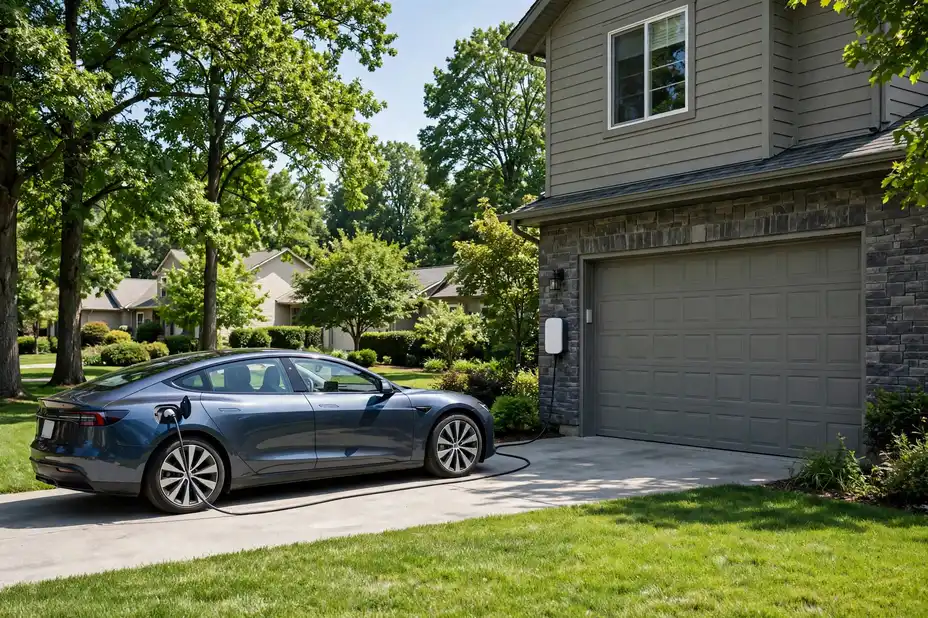
EV charging services in Dayton
Installers in Dayton book the same ten services as everywhere — but not in the same proportions. The three leading cards below are this city's pattern, set by its panels, its buildings and its statute book.
Home EV Charger Installation in Dayton
The core service, stated plainly: a dedicated 240-volt circuit run from your panel to your parking place, a station mounted and configured to that circuit, and the paperwork closed out with the permit office. Everything else in this section of the site exists to support or unblock this one job.
In Dayton: the install Dayton's new EV households book first, and the one the rest of this page keeps returning to.
Dedicated Circuit & Electrical Panel Upgrade in Dayton
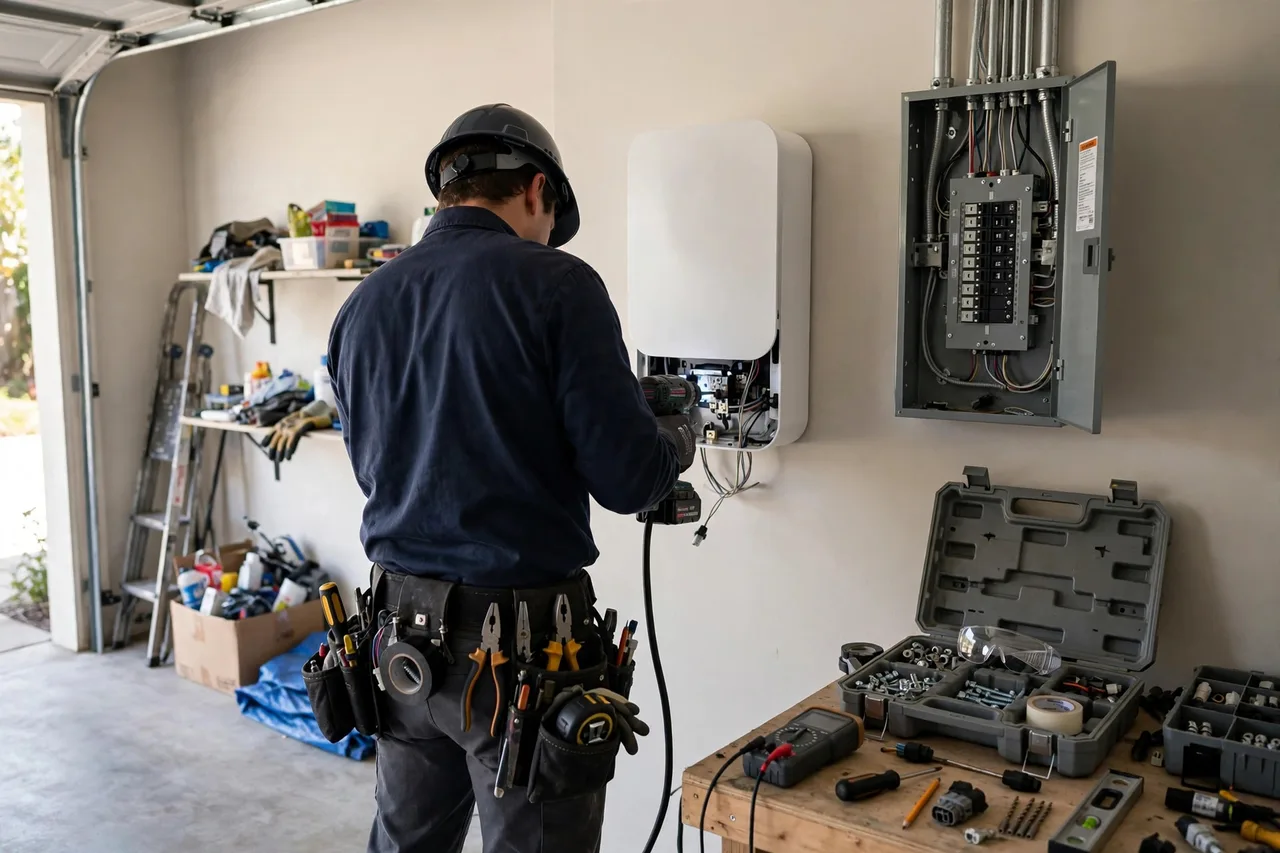
The upgrade is unglamorous and transformative: a modern panel with honest capacity, labelled circuits, and room for the decade's next three electrical ideas after the charger. Houses rarely regret capacity; they regret its absence annually.
In Dayton: service work that turns 'no room' into a circuit with headroom in Dayton homes.
Level 2 Charger Installation in Dayton
A Level 2 circuit turns charging from a ration into a routine. The job is electrical rather than electronic — breaker and conductor sized at the continuous-load factor, the run routed to the parking position, and the station dialled to the circuit rather than to its own headline maximum.
In Dayton: the 240-volt step that turns overnight charging in Dayton from a trickle into a full battery by morning.
Utility programs and electricity in Dayton
Electricity in Dayton comes from Ohio Edison Co. Parts of the wider metro are served by Duke Energy Ohio Inc, Dayton Power & Light Co, Pioneer Rural Elec Coop, Inc. The utility matters twice over for a charger install: it sets the time-of-use rates that decide what overnight charging costs you, and it is the organisation that may — or may not — currently help pay for the equipment.
The honest incentive position in Dayton is: nothing verified to claim. The federal charger credit (30C) ended on September 30, 2025; Ohio runs no state replacement for typical home installs; and in the utility and state sources checked for this page, Ohio Edison Co had no active residential charger rebate to point to. Programs reopen — when one does, it will be on the utility's own site with terms and dates. Anything an installer describes without that paper trail should be treated as conversation, not money.
If your service includes a demand component, the charger's start time matters more than its size: staggered against the house's other big loads, the same circuit costs noticeably less to run across a year.
Condos, HOAs and the law in Ohio
No statute promises a charger approval in Ohio. Unlike the states that have enacted right-to-charge laws, Ohio leaves the question entirely to each community's covenants and board discretion. For Dayton owners that is not the end of the road — it is a sign that the negotiation, the metering design and the written application carry the weight a statute would otherwise carry.
Timing helps too. Boards plan capital work annually; an application that arrives with the community's budget cycle, offering to coordinate with any planned electrical or repaving work, reads as a contribution rather than a demand.
Our condo and HOA guide covers both kinds of state; in Dayton the chapters on complete applications and cost allocation are the operative ones.
Climate, garages and charger placement
A four-season climate asks the installation to be boring in every month: cable that stays flexible in January, an enclosure untroubled by August humidity, and drainage that keeps spring melt away from the connector. None of this is exotic — it is the standard outdoor discipline, and it is why station placement gets a full minute of the site visit rather than a wave at the nearest wall.
Humidity is the slow variable: it works on exterior connections across seasons rather than in a single event, which is why coastal-grade habits — protected terminations, sealed entries, a yearly glance at the connector — pay off even well inland in a four-season climate.

Permits and inspection in Dayton
The permit trail also protects the next transaction: a charger circuit on the inspection record is an asset a buyer's inspector reads in one line, while an undocumented circuit is a question that follows the sale. Installers who work this metro treat the filing as part of the deliverable, not an errand.

Neighbourhoods and ZIP codes served
The page covers 43 ZIP codes in and around Dayton — including 45401, 45402, 45403, 45404, 45405, 45406, 45409, 45410, 45412, 45413, 45414, 45415, 45416, 45417, 45419, 45420, 45422, 45423, 45424, 45426, 45428, 45429, 45430, 45431, 45432, 45433, 45434, 45435, 45437, 45439, 45440, 45441, 45448, 45449, 45458, 45459, 45469, 45470, 45475, 45479, 45481, 45482, 45490 — across Greene, Montgomery. If your ZIP is not in the first set shown, ask anyway: installer coverage follows the metro, not a postcode fence.
The same working area takes in the neighbouring localities of Miamisburg, New Lebanon, Clayton, Englewood, Farmersville, Vandalia, Brookville, Germantown, Bellbrook, Phillipsburg, Alpha, Fairborn, Spring Valley, Xenia — the county ring an installer based in Dayton actually drives. Requests from those communities route exactly as city requests do: same services, same permit discipline, same local facts where they differ.
Montgomery County accounts for 51 of the ZIP codes and 10 named postal localities in the research file, the nearest of them Miamisburg, New Lebanon, Clayton, Englewood, Farmersville. The survey counts 536,096 residents in the county, with a median household income of $66,139 and a median home value of $180,900. Greene County accounts for 13 of the ZIP codes and 12 named postal localities in the research file, the nearest of them Bellbrook, Alpha, Fairborn, Spring Valley, Xenia. The survey counts 169,688 residents in the county, with a median household income of $87,309 and a median home value of $252,200. Measured across its ZIP codes, the Dayton footprint runs about 16 miles north to south and 15 east to west, from ZIP 45401 to 45490 — the ground an installer based here actually covers in a working week.
Beyond the county seats, the working area takes in Miamisburg, New Lebanon, Clayton, Englewood, Farmersville, Vandalia, Brookville, Germantown, Bellbrook, Phillipsburg, Springboro, Alpha, Fairborn, West Milton, Tipp City, West Alexandria, Franklin, Gratis, Verona, Medway, Lewisburg, Middletown, Spring Valley, Ludlow Falls, Potsdam, Laura, New Carlisle, Waynesville, Xenia, West Elkton, Enon, Troy, Pitsburg, Camden, Eaton, Yellow Springs, Pleasant Hill, Donnelsville, Trenton, Wilberforce, Arcanum, West Manchester, Harveysburg, Lebanon, Somerville, Casstown, Eldorado, North Hampton, Clifton, Christiansburg, Covington, Cedarville, Oregonia, Springfield, Piqua, Bradford, Gettysburg, Fletcher, New Paris, New Madison, Clarksville, Jamestown, Saint Paris, Port William, Tremont City, Conover, Greenville, Wilmington, Boston, Bowersville, Hollansburg, Palestine, Westville, South Charleston, Russia, Richmond, Houston, Versailles, Cuba, Rosewood, Liberty, Urbana, South Solon, Sidney, Reesville, Ansonia, Fountain City, Webster, Sabina, Milledgeville, Jeffersonville, Martinsville, Pemberton, Brownsville, Fort Loramie, Quincy, Centerville, Port Jefferson, Yorkshire, Lynn, Union City, Rossburg, Osgood, Williamsburg, De Graff, North Star, New Vienna, Maplewood, Greens Fork, Minster — the named localities for which Dayton is the nearest metro in the network (neighbouring metros' pages cover their own ground), each routing to the same installer-matching service.
The wider working area also reaches Monroe, Seven Mile, Overpeck, Collinsville, South Lebanon, Kings Mills, Hamilton, Fairfield, Mason, Morrow, Maineville, Oxford, College Corner, West College Corner, Pleasant Plain, Cincinnati, Blanchester, Loveland, Bath, Ross, Miamiville, Goshen, Midland, Shandon, Camp Dennison, South Vienna, Okeana, Milford, Newtonsville, Terrace Park, Fayetteville, Sedalia, Miamitown, Mechanicsburg, Cedar Grove — ground shared with neighbouring metros, where installers cross the same county lines in both directions.
ZIP codes in that shared ground include 43044, 45011, 45013, 45018, 45040, 45056, 45061, 45063, 45107, 45118, 45122, 45140, 45147, 45162, 45174, 45207, 45216, 45221, 45222, 45224, 45236, 45237, 45239, 45240, 45243, 45246, 45247, 45251, 45252, 45254, 45262, 45267, 45271, 45275, 45277, 45280, 45298, 45369, 47010, 47016.
The largest communities in that working area after Dayton itself, by the GeoNames populated-place file: Springfield (population 59,680), Kettering (population 55,525), Middletown (population 48,760), Beavercreek (population 46,277), Huber Heights (population 38,176), Richmond (population 35,854), Fairborn (population 33,452), Xenia (population 25,976). Charging demand follows those populations — the subdivisions and town centres where the next driveways, and the next panels, are.
Miami County reaches into the working area with 110,296 residents, a median household income of $76,817 and a median home value of $229,100; its localities on this page include West Milton, Tipp City, Ludlow Falls, Potsdam, Laura. Preble County reaches into the working area with 40,765 residents, a median household income of $69,223 and a median home value of $180,900; its localities on this page include West Alexandria, Gratis, Verona, Lewisburg, West Elkton. Warren County reaches into the working area with 250,008 residents, a median household income of $110,132 and a median home value of $349,400; its localities on this page include Springboro, Franklin, Waynesville, Harveysburg, Lebanon.
| ZIP | Locality | County |
|---|---|---|
| 45343 | Miamisburg | Montgomery |
| 45401 | Dayton | Montgomery |
| 45413 | Dayton | Montgomery |
| 45435 | Dayton | Montgomery |
| 45437 | Dayton | Montgomery |
| 45441 | Dayton | Montgomery |
| 45448 | Dayton | Montgomery |
| 45470 | Dayton | Montgomery |
| 45475 | Dayton | Montgomery |
| 45481 | Dayton | Montgomery |
| 45482 | Dayton | Montgomery |
| 45490 | Dayton | Montgomery |
| 45428 | Dayton | Montgomery |
| 45417 | Dayton | Montgomery |
| 45406 | Dayton | Montgomery |
| 45416 | Dayton | Montgomery |
| 45422 | Dayton | Montgomery |
| 45405 | Dayton | Montgomery |
| 45479 | Dayton | Montgomery |
| 45412 | Dayton | Montgomery |
| 45423 | Dayton | Montgomery |
| 45402 | Dayton | Montgomery |
| 45426 | Dayton | Montgomery |
| 45439 | Dayton | Montgomery |
| 45409 | Dayton | Montgomery |
| 45469 | Dayton | Montgomery |
| 45415 | Dayton | Montgomery |
| 45410 | Dayton | Montgomery |
| 45449 | Dayton | Montgomery |
| 45419 | Dayton | Montgomery |
| 45404 | Dayton | Montgomery |
| 45414 | Dayton | Montgomery |
| 45403 | Dayton | Montgomery |
| 45345 | New Lebanon | Montgomery |
| 45429 | Dayton | Montgomery |
| 45420 | Dayton | Montgomery |
| 45342 | Miamisburg | Montgomery |
| 45315 | Clayton | Montgomery |
| 45459 | Dayton | Montgomery |
| 45322 | Englewood | Montgomery |
| 45325 | Farmersville | Montgomery |
| 45430 | Dayton | Montgomery |
| 45440 | Dayton | Montgomery |
| 45432 | Dayton | Montgomery |
| 45377 | Vandalia | Montgomery |
| 45309 | Brookville | Montgomery |
| 45424 | Dayton | Montgomery |
| 45327 | Germantown | Montgomery |
| 45458 | Dayton | Montgomery |
| 45431 | Dayton | Greene |
| 45433 | Dayton | Greene |
| 45305 | Bellbrook | Greene |
| 45354 | Phillipsburg | Montgomery |
| 45066 | Springboro | Warren |
| 45434 | Dayton | Montgomery |
| 45301 | Alpha | Greene |
| 45324 | Fairborn | Greene |
| 45383 | West Milton | Miami |
| 45371 | Tipp City | Miami |
| 45381 | West Alexandria | Preble |
| 45005 | Franklin | Warren |
| 45330 | Gratis | Preble |
| 45378 | Verona | Preble |
| 45341 | Medway | Clark |
| 45338 | Lewisburg | Preble |
| 45042 | Middletown | Butler |
| 45370 | Spring Valley | Greene |
| 45339 | Ludlow Falls | Miami |
| 45361 | Potsdam | Miami |
| 45337 | Laura | Miami |
| 45044 | Middletown | Butler |
| 45344 | New Carlisle | Clark |
| 45068 | Waynesville | Warren |
| 45385 | Xenia | Greene |
| 45070 | West Elkton | Preble |
| 45323 | Enon | Clark |
| 45374 | Troy | Miami |
| 45373 | Troy | Miami |
| 45358 | Pitsburg | Darke |
| 45311 | Camden | Preble |
| 45320 | Eaton | Preble |
| 45387 | Yellow Springs | Greene |
| 45359 | Pleasant Hill | Miami |
| 45319 | Donnelsville | Clark |
| 45067 | Trenton | Butler |
| 45384 | Wilberforce | Greene |
| 45304 | Arcanum | Darke |
| 45382 | West Manchester | Preble |
| 45032 | Harveysburg | Warren |
| 45036 | Lebanon | Warren |

Planning the install: from panel to parking
A useful way to read any Dayton quote is to ask which of three jobs it describes. Job one: the panel has room and the run is short — a circuit and a station. Job two: the panel is full — capacity work joins the quote, as an upgrade or as load management. Job three: the property adds people — an HOA, a landlord, a building's shared service — and the approvals timeline joins the electrical one. None of the three is a bad job; they are simply different scopes, and a clear quote says which one you are in.
One more piece of sequencing advice Dayton installers give consistently: if the panel is being opened anyway, settle the other electrical maybes in the same visit — the circuit you will want next year costs least while the permit and the electrician are already in the house.
Home charging know-how for Dayton households
Adapters and other false economies
Continuous loads forgive nothing, and adapters are where charging setups go to be forgiven anyway: a chain of plugs between the wall and a device that draws near its circuit's limit for eight hours is a chain of warm connections. The standing rule from installers is plain — the station connects as its listing intends, hardwired or into a receptacle rated and installed for the duty, and borrowed dryer outlets and travel adapters are emergency expedients, not a charging system. Households that need the car charged nightly should own the boring version of the setup: one circuit, one connection, no improvisation.
Getting onto the board's agenda
Association decisions happen inside a procedure, and the procedure has a door: the agenda. Applications that miss the submission deadline wait a full cycle regardless of merit, so the first question for any board is clerical — when do items close for the next meeting, and in what format. Arrive inside the procedure with a complete package and the discussion is about your design; arrive outside it and the discussion is about process, and process always wins the evening. Property managers, asked politely, will tell you the format they prefer applications in.
Planning for the second EV
The second electric car rarely arrives as a surprise — it is the household's own verdict on the first one. Planning for it at the first install costs little: conduit sized a step up, panel capacity reserved on the schedule, and a station position that can serve a second bay or share its circuit through power-sharing equipment. Retrofitting the same readiness later means reopening finished work. Installers ask about the five-year picture during the site visit because the honest answers change today's scope more cheaply than any other conversation in the project.
Workplace charging as a policy, not a perk war
Workplace stations fail socially before they fail electrically: the same cars parked all day, visitors boxed out, no rule for the growing queue. The installs that work pair the hardware with a light policy from the start — session lengths matched to the shift, access that distinguishes staff from guests, and pricing or etiquette that keeps a full battery from squatting until six. The electrical design and the policy design are one conversation, because the dwell pattern the policy sets is the load pattern the circuit must serve.
Historic homes, modern loads
A house can be historically significant and electrically contemporary at once, but the marriage takes choreography: circuits routed through secondary spaces, equipment kept off protected fabric, the panel's growth planned where the preservation easement permits. The installers who do this work well treat the house's rules as a design brief rather than an obstacle, and the result — a period street front, a thoroughly modern garage — is the quiet norm in historic districts now.

Frequently asked questions
What happened to the federal home-charger credit in Dayton, OH?
No. The federal Alternative Fuel Refueling Property Credit (30C) ended for equipment placed in service after September 30, 2025. In the sources checked for this page, Ohio Edison Co had no verified residential charger rebate running either — if an installer names a current program, ask for its published terms.
Can my HOA or condo board in Dayton, OH refuse my charger?
In Dayton, they can — there is no Ohio statute stopping them. Right-to-charge protection simply has not been enacted here, so the board's own rules decide. Owners do still get approved regularly: the applications that succeed answer the board's concerns (metering, insurance, restoration, a licensed installer) before the meeting, in writing.
Panel upgrade or not — how do Dayton, OH homeowners find out?
The answer lives in your panel's directory and its arithmetic, not in the car's requirements. With 85% of Dayton's homes predating 1980 (median build 1951), local installers see both situations weekly: the 200-amp panel that takes the circuit directly, and the full 100-amp service that needs capacity work first. The site visit exists to sort your house into one of those two piles, on numbers.
How quickly will a Level 2 charger fill my car in Dayton, OH?
Level 2 is several-fold faster in the only unit that matters — miles back per hour parked: roughly 25–40 against Level 1's 3–5. The exact figure follows the circuit: a 40-amp circuit and a 60-amp circuit are both Level 2, and the car's onboard limit may sit below either. Your installer matches the three numbers at the site visit.
What happens next after I send a request?
Three things happen, in order. Your request is routed to licensed installers who work in Dayton; one of them contacts you to book a site visit; and the visit produces a written quote based on your actual panel and parking. PlugReady USA runs the matching, not the tools — the contractor on the job is the installer who visits.
How long does a typical home charger installation take in Dayton, OH?
Separate the three clocks. The installer's clock: typically a day of electrical work for the standard layout. The permit office's clock: issuance on the department's queue. The inspector's clock: a visit scheduled after the work. A realistic quote in Dayton, Ohio names all three; the total is usually days to a few weeks, dominated by the two clocks nobody on the crew controls.
Nearby cities in Ohio
- EV charger installation in Cincinnati — about 43 miles from Dayton, metro population 2,300,000
- EV charger installation in Columbus — about 73 miles from Dayton, metro population 2,150,000
- EV charger installation in Akron — about 176 miles from Dayton, metro population 700,000
- EV charger installation in Cleveland — about 191 miles from Dayton, metro population 2,100,000
- EV charger installation in Indianapolis, IN — about 102 miles from Dayton, metro population 2,100,000
- EV charger installation in Fort Wayne, IN — about 103 miles from Dayton, metro population 425,000
- EV charger installation in Lexington, KY — about 120 miles from Dayton, metro population 525,000
Ready to charge at home in Dayton?
Two minutes of form, and the request is in front of licensed installers who cover this city — quotes follow site visits, in writing.