EV Charger Installation in Lexington-Fayette, KY
Everything a Lexington-Fayette homeowner needs before booking a charger install — the panel question, the utility's current programs, the HOA law and the permit — sourced, dated and local.
Ask EV owners in Lexington-Fayette what changed their routine and most give the same answer: the car charges where it parks. Lexington-Fayette itself is home to about 323,725 people. Statewide, Kentucky counted 20,700 battery-electric vehicles and 8,600 plug-in hybrids on the road through 2025, and the metro's share of that fleet keeps growing. A home charger installation is not complicated, but it is local — the utility that serves your street, the age of your panel, your community's rules and your city's permit office all shape the job. This page pulls those Lexington-Fayette specifics together in one place, with the numbers sourced rather than rounded into slogans.
One honest note before the detail: PlugReady USA does not install chargers. We collect your requirements and pass them to licensed installers who cover Lexington-Fayette, and this page exists so that you can judge those conversations with the local facts already in hand.
Measured demand, not enthusiasm, put Lexington-Fayette in Tier B of this network: KY No. 2. For a homeowner the useful translation is simpler — installers here do this work weekly, know the local permit counter, and have seen your housing stock before.
Context from the Census Bureau's survey of Lexington-Fayette: median household income $69,479; 54% of occupied homes are owner-occupied; 58% of housing units are single-unit detached houses. It is the profile of a city where the typical charger job is a homeowner job — scoped by the panel and the wire run, not by permissions.

Put the survey together and Lexington-Fayette's charging profile reads like this: a housing stock of mixed vintages, where both electrical eras appear on the same street; a detached-house majority with a real attached and multifamily minority; buildings of five or more units hold a substantial share of homes, which keeps the multifamily sections of this page in daily use; and owners hold a working majority, with renters a significant minority. That combination — more than any single number — is what the installers working here plan around, and it is the lens for everything on this page.
Keep six figures and you keep Lexington-Fayette's whole electrical character: 148,959 housing units; 139,715 occupied homes; 75,121 owner-occupied; 86,998 detached houses; 66,924 pre-1980 homes; 38,517 homes in buildings of five or more units. Percentages elsewhere on this page are these numbers in disguise — the counts are the originals, and they are the numbers a local installer's experience is actually made of. The page's geography is equally concrete: 39 ZIP codes across Fayette, centred near 38.02 degrees north latitude. The city anchors the Lexington-Fayette metropolitan area, home to roughly 525,000 people on the research file's metro estimate — the wider labour and housing market this page's installers work across.
The same survey release fills in the household economics around the housing stock: a median home value of $318,400, median gross rent of $1,281, per-capita income of $44,786, and a median resident age of 35. The movement data matters as much as the money data: 74% of Lexington-Fayette workers drive to work alone — the commute pattern home charging is built around; 10% work from home, a population whose cars charge on daytime and overnight schedules alike; 2% commute by public transit; 51% of adults hold a bachelor's degree or higher. The survey's vehicle table is the one an EV page should quote first: 11,834 of Lexington-Fayette's households have no vehicle at all, while 77,685 have two or more — the multi-car households for whom the second circuit is a when, not an if.
The cost-burden lines say who feels housing costs most in Lexington-Fayette: 46% of renters spend 30% or more of income on rent, and 0% of owners with mortgages spend the same share on housing costs. Family households are 54% of all households — the two-car, school-run demographic whose charging patterns this page's planning sections keep circling back to.
What follows is the city read as an electrical place rather than a dot on a map. Neither old nor new, the housing is layered, and the installer's week is a tour of the layers: a 1960s split-level on Monday, a 2008 subdivision house on Wednesday, a 1920s four-square on Friday. With this much of the stock in shared buildings, the city's charging map is drawn in boardrooms as much as in electrical rooms: deeded spaces, common services, metering subplots in every application.
Renter weight gives this metro's charging story a negotiation at its centre: the circuit is easy, the permission is the project, and the paperwork patterns in the guides matter as much as any load calculation. Households here run the numbers — which is why the honest sections of this page, the ones that say what is verified and what is not, earn their keep. Scale brings a call centre, but it also brings published everything — interconnection standards, programme terms, complaint statistics — and the published page, not the phone call, is where this utility is most honest.
Early-market conditions have their own economics: fewer specialist installers, general electricians carrying the work, and a premium on the household arriving informed — which is the gap this page exists to close. The diary economics differ from the biggest metros: good installers book in weeks, not months, and the household that calls in spring is rarely queueing behind a season of work. Without a state charging statute, shared-property approvals in this metro are won on paper quality: metering clarity, licensed installers, insurance, reversibility — the complete package the guides set out.
The electrical reality in Lexington-Fayette homes
The Census Bureau counts Lexington-Fayette's housing in ways that turn out to be an installer's briefing: the median home dates to 1984, 45% of units stood before 1980, 58% are detached single-unit houses, and 54% of occupied homes belong to their occupants. Panel sizes, wire routes and even permit histories track those proportions street by street. A mixed-age stock like this splits installs into two camps: newer subdivisions where a 200-amp panel usually has planned capacity, and established neighbourhoods where the panel conversation comes first. Neither is a problem — but they are different jobs, and the estimate you get should say which camp your home falls into and why. Owner-occupiers can plan on their own timeline; renters and condo owners have an extra approval layer, which the law section below covers for this state.
One further survey line belongs in any Lexington-Fayette install conversation: 59% of the city's homes heat with electricity — 84,740 households whose panels already carry a major winter load before a charger is contemplated. Electric heat and EV charging are the two largest discretionary loads a house can host, and where they coincide, the load calculation stops being a formality.
Renters are the other constituency in these numbers: about 64,594 of Lexington-Fayette's occupied homes are rented rather than owned. Their charging route runs through a landlord conversation instead of a panel they control — a different project, covered by the rentals guide and the law section below, but a routine one in a city with this many renting households.
One more structural fact shapes Lexington-Fayette's charging map: 26% of the city's housing units sit in buildings of five or more units. Those households cannot simply book a circuit — their charger runs through a building, a board and a shared electrical service, which is why the multifamily service and the law section below carry unusual weight on this page.
EV charging services in Lexington-Fayette
Three of the network's services lead this page because local conditions put them first; the remaining seven are one click away and equally available here. Each card states what the service involves — the matching itself is free of obligation until you accept an installer's quote.
Home EV Charger Installation in Lexington-Fayette
The core service, stated plainly: a dedicated 240-volt circuit run from your panel to your parking place, a station mounted and configured to that circuit, and the paperwork closed out with the permit office. Everything else in this section of the site exists to support or unblock this one job.
In Lexington-Fayette: the install Lexington-Fayette's new EV households book first, and the one the rest of this page keeps returning to.
Dedicated Circuit & Electrical Panel Upgrade in Lexington-Fayette
The upgrade is unglamorous and transformative: a modern panel with honest capacity, labelled circuits, and room for the decade's next three electrical ideas after the charger. Houses rarely regret capacity; they regret its absence annually.
In Lexington-Fayette: the job that surfaces wherever housing is older — and Lexington-Fayette's stock makes it a routine conversation, settled by a load calculation.
Level 2 Charger Installation in Lexington-Fayette
The step up from a household outlet to a real circuit: 240 volts, sized as a continuous load, delivering several times the overnight range of a Level 1 cord. The craft is in matching circuit, station configuration and vehicle acceptance so the three agree.
In Lexington-Fayette: what most Lexington-Fayette drivers mean when they say they want 'a real charger' — 240 volts, sized to the circuit.
Utility programs and electricity in Lexington-Fayette
Electricity in Lexington-Fayette comes from Kentucky Utilities Co. Parts of the wider metro are served by Blue Grass Energy Coop Corp, Clark Energy Coop Inc. The utility matters twice over for a charger install: it sets the time-of-use rates that decide what overnight charging costs you, and it is the organisation that may — or may not — currently help pay for the equipment.
Rebate archaeology is a local sport: an old Kentucky Utilities Co program page, a neighbour's 2023 install story, a screenshot of terms nobody can date. The record for Lexington-Fayette, as checked for this page, is simpler. The federal credit closed on September 30, 2025; Kentucky operates no home-charger program; and no active Kentucky Utilities Co residential charger rebate appears in current published sources. Funded rounds do reopen in this industry — on the utility's timetable, announced on the utility's site, and worth exactly what their published terms say on the day you read them.
Renters and condo owners should note the metering question early: whose meter the charger hangs off decides who pays for the energy, and Kentucky Utilities Co's options for submetering are part of the multifamily conversation below.
Condos, HOAs and the law in Kentucky
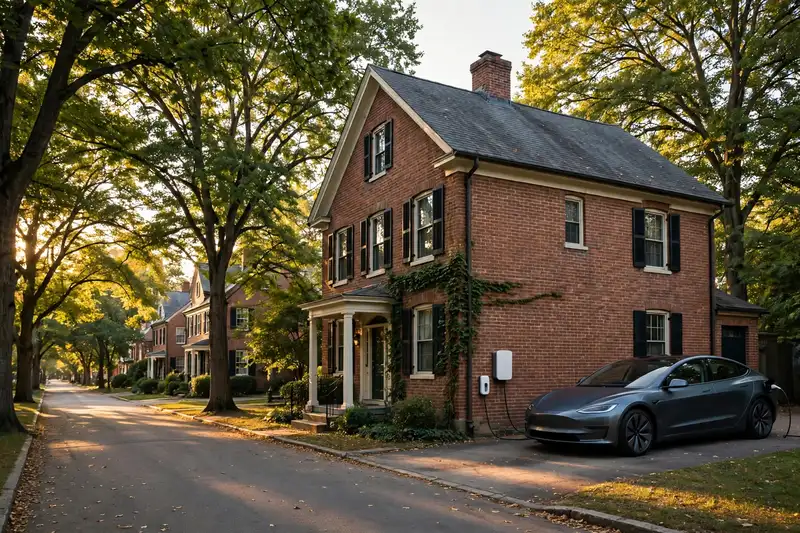
No statute promises a charger approval in Kentucky. Unlike the states that have enacted right-to-charge laws, Kentucky leaves the question entirely to each community's covenants and board discretion. For Lexington-Fayette owners that is not the end of the road — it is a sign that the negotiation, the metering design and the written application carry the weight a statute would otherwise carry.
Owners of single-family homes in HOA communities should also check the covenants before assuming the driveway is uncomplicated: exterior-equipment and architectural-approval clauses can apply to a visible wall-mounted station even where the garage interior is entirely the owner's business.
Our condo and HOA guide covers both kinds of state; in Lexington-Fayette the chapters on complete applications and cost allocation are the operative ones.
Climate, garages and charger placement
The seasons rotate the charging advice: precondition from the wall in winter, dodge the afternoon peak in summer, and let the shoulder months do what they like. Households here learn the two settings and change them with the clocks.
Four-season metros ask the install to be two things: kind to a battery in January and indifferent to a thunderstorm in July. The equipment is rated for both out of the box; the local craft is in the details — cable jacket chosen for cold flexibility, mounting placed with drainage in mind, a schedule that follows the seasons' rate windows.

Permits and inspection in Lexington-Fayette
Expect the permit to name the circuit, the breaker and the equipment. An installer who suggests skipping it is saving an afternoon by spending your liability; the inspection is also your independent check that the continuous-load sizing was done properly.

Neighbourhoods and ZIP codes served
The page covers 39 ZIP codes in and around Lexington-Fayette — including 40502, 40503, 40504, 40505, 40506, 40507, 40508, 40509, 40510, 40511, 40512, 40513, 40514, 40515, 40516, 40517, 40522, 40523, 40524, 40526, 40533, 40536, 40544, 40546, 40550, 40555, 40574, 40575, 40576, 40577, 40578, 40579, 40580, 40581, 40582, 40583, 40588, 40591, 40598 — across Fayette. If your ZIP is not in the first set shown, ask anyway: installer coverage follows the metro, not a postcode fence.
Fayette County accounts for 39 of the ZIP codes and 1 named postal localities in the research file, the nearest of them Lexington. The survey counts 323,725 residents in the county, with a median household income of $69,479 and a median home value of $293,500. Measured across its ZIP codes, the Lexington-Fayette footprint runs about 9 miles north to south and 13 east to west, from ZIP 40502 to 40598 — the ground an installer based here actually covers in a working week.
Beyond the county seats, the working area takes in Keene, Nicholasville, Versailles, Georgetown, Midway, Wilmore, Winchester, Paris, Richmond, Stamping Ground, Salvisa, North Middletown, Bryantsville, Burgin, Lawrenceburg, Frankfort, Harrodsburg, Lancaster, Sadieville, Millersburg, Waco, Cynthiana, Paint Lick, Danville, Mount Sterling, Berea, Clay City, Carlisle, Junction City, Jeffersonville, Berry, Sharpsburg, Bighill, Corinth, Irvine, Stanford, Mackville, Perryville, Owenton, Moorefield, Ravenna, Willisburg, Lockport, Mitchellsburg, Parksville, Crab Orchard, Hope, Preston, Stanton, Means, Mc Kinney, Owingsville, Wildie, Mount Olivet, Sandgap, Milford, Mount Vernon, Hustonville, Ewing, Olympia, Brodhead, Renfro Valley, Waneta, Gravel Switch — the named localities for which Lexington-Fayette is the nearest metro in the network (neighbouring metros' pages cover their own ground), each routing to the same installer-matching service.
The wider working area also reaches Waddy, Bagdad, Mount Eden, Mason, Chaplin, Pleasureville, Shelbyville, Bethlehem, Williamstown, Saint Catharine, Springfield, Bloomfield — ground shared with neighbouring metros, where installers cross the same county lines in both directions.
ZIP codes in that shared ground include 40003, 40007, 40008, 40012, 40046, 40057, 40061, 40065, 40066, 40069, 40076, 41054, 41097.
The largest communities in that working area after Lexington-Fayette itself, by the GeoNames populated-place file: Lexington (population 320,347), Richmond (population 33,533), Georgetown (population 32,356), Nicholasville (population 29,754), Frankfort (population 28,391), Winchester (population 18,446), Danville (population 16,690), Berea (population 14,882). Charging demand follows those populations — the subdivisions and town centres where the next driveways, and the next panels, are.
Franklin County reaches into the working area with 51,842 residents, a median household income of $65,298 and a median home value of $216,600; its localities on this page include Frankfort. Madison County reaches into the working area with 95,769 residents, a median household income of $63,351 and a median home value of $232,000; its localities on this page include Richmond, Waco, Berea. Jessamine County reaches into the working area with 54,588 residents, a median household income of $74,576 and a median home value of $268,100; its localities on this page include Keene, Nicholasville, Wilmore.
| ZIP | Locality | County |
|---|---|---|
| 40502 | Lexington | Fayette |
| 40512 | Lexington | Fayette |
| 40522 | Lexington | Fayette |
| 40523 | Lexington | Fayette |
| 40524 | Lexington | Fayette |
| 40526 | Lexington | Fayette |
| 40533 | Lexington | Fayette |
| 40544 | Lexington | Fayette |
| 40546 | Lexington | Fayette |
| 40550 | Lexington | Fayette |
| 40555 | Lexington | Fayette |
| 40574 | Lexington | Fayette |
| 40575 | Lexington | Fayette |
| 40576 | Lexington | Fayette |
| 40577 | Lexington | Fayette |
| 40578 | Lexington | Fayette |
| 40579 | Lexington | Fayette |
| 40580 | Lexington | Fayette |
| 40581 | Lexington | Fayette |
| 40582 | Lexington | Fayette |
| 40583 | Lexington | Fayette |
| 40588 | Lexington | Fayette |
| 40591 | Lexington | Fayette |
| 40506 | Lexington | Fayette |
| 40536 | Lexington | Fayette |
| 40507 | Lexington | Fayette |
| 40517 | Lexington | Fayette |
| 40508 | Lexington | Fayette |
| 40503 | Lexington | Fayette |
| 40509 | Lexington | Fayette |
| 40505 | Lexington | Fayette |
| 40504 | Lexington | Fayette |
| 40515 | Lexington | Fayette |
| 40598 | Lexington | Fayette |
| 40511 | Lexington | Fayette |
| 40513 | Lexington | Fayette |
| 40514 | Lexington | Fayette |
| 40510 | Lexington | Fayette |
| 40516 | Lexington | Fayette |
| 40339 | Keene | Jessamine |
| 40356 | Nicholasville | Jessamine |
| 40340 | Nicholasville | Jessamine |
| 40383 | Versailles | Woodford |
| 40384 | Versailles | Woodford |
| 40324 | Georgetown | Scott |
| 40347 | Midway | Woodford |
| 40390 | Wilmore | Jessamine |
| 40392 | Winchester | Clark |
| 40391 | Winchester | Clark |
| 40362 | Paris | Bourbon |
| 40361 | Paris | Bourbon |
| 40475 | Richmond | Madison |
| 40476 | Richmond | Madison |
| 40379 | Stamping Ground | Scott |
| 40372 | Salvisa | Mercer |
| 40357 | North Middletown | Bourbon |
| 40410 | Bryantsville | Garrard |
| 40310 | Burgin | Mercer |
| 40342 | Lawrenceburg | Anderson |
| 40621 | Frankfort | Franklin |
| 40622 | Frankfort | Franklin |
| 40330 | Harrodsburg | Mercer |
| 40444 | Lancaster | Garrard |
| 40601 | Frankfort | Franklin |
| 40370 | Sadieville | Scott |
| 40602 | Frankfort | Franklin |
| 40603 | Frankfort | Franklin |
| 40604 | Frankfort | Franklin |
| 40618 | Frankfort | Franklin |
| 40619 | Frankfort | Franklin |
| 40620 | Frankfort | Franklin |
| 40348 | Millersburg | Bourbon |
| 40385 | Waco | Madison |
| 41031 | Cynthiana | Harrison |
| 40461 | Paint Lick | Garrard |
| 40423 | Danville | Boyle |
| 40422 | Danville | Boyle |
| 40353 | Mount Sterling | Montgomery |
| 40403 | Berea | Madison |
| 40312 | Clay City | Powell |
| 40404 | Berea | Madison |
| 40311 | Carlisle | Nicholas |
| 40440 | Junction City | Boyle |
| 40337 | Jeffersonville | Montgomery |
| 41003 | Berry | Harrison |
| 40374 | Sharpsburg | Bath |
| 40405 | Bighill | Madison |
| 41010 | Corinth | Grant |
| 40336 | Irvine | Estill |
| 40484 | Stanford | Lincoln |

Planning the install: from panel to parking
The order of operations protects you. Load calculation before equipment choice, because the circuit sizes the station's settings. Route before purchase, because reach decides models. Permit before work, because inspection closes the file the insurer will one day read. In Lexington-Fayette the sequence is the same as everywhere — what varies is only how much of it your particular house asks for, and finding that out is the site visit's entire purpose.
Finally, photograph the finished work — station, nameplate, panel directory with the new breaker labelled — and file it with the inspection record. When the car changes, the house sells or a second station joins the first, that folder is the difference between a five-minute answer and an archaeological dig.
Home charging know-how for Lexington-Fayette households
Bidirectional charging, honestly framed
Vehicles that can return energy to a house or the grid exist, and the standards enabling them are settling — but for most households today it is a horizon technology, not a purchase category: it needs a compatible vehicle, bidirectional equipment, utility interconnection approval and a tariff that rewards it. None of that changes today's installation advice, except in one detail: conduit and panel capacity installed generously now are the same provisions a future bidirectional setup would want. Buy for the car you have; leave room for the one the industry is promising.
Adapters and other false economies
Continuous loads forgive nothing, and adapters are where charging setups go to be forgiven anyway: a chain of plugs between the wall and a device that draws near its circuit's limit for eight hours is a chain of warm connections. The standing rule from installers is plain — the station connects as its listing intends, hardwired or into a receptacle rated and installed for the duty, and borrowed dryer outlets and travel adapters are emergency expedients, not a charging system. Households that need the car charged nightly should own the boring version of the setup: one circuit, one connection, no improvisation.
Orientation: the garage's compass
A garage's orientation decides its microclimate: south- and west-facing doors take the day's heat load, north-facing ones hold the cold. The charger inherits the microclimate — electronics ageing in the hot wall's summer, cables stiffening in the cold one's January. Orientation is nobody's choice by install time, but it informs placement inside the room: the interior wall over the door wall, the shaded corner over the sun line, decided by someone who has read the room's compass.
Charging alongside rooftop solar
A house that generates as well as consumes plans its charging differently. The naive pattern — charge at night, export by day — is often fine; the refined pattern shifts some charging into the solar hours on home-working days, stores the commute in the car when the panels are producing, and leans on the overnight window only for the balance. None of this changes the circuit; it changes the schedule, and occasionally the case for a station whose output can follow the house's generation. Tell the installer the array exists — it belongs in the first conversation.
Shutoffs and sensible safety
Every charger installation contains its own off switch: the breaker in the panel, and, on larger circuits, a disconnect within sight of the equipment that the code requires. Knowing where both are — and that the station itself stops the session when the connector is unlatched — is the whole safety briefing, and a good installer gives it unprompted at handover. The equipment is listed, protected and designed to be operated daily by non-electricians; the homeowner's part is simply to know the two switches and to treat any change in behaviour — heat, noise, repeated trips — as a reason to call rather than to reset.

Frequently asked questions
Is the federal charger tax credit still available in Lexington-Fayette, KY?
No. The federal Alternative Fuel Refueling Property Credit (30C) ended for equipment placed in service after September 30, 2025. In the sources checked for this page, Kentucky Utilities Co had no verified residential charger rebate running either — if an installer names a current program, ask for its published terms.
What can my HOA in Lexington-Fayette, KY do about a charger install?
Legally, yes — and it is better to know that before you buy the car. Kentucky has enacted no right-to-charge law, so an association in Lexington-Fayette may refuse, condition or delay a charger under its covenants. The counterweight is a complete, documented application and, if refused, a written refusal citing the covenant — the record a future board or a future statute works from.
Does a Level 2 charger mean a panel upgrade for a Lexington-Fayette, KY home?
Sometimes, and the honest route to the answer is arithmetic rather than opinion. Lexington-Fayette's median home was built in 1984; roughly 45% of the stock predates 1980, which is where the 100-amp panels concentrate. If yours is one, expect the upgrade-or-management conversation; if it is a modern 200-amp service with spare spaces, expect a circuit. The site visit's calculation decides, and you are entitled to see it.
How much faster is Level 2 charging at home in Lexington-Fayette, KY?
In parked hours: a Level 1 cord returns about 3–5 miles for each of them, and a Level 2 circuit returns roughly 25–40, set by its amperage and the car's acceptance. For a Lexington-Fayette household parking ten hours, that is the difference between recovering a short errand day and recovering any day the car can legally drive.
What happens next after I send a request?
Three steps: the request routes to installers who work Lexington-Fayette, Kentucky; one contacts you to walk the property; the walk produces the written quote. Everything on this page — the utility position, the law, the housing data — is yours to check that quote against.
Can a charger be added to a detached garage in Lexington-Fayette?
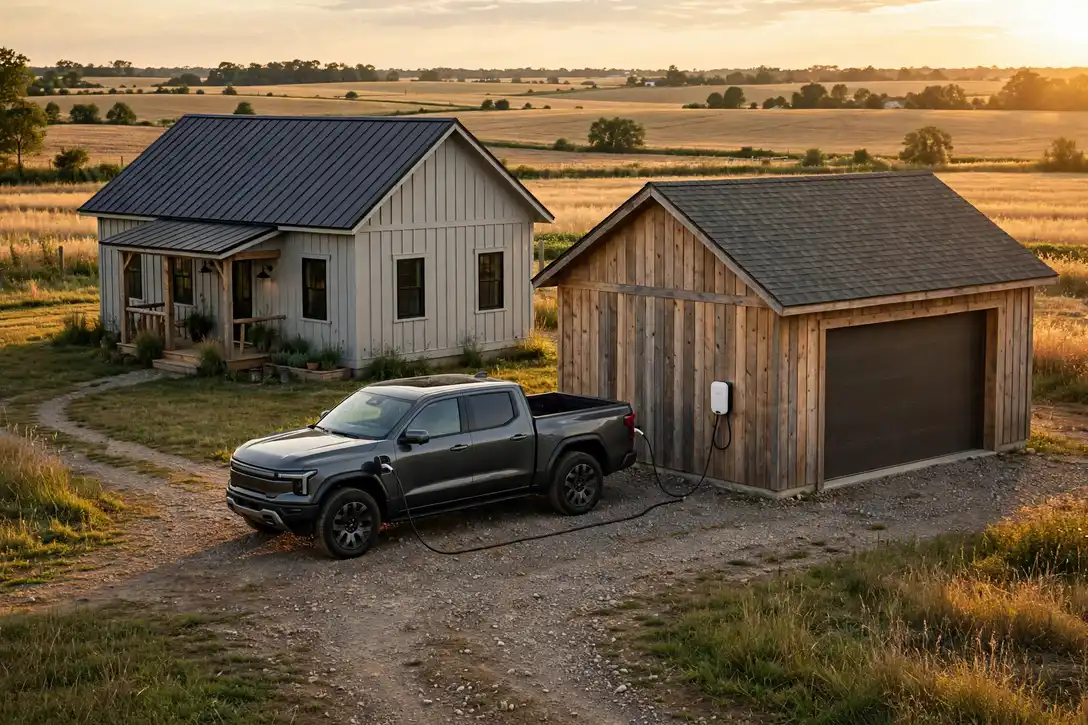
Yes — and detached garages are common in Lexington-Fayette, where about 58% of homes are single-unit detached. The run out to the building is the substance of the job: a buried conduit from the house panel, or a subpanel in the garage where the distance and future loads justify it. The station itself then behaves like any garage install.
Nearby cities in Kentucky
- EV charger installation in Louisville — about 67 miles from Lexington-Fayette, metro population 1,400,000
- EV charger installation in Cincinnati, OH — about 79 miles from Lexington-Fayette, metro population 2,300,000
- EV charger installation in Dayton, OH — about 120 miles from Lexington-Fayette, metro population 825,000
- EV charger installation in Knoxville, TN — about 141 miles from Lexington-Fayette, metro population 925,000
Ready to charge at home in Lexington-Fayette?
Send the essentials — what you need, where, and what kind of property — and a licensed local installer will pick it up from there.