EV Charger Installation in Lansing, MI
Charging where you park, in Lansing: the utility programs, state law, permit process and housing facts behind a home charger install, gathered in one place.
Every home charger installation is the same four decisions wearing local clothes: capacity in the panel, a route for the circuit, a position for the station, and paperwork that proves it was done properly. What changes from city to city is the content of those decisions — and in Lansing the content is specific. Lansing itself is home to about 113,466 people. Michigan's registered fleet stood at 112,600 battery-electric vehicles and 42,100 plug-in hybrids at the end of 2025, and this page works through the local version of each decision: your utility and its programs, your state's association law, your permit counter, and your housing stock's electrical habits.
How PlugReady USA works, in one breath: you describe the job once, licensed local installers who cover Lansing receive it, and the conversations happen with them directly. The rest of this page exists so those conversations start from facts — yours about the house, ours about the metro — rather than from a sales script.
Rank 95 of 300 in this network, Tier B — the placement is arithmetic, and the arithmetic is: MI capital + university. For the homeowner reading, the consequence is a mature local market: electricians who quote this work from experience rather than from a manual.
Survey context for Lansing, in the three lines installers actually use: median household income $55,366; owner-occupation at 53%; single-unit detached homes at 60%. Income tracks adoption pace, tenure decides whose signature a job needs, and structure decides whether the answer is a garage circuit or a building negotiation.
The composite picture matters more than any single statistic. In Lansing: an older housing fabric, where panel archaeology is a normal part of the first visit; a detached-house majority with a real attached and multifamily minority; buildings of five or more units hold a substantial share of homes, which keeps the multifamily sections of this page in daily use; meanwhile, owners hold a working majority, with renters a significant minority. A page that ignored that profile would give the same advice everywhere; this one is ordered by it.
In absolute terms, the survey counts 54,614 housing units in Lansing — 50,209 occupied, 26,574 of them by their owners. The stock resolves into 32,853 single-unit detached houses, 41,067 homes standing since before 1980, and 14,921 units in larger buildings. Those six counts are the city's charging map drawn without percentages, and every section of this page is a consequence of one of them. The page's geography is equally concrete: 22 ZIP codes across Eaton, Ingham, centred near 42.73 degrees north latitude. The city anchors the Lansing–East Lansing metropolitan area, home to roughly 550,000 people on the research file's metro estimate — the wider labour and housing market this page's installers work across.
The same survey release fills in the household economics around the housing stock: a median home value of $142,800, median gross rent of $1,003, per-capita income of $30,350, and a median resident age of 34. And the daily rhythms behind the housing numbers: 69% of Lansing workers drive to work alone — the commute pattern home charging is built around; 11% work from home, a population whose cars charge on daytime and overnight schedules alike; 4% commute by public transit; 30% of adults hold a bachelor's degree or higher. Vehicle ownership, from the same release: 20,165 households in Lansing run two or more vehicles, and 5,378 run none — the two ends of the market this page serves and does not serve.
The cost-burden lines say who feels housing costs most in Lansing: 49% of renters spend 30% or more of income on rent, and 0% of owners with mortgages spend the same share on housing costs. Family households are 48% of all households — the two-car, school-run demographic whose charging patterns this page's planning sections keep circling back to.
This is the context an installer works against, whether it is written down or not. A stock this old wires its history into the walls: cloth-wrapped conductors in the deepest streets, fuse boxes that outlived their century, panels added in layers by generations of electricians each solving their own decade's problem. With this much of the stock in shared buildings, the city's charging map is drawn in boardrooms as much as in electrical rooms: deeded spaces, common services, metering subplots in every application.
Property managers are the metro's charging gatekeepers at this tenure mix, and the installers who thrive are the ones whose proposals arrive manager-shaped: standardised, insured, reversible on paper. Modest incomes make the overnight tariff the headline act: the difference between peak and off-peak charging, compounded nightly for years, is the largest single number in the ownership equation. The commission's calendar quietly schedules the market: when a new time-of-use design is approved, installer phones ring in a pattern the docket predicted months earlier.
Volume professionalises everyone it touches: permit clerks who process charger applications as routine, inspectors who have seen every configuration, dealers who ask about home charging as a standard part of the sale. At this scale the city's charging infrastructure is legible — a household can learn the whole local system, its programmes, precedents and people, in an evening's reading. This page is most of that evening. Shared-property households here work with a written legal position rather than a board's mood, which changes the application from a petition into a procedure.
The electrical reality in Lansing homes
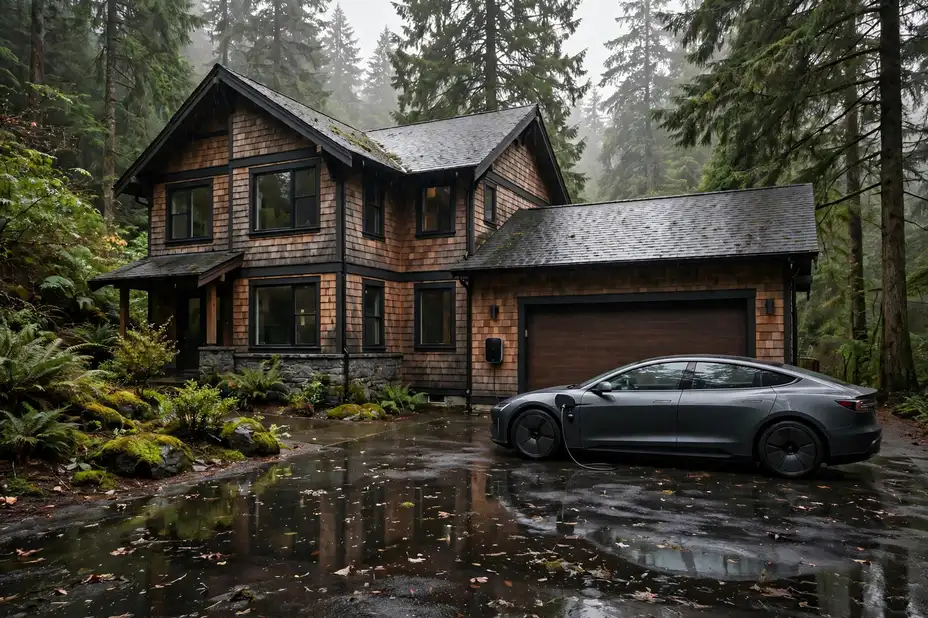
The survey's housing portrait for Lansing opens with its median: a home built in 1962, in a stock where 75% of units predate 1980 and 60% stand detached on their own lots. 53% of occupied homes are owner-occupied. An installer reads those lines as a weather forecast: mostly settled conditions, with older wiring fronts moving through the pre-1980 districts. Age shows up electrically before it shows up anywhere else: services sized for a house with a third of today's appliances. Expect the first conversation to be about capacity — what the panel is, what it already feeds, and which of the three routes (circuit, management, upgrade) your numbers support. Porches, carports and parking pads carry a real share of this city's charging, because the stock predates the two-car garage as a standard feature — outdoor-rated equipment is a local staple, not an edge case.
Heating fuel is the survey's quiet clue to panel life: in Lansing, 21% of homes heat electrically (10,824 households), against 77% heating with gas. A house already heating electrically has a service sized with that load in its history; a gas-heated house may have capacity to spare — either way the fuel mix is part of what the installer is reading.
The tenure split cuts the other way too: roughly 23,635 occupied homes in Lansing are rented. For those households the charger question is a negotiation with a property owner — written proposal, licensed installer, metering clarity — and it succeeds often enough that installers here keep the pattern ready.
And 27% of Lansing's homes are in buildings with five or more units — apartments and condominiums where charging is a building decision before it is an electrical one. If that is your situation, the law and multifamily sections of this page are the ones written for you.
EV charging services in Lansing
Ten services cover the work installers do in Lansing. Three lead the list here because of what this city's housing and law actually look like — each links to its national service page, where scope and process are set out in full.
Home EV Charger Installation in Lansing
One circuit, one station, one inspection: the residential install in its usual form. An installer sizes the circuit to the household's driving, mounts the station where the cable reaches the port without drama, sets its output to the circuit it landed on, and leaves the paperwork filed with the house.
In Lansing: the core residential job in Lansing: circuit, mounting, configuration and inspection in one visit pattern.
Dedicated Circuit & Electrical Panel Upgrade in Lansing
A service change is the least reversible and most enabling job on this page: it re-bases the whole house's electrical life. Done inside the charger project, it shares the permit, the utility visit and the electrician's day with the circuit it makes room for.
In Lansing: relevant in Lansing wherever a 100-amp panel already carries cooking, heating and hot water before a charger asks for room.
Multifamily & Condo EV Charging in Lansing
The multifamily install is a small constitution before it is a circuit: who may charge, on whose meter, under what cost split, with what path for the next ten applicants. Buildings that write that constitution once stop re-litigating it at every annual meeting.
In Lansing: constitutions for shared charging in Lansing buildings: metering, load and approvals.
Utility programs and electricity in Lansing
Electricity in Lansing comes from DTE Electric Company. Parts of the wider metro are served by Consumers Energy Co, City of Lansing, Tri-County Electric Coop (MI). The utility matters twice over for a charger install: it sets the time-of-use rates that decide what overnight charging costs you, and it is the organisation that may — or may not — currently help pay for the equipment.
Program status is a snapshot, and this page dates its snapshot: sources checked at build time found no DTE Electric Company residential charger rebate, no Michigan home-charger program, and a federal credit that ended September 30, 2025. Lansing households should treat that as the position until a utility announcement changes it — utilities publish openings prominently when budgets exist, because unspent program money is a problem for them too.
While you are reading your tariff, check how your plan treats the evening peak. A charger scheduled to start after the peak window is the single easiest saving in home charging, and it is set once, in the car or the station, then forgotten.
Condos, HOAs and the law in Michigan
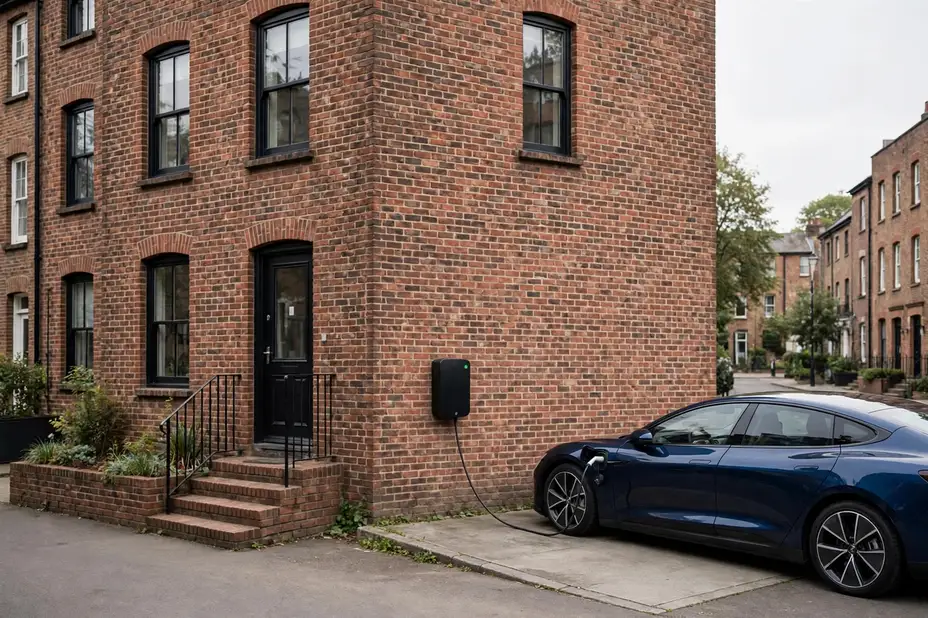
An association in Michigan cannot simply say no. The right-to-charge law recorded for this state (Homeowners' Energy Policy Act, MCL 559.305 (eff. Apr 2, 2025)) entitles an owner to install charging equipment for their own vehicle in their own parking space, subject to reasonable association conditions on placement, insurance and eventual restoration. For a Lansing owner, the practical consequence is that the application is a compliance exercise — equipment, circuit, paperwork — rather than a popularity contest at a board meeting.
Owners in Lansing should also know the statute travels with the space, not the car: a documented installation, permitted and recorded, stays an asset of the unit when it sells — one more reason the paperwork deserves the same care as the wiring.
For the design side — shared versus assigned spaces, load management across a building, billing per owner — see the multifamily and condo charging service page.
Climate, garages and charger placement
Ice discipline is the third local habit: a cable route that never crosses the shovelled path's landing zone, a holster at a height the snowbank does not reach, and a station position the roof does not shed onto. Winter rewards the installs that were designed in it.
Winter hardware habits are simple and worth copying: a holster the connector returns to every night (a connector left in a snowbank is a connector full of ice), a cable route that survives the snow-clearing line, and a station position the plough's output does not bury. Installers here raise all three without being asked.

Permits and inspection in Lansing
What the inspector is checking, in plain terms: conductor size against breaker size, the continuous-load calculation, terminations torqued, protection where the code wants it, and a station whose settings match the circuit it landed on. It is a short visit that validates everything you cannot see.

Neighbourhoods and ZIP codes served
The page covers 22 ZIP codes in and around Lansing — including 48901, 48906, 48908, 48909, 48910, 48911, 48912, 48913, 48915, 48916, 48917, 48918, 48919, 48922, 48924, 48929, 48930, 48933, 48937, 48951, 48956, 48980 — across Eaton, Ingham. If your ZIP is not in the first set shown, ask anyway: installer coverage follows the metro, not a postcode fence.
The same working area takes in the neighbouring localities of East Lansing, Holt, Dimondale, Okemos, Haslett, Grand Ledge, Potterville, Mason, Williamston, Eaton Rapids, Mulliken, Charlotte, Dansville, Onondaga — the county ring an installer based in Lansing actually drives. Requests from those communities route exactly as city requests do: same services, same permit discipline, same local facts where they differ.
Ingham County accounts for 35 of the ZIP codes and 12 named postal localities in the research file, the nearest of them East Lansing, Holt, Okemos, Haslett, Mason. The survey counts 283,913 residents in the county, with a median household income of $65,526 and a median home value of $198,800. Eaton County accounts for 12 of the ZIP codes and 11 named postal localities in the research file, the nearest of them Dimondale, Grand Ledge, Potterville, Eaton Rapids, Mulliken. The survey counts 109,130 residents in the county, with a median household income of $79,597 and a median home value of $216,900. Measured across its ZIP codes, the Lansing footprint runs about 12 miles north to south and 16 east to west, from ZIP 48901 to 48980 — the ground an installer based here actually covers in a working week.
Beyond the county seats, the working area takes in East Lansing, Holt, Dimondale, Dewitt, Okemos, Bath, Haslett, Grand Ledge, Potterville, Mason, Eagle, Laingsburg, Williamston, Shaftsburg, Eaton Rapids, Saint Johns, Perry, Mulliken, Charlotte, Dansville, Onondaga, Westphalia, Leslie, Ovid, Fowler, Portland, Webberville, Morrice, Sunfield, Rives Junction, Pewamo, Springport, Lyons, Eureka, Vermontville, Bancroft, Elsie, Maple Rapids, Pleasant Lake, Fowlerville, Olivet, Stockbridge, Owosso, Hubbardston, Muir, Munith, Perrinton, Gregory, Pompeii, Bannister, Henderson, Ashley, Parma, Woodland, Middleton, Vernon, Byron, Nashville, Jackson, Bellevue, Cohoctah, Durand, Albion, Oakley, Carson City, Palo, Howell, North Star, Corunna, Spring Arbor, Michigan Center, Grass Lake, Concord, Ithaca, Lennon, Gaines, Brant, Marshall, Chesaning, Pinckney, Chelsea, Crystal, Battle Creek, Sumner, Linden, New Lothrop, Horton, Napoleon, Homer, Swartz Creek, Clarklake, Hanover, Bedford, Saint Charles, Dexter, Norvell — the named localities for which Lansing is the nearest metro in the network (neighbouring metros' pages cover their own ground), each routing to the same installer-matching service.
The wider working area also reaches Lake Odessa, Ionia, Saranac, Clarksville, Orleans, Fenwick, Hastings, Dowling, Freeport, Cloverdale, Sheridan, Lakeland, Belding — ground shared with neighbouring metros, where installers cross the same county lines in both directions.
ZIP codes in that shared ground include 48143, 48809, 48815, 48834, 48846, 48849, 48865, 48881, 48884, 49035, 49050, 49058, 49325.
The largest communities in that working area after Lansing itself, by the GeoNames populated-place file: Flint (population 98,310), Battle Creek (population 51,589), Saginaw (population 49,347), East Lansing (population 48,471), Midland (population 42,200), Bay City (population 33,917), Jackson (population 33,133), Mount Pleasant (population 26,060). Charging demand follows those populations — the subdivisions and town centres where the next driveways, and the next panels, are.
Clinton County reaches into the working area with 79,626 residents, a median household income of $88,210 and a median home value of $259,500; its localities on this page include Dewitt, Bath, Eagle, Saint Johns, Westphalia. Shiawassee County reaches into the working area with 67,991 residents, a median household income of $67,404 and a median home value of $171,600; its localities on this page include Laingsburg, Shaftsburg, Perry, Morrice, Bancroft. Jackson County reaches into the working area with 160,060 residents, a median household income of $66,073 and a median home value of $193,700; its localities on this page include Rives Junction, Springport, Pleasant Lake, Munith, Parma.
| ZIP | Locality | County |
|---|---|---|
| 48901 | Lansing | Ingham |
| 48909 | Lansing | Ingham |
| 48913 | Lansing | Ingham |
| 48916 | Lansing | Ingham |
| 48918 | Lansing | Ingham |
| 48924 | Lansing | Ingham |
| 48980 | Lansing | Ingham |
| 48933 | Lansing | Ingham |
| 48922 | Lansing | Ingham |
| 48929 | Lansing | Ingham |
| 48930 | Lansing | Ingham |
| 48956 | Lansing | Ingham |
| 48919 | Lansing | Ingham |
| 48915 | Lansing | Ingham |
| 48937 | Lansing | Ingham |
| 48912 | Lansing | Ingham |
| 48906 | Lansing | Ingham |
| 48910 | Lansing | Ingham |
| 48951 | Lansing | Ingham |
| 48824 | East Lansing | Ingham |
| 48917 | Lansing | Eaton |
| 48911 | Lansing | Ingham |
| 48826 | East Lansing | Ingham |
| 48823 | East Lansing | Ingham |
| 48825 | East Lansing | Ingham |
| 48842 | Holt | Ingham |
| 48821 | Dimondale | Eaton |
| 48820 | Dewitt | Clinton |
| 48864 | Okemos | Ingham |
| 48808 | Bath | Clinton |
| 48840 | Haslett | Ingham |
| 48837 | Grand Ledge | Eaton |
| 48876 | Potterville | Eaton |
| 48854 | Mason | Ingham |
| 48822 | Eagle | Clinton |
| 48805 | Okemos | Ingham |
| 48848 | Laingsburg | Shiawassee |
| 48895 | Williamston | Ingham |
| 48882 | Shaftsburg | Shiawassee |
| 48827 | Eaton Rapids | Eaton |
| 48908 | Lansing | Eaton |
| 48879 | Saint Johns | Clinton |
| 48872 | Perry | Shiawassee |
| 48861 | Mulliken | Eaton |
| 48813 | Charlotte | Eaton |
| 48819 | Dansville | Ingham |
| 49264 | Onondaga | Ingham |
| 48894 | Westphalia | Clinton |
| 49251 | Leslie | Ingham |
| 48866 | Ovid | Clinton |
| 48835 | Fowler | Clinton |
| 48875 | Portland | Ionia |
| 48892 | Webberville | Ingham |
| 48857 | Morrice | Shiawassee |
| 48890 | Sunfield | Eaton |
| 49277 | Rives Junction | Jackson |
| 48873 | Pewamo | Ionia |
| 49284 | Springport | Jackson |
| 48851 | Lyons | Ionia |
| 48833 | Eureka | Clinton |
| 49096 | Vermontville | Eaton |
| 48414 | Bancroft | Shiawassee |
| 48831 | Elsie | Clinton |
| 48853 | Maple Rapids | Clinton |
| 49272 | Pleasant Lake | Jackson |
| 48836 | Fowlerville | Livingston |
| 49076 | Olivet | Eaton |
| 49285 | Stockbridge | Ingham |
| 48867 | Owosso | Shiawassee |
| 48845 | Hubbardston | Ionia |
| 48860 | Muir | Ionia |
| 49259 | Munith | Jackson |
| 48871 | Perrinton | Gratiot |
| 48137 | Gregory | Livingston |
| 48874 | Pompeii | Gratiot |
| 48807 | Bannister | Gratiot |
| 48841 | Henderson | Shiawassee |
| 48806 | Ashley | Gratiot |
| 49269 | Parma | Jackson |
| 48897 | Woodland | Barry |
| 48856 | Middleton | Gratiot |
| 48476 | Vernon | Shiawassee |
| 48418 | Byron | Shiawassee |
| 49073 | Nashville | Barry |
| 49202 | Jackson | Jackson |
| 49021 | Bellevue | Eaton |
| 48816 | Cohoctah | Livingston |
| 48429 | Durand | Shiawassee |
| 49201 | Jackson | Jackson |
| 49224 | Albion | Calhoun |

Planning the install: from panel to parking
The order of operations protects you. Load calculation before equipment choice, because the circuit sizes the station's settings. Route before purchase, because reach decides models. Permit before work, because inspection closes the file the insurer will one day read. In Lansing the sequence is the same as everywhere — what varies is only how much of it your particular house asks for, and finding that out is the site visit's entire purpose.
Future-proofing, in this trade, is mostly conduit and capacity: an oversized conduit run costs little during the first install and everything later; a panel position reserved is a breaker that never has to move. If a second EV, a workshop or an electrified water heater is anywhere in your five-year picture, say so at the site visit.
Home charging know-how for Lansing households
Garage layout: the unglamorous decider
More charging routines are decided by garage geography than by equipment. Which bay the EV takes, which side its port sits on, where the freezer, bikes and workbench have permanent tenure — the station belongs at the intersection of those facts, with a cable that reaches the port without crossing the walking line to the door. Installers who walk the layout with the car in place are not being thorough for its own sake; they are preventing the daily, decade-long annoyance of a station mounted for a parking pattern nobody uses.
Making the rate window automatic
Time-of-use tariffs reward households whose charging happens while the grid sleeps, and the reward compounds silently: every night, for the life of the car. The mechanism is trivial — a schedule set in the vehicle or the station — but the details decide whether it survives contact with real life: the window must fit the household's latest departure, the schedule must yield gracefully on the nights the car comes home empty, and the settings must live somewhere the household can find them again. Set it up at commissioning, with the installer, and the saving becomes infrastructure rather than intention.
Adapters and other false economies
Continuous loads forgive nothing, and adapters are where charging setups go to be forgiven anyway: a chain of plugs between the wall and a device that draws near its circuit's limit for eight hours is a chain of warm connections. The standing rule from installers is plain — the station connects as its listing intends, hardwired or into a receptacle rated and installed for the duty, and borrowed dryer outlets and travel adapters are emergency expedients, not a charging system. Households that need the car charged nightly should own the boring version of the setup: one circuit, one connection, no improvisation.
Vehicles that work from home
A growing class of households runs a business from the drive: trades vans, delivery vehicles, a car that is also the office. Their charging arithmetic differs from the commuter's — higher daily miles, tighter morning deadlines, and a vehicle whose readiness is revenue. The design answers scale accordingly: capacity with headroom, a schedule set against the working day rather than the night, and occasionally the second circuit sooner than a private household would need it. If the vehicle earns, say so at the site visit; it changes the specification.
The renter's route to a charger
Renters get chargers installed every week, on a simple insight: the proposal that works makes the landlord better off. A permitted circuit, installed by a licensed electrician at the tenant's expense, that remains with the property afterwards is not a favour to grant — it is an improvement to accept. The letter that carries it names the installer, the insurance, the metering arrangement for the electricity, and the restoration position at tenancy's end. Where this state's law gives tenants charging rights, the statute joins the letter; everywhere, the letter does the persuading.

Frequently asked questions
Is the federal charger tax credit still available in Lansing, MI?
The three possible pots are all, at present, empty for a Lansing homeowner: no DTE Electric Company residential rebate in current published sources, no Michigan home programme, and a federal credit that closed on September 30, 2025. Programmes do relaunch — on the utility's site, with dates — and until one does, the honest quote is the one with no rebate line at all.
Can my association in Lansing, MI say no to a home charger?
Not outright. Under Homeowners' Energy Policy Act, MCL 559.305 (eff. Apr 2, 2025), Michigan associations cannot prohibit an owner's charger; they can condition it — reasonably — on placement, insurance and restoration, with the owner funding the work. The disputes that do arise are usually about conditions, and they settle fastest when the application answers them in advance.
Will my Lansing, MI home need a panel upgrade for a Level 2 charger?
The question has a correct instrument: the load calculation. It totals what your service already carries — with the code's demand factors, not nameplate panic — and sets the charger's continuous load against the remainder. In Lansing, where the median home dates to 1962 and about 75% of units predate 1980, the answer splits by street: post-war and newer 200-amp homes usually proceed; older 100-amp homes choose between capacity work and load management. Anyone answering without the calculation is guessing in a uniform.
How much faster is Level 2 charging at home in Lansing, MI?
Think of it in parked hours. Level 1 gives you back 3–5 miles for each of them; Level 2 gives back about 25–40, set by the circuit's amperage and what the car can accept. Overnight, that is the gap between 'enough for tomorrow' and 'full, every morning'.
How does the installer matching on this page work?
Your request — service, Lansing ZIP, property type and timing — goes to licensed local installers who cover Lansing. They contact you directly to arrange a site visit and quote. PlugReady USA is the matching service, not the installer, and the sections above exist so you can judge any quote against the local facts.
Can a charger be added to a detached garage in Lansing?
It can. With roughly 60% of Lansing's stock in detached houses, the detached-garage run is a routine local job: conduit buried at code depth from the panel, or a subpanel that also serves the workshop. The trench, not the charger, is what the quote is really about.
Nearby cities in Michigan
- EV charger installation in Grand Rapids — about 62 miles from Lansing, metro population 1,100,000
- EV charger installation in Detroit — about 87 miles from Lansing, metro population 4,350,000
- EV charger installation in Fort Wayne, IN — about 117 miles from Lansing, metro population 425,000
- EV charger installation in South Bend, IN — about 119 miles from Lansing, metro population 325,000
- EV charger installation in Chicago, IL — about 179 miles from Lansing, metro population 9,450,000
Ready to charge at home in Lansing?
Two minutes of form, and the request is in front of licensed installers who cover this city — quotes follow site visits, in writing.