EV Charger Installation in Grand Rapids, MI
Charging where you park, in Grand Rapids: the utility programs, state law, permit process and housing facts behind a home charger install, gathered in one place.
Homeowners in Grand Rapids tend to research the charger first and the circuit second; installers work the other way round. The circuit is the project — its capacity, its route, its paperwork — and the station is the appliance that hangs off the end of it. Grand Rapids itself is home to about 200,131 people, and Michigan's roads carried 112,600 battery-electric vehicles and 42,100 plug-in hybrids by the end of 2025. This page is organised the installer's way: panel and housing realities first, then the utility's programs and tariffs, the law for shared properties, climate placement, and the permit that closes the job out properly.
How this page is organised matters less than what is in it: verified local facts, stated with their sources, so you can check them yourself. PlugReady USA matches homeowners in Grand Rapids with licensed local installers; the detail below is the homework we would want done before anyone quotes the job.
Rank 51 of 300 in this network, Tier B — the placement is arithmetic, and the arithmetic is: MI growth; new HOA law. For the homeowner reading, the consequence is a mature local market: electricians who quote this work from experience rather than from a manual.
Three percentages describe the working conditions for charging in Grand Rapids: 53% owner-occupied, 56% single-unit detached, and a median household income of $70,515 standing behind both. Everything in the sections below — panels, permissions, metering — is commentary on those proportions.

Every city charges differently, and Grand Rapids's difference is legible in the data: an older housing fabric, where panel archaeology is a normal part of the first visit; a detached-house majority with a real attached and multifamily minority; buildings of five or more units hold a substantial share of homes, which keeps the multifamily sections of this page in daily use; owners hold a working majority, with renters a significant minority. Read the sections below through that profile and the local advice resolves into specifics — which questions are routine here, and which are rare.
Keep six figures and you keep Grand Rapids's whole electrical character: 84,949 housing units; 80,313 occupied homes; 42,947 owner-occupied; 47,344 detached houses; 65,016 pre-1980 homes; 18,748 homes in buildings of five or more units. Percentages elsewhere on this page are these numbers in disguise — the counts are the originals, and they are the numbers a local installer's experience is actually made of. The page's geography is equally concrete: 26 ZIP codes across Kent, Ottawa, centred near 42.98 degrees north latitude. The city anchors the Grand Rapids–Kent County metropolitan area, home to roughly 1,100,000 people on the research file's metro estimate — the wider labour and housing market this page's installers work across.
The same survey release fills in the household economics around the housing stock: a median home value of $286,500, median gross rent of $1,362, per-capita income of $36,345, and a median resident age of 33. And the daily rhythms behind the housing numbers: 70% of Grand Rapids workers drive to work alone — the commute pattern home charging is built around; 14% work from home, a population whose cars charge on daytime and overnight schedules alike; 3% commute by public transit; 43% of adults hold a bachelor's degree or higher. Vehicle ownership, from the same release: 41,591 households in Grand Rapids run two or more vehicles, and 7,540 run none — the two ends of the market this page serves and does not serve.
Household structure, from the same release: 52% of Grand Rapids households are family households. The burden shares behind the housing stock: 44% of renting households are cost-burdened at the 30%-of-income line, as are 0% of mortgaged owners — context for why the overnight rate window, once set, is treated here as a household fixture rather than a hobby.
Read together, the local facts draw a recognisable picture. Pre-war and immediate post-war streets dominate the map, and their electrical fabric is stratified — original services beneath mid-century additions beneath modern subpanels, an archaeology the load calculation reads layer by layer. Mixed form means mixed timelines: a homeowner's install is a fortnight's scheduling, a condo's is a season's governance; the metro's charging growth arrives on both clocks at once.
Renter weight gives this metro's charging story a negotiation at its centre: the circuit is easy, the permission is the project, and the paperwork patterns in the guides matter as much as any load calculation. Middle-income arithmetic governs the metro's installs: the circuit specced to the need, the schedule set to the overnight window, the tariff read carefully because the monthly difference is real money over a car's life. Investor-owned utility territory runs on published tariffs and regulator-approved programmes: everything material about charging economics here exists in a filed document with an effective date, findable by anyone who reads filings.
The state fleet is well past the early-adopter chapter: dealer lots, workplace car parks and school runs all show it, and the installer market has professionalised in response. A mid-sized metro's market has a particular shape: a handful of established electrical firms, a few charging specialists, and word of mouth that travels fast enough to discipline all of them. Where the state's statute speaks, the local conversation changes register: installers quote the framework, boards keep counsel's template, and approvals become administrative.
The electrical reality in Grand Rapids homes
The Census Bureau's latest American Community Survey puts the median Grand Rapids home's build year at 1955: about 77% of the city's housing units were built before 1980, 56% are single-unit detached houses, and 53% of occupied homes are owner-occupied. Those three numbers predict most of what an installer will find. Age shows up electrically before it shows up anywhere else: services sized for a house with a third of today's appliances. Expect the first conversation to be about capacity — what the panel is, what it already feeds, and which of the three routes (circuit, management, upgrade) your numbers support. Garages here earn their keep across the year — workshop, storage and storm shelter by turns — so a station position that survives the household's real parking pattern matters more than the technically neatest wall.
One further survey line belongs in any Grand Rapids install conversation: 15% of the city's homes heat with electricity — 12,234 households whose panels already carry a major winter load before a charger is contemplated. Electric heat and EV charging are the two largest discretionary loads a house can host, and where they coincide, the load calculation stops being a formality.
The tenure split cuts the other way too: roughly 37,366 occupied homes in Grand Rapids are rented. For those households the charger question is a negotiation with a property owner — written proposal, licensed installer, metering clarity — and it succeeds often enough that installers here keep the pattern ready.
And 22% of Grand Rapids's homes are in buildings with five or more units — apartments and condominiums where charging is a building decision before it is an electrical one. If that is your situation, the law and multifamily sections of this page are the ones written for you.
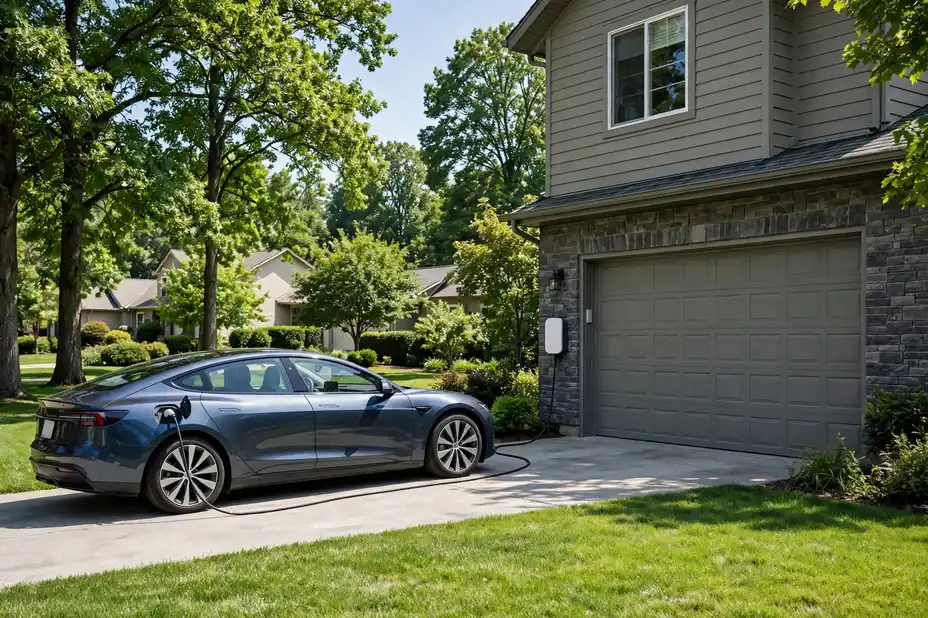
EV charging services in Grand Rapids
The full menu runs to ten services; the three cards at the top are the ones Grand Rapids's housing stock and state law push to the front. Everything links to its national service page for scope and process in full.
Home EV Charger Installation in Grand Rapids
Think of it as plumbing for electrons, with the same virtues: correct sizing, honest materials, tidy runs, tested joints. The installers who do it weekly follow a pattern — assess, calculate, route, mount, configure, document — and the pattern is why their installs rarely make news afterwards.
In Grand Rapids: the core residential job in Grand Rapids: circuit, mounting, configuration and inspection in one visit pattern.
Dedicated Circuit & Electrical Panel Upgrade in Grand Rapids
A service change is the least reversible and most enabling job on this page: it re-bases the whole house's electrical life. Done inside the charger project, it shares the permit, the utility visit and the electrician's day with the circuit it makes room for.
In Grand Rapids: relevant in Grand Rapids wherever a 100-amp panel already carries cooking, heating and hot water before a charger asks for room.
Multifamily & Condo EV Charging in Grand Rapids
The building version of the home job, with a governance layer on top. Boards approve complete applications; residents pay for their own energy through the metering design; the building's capacity is shared by management rather than by argument. That system is what this service installs.
In Grand Rapids: the approvals-plus-wiring job for Grand Rapids's condos and HOA communities, where the process matters as much as the circuit.
Utility programs and electricity in Grand Rapids
Electricity in Grand Rapids comes from Consumers Energy Co. Parts of the wider metro are served by Great Lakes Energy Coop, City of Holland, City of Grand Haven. The utility matters twice over for a charger install: it sets the time-of-use rates that decide what overnight charging costs you, and it is the organisation that may — or may not — currently help pay for the equipment.
No verified residential charger rebate was in place for Consumers Energy Co in the sources checked for this page (the federal Alternative Fuel Refueling Property Credit ended on September 30, 2025, and no Michigan state program replaced it for typical home installs). That can change — utilities open and close funded rounds — so an installer quoting you today should be able to name any current program precisely, with its published terms. If they cannot name it, it is not part of your job.
Before the install, it is worth a two-minute look at your tariff. Many Consumers Energy Co customers can move to a time-of-use plan where overnight energy is charged at a lower rate, and a scheduled charger makes that saving automatic.
Condos, HOAs and the law in Michigan
Charging is a protected right for association owners in Michigan. The state's right-to-charge statute (Homeowners' Energy Policy Act, MCL 559.305 (eff. Apr 2, 2025)) stops a homeowners association or condominium from banning an owner's charging station outright. Conditions still exist — placement, appearance, insurance and restoration can all be regulated, and the owner pays — yet the starting position is yes-with-rules rather than no-unless-persuaded, and that difference decides most applications before they are written.
For renters, coverage in Michigan is recorded as: Owners (HOA). If you rent in Grand Rapids, the practical route is still a written proposal to the landlord — dedicated circuit, licensed installer, your name on the permit — because a charger-ready space is an asset most landlords keep when you leave.
Start with the condo and HOA guide for the application itself, and the multifamily service page for how the electrical design is usually laid out in Michigan buildings.
Climate, garages and charger placement
Snow management decides charger geography in cold metros more than any electrical factor: the station out of the plough's throw, the parking position out of the drift line, the cable route off the shovelled path. Walk the site in your head in February before signing the layout in June.
Winter hardware habits are simple and worth copying: a holster the connector returns to every night (a connector left in a snowbank is a connector full of ice), a cable route that survives the snow-clearing line, and a station position the plough's output does not bury. Installers here raise all three without being asked.

Permits and inspection in Grand Rapids
What the inspector is checking, in plain terms: conductor size against breaker size, the continuous-load calculation, terminations torqued, protection where the code wants it, and a station whose settings match the circuit it landed on. It is a short visit that validates everything you cannot see.

Neighbourhoods and ZIP codes served
The page covers 26 ZIP codes in and around Grand Rapids — including 49501, 49502, 49503, 49504, 49505, 49506, 49507, 49508, 49510, 49512, 49514, 49515, 49516, 49518, 49523, 49525, 49528, 49530, 49534, 49544, 49546, 49548, 49555, 49560, 49588, 49599 — across Kent, Ottawa. If your ZIP is not in the first set shown, ask anyway: installer coverage follows the metro, not a postcode fence.
The same working area takes in the neighbouring localities of Comstock Park, Wyoming, Belmont, Ada, Grandville, Rockford, Cannonsburg, Jenison, Marne, Sparta, Caledonia, Byron Center, Lowell, Lamont — the county ring an installer based in Grand Rapids actually drives. Requests from those communities route exactly as city requests do: same services, same permit discipline, same local facts where they differ.
Kent County accounts for 46 of the ZIP codes and 16 named postal localities in the research file, the nearest of them Comstock Park, Wyoming, Belmont, Ada, Grandville. The survey counts 663,150 residents in the county, with a median household income of $82,631 and a median home value of $289,900. Ottawa County accounts for 20 of the ZIP codes and 17 named postal localities in the research file, the nearest of them Jenison, Marne, Lamont, Hudsonville, Jamestown. The survey counts 301,203 residents in the county, with a median household income of $90,502 and a median home value of $323,400. Measured across its ZIP codes, the Grand Rapids footprint runs about 11 miles north to south and 11 east to west, from ZIP 49501 to 49599 — the ground an installer based here actually covers in a working week.
Beyond the county seats, the working area takes in Comstock Park, Wyoming, Belmont, Ada, Grandville, Rockford, Cannonsburg, Jenison, Marne, Sparta, Caledonia, Byron Center, Lowell, Lamont, Hudsonville, Alto, Jamestown, Allendale, Conklin, Cedar Springs, Moline, Kent City, Coopersville, Dorr, Casnovia, Smyrna, Burnips, Middleville, Wayland, Sand Lake, Freeport, Bailey, Belding, Clarksville, Zeeland, Saranac, Gowen, Ravenna, Bradley, Hopkins, Greenville, Pierson, Shelbyville, Trufant, Grant, Nunica, Hamilton, West Olive, Orleans, Coral, Holland, Hastings, Fruitport, Howard City, Lake Odessa, Ionia, Martin, Newaygo, Grand Haven, Spring Lake, Cloverdale, Sidney, Ferrysburg, Fenwick, Muskegon, Allegan, Delton, Macatawa, Otsego, Lakeview, Sheridan, Plainwell, Stanton, Morley, Saugatuck, Fremont, Twin Lake, White Cloud, Fennville, Dowling, Douglas, Mcbrides, Hickory Corners, Six Lakes, Holton, Richland, Pullman, Kalamazoo, Stanwood, Gobles, Kendall, Edmore — the named localities for which Grand Rapids is the nearest metro in the network (neighbouring metros' pages cover their own ground), each routing to the same installer-matching service.
The wider working area also reaches Woodland, Palo, Muir, Sunfield, Nashville, Lyons, Portland, Vermontville, Pewamo, Mulliken, Carson City, Hubbardston, Crystal — ground shared with neighbouring metros, where installers cross the same county lines in both directions.
ZIP codes in that shared ground include 48811, 48818, 48845, 48851, 48860, 48861, 48870, 48873, 48875, 48890, 48897, 49073, 49096.
The largest communities in that working area after Grand Rapids itself, by the GeoNames populated-place file: Kalamazoo (population 76,041), Wyoming (population 75,275), Kentwood (population 51,357), Muskegon (population 38,401), Holland (population 33,742), Forest Hills (population 25,867), Walker (population 24,647), Norton Shores (population 24,208). Charging demand follows those populations — the subdivisions and town centres where the next driveways, and the next panels, are.
| ZIP | Locality | County |
|---|---|---|
| 49501 | Grand Rapids | Kent |
| 49503 | Grand Rapids | Kent |
| 49505 | Grand Rapids | Kent |
| 49525 | Grand Rapids | Kent |
| 49502 | Grand Rapids | Kent |
| 49523 | Grand Rapids | Kent |
| 49555 | Grand Rapids | Kent |
| 49506 | Grand Rapids | Kent |
| 49507 | Grand Rapids | Kent |
| 49504 | Grand Rapids | Kent |
| 49510 | Grand Rapids | Kent |
| 49514 | Grand Rapids | Kent |
| 49515 | Grand Rapids | Kent |
| 49516 | Grand Rapids | Kent |
| 49518 | Grand Rapids | Kent |
| 49530 | Grand Rapids | Kent |
| 49560 | Grand Rapids | Kent |
| 49588 | Grand Rapids | Kent |
| 49599 | Grand Rapids | Kent |
| 49544 | Grand Rapids | Kent |
| 49546 | Grand Rapids | Kent |
| 49321 | Comstock Park | Kent |
| 49509 | Wyoming | Kent |
| 49508 | Grand Rapids | Kent |
| 49528 | Grand Rapids | Kent |
| 49534 | Grand Rapids | Ottawa |
| 49306 | Belmont | Kent |
| 49519 | Wyoming | Kent |
| 49355 | Ada | Kent |
| 49356 | Ada | Kent |
| 49357 | Ada | Kent |
| 49548 | Grand Rapids | Kent |
| 49301 | Ada | Kent |
| 49512 | Grand Rapids | Kent |
| 49468 | Grandville | Kent |
| 49418 | Grandville | Kent |
| 49351 | Rockford | Kent |
| 49317 | Cannonsburg | Kent |
| 49429 | Jenison | Ottawa |
| 49341 | Rockford | Kent |
| 49428 | Jenison | Ottawa |
| 49435 | Marne | Ottawa |
| 49345 | Sparta | Kent |
| 49316 | Caledonia | Kent |
| 49315 | Byron Center | Kent |
| 49331 | Lowell | Kent |
| 49430 | Lamont | Ottawa |
| 49426 | Hudsonville | Ottawa |
| 49302 | Alto | Kent |
| 49427 | Jamestown | Ottawa |
| 49401 | Allendale | Ottawa |
| 49403 | Conklin | Ottawa |
| 49319 | Cedar Springs | Kent |
| 49335 | Moline | Allegan |
| 49330 | Kent City | Kent |
| 49404 | Coopersville | Ottawa |
| 49323 | Dorr | Allegan |
| 49318 | Casnovia | Muskegon |
| 48887 | Smyrna | Ionia |
| 49314 | Burnips | Allegan |
| 49333 | Middleville | Barry |
| 49348 | Wayland | Allegan |
| 49343 | Sand Lake | Kent |
| 49325 | Freeport | Barry |
| 49303 | Bailey | Muskegon |
| 48809 | Belding | Ionia |
| 48815 | Clarksville | Ionia |
| 49464 | Zeeland | Ottawa |
| 48881 | Saranac | Ionia |
| 49326 | Gowen | Montcalm |
| 49451 | Ravenna | Muskegon |
| 49311 | Bradley | Allegan |
| 49328 | Hopkins | Allegan |
| 48838 | Greenville | Montcalm |
| 49339 | Pierson | Montcalm |
| 49344 | Shelbyville | Allegan |
| 49347 | Trufant | Montcalm |
| 49327 | Grant | Newaygo |
| 49448 | Nunica | Ottawa |
| 49419 | Hamilton | Allegan |
| 49460 | West Olive | Ottawa |
| 48865 | Orleans | Ionia |
| 49322 | Coral | Montcalm |
| 49422 | Holland | Ottawa |
| 49058 | Hastings | Barry |
| 49415 | Fruitport | Muskegon |
| 49329 | Howard City | Montcalm |
| 48849 | Lake Odessa | Ionia |
| 49424 | Holland | Ottawa |
| 49423 | Holland | Ottawa |

Planning the install: from panel to parking
The order of operations protects you. Load calculation before equipment choice, because the circuit sizes the station's settings. Route before purchase, because reach decides models. Permit before work, because inspection closes the file the insurer will one day read. In Grand Rapids the sequence is the same as everywhere — what varies is only how much of it your particular house asks for, and finding that out is the site visit's entire purpose.
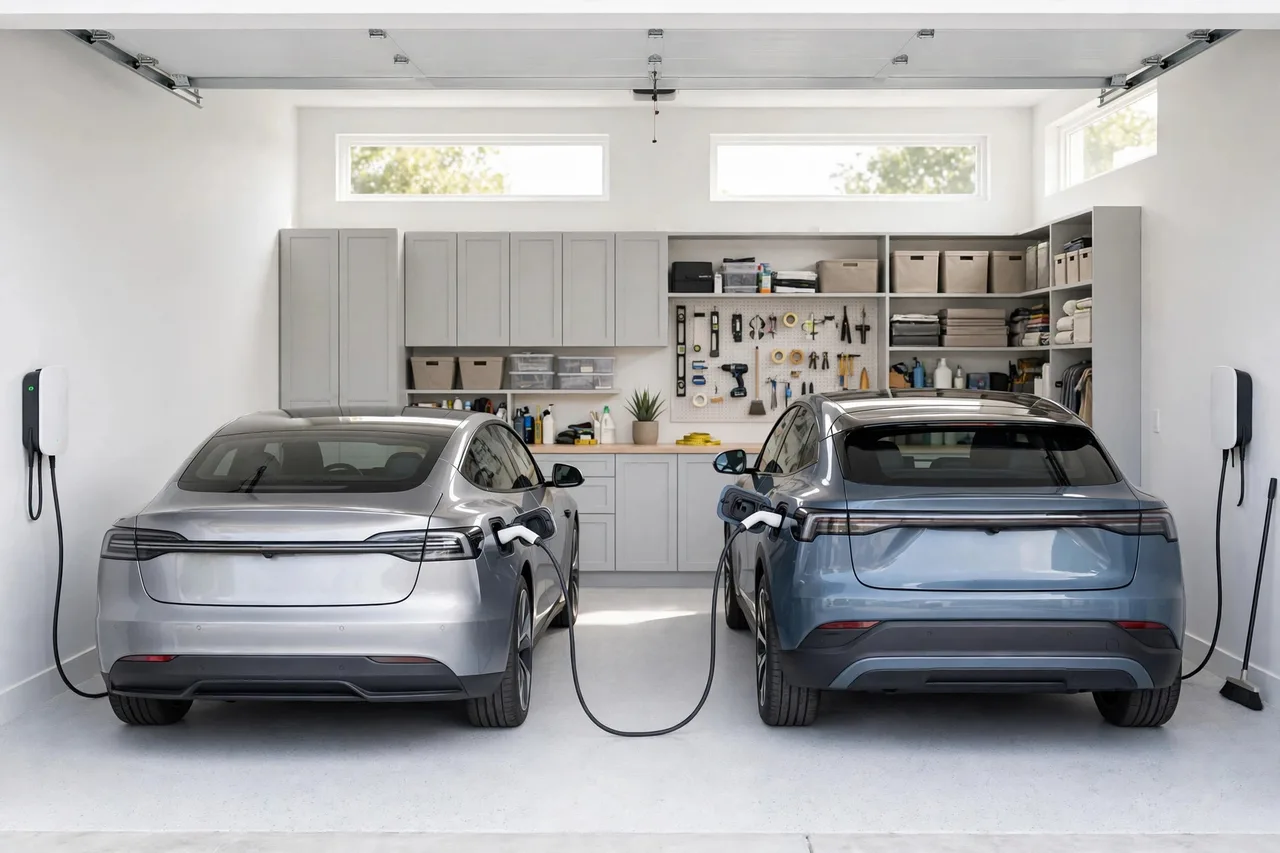
Plan for the household you will be, not just the car you have. A second EV is the most common reason a charger circuit gets revisited, and the cheap moment to prepare for it — conduit sized up, panel capacity reserved, station placement that serves two bays — is during the first install, while the permit is open and the electrician is already in the panel.
Home charging know-how for Grand Rapids households
Charging on a shift worker's clock
Night-shift households run the tariff backwards: the car works while others charge and charges through the day while others work. Their design questions differ — daytime sessions against the household's sleeping hours, schedules that flip with the rota, and the second car's opposite rhythm. None of it is complicated, but all of it must be said at the site visit, because the default schedule baked into every station assumes a nine-to-five that this household does not live.
The insurance conversation
A permitted charger installation is a short conversation with your insurer, and it is worth having before rather than after. The documented install — permit, inspection, listed equipment, licensed electrician — is the version insurers process without friction, because every question they ask is answered by the file. Undocumented electrical work is where claims go to become arguments. Tell the insurer the circuit exists, keep the paperwork with the policy documents, and the charger's insurance chapter closes in one phone call.
After the power comes back
Outages end untidily: a surge as the grid re-energises, a station mid-session interrupted, a car that resumes charging on its own schedule or waits for instruction depending on its settings. The household habits are minimal — know what your car and station each do on restoration, let the first post-outage session be a watched one, and treat any new tripping afterwards as information rather than nuisance. Equipment that rode out a storm badly usually says so promptly.
Smart features, soberly assessed
Connectivity buys three real things in a charging station: scheduling against rate windows, session records the household can actually read, and power sharing between stations. It does not buy speed — the circuit decides that — and a station whose network features fail should still charge the car, which the good ones do. Households deep in a smart-home ecosystem may value the integrations; everyone else should choose on the electrical merits and treat the application as a bonus. Either way, the configuration that matters is set at commissioning: rate, schedule, and the circuit's limit, recorded on the paperwork.
Garage layout: the unglamorous decider
More charging routines are decided by garage geography than by equipment. Which bay the EV takes, which side its port sits on, where the freezer, bikes and workbench have permanent tenure — the station belongs at the intersection of those facts, with a cable that reaches the port without crossing the walking line to the door. Installers who walk the layout with the car in place are not being thorough for its own sake; they are preventing the daily, decade-long annoyance of a station mounted for a parking pattern nobody uses.

Frequently asked questions
Can I still get the federal tax credit for a home charger in Grand Rapids, MI?
Treat the answer as a standing no with a watching brief. The 30C credit is finished, Michigan has not replaced it for homeowners, and no verified Consumers Energy Co rebate was running in the sources checked for this page. Should that change, the utility's program page will say so first — and this page will be updated to match.
Can my association in Grand Rapids, MI say no to a home charger?
Not outright. Under Homeowners' Energy Policy Act, MCL 559.305 (eff. Apr 2, 2025), Michigan associations cannot prohibit an owner's charger; they can condition it — reasonably — on placement, insurance and restoration, with the owner funding the work. The disputes that do arise are usually about conditions, and they settle fastest when the application answers them in advance.
Will my Grand Rapids, MI home need a panel upgrade for a Level 2 charger?
Nobody can answer that from a photograph of your panel's door, and you should be suspicious of anyone who tries. In a city where the median home dates to 1955 and about 77% of units predate 1980, the honest answer is a load calculation: what your service is, what it already carries, and what a continuous charger load does to the total. Then the options — circuit, load management, or upgrade — compare on paper.
How quickly will a Level 2 charger fill my car in Grand Rapids, MI?
Level 2 is several-fold faster in the only unit that matters — miles back per hour parked: roughly 25–40 against Level 1's 3–5. The exact figure follows the circuit: a 40-amp circuit and a 60-amp circuit are both Level 2, and the car's onboard limit may sit below either. Your installer matches the three numbers at the site visit.
What happens next after I send a request?
Your request is matched to licensed installers covering Grand Rapids, Michigan — service, ZIP, property type and timing travel with it. The installer who takes it arranges the site visit and quotes in writing; PlugReady USA's part is the research on this page and the introduction, and your contract is with the installer throughout.
I live in a Grand Rapids apartment or condo building — can I charge at home?
With about 22% of Grand Rapids's housing in buildings of five or more units, building charging is a mainstream question here. It is an approvals project before it is an electrical one — board or landlord, metering, load design — and the sections above walk through both the legal position in Michigan and the application package that works.
Nearby cities in Michigan
- EV charger installation in Lansing — about 62 miles from Grand Rapids, metro population 550,000
- EV charger installation in Detroit — about 148 miles from Grand Rapids, metro population 4,350,000
- EV charger installation in South Bend, IN — about 97 miles from Grand Rapids, metro population 325,000
- EV charger installation in Milwaukee, WI — about 126 miles from Grand Rapids, metro population 1,575,000
- EV charger installation in Chicago, IL — about 133 miles from Grand Rapids, metro population 9,450,000
Ready to charge at home in Grand Rapids?
Send the essentials — what you need, where, and what kind of property — and a licensed local installer will pick it up from there.