EV Charger Installation in Yuba City, CA
Charging where you park, in Yuba City: the utility programs, state law, permit process and housing facts behind a home charger install, gathered in one place.
Ask EV owners in Yuba City what changed their routine and most give the same answer: the car charges where it parks. Yuba City itself is home to about 69,150 people. Statewide, California counted 1,843,100 battery-electric vehicles and 490,900 plug-in hybrids on the road through 2025, and the metro's share of that fleet keeps growing. A home charger installation is not complicated, but it is local — the utility that serves your street, the age of your panel, your community's rules and your city's permit office all shape the job. This page pulls those Yuba City specifics together in one place, with the numbers sourced rather than rounded into slogans.
A word on how to use the page: each section answers one of the questions an installer will ask you anyway — panel, utility, property rules, permits — with Yuba City's actual answers. Read the two that apply to your house and you will start the quoting conversation several steps ahead.
Measured demand, not enthusiasm, put Yuba City in Tier C of this network: Sacramento exurb. For a homeowner the useful translation is simpler — installers here do this work weekly, know the local permit counter, and have seen your housing stock before.
Read the survey numbers as an installer reads them. A median household income of $80,072 and an owner-occupation rate of 59% describe a city where most charger decisions are made by the person who owns the panel — no landlord layer, no board layer for the typical job. The 63% of homes that are single-unit detached are the straightforward installs: garage or driveway, one owner, one circuit.

Every city charges differently, and Yuba City's difference is legible in the data: an older housing fabric, where panel archaeology is a normal part of the first visit; a detached-house majority with a real attached and multifamily minority; buildings of five or more units are a visible minority of the stock; owners hold a working majority, with renters a significant minority. Read the sections below through that profile and the local advice resolves into specifics — which questions are routine here, and which are rare.
In absolute terms, the survey counts 24,528 housing units in Yuba City — 22,950 occupied, 13,618 of them by their owners. The stock resolves into 15,372 single-unit detached houses, 11,175 homes standing since before 1980, and 4,852 units in larger buildings. Those six counts are the city's charging map drawn without percentages, and every section of this page is a consequence of one of them. The page's geography is equally concrete: 3 ZIP codes across Sutter, centred near 39.11 degrees north latitude. The city anchors the Yuba City metropolitan area, home to roughly 185,000 people on the research file's metro estimate — the wider labour and housing market this page's installers work across.
The same survey release fills in the household economics around the housing stock: a median home value of $434,600, median gross rent of $1,454, per-capita income of $34,401, and a median resident age of 36. The movement data matters as much as the money data: 74% of Yuba City workers drive to work alone — the commute pattern home charging is built around; 7% work from home, a population whose cars charge on daytime and overnight schedules alike; 1% commute by public transit; 20% of adults hold a bachelor's degree or higher. And the fleet in the driveways: 6,359 households in Yuba City have exactly one vehicle, 14,905 have two or more, and 1,686 have none.
Two burden statistics frame the economics: in Yuba City, 38% of renters and 0% of mortgage-holding owners are housing-cost burdened at the standard 30% threshold. And 72% of households are family households, the segment most likely to run the two-vehicle, two-schedule pattern the second-vehicle planning notes address.
What follows is the city read as an electrical place rather than a dot on a map. The oldest housing throws the longest shadows over an install: knob-and-tube remnants in the attic, ungrounded receptacles, services sized for iceboxes and radios that now feed induction ranges and heat pumps. Variety is the installer's training programme here: no two days alike, the van stocked for houses and buildings alike, and a diary that reads like the housing survey performed live.
Balanced tenure also means the city's charging map has two legends: the owner streets, where adoption is a purchase, and the rental districts, where it is a negotiation — both legible on this page's numbers. Households here run the numbers — which is why the honest sections of this page, the ones that say what is verified and what is not, earn their keep. A large utility's scale cuts both ways — programme budgets that dwarf a small co-op's, and call-centre distance between a household and anyone who can decide anything. The published page rules; keep it bookmarked.
Scale brings specialisation: firms here can afford to do nothing but charging installs, and their process shows it — templated applications, standing inspector relationships, diaries booked in weeks. The permit counter in a smaller city is a conversation, not a queue: applications are read by people who may know the street, and complete paperwork is remembered kindly. Where the state's statute speaks, the local conversation changes register: installers quote the framework, boards keep counsel's template, and approvals become administrative.
The electrical reality in Yuba City homes
The Census Bureau counts Yuba City's housing in ways that turn out to be an installer's briefing: the median home dates to 1983, 46% of units stood before 1980, 63% are detached single-unit houses, and 59% of occupied homes belong to their occupants. Panel sizes, wire routes and even permit histories track those proportions street by street. A housing stock this age leans on smaller electrical services — 100-amp panels are common, and fuse-era equipment still turns up in the oldest streets. For many of those homes the honest answer is a panel upgrade or a load-management device before the charger circuit goes in, and a good installer will show you the load calculation rather than asking you to take it on faith. Detached houses matter for a practical reason: a garage or driveway on your own lot means the charger, the car and the circuit are all under one roof and one owner's control, which is the simplest configuration there is.
The fuel table adds one more local fact: 7,161 Yuba City homes — 30% of the stock — heat with electricity. Those households already think in kilowatts through the winter, their panels carry the load to prove it, and a charger's overnight appetite joins a system that is, in the useful sense, already electrified.
One further split matters for how this page is organised: about 9,332 of Yuba City's occupied homes are renter-occupied. Everything above assumes you can approve your own electrical work; where you cannot, the approval layer — landlord or association — becomes part of the job, which is why the law section carries unusual weight here.
The city's stock is not all houses: 20% of units are in structures of five or more. Shared buildings mean shared panels, assigned parking and association process — the substance of the multifamily sections below.
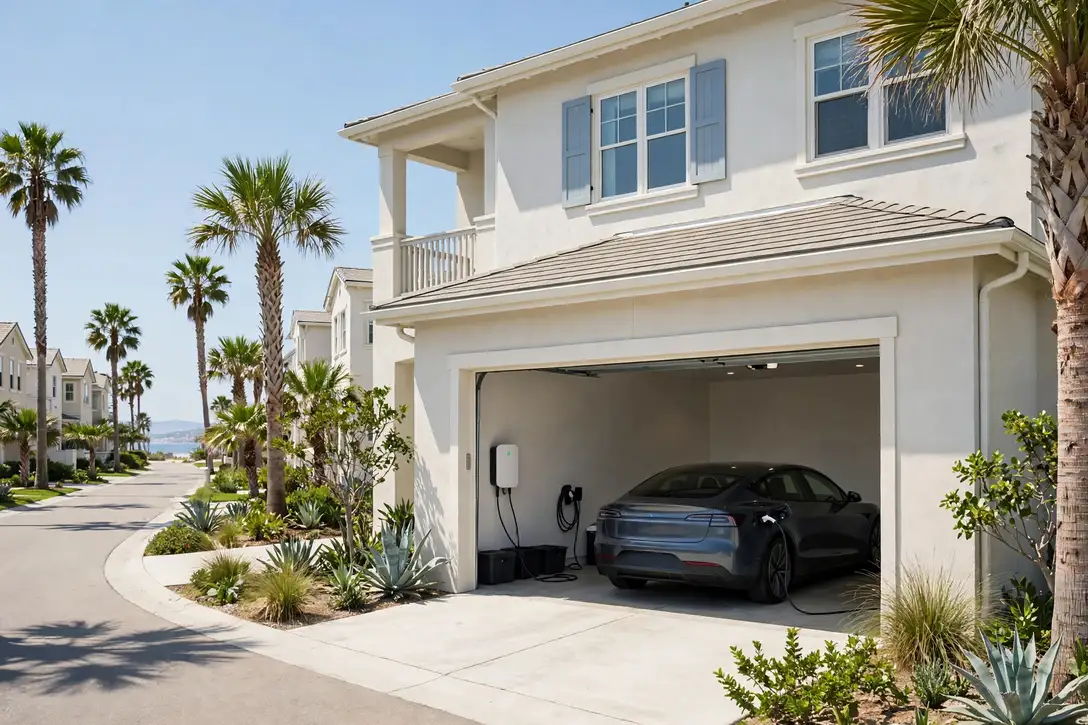
EV charging services in Yuba City
The services below are ordered by what Yuba City households most often need first, judged from the housing and fleet facts on this page. The full menu follows in the grid — every service is offered in this metro.
Home EV Charger Installation in Yuba City
For most households this is the whole project: a Level 2 station mounted where the car sleeps, fed by its own 240-volt circuit. The visit pattern is consistent — load calculation, route the run, mount and configure, inspect — and the variables are your panel, your parking and your permit office.
In Yuba City: the install Yuba City's new EV households book first, and the one the rest of this page keeps returning to.
Dedicated Circuit & Electrical Panel Upgrade in Yuba City
The capacity project behind the charger project. A load calculation decides whether the answer is a service increase, a panel replacement, a subpanel or load management — and the work is sequenced with the utility and the inspector so the house is live again the same day in most cases.
In Yuba City: the job that surfaces wherever housing is older — and Yuba City's stock makes it a routine conversation, settled by a load calculation.
Multifamily & Condo EV Charging in Yuba City
The multifamily install is a small constitution before it is a circuit: who may charge, on whose meter, under what cost split, with what path for the next ten applicants. Buildings that write that constitution once stop re-litigating it at every annual meeting.
In Yuba City: constitutions for shared charging in Yuba City buildings: metering, load and approvals.
Utility programs and electricity in Yuba City
Electricity in Yuba City comes from Pacific Gas & Electric Co.. Parts of the wider metro are served by WAPA-- Western Area Power Administration. The utility matters twice over for a charger install: it sets the time-of-use rates that decide what overnight charging costs you, and it is the organisation that may — or may not — currently help pay for the equipment.
Plan on no rebate in Yuba City at the moment. In the sources checked for this page, Pacific Gas & Electric Co. publishes no residential charger rebate, California runs no state scheme for typical home installs, and the federal credit that once filled this gap closed on September 30, 2025. Installers quote the work; utilities fund programs; the second list is currently empty here, and any quote that implies otherwise should come with the program's published terms attached.
If your service includes a demand component, the charger's start time matters more than its size: staggered against the house's other big loads, the same circuit costs noticeably less to run across a year.
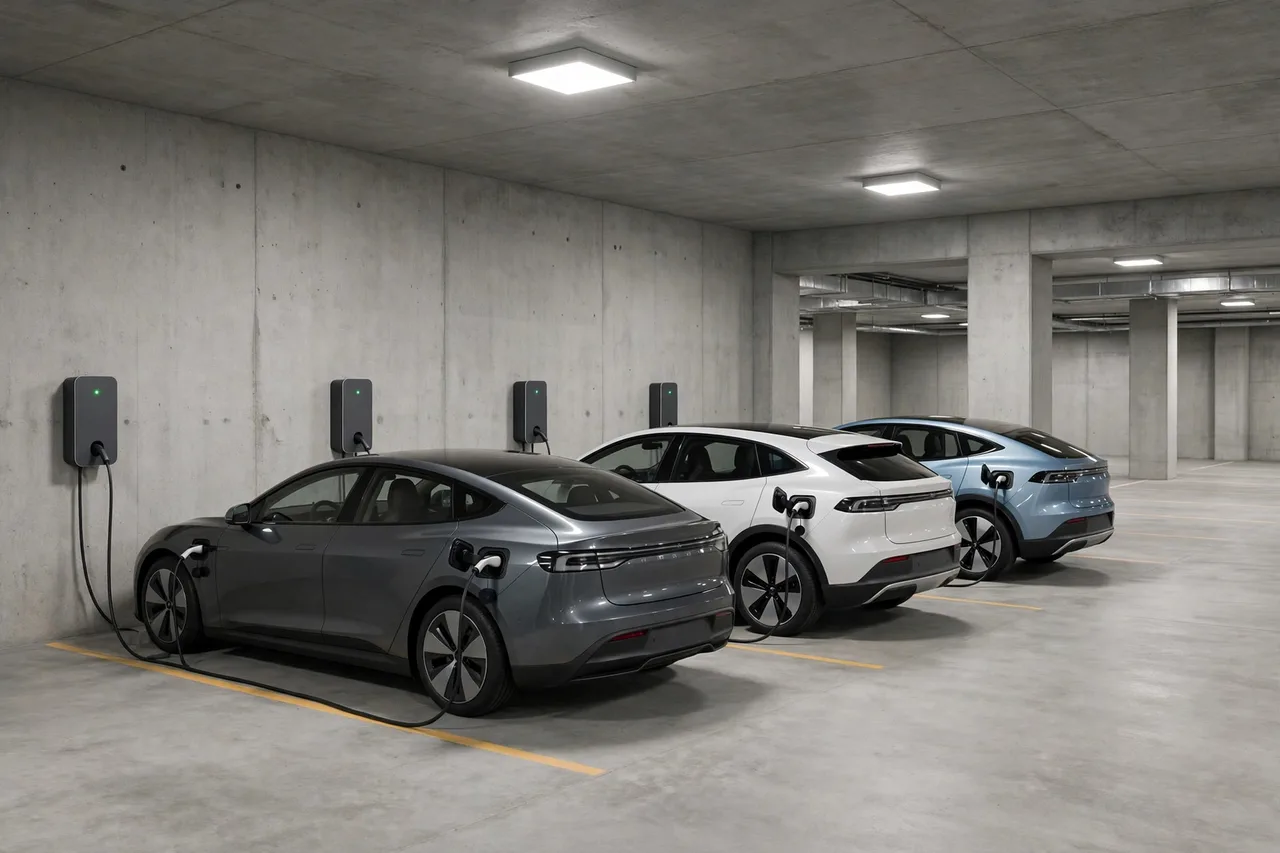
Condos, HOAs and the law in California
Charging is a protected right for association owners in California. The state's right-to-charge statute (Civ. Code §4745; §1947.6 (renters)) stops a homeowners association or condominium from banning an owner's charging station outright. Conditions still exist — placement, appearance, insurance and restoration can all be regulated, and the owner pays — yet the starting position is yes-with-rules rather than no-unless-persuaded, and that difference decides most applications before they are written.
Two practical corollaries follow for Yuba City owners. First, assigned spaces are the clean case: the statute's protection is clearest where the parking is deeded or exclusively assigned. Second, insurance conditions are real but bounded — if a board's requirement looks invented, asking for its basis in the statute is a reasonable, usually decisive, question.
Start with the condo and HOA guide for the application itself, and the multifamily service page for how the electrical design is usually laid out in California buildings.
Climate, garages and charger placement
Four-season metros ask the install to be two things: kind to a battery in January and indifferent to a thunderstorm in July. The equipment is rated for both out of the box; the local craft is in the details — cable jacket chosen for cold flexibility, mounting placed with drainage in mind, a schedule that follows the seasons' rate windows.
Leaf-fall and pollen sound beneath an electrician's notice until they are inside a connector left lying open. The holster habit — connector docked, cap where the design provides one — is the entire countermeasure, and it is free.

Permits and inspection in Yuba City
The permit trail also protects the next transaction: a charger circuit on the inspection record is an asset a buyer's inspector reads in one line, while an undocumented circuit is a question that follows the sale. Installers who work this metro treat the filing as part of the deliverable, not an errand.

Neighbourhoods and ZIP codes served
The page covers 3 ZIP codes in and around Yuba City — including 95991, 95992, 95993 — across Sutter. If your ZIP is not in the first set shown, ask anyway: installer coverage follows the metro, not a postcode fence.
The same working area takes in the neighbouring localities of Sutter, Meridian, Live Oak, Rio Oso, Robbins, Nicolaus, Pleasant Grove — the county ring an installer based in Yuba City actually drives. Requests from those communities route exactly as city requests do: same services, same permit discipline, same local facts where they differ.
Sutter County accounts for 10 of the ZIP codes and 8 named postal localities in the research file, the nearest of them Sutter, Meridian, Live Oak, Rio Oso, Robbins. The survey counts 98,857 residents in the county, with a median household income of $79,704 and a median home value of $433,500. Measured across its ZIP codes, the Yuba City footprint runs about 7 miles north to south and 3 east to west, from ZIP 95991 to 95993 — the ground an installer based here actually covers in a working week.
Beyond the county seats, the working area takes in Olivehurst, Marysville, Sutter, Meridian, Live Oak, Wheatland, Rio Oso, Beale Afb, Grimes, Sheridan, Robbins, Nicolaus, Gridley, Knights Landing, Smartsville, Browns Valley, Biggs, Bangor, Palermo, Lincoln, Arbuckle, Penn Valley, Colusa, Oregon House, Zamora, Dunnigan, Rough And Ready, Rackerby, Dobbins, Grass Valley, Auburn, Brownsville, Williams, Meadow Vista, Cedar Ridge, Challenge, Maxwell, North San Juan, Applegate, Forbestown, Weimar, Chicago Park, Colfax, Nevada City, Clipper Mills, Camptonville, Gold Run, Dutch Flat — the named localities for which Yuba City is the nearest metro in the network (neighbouring metros' pages cover their own ground), each routing to the same installer-matching service.
The wider working area also reaches Yolo, Oroville, Richvale, Elverta, Rocklin, Penryn, Rio Linda, Antelope, Butte City, Nelson, Princeton, Loomis, North Highlands, Mcclellan, Citrus Heights, Granite Bay, Esparto, Orangevale, Carmichael, Fair Oaks, Guinda, Represa, Capay, Durham, Brooks, Cool, Folsom, Rancho Cordova, Feather Falls, Berry Creek, Greenwood, El Dorado Hills, Lotus, Rescue, Chico — ground shared with neighbouring metros, where installers cross the same county lines in both directions.
ZIP codes in that shared ground include 94203, 94206, 94208, 94229, 94237, 94250, 94254, 94257, 94263, 94268, 94273, 94280, 94283, 94287, 94293, 94294, 94297, 95605, 95606, 95609, 95616, 95658, 95679, 95697, 95741, 95762, 95765, 95814, 95817, 95818, 95826, 95828, 95831, 95833, 95834, 95860, 95916, 95929, 95938, 95940.
The largest communities in that working area after Yuba City itself, by the GeoNames populated-place file: Lincoln (population 49,757), Linda (population 17,773), South Yuba City (population 15,217), Olivehurst (population 13,656), North Auburn (population 13,022), Grass Valley (population 12,944), Marysville (population 12,216), Live Oak (population 8,531), Alta Sierra (population 6,911), Gridley (population 6,582), Colusa (population 5,935), Plumas Lake (population 5,853), Tierra Buena (population 5,797), Palermo (population 5,382), Williams (population 5,196), Lake Wildwood (population 4,991), Lake of the Pines (population 3,917), Wheatland (population 3,725), Meadow Vista (population 3,217), Nevada City (population 3,152). Charging demand follows those populations — the subdivisions and town centres where the next driveways, and the next panels, are.
Yuba County reaches into the working area with 84,507 residents, a median household income of $76,373 and a median home value of $412,300; its localities on this page include Olivehurst, Marysville, Wheatland, Beale Afb, Browns Valley. Placer County reaches into the working area with 419,156 residents, a median household income of $115,998 and a median home value of $688,100; its localities on this page include Sheridan, Lincoln, Auburn, Meadow Vista, Applegate. Nevada County reaches into the working area with 102,481 residents, a median household income of $89,882 and a median home value of $621,800; its localities on this page include Smartsville, Penn Valley, Rough And Ready, Grass Valley, Cedar Ridge. Butte County reaches into the working area with 207,929 residents, a median household income of $67,928 and a median home value of $424,700; its localities on this page include Gridley, Biggs, Bangor, Palermo, Forbestown. Colusa County reaches into the working area with 21,984 residents, a median household income of $75,672 and a median home value of $393,400; its localities on this page include Grimes, Arbuckle, Colusa, Williams, Maxwell.
| ZIP | Locality | County |
|---|---|---|
| 95991 | Yuba City | Sutter |
| 95993 | Yuba City | Sutter |
| 95961 | Olivehurst | Yuba |
| 95992 | Yuba City | Sutter |
| 95901 | Marysville | Yuba |
| 95982 | Sutter | Sutter |
| 95957 | Meridian | Sutter |
| 95953 | Live Oak | Sutter |
| 95692 | Wheatland | Yuba |
| 95674 | Rio Oso | Sutter |
| 95903 | Beale Afb | Yuba |
| 95950 | Grimes | Colusa |
| 95681 | Sheridan | Placer |
| 95676 | Robbins | Sutter |
| 95659 | Nicolaus | Sutter |
| 95948 | Gridley | Butte |
| 95645 | Knights Landing | Yolo |
| 95977 | Smartsville | Nevada |
| 95918 | Browns Valley | Yuba |
| 95917 | Biggs | Butte |
| 95914 | Bangor | Butte |
| 95968 | Palermo | Butte |
| 95648 | Lincoln | Placer |
| 95912 | Arbuckle | Colusa |
| 95946 | Penn Valley | Nevada |
| 95932 | Colusa | Colusa |
| 95962 | Oregon House | Yuba |
| 95698 | Zamora | Yolo |
| 95937 | Dunnigan | Yolo |
| 95975 | Rough And Ready | Nevada |
| 95972 | Rackerby | Yuba |
| 95935 | Dobbins | Yuba |
| 95949 | Grass Valley | Nevada |
| 95602 | Auburn | Placer |
| 95919 | Brownsville | Yuba |
| 95987 | Williams | Colusa |
| 95722 | Meadow Vista | Placer |
| 95924 | Cedar Ridge | Nevada |
| 95925 | Challenge | Yuba |
| 95955 | Maxwell | Colusa |
| 95945 | Grass Valley | Nevada |
| 95960 | North San Juan | Nevada |
| 95703 | Applegate | Placer |
| 95941 | Forbestown | Butte |
| 95736 | Weimar | Placer |
| 95712 | Chicago Park | Nevada |
| 95713 | Colfax | Placer |
| 95959 | Nevada City | Nevada |
| 95930 | Clipper Mills | Butte |
| 95922 | Camptonville | Yuba |
| 95717 | Gold Run | Placer |
| 95714 | Dutch Flat | Placer |

Planning the install: from panel to parking
A useful way to read any Yuba City quote is to ask which of three jobs it describes. Job one: the panel has room and the run is short — a circuit and a station. Job two: the panel is full — capacity work joins the quote, as an upgrade or as load management. Job three: the property adds people — an HOA, a landlord, a building's shared service — and the approvals timeline joins the electrical one. None of the three is a bad job; they are simply different scopes, and a clear quote says which one you are in.
Future-proofing, in this trade, is mostly conduit and capacity: an oversized conduit run costs little during the first install and everything later; a panel position reserved is a breaker that never has to move. If a second EV, a workshop or an electrified water heater is anywhere in your five-year picture, say so at the site visit.
Home charging know-how for Yuba City households
When you move: take it or leave it
The station is portable in a way the circuit is not. A plug-in unit unplugs and travels; a hardwired one leaves with an electrician's half hour. The circuit — the larger share of the original project — stays with the house, where the paperwork decides what it is worth: documented as a permitted charger circuit, it is a listing feature for the next EV household; undocumented, it is a mystery outlet in the garage. Owners planning a move inside a few years can say so at install time; the plug-in-versus-hardwired choice reads differently with a departure date attached.
Carports and the condensation line
A carport shelters the car from rain but not from air, and overnight condensation is its signature: cool surfaces, damp mornings, connectors beaded with moisture. Equipment listed for the exposure handles it as routine; the details are in drainage and holstering — a connector docked nose-down in its holder sheds water, one left coiled on the slab collects it. Small physics, daily consequences.
The school-run charge window
Households organised around school runs live on a distinctive charge curve: two short hops, a long parked day, an afternoon of activities. The car sits at home for the middle of the day — which, for solar households, is precisely the generation window, and for everyone else makes the overnight session almost an afterthought. Scheduling follows the family's actual day, not the tariff's assumption of one, and the installer who asks about the school run is designing, not chatting.
Garage layout: the unglamorous decider
More charging routines are decided by garage geography than by equipment. Which bay the EV takes, which side its port sits on, where the freezer, bikes and workbench have permanent tenure — the station belongs at the intersection of those facts, with a cable that reaches the port without crossing the walking line to the door. Installers who walk the layout with the car in place are not being thorough for its own sake; they are preventing the daily, decade-long annoyance of a station mounted for a parking pattern nobody uses.

Frequently asked questions
Is the federal charger tax credit still available in Yuba City, CA?
That credit is finished: 30C ended on September 30, 2025. What about locally? In the utility and state sources checked for this page, nothing verified was running for Yuba City homeowners — no Pacific Gas & Electric Co. rebate, no state scheme. If one opens, it will appear on the utility's site with dates; plan your install without it meanwhile.
Can my HOA or condo board in Yuba City, CA refuse my charger?
Only within limits the statute sets. California law (Civ. Code §4745; §1947.6 (renters)) protects an owner's right to install in their own space; associations may regulate placement, appearance and insurance and require restoration on removal, but a blanket refusal is not theirs to give. If a board stalls, a complete written application citing the statute is the standard remedy.
Does a Level 2 charger mean a panel upgrade for a Yuba City, CA home?
It hinges on two numbers you cannot read off the panel door: the service's rating, and what the load calculation says it already carries. The vintage of Yuba City's stock — median build year 1983, about 46% of homes from before 1980 — means both answers are common here. The charger enters the arithmetic at 125% of its draw; whatever room survives that entry decides between a circuit, a management device, and an upgrade.
How quickly will a Level 2 charger fill my car in Yuba City, CA?
Level 1 — the cord in the boot, on a normal outlet — returns about 3–5 miles of range an hour. Level 2 on its own 240-volt circuit returns roughly 25–40. A Yuba City commuter who parks at seven and leaves at seven stops doing battery arithmetic entirely.
How does the installer matching on this page work?
Send the request and it is matched against installers covering Yuba City — your service, ZIP, property type and timing travel with it. An installer then arranges the site visit and quotes in writing. Our role ends at the introduction; your contract, permit and paperwork are with the installer.
Does Pacific Gas & Electric Co. offer a time-of-use rate for EV charging in Yuba City?
Worth checking before the install, because it changes the setup rather than the circuit: if Pacific Gas & Electric Co. offers your address a time-of-use plan, the station's schedule is programmed to its overnight window at commissioning. The tariff pages or a call to the utility confirm your plan's windows; guessing from a neighbour's bill is how households end up charging at peak by default.
Nearby cities in California
- EV charger installation in Sacramento — about 37 miles from Yuba City, metro population 2,400,000
- EV charger installation in Chico — about 46 miles from Yuba City, metro population 210,000
- EV charger installation in Napa — about 57 miles from Yuba City, metro population 140,000
- EV charger installation in Vallejo — about 75 miles from Yuba City, metro population 450,000
- EV charger installation in Santa Rosa — about 78 miles from Yuba City, metro population 500,000
- EV charger installation in Stockton — about 81 miles from Yuba City, metro population 800,000
- EV charger installation in Reno, NV — about 104 miles from Yuba City, metro population 500,000
- EV charger installation in Medford, OR — about 230 miles from Yuba City, metro population 220,000
- EV charger installation in Bend, OR — about 345 miles from Yuba City, metro population 205,000
Ready to charge at home in Yuba City?
Tell us the job — service, ZIP and property type — and licensed local installers will take it from there.