EV Charger Installation in Stockton, CA
Charging where you park, in Stockton: the utility programs, state law, permit process and housing facts behind a home charger install, gathered in one place.
Start with the vehicle you already own and the driveway it already sleeps in: home charging succeeds when the electrical side is treated as a small building project rather than an accessory purchase. In Stockton that project has local coordinates. Stockton itself is home to about 324,980 people, inside a state counting 1,843,100 battery-electric vehicles and 490,900 plug-in hybrids through 2025. The utility serving your street, the vintage of your panel, the rules of your community and the habits of your permit office are the four coordinates — this page fixes each one for Stockton.
One honest note before the detail: PlugReady USA does not install chargers. We collect your requirements and pass them to licensed installers who cover Stockton, and this page exists so that you can judge those conversations with the local facts already in hand.
What the Experian and AFDC registration data say about Stockton: Bay Area spillover housing. Translated out of market language: your neighbours are already charging at home, the permit office already knows the paperwork, and the installers already know the housing stock.
The Census Bureau's portrait of Stockton — median household income $78,627, 54% of occupied homes owner-occupied, 64% of units in single-unit detached houses — is, read correctly, a charging forecast. Owners approve their own work; detached houses host their own circuits; the remaining share is where the interesting projects live.

Put the survey together and Stockton's charging profile reads like this: an older housing fabric, where panel archaeology is a normal part of the first visit; a detached-house majority with a real attached and multifamily minority; buildings of five or more units are a visible minority of the stock; and owners hold a working majority, with renters a significant minority. That combination — more than any single number — is what the installers working here plan around, and it is the lens for everything on this page.
Keep six figures and you keep Stockton's whole electrical character: 104,027 housing units; 98,473 occupied homes; 52,891 owner-occupied; 66,678 detached houses; 51,003 pre-1980 homes; 19,945 homes in buildings of five or more units. Percentages elsewhere on this page are these numbers in disguise — the counts are the originals, and they are the numbers a local installer's experience is actually made of. The page's geography is equally concrete: 20 ZIP codes across San Joaquin, centred near 37.96 degrees north latitude. The city anchors the Stockton metropolitan area, home to roughly 800,000 people on the research file's metro estimate — the wider labour and housing market this page's installers work across.
The same survey release fills in the household economics around the housing stock: a median home value of $456,800, median gross rent of $1,635, per-capita income of $31,948, and a median resident age of 34. How the city moves completes the picture: 71% of Stockton workers drive to work alone — the commute pattern home charging is built around; 8% work from home, a population whose cars charge on daytime and overnight schedules alike; 1% commute by public transit; 23% of adults hold a bachelor's degree or higher. Vehicle ownership, from the same release: 59,101 households in Stockton run two or more vehicles, and 8,543 run none — the two ends of the market this page serves and does not serve.
Two burden statistics frame the economics: in Stockton, 52% of renters and 0% of mortgage-holding owners are housing-cost burdened at the standard 30% threshold. And 73% of households are family households, the segment most likely to run the two-vehicle, two-schedule pattern the second-vehicle planning notes address.
What follows is the city read as an electrical place rather than a dot on a map. A stock this old wires its history into the walls: cloth-wrapped conductors in the deepest streets, fuse boxes that outlived their century, panels added in layers by generations of electricians each solving their own decade's problem. Variety is the installer's training programme here: no two days alike, the van stocked for houses and buildings alike, and a diary that reads like the housing survey performed live.
Renter weight gives this metro's charging story a negotiation at its centre: the circuit is easy, the permission is the project, and the paperwork patterns in the guides matter as much as any load calculation. Households at this band comparison-shop on scope rather than on slogans, which rewards the installer whose quote shows its working — the load study, the route, the permit, itemised. Filed tariffs and public dockets give this territory a paper trail most markets lack: the diligent household can read the utility's own electrification plan and know which programmes are funded, piloted or merely proposed.
Scale brings specialisation: firms here can afford to do nothing but charging installs, and their process shows it — templated applications, standing inspector relationships, diaries booked in weeks. At this scale the city's charging infrastructure is legible — a household can learn the whole local system, its programmes, precedents and people, in an evening's reading. This page is most of that evening. Where the state's statute speaks, the local conversation changes register: installers quote the framework, boards keep counsel's template, and approvals become administrative.
The electrical reality in Stockton homes
Four numbers organise everything an installer expects in Stockton: median build year 1981; 49% of units built before 1980; 64% of the stock detached; 54% of occupied homes owner-occupied. Capacity, circuit routes and approval layers all correlate with those four. The paragraphs below are their commentary. Age shows up electrically before it shows up anywhere else: services sized for a house with a third of today's appliances. Expect the first conversation to be about capacity — what the panel is, what it already feeds, and which of the three routes (circuit, management, upgrade) your numbers support. Housing age also tracks wire-run reality: older homes more often place the panel in a basement or interior wall far from the garage, and distance is copper, conduit and labour.
Heating fuel is the survey's quiet clue to panel life: in Stockton, 37% of homes heat electrically (36,802 households), against 56% heating with gas. A house already heating electrically has a service sized with that load in its history; a gas-heated house may have capacity to spare — either way the fuel mix is part of what the installer is reading.
One further split matters for how this page is organised: about 45,582 of Stockton's occupied homes are renter-occupied. Everything above assumes you can approve your own electrical work; where you cannot, the approval layer — landlord or association — becomes part of the job, which is why the law section carries unusual weight here.
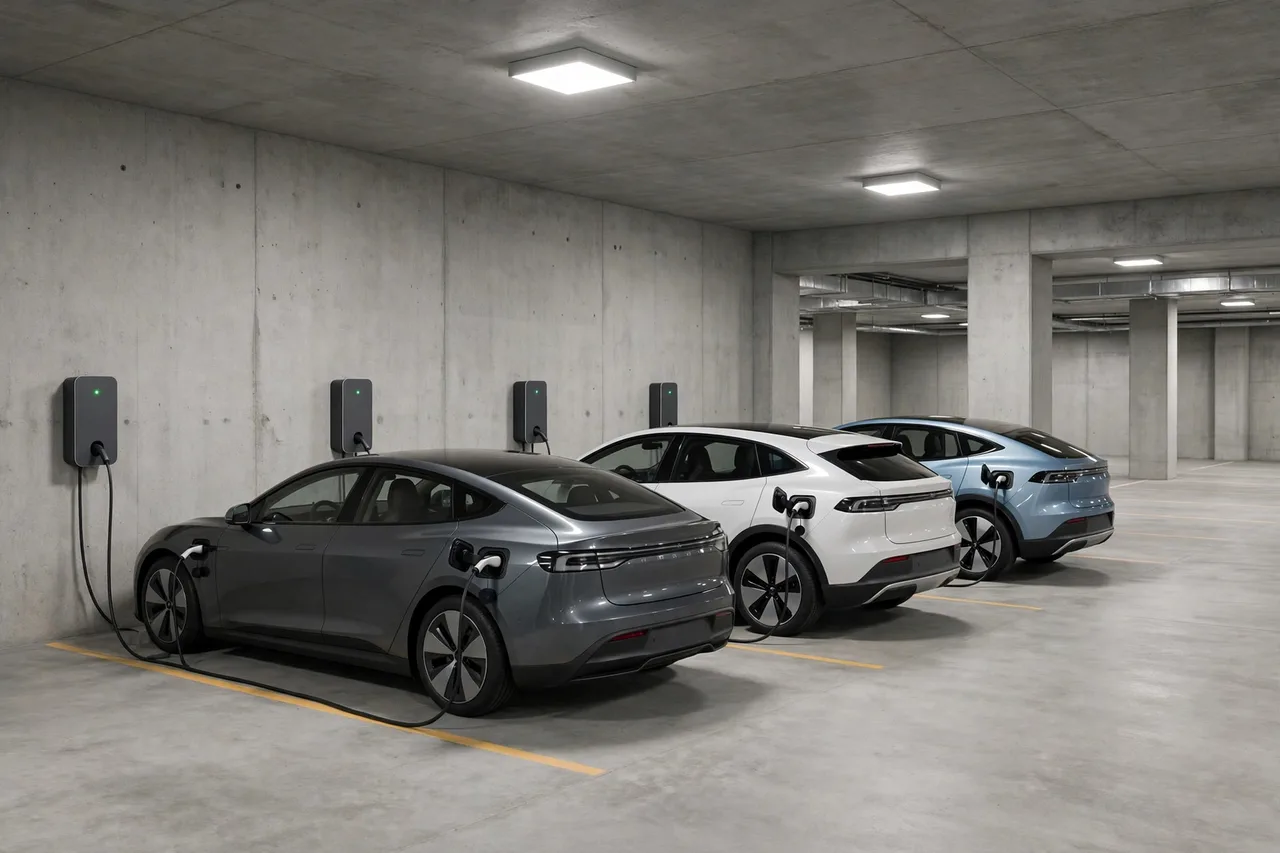
The city's stock is not all houses: 19% of units are in structures of five or more. Shared buildings mean shared panels, assigned parking and association process — the substance of the multifamily sections below.
EV charging services in Stockton
Ten services cover the work installers do in Stockton. Three lead the list here because of what this city's housing and law actually look like — each links to its national service page, where scope and process are set out in full.
Home EV Charger Installation in Stockton
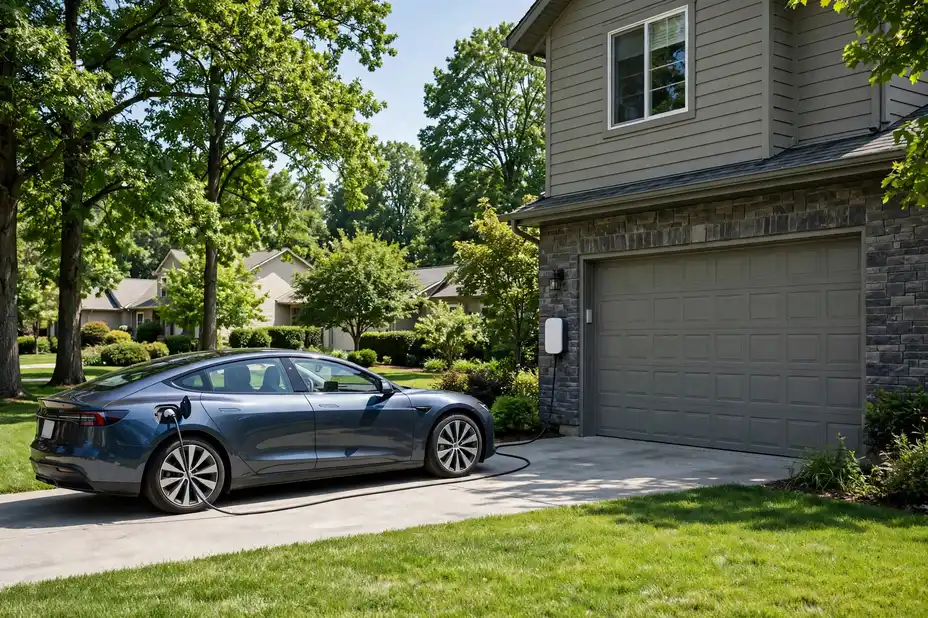
Think of it as plumbing for electrons, done once: capacity checked, circuit run, station mounted and configured, inspection passed. The households that report the smoothest projects describe the same shape — a visit that measured, a quote that itemised, and a car that simply charged from the first night.
In Stockton: the core residential job in Stockton: circuit, mounting, configuration and inspection in one visit pattern.
Dedicated Circuit & Electrical Panel Upgrade in Stockton
Where the load calculation fails the existing service, the upgrade is not an upsell — it is the finding. Done under permit with the utility's meter work coordinated, it converts the charger project into the house's electrical reset, and every later project inherits the headroom.
In Stockton: the capacity answer when Stockton's older panels meet a continuous load.
Multifamily & Condo EV Charging in Stockton
The multifamily install is a small constitution before it is a circuit: who may charge, on whose meter, under what cost split, with what path for the next ten applicants. Buildings that write that constitution once stop re-litigating it at every annual meeting.
In Stockton: the route from board agenda to working charger in Stockton's communities.
Utility programs and electricity in Stockton
Electricity in Stockton comes from Pacific Gas & Electric Co.. Parts of the wider metro are served by Modesto Irrigation District, City of Lodi, Port of Stockton. The utility matters twice over for a charger install: it sets the time-of-use rates that decide what overnight charging costs you, and it is the organisation that may — or may not — currently help pay for the equipment.
Frame the Stockton incentive question correctly and it answers itself. Three pots could in principle fund part of a home charger: a federal credit, a California program, a Pacific Gas & Electric Co. rebate. The first ended on September 30, 2025. The second does not exist for typical home installs. The third, in the sources checked for this page, is not currently offered for residential customers. Zero plus zero plus zero is the honest budget line — and any future change will arrive through the utility's own program page, with dates, which is where this page will take it from.
Net-metering households — rooftop solar is common across the metro — should tell the installer: charging schedules and load management are planned differently when the house generates as well as consumes.
Condos, HOAs and the law in California
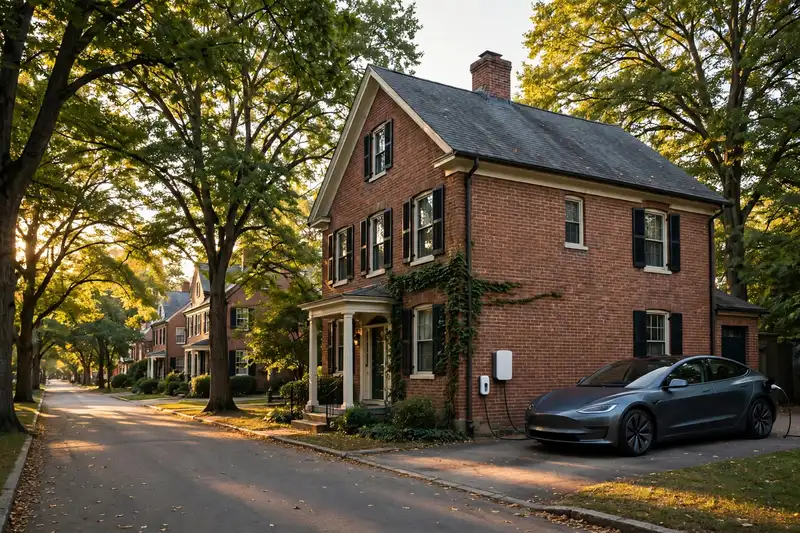
California has a right-to-charge law. Under Civ. Code §4745; §1947.6 (renters), a homeowners association or condominium cannot simply prohibit an owner from installing a charging station in their own parking space. The law does not make the process free or instant — owners typically carry the cost, must use a licensed installer, carry any insurance the statute specifies, and can be required to restore the space if they remove the equipment — but it converts the conversation from a request for permission into a defined process with rules on both sides.
For renters, coverage in California is recorded as: Yes. If you rent in Stockton, the practical route is still a written proposal to the landlord — dedicated circuit, licensed installer, your name on the permit — because a charger-ready space is an asset most landlords keep when you leave.
Both the process and the paperwork are covered in the condo and HOA guide; Stockton readers can skip the chapters about persuading reluctant boards and go straight to the compliance checklist.
Climate, garages and charger placement
The seasons rotate the charging advice: precondition from the wall in winter, dodge the afternoon peak in summer, and let the shoulder months do what they like. Households here learn the two settings and change them with the clocks.
Four-season metros ask the install to be two things: kind to a battery in January and indifferent to a thunderstorm in July. The equipment is rated for both out of the box; the local craft is in the details — cable jacket chosen for cold flexibility, mounting placed with drainage in mind, a schedule that follows the seasons' rate windows.

Permits and inspection in Stockton
Timelines are set by the city's counter, not the installer: the electrical work itself is typically a day, while permit issuance and the inspection visit follow the department's queue. A quote that promises a date should tell you which parts of that date the installer actually controls.

Neighbourhoods and ZIP codes served
The page covers 20 ZIP codes in and around Stockton — including 95201, 95202, 95203, 95204, 95205, 95206, 95207, 95208, 95209, 95210, 95211, 95212, 95213, 95214, 95215, 95219, 95267, 95269, 95296, 95297 — across San Joaquin. If your ZIP is not in the first set shown, ask anyway: installer coverage follows the metro, not a postcode fence.
The same working area takes in the neighbouring localities of French Camp, Holt, Lathrop, Manteca, Lodi, Victor, Woodbridge, Linden, Farmington, Lockeford, Ripon, Tracy, Acampo, Escalon — the county ring an installer based in Stockton actually drives. Requests from those communities route exactly as city requests do: same services, same permit discipline, same local facts where they differ.
San Joaquin County accounts for 44 of the ZIP codes and 18 named postal localities in the research file, the nearest of them French Camp, Holt, Lathrop, Manteca, Lodi. The survey counts 797,334 residents in the county, with a median household income of $92,179 and a median home value of $530,700. Measured across its ZIP codes, the Stockton footprint runs about 9 miles north to south and 13 east to west, from ZIP 95201 to 95297 — the ground an installer based here actually covers in a working week.
Beyond the county seats, the working area takes in French Camp, Holt, Lathrop, Manteca, Lodi, Victor, Woodbridge, Linden, Farmington, Lockeford, Tracy, Acampo, Discovery Bay, Clements, Thornton, Bethel Island, Byron, Knightsen, Galt, Brentwood, Isleton, Oakley, Wallace, Herald, Rio Vista, Burson, Antioch, Valley Springs, Campo Seco, Ione, San Andreas, Martell, Jackson — the named localities for which Stockton is the nearest metro in the network (neighbouring metros' pages cover their own ground), each routing to the same installer-matching service.
The wider working area also reaches Escalon, Modesto, Ryde, Oakdale, Westley, Courtland, Livermore, Wilton, Elk Grove, Ceres, Clarksburg, Hughson, Clayton, Sacramento, Concord, San Ramon, Pleasanton, Diablo, Turlock, Dublin, Crows Landing, Hayward, Hickman, Angels Camp, Walnut Creek, Amador City, Alamo, Mather, Sunol, Travis Afb, Plymouth, Rancho Cordova, Elmira, West Sacramento, Castro Valley — ground shared with neighbouring metros, where installers cross the same county lines in both directions.
ZIP codes in that shared ground include 94205, 94211, 94232, 94236, 94248, 94254, 94256, 94257, 94262, 94267, 94277, 94278, 94284, 94289, 94291, 94295, 94298, 94507, 94517, 94523, 94526, 94528, 94557, 94568, 94575, 94586, 95228, 95320, 95350, 95353, 95356, 95358, 95385, 95683, 95693, 95741, 95757, 95814, 95817, 95822.
The largest communities in that working area after Stockton itself, by the GeoNames populated-place file: Tracy (population 87,075), Manteca (population 75,448), Lodi (population 64,596), Brentwood (population 58,968), Oakley (population 39,813), Galt (population 25,303), Lathrop (population 20,866), Discovery Bay (population 13,352), Garden Acres (population 10,648), Mountain House (population 9,675), Country Club (population 9,379), August (population 8,390), Rio Vista (population 8,348), Ione (population 7,000), Jackson (population 4,649), Rancho Calaveras (population 4,489), Lincoln Village (population 4,381), Woodbridge (population 3,984), Morada (population 3,828), Valley Springs (population 3,553). Charging demand follows those populations — the subdivisions and town centres where the next driveways, and the next panels, are.
Contra Costa County reaches into the working area with 1,165,012 residents, a median household income of $127,229 and a median home value of $866,800; its localities on this page include Discovery Bay, Bethel Island, Byron, Knightsen, Brentwood. Calaveras County reaches into the working area with 46,248 residents, a median household income of $78,647 and a median home value of $457,200; its localities on this page include Wallace, Burson, Valley Springs, Campo Seco, San Andreas. Sacramento County reaches into the working area with 1,594,006 residents, a median household income of $92,175 and a median home value of $534,200; its localities on this page include Galt, Isleton, Herald. Amador County reaches into the working area with 41,428 residents, a median household income of $88,044 and a median home value of $449,800; its localities on this page include Ione, Martell, Jackson. Solano County reaches into the working area with 451,918 residents, a median household income of $100,401 and a median home value of $617,700; its localities on this page include Rio Vista.
| ZIP | Locality | County |
|---|---|---|
| 95201 | Stockton | San Joaquin |
| 95296 | Stockton | San Joaquin |
| 95202 | Stockton | San Joaquin |
| 95203 | Stockton | San Joaquin |
| 95205 | Stockton | San Joaquin |
| 95204 | Stockton | San Joaquin |
| 95211 | Stockton | San Joaquin |
| 95206 | Stockton | San Joaquin |
| 95267 | Stockton | San Joaquin |
| 95207 | Stockton | San Joaquin |
| 95297 | Stockton | San Joaquin |
| 95269 | Stockton | San Joaquin |
| 95215 | Stockton | San Joaquin |
| 95210 | Stockton | San Joaquin |
| 95214 | Stockton | San Joaquin |
| 95213 | Stockton | San Joaquin |
| 95212 | Stockton | San Joaquin |
| 95231 | French Camp | San Joaquin |
| 95219 | Stockton | San Joaquin |
| 95209 | Stockton | San Joaquin |
| 95234 | Holt | San Joaquin |
| 95208 | Stockton | San Joaquin |
| 95330 | Lathrop | San Joaquin |
| 95336 | Manteca | San Joaquin |
| 95240 | Lodi | San Joaquin |
| 95241 | Lodi | San Joaquin |
| 95242 | Lodi | San Joaquin |
| 95337 | Manteca | San Joaquin |
| 95253 | Victor | San Joaquin |
| 95258 | Woodbridge | San Joaquin |
| 95236 | Linden | San Joaquin |
| 95230 | Farmington | San Joaquin |
| 95237 | Lockeford | San Joaquin |
| 95304 | Tracy | San Joaquin |
| 95220 | Acampo | San Joaquin |
| 95376 | Tracy | San Joaquin |
| 94505 | Discovery Bay | Contra Costa |
| 95391 | Tracy | San Joaquin |
| 95227 | Clements | San Joaquin |
| 95686 | Thornton | San Joaquin |
| 94511 | Bethel Island | Contra Costa |
| 94514 | Byron | Contra Costa |
| 94548 | Knightsen | Contra Costa |
| 95378 | Tracy | San Joaquin |
| 95632 | Galt | Sacramento |
| 94513 | Brentwood | Contra Costa |
| 95641 | Isleton | Sacramento |
| 94561 | Oakley | Contra Costa |
| 95377 | Tracy | San Joaquin |
| 95254 | Wallace | Calaveras |
| 95638 | Herald | Sacramento |
| 94571 | Rio Vista | Solano |
| 95225 | Burson | Calaveras |
| 94531 | Antioch | Contra Costa |
| 95252 | Valley Springs | Calaveras |
| 95226 | Campo Seco | Calaveras |
| 95640 | Ione | Amador |
| 95249 | San Andreas | Calaveras |
| 95654 | Martell | Amador |
| 95642 | Jackson | Amador |

Planning the install: from panel to parking
Two decisions shape every Stockton install, and both are made before any equipment is ordered. The first is electrical: the load calculation that decides between a straight circuit, a panel upgrade and load management. The second is physical: where the station lives — which wall, which side of the car the charge port sits on, and whether the cable reaches a second vehicle or a future one. Installers in Stockton see the same housing patterns repeat street by street, which is why a ten-minute site visit produces a firmer quote than any online form: the form starts the conversation, the visit settles it.
One more piece of sequencing advice Stockton installers give consistently: if the panel is being opened anyway, settle the other electrical maybes in the same visit — the circuit you will want next year costs least while the permit and the electrician are already in the house.
Home charging know-how for Stockton households
The paperwork is part of the installation
A finished install leaves two legacies: a working charger and a file. The file — permit, passed inspection, the station's configuration recorded, the panel schedule updated, a photograph of the finished work — is what the future runs on. It answers the insurer's question, the buyer's question, the second installer's load calculation, and the warranty conversation, each in one page. Households that treat the paperwork as part of the deliverable never have to reconstruct it; households that do not, eventually do. Ask for the file at handover and keep it with the house documents.
Carports and the condensation line
A carport shelters the car from rain but not from air, and overnight condensation is its signature: cool surfaces, damp mornings, connectors beaded with moisture. Equipment listed for the exposure handles it as routine; the details are in drainage and holstering — a connector docked nose-down in its holder sheds water, one left coiled on the slab collects it. Small physics, daily consequences.
When protection trips, listen to it
Ground-fault protection and EV charging have a known friction: certain combinations of breaker protection and station electronics nuisance-trip each other, leaving a car uncharged by morning. The answers are design answers — a hardwired configuration, a breaker the station's manufacturer lists as compatible, protection delivered inside the equipment where the code allows — and they belong at install time, not after the third flat morning. A trip that begins months later is a different message: protection devices report faults, and a new trip pattern earns an electrician's visit, not a reset habit.
The landlord's side of the charger
For a landlord, a charger circuit is an amenity with unusual arithmetic: it is visible in listings, filterable in searches, and durable across tenancies in a way paint is not. The questions that decide it are practical rather than visionary — whose meter the circuit hangs from, how the cost is recovered, what the end-of-tenancy position is — and each has a standard answer the multifamily sections of this site describe. Landlords who run the numbers tenant by tenant usually conclude the circuit earns its wall space.
Vehicles that work from home
A growing class of households runs a business from the drive: trades vans, delivery vehicles, a car that is also the office. Their charging arithmetic differs from the commuter's — higher daily miles, tighter morning deadlines, and a vehicle whose readiness is revenue. The design answers scale accordingly: capacity with headroom, a schedule set against the working day rather than the night, and occasionally the second circuit sooner than a private household would need it. If the vehicle earns, say so at the site visit; it changes the specification.
Frequently asked questions
Can I still get the federal tax credit for a home charger in Stockton, CA?
That credit is finished: 30C ended on September 30, 2025. What about locally? In the utility and state sources checked for this page, nothing verified was running for Stockton homeowners — no Pacific Gas & Electric Co. rebate, no state scheme. If one opens, it will appear on the utility's site with dates; plan your install without it meanwhile.
Can my association in Stockton, CA say no to a home charger?
Not outright. Under Civ. Code §4745; §1947.6 (renters), California associations cannot prohibit an owner's charger; they can condition it — reasonably — on placement, insurance and restoration, with the owner funding the work. The disputes that do arise are usually about conditions, and they settle fastest when the application answers them in advance.
Panel upgrade or not — how do Stockton, CA homeowners find out?
The question has a correct instrument: the load calculation. It totals what your service already carries — with the code's demand factors, not nameplate panic — and sets the charger's continuous load against the remainder. In Stockton, where the median home dates to 1981 and about 49% of units predate 1980, the answer splits by street: post-war and newer 200-amp homes usually proceed; older 100-amp homes choose between capacity work and load management. Anyone answering without the calculation is guessing in a uniform.
Level 1 or Level 2 in Stockton, CA — what is the real difference?
In parked hours: a Level 1 cord returns about 3–5 miles for each of them, and a Level 2 circuit returns roughly 25–40, set by its amperage and the car's acceptance. For a Stockton household parking ten hours, that is the difference between recovering a short errand day and recovering any day the car can legally drive.
What happens next after I send a request?
Your request is matched to licensed installers covering Stockton, California — service, ZIP, property type and timing travel with it. The installer who takes it arranges the site visit and quotes in writing; PlugReady USA's part is the research on this page and the introduction, and your contract is with the installer throughout.
Does Pacific Gas & Electric Co. offer a time-of-use rate for EV charging in Stockton?
Worth checking before the install, because it changes the setup rather than the circuit: if Pacific Gas & Electric Co. offers your address a time-of-use plan, the station's schedule is programmed to its overnight window at commissioning. The tariff pages or a call to the utility confirm your plan's windows; guessing from a neighbour's bill is how households end up charging at peak by default.
Nearby cities in California
- EV charger installation in Modesto — about 25 miles from Stockton, metro population 575,000
- EV charger installation in Sacramento — about 45 miles from Stockton, metro population 2,400,000
- EV charger installation in San Jose — about 54 miles from Stockton, metro population 2,000,000
- EV charger installation in Vallejo — about 57 miles from Stockton, metro population 450,000
- EV charger installation in San Francisco — about 64 miles from Stockton, metro population 6,700,000
- EV charger installation in Napa — about 64 miles from Stockton, metro population 140,000
- EV charger installation in Reno, NV — about 135 miles from Stockton, metro population 500,000
- EV charger installation in Medford, OR — about 311 miles from Stockton, metro population 220,000
- EV charger installation in Las Vegas, NV — about 362 miles from Stockton, metro population 2,300,000
Ready to charge at home in Stockton?
Two minutes of form, and the request is in front of licensed installers who cover this city — quotes follow site visits, in writing.