EV Charger Installation in Modesto, CA
Home Level 2 charging, panel upgrades and condo installs in Modesto — matched to licensed local installers, with the local facts that shape the job set out below.
There is a reason most charging happens at home: it is the most convenient fuelling an EV owner will ever use, and it happens while the car sits idle anyway. In Modesto, getting set up means answering a handful of local questions first. Modesto itself is home to about 220,617 people, inside a state that registered 1,843,100 battery-electric vehicles and 490,900 plug-in hybrids through 2025. Which utility serves your address, whether it currently funds part of a charger install, what your panel can carry, and what your HOA or condo board can and cannot say no to — this page covers each of them for Modesto specifically.
How PlugReady USA works, in one breath: you describe the job once, licensed local installers who cover Modesto receive it, and the conversations happen with them directly. The rest of this page exists so those conversations start from facts — yours about the house, ours about the metro — rather than from a sales script.
The registration ledger for the Modesto metro reads: CA Central Valley. Ledgers like this are what installer rounds are built from — they show where the cars already are, which is where the circuits get requested, permitted and inspected week after week.
Read the survey numbers as an installer reads them. A median household income of $79,211 and an owner-occupation rate of 60% describe a city where most charger decisions are made by the person who owns the panel — no landlord layer, no board layer for the typical job. The 70% of homes that are single-unit detached are the straightforward installs: garage or driveway, one owner, one circuit.

Every city charges differently, and Modesto's difference is legible in the data: an older housing fabric, where panel archaeology is a normal part of the first visit; overwhelmingly a detached-house city, so most installs are the simple garage pattern; buildings of five or more units are a visible minority of the stock; owners hold a working majority, with renters a significant minority. Read the sections below through that profile and the local advice resolves into specifics — which questions are routine here, and which are rare.
Keep six figures and you keep Modesto's whole electrical character: 75,882 housing units; 74,680 occupied homes; 45,001 owner-occupied; 53,479 detached houses; 39,033 pre-1980 homes; 10,861 homes in buildings of five or more units. Percentages elsewhere on this page are these numbers in disguise — the counts are the originals, and they are the numbers a local installer's experience is actually made of. The page's geography is equally concrete: 10 ZIP codes across Stanislaus, centred near 37.67 degrees north latitude. The city anchors the Modesto metropolitan area, home to roughly 575,000 people on the research file's metro estimate — the wider labour and housing market this page's installers work across.
The same survey release fills in the household economics around the housing stock: a median home value of $467,600, median gross rent of $1,822, per-capita income of $35,211, and a median resident age of 36. And the daily rhythms behind the housing numbers: 77% of Modesto workers drive to work alone — the commute pattern home charging is built around; 7% work from home, a population whose cars charge on daytime and overnight schedules alike; 2% commute by public transit; 22% of adults hold a bachelor's degree or higher. Vehicle ownership, from the same release: 47,678 households in Modesto run two or more vehicles, and 3,876 run none — the two ends of the market this page serves and does not serve.
Two burden statistics frame the economics: in Modesto, 60% of renters and 0% of mortgage-holding owners are housing-cost burdened at the standard 30% threshold. And 70% of households are family households, the segment most likely to run the two-vehicle, two-schedule pattern the second-vehicle planning notes address.
This is the context an installer works against, whether it is written down or not. The oldest housing throws the longest shadows over an install: knob-and-tube remnants in the attic, ungrounded receptacles, services sized for iceboxes and radios that now feed induction ranges and heat pumps. House-by-house urbanism gives the metro a house-by-house charging pattern — no building-scale projects, just thousands of individual circuits appearing one permit at a time.
Neither renter-heavy nor owner-dominated, the market rewards installers who can work both sides of the tenure line: the domestic circuit and the negotiated one. Here the tariff conversation is a budget conversation: the overnight window's arithmetic, done honestly once, pays out every night of the car's life without further attention. The commission's calendar quietly schedules the market: when a new time-of-use design is approved, installer phones ring in a pattern the docket predicted months earlier.
At this fleet volume the questions mature: not whether to install, but how the second circuit shares capacity, how buildings retrofit at scale, how the grid's evening ramp is managed street by street. The diary economics differ from the biggest metros: good installers book in weeks, not months, and the household that calls in spring is rarely queueing behind a season of work. The association dimension, at least, comes with a statutory frame in this state — the law section above sets out what boards may and may not do, and applications written inside that frame travel noticeably faster.
The electrical reality in Modesto homes
Read the stock the way a panel schedule reads it. Median build year 1979 means half of Modesto's homes were wired to codes of that era or earlier; 51% predate 1980 entirely. 70% of units are detached houses, and 60% of occupied homes are owned by their occupants — so most charger conversations here happen between a homeowner and an electrician, with no third party at the table. Age shows up electrically before it shows up anywhere else: services sized for a house with a third of today's appliances. Expect the first conversation to be about capacity — what the panel is, what it already feeds, and which of the three routes (circuit, management, upgrade) your numbers support. Garages here earn their keep across the year — workshop, storage and storm shelter by turns — so a station position that survives the household's real parking pattern matters more than the technically neatest wall.
The fuel table adds one more local fact: 23,703 Modesto homes — 32% of the stock — heat with electricity. Those households already think in kilowatts through the winter, their panels carry the load to prove it, and a charger's overnight appetite joins a system that is, in the useful sense, already electrified.
The tenure split cuts the other way too: roughly 29,679 occupied homes in Modesto are rented. For those households the charger question is a negotiation with a property owner — written proposal, licensed installer, metering clarity — and it succeeds often enough that installers here keep the pattern ready.
The city's stock is not all houses: 14% of units are in structures of five or more. Shared buildings mean shared panels, assigned parking and association process — the substance of the multifamily sections below.
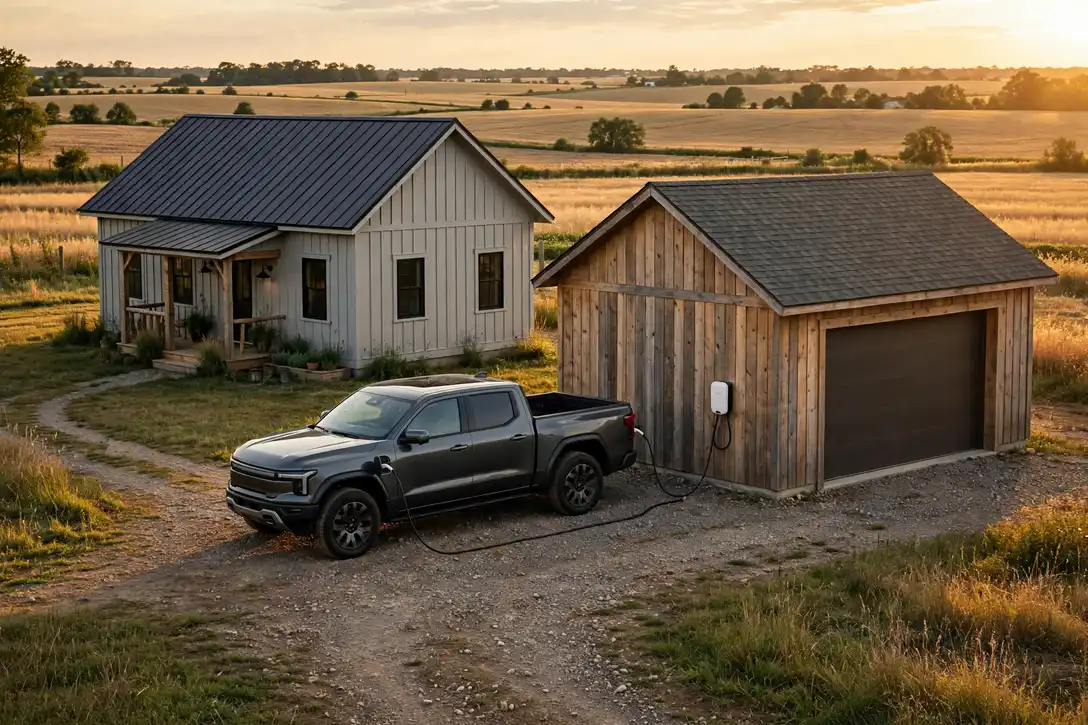
EV charging services in Modesto
Installers in Modesto book the same ten services as everywhere — but not in the same proportions. The three leading cards below are this city's pattern, set by its panels, its buildings and its statute book.
Home EV Charger Installation in Modesto
The standard first install: a dedicated circuit from the panel to the parking space, a station mounted and configured to that circuit, and a passed inspection to close it out. What changes from house to house is never the recipe — it is the panel's spare capacity, the length of the run, and how the car actually parks.
In Modesto: the core residential job in Modesto: circuit, mounting, configuration and inspection in one visit pattern.
Dedicated Circuit & Electrical Panel Upgrade in Modesto
The capacity project behind the charger project. A load calculation decides whether the answer is a service increase, a panel replacement, a subpanel or load management — and the work is sequenced with the utility and the inspector so the house is live again the same day in most cases.
In Modesto: service work that turns 'no room' into a circuit with headroom in Modesto homes.
Multifamily & Condo EV Charging in Modesto
In a multifamily building the charger is the easy half. The craft is the route to yes: a complete board application, a metering design that bills the right owner, load management that shares the building's capacity, and only then the circuit. Installers who do this work weekly carry the paperwork templates with them.
In Modesto: constitutions for shared charging in Modesto buildings: metering, load and approvals.
Utility programs and electricity in Modesto
Electricity in Modesto comes from Pacific Gas & Electric Co.. Parts of the wider metro are served by Modesto Irrigation District, Turlock Irrigation District. The utility matters twice over for a charger install: it sets the time-of-use rates that decide what overnight charging costs you, and it is the organisation that may — or may not — currently help pay for the equipment.
There is a strategic consequence to the empty incentive shelf in Modesto: the install decision reduces to the work itself and the tariff it runs on. With no rebate distorting the comparison, quotes compete on scope, licensing and the load calculation's honesty — which is the competition homeowners should want. And the overnight rate window, where Pacific Gas & Electric Co. offers one, quietly returns more over the car's life than most one-off rebates ever did.
Before the install, it is worth a two-minute look at your tariff. Many Pacific Gas & Electric Co. customers can move to a time-of-use plan where overnight energy is charged at a lower rate, and a scheduled charger makes that saving automatic.
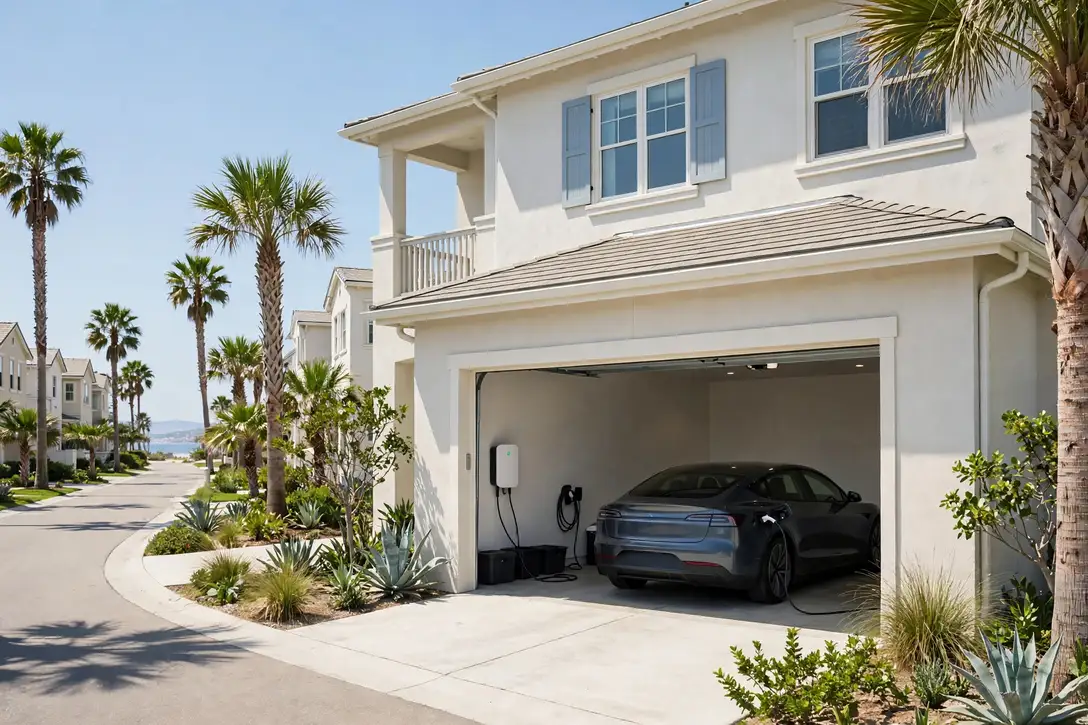
Condos, HOAs and the law in California
Charging is a protected right for association owners in California. The state's right-to-charge statute (Civ. Code §4745; §1947.6 (renters)) stops a homeowners association or condominium from banning an owner's charging station outright. Conditions still exist — placement, appearance, insurance and restoration can all be regulated, and the owner pays — yet the starting position is yes-with-rules rather than no-unless-persuaded, and that difference decides most applications before they are written.
If your board is stalling, the sequence that works in Modesto is boring and effective: cite the statute, submit a complete application (equipment, circuit, installer licence, insurance), and keep everything in writing.
Start with the condo and HOA guide for the application itself, and the multifamily service page for how the electrical design is usually laid out in California buildings.
Climate, garages and charger placement
Four-season metros ask the install to be two things: kind to a battery in January and indifferent to a thunderstorm in July. The equipment is rated for both out of the box; the local craft is in the details — cable jacket chosen for cold flexibility, mounting placed with drainage in mind, a schedule that follows the seasons' rate windows.
Seasonal scheduling is the quiet optimisation here: summer peaks and winter range loss both argue for charging deep in the overnight window, when rates and temperatures are kindest. Set the schedule once, in the car or the station, and the seasons stop appearing in the household's charging routine at all.

Permits and inspection in Modesto
What the inspector is checking, in plain terms: conductor size against breaker size, the continuous-load calculation, terminations torqued, protection where the code wants it, and a station whose settings match the circuit it landed on. It is a short visit that validates everything you cannot see.

Neighbourhoods and ZIP codes served
The page covers 10 ZIP codes in and around Modesto — including 95350, 95351, 95352, 95353, 95354, 95355, 95356, 95357, 95358, 95397 — across Stanislaus. If your ZIP is not in the first set shown, ask anyway: installer coverage follows the metro, not a postcode fence.
The same working area takes in the neighbouring localities of Salida, Riverbank, Empire, Ceres, Keyes, Hughson, Oakdale, Turlock, Westley, Waterford, Patterson, Denair, Crows Landing, Hickman — the county ring an installer based in Modesto actually drives. Requests from those communities route exactly as city requests do: same services, same permit discipline, same local facts where they differ.
Stanislaus County accounts for 28 of the ZIP codes and 17 named postal localities in the research file, the nearest of them Salida, Riverbank, Empire, Ceres, Keyes. The survey counts 553,990 residents in the county, with a median household income of $81,468 and a median home value of $450,100. Measured across its ZIP codes, the Modesto footprint runs about 5 miles north to south and 9 east to west, from ZIP 95350 to 95397 — the ground an installer based here actually covers in a working week.
Beyond the county seats, the working area takes in Salida, Riverbank, Empire, Ceres, Ripon, Escalon, Keyes, Hughson, Oakdale, Turlock, Vernalis, Westley, Waterford, Patterson, Denair, Crows Landing, Hickman, Hilmar, Newman, Copperopolis, Jamestown, Chinese Camp, Angels Camp, Altaville, Vallecito, Columbia, Douglas Flat, Sonora, Standard, Murphys — the named localities for which Modesto is the nearest metro in the network (neighbouring metros' pages cover their own ground), each routing to the same installer-matching service.
The wider working area also reaches Manteca, Farmington, Lathrop, French Camp, Delhi, Tracy, Linden, Stevinson, Cressey, Livingston, Holt, Winton, Atwater, Gustine, Lodi, Lockeford, La Grange, Valley Springs, Byron, Burson, Clements, Snelling, Discovery Bay, Santa Rita Park, Campo Seco, Moccasin, Brentwood, Livermore, Bethel Island, Big Oak Flat, Hornitos, Los Banos, Galt, Oakley, Thornton — ground shared with neighbouring metros, where installers cross the same county lines in both directions.
ZIP codes in that shared ground include 93635, 93661, 94513, 94514, 94548, 94551, 94561, 95140, 95202, 95205, 95206, 95207, 95208, 95211, 95212, 95214, 95215, 95220, 95226, 95236, 95240, 95241, 95249, 95252, 95267, 95296, 95301, 95304, 95305, 95312, 95322, 95329, 95330, 95334, 95336, 95344, 95376, 95377, 95378, 95638.
The largest communities in that working area after Modesto itself, by the GeoNames populated-place file: Turlock (population 72,292), Ceres (population 47,963), Riverbank (population 24,122), Oakdale (population 22,259), Patterson (population 21,498), Ripon (population 15,151), Salida (population 13,722), Newman (population 10,899), Waterford (population 8,824), Escalon (population 7,523), Hughson (population 7,384), Gustine (population 5,756), West Modesto (population 5,682), Keyes (population 5,601), Hilmar-Irwin (population 5,197), Bret Harte (population 5,152), Sonora (population 4,818), Denair (population 4,404), Phoenix Lake (population 4,269), Empire (population 4,189). Charging demand follows those populations — the subdivisions and town centres where the next driveways, and the next panels, are.
Calaveras County reaches into the working area with 46,248 residents, a median household income of $78,647 and a median home value of $457,200; its localities on this page include Copperopolis, Angels Camp, Altaville, Vallecito, Douglas Flat. Tuolumne County reaches into the working area with 54,498 residents, a median household income of $77,404 and a median home value of $433,200; its localities on this page include Jamestown, Chinese Camp, Columbia, Sonora, Standard. San Joaquin County reaches into the working area with 797,334 residents, a median household income of $92,179 and a median home value of $530,700; its localities on this page include Ripon, Escalon, Vernalis. Merced County reaches into the working area with 290,201 residents, a median household income of $65,510 and a median home value of $391,800; its localities on this page include Hilmar.
| ZIP | Locality | County |
|---|---|---|
| 95350 | Modesto | Stanislaus |
| 95352 | Modesto | Stanislaus |
| 95397 | Modesto | Stanislaus |
| 95356 | Modesto | Stanislaus |
| 95353 | Modesto | Stanislaus |
| 95354 | Modesto | Stanislaus |
| 95355 | Modesto | Stanislaus |
| 95351 | Modesto | Stanislaus |
| 95358 | Modesto | Stanislaus |
| 95368 | Salida | Stanislaus |
| 95367 | Riverbank | Stanislaus |
| 95319 | Empire | Stanislaus |
| 95307 | Ceres | Stanislaus |
| 95357 | Modesto | Stanislaus |
| 95366 | Ripon | San Joaquin |
| 95320 | Escalon | San Joaquin |
| 95328 | Keyes | Stanislaus |
| 95326 | Hughson | Stanislaus |
| 95361 | Oakdale | Stanislaus |
| 95382 | Turlock | Stanislaus |
| 95385 | Vernalis | San Joaquin |
| 95387 | Westley | Stanislaus |
| 95381 | Turlock | Stanislaus |
| 95380 | Turlock | Stanislaus |
| 95386 | Waterford | Stanislaus |
| 95363 | Patterson | Stanislaus |
| 95316 | Denair | Stanislaus |
| 95313 | Crows Landing | Stanislaus |
| 95323 | Hickman | Stanislaus |
| 95324 | Hilmar | Merced |
| 95360 | Newman | Stanislaus |
| 95228 | Copperopolis | Calaveras |
| 95327 | Jamestown | Tuolumne |
| 95309 | Chinese Camp | Tuolumne |
| 95222 | Angels Camp | Calaveras |
| 95221 | Altaville | Calaveras |
| 95251 | Vallecito | Calaveras |
| 95310 | Columbia | Tuolumne |
| 95229 | Douglas Flat | Calaveras |
| 95370 | Sonora | Tuolumne |
| 95373 | Standard | Tuolumne |
| 95247 | Murphys | Calaveras |

Planning the install: from panel to parking
Experienced Modesto installers talk about 'the tell': the small observation that predicts the job. A panel directory in pencil with three generations of handwriting. A garage converted, then converted back. A charger-shaped hole in the household's plans — the second car already ordered. Mention your own tells at the visit; they are scope information, and scope named early is scope settled fairly.
One more piece of sequencing advice Modesto installers give consistently: if the panel is being opened anyway, settle the other electrical maybes in the same visit — the circuit you will want next year costs least while the permit and the electrician are already in the house.
Home charging know-how for Modesto households
Dust, grime and the working garage
Garages are workshops, and workshops make dust. A charging connector living in one needs its holster the way a tool needs its hook — off the bench, out of the sawdust's fall line, capped by its dock rather than dangling. Metal filings and charger contacts are particular enemies; grinding and charging do not share a corner happily. None of this asks for a cleanroom — just the ordinary discipline of a space that works for a living, extended to the one appliance that is also a fuel line.
Charging with an accessory dwelling
Houses with a second unit — a garage apartment, a granny flat, a rented studio — add a cast member to the charging design: another household. The questions multiply politely. Whose panel carries the circuit? Whose meter records the energy? Does the tenancy agreement mention the charger at all? None are hard questions, and all are cheaper answered at design time than at the first shared bill. Where the second unit has its own meter and panel, the design is simply two small domestic installs sharing an address.
Bidirectional charging, honestly framed
Vehicles that can return energy to a house or the grid exist, and the standards enabling them are settling — but for most households today it is a horizon technology, not a purchase category: it needs a compatible vehicle, bidirectional equipment, utility interconnection approval and a tariff that rewards it. None of that changes today's installation advice, except in one detail: conduit and panel capacity installed generously now are the same provisions a future bidirectional setup would want. Buy for the car you have; leave room for the one the industry is promising.
The insurance conversation
A permitted charger installation is a short conversation with your insurer, and it is worth having before rather than after. The documented install — permit, inspection, listed equipment, licensed electrician — is the version insurers process without friction, because every question they ask is answered by the file. Undocumented electrical work is where claims go to become arguments. Tell the insurer the circuit exists, keep the paperwork with the policy documents, and the charger's insurance chapter closes in one phone call.
Why chargers slow themselves down
Charging equipment protects itself thermally: a station whose electronics run hot — a sun-baked wall, a sealed enclosure in a heatwave garage — reduces its output rather than cook. Owners experience it as an unexpectedly slow session on the year's hottest afternoon. It is the equipment working as designed, and the installation answers are environmental: shade, airflow, an enclosure that breathes as its listing intends. A session that derates in mild weather, by contrast, is a symptom worth an electrician's opinion.

Frequently asked questions
What happened to the federal home-charger credit in Modesto, CA?
That credit is finished: 30C ended on September 30, 2025. What about locally? In the utility and state sources checked for this page, nothing verified was running for Modesto homeowners — no Pacific Gas & Electric Co. rebate, no state scheme. If one opens, it will appear on the utility's site with dates; plan your install without it meanwhile.
Can my association in Modesto, CA say no to a home charger?
Not outright. Under Civ. Code §4745; §1947.6 (renters), California associations cannot prohibit an owner's charger; they can condition it — reasonably — on placement, insurance and restoration, with the owner funding the work. The disputes that do arise are usually about conditions, and they settle fastest when the application answers them in advance.
Will my Modesto, CA home need a panel upgrade for a Level 2 charger?
Sometimes — and Modesto's housing stock is exactly why the question is worth asking properly. With a median build year of 1979 and roughly 51% of homes predating 1980, plenty of local panels are 100-amp units already carrying a full modern load. Those homes choose between an upgrade and load management; newer 200-amp homes usually just add the circuit. The site visit's load calculation is the decider.
How much faster is Level 2 charging at home in Modesto, CA?
Level 1 — the cord in the boot, on a normal outlet — returns about 3–5 miles of range an hour. Level 2 on its own 240-volt circuit returns roughly 25–40. A Modesto commuter who parks at seven and leaves at seven stops doing battery arithmetic entirely.
What happens after I request an installer through this page?
Three steps: the request routes to installers who work Modesto, California; one contacts you to walk the property; the walk produces the written quote. Everything on this page — the utility position, the law, the housing data — is yours to check that quote against.
Does Pacific Gas & Electric Co. offer a time-of-use rate for EV charging in Modesto?
Many Pacific Gas & Electric Co. customers can choose a time-of-use tariff; whether yours is one, and where its cheap window sits, decides how the charger should be scheduled from night one. Two minutes with your tariff sheet during the planning stage is the whole task — the installer sets the schedule to match while commissioning the station.
Nearby cities in California
- EV charger installation in Stockton — about 25 miles from Modesto, metro population 800,000
- EV charger installation in Merced — about 40 miles from Modesto, metro population 290,000
- EV charger installation in San Jose — about 54 miles from Modesto, metro population 2,000,000
- EV charger installation in Sacramento — about 68 miles from Modesto, metro population 2,400,000
- EV charger installation in Santa Cruz — about 76 miles from Modesto, metro population 275,000
- EV charger installation in Vallejo — about 78 miles from Modesto, metro population 450,000
- EV charger installation in Reno, NV — about 144 miles from Modesto, metro population 500,000
- EV charger installation in Medford, OR — about 335 miles from Modesto, metro population 220,000
- EV charger installation in Las Vegas, NV — about 341 miles from Modesto, metro population 2,300,000
Ready to charge at home in Modesto?
Two minutes of form, and the request is in front of licensed installers who cover this city — quotes follow site visits, in writing.