EV Charger Installation in Merced, CA
Charging where you park, in Merced: the utility programs, state law, permit process and housing facts behind a home charger install, gathered in one place.
Homeowners in Merced tend to research the charger first and the circuit second; installers work the other way round. The circuit is the project — its capacity, its route, its paperwork — and the station is the appliance that hangs off the end of it. Merced itself is home to about 96,082 people, and California's roads carried 1,843,100 battery-electric vehicles and 490,900 plug-in hybrids by the end of 2025. This page is organised the installer's way: panel and housing realities first, then the utility's programs and tariffs, the law for shared properties, climate placement, and the permit that closes the job out properly.
PlugReady USA is a matching service, not the installer: you tell us the job, and we route the request to licensed local electricians and EV-installer companies who work in Merced. Use the local detail below to arrive at that conversation informed — the sections are ordered the way an installer will think about your project, from the panel outward.
The demand picture for the Merced metro, from the registration data this site is built on: UC Merced growth. Registration counts are the honest way to size a charging market — they count households, not headlines — and they are why Merced sits where it does in our build order (rank 185 of 300 metros, Tier C).
Three survey lines do most of the predictive work on this page. Income — a median of $70,414 per household — tracks the pace at which Merced households adopt EVs at all. Tenure — 53% owner-occupied — decides whose signature the work needs. And structure — 70% single-unit detached — decides how often the answer is a simple garage circuit rather than a building negotiation.

Put the survey together and Merced's charging profile reads like this: a housing stock of mixed vintages, where both electrical eras appear on the same street; a detached-house majority with a real attached and multifamily minority; buildings of five or more units are a visible minority of the stock; and owners hold a working majority, with renters a significant minority. That combination — more than any single number — is what the installers working here plan around, and it is the lens for everything on this page.
In absolute terms, the survey counts 28,968 housing units in Merced — 27,059 occupied, 14,316 of them by their owners. The stock resolves into 20,140 single-unit detached houses, 11,868 homes standing since before 1980, and 4,519 units in larger buildings. Those six counts are the city's charging map drawn without percentages, and every section of this page is a consequence of one of them. The page's geography is equally concrete: 5 ZIP codes across Merced, centred near 37.30 degrees north latitude. The city anchors the Merced metropolitan area, home to roughly 290,000 people on the research file's metro estimate — the wider labour and housing market this page's installers work across.
The same survey release fills in the household economics around the housing stock: a median home value of $372,600, median gross rent of $1,393, per-capita income of $27,343, and a median resident age of 30. How the city moves completes the picture: 74% of Merced workers drive to work alone — the commute pattern home charging is built around; 8% work from home, a population whose cars charge on daytime and overnight schedules alike; 1% commute by public transit; 20% of adults hold a bachelor's degree or higher. The survey's vehicle table is the one an EV page should quote first: 3,243 of Merced's households have no vehicle at all, while 16,417 have two or more — the multi-car households for whom the second circuit is a when, not an if.
Household structure, from the same release: 70% of Merced households are family households. The burden shares behind the housing stock: 56% of renting households are cost-burdened at the 30%-of-income line, as are 0% of mortgaged owners — context for why the overnight rate window, once set, is treated here as a household fixture rather than a hobby.
What follows is the city read as an electrical place rather than a dot on a map. Growth rings are the city's autobiography: each decade's standard — service size, wiring method, garage provision — survives intact in its ring, and the charger wave is now writing the next ring's standard. Installers here run two trades in one van — domestic circuits in the morning, a building's shared-service design in the afternoon — and the city's pages, this one included, have to serve both readers.
High renter share also means charging follows the lease cycle: applications cluster at move-in, installations at renewal leverage, and the whole market breathes on the rental calendar. The specification pattern at this income band is disciplined: capacity for today's car and a conduit sized for tomorrow's, the upgrade deferred until the load calculation insists. Scale brings a call centre, but it also brings published everything — interconnection standards, programme terms, complaint statistics — and the published page, not the phone call, is where this utility is most honest.
A mature fleet also means a mature used market — households buying their first EV second-hand arrive at this page with the same install questions the pioneers asked, minus the pioneers' uncertainty. A smaller metro runs on relationships: the electrical firms are few, known, and booked through reputations maintained across decades of local work. Shared-property households here work with a written legal position rather than a board's mood, which changes the application from a petition into a procedure.
The electrical reality in Merced homes
Read the stock the way a panel schedule reads it. Median build year 1985 means half of Merced's homes were wired to codes of that era or earlier; 41% predate 1980 entirely. 70% of units are detached houses, and 53% of occupied homes are owned by their occupants — so most charger conversations here happen between a homeowner and an electrician, with no third party at the table. A mixed-age stock like this splits installs into two camps: newer subdivisions where a 200-amp panel usually has planned capacity, and established neighbourhoods where the panel conversation comes first. Neither is a problem — but they are different jobs, and the estimate you get should say which camp your home falls into and why. Detached houses matter for a practical reason: a garage or driveway on your own lot means the charger, the car and the circuit are all under one roof and one owner's control, which is the simplest configuration there is.
Heating fuel is the survey's quiet clue to panel life: in Merced, 35% of homes heat electrically (9,749 households), against 62% heating with gas. A house already heating electrically has a service sized with that load in its history; a gas-heated house may have capacity to spare — either way the fuel mix is part of what the installer is reading.
The tenure split cuts the other way too: roughly 12,743 occupied homes in Merced are rented. For those households the charger question is a negotiation with a property owner — written proposal, licensed installer, metering clarity — and it succeeds often enough that installers here keep the pattern ready.
And 16% of Merced's homes are in buildings with five or more units — apartments and condominiums where charging is a building decision before it is an electrical one. If that is your situation, the law and multifamily sections of this page are the ones written for you.
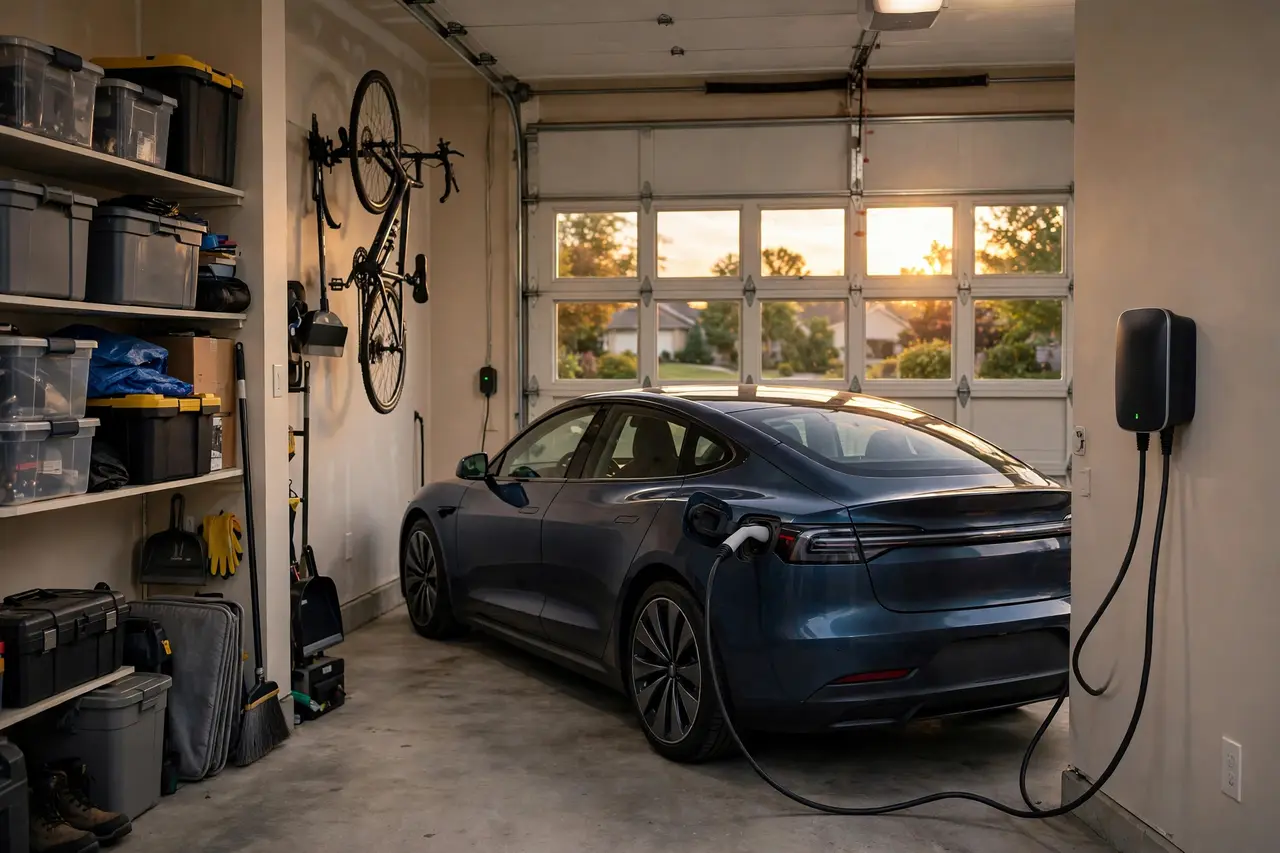
EV charging services in Merced
The services below are ordered by what Merced households most often need first, judged from the housing and fleet facts on this page. The full menu follows in the grid — every service is offered in this metro.
Home EV Charger Installation in Merced
Think of it as plumbing for electrons, done once: capacity checked, circuit run, station mounted and configured, inspection passed. The households that report the smoothest projects describe the same shape — a visit that measured, a quote that itemised, and a car that simply charged from the first night.
In Merced: the core residential job in Merced: circuit, mounting, configuration and inspection in one visit pattern.
Dedicated Circuit & Electrical Panel Upgrade in Merced
The capacity project behind the charger project. A load calculation decides whether the answer is a service increase, a panel replacement, a subpanel or load management — and the work is sequenced with the utility and the inspector so the house is live again the same day in most cases.
In Merced: the capacity fix that lets the charger circuit go in without the rest of the house living at its limit.
Multifamily & Condo EV Charging in Merced
Buildings that solve charging solve it as infrastructure: a backbone capacity decision, a fair cost-allocation rule, and spaces that can be electrified in ones as residents arrive. The first installation is the constitution; the rest are amendments.
In Merced: constitutions for shared charging in Merced buildings: metering, load and approvals.
Utility programs and electricity in Merced
Electricity in Merced comes from Pacific Gas & Electric Co.. Parts of the wider metro are served by Turlock Irrigation District, Merced Irrigation District, WAPA-- Western Area Power Administration. The utility matters twice over for a charger install: it sets the time-of-use rates that decide what overnight charging costs you, and it is the organisation that may — or may not — currently help pay for the equipment.
No verified residential charger rebate was in place for Pacific Gas & Electric Co. in the sources checked for this page (the federal Alternative Fuel Refueling Property Credit ended on September 30, 2025, and no California state program replaced it for typical home installs). That can change — utilities open and close funded rounds — so an installer quoting you today should be able to name any current program precisely, with its published terms. If they cannot name it, it is not part of your job.
If your service includes a demand component, the charger's start time matters more than its size: staggered against the house's other big loads, the same circuit costs noticeably less to run across a year.
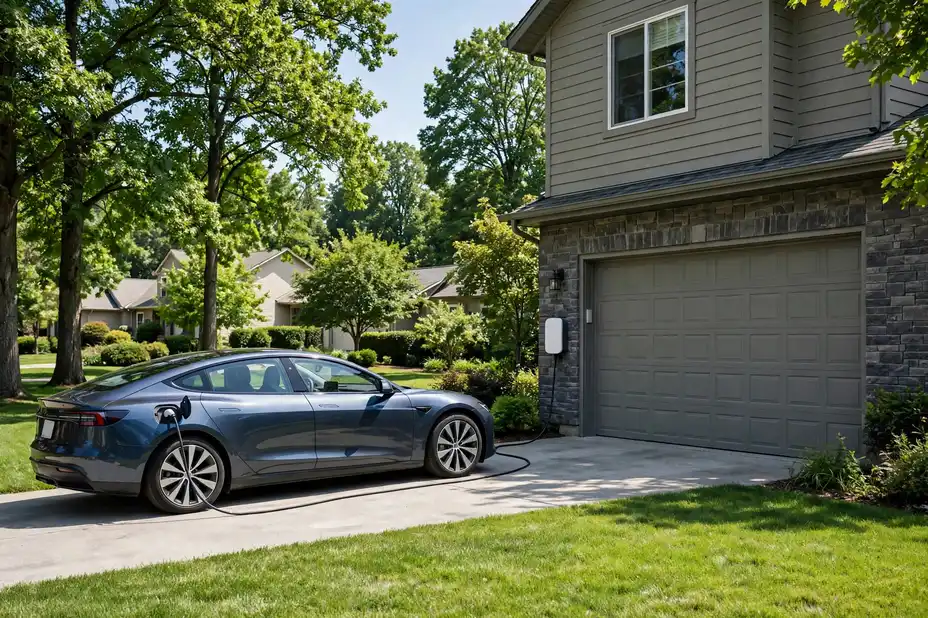
Condos, HOAs and the law in California
An association in California cannot simply say no. The right-to-charge law recorded for this state (Civ. Code §4745; §1947.6 (renters)) entitles an owner to install charging equipment for their own vehicle in their own parking space, subject to reasonable association conditions on placement, insurance and eventual restoration. For a Merced owner, the practical consequence is that the application is a compliance exercise — equipment, circuit, paperwork — rather than a popularity contest at a board meeting.
For renters, coverage in California is recorded as: Yes. If you rent in Merced, the practical route is still a written proposal to the landlord — dedicated circuit, licensed installer, your name on the permit — because a charger-ready space is an asset most landlords keep when you leave.
The step-by-step version lives in our guide to installing an EV charger in a condo or HOA community — the application sequence, the metering designs and the questions boards ask, in order.
Climate, garages and charger placement
A four-season climate asks the installation to be boring in every month: cable that stays flexible in January, an enclosure untroubled by August humidity, and drainage that keeps spring melt away from the connector. None of this is exotic — it is the standard outdoor discipline, and it is why station placement gets a full minute of the site visit rather than a wave at the nearest wall.
The seasons rotate the charging advice: precondition from the wall in winter, dodge the afternoon peak in summer, and let the shoulder months do what they like. Households here learn the two settings and change them with the clocks.

Permits and inspection in Merced
Timelines are set by the city's counter, not the installer: the electrical work itself is typically a day, while permit issuance and the inspection visit follow the department's queue. A quote that promises a date should tell you which parts of that date the installer actually controls.
Neighbourhoods and ZIP codes served
The page covers 5 ZIP codes in and around Merced — including 95340, 95341, 95343, 95344, 95348 — across Merced. If your ZIP is not in the first set shown, ask anyway: installer coverage follows the metro, not a postcode fence.
The same working area takes in the neighbouring localities of Planada, Atwater, Winton, Le Grand, El Nido, Santa Rita Park, Cressey, Livingston, Ballico, Snelling, Delhi, Dos Palos, Stevinson, Hilmar — the county ring an installer based in Merced actually drives. Requests from those communities route exactly as city requests do: same services, same permit discipline, same local facts where they differ.
Merced County accounts for 23 of the ZIP codes and 19 named postal localities in the research file, the nearest of them Planada, Atwater, Winton, Le Grand, El Nido. The survey counts 290,201 residents in the county, with a median household income of $65,510 and a median home value of $391,800. Measured across its ZIP codes, the Merced footprint runs about 7 miles north to south and 3 east to west, from ZIP 95340 to 95348 — the ground an installer based here actually covers in a working week.
Beyond the county seats, the working area takes in Planada, Atwater, Winton, Le Grand, El Nido, Santa Rita Park, Cressey, Livingston, Hornitos, Ballico, Snelling, Chowchilla, Delhi, Catheys Valley, Dos Palos, Stevinson, South Dos Palos, Los Banos, La Grange, Firebaugh, Gustine, Mariposa, Midpines, Coulterville, Moccasin, Big Oak Flat, Groveland, El Portal, Yosemite National Park — the named localities for which Merced is the nearest metro in the network (neighbouring metros' pages cover their own ground), each routing to the same installer-matching service.
The wider working area also reaches Hilmar, Denair, Turlock, Waterford, Crows Landing, Ceres, Empire, Newman, Modesto, Chinese Camp, Coarsegold, Salida, O Neals, Escalon, Tranquillity, Copperopolis, Standard, Tuolumne, Sonora, Wishon, San Joaquin, Farmington, Clovis, Twain Harte, Angels Camp, Manteca, Altaville, Mi Wuk Village, Vallecito, Raisin City, Murphys, Auberry, Lathrop, Hollister, Stockton — ground shared with neighbouring metros, where installers cross the same county lines in both directions.
ZIP codes in that shared ground include 93607, 93619, 93636, 93638, 93639, 93644, 93651, 93653, 93660, 93669, 93703, 93721, 93722, 93724, 93737, 93745, 93750, 93761, 93771, 93774, 93777, 93792, 93794, 95221, 95222, 95230, 95251, 95307, 95313, 95316, 95319, 95320, 95324, 95336, 95350, 95356, 95358, 95379, 95385, 95386.
The largest communities in that working area after Merced itself, by the GeoNames populated-place file: Los Banos (population 37,457), Atwater (population 29,237), Chowchilla (population 18,510), Livingston (population 13,902), Delhi (population 10,755), Winton (population 10,613), Firebaugh (population 8,330), Dos Palos (population 5,125), Planada (population 4,584), Mariposa (population 2,173), Le Grand (population 1,659), South Dos Palos (population 1,620), Midpines (population 1,204), Bootjack (population 960), Greeley Hill (population 915), Catheys Valley (population 825), Groveland (population 601). Charging demand follows those populations — the subdivisions and town centres where the next driveways, and the next panels, are.
Mariposa County reaches into the working area with 17,082 residents, a median household income of $68,412 and a median home value of $387,900; its localities on this page include Hornitos, Catheys Valley, Mariposa, Midpines, Coulterville. Tuolumne County reaches into the working area with 54,498 residents, a median household income of $77,404 and a median home value of $433,200; its localities on this page include Moccasin, Big Oak Flat, Groveland. Madera County reaches into the working area with 160,940 residents, a median household income of $76,627 and a median home value of $393,200; its localities on this page include Chowchilla. Stanislaus County reaches into the working area with 553,990 residents, a median household income of $81,468 and a median home value of $450,100; its localities on this page include La Grange. Fresno County reaches into the working area with 1,016,725 residents, a median household income of $74,201 and a median home value of $388,800; its localities on this page include Firebaugh.
| ZIP | Locality | County |
|---|---|---|
| 95340 | Merced | Merced |
| 95343 | Merced | Merced |
| 95344 | Merced | Merced |
| 95348 | Merced | Merced |
| 95341 | Merced | Merced |
| 95365 | Planada | Merced |
| 95301 | Atwater | Merced |
| 95388 | Winton | Merced |
| 95333 | Le Grand | Merced |
| 95317 | El Nido | Merced |
| 93661 | Santa Rita Park | Merced |
| 95312 | Cressey | Merced |
| 95334 | Livingston | Merced |
| 95325 | Hornitos | Mariposa |
| 95303 | Ballico | Merced |
| 95369 | Snelling | Merced |
| 93610 | Chowchilla | Madera |
| 95315 | Delhi | Merced |
| 95306 | Catheys Valley | Mariposa |
| 93620 | Dos Palos | Merced |
| 95374 | Stevinson | Merced |
| 93665 | South Dos Palos | Merced |
| 93635 | Los Banos | Merced |
| 95329 | La Grange | Stanislaus |
| 93622 | Firebaugh | Fresno |
| 95322 | Gustine | Merced |
| 95338 | Mariposa | Mariposa |
| 95345 | Midpines | Mariposa |
| 95311 | Coulterville | Mariposa |
| 95347 | Moccasin | Tuolumne |
| 95305 | Big Oak Flat | Tuolumne |
| 95321 | Groveland | Tuolumne |
| 95318 | El Portal | Mariposa |
| 95389 | Yosemite National Park | Mariposa |

Planning the install: from panel to parking
Consider the two households inside every Merced install. The first owns the panel, the parking and the decision; the second — a partner, a teenager with the next car, a future buyer — inherits all three. Designing for the second household is the difference between an install and an asset: capacity reserved, conduit honest, paperwork filed. The first conversation with an installer should name both households explicitly.
One more piece of sequencing advice Merced installers give consistently: if the panel is being opened anyway, settle the other electrical maybes in the same visit — the circuit you will want next year costs least while the permit and the electrician are already in the house.
Home charging know-how for Merced households
The charger and the home network
A networked station asks one thing of the house: a wireless signal that actually reaches the garage. Exterior walls, metal cladding and distance tax domestic Wi-Fi exactly where chargers live, and the household that checks signal strength at the mounting position before install day avoids the dead-zone discovery afterwards. Where the signal will not reach, the honest options are a network extension, a station chosen for offline competence, or cellular-connected equipment — decided in advance, not improvised on the day.
Historic districts and exterior rules
In a designated historic district, the charger's exterior footprint can need a second audience: the preservation commission, whose concern is the streetscape rather than the circuit. The designs that pass keep faith with that concern — equipment inside the garage where possible, conduit routed away from the principal facade, nothing mounted on historic fabric. It adds a step, not a saga, and local installers know their commission's habits the way they know their permit counter's.
The autumn checklist
Households in seasonal country develop a small autumn ritual around the charger: the connector and holster checked before the weather turns, the cable's route confirmed clear of the snow-storage corner and the plough's line, the schedule revisited against winter tariffs and winter range. Ten minutes, once a year, timed with the rest of the house's changeover. It belongs to the same family as the inspection file — the unglamorous habits that make an installation feel, five winters later, like it was designed by someone who had met the climate before.
Two kinds of protection, one circuit
Modern charging circuits sit at the meeting point of two protection philosophies: the breaker's ground-fault protection watching the circuit, and the station's own ground-fault and monitoring systems watching the session. Coordinating them is a specification task — which device leads, which breaker types the station manufacturer lists as compatible, whether the installation is hardwired or receptacle-fed. Done at design time, the two systems coexist silently for decades; done by trial, they announce themselves at 3 am.

Frequently asked questions
What happened to the federal home-charger credit in Merced, CA?
The honest ledger for Merced reads: federal credit, ended September 30, 2025; state program, none for typical home installs; Pacific Gas & Electric Co. residential rebate, none verified in the sources checked. If a salesperson's quote leans on any of the three, the correct response is a request for the program's published page.
Can my association in Merced, CA say no to a home charger?
Not outright. Under Civ. Code §4745; §1947.6 (renters), California associations cannot prohibit an owner's charger; they can condition it — reasonably — on placement, insurance and restoration, with the owner funding the work. The disputes that do arise are usually about conditions, and they settle fastest when the application answers them in advance.
Will my Merced, CA home need a panel upgrade for a Level 2 charger?
Start from the median, then verify: the median Merced home was built in 1985, and 41% of the stock predates 1980, so 100-amp panels are a normal sight here — and a normal candidate for either an upgrade or a load-management device. The load calculation distinguishes the two in one visit, and any quote that skips it is guessing with your money.
How much faster is Level 2 charging at home in Merced, CA?
A Level 1 cord on a household outlet adds roughly 3–5 miles of range per hour; a Level 2 station on a 240-volt circuit typically adds about 25–40 miles per hour depending on the circuit's amperage and the vehicle. For most drivers that is the difference between rationing the battery and never thinking about it.
How does the installer matching on this page work?
Send the request and it is matched against installers covering Merced — your service, ZIP, property type and timing travel with it. An installer then arranges the site visit and quotes in writing. Our role ends at the introduction; your contract, permit and paperwork are with the installer.
Does Pacific Gas & Electric Co. offer a time-of-use rate for EV charging in Merced?
Many utilities do — a tariff where overnight energy carries a lower rate, designed for exactly this load. Whether your current plan includes such a window is a two-minute check on your tariff or the utility's rate pages. If it does, the charger's schedule is set once, at commissioning, and the saving runs itself from then on.
Nearby cities in California
- EV charger installation in Modesto — about 40 miles from Merced, metro population 575,000
- EV charger installation in Madera — about 40 miles from Merced, metro population 160,000
- EV charger installation in Fresno — about 48 miles from Merced, metro population 1,000,000
- EV charger installation in Stockton — about 64 miles from Merced, metro population 800,000
- EV charger installation in San Jose — about 79 miles from Merced, metro population 2,000,000
- EV charger installation in Salinas — about 79 miles from Merced, metro population 450,000
- EV charger installation in Reno, NV — about 158 miles from Merced, metro population 500,000
- EV charger installation in Las Vegas, NV — about 305 miles from Merced, metro population 2,300,000
- EV charger installation in Medford, OR — about 369 miles from Merced, metro population 220,000
Ready to charge at home in Merced?
Two minutes of form, and the request is in front of licensed installers who cover this city — quotes follow site visits, in writing.