EV Charger Installation in Madera, CA
Home Level 2 charging, panel upgrades and condo installs in Madera — matched to licensed local installers, with the local facts that shape the job set out below.
Charging at home is the version of EV ownership that actually works day to day, and in Madera it starts with a straightforward question: where will the car sleep, and what can the electrical panel behind that wall honestly support? Madera itself is home to about 69,097 people, and 1,843,100 battery-electric vehicles plus 490,900 plug-in hybrids were registered across California by the end of 2025 — every one of them a household that charges somewhere. This page gathers what a homeowner in Madera needs to know before booking an installer: the local utility and its current charger programs, the state law that applies in condos and HOA communities, the permit process, and the housing realities that decide how simple or involved an installation will be.
One honest note before the detail: PlugReady USA does not install chargers. We collect your requirements and pass them to licensed installers who cover Madera, and this page exists so that you can judge those conversations with the local facts already in hand.
What the Experian and AFDC registration data say about Madera: Central Valley. Translated out of market language: your neighbours are already charging at home, the permit office already knows the paperwork, and the installers already know the housing stock.
The Census Bureau's portrait of Madera — median household income $60,368, 54% of occupied homes owner-occupied, 72% of units in single-unit detached houses — is, read correctly, a charging forecast. Owners approve their own work; detached houses host their own circuits; the remaining share is where the interesting projects live.

Every city charges differently, and Madera's difference is legible in the data: a housing stock of mixed vintages, where both electrical eras appear on the same street; overwhelmingly a detached-house city, so most installs are the simple garage pattern; buildings of five or more units are a visible minority of the stock; owners hold a working majority, with renters a significant minority. Read the sections below through that profile and the local advice resolves into specifics — which questions are routine here, and which are rare.
Keep six figures and you keep Madera's whole electrical character: 19,148 housing units; 18,051 occupied homes; 9,683 owner-occupied; 13,778 detached houses; 6,205 pre-1980 homes; 2,406 homes in buildings of five or more units. Percentages elsewhere on this page are these numbers in disguise — the counts are the originals, and they are the numbers a local installer's experience is actually made of. The page's geography is equally concrete: 4 ZIP codes across Madera, Merced, centred near 36.95 degrees north latitude. The city anchors the Madera metropolitan area, home to roughly 160,000 people on the research file's metro estimate — the wider labour and housing market this page's installers work across.
The same survey release fills in the household economics around the housing stock: a median home value of $359,900, median gross rent of $1,353, per-capita income of $24,200, and a median resident age of 30. The movement data matters as much as the money data: 71% of Madera workers drive to work alone — the commute pattern home charging is built around; 7% work from home, a population whose cars charge on daytime and overnight schedules alike; 1% commute by public transit; 11% of adults hold a bachelor's degree or higher. Vehicle ownership, from the same release: 12,386 households in Madera run two or more vehicles, and 1,117 run none — the two ends of the market this page serves and does not serve.
Household structure, from the same release: 79% of Madera households are family households. The burden shares behind the housing stock: 60% of renting households are cost-burdened at the 30%-of-income line, as are 0% of mortgaged owners — context for why the overnight rate window, once set, is treated here as a household fixture rather than a hobby.
Taken as one portrait, the numbers describe a specific charging market. Neither old nor new, the housing is layered, and the installer's week is a tour of the layers: a 1960s split-level on Monday, a 2008 subdivision house on Wednesday, a 1920s four-square on Friday. Single-family form factor means the approval chain has one link. The design conversation is about copper and placement, not about committees, covenants or common elements.
Property managers are the metro's charging gatekeepers at this tenure mix, and the installers who thrive are the ones whose proposals arrive manager-shaped: standardised, insured, reversible on paper. The specification pattern at this income band is disciplined: capacity for today's car and a conduit sized for tomorrow's, the upgrade deferred until the load calculation insists. A large utility's scale cuts both ways — programme budgets that dwarf a small co-op's, and call-centre distance between a household and anyone who can decide anything. The published page rules; keep it bookmarked.
At this fleet volume the questions mature: not whether to install, but how the second circuit shares capacity, how buildings retrofit at scale, how the grid's evening ramp is managed street by street. The permit counter in a smaller city is a conversation, not a queue: applications are read by people who may know the street, and complete paperwork is remembered kindly. The association dimension, at least, comes with a statutory frame in this state — the law section above sets out what boards may and may not do, and applications written inside that frame travel noticeably faster.
The electrical reality in Madera homes
Start with the survey's three operative figures for Madera: median build year 1994; 32% of housing units standing since before 1980; 72% of the stock in single-unit detached houses, with 54% of occupied homes owner-occupied. Between them, they sketch the electrical city an installer works in. A mixed-age stock like this splits installs into two camps: newer subdivisions where a 200-amp panel usually has planned capacity, and established neighbourhoods where the panel conversation comes first. Neither is a problem — but they are different jobs, and the estimate you get should say which camp your home falls into and why. Owner-occupiers can plan on their own timeline; renters and condo owners have an extra approval layer, which the law section below covers for this state.
One further survey line belongs in any Madera install conversation: 36% of the city's homes heat with electricity — 6,326 households whose panels already carry a major winter load before a charger is contemplated. Electric heat and EV charging are the two largest discretionary loads a house can host, and where they coincide, the load calculation stops being a formality.
Renters are the other constituency in these numbers: about 8,368 of Madera's occupied homes are rented rather than owned. Their charging route runs through a landlord conversation instead of a panel they control — a different project, covered by the rentals guide and the law section below, but a routine one in a city with this many renting households.
The city's stock is not all houses: 13% of units are in structures of five or more. Shared buildings mean shared panels, assigned parking and association process — the substance of the multifamily sections below.
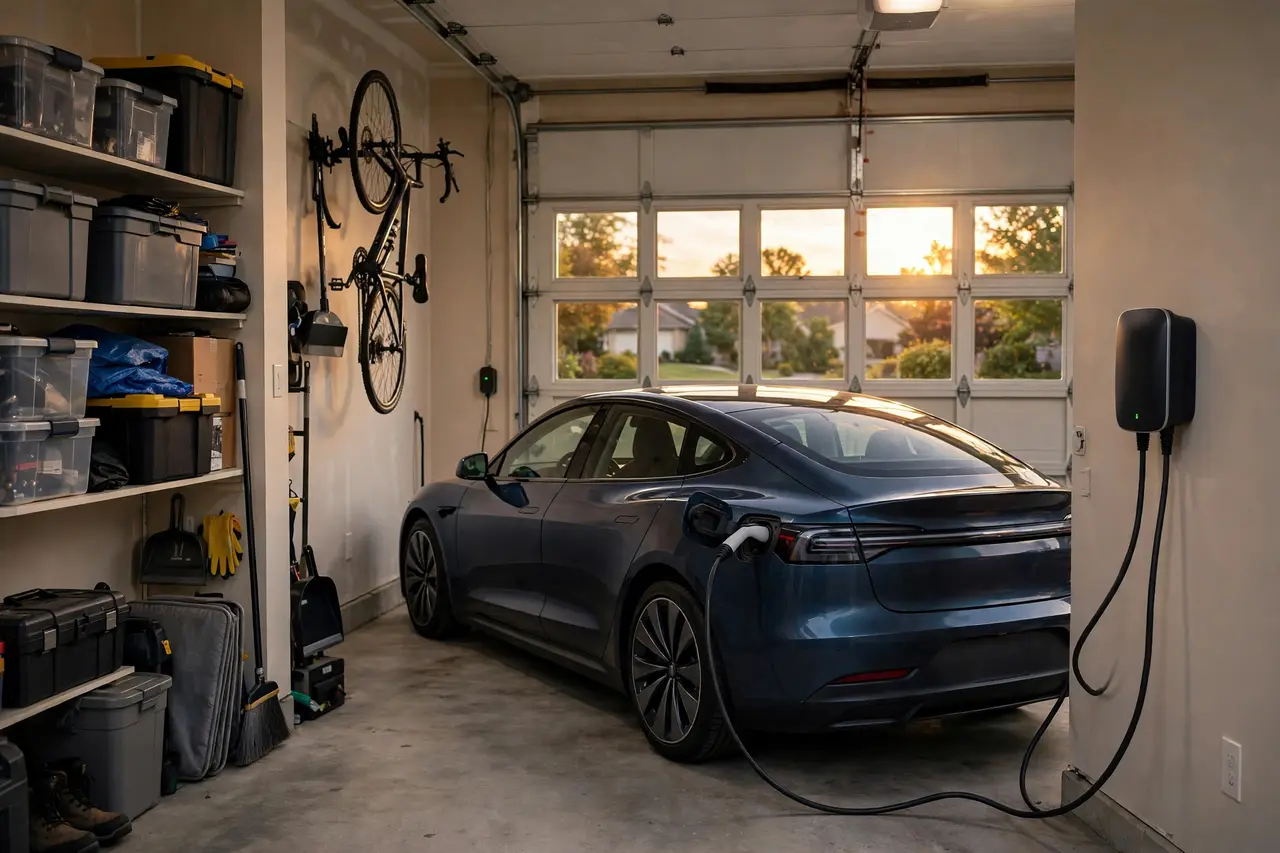
EV charging services in Madera
Ten services cover the work installers do in Madera. Three lead the list here because of what this city's housing and law actually look like — each links to its national service page, where scope and process are set out in full.
Home EV Charger Installation in Madera
The standard first install: a dedicated circuit from the panel to the parking space, a station mounted and configured to that circuit, and a passed inspection to close it out. What changes from house to house is never the recipe — it is the panel's spare capacity, the length of the run, and how the car actually parks.
In Madera: the install Madera's new EV households book first, and the one the rest of this page keeps returning to.
Multifamily & Condo EV Charging in Madera
Buildings that solve charging solve it as infrastructure: a backbone capacity decision, a fair cost-allocation rule, and spaces that can be electrified in ones as residents arrive. The first installation is the constitution; the rest are amendments.
In Madera: the service behind the law section below — boards, applications and shared electrical capacity in Madera buildings.
Level 2 Charger Installation in Madera
What is being bought is recovery rate. A Level 2 circuit returns in one overnight session what a household receptacle returns in a day and a half, and that margin is the difference between planning around the car and forgetting about it.
In Madera: the 240-volt step that turns overnight charging in Madera from a trickle into a full battery by morning.
Utility programs and electricity in Madera
Electricity in Madera comes from Pacific Gas & Electric Co.. Parts of the wider metro are served by Southern California Edison Co, Turlock Irrigation District, Merced Irrigation District. The utility matters twice over for a charger install: it sets the time-of-use rates that decide what overnight charging costs you, and it is the organisation that may — or may not — currently help pay for the equipment.
There is a strategic consequence to the empty incentive shelf in Madera: the install decision reduces to the work itself and the tariff it runs on. With no rebate distorting the comparison, quotes compete on scope, licensing and the load calculation's honesty — which is the competition homeowners should want. And the overnight rate window, where Pacific Gas & Electric Co. offers one, quietly returns more over the car's life than most one-off rebates ever did.
Renters and condo owners should note the metering question early: whose meter the charger hangs off decides who pays for the energy, and Pacific Gas & Electric Co.'s options for submetering are part of the multifamily conversation below.
Condos, HOAs and the law in California
California has a right-to-charge law. Under Civ. Code §4745; §1947.6 (renters), a homeowners association or condominium cannot simply prohibit an owner from installing a charging station in their own parking space. The law does not make the process free or instant — owners typically carry the cost, must use a licensed installer, carry any insurance the statute specifies, and can be required to restore the space if they remove the equipment — but it converts the conversation from a request for permission into a defined process with rules on both sides.
If your board is stalling, the sequence that works in Madera is boring and effective: cite the statute, submit a complete application (equipment, circuit, installer licence, insurance), and keep everything in writing.
Start with the condo and HOA guide for the application itself, and the multifamily service page for how the electrical design is usually laid out in California buildings.
Climate, garages and charger placement
Seasonal scheduling is the quiet optimisation here: summer peaks and winter range loss both argue for charging deep in the overnight window, when rates and temperatures are kindest. Set the schedule once, in the car or the station, and the seasons stop appearing in the household's charging routine at all.
A four-season climate asks the installation to be boring in every month: cable that stays flexible in January, an enclosure untroubled by August humidity, and drainage that keeps spring melt away from the connector. None of this is exotic — it is the standard outdoor discipline, and it is why station placement gets a full minute of the site visit rather than a wave at the nearest wall.

Permits and inspection in Madera
If your install is part of a larger job — a panel upgrade, a garage build — the charger usually rides on the same permit set. Ask for the charger circuit to be listed explicitly so the inspection record shows it.

Neighbourhoods and ZIP codes served
The page covers 4 ZIP codes in and around Madera — including 93636, 93637, 93638, 93639 — across Madera, Merced. If your ZIP is not in the first set shown, ask anyway: installer coverage follows the metro, not a postcode fence.
The same working area takes in the neighbouring localities of O Neals, Coarsegold, Raymond, Chowchilla, North Fork, Wishon, Le Grand, Oakhurst, Bass Lake, Ahwahnee, Planada, El Nido, Merced, Dos Palos — the county ring an installer based in Madera actually drives. Requests from those communities route exactly as city requests do: same services, same permit discipline, same local facts where they differ.
Merced County accounts for 23 of the ZIP codes and 19 named postal localities in the research file, the nearest of them Le Grand, Planada, El Nido, Merced, Dos Palos. The survey counts 290,201 residents in the county, with a median household income of $65,510 and a median home value of $391,800. Madera County accounts for 12 of the ZIP codes and 10 named postal localities in the research file, the nearest of them O Neals, Coarsegold, Raymond, Chowchilla, North Fork. The survey counts 160,940 residents in the county, with a median household income of $76,627 and a median home value of $393,200. Measured across its ZIP codes, the Madera footprint runs about 7 miles north to south and 11 east to west, from ZIP 93636 to 93639 — the ground an installer based here actually covers in a working week.
Beyond the county seats, the working area takes in Friant, O Neals, Coarsegold, Raymond, Auberry, North Fork, Wishon, Oakhurst, Bass Lake, Ahwahnee, Mendota, Fish Camp, Big Creek, Lakeshore, Mono Hot Springs, June Lake, Mammoth Lakes, Lee Vining, Benton — the named localities for which Madera is the nearest metro in the network (neighbouring metros' pages cover their own ground), each routing to the same installer-matching service.
The wider working area also reaches Fresno, Biola, Kerman, Chowchilla, Del Rey, Tollhouse, Selma, Piedra, Helm, Firebaugh, Reedley, Merced, Traver, Sultana, Hornitos, Orosi, Cutler, Hume, La Grange, Corcoran, Gustine, Avenal, Paicines, Chinese Camp, Tipton, Strathmore, Tuolumne, Ceres, Empire, Standard, Sonora, Alpaugh, Oakdale, Twain Harte, Riverbank — ground shared with neighbouring metros, where installers cross the same county lines in both directions.
ZIP codes in that shared ground include 93201, 93208, 93215, 93219, 93232, 93246, 93249, 93261, 93262, 93266, 93267, 93277, 93292, 93447, 93451, 93610, 93613, 93616, 93625, 93628, 93650, 93657, 93660, 93664, 93667, 93702, 93704, 93715, 93720, 93723, 93724, 93725, 93729, 93737, 93760, 93772, 93773, 93792, 93794, 93844.
The largest communities in that working area after Madera itself, by the GeoNames populated-place file: Mendota (population 11,430), Madera Acres (population 9,163), Bonadelle Ranchos-Madera Ranchos (population 8,569), Mammoth Lakes (population 7,946), Yosemite Lakes (population 4,952), Oakhurst (population 2,829), Parksdale (population 2,621), Auberry (population 2,369), Parkwood (population 2,268), Ahwahnee (population 2,246), Coarsegold (population 1,840), Fairmead (population 1,447), Yosemite Valley (population 1,035), June Lake (population 629), Bass Lake (population 527), Friant (population 509). Charging demand follows those populations — the subdivisions and town centres where the next driveways, and the next panels, are.
Fresno County reaches into the working area with 1,016,725 residents, a median household income of $74,201 and a median home value of $388,800; its localities on this page include Friant, Auberry, Mendota, Big Creek, Lakeshore. Mariposa County reaches into the working area with 17,082 residents, a median household income of $68,412 and a median home value of $387,900; its localities on this page include Fish Camp.
| ZIP | Locality | County |
|---|---|---|
| 93636 | Madera | Merced |
| 93639 | Madera | Madera |
| 93638 | Madera | Madera |
| 93637 | Madera | Madera |
| 93626 | Friant | Fresno |
| 93645 | O Neals | Madera |
| 93614 | Coarsegold | Madera |
| 93653 | Raymond | Madera |
| 93602 | Auberry | Fresno |
| 93643 | North Fork | Madera |
| 93669 | Wishon | Madera |
| 93644 | Oakhurst | Madera |
| 93604 | Bass Lake | Madera |
| 93601 | Ahwahnee | Madera |
| 93640 | Mendota | Fresno |
| 93623 | Fish Camp | Mariposa |
| 93605 | Big Creek | Fresno |
| 93634 | Lakeshore | Fresno |
| 93642 | Mono Hot Springs | Fresno |
| 93529 | June Lake | Mono |
| 93546 | Mammoth Lakes | Mono |
| 93541 | Lee Vining | Mono |
| 93512 | Benton | Mono |

Planning the install: from panel to parking
Two decisions shape every Madera install, and both are made before any equipment is ordered. The first is electrical: the load calculation that decides between a straight circuit, a panel upgrade and load management. The second is physical: where the station lives — which wall, which side of the car the charge port sits on, and whether the cable reaches a second vehicle or a future one. Installers in Madera see the same housing patterns repeat street by street, which is why a ten-minute site visit produces a firmer quote than any online form: the form starts the conversation, the visit settles it.
Plan for the household you will be, not just the car you have. A second EV is the most common reason a charger circuit gets revisited, and the cheap moment to prepare for it — conduit sized up, panel capacity reserved, station placement that serves two bays — is during the first install, while the permit is open and the electrician is already in the panel.
Home charging know-how for Madera households
Assigned spaces and the waitlist problem
In established communities the first charger is the easy one; the design question is the tenth. Assigned-space installs should be planned as a system from the beginning — a shared capacity backbone, a metering pattern that repeats, conduit routes that serve a row rather than a single bay — so each new arrival plugs into a decision already made. Communities that improvise charger by charger eventually own a patchwork of circuits fighting over a service never designed for them. The board conversation that prevents it is short, and it happens once.
Home as the road-trip base
A home charger changes road trips at both ends. Departure: the car leaves full, on the household's lowest-cost energy, at the household's chosen hour. Return: it arrives home low without anxiety, because the recovery is the driveway rather than a detour. The middle belongs to the public networks; the ends — the parts travellers actually remember — belong to the wall at home. Households that tour often find this, quietly, is the feature they would surrender last.
Two kinds of protection, one circuit
Modern charging circuits sit at the meeting point of two protection philosophies: the breaker's ground-fault protection watching the circuit, and the station's own ground-fault and monitoring systems watching the session. Coordinating them is a specification task — which device leads, which breaker types the station manufacturer lists as compatible, whether the installation is hardwired or receptacle-fed. Done at design time, the two systems coexist silently for decades; done by trial, they announce themselves at 3 am.
Vehicles that work from home
A growing class of households runs a business from the drive: trades vans, delivery vehicles, a car that is also the office. Their charging arithmetic differs from the commuter's — higher daily miles, tighter morning deadlines, and a vehicle whose readiness is revenue. The design answers scale accordingly: capacity with headroom, a schedule set against the working day rather than the night, and occasionally the second circuit sooner than a private household would need it. If the vehicle earns, say so at the site visit; it changes the specification.

Frequently asked questions
Is the federal charger tax credit still available in Madera, CA?
That credit is finished: 30C ended on September 30, 2025. What about locally? In the utility and state sources checked for this page, nothing verified was running for Madera homeowners — no Pacific Gas & Electric Co. rebate, no state scheme. If one opens, it will appear on the utility's site with dates; plan your install without it meanwhile.
Can my association in Madera, CA say no to a home charger?
California law (Civ. Code §4745; §1947.6 (renters)) limits that: associations cannot prohibit an owner's charger outright, though they can impose reasonable conditions on placement, insurance and restoration, and the owner pays for the installation. The process section above walks through it.
Does a Level 2 charger mean a panel upgrade for a Madera, CA home?
Nobody can answer that from a photograph of your panel's door, and you should be suspicious of anyone who tries. In a city where the median home dates to 1994 and about 32% of units predate 1980, the honest answer is a load calculation: what your service is, what it already carries, and what a continuous charger load does to the total. Then the options — circuit, load management, or upgrade — compare on paper.
How much faster is Level 2 charging at home in Madera, CA?
Think of it in parked hours. Level 1 gives you back 3–5 miles for each of them; Level 2 gives back about 25–40, set by the circuit's amperage and what the car can accept. Overnight, that is the gap between 'enough for tomorrow' and 'full, every morning'.
What happens next after I send a request?
Send the request and it is matched against installers covering Madera — your service, ZIP, property type and timing travel with it. An installer then arranges the site visit and quotes in writing. Our role ends at the introduction; your contract, permit and paperwork are with the installer.
Do installers cover the communities around Madera, CA?
Yes — an installer's working area is the county ring, not the city limit. From this page the same request flow covers O Neals, Coarsegold, Raymond, Chowchilla, North Fork and the rest of Madera's surrounding localities, under the same permit discipline and the same local facts where they differ.
Nearby cities in California
- EV charger installation in Fresno — about 9 miles from Madera, metro population 1,000,000
- EV charger installation in Merced — about 40 miles from Madera, metro population 290,000
- EV charger installation in Hanford — about 45 miles from Madera, metro population 155,000
- EV charger installation in Visalia — about 54 miles from Madera, metro population 475,000
- EV charger installation in Modesto — about 80 miles from Madera, metro population 575,000
- EV charger installation in Salinas — about 100 miles from Madera, metro population 450,000
- EV charger installation in Reno, NV — about 178 miles from Madera, metro population 500,000
- EV charger installation in Las Vegas, NV — about 268 miles from Madera, metro population 2,300,000
- EV charger installation in St. George, UT — about 348 miles from Madera, metro population 185,000
Ready to charge at home in Madera?
Send the essentials — what you need, where, and what kind of property — and a licensed local installer will pick it up from there.