EV Charger Installation in Las Vegas, NV
Everything a Las Vegas homeowner needs before booking a charger install — the panel question, the utility's current programs, the HOA law and the permit — sourced, dated and local.
Start from the meter. Every home charger in Las Vegas is, underneath the hardware, an arrangement between a car, a panel and Nevada's electricity supply — and the households that arrange it well do so in that order. Las Vegas itself is home to about 678,924 people, in a state whose registered fleet reached 85,600 battery-electric vehicles and 16,100 plug-in hybrids by the end of 2025. This page works outward from the meter: the utility that serves your street and whether it currently funds charger installs, the association law that governs shared buildings, the permit counter's expectations, and the housing numbers that predict your panel's mood. Read it before the quotes, and the quotes get shorter.
How PlugReady USA works, in one breath: you describe the job once, licensed local installers who cover Las Vegas receive it, and the conversations happen with them directly. The rest of this page exists so those conversations start from facts — yours about the house, ours about the metro — rather than from a sales script.
The registration ledger for the Las Vegas–Henderson–Paradise metro reads: NV 85.6K BEVs, high EVs-per-charger ratio = unmet home-charging demand. Ledgers like this are what installer rounds are built from — they show where the cars already are, which is where the circuits get requested, permitted and inspected week after week.
Read the survey numbers as an installer reads them. A median household income of $78,556 and an owner-occupation rate of 57% describe a city where most charger decisions are made by the person who owns the panel — no landlord layer, no board layer for the typical job. The 62% of homes that are single-unit detached are the straightforward installs: garage or driveway, one owner, one circuit.

Every city charges differently, and Las Vegas's difference is legible in the data: a comparatively young housing fabric, where modern services are the default; a detached-house majority with a real attached and multifamily minority; buildings of five or more units hold a substantial share of homes, which keeps the multifamily sections of this page in daily use; owners hold a working majority, with renters a significant minority. Read the sections below through that profile and the local advice resolves into specifics — which questions are routine here, and which are rare.
Keep six figures and you keep Las Vegas's whole electrical character: 276,629 housing units; 253,523 occupied homes; 143,581 owner-occupied; 171,297 detached houses; 60,751 pre-1980 homes; 66,110 homes in buildings of five or more units. Percentages elsewhere on this page are these numbers in disguise — the counts are the originals, and they are the numbers a local installer's experience is actually made of. The page's geography is equally concrete: 77 ZIP codes across Clark, centred near 36.17 degrees north latitude. The city anchors the Las Vegas–Henderson–Paradise metropolitan area, home to roughly 2,300,000 people on the research file's metro estimate — the wider labour and housing market this page's installers work across.
The same survey release fills in the household economics around the housing stock: a median home value of $458,300, median gross rent of $1,688, per-capita income of $41,016, and a median resident age of 38. And the daily rhythms behind the housing numbers: 70% of Las Vegas workers drive to work alone — the commute pattern home charging is built around; 12% work from home, a population whose cars charge on daytime and overnight schedules alike; 3% commute by public transit; 28% of adults hold a bachelor's degree or higher. Vehicle ownership, from the same release: 136,276 households in Las Vegas run two or more vehicles, and 22,444 run none — the two ends of the market this page serves and does not serve.
The cost-burden lines say who feels housing costs most in Las Vegas: 60% of renters spend 30% or more of income on rent, and 0% of owners with mortgages spend the same share on housing costs. Family households are 63% of all households — the two-car, school-run demographic whose charging patterns this page's planning sections keep circling back to.
Taken as one portrait, the numbers describe a specific charging market. Where the stock is this new, the city's charging story is a volume story — street after street of similar houses taking similar circuits, and installer pricing sharpened by repetition. Mixed form means mixed timelines: a homeowner's install is a fortnight's scheduling, a condo's is a season's governance; the metro's charging growth arrives on both clocks at once.
Balanced tenure also means the city's charging map has two legends: the owner streets, where adoption is a purchase, and the rental districts, where it is a negotiation — both legible on this page's numbers. Here the tariff conversation is a budget conversation: the overnight window's arithmetic, done honestly once, pays out every night of the car's life without further attention. Tariff design is the quiet policy: the shape of the overnight window, the demand charges commercial customers face, the interconnection queue's pace — all set in dockets the diligent can read.
Growth-phase markets reward the prepared household: boards writing their first charging policy, landlords forming their first standard answer — a complete, professional application shapes the precedent it will be judged by. As one of the country's largest metros, Las Vegas supports depth in every direction: specialist installers, competing quotes worth comparing, utility staff who handle charging questions daily. Boards here decide without a statutory script, which makes precedent the currency: the first well-built application in a community quietly writes the policy for everyone after it.
The electrical reality in Las Vegas homes
Read the stock the way a panel schedule reads it. Median build year 1995 means half of Las Vegas's homes were wired to codes of that era or earlier; 22% predate 1980 entirely. 62% of units are detached houses, and 57% of occupied homes are owned by their occupants — so most charger conversations here happen between a homeowner and an electrician, with no third party at the table. Newer stock, newer services: 200-amp panels are the norm in the recent subdivisions, and the charger conversation moves quickly from 'can we' to 'where exactly'. The variables left are the run's length and the station's position relative to the car's port. Detached houses matter for a practical reason: a garage or driveway on your own lot means the charger, the car and the circuit are all under one roof and one owner's control, which is the simplest configuration there is.
The fuel table adds one more local fact: 90,894 Las Vegas homes — 36% of the stock — heat with electricity. Those households already think in kilowatts through the winter, their panels carry the load to prove it, and a charger's overnight appetite joins a system that is, in the useful sense, already electrified.
The tenure split cuts the other way too: roughly 109,942 occupied homes in Las Vegas are rented. For those households the charger question is a negotiation with a property owner — written proposal, licensed installer, metering clarity — and it succeeds often enough that installers here keep the pattern ready.
One more structural fact shapes Las Vegas's charging map: 24% of the city's housing units sit in buildings of five or more units. Those households cannot simply book a circuit — their charger runs through a building, a board and a shared electrical service, which is why the multifamily service and the law section below carry unusual weight on this page.
EV charging services in Las Vegas
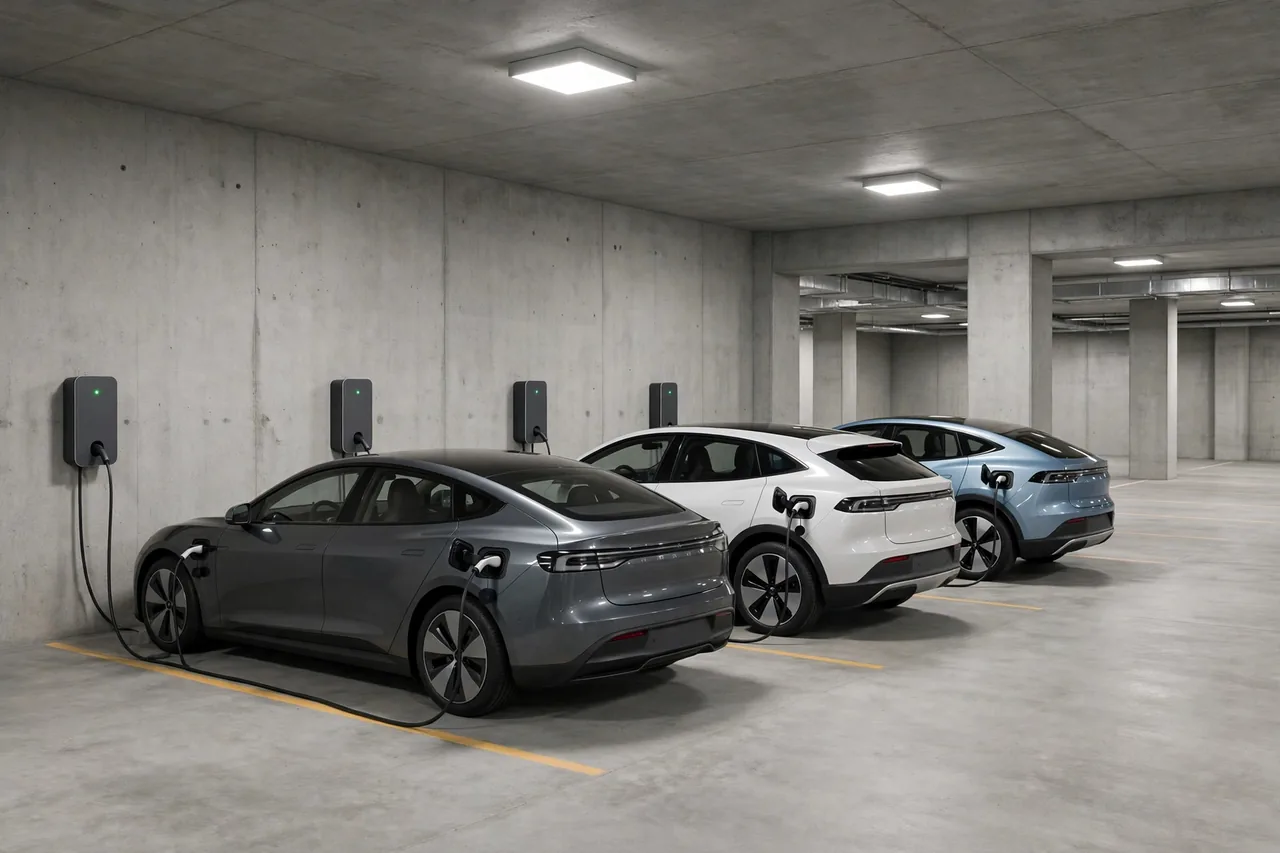
The full menu runs to ten services; the three cards at the top are the ones Las Vegas's housing stock and state law push to the front. Everything links to its national service page for scope and process in full.
Home EV Charger Installation in Las Vegas
The residential standard: a station where the car sleeps, on a circuit of its own, installed under permit. Variations are all local — the panel's spare room, the run's route through the house's fabric, and the parking pattern the cable has to serve.
In Las Vegas: the core residential job in Las Vegas: circuit, mounting, configuration and inspection in one visit pattern.
Level 2 Charger Installation in Las Vegas
The step from a household receptacle to a Level 2 circuit is the step from sipping to drinking: the car takes energy at the rate family life actually consumes it. The work is a breaker, a run of appropriately gauged conductor, and a connection made to torque — modest materials, permanent consequences.
In Las Vegas: the upgrade from a wall outlet to a dedicated 240-volt circuit, and the end of range arithmetic at bedtime.
Load Management & Smart Charging Setup in Las Vegas
The management system is an accountant for amperes: it watches the house's draw in real time and writes the charger a budget from whatever is spare. On paper the panel is full; in practice it is idle most of the night, and the accountant knows it.
In Las Vegas: a monitor-and-throttle setup that lets a Las Vegas charger share capacity with the rest of the house safely.
Utility programs and electricity in Las Vegas
Electricity in Las Vegas comes from Nevada Power Co. Parts of the wider metro are served by Valley Electric Assn, Inc, Overton Power District No 5, City of Boulder City. The utility matters twice over for a charger install: it sets the time-of-use rates that decide what overnight charging costs you, and it is the organisation that may — or may not — currently help pay for the equipment.
Rebate status in Las Vegas: none verified. The utility and state sources checked for this page list no active residential charger rebate from Nevada Power Co, no Nevada replacement program for home installs, and the federal 30C credit ended on September 30, 2025. When a funded round opens it appears on the utility's own program pages with terms and dates; until one does, the honest budget for a charger install here is the install itself.
While you are in the tariff pages, look at how the plan values the evening ramp — the hours when cooking, cooling and charging would otherwise stack. A charger that starts after the ramp is the simplest scheduling decision in home charging, and it is set once.
Condos, HOAs and the law in Nevada
There is no Nevada right-to-charge statute to lean on. Some national roundups list protection that does not exist in this state's code; the statute indexes checked for this page are clear. In Las Vegas, a condo or HOA charger is approved — or not — under the community's own documents, which makes the quality of your application the whole ballgame.
If the board says no, ask for the refusal in writing with the covenant cited. Rules change — several states added right-to-charge laws in 2025 alone — and a documented refusal is what a future rule change, or a future board, works from.
For the full playbook — application contents, metering designs, the questions boards ask — see the condo and HOA charging guide. In Las Vegas it should be read as a negotiation manual, because negotiation is what the absence of a statute leaves you.
Climate, garages and charger placement
Monsoon-season habits, where the desert has them: exterior equipment sealed against wind-driven dust and sudden water, runs pitched clear of the flash drainage paths every local knows by sight, and a connector that lives holstered rather than on gravel. The desert is gentle on chargers that respect it.
The desert garage can be the hottest room in the Southwest by late afternoon, which is why arid-metro charging is a night industry. The station's thermal management and the car's agree on the schedule independently — after midnight, when the slab has given back the day's heat and the tariff is at its kindest.

Permits and inspection in Las Vegas
What the inspector is checking, in plain terms: conductor size against breaker size, the continuous-load calculation, terminations torqued, protection where the code wants it, and a station whose settings match the circuit it landed on. It is a short visit that validates everything you cannot see.

Neighbourhoods and ZIP codes served
The page covers 77 ZIP codes in and around Las Vegas — including 89101, 89102, 89103, 89104, 89105, 89106, 89107, 89108, 89109, 89110, 89111, 89112, 89113, 89114, 89115, 89116, 89117, 89118, 89119, 89120, 89121, 89122, 89123, 89124, 89125, 89126, 89127, 89128, 89129, 89130, 89131, 89132, 89133, 89134, 89135, 89136, 89137, 89138, 89139, 89140, 89141, 89142, 89143, 89144, 89145, 89146, 89147, 89148, 89149, 89150, 89151, 89152, 89153, 89154, 89155, 89156, 89157, 89158, 89159, 89160 — across Clark. If your ZIP is not in the first set shown, ask anyway: installer coverage follows the metro, not a postcode fence.
The same working area takes in the neighbouring localities of The Lakes, North Las Vegas, Nellis Afb, Henderson, Coyote Springs, Sloan, Blue Diamond, Boulder City, Jean, Indian Springs, Moapa, Overton, Logandale, Searchlight — the county ring an installer based in Las Vegas actually drives. Requests from those communities route exactly as city requests do: same services, same permit discipline, same local facts where they differ.
Clark County accounts for 124 of the ZIP codes and 19 named postal localities in the research file, the nearest of them The Lakes, North Las Vegas, Nellis Afb, Henderson, Coyote Springs. The survey counts 2,329,548 residents in the county, with a median household income of $76,472 and a median home value of $431,000. Measured across its ZIP codes, the Las Vegas footprint runs about 30 miles north to south and 28 east to west, from ZIP 89101 to 89199 — the ground an installer based here actually covers in a working week.
Beyond the county seats, the working area takes in The Lakes, North Las Vegas, Nellis Afb, Henderson, Coyote Springs, Sloan, Blue Diamond, Boulder City, Jean, Indian Springs, Moapa, Willow Beach — the named localities for which Las Vegas is the nearest metro in the network (neighbouring metros' pages cover their own ground), each routing to the same installer-matching service.
The largest communities in that working area after Las Vegas itself, by the GeoNames populated-place file: Henderson (population 285,667), North Las Vegas (population 234,807), Paradise (population 223,167), Sunrise Manor (population 189,372), Spring Valley (population 178,395), Enterprise (population 108,481), Whitney (population 38,585), Pahrump (population 36,441), Winchester (population 27,978), Summerlin South (population 24,085), Boulder City (population 15,551), Moapa Valley (population 6,924), Nellis Air Force Base (population 3,187), Sandy Valley (population 2,051), Dolan Springs (population 2,033), Meadview (population 1,224), Death Valley (population 1,124), Alamo (population 1,080), Moapa Town (population 1,025), Indian Springs (population 991). Charging demand follows those populations — the subdivisions and town centres where the next driveways, and the next panels, are.
| ZIP | Locality | County |
|---|---|---|
| 89101 | Las Vegas | Clark |
| 89136 | Las Vegas | Clark |
| 89111 | Las Vegas | Clark |
| 89116 | Las Vegas | Clark |
| 89126 | Las Vegas | Clark |
| 89127 | Las Vegas | Clark |
| 89133 | Las Vegas | Clark |
| 89137 | Las Vegas | Clark |
| 89150 | Las Vegas | Clark |
| 89151 | Las Vegas | Clark |
| 89152 | Las Vegas | Clark |
| 89153 | Las Vegas | Clark |
| 89154 | Las Vegas | Clark |
| 89155 | Las Vegas | Clark |
| 89157 | Las Vegas | Clark |
| 89158 | Las Vegas | Clark |
| 89159 | Las Vegas | Clark |
| 89160 | Las Vegas | Clark |
| 89163 | The Lakes | Clark |
| 89164 | Las Vegas | Clark |
| 89170 | Las Vegas | Clark |
| 89173 | Las Vegas | Clark |
| 89177 | Las Vegas | Clark |
| 89180 | Las Vegas | Clark |
| 89185 | Las Vegas | Clark |
| 89193 | Las Vegas | Clark |
| 89195 | Las Vegas | Clark |
| 89199 | Las Vegas | Clark |
| 89162 | Las Vegas | Clark |
| 89104 | Las Vegas | Clark |
| 89036 | North Las Vegas | Clark |
| 89106 | Las Vegas | Clark |
| 89030 | North Las Vegas | Clark |
| 89110 | Las Vegas | Clark |
| 89109 | Las Vegas | Clark |
| 89169 | Las Vegas | Clark |
| 89087 | North Las Vegas | Clark |
| 89121 | Las Vegas | Clark |
| 89032 | North Las Vegas | Clark |
| 89115 | Las Vegas | Clark |
| 89102 | Las Vegas | Clark |
| 89142 | Las Vegas | Clark |
| 89119 | Las Vegas | Clark |
| 89156 | Las Vegas | Clark |
| 89107 | Las Vegas | Clark |
| 89122 | Las Vegas | Clark |
| 89112 | Las Vegas | Clark |
| 89120 | Las Vegas | Clark |
| 89146 | Las Vegas | Clark |
| 89108 | Las Vegas | Clark |
| 89081 | North Las Vegas | Clark |
| 89105 | Las Vegas | Clark |
| 89140 | Las Vegas | Clark |
| 89103 | Las Vegas | Clark |
| 89031 | North Las Vegas | Clark |
| 89191 | Nellis Afb | Clark |
| 89130 | Las Vegas | Clark |
| 89086 | North Las Vegas | Clark |
| 89084 | North Las Vegas | Clark |
| 89033 | North Las Vegas | Clark |
| 89128 | Las Vegas | Clark |
| 89118 | Las Vegas | Clark |
| 89014 | Henderson | Clark |
| 89125 | Las Vegas | Clark |
| 89145 | Las Vegas | Clark |
| 89117 | Las Vegas | Clark |
| 89123 | Las Vegas | Clark |
| 89074 | Henderson | Clark |
| 89113 | Las Vegas | Clark |
| 89147 | Las Vegas | Clark |
| 89129 | Las Vegas | Clark |
| 89134 | Las Vegas | Clark |
| 89085 | North Las Vegas | Clark |
| 89037 | Coyote Springs | Clark |
| 89132 | Las Vegas | Clark |
| 89131 | Las Vegas | Clark |
| 89144 | Las Vegas | Clark |
| 89114 | Las Vegas | Clark |
| 89135 | Las Vegas | Clark |
| 89149 | Las Vegas | Clark |
| 89012 | Henderson | Clark |
| 89077 | Henderson | Clark |
| 89139 | Las Vegas | Clark |
| 89011 | Henderson | Clark |
| 89141 | Las Vegas | Clark |
| 89183 | Las Vegas | Clark |
| 89015 | Henderson | Clark |
| 89052 | Henderson | Clark |
| 89148 | Las Vegas | Clark |
| 89138 | Las Vegas | Clark |

Planning the install: from panel to parking
Think of the project as a chain with four links: capacity, route, placement, paperwork. Capacity is the load calculation. Route is the path copper takes from panel to parking — through a shared wall if you are lucky, across a ceiling or a trench if you are not. Placement is the unglamorous decision that governs daily life with the car for a decade: reach, cable slack, and which side the port is on. Paperwork is the permit and the passed inspection, the proof that outlives the installer's visit.
Plan for the household you will be, not just the car you have. A second EV is the most common reason a charger circuit gets revisited, and the cheap moment to prepare for it — conduit sized up, panel capacity reserved, station placement that serves two bays — is during the first install, while the permit is open and the electrician is already in the panel.
Home charging know-how for Las Vegas households
Adapters and other false economies
Continuous loads forgive nothing, and adapters are where charging setups go to be forgiven anyway: a chain of plugs between the wall and a device that draws near its circuit's limit for eight hours is a chain of warm connections. The standing rule from installers is plain — the station connects as its listing intends, hardwired or into a receptacle rated and installed for the duty, and borrowed dryer outlets and travel adapters are emergency expedients, not a charging system. Households that need the car charged nightly should own the boring version of the setup: one circuit, one connection, no improvisation.
Making the rate window automatic
Time-of-use tariffs reward households whose charging happens while the grid sleeps, and the reward compounds silently: every night, for the life of the car. The mechanism is trivial — a schedule set in the vehicle or the station — but the details decide whether it survives contact with real life: the window must fit the household's latest departure, the schedule must yield gracefully on the nights the car comes home empty, and the settings must live somewhere the household can find them again. Set it up at commissioning, with the installer, and the saving becomes infrastructure rather than intention.
What an outage does and does not change
When the grid goes down, a standard home charging station goes quiet with everything else — it is a load, not a source, and it neither drains the car nor feeds the house. Sessions resume or restart when power returns, and the car's own settings govern which. Households in outage country plan around this plainly: charge ahead of forecast storms the way you would fill a fuel tank, and treat the car as the household's largest battery-shaped object — one that, with today's standard equipment, keeps its energy to itself.
Two kinds of protection, one circuit
Modern charging circuits sit at the meeting point of two protection philosophies: the breaker's ground-fault protection watching the circuit, and the station's own ground-fault and monitoring systems watching the session. Coordinating them is a specification task — which device leads, which breaker types the station manufacturer lists as compatible, whether the installation is hardwired or receptacle-fed. Done at design time, the two systems coexist silently for decades; done by trial, they announce themselves at 3 am.
Shutoffs and sensible safety
Every charger installation contains its own off switch: the breaker in the panel, and, on larger circuits, a disconnect within sight of the equipment that the code requires. Knowing where both are — and that the station itself stops the session when the connector is unlatched — is the whole safety briefing, and a good installer gives it unprompted at handover. The equipment is listed, protected and designed to be operated daily by non-electricians; the homeowner's part is simply to know the two switches and to treat any change in behaviour — heat, noise, repeated trips — as a reason to call rather than to reset.
Frequently asked questions
What happened to the federal home-charger credit in Las Vegas, NV?
The honest ledger for Las Vegas reads: federal credit, ended September 30, 2025; state program, none for typical home installs; Nevada Power Co residential rebate, none verified in the sources checked. If a salesperson's quote leans on any of the three, the correct response is a request for the program's published page.
What can my HOA in Las Vegas, NV do about a charger install?
In Las Vegas the honest answer is yes, they can refuse: Nevada gives owners no statutory charging right, so the board's discretion governs. What changes outcomes is the quality of the file in front of them — drawings, metering, insurance, a named licensed installer — and a growing number of boards here approve exactly that file.
Does a Level 2 charger mean a panel upgrade for a Las Vegas, NV home?
Nobody can answer that from a photograph of your panel's door, and you should be suspicious of anyone who tries. In a city where the median home dates to 1995 and about 22% of units predate 1980, the honest answer is a load calculation: what your service is, what it already carries, and what a continuous charger load does to the total. Then the options — circuit, load management, or upgrade — compare on paper.
How much faster is Level 2 charging at home in Las Vegas, NV?
A Level 1 cord on a household outlet adds roughly 3–5 miles of range per hour; a Level 2 station on a 240-volt circuit typically adds about 25–40 miles per hour depending on the circuit's amperage and the vehicle. For most drivers that is the difference between rationing the battery and never thinking about it.
How does the installer matching on this page work?
Your request — service, Las Vegas ZIP, property type and timing — goes to licensed local installers who cover Las Vegas. They contact you directly to arrange a site visit and quote. PlugReady USA is the matching service, not the installer, and the sections above exist so you can judge any quote against the local facts.
Can a charger be added to a detached garage in Las Vegas?
Yes — and detached garages are common in Las Vegas, where about 62% of homes are single-unit detached. The run out to the building is the substance of the job: a buried conduit from the house panel, or a subpanel in the garage where the distance and future loads justify it. The station itself then behaves like any garage install.
Nearby cities in Nevada
- EV charger installation in Reno — about 347 miles from Las Vegas, metro population 500,000
- EV charger installation in St. George, UT — about 107 miles from Las Vegas, metro population 185,000
- EV charger installation in Lake Havasu City, AZ — about 124 miles from Las Vegas, metro population 215,000
- EV charger installation in Prescott Valley, AZ — about 187 miles from Las Vegas, metro population 245,000
Ready to charge at home in Las Vegas?
Two minutes of form, and the request is in front of licensed installers who cover this city — quotes follow site visits, in writing.