EV Charger Installation in Lake Havasu City, AZ
Everything a Lake Havasu City homeowner needs before booking a charger install — the panel question, the utility's current programs, the HOA law and the permit — sourced, dated and local.
There is a short list of things that never change about a charger install — it needs capacity, a route, a position and a permit — and a longer list of things that change with the ZIP code. This page is the longer list, for Lake Havasu City. Lake Havasu City itself is home to about 58,359 people. Arizona's registered electric fleet reached 141,800 battery-electric vehicles and 33,900 plug-in hybrids through 2025, and the installers working this metro have local habits worth borrowing. The utility section states what is verified and what is not; the law section quotes the position as it stands; the housing section works from survey data rather than vibes.
Treat what follows as the site visit in written form. Each section is one of the stops a thorough installer makes — panel, tariff, property rules, permit — written out with Lake Havasu City's facts in place, so that when the visit happens for real you can follow the reasoning and question it where it matters.
What the Experian and AFDC registration data say about Lake Havasu City–Kingman: Mohave County. Translated out of market language: your neighbours are already charging at home, the permit office already knows the paperwork, and the installers already know the housing stock.
The same survey puts median household income in Lake Havasu City at $70,148, with 73% of occupied homes owner-occupied and 76% of the housing stock single-unit detached. For charging, those are the operative facts: owners can approve their own electrical work, and detached homes put the car, the panel and the parking under one roof.

Every city charges differently, and Lake Havasu City's difference is legible in the data: a comparatively young housing fabric, where modern services are the default; overwhelmingly a detached-house city, so most installs are the simple garage pattern; larger buildings are a small share, so the multifamily route matters to a minority of readers; owner-occupiers dominate, so most readers can approve their own electrical work outright. Read the sections below through that profile and the local advice resolves into specifics — which questions are routine here, and which are rare.
In absolute terms, the survey counts 35,394 housing units in Lake Havasu City — 28,463 occupied, 20,838 of them by their owners. The stock resolves into 27,055 single-unit detached houses, 5,941 homes standing since before 1980, and 2,781 units in larger buildings. Those six counts are the city's charging map drawn without percentages, and every section of this page is a consequence of one of them. The page's geography is equally concrete: 4 ZIP codes across Mohave, centred near 34.48 degrees north latitude. The city anchors the Lake Havasu City–Kingman metropolitan area, home to roughly 215,000 people on the research file's metro estimate — the wider labour and housing market this page's installers work across.
The same survey release fills in the household economics around the housing stock: a median home value of $455,400, median gross rent of $1,320, per-capita income of $44,999, and a median resident age of 56. And the daily rhythms behind the housing numbers: 74% of Lake Havasu City workers drive to work alone — the commute pattern home charging is built around; 10% work from home, a population whose cars charge on daytime and overnight schedules alike; 0% commute by public transit; 18% of adults hold a bachelor's degree or higher. The survey's vehicle table is the one an EV page should quote first: 1,134 of Lake Havasu City's households have no vehicle at all, while 17,815 have two or more — the multi-car households for whom the second circuit is a when, not an if.
Two burden statistics frame the economics: in Lake Havasu City, 46% of renters and 0% of mortgage-holding owners are housing-cost burdened at the standard 30% threshold. And 61% of households are family households, the segment most likely to run the two-vehicle, two-schedule pattern the second-vehicle planning notes address.
Taken as one portrait, the numbers describe a specific charging market. A young stock standardises the install conversation — the variables narrow to run length, station position and the household's second-car horizon, because the capacity question was answered by the builder years ago. The detached-house majority keeps the geometry simple: lot, driveway, garage, panel — four elements under one ownership, arranged by the household rather than negotiated with a building.
Where owners dominate, installer advice lands differently: investments in capacity and conduit are pitched against decades of tenure rather than a lease's remainder, and households plan accordingly. The specification pattern at this income band is disciplined: capacity for today's car and a conduit sized for tomorrow's, the upgrade deferred until the load calculation insists. Tariff design is the quiet policy: the shape of the overnight window, the demand charges commercial customers face, the interconnection queue's pace — all set in dockets the diligent can read.
The used-EV wave has arrived at this fleet scale, and it democratises the install question: households that bought electric second-hand, at family-car money, asking the same panel questions as the pioneers — with better local answers available. A smaller metro runs on relationships: the electrical firms are few, known, and booked through reputations maintained across decades of local work. Boards here decide without a statutory script, which makes precedent the currency: the first well-built application in a community quietly writes the policy for everyone after it.
The electrical reality in Lake Havasu City homes
Four numbers organise everything an installer expects in Lake Havasu City: median build year 1995; 17% of units built before 1980; 76% of the stock detached; 73% of occupied homes owner-occupied. Capacity, circuit routes and approval layers all correlate with those four. The paragraphs below are their commentary. A comparatively young housing stock works in a charger's favour: most homes here were built with 200-amp service and modern panels, so the circuit itself is usually the whole job. The questions that remain are placement, wire-run length and whether the garage layout suits a wall-mounted station or a pedestal. Owner-occupiers can plan on their own timeline; renters and condo owners have an extra approval layer, which the law section below covers for this state.
One further survey line belongs in any Lake Havasu City install conversation: 84% of the city's homes heat with electricity — 23,923 households whose panels already carry a major winter load before a charger is contemplated. Electric heat and EV charging are the two largest discretionary loads a house can host, and where they coincide, the load calculation stops being a formality.
The tenure split cuts the other way too: roughly 7,625 occupied homes in Lake Havasu City are rented. For those households the charger question is a negotiation with a property owner — written proposal, licensed installer, metering clarity — and it succeeds often enough that installers here keep the pattern ready.
One more structural fact shapes Lake Havasu City's charging map: 8% of the city's housing units sit in buildings of five or more units. Those households cannot simply book a circuit — their charger runs through a building, a board and a shared electrical service, which is why the multifamily service and the law section below carry unusual weight on this page.
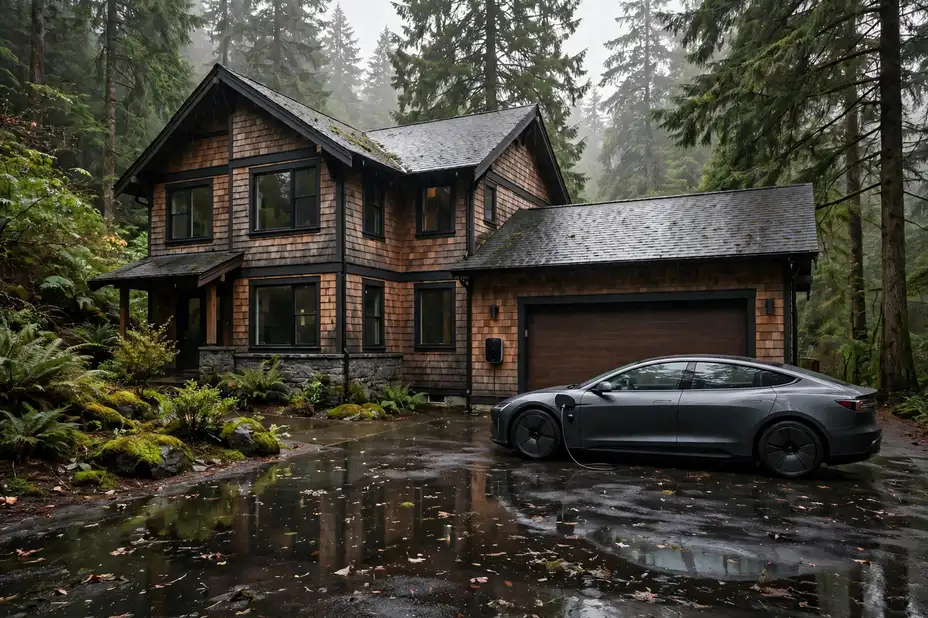
EV charging services in Lake Havasu City
Three of the network's services lead this page because local conditions put them first; the remaining seven are one click away and equally available here. Each card states what the service involves — the matching itself is free of obligation until you accept an installer's quote.
Home EV Charger Installation in Lake Havasu City
The residential standard: a station where the car sleeps, on a circuit of its own, installed under permit. Variations are all local — the panel's spare room, the run's route through the house's fabric, and the parking pattern the cable has to serve.
In Lake Havasu City: where most Lake Havasu City projects start and finish: one circuit, one station, one inspection.
Level 2 Charger Installation in Lake Havasu City
A Level 2 circuit turns charging from a ration into a routine. The job is electrical rather than electronic — breaker and conductor sized at the continuous-load factor, the run routed to the parking position, and the station dialled to the circuit rather than to its own headline maximum.
In Lake Havasu City: what most Lake Havasu City drivers mean when they say they want 'a real charger' — 240 volts, sized to the circuit.
Load Management & Smart Charging Setup in Lake Havasu City
The management system is an accountant for amperes: it watches the house's draw in real time and writes the charger a budget from whatever is spare. On paper the panel is full; in practice it is idle most of the night, and the accountant knows it.
In Lake Havasu City: the managed-charger route around Lake Havasu City's capacity limits.
Utility programs and electricity in Lake Havasu City
Electricity in Lake Havasu City comes from Arizona Public Service Co. Parts of the wider metro are served by UNS Electric, Inc, Mohave Electric Cooperative, Inc., Dixie Escalante R E A, Inc. The utility matters twice over for a charger install: it sets the time-of-use rates that decide what overnight charging costs you, and it is the organisation that may — or may not — currently help pay for the equipment.
Plan on no rebate in Lake Havasu City at the moment. In the sources checked for this page, Arizona Public Service Co publishes no residential charger rebate, Arizona runs no state scheme for typical home installs, and the federal credit that once filled this gap closed on September 30, 2025. Installers quote the work; utilities fund programs; the second list is currently empty here, and any quote that implies otherwise should come with the program's published terms attached.
Net-metering households — rooftop solar is common across the metro — should tell the installer: charging schedules and load management are planned differently when the house generates as well as consumes.
Condos, HOAs and the law in Arizona
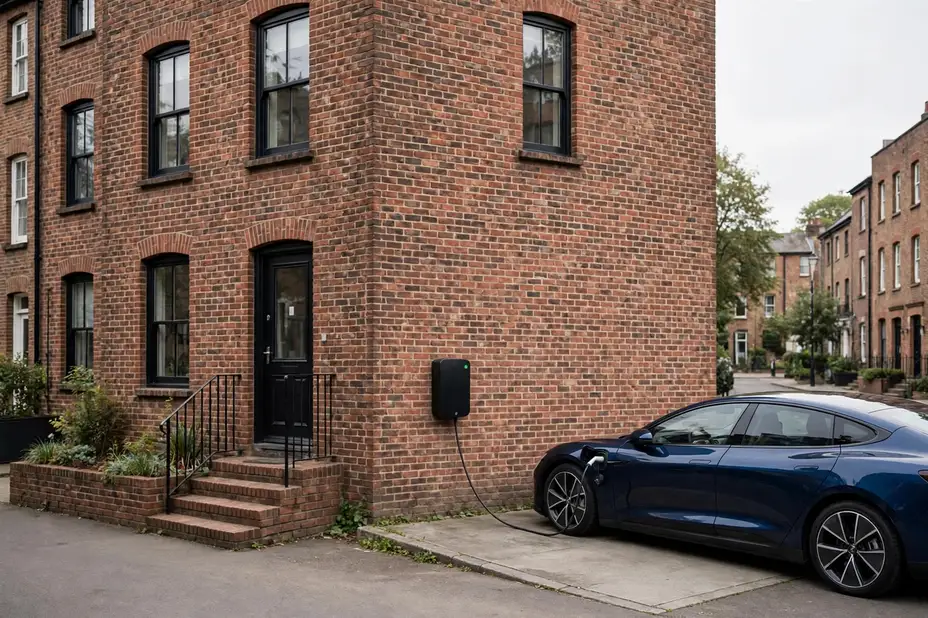
There is no Arizona right-to-charge statute to lean on. Some national roundups list protection that does not exist in this state's code; the statute indexes checked for this page are clear. In Lake Havasu City, a condo or HOA charger is approved — or not — under the community's own documents, which makes the quality of your application the whole ballgame.
No law does not mean no path. Boards approve chargers every week when the proposal answers their real concerns in advance: a licensed installer, a dedicated circuit that touches nothing shared, metering that keeps the electricity cost on the owner, insurance, and a commitment to restore the space on removal. Bring that package, in writing, before the meeting — not during it.
For the full playbook — application contents, metering designs, the questions boards ask — see the condo and HOA charging guide. In Lake Havasu City it should be read as a negotiation manual, because negotiation is what the absence of a statute leaves you.
Climate, garages and charger placement
Monsoon-season habits, where the desert has them: exterior equipment sealed against wind-driven dust and sudden water, runs pitched clear of the flash drainage paths every local knows by sight, and a connector that lives holstered rather than on gravel. The desert is gentle on chargers that respect it.
Dust is the desert's weather, and it has an install opinion: enclosures that seal rather than vent where the design allows, connectors holstered capped rather than open, and a cable route that keeps the plug off the ground's grit between sessions. Equipment chosen for the region already assumes it; mounting discipline completes it.

Permits and inspection in Lake Havasu City
Bring the panel schedule up to date while the electrician is in it — the new circuit labelled, in the directory, in pen. Inspectors notice; future electricians bless you for it; and the load calculation for any second circuit starts from that card.

Neighbourhoods and ZIP codes served
The page covers 4 ZIP codes in and around Lake Havasu City — including 86403, 86404, 86405, 86406 — across Mohave. If your ZIP is not in the first set shown, ask anyway: installer coverage follows the metro, not a postcode fence.
The same working area takes in the neighbouring localities of Topock, Mohave Valley, Yucca, Oatman, Fort Mohave, Wikieup, Bullhead City, Temple Bar Marina, Kingman, Golden Valley, Chloride, Hualapai, Hackberry, Valentine — the county ring an installer based in Lake Havasu City actually drives. Requests from those communities route exactly as city requests do: same services, same permit discipline, same local facts where they differ.
Mohave County accounts for 31 of the ZIP codes and 21 named postal localities in the research file, the nearest of them Topock, Mohave Valley, Yucca, Oatman, Fort Mohave. The survey counts 220,517 residents in the county, with a median household income of $57,684 and a median home value of $281,000. Measured across its ZIP codes, the Lake Havasu City footprint runs about 9 miles north to south and 13 east to west, from ZIP 86403 to 86406 — the ground an installer based here actually covers in a working week.
Beyond the county seats, the working area takes in Parker Dam, Topock, Earp, Parker, Needles, Vidal, Mohave Valley, Yucca, Poston, Oatman, Fort Mohave, Bouse, Wikieup, Bullhead City, Laughlin, Temple Bar Marina, Quartzsite, Kingman, Golden Valley, Wenden, Ehrenberg, Cal Nev Ari, Blythe, Chloride, Salome, Essex, Hualapai, Hackberry, Valentine, Amboy — the named localities for which Lake Havasu City is the nearest metro in the network (neighbouring metros' pages cover their own ground), each routing to the same installer-matching service.
The wider working area also reaches Bagdad, Desert Center, Aguila, Dolan Springs, Searchlight, Palo Verde — ground shared with neighbouring metros, where installers cross the same county lines in both directions.
The largest communities in that working area after Lake Havasu City itself, by the GeoNames populated-place file: Bullhead City (population 39,445), Kingman (population 28,912), Blythe (population 19,208), New Kingman-Butler (population 12,134), Golden Valley (population 8,370), Laughlin (population 7,323), Needles (population 4,984), Quartzsite (population 3,626), Parker (population 3,046), Mohave Valley (population 2,616), Desert Hills (population 2,245), Golden Shores (population 2,047), Cienega Springs (population 1,798), Valle Vista (population 1,659), Salome (population 1,530), Ehrenberg (population 1,470), Big River (population 1,327), Willow Valley (population 1,062), Bouse (population 996), Arizona Village (population 946). Charging demand follows those populations — the subdivisions and town centres where the next driveways, and the next panels, are.
La Paz County reaches into the working area with 16,664 residents, a median household income of $49,478 and a median home value of $135,800; its localities on this page include Parker, Poston, Bouse, Quartzsite.
| ZIP | Locality | County |
|---|---|---|
| 86403 | Lake Havasu City | Mohave |
| 86405 | Lake Havasu City | Mohave |
| 86404 | Lake Havasu City | Mohave |
| 86406 | Lake Havasu City | Mohave |
| 92267 | Parker Dam | San Bernardino |
| 86436 | Topock | Mohave |
| 92242 | Earp | San Bernardino |
| 85344 | Parker | La Paz |
| 92363 | Needles | San Bernardino |
| 92280 | Vidal | San Bernardino |
| 86446 | Mohave Valley | Mohave |
| 86438 | Yucca | Mohave |
| 86440 | Mohave Valley | Mohave |
| 85371 | Poston | La Paz |
| 86433 | Oatman | Mohave |
| 86426 | Fort Mohave | Mohave |
| 86427 | Fort Mohave | Mohave |
| 85325 | Bouse | La Paz |
| 85360 | Wikieup | Mohave |
| 86442 | Bullhead City | Mohave |
| 86430 | Bullhead City | Mohave |
| 86439 | Bullhead City | Mohave |
| 89029 | Laughlin | Clark |
| 86429 | Bullhead City | Mohave |
| 86443 | Temple Bar Marina | Mohave |
| 89028 | Laughlin | Clark |
| 85346 | Quartzsite | La Paz |
| 86402 | Kingman | Mohave |
| 85359 | Quartzsite | La Paz |
| 86409 | Kingman | Mohave |
| 86413 | Golden Valley | Mohave |
| 86401 | Kingman | Mohave |
| 85357 | Wenden | La Paz |
| 85334 | Ehrenberg | La Paz |
| 89039 | Cal Nev Ari | Clark |
| 92225 | Blythe | Riverside |
| 86431 | Chloride | Mohave |
| 85348 | Salome | La Paz |
| 92332 | Essex | San Bernardino |
| 86412 | Hualapai | Mohave |
| 86411 | Hackberry | Mohave |
| 86437 | Valentine | Mohave |
| 92304 | Amboy | San Bernardino |

Planning the install: from panel to parking
A useful way to read any Lake Havasu City quote is to ask which of three jobs it describes. Job one: the panel has room and the run is short — a circuit and a station. Job two: the panel is full — capacity work joins the quote, as an upgrade or as load management. Job three: the property adds people — an HOA, a landlord, a building's shared service — and the approvals timeline joins the electrical one. None of the three is a bad job; they are simply different scopes, and a clear quote says which one you are in.
One more piece of sequencing advice Lake Havasu City installers give consistently: if the panel is being opened anyway, settle the other electrical maybes in the same visit — the circuit you will want next year costs least while the permit and the electrician are already in the house.
Home charging know-how for Lake Havasu City households
The charger and the home network
A networked station asks one thing of the house: a wireless signal that actually reaches the garage. Exterior walls, metal cladding and distance tax domestic Wi-Fi exactly where chargers live, and the household that checks signal strength at the mounting position before install day avoids the dead-zone discovery afterwards. Where the signal will not reach, the honest options are a network extension, a station chosen for offline competence, or cellular-connected equipment — decided in advance, not improvised on the day.
Workplace charging as a policy, not a perk war
Workplace stations fail socially before they fail electrically: the same cars parked all day, visitors boxed out, no rule for the growing queue. The installs that work pair the hardware with a light policy from the start — session lengths matched to the shift, access that distinguishes staff from guests, and pricing or etiquette that keeps a full battery from squatting until six. The electrical design and the policy design are one conversation, because the dwell pattern the policy sets is the load pattern the circuit must serve.
The school-run charge window
Households organised around school runs live on a distinctive charge curve: two short hops, a long parked day, an afternoon of activities. The car sits at home for the middle of the day — which, for solar households, is precisely the generation window, and for everyone else makes the overnight session almost an afterthought. Scheduling follows the family's actual day, not the tariff's assumption of one, and the installer who asks about the school run is designing, not chatting.
Reading the bill after the charger arrives
The first bills after an install reward a careful read. Charging appears as consumption, not as a line item — the household's kilowatt-hours rise by roughly the car's appetite, and the rate applied to the new hours depends on when they happened. Owners who check the schedule actually ran — that the car charged inside the intended window — catch the one configuration mistake that costs money monthly. After that, the bill becomes the household's quietest document: the car simply costs what the overnight rate says it should.

Frequently asked questions
Can I still get the federal tax credit for a home charger in Lake Havasu City, AZ?
Treat the answer as a standing no with a watching brief. The 30C credit is finished, Arizona has not replaced it for homeowners, and no verified Arizona Public Service Co rebate was running in the sources checked for this page. Should that change, the utility's program page will say so first — and this page will be updated to match.
What can my HOA in Lake Havasu City, AZ do about a charger install?
In Lake Havasu City, they can — there is no Arizona statute stopping them. Right-to-charge protection simply has not been enacted here, so the board's own rules decide. Owners do still get approved regularly: the applications that succeed answer the board's concerns (metering, insurance, restoration, a licensed installer) before the meeting, in writing.
Does a Level 2 charger mean a panel upgrade for a Lake Havasu City, AZ home?
Start from the median, then verify: the median Lake Havasu City home was built in 1995, and 17% of the stock predates 1980, so 100-amp panels are a normal sight here — and a normal candidate for either an upgrade or a load-management device. The load calculation distinguishes the two in one visit, and any quote that skips it is guessing with your money.
How much faster is Level 2 charging at home in Lake Havasu City, AZ?
In parked hours: a Level 1 cord returns about 3–5 miles for each of them, and a Level 2 circuit returns roughly 25–40, set by its amperage and the car's acceptance. For a Lake Havasu City household parking ten hours, that is the difference between recovering a short errand day and recovering any day the car can legally drive.
What happens next after I send a request?
Three things happen, in order. Your request is routed to licensed installers who work in Lake Havasu City; one of them contacts you to book a site visit; and the visit produces a written quote based on your actual panel and parking. PlugReady USA runs the matching, not the tools — the contractor on the job is the installer who visits.
Does Arizona Public Service Co offer a time-of-use rate for EV charging in Lake Havasu City?
Check your tariff before the install rather than after: time-of-use plans are common, and an overnight window changes nothing about the circuit but everything about what charging costs across a year. Your installer can set the station's schedule to the window during commissioning — after that the habit is automatic.
Nearby cities in Arizona
- EV charger installation in Prescott Valley — about 113 miles from Lake Havasu City, metro population 245,000
- EV charger installation in Yuma — about 124 miles from Lake Havasu City, metro population 205,000
- EV charger installation in Phoenix — about 144 miles from Lake Havasu City, metro population 4,950,000
- EV charger installation in Flagstaff — about 156 miles from Lake Havasu City, metro population 145,000
- EV charger installation in Tucson — about 243 miles from Lake Havasu City, metro population 1,050,000
- EV charger installation in Sierra Vista — about 303 miles from Lake Havasu City, metro population 130,000
- EV charger installation in Las Vegas, NV — about 124 miles from Lake Havasu City, metro population 2,300,000
- EV charger installation in El Centro, CA — about 135 miles from Lake Havasu City, metro population 180,000
- EV charger installation in Riverside, CA — about 170 miles from Lake Havasu City, metro population 4,700,000
Ready to charge at home in Lake Havasu City?
Two minutes of form, and the request is in front of licensed installers who cover this city — quotes follow site visits, in writing.