EV Charger Installation in Flagstaff, AZ
Charging where you park, in Flagstaff: the utility programs, state law, permit process and housing facts behind a home charger install, gathered in one place.
The economics of home charging are made in two places: the tariff you charge on, and the circuit you charge through. Both are decided locally, and both are decided before the hardware is chosen. Flagstaff itself is home to about 77,549 people; Arizona counted 141,800 battery-electric vehicles and 33,900 plug-in hybrids by the end of 2025, and the metro's households are making these two decisions every week. Below: the utility position for Flagstaff as verified, the state law on association charging, the permit route, and the housing-stock numbers that tell you how much panel conversation to expect at your own address.
Nothing on this page is decorative. The statutes are quoted because boards respect them, the survey numbers are shown because quotes should follow them, and the program status is stated plainly — including when the plain statement is that no verified program currently exists for Flagstaff. Informed homeowners get better installs; this page is the informing.
The demand picture for the Flagstaff metro, from the registration data this site is built on: Northern AZ. Registration counts are the honest way to size a charging market — they count households, not headlines — and they are why Flagstaff sits where it does in our build order (rank 291 of 300 metros, Tier C).
Three percentages describe the working conditions for charging in Flagstaff: 44% owner-occupied, 44% single-unit detached, and a median household income of $74,417 standing behind both. Everything in the sections below — panels, permissions, metering — is commentary on those proportions.

Every city charges differently, and Flagstaff's difference is legible in the data: a housing stock of mixed vintages, where both electrical eras appear on the same street; a genuinely mixed city — houses, townhouses and larger buildings all carry weight; buildings of five or more units hold a substantial share of homes, which keeps the multifamily sections of this page in daily use; renters form a large share of households, so the landlord conversation is a first-class topic here. Read the sections below through that profile and the local advice resolves into specifics — which questions are routine here, and which are rare.
In absolute terms, the survey counts 33,617 housing units in Flagstaff — 30,562 occupied, 13,309 of them by their owners. The stock resolves into 14,735 single-unit detached houses, 9,550 homes standing since before 1980, and 10,379 units in larger buildings. Those six counts are the city's charging map drawn without percentages, and every section of this page is a consequence of one of them. The page's geography is equally concrete: 6 ZIP codes across Coconino, centred near 35.19 degrees north latitude. The city anchors the Flagstaff metropolitan area, home to roughly 145,000 people on the research file's metro estimate — the wider labour and housing market this page's installers work across.
The same survey release fills in the household economics around the housing stock: a median home value of $552,900, median gross rent of $1,645, per-capita income of $38,409, and a median resident age of 26. How the city moves completes the picture: 62% of Flagstaff workers drive to work alone — the commute pattern home charging is built around; 13% work from home, a population whose cars charge on daytime and overnight schedules alike; 2% commute by public transit; 52% of adults hold a bachelor's degree or higher. The survey's vehicle table is the one an EV page should quote first: 1,147 of Flagstaff's households have no vehicle at all, while 17,903 have two or more — the multi-car households for whom the second circuit is a when, not an if.
The cost-burden lines say who feels housing costs most in Flagstaff: 51% of renters spend 30% or more of income on rent, and 0% of owners with mortgages spend the same share on housing costs. Family households are 45% of all households — the two-car, school-run demographic whose charging patterns this page's planning sections keep circling back to.
What follows is the city read as an electrical place rather than a dot on a map. Mixed-age stock means mixed answers: the same street can hold a 100-amp fuse-era service and a 200-amp panel with spare ways, so city-level generalisations dissolve at the level of the individual driveway. The renter-and-condo share makes the law section of this page load-bearing: statutory rights, application windows and metering rules are not fine print here, they are the project's first phase.
High renter share also means charging follows the lease cycle: applications cluster at move-in, installations at renewal leverage, and the whole market breathes on the rental calendar. The specification pattern at this income band is disciplined: capacity for today's car and a conduit sized for tomorrow's, the upgrade deferred until the load calculation insists. Filed tariffs and public dockets give this territory a paper trail most markets lack: the diligent household can read the utility's own electrification plan and know which programmes are funded, piloted or merely proposed.
Households here are rarely the first on their street; the local knowledge pool — which installer, which tariff, which board precedent — is deep and shared freely. The permit counter in a smaller city is a conversation, not a queue: applications are read by people who may know the street, and complete paperwork is remembered kindly. Boards here decide without a statutory script, which makes precedent the currency: the first well-built application in a community quietly writes the policy for everyone after it.
The electrical reality in Flagstaff homes
The Census Bureau counts Flagstaff's housing in ways that turn out to be an installer's briefing: the median home dates to 1992, 28% of units stood before 1980, 44% are detached single-unit houses, and 44% of occupied homes belong to their occupants. Panel sizes, wire routes and even permit histories track those proportions street by street. A mixed-age stock like this splits installs into two camps: newer subdivisions where a 200-amp panel usually has planned capacity, and established neighbourhoods where the panel conversation comes first. Neither is a problem — but they are different jobs, and the estimate you get should say which camp your home falls into and why. Owner-occupiers can plan on their own timeline; renters and condo owners have an extra approval layer, which the law section below covers for this state.
The fuel table adds one more local fact: 7,555 Flagstaff homes — 26% of the stock — heat with electricity. Those households already think in kilowatts through the winter, their panels carry the load to prove it, and a charger's overnight appetite joins a system that is, in the useful sense, already electrified.
One further split matters for how this page is organised: about 17,253 of Flagstaff's occupied homes are renter-occupied. Everything above assumes you can approve your own electrical work; where you cannot, the approval layer — landlord or association — becomes part of the job, which is why the law section carries unusual weight here.
And 31% of Flagstaff's homes are in buildings with five or more units — apartments and condominiums where charging is a building decision before it is an electrical one. If that is your situation, the law and multifamily sections of this page are the ones written for you.
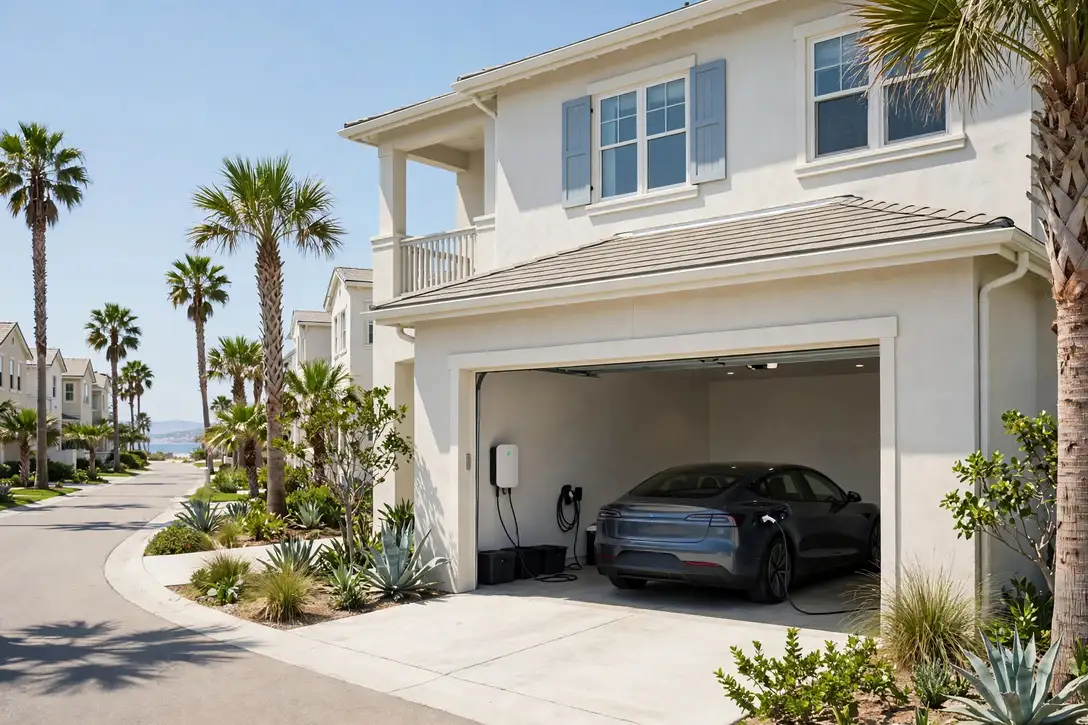
EV charging services in Flagstaff
An installer's work in Flagstaff usually starts with one of the three lead services below. The cards describe the job as it is actually scoped; the grid underneath carries the rest of the menu.
Home EV Charger Installation in Flagstaff
The residential standard: a station where the car sleeps, on a circuit of its own, installed under permit. Variations are all local — the panel's spare room, the run's route through the house's fabric, and the parking pattern the cable has to serve.
In Flagstaff: the install Flagstaff's new EV households book first, and the one the rest of this page keeps returning to.
Level 2 Charger Installation in Flagstaff
A Level 2 circuit turns charging from a ration into a routine. The job is electrical rather than electronic — breaker and conductor sized at the continuous-load factor, the run routed to the parking position, and the station dialled to the circuit rather than to its own headline maximum.
In Flagstaff: the circuit class behind nearly every home install in Flagstaff, from first car to second.
Load Management & Smart Charging Setup in Flagstaff
The management system is an accountant for amperes: it watches the house's draw in real time and writes the charger a budget from whatever is spare. On paper the panel is full; in practice it is idle most of the night, and the accountant knows it.
In Flagstaff: letting a full Flagstaff panel tell the truth about its valleys.
Utility programs and electricity in Flagstaff
Electricity in Flagstaff comes from Arizona Public Service Co. Parts of the wider metro are served by Mohave Electric Cooperative, Inc., Navajo Tribal Utility Authority, Garkane Energy Coop, Inc. The utility matters twice over for a charger install: it sets the time-of-use rates that decide what overnight charging costs you, and it is the organisation that may — or may not — currently help pay for the equipment.
Why does this page labour the absence of a rebate? Because in Flagstaff the phantom rebate is the most common distortion in charger quotes: a figure justified by money that is not, at present, claimable. The verified position: federal 30C ended September 30, 2025; no Arizona replacement for typical home installs; no Arizona Public Service Co residential charger rebate in the sources checked. If someone quotes you a rebate, the follow-up is one sentence — show me the program page — and its answer decides the quote's credibility.
Before the install, it is worth a two-minute look at your tariff. Many Arizona Public Service Co customers can move to a time-of-use plan where overnight energy is charged at a lower rate, and a scheduled charger makes that saving automatic.
Condos, HOAs and the law in Arizona
Arizona has no statewide right-to-charge law. That needs saying plainly, because roundups on the internet sometimes claim otherwise: in the authoritative statute indexes checked for this page, no Arizona law prevents a homeowners association or condominium from refusing a charger in a common or assigned space. Your community's own covenants and board govern the question in Flagstaff.
There is also a longer game available to Flagstaff owners: associations revise their documents, boards turn over, and state legislatures have been adding right-to-charge laws year after year. A written application — and, if it comes to it, a written refusal — is the record that each of those futures works from.
Our condo and HOA guide covers both kinds of state; in Flagstaff the chapters on complete applications and cost allocation are the operative ones.
Climate, garages and charger placement
Dust discipline is minor but real: a connector that returns to its holster stays clean, and a capped, holstered station asks nothing of its owner between drives. In a climate this dry, that small habit is most of the maintenance schedule there is.
The desert house's electrical centre of gravity shifts at night — cooling loads fall, the car takes the stage, and the panel that groaned at 6 pm idles by midnight. The schedule is the whole strategy, and it is set once.

Permits and inspection in Flagstaff
Bring the panel schedule up to date while the electrician is in it — the new circuit labelled, in the directory, in pen. Inspectors notice; future electricians bless you for it; and the load calculation for any second circuit starts from that card.

Neighbourhoods and ZIP codes served
The page covers 6 ZIP codes in and around Flagstaff — including 86001, 86002, 86003, 86004, 86005, 86011 — across Coconino. If your ZIP is not in the first set shown, ask anyway: installer coverage follows the metro, not a postcode fence.
The same working area takes in the neighbouring localities of Bellemont, Parks, Munds Park, Mormon Lake, Sedona, Williams, Leupp, Gray Mountain, Happy Jack, Cameron, Grand Canyon, Tuba City, Forest Lakes, North Rim — the county ring an installer based in Flagstaff actually drives. Requests from those communities route exactly as city requests do: same services, same permit discipline, same local facts where they differ.
Coconino County accounts for 28 of the ZIP codes and 21 named postal localities in the research file, the nearest of them Bellemont, Parks, Munds Park, Mormon Lake, Sedona. The survey counts 144,508 residents in the county, with a median household income of $72,966 and a median home value of $448,000. Measured across its ZIP codes, the Flagstaff footprint runs about 5 miles north to south and 6 east to west, from ZIP 86001 to 86011 — the ground an installer based here actually covers in a working week.
Beyond the county seats, the working area takes in Bellemont, Parks, Munds Park, Mormon Lake, Sedona, Williams, Leupp, Gray Mountain, Happy Jack, Winslow, Cameron, Grand Canyon, Tuba City, Forest Lakes, North Rim, Kykotsmovi Village, Joseph City, Hotevilla, Second Mesa, Heber, Overgaard, Polacca, Kaibeto, Holbrook, Keams Canyon, Indian Wells, Sun Valley, Woodruff, Clay Springs, Pinedale, Snowflake — the named localities for which Flagstaff is the nearest metro in the network (neighbouring metros' pages cover their own ground), each routing to the same installer-matching service.
The wider working area also reaches Cornville, Clarkdale, Lake Montezuma, Cottonwood, Rimrock, Jerome, Camp Verde, Ash Fork, Prescott Valley, Paulden, Prescott, Chino Valley, Dewey, Humboldt, Pine, Mayer, Payson, Seligman, Skull Valley, Crown King, Black Canyon City, Young, Kirkland, Yarnell, New River, Cave Creek, Supai, Congress, Bagdad, Carefree, Tonto Basin, Scottsdale, Phoenix — ground shared with neighbouring metros, where installers cross the same county lines in both directions.
ZIP codes in that shared ground include 85086, 85087, 85262, 85266, 85324, 85327, 85331, 85332, 85362, 85541, 85544, 85547, 85553, 85554, 86302, 86303, 86304, 86305, 86312, 86313, 86314, 86315, 86321, 86322, 86323, 86324, 86325, 86326, 86327, 86329, 86331, 86333, 86334, 86335, 86337, 86338, 86340, 86342, 86343, 86435.
The largest communities in that working area after Flagstaff itself, by the GeoNames populated-place file: West Sedona (population 11,299), Sedona (population 10,388), Winslow (population 9,600), Tuba City (population 8,611), Big Park (population 6,695), Village of Oak Creek (Big Park) (population 6,147), Snowflake (population 5,666), Holbrook (population 5,019), Taylor (population 4,151), Williams (population 3,122), Heber-Overgaard (population 2,822), Kachina Village (population 2,622), First Mesa (population 1,555), Grand Canyon Village (population 1,550), Grand Canyon (population 1,460), LeChee (population 1,443), Joseph City (population 1,386), Parks (population 1,188), Dilkon (population 1,184), Mountainaire (population 1,119). Charging demand follows those populations — the subdivisions and town centres where the next driveways, and the next panels, are.
Navajo County reaches into the working area with 108,415 residents, a median household income of $54,606 and a median home value of $201,500; its localities on this page include Winslow, Kykotsmovi Village, Joseph City, Hotevilla, Second Mesa. Yavapai County reaches into the working area with 245,480 residents, a median household income of $69,613 and a median home value of $425,200; its localities on this page include Sedona.
| ZIP | Locality | County |
|---|---|---|
| 86001 | Flagstaff | Coconino |
| 86002 | Flagstaff | Coconino |
| 86003 | Flagstaff | Coconino |
| 86011 | Flagstaff | Coconino |
| 86005 | Flagstaff | Coconino |
| 86004 | Flagstaff | Coconino |
| 86015 | Bellemont | Coconino |
| 86018 | Parks | Coconino |
| 86017 | Munds Park | Coconino |
| 86038 | Mormon Lake | Coconino |
| 86339 | Sedona | Coconino |
| 86336 | Sedona | Coconino |
| 86341 | Sedona | Yavapai |
| 86351 | Sedona | Coconino |
| 86046 | Williams | Coconino |
| 86035 | Leupp | Coconino |
| 86016 | Gray Mountain | Coconino |
| 86024 | Happy Jack | Coconino |
| 86047 | Winslow | Navajo |
| 86020 | Cameron | Coconino |
| 86023 | Grand Canyon | Coconino |
| 86045 | Tuba City | Coconino |
| 85931 | Forest Lakes | Coconino |
| 86052 | North Rim | Coconino |
| 86039 | Kykotsmovi Village | Navajo |
| 86032 | Joseph City | Navajo |
| 86030 | Hotevilla | Navajo |
| 86043 | Second Mesa | Navajo |
| 85928 | Heber | Navajo |
| 85933 | Overgaard | Navajo |
| 86042 | Polacca | Navajo |
| 86053 | Kaibeto | Coconino |
| 86025 | Holbrook | Navajo |
| 86034 | Keams Canyon | Navajo |
| 86031 | Indian Wells | Navajo |
| 86029 | Sun Valley | Navajo |
| 85942 | Woodruff | Navajo |
| 85923 | Clay Springs | Navajo |
| 85934 | Pinedale | Navajo |
| 85937 | Snowflake | Navajo |

Planning the install: from panel to parking
Two decisions shape every Flagstaff install, and both are made before any equipment is ordered. The first is electrical: the load calculation that decides between a straight circuit, a panel upgrade and load management. The second is physical: where the station lives — which wall, which side of the car the charge port sits on, and whether the cable reaches a second vehicle or a future one. Installers in Flagstaff see the same housing patterns repeat street by street, which is why a ten-minute site visit produces a firmer quote than any online form: the form starts the conversation, the visit settles it.
Future-proofing, in this trade, is mostly conduit and capacity: an oversized conduit run costs little during the first install and everything later; a panel position reserved is a breaker that never has to move. If a second EV, a workshop or an electrified water heater is anywhere in your five-year picture, say so at the site visit.
Home charging know-how for Flagstaff households
The insurance conversation
A permitted charger installation is a short conversation with your insurer, and it is worth having before rather than after. The documented install — permit, inspection, listed equipment, licensed electrician — is the version insurers process without friction, because every question they ask is answered by the file. Undocumented electrical work is where claims go to become arguments. Tell the insurer the circuit exists, keep the paperwork with the policy documents, and the charger's insurance chapter closes in one phone call.
Household safety habits around the charger
A charging setup joins a household's ordinary safety landscape — the same category as the stove and the water heater: respected, listed, and left to do its job. The household habits are few. The cable lives off the floor where small feet and wheels travel; the connector is docked, not dangled; children learn the house rule that the charger is an appliance, not a toy, the way they learn the oven's. Nothing about a properly installed station asks for anxiety — just the standard respect electricity has always been owed.
Two-storey houses and the vertical run
In a two-storey house the panel often lives in a utility room, a laundry or a ground-floor wall far from the garage, and the circuit's path becomes a vertical problem: chases, soffits and floor cavities are the route's vocabulary. Experienced installers read a house's structure the way a plumber does — where the stacked walls are, which cavities run uninterrupted — and the quote follows that reading. Expect the site visit to include a look upstairs; the ceiling above the garage is part of the job.
A word about the word 'charger'
Strictly speaking, the charger lives in the car: the onboard unit that converts alternating current from the wall into the direct current the battery stores. The box on your wall is supply equipment — it negotiates, switches and protects, but the conversion happens in the vehicle. The distinction explains two practical things: why the car's acceptance rate caps every circuit conversation, and why the same wall equipment serves different cars at different speeds. Installers use 'charger' for the wall box anyway, as does this page — but the mental model is worth owning.

Frequently asked questions
Can I still get the federal tax credit for a home charger in Flagstaff, AZ?
The three possible pots are all, at present, empty for a Flagstaff homeowner: no Arizona Public Service Co residential rebate in current published sources, no Arizona home programme, and a federal credit that closed on September 30, 2025. Programmes do relaunch — on the utility's site, with dates — and until one does, the honest quote is the one with no rebate line at all.
Can my HOA or condo board in Flagstaff, AZ refuse my charger?
As the law stands, yes: without a Arizona right-to-charge statute, an association in Flagstaff may refuse or condition a charger under its own documents. The practical counterweight is preparation — a complete written package, a metering answer, and a request that the refusal, if it comes, be issued in writing with the covenant cited.
Will my Flagstaff, AZ home need a panel upgrade for a Level 2 charger?
Sometimes — and Flagstaff's housing stock is exactly why the question is worth asking properly. With a median build year of 1992 and roughly 28% of homes predating 1980, plenty of local panels are 100-amp units already carrying a full modern load. Those homes choose between an upgrade and load management; newer 200-amp homes usually just add the circuit. The site visit's load calculation is the decider.
Level 1 or Level 2 in Flagstaff, AZ — what is the real difference?
In parked hours: a Level 1 cord returns about 3–5 miles for each of them, and a Level 2 circuit returns roughly 25–40, set by its amperage and the car's acceptance. For a Flagstaff household parking ten hours, that is the difference between recovering a short errand day and recovering any day the car can legally drive.
What happens after I request an installer through this page?
Send the request and it is matched against installers covering Flagstaff — your service, ZIP, property type and timing travel with it. An installer then arranges the site visit and quotes in writing. Our role ends at the introduction; your contract, permit and paperwork are with the installer.
Does Arizona Public Service Co offer a time-of-use rate for EV charging in Flagstaff?
Many Arizona Public Service Co customers can choose a time-of-use tariff; whether yours is one, and where its cheap window sits, decides how the charger should be scheduled from night one. Two minutes with your tariff sheet during the planning stage is the whole task — the installer sets the schedule to match while commissioning the station.
Nearby cities in Arizona
- EV charger installation in Prescott Valley — about 50 miles from Flagstaff, metro population 245,000
- EV charger installation in Phoenix — about 122 miles from Flagstaff, metro population 4,950,000
- EV charger installation in Lake Havasu City — about 156 miles from Flagstaff, metro population 215,000
- EV charger installation in Tucson — about 209 miles from Flagstaff, metro population 1,050,000
- EV charger installation in Yuma — about 238 miles from Flagstaff, metro population 205,000
- EV charger installation in Sierra Vista — about 263 miles from Flagstaff, metro population 130,000
- EV charger installation in St. George, UT — about 170 miles from Flagstaff, metro population 185,000
- EV charger installation in Las Vegas, NV — about 203 miles from Flagstaff, metro population 2,300,000
- EV charger installation in Farmington, NM — about 220 miles from Flagstaff, metro population 130,000
Ready to charge at home in Flagstaff?
Tell us the job — service, ZIP and property type — and licensed local installers will take it from there.