EV Charger Installation in Tucson, AZ
Home Level 2 charging, panel upgrades and condo installs in Tucson — matched to licensed local installers, with the local facts that shape the job set out below.
Charging at home is the version of EV ownership that actually works day to day, and in Tucson it starts with a straightforward question: where will the car sleep, and what can the electrical panel behind that wall honestly support? Tucson itself is home to about 554,011 people, and 141,800 battery-electric vehicles plus 33,900 plug-in hybrids were registered across Arizona by the end of 2025 — every one of them a household that charges somewhere. This page gathers what a homeowner in Tucson needs to know before booking an installer: the local utility and its current charger programs, the state law that applies in condos and HOA communities, the permit process, and the housing realities that decide how simple or involved an installation will be.
How PlugReady USA works, in one breath: you describe the job once, licensed local installers who cover Tucson receive it, and the conversations happen with them directly. The rest of this page exists so those conversations start from facts — yours about the house, ours about the metro — rather than from a sales script.
What the Experian and AFDC registration data say about Tucson: AZ stock; TEP territory. Translated out of market language: your neighbours are already charging at home, the permit office already knows the paperwork, and the installers already know the housing stock.
Read the survey numbers as an installer reads them. A median household income of $60,483 and an owner-occupation rate of 52% describe a city where most charger decisions are made by the person who owns the panel — no landlord layer, no board layer for the typical job. The 53% of homes that are single-unit detached are the straightforward installs: garage or driveway, one owner, one circuit.

The composite picture matters more than any single statistic. In Tucson: an older housing fabric, where panel archaeology is a normal part of the first visit; a detached-house majority with a real attached and multifamily minority; buildings of five or more units hold a substantial share of homes, which keeps the multifamily sections of this page in daily use; meanwhile, owners hold a working majority, with renters a significant minority. A page that ignored that profile would give the same advice everywhere; this one is ordered by it.
The counts behind the percentages, for the record: Tucson has 251,448 housing units on the survey's count, 233,314 of them occupied, and 122,246 owner-occupied households making their own electrical decisions. Detached houses number 132,203; homes built before 1980 number 130,096; units in buildings of five or more number 66,960. An installer's week in this city is a walk through exactly that distribution. The page's geography is equally concrete: 54 ZIP codes across Pima, centred near 32.21 degrees north latitude. The city anchors the Tucson metropolitan area, home to roughly 1,050,000 people on the research file's metro estimate — the wider labour and housing market this page's installers work across.
The same survey release fills in the household economics around the housing stock: a median home value of $299,700, median gross rent of $1,235, per-capita income of $32,970, and a median resident age of 35. How the city moves completes the picture: 66% of Tucson workers drive to work alone — the commute pattern home charging is built around; 12% work from home, a population whose cars charge on daytime and overnight schedules alike; 2% commute by public transit; 33% of adults hold a bachelor's degree or higher. Vehicle ownership, from the same release: 116,500 households in Tucson run two or more vehicles, and 22,913 run none — the two ends of the market this page serves and does not serve.
The cost-burden lines say who feels housing costs most in Tucson: 53% of renters spend 30% or more of income on rent, and 0% of owners with mortgages spend the same share on housing costs. Family households are 54% of all households — the two-car, school-run demographic whose charging patterns this page's planning sections keep circling back to.
This is the context an installer works against, whether it is written down or not. A stock this old wires its history into the walls: cloth-wrapped conductors in the deepest streets, fuse boxes that outlived their century, panels added in layers by generations of electricians each solving their own decade's problem. Multifamily weight changes the installer market too — the firms that thrive here carry association paperwork fluency alongside their licences, and their references are buildings, not just households.
Property managers are the metro's charging gatekeepers at this tenure mix, and the installers who thrive are the ones whose proposals arrive manager-shaped: standardised, insured, reversible on paper. Here the tariff conversation is a budget conversation: the overnight window's arithmetic, done honestly once, pays out every night of the car's life without further attention. The commission's calendar quietly schedules the market: when a new time-of-use design is approved, installer phones ring in a pattern the docket predicted months earlier.
Households here are rarely the first on their street; the local knowledge pool — which installer, which tariff, which board precedent — is deep and shared freely. A mid-sized metro's market has a particular shape: a handful of established electrical firms, a few charging specialists, and word of mouth that travels fast enough to discipline all of them. Boards here decide without a statutory script, which makes precedent the currency: the first well-built application in a community quietly writes the policy for everyone after it.
The electrical reality in Tucson homes
The Census Bureau's latest American Community Survey puts the median Tucson home's build year at 1979: about 52% of the city's housing units were built before 1980, 53% are single-unit detached houses, and 52% of occupied homes are owner-occupied. Those three numbers predict most of what an installer will find. Age shows up electrically before it shows up anywhere else: services sized for a house with a third of today's appliances. Expect the first conversation to be about capacity — what the panel is, what it already feeds, and which of the three routes (circuit, management, upgrade) your numbers support. Porches, carports and parking pads carry a real share of this city's charging, because the stock predates the two-car garage as a standard feature — outdoor-rated equipment is a local staple, not an edge case.
Heating fuel is the survey's quiet clue to panel life: in Tucson, 49% of homes heat electrically (114,558 households), against 48% heating with gas. A house already heating electrically has a service sized with that load in its history; a gas-heated house may have capacity to spare — either way the fuel mix is part of what the installer is reading.
Renters are the other constituency in these numbers: about 111,068 of Tucson's occupied homes are rented rather than owned. Their charging route runs through a landlord conversation instead of a panel they control — a different project, covered by the rentals guide and the law section below, but a routine one in a city with this many renting households.
And 27% of Tucson's homes are in buildings with five or more units — apartments and condominiums where charging is a building decision before it is an electrical one. If that is your situation, the law and multifamily sections of this page are the ones written for you.
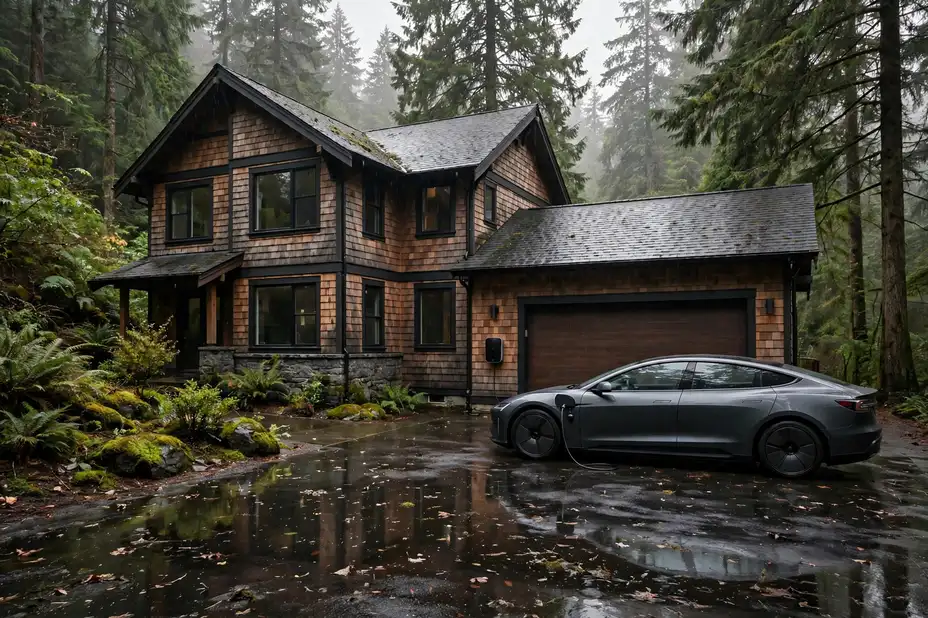
EV charging services in Tucson
An installer's work in Tucson usually starts with one of the three lead services below. The cards describe the job as it is actually scoped; the grid underneath carries the rest of the menu.
Home EV Charger Installation in Tucson
For most households this is the whole project: a Level 2 station mounted where the car sleeps, fed by its own 240-volt circuit. The visit pattern is consistent — load calculation, route the run, mount and configure, inspect — and the variables are your panel, your parking and your permit office.
In Tucson: the core residential job in Tucson: circuit, mounting, configuration and inspection in one visit pattern.
Dedicated Circuit & Electrical Panel Upgrade in Tucson
Capacity work wears three costumes — more amps, a fresh panel, or management electronics that make the existing amps behave like more. The load calculation is the fitting room: it shows which costume your house actually needs, and a trustworthy quote names the calculation before the costume.
In Tucson: the capacity answer when Tucson's older panels meet a continuous load.
Level 2 Charger Installation in Tucson
What is being bought is recovery rate. A Level 2 circuit returns in one overnight session what a household receptacle returns in a day and a half, and that margin is the difference between planning around the car and forgetting about it.
In Tucson: the 240-volt step that turns overnight charging in Tucson from a trickle into a full battery by morning.
Utility programs and electricity in Tucson
Electricity in Tucson comes from Arizona Public Service Co. Parts of the wider metro are served by Tucson Electric Power Co, Trico Electric Cooperative Inc, Sulphur Springs Valley E C Inc. The utility matters twice over for a charger install: it sets the time-of-use rates that decide what overnight charging costs you, and it is the organisation that may — or may not — currently help pay for the equipment.
Rebate archaeology is a local sport: an old Arizona Public Service Co program page, a neighbour's 2023 install story, a screenshot of terms nobody can date. The record for Tucson, as checked for this page, is simpler. The federal credit closed on September 30, 2025; Arizona operates no home-charger program; and no active Arizona Public Service Co residential charger rebate appears in current published sources. Funded rounds do reopen in this industry — on the utility's timetable, announced on the utility's site, and worth exactly what their published terms say on the day you read them.
While you are in the tariff pages, look at how the plan values the evening ramp — the hours when cooking, cooling and charging would otherwise stack. A charger that starts after the ramp is the simplest scheduling decision in home charging, and it is set once.
Condos, HOAs and the law in Arizona
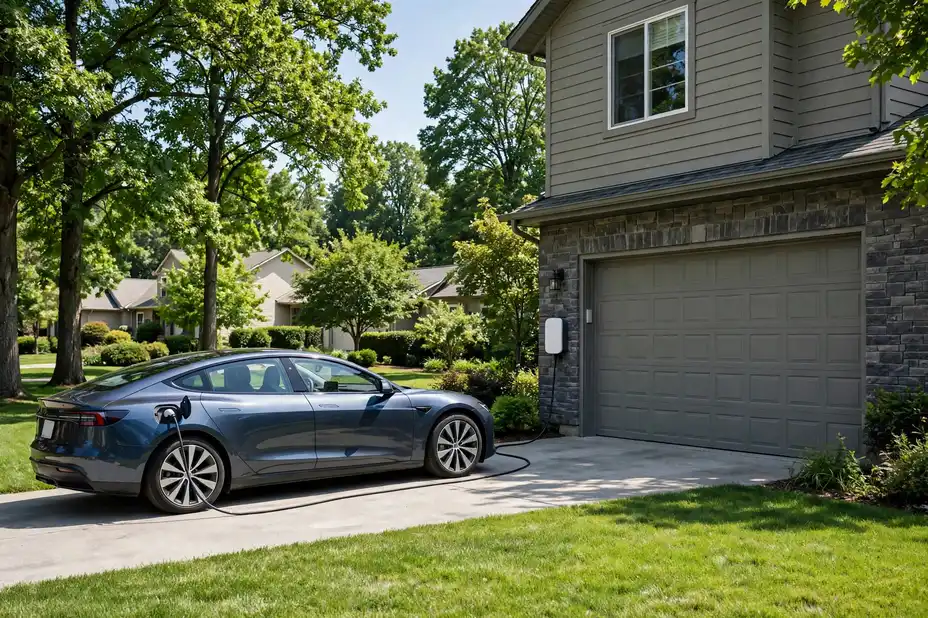
No statute promises a charger approval in Arizona. Unlike the states that have enacted right-to-charge laws, Arizona leaves the question entirely to each community's covenants and board discretion. For Tucson owners that is not the end of the road — it is a sign that the negotiation, the metering design and the written application carry the weight a statute would otherwise carry.
No law does not mean no path. Boards approve chargers every week when the proposal answers their real concerns in advance: a licensed installer, a dedicated circuit that touches nothing shared, metering that keeps the electricity cost on the owner, insurance, and a commitment to restore the space on removal. Bring that package, in writing, before the meeting — not during it.
The negotiation playbook — application contents, metering options, the wording that answers boards' standard objections — is set out in our condo and HOA guide, read here as a persuasion manual rather than a rights manual.
Climate, garages and charger placement
The desert house's electrical centre of gravity shifts at night — cooling loads fall, the car takes the stage, and the panel that groaned at 6 pm idles by midnight. The schedule is the whole strategy, and it is set once.
The overnight window is the desert's gift to EV owners: temperatures fall, rates fall, and the car charges in the mildest hours available. Scheduling the session for the small hours is set once and forgotten, and it is kinder to the battery, the station and the household's peak demand all at once.

Permits and inspection in Tucson
What the inspector is checking, in plain terms: conductor size against breaker size, the continuous-load calculation, terminations torqued, protection where the code wants it, and a station whose settings match the circuit it landed on. It is a short visit that validates everything you cannot see.

Neighbourhoods and ZIP codes served
The page covers 54 ZIP codes in and around Tucson — including 85701, 85702, 85703, 85704, 85705, 85706, 85707, 85708, 85709, 85710, 85711, 85712, 85713, 85714, 85715, 85716, 85717, 85718, 85719, 85720, 85721, 85722, 85723, 85724, 85725, 85726, 85728, 85730, 85731, 85732, 85733, 85734, 85735, 85736, 85737, 85739, 85740, 85741, 85742, 85743, 85744, 85745, 85746, 85747, 85748, 85749, 85750, 85751, 85752, 85754, 85755, 85756, 85757, 85775 — across Pima. If your ZIP is not in the first set shown, ask anyway: installer coverage follows the metro, not a postcode fence.
The same working area takes in the neighbouring localities of Mount Lemmon, Cortaro, Rillito, Sahuarita, Catalina, Vail, Marana, Green Valley, Arivaca, Topawa, Sells, Sasabe, Ajo, Lukeville — the county ring an installer based in Tucson actually drives. Requests from those communities route exactly as city requests do: same services, same permit discipline, same local facts where they differ.
Pima County accounts for 69 of the ZIP codes and 15 named postal localities in the research file, the nearest of them Mount Lemmon, Cortaro, Rillito, Sahuarita, Catalina. The survey counts 1,060,490 residents in the county, with a median household income of $70,315 and a median home value of $319,700. Measured across its ZIP codes, the Tucson footprint runs about 39 miles north to south and 38 east to west, from ZIP 85701 to 85775 — the ground an installer based here actually covers in a working week.
Beyond the county seats, the working area takes in Mount Lemmon, Cortaro, Rillito, Marana, Sahuarita, Catalina, Vail, Green Valley, Oracle, Red Rock, San Manuel, Amado, Mammoth, Picacho, Tubac — the named localities for which Tucson is the nearest metro in the network (neighbouring metros' pages cover their own ground), each routing to the same installer-matching service.
The largest communities in that working area after Tucson itself, by the GeoNames populated-place file: Casas Adobes (population 66,795), Catalina Foothills (population 50,796), Oro Valley (population 45,303), Marana (population 41,315), Drexel Heights (population 27,749), Sahuarita (population 25,707), Green Valley (population 21,391), Eloy (population 17,059), Tanque Verde (population 16,901), Flowing Wells (population 16,419), Saddlebrooke (population 12,574), Tucson Estates (population 12,192), Vail (population 10,208), Safford (population 9,683), Picture Rocks (population 9,563), Valencia West (population 9,355), Catalina (population 7,569), Avra Valley (population 6,050), South Tucson (population 5,715), Corona de Tucson (population 5,675). Charging demand follows those populations — the subdivisions and town centres where the next driveways, and the next panels, are.
| ZIP | Locality | County |
|---|---|---|
| 85701 | Tucson | Pima |
| 85713 | Tucson | Pima |
| 85726 | Tucson | Pima |
| 85721 | Tucson | Pima |
| 85724 | Tucson | Pima |
| 85702 | Tucson | Pima |
| 85703 | Tucson | Pima |
| 85717 | Tucson | Pima |
| 85720 | Tucson | Pima |
| 85722 | Tucson | Pima |
| 85723 | Tucson | Pima |
| 85725 | Tucson | Pima |
| 85728 | Tucson | Pima |
| 85731 | Tucson | Pima |
| 85732 | Tucson | Pima |
| 85733 | Tucson | Pima |
| 85740 | Tucson | Pima |
| 85744 | Tucson | Pima |
| 85751 | Tucson | Pima |
| 85752 | Tucson | Pima |
| 85754 | Tucson | Pima |
| 85775 | Tucson | Pima |
| 85719 | Tucson | Pima |
| 85714 | Tucson | Pima |
| 85745 | Tucson | Pima |
| 85716 | Tucson | Pima |
| 85705 | Tucson | Pima |
| 85709 | Tucson | Pima |
| 85711 | Tucson | Pima |
| 85712 | Tucson | Pima |
| 85706 | Tucson | Pima |
| 85708 | Tucson | Pima |
| 85707 | Tucson | Pima |
| 85746 | Tucson | Pima |
| 85718 | Tucson | Pima |
| 85710 | Tucson | Pima |
| 85704 | Tucson | Pima |
| 85730 | Tucson | Pima |
| 85715 | Tucson | Pima |
| 85757 | Tucson | Pima |
| 85750 | Tucson | Pima |
| 85756 | Tucson | Pima |
| 85741 | Tucson | Pima |
| 85734 | Tucson | Pima |
| 85748 | Tucson | Pima |
| 85749 | Tucson | Pima |
| 85737 | Tucson | Pima |
| 85743 | Tucson | Pima |
| 85742 | Tucson | Pima |
| 85755 | Tucson | Pima |
| 85747 | Tucson | Pima |
| 85619 | Mount Lemmon | Pima |
| 85652 | Cortaro | Pima |
| 85654 | Rillito | Pima |
| 85658 | Marana | Pinal |
| 85739 | Tucson | Pima |
| 85629 | Sahuarita | Pima |
| 85738 | Catalina | Pima |
| 85641 | Vail | Pima |
| 85653 | Marana | Pima |
| 85735 | Tucson | Pima |
| 85614 | Green Valley | Pima |
| 85622 | Green Valley | Pima |
| 85623 | Oracle | Pinal |
| 85736 | Tucson | Pima |
| 85145 | Red Rock | Pinal |
| 85631 | San Manuel | Pinal |
| 85645 | Amado | Santa Cruz |
| 85618 | Mammoth | Pinal |
| 85141 | Picacho | Pinal |
| 85646 | Tubac | Santa Cruz |

Planning the install: from panel to parking
Experienced Tucson installers talk about 'the tell': the small observation that predicts the job. A panel directory in pencil with three generations of handwriting. A garage converted, then converted back. A charger-shaped hole in the household's plans — the second car already ordered. Mention your own tells at the visit; they are scope information, and scope named early is scope settled fairly.
Future-proofing, in this trade, is mostly conduit and capacity: an oversized conduit run costs little during the first install and everything later; a panel position reserved is a breaker that never has to move. If a second EV, a workshop or an electrified water heater is anywhere in your five-year picture, say so at the site visit.
Home charging know-how for Tucson households
Homework that sharpens the site visit
You can cut a site visit's uncertainty in half with a phone camera. Photograph the panel — door open, directory card legible, the rating label in frame — plus the wall where the station would go and the car's parking position with the port side visible. Send them with the request. The installer arrives already knowing the panel's make and spare spaces, the run's likely route, and which questions remain live ones. Quotes get firmer, visits get shorter, and nobody discovers the decisive fact at the door.
Chargers and the flood line
Some garages flood — not catastrophically, just historically: the spring inch, the storm drain's bad day. The charger belongs above the line the water has actually reached, a fact the house knows and the install conversation should ask about. Mounting height, conduit entry points and the station's own listing all have flood-aware versions, and in the streets that need them, local installers raise the subject before the homeowner does.
When the garage is detached
A detached garage changes the install's centre of gravity: the circuit must travel. The route is usually a buried conduit run from the house panel, with depth, conduit type and the trench's path past roots, irrigation and paving all settled at the design stage — or, where the run is long and the loads justify it, a subpanel in the garage that also serves the workshop the building inevitably becomes. The charger at the end of that run behaves exactly like any other; it is the journey, measured in copper and digging, that defines the job.
Timing the install with other work
The least disruptive charger circuit is the one installed while other electrical work is already open. A renovation, a panel project, a garage build — each already carries the mobilisation, the permit process and the opened walls that a standalone charger job must pay for alone. The sequencing conversation costs nothing: tell the installer what else the house has planned in the next two years, and let the scope absorb the charger while the house is already a building site. The same logic in reverse — roughing in during this project for a charger planned later — is the EV-ready idea, and it belongs in the same sentence.
Getting onto the board's agenda
Association decisions happen inside a procedure, and the procedure has a door: the agenda. Applications that miss the submission deadline wait a full cycle regardless of merit, so the first question for any board is clerical — when do items close for the next meeting, and in what format. Arrive inside the procedure with a complete package and the discussion is about your design; arrive outside it and the discussion is about process, and process always wins the evening. Property managers, asked politely, will tell you the format they prefer applications in.

Frequently asked questions
What happened to the federal home-charger credit in Tucson, AZ?
Treat the answer as a standing no with a watching brief. The 30C credit is finished, Arizona has not replaced it for homeowners, and no verified Arizona Public Service Co rebate was running in the sources checked for this page. Should that change, the utility's program page will say so first — and this page will be updated to match.
Can my association in Tucson, AZ say no to a home charger?
In Tucson, they can — there is no Arizona statute stopping them. Right-to-charge protection simply has not been enacted here, so the board's own rules decide. Owners do still get approved regularly: the applications that succeed answer the board's concerns (metering, insurance, restoration, a licensed installer) before the meeting, in writing.
Panel upgrade or not — how do Tucson, AZ homeowners find out?
Nobody can answer that from a photograph of your panel's door, and you should be suspicious of anyone who tries. In a city where the median home dates to 1979 and about 52% of units predate 1980, the honest answer is a load calculation: what your service is, what it already carries, and what a continuous charger load does to the total. Then the options — circuit, load management, or upgrade — compare on paper.
Level 1 or Level 2 in Tucson, AZ — what is the real difference?
Level 2 is several-fold faster in the only unit that matters — miles back per hour parked: roughly 25–40 against Level 1's 3–5. The exact figure follows the circuit: a 40-amp circuit and a 60-amp circuit are both Level 2, and the car's onboard limit may sit below either. Your installer matches the three numbers at the site visit.
What happens next after I send a request?
Your request is matched to licensed installers covering Tucson, Arizona — service, ZIP, property type and timing travel with it. The installer who takes it arranges the site visit and quotes in writing; PlugReady USA's part is the research on this page and the introduction, and your contract is with the installer throughout.
I live in a Tucson apartment or condo building — can I charge at home?
Yes, with the building as a partner rather than an obstacle. In Tucson, about 27% of homes sit in buildings of five or more units, so the pattern is established: a written proposal, a licensed installer, a metering design that charges the energy to you, and the association or landlord approving a package rather than a request. The law section above gives Arizona's position; the multifamily service designs the rest.
Nearby cities in Arizona
- EV charger installation in Sierra Vista — about 61 miles from Tucson, metro population 130,000
- EV charger installation in Phoenix — about 105 miles from Tucson, metro population 4,950,000
- EV charger installation in Prescott Valley — about 185 miles from Tucson, metro population 245,000
- EV charger installation in Yuma — about 206 miles from Tucson, metro population 205,000
- EV charger installation in Flagstaff — about 209 miles from Tucson, metro population 145,000
- EV charger installation in Lake Havasu City — about 243 miles from Tucson, metro population 215,000
- EV charger installation in Las Cruces, NM — about 233 miles from Tucson, metro population 220,000
- EV charger installation in El Paso, TX — about 250 miles from Tucson, metro population 875,000
- EV charger installation in El Centro, CA — about 257 miles from Tucson, metro population 180,000
Ready to charge at home in Tucson?
Tell us the job — service, ZIP and property type — and licensed local installers will take it from there.