EV Charger Installation in Las Cruces, NM
Charging where you park, in Las Cruces: the utility programs, state law, permit process and housing facts behind a home charger install, gathered in one place.
Charging at home is the version of EV ownership that actually works day to day, and in Las Cruces it starts with a straightforward question: where will the car sleep, and what can the electrical panel behind that wall honestly support? Las Cruces itself is home to about 116,992 people, and 16,600 battery-electric vehicles plus 7,100 plug-in hybrids were registered across New Mexico by the end of 2025 — every one of them a household that charges somewhere. This page gathers what a homeowner in Las Cruces needs to know before booking an installer: the local utility and its current charger programs, the state law that applies in condos and HOA communities, the permit process, and the housing realities that decide how simple or involved an installation will be.
How this page is organised matters less than what is in it: verified local facts, stated with their sources, so you can check them yourself. PlugReady USA matches homeowners in Las Cruces with licensed local installers; the detail below is the homework we would want done before anyone quotes the job.
The demand picture for the Las Cruces metro, from the registration data this site is built on: El Paso Electric rebate territory. Registration counts are the honest way to size a charging market — they count households, not headlines — and they are why Las Cruces sits where it does in our build order (rank 296 of 300 metros, Tier C).
The same survey puts median household income in Las Cruces at $58,871, with 58% of occupied homes owner-occupied and 62% of the housing stock single-unit detached. For charging, those are the operative facts: owners can approve their own electrical work, and detached homes put the car, the panel and the parking under one roof.

Every city charges differently, and Las Cruces's difference is legible in the data: a housing stock of mixed vintages, where both electrical eras appear on the same street; a detached-house majority with a real attached and multifamily minority; buildings of five or more units are a visible minority of the stock; owners hold a working majority, with renters a significant minority. Read the sections below through that profile and the local advice resolves into specifics — which questions are routine here, and which are rare.
In absolute terms, the survey counts 50,867 housing units in Las Cruces — 47,363 occupied, 27,700 of them by their owners. The stock resolves into 31,572 single-unit detached houses, 15,589 homes standing since before 1980, and 7,444 units in larger buildings. Those six counts are the city's charging map drawn without percentages, and every section of this page is a consequence of one of them. The page's geography is equally concrete: 9 ZIP codes across Doña Ana, centred near 32.29 degrees north latitude. The city anchors the Las Cruces metropolitan area, home to roughly 220,000 people on the research file's metro estimate — the wider labour and housing market this page's installers work across.
The same survey release fills in the household economics around the housing stock: a median home value of $231,700, median gross rent of $974, per-capita income of $31,140, and a median resident age of 33. The movement data matters as much as the money data: 73% of Las Cruces workers drive to work alone — the commute pattern home charging is built around; 11% work from home, a population whose cars charge on daytime and overnight schedules alike; 1% commute by public transit; 37% of adults hold a bachelor's degree or higher. The survey's vehicle table is the one an EV page should quote first: 3,684 of Las Cruces's households have no vehicle at all, while 27,053 have two or more — the multi-car households for whom the second circuit is a when, not an if.
Two burden statistics frame the economics: in Las Cruces, 47% of renters and 0% of mortgage-holding owners are housing-cost burdened at the standard 30% threshold. And 55% of households are family households, the segment most likely to run the two-vehicle, two-schedule pattern the second-vehicle planning notes address.
Taken as one portrait, the numbers describe a specific charging market. Mixed-age stock means mixed answers: the same street can hold a 100-amp fuse-era service and a 200-amp panel with spare ways, so city-level generalisations dissolve at the level of the individual driveway. Where form is mixed, advice must be conditional — the honest page, like the honest installer, keeps asking which housing the reader actually lives in before prescribing.
A balanced tenure map makes the landlord conversation a standard local genre — proposal letters, metering arrangements, restoration clauses — familiar to installers and property managers alike. At this income band the phantom-rebate problem bites hardest, which is why this page states the verified incentive position in plain terms and dates it. The regulatory calendar is the programme calendar: rate cases, electrification plans and pilot approvals move through the commission on public timetables, and installers plan their marketing around them.
Youth in the fleet also means the used-EV wave has not arrived; adoption here is new-car led, and charging installs follow the dealer map more than the classifieds. A smaller metro runs on relationships: the electrical firms are few, known, and booked through reputations maintained across decades of local work. The association dimension here runs on persuasion rather than statute — no state charging law frames the application, so the complete, professional proposal carries the whole argument, as the law section above explains.
The electrical reality in Las Cruces homes
Tenure first, because tenure allocates the decisions: 58% of Las Cruces's occupied homes are owner-occupied, free to commission electrical work outright. The stock they occupy has a median build year of 1993; 31% predates 1980; 62% is detached single-unit. For the owner-occupied majority, the charger question is purely electrical, and these are the electrical facts. The metro's building booms left two electrical eras side by side. Post-1990s subdivisions were wired for modern loads and usually take a charger circuit directly; the established in-town stock asks harder questions of its panels. Knowing which era your street belongs to tells you most of what your site visit will conclude. Owner-occupiers can plan on their own timeline; renters and condo owners have an extra approval layer, which the law section below covers for this state.
Heating fuel is the survey's quiet clue to panel life: in Las Cruces, 33% of homes heat electrically (15,580 households), against 66% heating with gas. A house already heating electrically has a service sized with that load in its history; a gas-heated house may have capacity to spare — either way the fuel mix is part of what the installer is reading.
One further split matters for how this page is organised: about 19,663 of Las Cruces's occupied homes are renter-occupied. Everything above assumes you can approve your own electrical work; where you cannot, the approval layer — landlord or association — becomes part of the job, which is why the law section carries unusual weight here.
The city's stock is not all houses: 15% of units are in structures of five or more. Shared buildings mean shared panels, assigned parking and association process — the substance of the multifamily sections below.
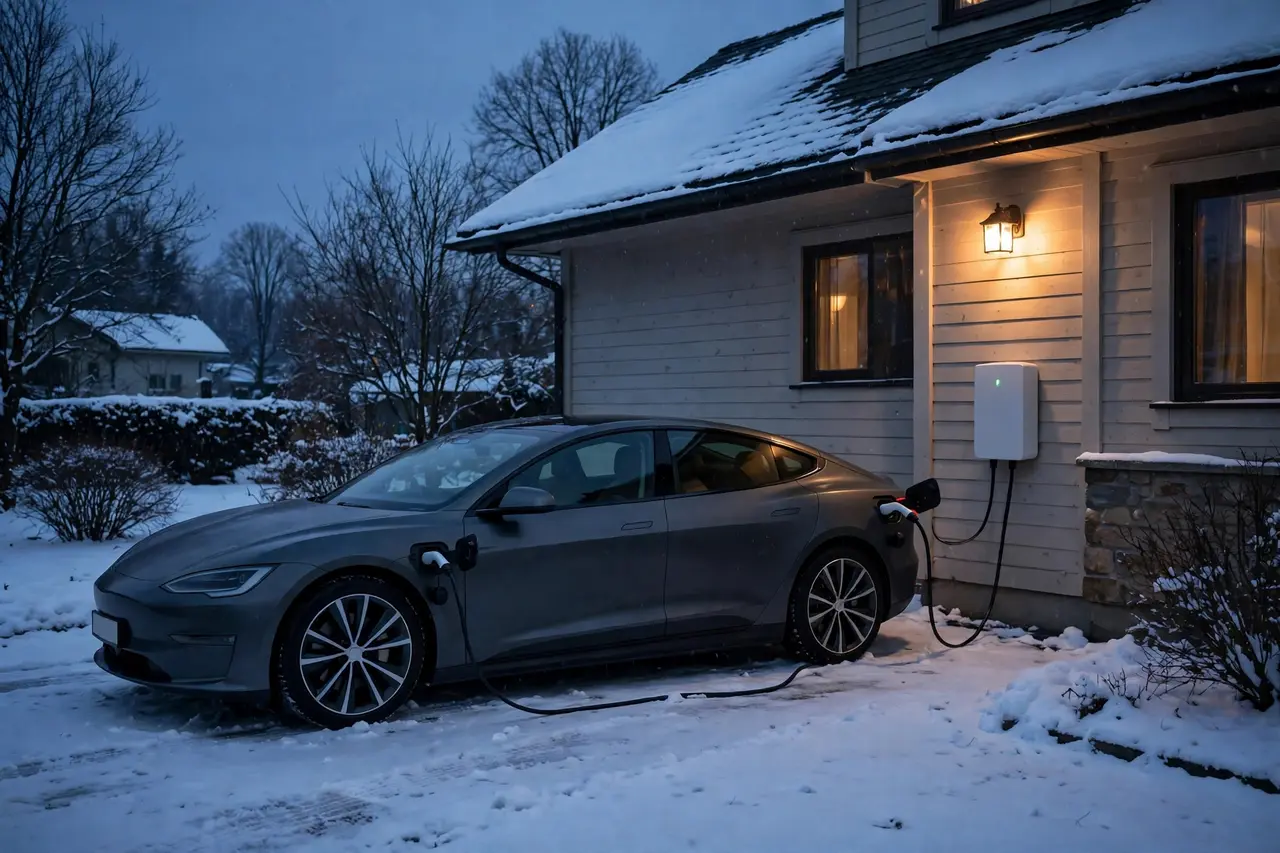
EV charging services in Las Cruces
Ten services cover the work installers do in Las Cruces. Three lead the list here because of what this city's housing and law actually look like — each links to its national service page, where scope and process are set out in full.
Home EV Charger Installation in Las Cruces
The residential standard: a station where the car sleeps, on a circuit of its own, installed under permit. Variations are all local — the panel's spare room, the run's route through the house's fabric, and the parking pattern the cable has to serve.
In Las Cruces: the default first install for Las Cruces's EV households — a station where the car already parks.
Level 2 Charger Installation in Las Cruces
Level 2 is where home charging becomes effortless: a dedicated 240-volt circuit returning a full battery overnight instead of a partial one by morning. The installer's work is the circuit itself — breaker, conductor, connection type — and the station's settings matched to it.
In Las Cruces: the 240-volt step that turns overnight charging in Las Cruces from a trickle into a full battery by morning.
Load Management & Smart Charging Setup in Las Cruces
The management system is an accountant for amperes: it watches the house's draw in real time and writes the charger a budget from whatever is spare. On paper the panel is full; in practice it is idle most of the night, and the accountant knows it.
In Las Cruces: the alternative to a bigger service in Las Cruces homes that only occasionally approach their panel's limit.
Utility programs and electricity in Las Cruces
Electricity in Las Cruces comes from Public Service Co of NM. Parts of the wider metro are served by El Paso Electric Co, Columbus Electric Coop, Inc. The utility matters twice over for a charger install: it sets the time-of-use rates that decide what overnight charging costs you, and it is the organisation that may — or may not — currently help pay for the equipment.
Do not budget for a rebate in Las Cruces right now. As of the sources checked for this page, Public Service Co of NM publishes no residential charger rebate, New Mexico offers no state program for typical home installs, and the federal 30C credit ended on September 30, 2025. If that changes, the utility's program page will say so with an as-of date — and this page will be updated to match. Until then, judge quotes on the work itself.
Before the install, it is worth a two-minute look at your tariff. Many Public Service Co of NM customers can move to a time-of-use plan where overnight energy is charged at a lower rate, and a scheduled charger makes that saving automatic.
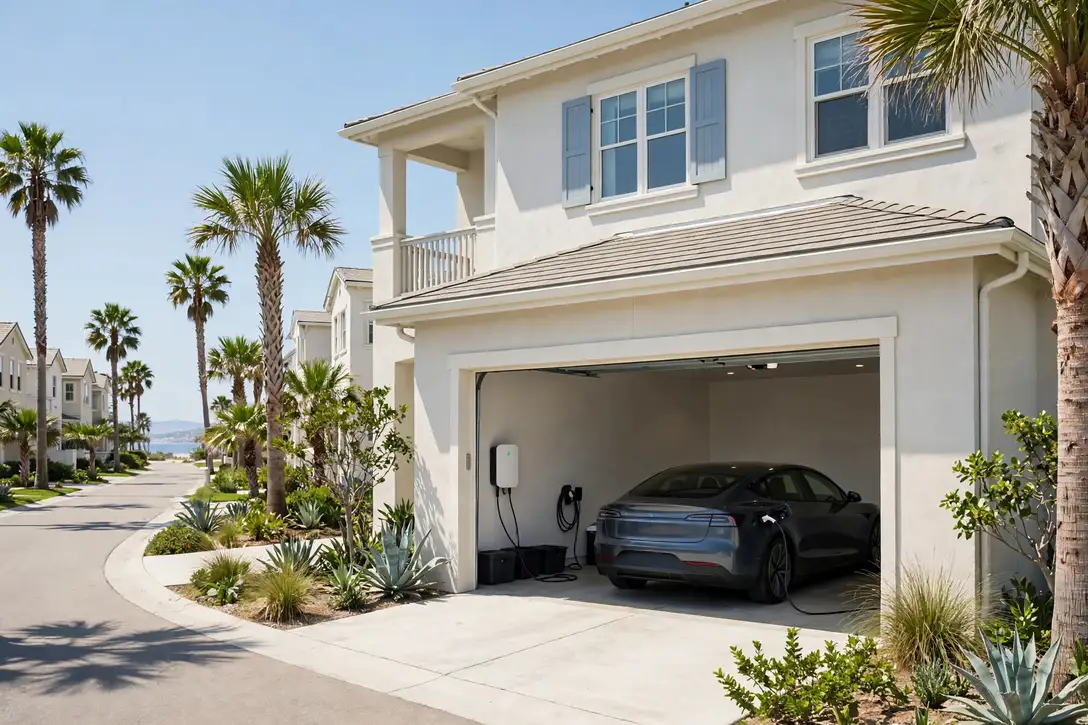
Condos, HOAs and the law in New Mexico
New Mexico has no statewide right-to-charge law. That needs saying plainly, because roundups on the internet sometimes claim otherwise: in the authoritative statute indexes checked for this page, no New Mexico law prevents a homeowners association or condominium from refusing a charger in a common or assigned space. Your community's own covenants and board govern the question in Las Cruces.
Owners of single-family homes in HOA communities should also check the covenants before assuming the driveway is uncomplicated: exterior-equipment and architectural-approval clauses can apply to a visible wall-mounted station even where the garage interior is entirely the owner's business.
The negotiation playbook — application contents, metering options, the wording that answers boards' standard objections — is set out in our condo and HOA guide, read here as a persuasion manual rather than a rights manual.
Climate, garages and charger placement
Monsoon season writes one arid rule in water: drainage. The charging position is chosen where the rare but real storm flow does not cross, the pedestal foundation sheds rather than ponds, and conduit entries seal against the driven rain that arrives horizontally a few times a year.
The desert garage can be the hottest room in the Southwest by late afternoon, which is why arid-metro charging is a night industry. The station's thermal management and the car's agree on the schedule independently — after midnight, when the slab has given back the day's heat and the tariff is at its kindest.

Permits and inspection in Las Cruces
Timelines are set by the city's counter, not the installer: the electrical work itself is typically a day, while permit issuance and the inspection visit follow the department's queue. A quote that promises a date should tell you which parts of that date the installer actually controls.

Neighbourhoods and ZIP codes served
The page covers 9 ZIP codes in and around Las Cruces — including 88001, 88003, 88004, 88005, 88006, 88007, 88011, 88012, 88013 — across Doña Ana. If your ZIP is not in the first set shown, ask anyway: installer coverage follows the metro, not a postcode fence.
The same working area takes in the neighbouring localities of Mesilla, Mesilla Park, Fairacres, Dona Ana, San Miguel, La Mesa, Mesquite, Organ, Vado, White Sands Missile Range, Radium Springs, Berino, Chamberino, Anthony — the county ring an installer based in Las Cruces actually drives. Requests from those communities route exactly as city requests do: same services, same permit discipline, same local facts where they differ.
Doña Ana County accounts for 29 of the ZIP codes and 21 named postal localities in the research file, the nearest of them Mesilla, Mesilla Park, Fairacres, Dona Ana, San Miguel. The survey counts 224,266 residents in the county, with a median household income of $56,848 and a median home value of $220,800. Measured across its ZIP codes, the Las Cruces footprint runs about 21 miles north to south and 9 east to west, from ZIP 88001 to 88013 — the ground an installer based here actually covers in a working week.
Beyond the county seats, the working area takes in Mesilla, Mesilla Park, Fairacres, Dona Ana, San Miguel, La Mesa, Mesquite, Organ, Vado, White Sands Missile Range, Radium Springs, Berino, Chamberino, Chaparral, Rincon, Hatch, Orogrande, Salem, Garfield, Derry, Arrey, Spaceport City, Holloman Air Force Base, Deming, Columbus, Caballo — the named localities for which Las Cruces is the nearest metro in the network (neighbouring metros' pages cover their own ground), each routing to the same installer-matching service.
The wider working area also reaches Anthony, Canutillo, El Paso, Santa Teresa, Sunland Park, Fort Bliss, San Elizario, Clint — ground shared with neighbouring metros, where installers cross the same county lines in both directions.
ZIP codes in that shared ground include 79835, 79904, 79905, 79911, 79912, 79918, 79920, 79927, 79930, 79935, 79940, 79942, 79945, 79951, 79953, 79955, 79968, 79999, 88021, 88063, 88520, 88524, 88534, 88542, 88550, 88553, 88559, 88560, 88562, 88565, 88569, 88573, 88574, 88579, 88580, 88583, 88588, 88589, 88590, 88595.
The largest communities in that working area after Las Cruces itself, by the GeoNames populated-place file: Alamogordo (population 30,753), Deming (population 14,522), Silver City (population 10,004), Ruidoso (population 7,739), Truth or Consequences (population 6,079), University Park (population 4,192), Vado (population 3,194), Holloman Air Force Base (population 3,054), Tularosa (population 2,864), Ruidoso Downs (population 2,586), Bayard (population 2,264), San Ysidro (population 2,090), Mesilla (population 1,874), Radium Springs (population 1,699), La Luz (population 1,697), White Sands (population 1,651), Boles Acres (population 1,638), Santa Clara (population 1,638), Columbus (population 1,625), Hatch (population 1,600). Charging demand follows those populations — the subdivisions and town centres where the next driveways, and the next panels, are.
Otero County reaches into the working area with 68,816 residents, a median household income of $55,876 and a median home value of $162,700; its localities on this page include Chaparral, Orogrande, Holloman Air Force Base.
| ZIP | Locality | County |
|---|---|---|
| 88001 | Las Cruces | Doña Ana |
| 88003 | Las Cruces | Doña Ana |
| 88006 | Las Cruces | Doña Ana |
| 88005 | Las Cruces | Doña Ana |
| 88046 | Mesilla | Doña Ana |
| 88007 | Las Cruces | Doña Ana |
| 88011 | Las Cruces | Doña Ana |
| 88047 | Mesilla Park | Doña Ana |
| 88033 | Fairacres | Doña Ana |
| 88032 | Dona Ana | Doña Ana |
| 88058 | San Miguel | Doña Ana |
| 88004 | Las Cruces | Doña Ana |
| 88044 | La Mesa | Doña Ana |
| 88048 | Mesquite | Doña Ana |
| 88052 | Organ | Doña Ana |
| 88072 | Vado | Doña Ana |
| 88002 | White Sands Missile Range | Doña Ana |
| 88054 | Radium Springs | Doña Ana |
| 88024 | Berino | Doña Ana |
| 88027 | Chamberino | Doña Ana |
| 88012 | Las Cruces | Doña Ana |
| 88013 | Las Cruces | Doña Ana |
| 88081 | Chaparral | Otero |
| 87940 | Rincon | Doña Ana |
| 87937 | Hatch | Doña Ana |
| 88342 | Orogrande | Otero |
| 87941 | Salem | Doña Ana |
| 87936 | Garfield | Doña Ana |
| 87933 | Derry | Sierra |
| 87930 | Arrey | Sierra |
| 87654 | Spaceport City | Sierra |
| 88330 | Holloman Air Force Base | Otero |
| 88031 | Deming | Luna |
| 88030 | Deming | Luna |
| 88029 | Columbus | Luna |
| 87931 | Caballo | Sierra |

Planning the install: from panel to parking
Homeowners sometimes ask why a job that looks like 'one outlet' needs a site visit at all. The visit exists because the three variables that set the scope — spare capacity, the run's route, and the property's approval layer — are all invisible from a photograph. In Las Cruces an experienced installer reads them in minutes, in the panel's directory card, the garage's geometry and the community's documents. The quote that follows a visit is a different species from the quote that precedes one: it can be held to.
Plan for the household you will be, not just the car you have. A second EV is the most common reason a charger circuit gets revisited, and the cheap moment to prepare for it — conduit sized up, panel capacity reserved, station placement that serves two bays — is during the first install, while the permit is open and the electrician is already in the panel.
Home charging know-how for Las Cruces households
Breakers: the household's safety switches
A breaker is a switch that watches current and opens when the current stops being safe — heat in a conductor is the thing it exists to prevent. Two household rules follow. First, a tripping breaker is reporting, not malfunctioning by default: reset once, and if it repeats, the circuit gets an electrician, not another reset. Second, the forbidden fix: never answer a trip by fitting a larger breaker. The breaker protects the wire in the wall; upsizing the guard without upsizing the wire removes the protection and keeps the problem.
How rebate paperwork usually works
Where a utility program does exist, its money moves on paperwork rails: pre-approval before purchase in some programmes, photographs and the inspection record after installation, deadlines measured in weeks. The practical lesson travels even to cities without a current program — keep everything. The permit, the passed inspection, the equipment invoice with model and serial, photographs of the finished work: filed together, they are the application for any programme that opens later, and the file costs nothing to keep.
The renter's route to a charger
Renters get chargers installed every week, on a simple insight: the proposal that works makes the landlord better off. A permitted circuit, installed by a licensed electrician at the tenant's expense, that remains with the property afterwards is not a favour to grant — it is an improvement to accept. The letter that carries it names the installer, the insurance, the metering arrangement for the electricity, and the restoration position at tenancy's end. Where this state's law gives tenants charging rights, the statute joins the letter; everywhere, the letter does the persuading.
Selling a house that charges
A documented charger has become a listing fact: the housing market's filters increasingly include charging, and the buyers behind them read a permitted, inspected installation as maintained infrastructure. The operative word is documented. The permit and inspection record, the panel schedule showing the circuit, and the station's manual together convert the charger from a question a buyer's inspector raises into a feature the listing can name. If a sale is anywhere on the horizon, the paperwork conversation with your installer is worth having at install time, while it is free.

Frequently asked questions
Is the federal charger tax credit still available in Las Cruces, NM?
You cannot — it no longer exists. The 30C credit closed to equipment placed in service after September 30, 2025, and no New Mexico program replaced it for home installs. Nor did the sources checked for this page show a live Public Service Co of NM residential rebate. Treat any 'credit' mentioned in a quote as a request for paperwork.
What can my HOA in Las Cruces, NM do about a charger install?
In Las Cruces the honest answer is yes, they can refuse: New Mexico gives owners no statutory charging right, so the board's discretion governs. What changes outcomes is the quality of the file in front of them — drawings, metering, insurance, a named licensed installer — and a growing number of boards here approve exactly that file.
Will my Las Cruces, NM home need a panel upgrade for a Level 2 charger?
Nobody can answer that from a photograph of your panel's door, and you should be suspicious of anyone who tries. In a city where the median home dates to 1993 and about 31% of units predate 1980, the honest answer is a load calculation: what your service is, what it already carries, and what a continuous charger load does to the total. Then the options — circuit, load management, or upgrade — compare on paper.
How much faster is Level 2 charging at home in Las Cruces, NM?
Think of it in parked hours. Level 1 gives you back 3–5 miles for each of them; Level 2 gives back about 25–40, set by the circuit's amperage and what the car can accept. Overnight, that is the gap between 'enough for tomorrow' and 'full, every morning'.
What happens next after I send a request?
Three steps: the request routes to installers who work Las Cruces, New Mexico; one contacts you to walk the property; the walk produces the written quote. Everything on this page — the utility position, the law, the housing data — is yours to check that quote against.
Can a charger be added to a detached garage in Las Cruces?
Yes — and detached garages are common in Las Cruces, where about 62% of homes are single-unit detached. The run out to the building is the substance of the job: a buried conduit from the house panel, or a subpanel in the garage where the distance and future loads justify it. The station itself then behaves like any garage install.
Nearby cities in New Mexico
- EV charger installation in Albuquerque — about 201 miles from Las Cruces, metro population 915,000
- EV charger installation in Santa Fe — about 239 miles from Las Cruces, metro population 155,000
- EV charger installation in Farmington — about 317 miles from Las Cruces, metro population 130,000
- EV charger installation in El Paso, TX — about 40 miles from Las Cruces, metro population 875,000
- EV charger installation in Sierra Vista, AZ — about 201 miles from Las Cruces, metro population 130,000
- EV charger installation in Tucson, AZ — about 233 miles from Las Cruces, metro population 1,050,000
Ready to charge at home in Las Cruces?
Tell us the job — service, ZIP and property type — and licensed local installers will take it from there.