EV Charger Installation in Farmington, NM
Everything a Farmington homeowner needs before booking a charger install — the panel question, the utility's current programs, the HOA law and the permit — sourced, dated and local.
Start from the meter. Every home charger in Farmington is, underneath the hardware, an arrangement between a car, a panel and New Mexico's electricity supply — and the households that arrange it well do so in that order. Farmington itself is home to about 46,314 people, in a state whose registered fleet reached 16,600 battery-electric vehicles and 7,100 plug-in hybrids by the end of 2025. This page works outward from the meter: the utility that serves your street and whether it currently funds charger installs, the association law that governs shared buildings, the permit counter's expectations, and the housing numbers that predict your panel's mood. Read it before the quotes, and the quotes get shorter.
PlugReady USA is a matching service, not the installer: you tell us the job, and we route the request to licensed local electricians and EV-installer companies who work in Farmington. Use the local detail below to arrive at that conversation informed — the sections are ordered the way an installer will think about your project, from the panel outward.
Measured demand, not enthusiasm, put Farmington in Tier C of this network: Four Corners. For a homeowner the useful translation is simpler — installers here do this work weekly, know the local permit counter, and have seen your housing stock before.
The same survey puts median household income in Farmington at $68,784, with 66% of occupied homes owner-occupied and 63% of the housing stock single-unit detached. For charging, those are the operative facts: owners can approve their own electrical work, and detached homes put the car, the panel and the parking under one roof.
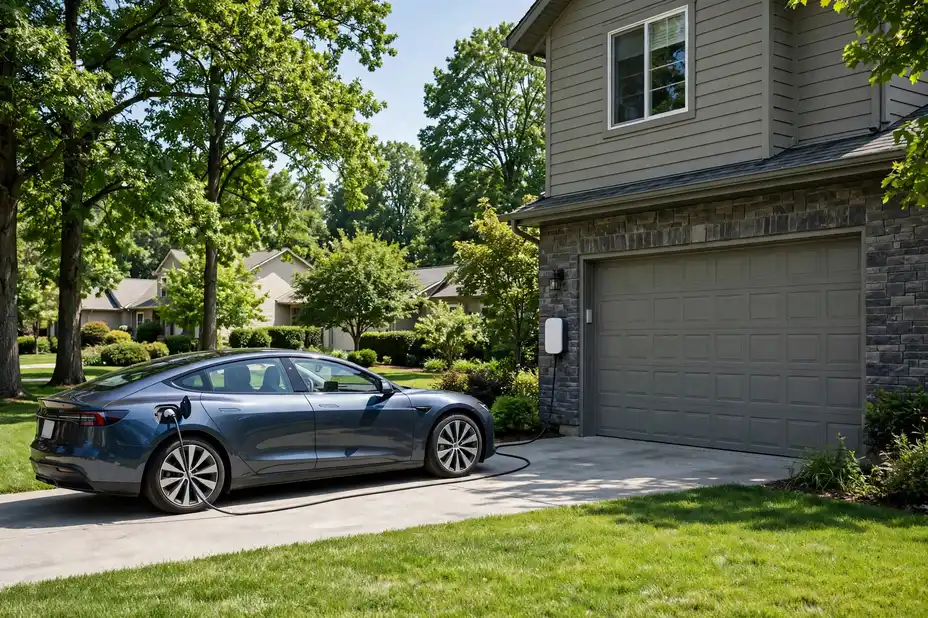
Put the survey together and Farmington's charging profile reads like this: an older housing fabric, where panel archaeology is a normal part of the first visit; a detached-house majority with a real attached and multifamily minority; larger buildings are a small share, so the multifamily route matters to a minority of readers; and owner-occupiers dominate, so most readers can approve their own electrical work outright. That combination — more than any single number — is what the installers working here plan around, and it is the lens for everything on this page.
In absolute terms, the survey counts 18,788 housing units in Farmington — 17,114 occupied, 11,327 of them by their owners. The stock resolves into 11,896 single-unit detached houses, 8,873 homes standing since before 1980, and 1,239 units in larger buildings. Those six counts are the city's charging map drawn without percentages, and every section of this page is a consequence of one of them. The page's geography is equally concrete: 3 ZIP codes across San Juan, centred near 36.74 degrees north latitude. The city anchors the Farmington metropolitan area, home to roughly 130,000 people on the research file's metro estimate — the wider labour and housing market this page's installers work across.
The same survey release fills in the household economics around the housing stock: a median home value of $233,000, median gross rent of $1,037, per-capita income of $33,855, and a median resident age of 39. The movement data matters as much as the money data: 84% of Farmington workers drive to work alone — the commute pattern home charging is built around; 6% work from home, a population whose cars charge on daytime and overnight schedules alike; 26% of adults hold a bachelor's degree or higher; 9% of housing units stood vacant at the survey. Vehicle ownership, from the same release: 10,410 households in Farmington run two or more vehicles, and 1,313 run none — the two ends of the market this page serves and does not serve.
Household structure, from the same release: 63% of Farmington households are family households. The burden shares behind the housing stock: 38% of renting households are cost-burdened at the 30%-of-income line, as are 0% of mortgaged owners — context for why the overnight rate window, once set, is treated here as a household fixture rather than a hobby.
Read together, the local facts draw a recognisable picture. Where so much of the stock predates modern code cycles, the site visit doubles as a survey — grounding electrode, service entrance, panel provenance — before it is ever a quote. Installers here run two trades in one van — domestic circuits in the morning, a building's shared-service design in the afternoon — and the city's pages, this one included, have to serve both readers.
Where owners dominate, installer advice lands differently: investments in capacity and conduit are pitched against decades of tenure rather than a lease's remainder, and households plan accordingly. The specification pattern at this income band is disciplined: capacity for today's car and a conduit sized for tomorrow's, the upgrade deferred until the load calculation insists. Filed tariffs and public dockets give this territory a paper trail most markets lack: the diligent household can read the utility's own electrification plan and know which programmes are funded, piloted or merely proposed.
Early-market conditions have their own economics: fewer specialist installers, general electricians carrying the work, and a premium on the household arriving informed — which is the gap this page exists to close. At this scale the page's role sharpens — in a market without a crowd of specialists to interview, the household's own preparation carries more of the project's quality. Without a state charging statute, shared-property approvals in this metro are won on paper quality: metering clarity, licensed installers, insurance, reversibility — the complete package the guides set out.
The electrical reality in Farmington homes
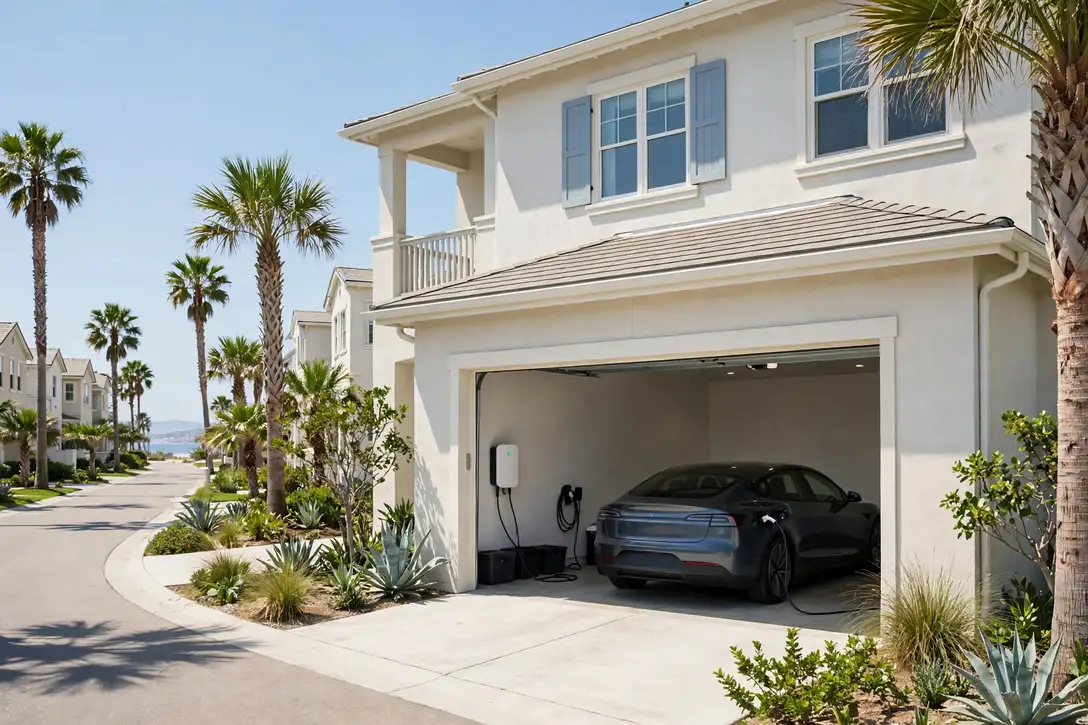
Tenure first, because tenure allocates the decisions: 66% of Farmington's occupied homes are owner-occupied, free to commission electrical work outright. The stock they occupy has a median build year of 1982; 47% predates 1980; 63% is detached single-unit. For the owner-occupied majority, the charger question is purely electrical, and these are the electrical facts. A housing stock this age leans on smaller electrical services — 100-amp panels are common, and fuse-era equipment still turns up in the oldest streets. For many of those homes the honest answer is a panel upgrade or a load-management device before the charger circuit goes in, and a good installer will show you the load calculation rather than asking you to take it on faith. Porches, carports and parking pads carry a real share of this city's charging, because the stock predates the two-car garage as a standard feature — outdoor-rated equipment is a local staple, not an edge case.
Heating fuel is the survey's quiet clue to panel life: in Farmington, 9% of homes heat electrically (1,617 households), against 88% heating with gas. A house already heating electrically has a service sized with that load in its history; a gas-heated house may have capacity to spare — either way the fuel mix is part of what the installer is reading.
One further split matters for how this page is organised: about 5,787 of Farmington's occupied homes are renter-occupied. Everything above assumes you can approve your own electrical work; where you cannot, the approval layer — landlord or association — becomes part of the job, which is why the law section carries unusual weight here.
The city's stock is not all houses: 7% of units are in structures of five or more. Shared buildings mean shared panels, assigned parking and association process — the substance of the multifamily sections below.
EV charging services in Farmington
Ten services cover the work installers do in Farmington. Three lead the list here because of what this city's housing and law actually look like — each links to its national service page, where scope and process are set out in full.
Home EV Charger Installation in Farmington
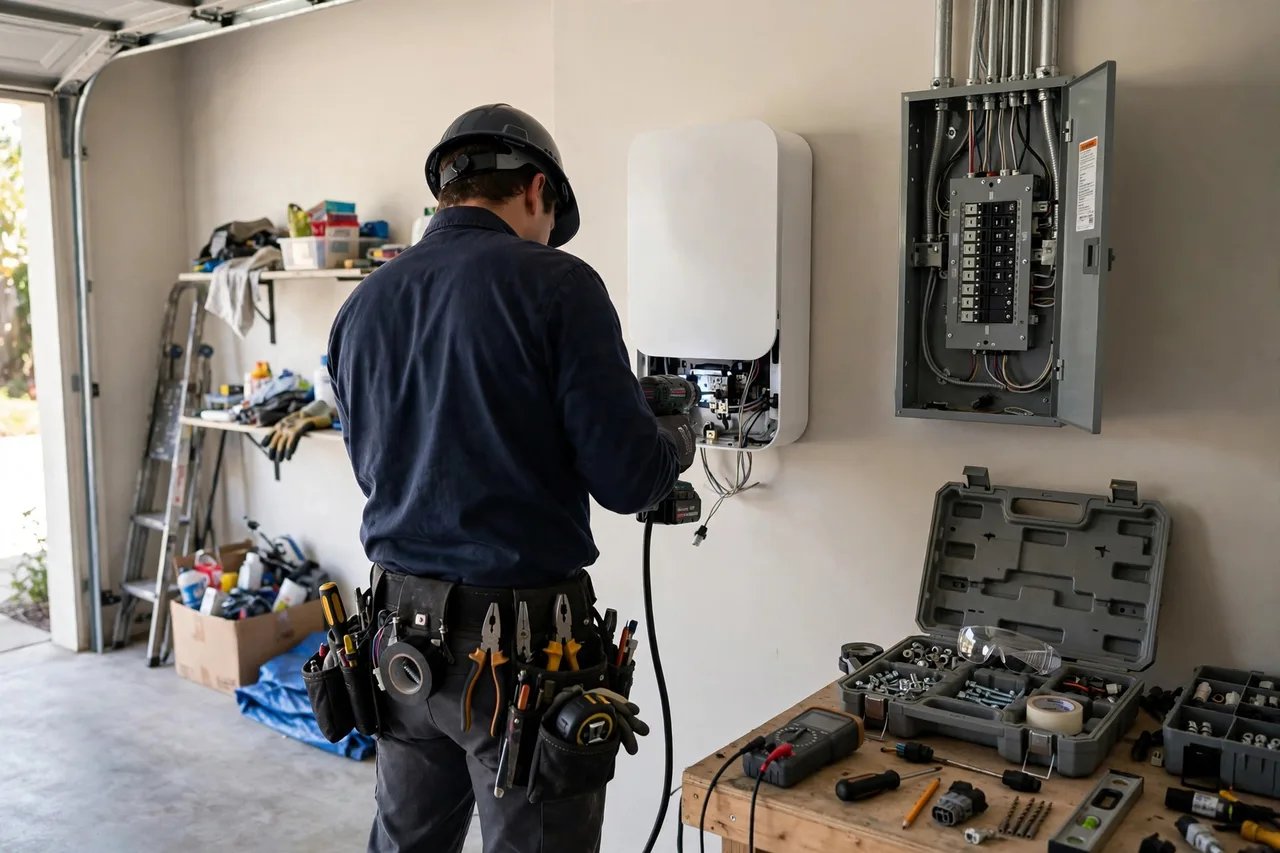
Think of it as plumbing for electrons, with the same virtues: correct sizing, honest materials, tidy runs, tested joints. The installers who do it weekly follow a pattern — assess, calculate, route, mount, configure, document — and the pattern is why their installs rarely make news afterwards.
In Farmington: the core residential job in Farmington: circuit, mounting, configuration and inspection in one visit pattern.
Dedicated Circuit & Electrical Panel Upgrade in Farmington
Where the load calculation fails the existing service, the upgrade is not an upsell — it is the finding. Done under permit with the utility's meter work coordinated, it converts the charger project into the house's electrical reset, and every later project inherits the headroom.
In Farmington: service work that turns 'no room' into a circuit with headroom in Farmington homes.
Level 2 Charger Installation in Farmington
What is being bought is recovery rate. A Level 2 circuit returns in one overnight session what a household receptacle returns in a day and a half, and that margin is the difference between planning around the car and forgetting about it.
In Farmington: the 240-volt step that turns overnight charging in Farmington from a trickle into a full battery by morning.
Utility programs and electricity in Farmington
Electricity in Farmington comes from Public Service Co of NM. Parts of the wider metro are served by City of Farmington, Jemez Mountains Elec Coop, Inc, Navajo Tribal Utility Authority. The utility matters twice over for a charger install: it sets the time-of-use rates that decide what overnight charging costs you, and it is the organisation that may — or may not — currently help pay for the equipment.
Program status is a snapshot, and this page dates its snapshot: sources checked at build time found no Public Service Co of NM residential charger rebate, no New Mexico home-charger program, and a federal credit that ended September 30, 2025. Farmington households should treat that as the position until a utility announcement changes it — utilities publish openings prominently when budgets exist, because unspent program money is a problem for them too.
While you are reading your tariff, check how your plan treats the evening peak. A charger scheduled to start after the peak window is the single easiest saving in home charging, and it is set once, in the car or the station, then forgotten.
Condos, HOAs and the law in New Mexico
There is no New Mexico right-to-charge statute to lean on. Some national roundups list protection that does not exist in this state's code; the statute indexes checked for this page are clear. In Farmington, a condo or HOA charger is approved — or not — under the community's own documents, which makes the quality of your application the whole ballgame.
Strategy, then, is the local substitute for statute. In Farmington the applications that succeed tend to share a shape: they arrive before the meeting rather than at it, they answer metering and insurance in the first paragraph, and they offer the board a design it can approve once and reuse for the next owner who asks.
For the full playbook — application contents, metering designs, the questions boards ask — see the condo and HOA charging guide. In Farmington it should be read as a negotiation manual, because negotiation is what the absence of a statute leaves you.
Climate, garages and charger placement
Monsoon-season habits, where the desert has them: exterior equipment sealed against wind-driven dust and sudden water, runs pitched clear of the flash drainage paths every local knows by sight, and a connector that lives holstered rather than on gravel. The desert is gentle on chargers that respect it.
Sun discipline extends to the equipment itself: a station in direct afternoon sun ages its display, its seals and its cable jacket on an accelerated calendar. A mounting position in the building's own shade is worth, over a decade, more than any feature on the box.

Permits and inspection in Farmington
The permit trail also protects the next transaction: a charger circuit on the inspection record is an asset a buyer's inspector reads in one line, while an undocumented circuit is a question that follows the sale. Installers who work this metro treat the filing as part of the deliverable, not an errand.

Neighbourhoods and ZIP codes served
The page covers 3 ZIP codes in and around Farmington — including 87401, 87402, 87499 — across San Juan. If your ZIP is not in the first set shown, ask anyway: installer coverage follows the metro, not a postcode fence.
The same working area takes in the neighbouring localities of Flora Vista, Kirtland, Aztec, Bloomfield, Fruitland, La Plata, Waterflow, Blanco, Navajo Dam, Shiprock, Newcomb, Sanostee, Nageezi, Sheep Springs — the county ring an installer based in Farmington actually drives. Requests from those communities route exactly as city requests do: same services, same permit discipline, same local facts where they differ.
San Juan County accounts for 17 of the ZIP codes and 15 named postal localities in the research file, the nearest of them Flora Vista, Kirtland, Aztec, Bloomfield, Fruitland. The survey counts 120,942 residents in the county, with a median household income of $55,872 and a median home value of $193,800. Measured across its ZIP codes, the Farmington footprint runs about 2 miles north to south and 6 east to west, from ZIP 87401 to 87499 — the ground an installer based here actually covers in a working week.
Beyond the county seats, the working area takes in Flora Vista, Kirtland, Aztec, Bloomfield, Fruitland, La Plata, Waterflow, Blanco, Marvel, Hesperus, Durango, Navajo Dam, Shiprock, Mesa Verde National Park, Ignacio, Mancos, Newcomb, Towaoc, Sanostee, Nageezi, Arboles, Bayfield, Cortez, Sheep Springs, Dolores, Counselor, Tohatchi, Lewis — the named localities for which Farmington is the nearest metro in the network (neighbouring metros' pages cover their own ground), each routing to the same installer-matching service.
The largest communities in that working area after Farmington itself, by the GeoNames populated-place file: Gallup (population 23,240), Durango (population 18,006), Cortez (population 8,715), Shiprock (population 8,295), Kirtland (population 7,875), Bloomfield (population 7,314), Aztec (population 6,147), Lee Acres (population 5,858), Chinle (population 4,518), Blanding (population 3,785), Fort Defiance (population 3,624), West Hammond (population 2,790), Dulce (population 2,743), Window Rock (population 2,712), Bayfield (population 2,567), Telluride (population 2,399), Crownpoint (population 2,278), Flora Vista (population 2,191), Navajo (population 2,087), Pagosa Springs (population 1,756). Charging demand follows those populations — the subdivisions and town centres where the next driveways, and the next panels, are.
Sandoval County reaches into the working area with 153,604 residents, a median household income of $86,636 and a median home value of $313,800; its localities on this page include Counselor. McKinley County reaches into the working area with 70,431 residents, a median household income of $47,668 and a median home value of $78,700; its localities on this page include Tohatchi.
| ZIP | Locality | County |
|---|---|---|
| 87401 | Farmington | San Juan |
| 87402 | Farmington | San Juan |
| 87499 | Farmington | San Juan |
| 87415 | Flora Vista | San Juan |
| 87417 | Kirtland | San Juan |
| 87410 | Aztec | San Juan |
| 87413 | Bloomfield | San Juan |
| 87416 | Fruitland | San Juan |
| 87418 | La Plata | San Juan |
| 87421 | Waterflow | San Juan |
| 87412 | Blanco | San Juan |
| 81329 | Marvel | La Plata |
| 81326 | Hesperus | La Plata |
| 81303 | Durango | La Plata |
| 87419 | Navajo Dam | San Juan |
| 87420 | Shiprock | San Juan |
| 81330 | Mesa Verde National Park | Montezuma |
| 81137 | Ignacio | La Plata |
| 81302 | Durango | La Plata |
| 81301 | Durango | La Plata |
| 81328 | Mancos | Montezuma |
| 87455 | Newcomb | San Juan |
| 81334 | Towaoc | Montezuma |
| 87461 | Sanostee | San Juan |
| 87037 | Nageezi | San Juan |
| 81121 | Arboles | Archuleta |
| 81122 | Bayfield | La Plata |
| 81321 | Cortez | Montezuma |
| 87364 | Sheep Springs | San Juan |
| 81323 | Dolores | Montezuma |
| 87018 | Counselor | Sandoval |
| 87325 | Tohatchi | McKinley |
| 81327 | Lewis | Montezuma |

Planning the install: from panel to parking
Experienced Farmington installers talk about 'the tell': the small observation that predicts the job. A panel directory in pencil with three generations of handwriting. A garage converted, then converted back. A charger-shaped hole in the household's plans — the second car already ordered. Mention your own tells at the visit; they are scope information, and scope named early is scope settled fairly.
One more piece of sequencing advice Farmington installers give consistently: if the panel is being opened anyway, settle the other electrical maybes in the same visit — the circuit you will want next year costs least while the permit and the electrician are already in the house.
Home charging know-how for Farmington households
A receptacle is not a station
The portable cord in the car's boot and a wall-mounted station both deliver Level 2 energy, and the resemblance ends there. The fixed station is torqued, configured, weather-sealed and holstered as a permanent appliance; the receptacle route asks a domestic outlet and plug to sustain a continuous load for a decade of nightly cycles. Both are legitimate in the code's eyes when done properly — but the daily-living difference, and the wear pattern on the receptacle, are why permanent parking places graduate to permanent equipment.
Long runs and voltage drop
Distance taxes a circuit twice: in materials, and in voltage. A long run at charging currents loses voltage along its length, and the code's remedy is conductor sized a step beyond the minimum so the station at the far end still receives what it expects. This is one of the reasons a detached structure or a far-corner panel turns a simple circuit into a designed one — the arithmetic is easy, but it has to be done, and it is invisible in any quote that scopes the job from the charger box alone. The site visit is where the tape measure settles it.
The renter's route to a charger
Renters get chargers installed every week, on a simple insight: the proposal that works makes the landlord better off. A permitted circuit, installed by a licensed electrician at the tenant's expense, that remains with the property afterwards is not a favour to grant — it is an improvement to accept. The letter that carries it names the installer, the insurance, the metering arrangement for the electricity, and the restoration position at tenancy's end. Where this state's law gives tenants charging rights, the statute joins the letter; everywhere, the letter does the persuading.
Breakers: the household's safety switches
A breaker is a switch that watches current and opens when the current stops being safe — heat in a conductor is the thing it exists to prevent. Two household rules follow. First, a tripping breaker is reporting, not malfunctioning by default: reset once, and if it repeats, the circuit gets an electrician, not another reset. Second, the forbidden fix: never answer a trip by fitting a larger breaker. The breaker protects the wire in the wall; upsizing the guard without upsizing the wire removes the protection and keeps the problem.

Frequently asked questions
Is the federal charger tax credit still available in Farmington, NM?
The three possible pots are all, at present, empty for a Farmington homeowner: no Public Service Co of NM residential rebate in current published sources, no New Mexico home programme, and a federal credit that closed on September 30, 2025. Programmes do relaunch — on the utility's site, with dates — and until one does, the honest quote is the one with no rebate line at all.
Can my HOA or condo board in Farmington, NM refuse my charger?
Possibly, yes. New Mexico has no statewide right-to-charge law in the authoritative indexes checked for this page, so your community's covenants govern. A complete written application — licensed installer, dedicated circuit, owner-paid metering and insurance — is the approach that gets approvals here.
Will my Farmington, NM home need a panel upgrade for a Level 2 charger?
The answer lives in your panel's directory and its arithmetic, not in the car's requirements. With 47% of Farmington's homes predating 1980 (median build 1982), local installers see both situations weekly: the 200-amp panel that takes the circuit directly, and the full 100-amp service that needs capacity work first. The site visit exists to sort your house into one of those two piles, on numbers.
How quickly will a Level 2 charger fill my car in Farmington, NM?
A Level 1 cord on a household outlet adds roughly 3–5 miles of range per hour; a Level 2 station on a 240-volt circuit typically adds about 25–40 miles per hour depending on the circuit's amperage and the vehicle. For most drivers that is the difference between rationing the battery and never thinking about it.
What happens after I request an installer through this page?
Three steps: the request routes to installers who work Farmington, New Mexico; one contacts you to walk the property; the walk produces the written quote. Everything on this page — the utility position, the law, the housing data — is yours to check that quote against.
Does Public Service Co of NM offer a time-of-use rate for EV charging in Farmington?
Worth checking before the install, because it changes the setup rather than the circuit: if Public Service Co of NM offers your address a time-of-use plan, the station's schedule is programmed to its overnight window at commissioning. The tariff pages or a call to the utility confirm your plan's windows; guessing from a neighbour's bill is how households end up charging at peak by default.
Nearby cities in New Mexico
- EV charger installation in Albuquerque — about 136 miles from Farmington, metro population 915,000
- EV charger installation in Santa Fe — about 141 miles from Farmington, metro population 155,000
- EV charger installation in Las Cruces — about 317 miles from Farmington, metro population 220,000
- EV charger installation in Grand Junction, CO — about 163 miles from Farmington, metro population 160,000
- EV charger installation in Flagstaff, AZ — about 220 miles from Farmington, metro population 145,000
- EV charger installation in Prescott Valley, AZ — about 269 miles from Farmington, metro population 245,000
Ready to charge at home in Farmington?
Send the essentials — what you need, where, and what kind of property — and a licensed local installer will pick it up from there.