EV Charger Installation in Grand Junction, CO
Charging where you park, in Grand Junction: the utility programs, state law, permit process and housing facts behind a home charger install, gathered in one place.
There is a reason most charging happens at home: it is the most convenient fuelling an EV owner will ever use, and it happens while the car sits idle anyway. In Grand Junction, getting set up means answering a handful of local questions first. Grand Junction itself is home to about 70,556 people, inside a state that registered 162,800 battery-electric vehicles and 57,100 plug-in hybrids through 2025. Which utility serves your address, whether it currently funds part of a charger install, what your panel can carry, and what your HOA or condo board can and cannot say no to — this page covers each of them for Grand Junction specifically.
PlugReady USA is a matching service, not the installer: you tell us the job, and we route the request to licensed local electricians and EV-installer companies who work in Grand Junction. Use the local detail below to arrive at that conversation informed — the sections are ordered the way an installer will think about your project, from the panel outward.
The registration ledger for the Grand Junction metro reads: Western Slope anchor. Ledgers like this are what installer rounds are built from — they show where the cars already are, which is where the circuits get requested, permitted and inspected week after week.
Three survey lines do most of the predictive work on this page. Income — a median of $78,788 per household — tracks the pace at which Grand Junction households adopt EVs at all. Tenure — 66% owner-occupied — decides whose signature the work needs. And structure — 67% single-unit detached — decides how often the answer is a simple garage circuit rather than a building negotiation.

Every city charges differently, and Grand Junction's difference is legible in the data: a housing stock of mixed vintages, where both electrical eras appear on the same street; a detached-house majority with a real attached and multifamily minority; buildings of five or more units are a visible minority of the stock; owner-occupiers dominate, so most readers can approve their own electrical work outright. Read the sections below through that profile and the local advice resolves into specifics — which questions are routine here, and which are rare.
In absolute terms, the survey counts 32,332 housing units in Grand Junction — 31,264 occupied, 20,531 of them by their owners. The stock resolves into 21,559 single-unit detached houses, 11,375 homes standing since before 1980, and 5,686 units in larger buildings. Those six counts are the city's charging map drawn without percentages, and every section of this page is a consequence of one of them. The page's geography is equally concrete: 7 ZIP codes across Mesa, centred near 39.08 degrees north latitude. The city anchors the Grand Junction metropolitan area, home to roughly 160,000 people on the research file's metro estimate — the wider labour and housing market this page's installers work across.
The same survey release fills in the household economics around the housing stock: a median home value of $389,800, median gross rent of $1,142, per-capita income of $41,208, and a median resident age of 40. And the daily rhythms behind the housing numbers: 72% of Grand Junction workers drive to work alone — the commute pattern home charging is built around; 12% work from home, a population whose cars charge on daytime and overnight schedules alike; 1% commute by public transit; 38% of adults hold a bachelor's degree or higher. And the fleet in the driveways: 7,712 households in Grand Junction have exactly one vehicle, 19,818 have two or more, and 3,734 have none.
Two burden statistics frame the economics: in Grand Junction, 41% of renters and 0% of mortgage-holding owners are housing-cost burdened at the standard 30% threshold. And 56% of households are family households, the segment most likely to run the two-vehicle, two-schedule pattern the second-vehicle planning notes address.
Read together, the local facts draw a recognisable picture. The stock reads in strata: a pre-war core, a ranch-era ring, subdivisions from the nineties, infill from the last decade — four electrical eras sharing one permit office and one installer workforce. The built form refuses a single story: houses with garages on one side of the arterial, garden apartments and mid-rise condos on the other, each population charging by different rules.
Long tenures justify long specifications: conduit oversized for the second car, capacity bought for the decade — arithmetic that only makes sense where households stay, and here they stay. Value engineering is the local dialect: load management weighed against panel work on merit, quotes compared line by line, the site visit treated as the moment the scope becomes honest. Scale brings a call centre, but it also brings published everything — interconnection standards, programme terms, complaint statistics — and the published page, not the phone call, is where this utility is most honest.
A large fleet normalises the paperwork: boards have seen the application before, landlords have a standard answer, permit counters process charger circuits as routine volume. The permit counter in a smaller city is a conversation, not a queue: applications are read by people who may know the street, and complete paperwork is remembered kindly. The association dimension, at least, comes with a statutory frame in this state — the law section above sets out what boards may and may not do, and applications written inside that frame travel noticeably faster.
The electrical reality in Grand Junction homes
Start with the survey's three operative figures for Grand Junction: median build year 1992; 35% of housing units standing since before 1980; 67% of the stock in single-unit detached houses, with 66% of occupied homes owner-occupied. Between them, they sketch the electrical city an installer works in. The metro's building booms left two electrical eras side by side. Post-1990s subdivisions were wired for modern loads and usually take a charger circuit directly; the established in-town stock asks harder questions of its panels. Knowing which era your street belongs to tells you most of what your site visit will conclude. Porches, carports and parking pads carry a real share of this city's charging, because the stock predates the two-car garage as a standard feature — outdoor-rated equipment is a local staple, not an edge case.
The fuel table adds one more local fact: 6,941 Grand Junction homes — 23% of the stock — heat with electricity. Those households already think in kilowatts through the winter, their panels carry the load to prove it, and a charger's overnight appetite joins a system that is, in the useful sense, already electrified.
The tenure split cuts the other way too: roughly 10,733 occupied homes in Grand Junction are rented. For those households the charger question is a negotiation with a property owner — written proposal, licensed installer, metering clarity — and it succeeds often enough that installers here keep the pattern ready.
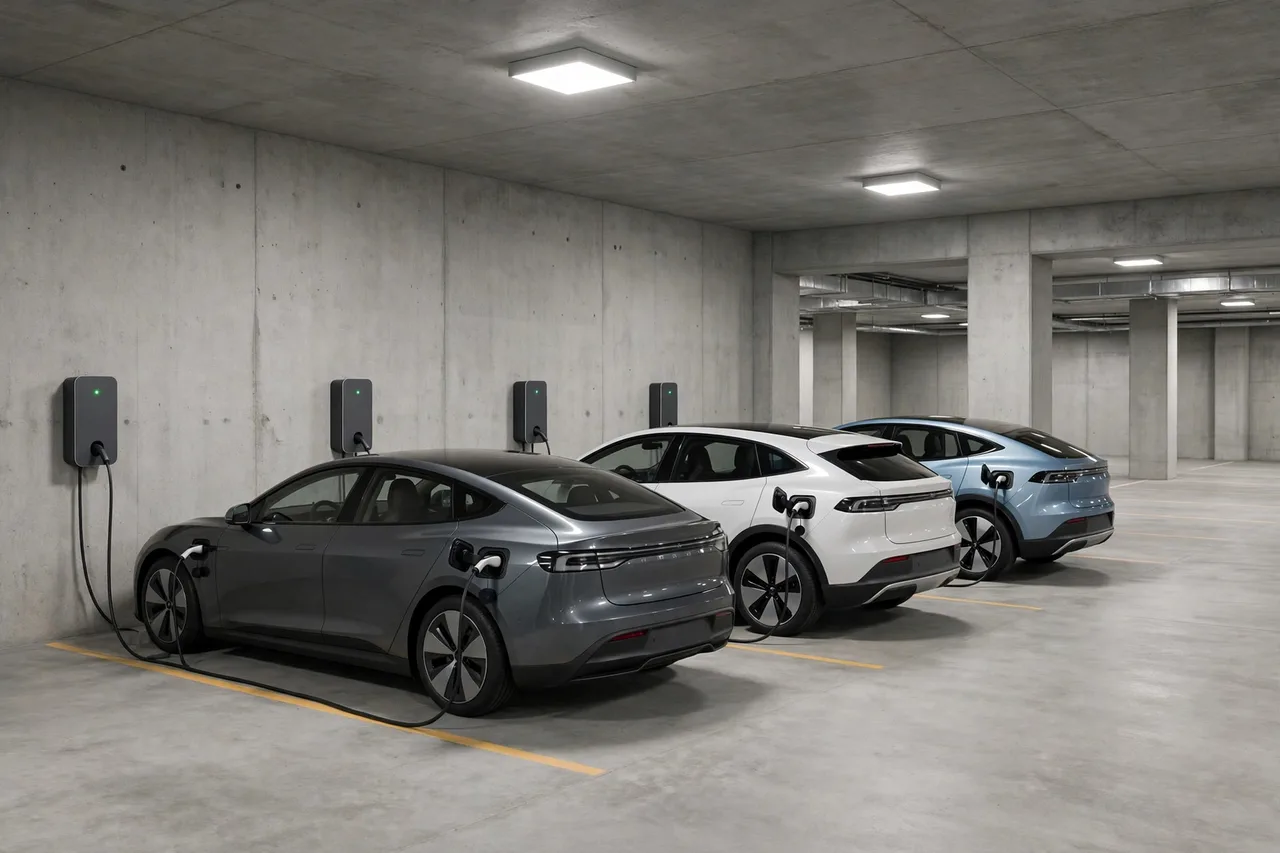
And 18% of Grand Junction's homes are in buildings with five or more units — apartments and condominiums where charging is a building decision before it is an electrical one. If that is your situation, the law and multifamily sections of this page are the ones written for you.
EV charging services in Grand Junction
The full menu runs to ten services; the three cards at the top are the ones Grand Junction's housing stock and state law push to the front. Everything links to its national service page for scope and process in full.
Home EV Charger Installation in Grand Junction
One circuit, one station, one inspection: the residential install in its usual form. An installer sizes the circuit to the household's driving, mounts the station where the cable reaches the port without drama, sets its output to the circuit it landed on, and leaves the paperwork filed with the house.
In Grand Junction: the core residential job in Grand Junction: circuit, mounting, configuration and inspection in one visit pattern.
Dedicated Circuit & Electrical Panel Upgrade in Grand Junction
The upgrade is unglamorous and transformative: a modern panel with honest capacity, labelled circuits, and room for the decade's next three electrical ideas after the charger. Houses rarely regret capacity; they regret its absence annually.
In Grand Junction: the job that surfaces wherever housing is older — and Grand Junction's stock makes it a routine conversation, settled by a load calculation.
Multifamily & Condo EV Charging in Grand Junction
Shared buildings convert charging from a purchase into a policy, and the installers fluent here speak both languages — amperage and agenda items. The electrical design that wins approval is the one whose metering and load answers arrive attached to the application.
In Grand Junction: the route from board agenda to working charger in Grand Junction's communities.
Utility programs and electricity in Grand Junction
Electricity in Grand Junction comes from Public Service Co of Colorado. Parts of the wider metro are served by Holy Cross Electric Assn, Inc, Grand Valley Power, San Miguel Power Assn, Inc. The utility matters twice over for a charger install: it sets the time-of-use rates that decide what overnight charging costs you, and it is the organisation that may — or may not — currently help pay for the equipment.
Rebate archaeology is a local sport: an old Public Service Co of Colorado program page, a neighbour's 2023 install story, a screenshot of terms nobody can date. The record for Grand Junction, as checked for this page, is simpler. The federal credit closed on September 30, 2025; Colorado operates no home-charger program; and no active Public Service Co of Colorado residential charger rebate appears in current published sources. Funded rounds do reopen in this industry — on the utility's timetable, announced on the utility's site, and worth exactly what their published terms say on the day you read them.
One more utility habit worth copying from Grand Junction's EV owners: charge on the overnight rate window if your plan has one. The charger itself can usually be scheduled from the car or the station, so the habit costs nothing once it is set.
Condos, HOAs and the law in Colorado
Colorado has a right-to-charge law. Under CRS §38-33.3-106.8; §38-12-601 (landlord-tenant), a homeowners association or condominium cannot simply prohibit an owner from installing a charging station in their own parking space. The law does not make the process free or instant — owners typically carry the cost, must use a licensed installer, carry any insurance the statute specifies, and can be required to restore the space if they remove the equipment — but it converts the conversation from a request for permission into a defined process with rules on both sides.
For renters, coverage in Colorado is recorded as: Limited. If you rent in Grand Junction, the practical route is still a written proposal to the landlord — dedicated circuit, licensed installer, your name on the permit — because a charger-ready space is an asset most landlords keep when you leave.
For the design side — shared versus assigned spaces, load management across a building, billing per owner — see the multifamily and condo charging service page.
Climate, garages and charger placement
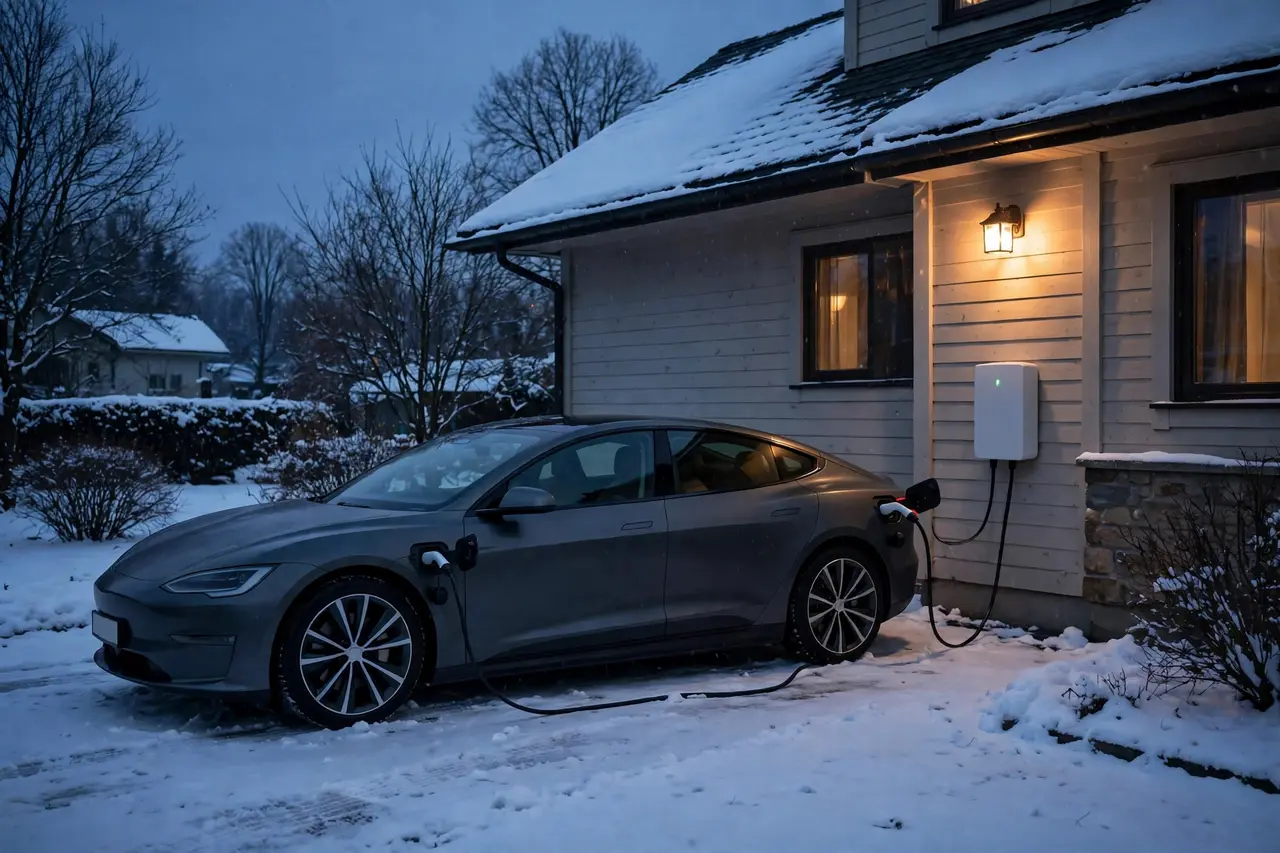
Garage temperature is a charging feature here. An insulated garage that holds even a modest margin over the street's cold shortens the battery's warm-up and steadies winter range; a carport install accepts the full season and plans the circuit's headroom accordingly. Either works — they are simply different designs, and the site visit should name which one you own.
Winter hardware habits are simple and worth copying: a holster the connector returns to every night (a connector left in a snowbank is a connector full of ice), a cable route that survives the snow-clearing line, and a station position the plough's output does not bury. Installers here raise all three without being asked.

Permits and inspection in Grand Junction
If your install is part of a larger job — a panel upgrade, a garage build — the charger usually rides on the same permit set. Ask for the charger circuit to be listed explicitly so the inspection record shows it.

Neighbourhoods and ZIP codes served
The page covers 7 ZIP codes in and around Grand Junction — including 81501, 81502, 81503, 81504, 81505, 81506, 81507 — across Mesa. If your ZIP is not in the first set shown, ask anyway: installer coverage follows the metro, not a postcode fence.
The same working area takes in the neighbouring localities of Clifton, Palisade, Whitewater, Fruita, Glade Park, Loma, De Beque, Mack, Mesa, Molina, Collbran, Gateway — the county ring an installer based in Grand Junction actually drives. Requests from those communities route exactly as city requests do: same services, same permit discipline, same local facts where they differ.
Mesa County accounts for 19 of the ZIP codes and 13 named postal localities in the research file, the nearest of them Clifton, Palisade, Whitewater, Fruita, Glade Park. The survey counts 158,601 residents in the county, with a median household income of $73,658 and a median home value of $378,600. Measured across its ZIP codes, the Grand Junction footprint runs about 6 miles north to south and 9 east to west, from ZIP 81501 to 81507 — the ground an installer based here actually covers in a working week.
Beyond the county seats, the working area takes in Clifton, Palisade, Whitewater, Fruita, Glade Park, Loma, De Beque, Mack, Mesa, Molina, Delta, Eckert, Cedaredge, Collbran, Gateway, Cory, Austin, Parachute, Battlement Mesa, Cisco, Olathe, Lazear, Hotchkiss, Rifle, Paradox, Paonia, Montrose, Nucla, Silt, Crawford, Naturita — the named localities for which Grand Junction is the nearest metro in the network (neighbouring metros' pages cover their own ground), each routing to the same installer-matching service.
The largest communities in that working area after Grand Junction itself, by the GeoNames populated-place file: Clifton (population 19,889), Montrose (population 19,062), Fruita (population 12,795), Glenwood Springs (population 9,906), Rifle (population 9,563), Delta (population 8,791), Redlands (population 8,685), Fruitvale (population 7,675), Gypsum (population 6,922), Aspen (population 6,882), Orchard Mesa (population 6,836), Carbondale (population 6,670), Gunnison (population 6,076), Moab (population 5,235), New Castle (population 4,669), Battlement Mesa (population 4,471), Basalt (population 3,891), El Jebel (population 3,801), Silt (population 3,043), Orchard City (population 3,011). Charging demand follows those populations — the subdivisions and town centres where the next driveways, and the next panels, are.
Delta County reaches into the working area with 31,598 residents, a median household income of $57,774 and a median home value of $343,200; its localities on this page include Delta, Eckert, Cedaredge, Cory, Austin. Montrose County reaches into the working area with 43,807 residents, a median household income of $72,120 and a median home value of $388,400; its localities on this page include Olathe, Paradox, Montrose, Nucla. Garfield County reaches into the working area with 62,479 residents, a median household income of $91,131 and a median home value of $527,800; its localities on this page include Parachute, Battlement Mesa, Rifle, Silt. Grand County reaches into the working area with 15,895 residents, a median household income of $88,612 and a median home value of $601,500; its localities on this page include Cisco.
| ZIP | Locality | County |
|---|---|---|
| 81501 | Grand Junction | Mesa |
| 81506 | Grand Junction | Mesa |
| 81504 | Grand Junction | Mesa |
| 81505 | Grand Junction | Mesa |
| 81520 | Clifton | Mesa |
| 81502 | Grand Junction | Mesa |
| 81507 | Grand Junction | Mesa |
| 81503 | Grand Junction | Mesa |
| 81526 | Palisade | Mesa |
| 81527 | Whitewater | Mesa |
| 81521 | Fruita | Mesa |
| 81523 | Glade Park | Mesa |
| 81524 | Loma | Mesa |
| 81630 | De Beque | Mesa |
| 81525 | Mack | Mesa |
| 81643 | Mesa | Mesa |
| 81646 | Molina | Mesa |
| 81416 | Delta | Delta |
| 81418 | Eckert | Delta |
| 81413 | Cedaredge | Delta |
| 81624 | Collbran | Mesa |
| 81522 | Gateway | Mesa |
| 81414 | Cory | Delta |
| 81410 | Austin | Delta |
| 81635 | Parachute | Garfield |
| 81636 | Battlement Mesa | Garfield |
| 84515 | Cisco | Grand |
| 81425 | Olathe | Montrose |
| 81420 | Lazear | Delta |
| 81419 | Hotchkiss | Delta |
| 81650 | Rifle | Garfield |
| 81429 | Paradox | Montrose |
| 81428 | Paonia | Delta |
| 81402 | Montrose | Montrose |
| 81424 | Nucla | Montrose |
| 81401 | Montrose | Montrose |
| 81652 | Silt | Garfield |
| 81415 | Crawford | Delta |
| 81422 | Naturita | Montrose |
| 81403 | Montrose | Montrose |

Planning the install: from panel to parking
Consider the two households inside every Grand Junction install. The first owns the panel, the parking and the decision; the second — a partner, a teenager with the next car, a future buyer — inherits all three. Designing for the second household is the difference between an install and an asset: capacity reserved, conduit honest, paperwork filed. The first conversation with an installer should name both households explicitly.
Finally, photograph the finished work — station, nameplate, panel directory with the new breaker labelled — and file it with the inspection record. When the car changes, the house sells or a second station joins the first, that folder is the difference between a five-minute answer and an archaeological dig.
Home charging know-how for Grand Junction households
The insurance conversation
A permitted charger installation is a short conversation with your insurer, and it is worth having before rather than after. The documented install — permit, inspection, listed equipment, licensed electrician — is the version insurers process without friction, because every question they ask is answered by the file. Undocumented electrical work is where claims go to become arguments. Tell the insurer the circuit exists, keep the paperwork with the policy documents, and the charger's insurance chapter closes in one phone call.
Etiquette for shared stations
Shared stations run on norms before they run on rules. The norms that work: move the car when the session ends, coil the cable for the next driver, report a fault rather than stepping over it, and never unplug a stranger's session except under the building's posted arrangement. Buildings formalise this gradually — a group message thread, a simple rota in high season — and the households that start with courtesy rarely need the formal version. The equipment is shared; so is the goodwill it runs on.
The labelled breaker
Panel directories are autobiographies written in pencil, and a charger install adds a chapter. The new breaker gets labelled — circuit, station, date — in the directory and, in thorough households, on the panel schedule taped inside the door. It reads as pedantry until the night something trips at 11 pm and the labelled directory turns a flashlight search into a ten-second answer. It also serves the future: the next electrician, the inspector, the buyer, each reads the panel's story faster when the latest chapter is legible.
A receptacle is not a station
The portable cord in the car's boot and a wall-mounted station both deliver Level 2 energy, and the resemblance ends there. The fixed station is torqued, configured, weather-sealed and holstered as a permanent appliance; the receptacle route asks a domestic outlet and plug to sustain a continuous load for a decade of nightly cycles. Both are legitimate in the code's eyes when done properly — but the daily-living difference, and the wear pattern on the receptacle, are why permanent parking places graduate to permanent equipment.

Frequently asked questions
Can I still get the federal tax credit for a home charger in Grand Junction, CO?
Checked and dated: in the sources reviewed for this page, Public Service Co of Colorado runs no residential charger rebate, Colorado runs no home-charger programme, and the federal credit that once filled the gap ended on September 30, 2025. If a salesperson's spreadsheet shows a rebate line for a Grand Junction install, the published programme page is the only acceptable evidence.
Can my association in Grand Junction, CO say no to a home charger?
Not outright. Under CRS §38-33.3-106.8; §38-12-601 (landlord-tenant), Colorado associations cannot prohibit an owner's charger; they can condition it — reasonably — on placement, insurance and restoration, with the owner funding the work. The disputes that do arise are usually about conditions, and they settle fastest when the application answers them in advance.
Does a Level 2 charger mean a panel upgrade for a Grand Junction, CO home?
Sometimes, and the honest route to the answer is arithmetic rather than opinion. Grand Junction's median home was built in 1992; roughly 35% of the stock predates 1980, which is where the 100-amp panels concentrate. If yours is one, expect the upgrade-or-management conversation; if it is a modern 200-amp service with spare spaces, expect a circuit. The site visit's calculation decides, and you are entitled to see it.
Level 1 or Level 2 in Grand Junction, CO — what is the real difference?
A Level 1 cord on a household outlet adds roughly 3–5 miles of range per hour; a Level 2 station on a 240-volt circuit typically adds about 25–40 miles per hour depending on the circuit's amperage and the vehicle. For most drivers that is the difference between rationing the battery and never thinking about it.
How does the installer matching on this page work?
Three steps: the request routes to installers who work Grand Junction, Colorado; one contacts you to walk the property; the walk produces the written quote. Everything on this page — the utility position, the law, the housing data — is yours to check that quote against.
Can a charger be added to a detached garage in Grand Junction?
Yes — and detached garages are common in Grand Junction, where about 67% of homes are single-unit detached. The run out to the building is the substance of the job: a buried conduit from the house panel, or a subpanel in the garage where the distance and future loads justify it. The station itself then behaves like any garage install.
Nearby cities in Colorado
- EV charger installation in Boulder — about 196 miles from Grand Junction, metro population 330,000
- EV charger installation in Denver — about 208 miles from Grand Junction, metro population 3,000,000
- EV charger installation in Fort Collins — about 216 miles from Grand Junction, metro population 375,000
- EV charger installation in Farmington, NM — about 163 miles from Grand Junction, metro population 130,000
- EV charger installation in Provo, UT — about 190 miles from Grand Junction, metro population 700,000
- EV charger installation in Salt Lake City, UT — about 218 miles from Grand Junction, metro population 1,300,000
Ready to charge at home in Grand Junction?
Two minutes of form, and the request is in front of licensed installers who cover this city — quotes follow site visits, in writing.