EV Charger Installation in Boulder, CO
Home Level 2 charging, panel upgrades and condo installs in Boulder — matched to licensed local installers, with the local facts that shape the job set out below.
There is a reason most charging happens at home: it is the most convenient fuelling an EV owner will ever use, and it happens while the car sits idle anyway. In Boulder, getting set up means answering a handful of local questions first. Boulder itself is home to about 106,802 people, inside a state that registered 162,800 battery-electric vehicles and 57,100 plug-in hybrids through 2025. Which utility serves your address, whether it currently funds part of a charger install, what your panel can carry, and what your HOA or condo board can and cannot say no to — this page covers each of them for Boulder specifically.
Nothing on this page is decorative. The statutes are quoted because boards respect them, the survey numbers are shown because quotes should follow them, and the program status is stated plainly — including when the plain statement is that no verified program currently exists for Boulder. Informed homeowners get better installs; this page is the informing.
The registration ledger for the Boulder metro reads: Among the highest EV shares of any US metro. Ledgers like this are what installer rounds are built from — they show where the cars already are, which is where the circuits get requested, permitted and inspected week after week.
The same survey puts median household income in Boulder at $85,761, with 42% of occupied homes owner-occupied and 37% of the housing stock single-unit detached. For charging, those are the operative facts: owners can approve their own electrical work, and detached homes put the car, the panel and the parking under one roof.

Every city charges differently, and Boulder's difference is legible in the data: an older housing fabric, where panel archaeology is a normal part of the first visit; a genuinely mixed city — houses, townhouses and larger buildings all carry weight; buildings of five or more units hold a substantial share of homes, which keeps the multifamily sections of this page in daily use; renters form a large share of households, so the landlord conversation is a first-class topic here. Read the sections below through that profile and the local advice resolves into specifics — which questions are routine here, and which are rare.
In absolute terms, the survey counts 49,329 housing units in Boulder — 45,900 occupied, 19,311 of them by their owners. The stock resolves into 18,112 single-unit detached houses, 27,106 homes standing since before 1980, and 22,961 units in larger buildings. Those six counts are the city's charging map drawn without percentages, and every section of this page is a consequence of one of them. The page's geography is equally concrete: 11 ZIP codes across Boulder, centred near 40.05 degrees north latitude. The city anchors the Boulder metropolitan area, home to roughly 330,000 people on the research file's metro estimate — the wider labour and housing market this page's installers work across.
The same survey release fills in the household economics around the housing stock: a median home value of $1,039,500, median gross rent of $2,018, per-capita income of $63,074, and a median resident age of 29. And the daily rhythms behind the housing numbers: 39% of Boulder workers drive to work alone — the commute pattern home charging is built around; 34% work from home, a population whose cars charge on daytime and overnight schedules alike; 5% commute by public transit; 77% of adults hold a bachelor's degree or higher. The survey's vehicle table is the one an EV page should quote first: 4,420 of Boulder's households have no vehicle at all, while 19,896 have two or more — the multi-car households for whom the second circuit is a when, not an if.
Two burden statistics frame the economics: in Boulder, 59% of renters and 0% of mortgage-holding owners are housing-cost burdened at the standard 30% threshold. And 42% of households are family households, the segment most likely to run the two-vehicle, two-schedule pattern the second-vehicle planning notes address.
Taken as one portrait, the numbers describe a specific charging market. The oldest housing throws the longest shadows over an install: knob-and-tube remnants in the attic, ungrounded receptacles, services sized for iceboxes and radios that now feed induction ranges and heat pumps. The renter-and-condo share makes the law section of this page load-bearing: statutory rights, application windows and metering rules are not fine print here, they are the project's first phase.
Where renting dominates, the successful install is a document before it is a device — installer licence, insurance, metering clarity, end-of-tenancy position — assembled to make a landlord's yes the path of least resistance. Households here run the numbers — which is why the honest sections of this page, the ones that say what is verified and what is not, earn their keep. Scale brings a call centre, but it also brings published everything — interconnection standards, programme terms, complaint statistics — and the published page, not the phone call, is where this utility is most honest.
A fleet this size changes the questions at the kerb: not whether the neighbours approve of EVs, but whose installer did their circuit and whether the panel needed work — consumer intelligence, traded over fences. At this scale the page's role sharpens — in a market without a crowd of specialists to interview, the household's own preparation carries more of the project's quality. Where the state's statute speaks, the local conversation changes register: installers quote the framework, boards keep counsel's template, and approvals become administrative.
The electrical reality in Boulder homes
The survey's housing portrait for Boulder opens with its median: a home built in 1977, in a stock where 55% of units predate 1980 and 37% stand detached on their own lots. 42% of occupied homes are owner-occupied. An installer reads those lines as a weather forecast: mostly settled conditions, with older wiring fronts moving through the pre-1980 districts. A housing stock this age leans on smaller electrical services — 100-amp panels are common, and fuse-era equipment still turns up in the oldest streets. For many of those homes the honest answer is a panel upgrade or a load-management device before the charger circuit goes in, and a good installer will show you the load calculation rather than asking you to take it on faith. Porches, carports and parking pads carry a real share of this city's charging, because the stock predates the two-car garage as a standard feature — outdoor-rated equipment is a local staple, not an edge case.
Heating fuel is the survey's quiet clue to panel life: in Boulder, 35% of homes heat electrically (15,901 households), against 64% heating with gas. A house already heating electrically has a service sized with that load in its history; a gas-heated house may have capacity to spare — either way the fuel mix is part of what the installer is reading.
Renters are the other constituency in these numbers: about 26,589 of Boulder's occupied homes are rented rather than owned. Their charging route runs through a landlord conversation instead of a panel they control — a different project, covered by the rentals guide and the law section below, but a routine one in a city with this many renting households.
The city's stock is not all houses: 47% of units are in structures of five or more. Shared buildings mean shared panels, assigned parking and association process — the substance of the multifamily sections below.
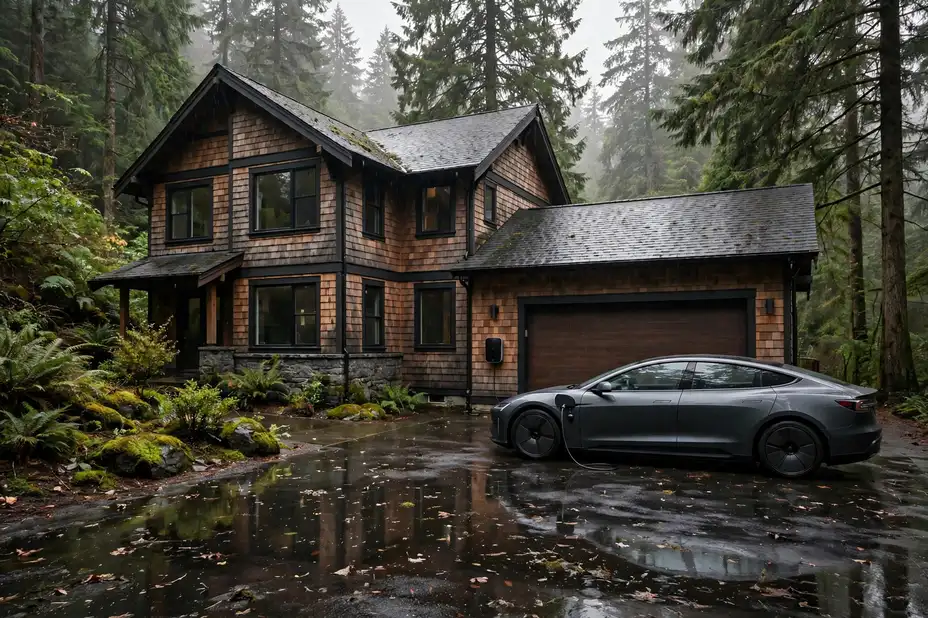
EV charging services in Boulder
Ten services cover the work installers do in Boulder. Three lead the list here because of what this city's housing and law actually look like — each links to its national service page, where scope and process are set out in full.
Home EV Charger Installation in Boulder
One circuit, one station, one inspection: the residential install in its usual form. An installer sizes the circuit to the household's driving, mounts the station where the cable reaches the port without drama, sets its output to the circuit it landed on, and leaves the paperwork filed with the house.
In Boulder: where most Boulder projects start and finish: one circuit, one station, one inspection.
Dedicated Circuit & Electrical Panel Upgrade in Boulder
Panel work is the one part of a charger project that outlives the car, the station and possibly the household's tenure. Specified generously and documented properly, it is less an expense than a permanent alteration in what the house can do.
In Boulder: the capacity answer when Boulder's older panels meet a continuous load.
Multifamily & Condo EV Charging in Boulder
Shared buildings convert charging from a purchase into a policy, and the installers fluent here speak both languages — amperage and agenda items. The electrical design that wins approval is the one whose metering and load answers arrive attached to the application.
In Boulder: the approvals-plus-wiring job for Boulder's condos and HOA communities, where the process matters as much as the circuit.
Utility programs and electricity in Boulder
Electricity in Boulder comes from Public Service Co of Colorado. Parts of the wider metro are served by United Power, Inc, Poudre Valley REA, Inc, City of Longmont. The utility matters twice over for a charger install: it sets the time-of-use rates that decide what overnight charging costs you, and it is the organisation that may — or may not — currently help pay for the equipment.
Frame the Boulder incentive question correctly and it answers itself. Three pots could in principle fund part of a home charger: a federal credit, a Colorado program, a Public Service Co of Colorado rebate. The first ended on September 30, 2025. The second does not exist for typical home installs. The third, in the sources checked for this page, is not currently offered for residential customers. Zero plus zero plus zero is the honest budget line — and any future change will arrive through the utility's own program page, with dates, which is where this page will take it from.
If your service includes a demand component, the charger's start time matters more than its size: staggered against the house's other big loads, the same circuit costs noticeably less to run across a year.
Condos, HOAs and the law in Colorado
Colorado has a right-to-charge law. Under CRS §38-33.3-106.8; §38-12-601 (landlord-tenant), a homeowners association or condominium cannot simply prohibit an owner from installing a charging station in their own parking space. The law does not make the process free or instant — owners typically carry the cost, must use a licensed installer, carry any insurance the statute specifies, and can be required to restore the space if they remove the equipment — but it converts the conversation from a request for permission into a defined process with rules on both sides.
If your board is stalling, the sequence that works in Boulder is boring and effective: cite the statute, submit a complete application (equipment, circuit, installer licence, insurance), and keep everything in writing.
The step-by-step version lives in our guide to installing an EV charger in a condo or HOA community — the application sequence, the metering designs and the questions boards ask, in order.
Climate, garages and charger placement
The shoulder seasons deserve a mention: freeze-thaw cycles work on exterior conduit and enclosures, and the connector that was easy in October can be stiff company in February. Equipment listed for the exposure, mounted where the melt does not drip across it, is the whole answer — local installers apply it without being asked.
Preconditioning is the cold-climate feature owners actually use: the car warms its battery and cabin from the wall while it is still plugged in, leaving with a full battery instead of spending the first miles on heat. It only works if the car is connected overnight — which is the whole argument for a home circuit that is effortless to use in gloves, in the dark, in February.

Permits and inspection in Boulder
Inspection day itself is undramatic by design: access to the panel and the station, the calculation on hand, the equipment's settings matching the circuit. Jobs fail inspection on paperwork mismatches far more often than on wiring — a fact that quietly grades installers.

Neighbourhoods and ZIP codes served
The page covers 11 ZIP codes in and around Boulder — including 80301, 80302, 80303, 80304, 80305, 80306, 80307, 80308, 80309, 80310, 80314 — across Boulder. If your ZIP is not in the first set shown, ask anyway: installer coverage follows the metro, not a postcode fence.
The same working area takes in the neighbouring localities of Niwot, Louisville, Lafayette, Longmont, Eldorado Springs, Hygiene, Jamestown, Broomfield, Lyons, Pinecliffe, Nederland, Ward, Allenspark — the county ring an installer based in Boulder actually drives. Requests from those communities route exactly as city requests do: same services, same permit discipline, same local facts where they differ.
Boulder County accounts for 27 of the ZIP codes and 14 named postal localities in the research file, the nearest of them Niwot, Louisville, Lafayette, Longmont, Eldorado Springs. The survey counts 328,961 residents in the county, with a median household income of $103,994 and a median home value of $756,300. Measured across its ZIP codes, the Boulder footprint runs about 8 miles north to south and 9 east to west, from ZIP 80301 to 80314 — the ground an installer based here actually covers in a working week.
Beyond the county seats, the working area takes in Niwot, Louisville, Lafayette, Longmont, Erie, Eldorado Springs, Hygiene, Jamestown, Broomfield, Arvada, Lyons, Pinecliffe, Denver, Nederland, Dacono, Firestone, Golden, Frederick, Ward, Mead, Berthoud, Rollinsville, Allenspark, Black Hawk, Fort Lupton, Central City, Platteville, Dumont, Idaho Springs, Empire, Winter Park, Fraser, Georgetown, Tabernash, Grand Lake, Silver Plume, Granby — the named localities for which Boulder is the nearest metro in the network (neighbouring metros' pages cover their own ground), each routing to the same installer-matching service.
The wider working area also reaches Westminster, Eastlake, Brighton, Wheat Ridge, Dupont, Henderson, Commerce City, Loveland, Johnstown, Idledale, Milliken, Drake, Kittredge, Gilcrest, Aurora, Indian Hills, Englewood, Masonville, Morrison, Glen Haven, La Salle, Fort Collins, Greeley, Windsor, Evans, Conifer, Severance, Lone Tree, Bellvue, Watkins, Laporte, Lucerne, Louviers, Eaton, Bailey — ground shared with neighbouring metros, where installers cross the same county lines in both directions.
ZIP codes in that shared ground include 80010, 80013, 80014, 80031, 80035, 80037, 80113, 80121, 80125, 80129, 80130, 80131, 80155, 80160, 80162, 80205, 80207, 80210, 80219, 80226, 80227, 80230, 80235, 80236, 80238, 80239, 80247, 80249, 80250, 80261, 80265, 80271, 80290, 80421, 80433, 80437, 80454, 80526, 80528, 80539.
The largest communities in that working area after Boulder itself, by the GeoNames populated-place file: Longmont (population 92,088), Broomfield (population 65,065), Lafayette (population 27,729), Erie (population 21,420), Louisville (population 20,396), Superior (population 12,980), Steamboat Springs (population 12,435), Firestone (population 11,999), Frederick (population 11,413), Edwards (population 10,266), Gunbarrel (population 9,263), Fort Lupton (population 7,822), Eagle (population 6,678), Avon (population 6,505), Vail (population 5,461), Breckenridge (population 4,896), Dacono (population 4,792), Mead (population 4,476), Silverthorne (population 4,418), Niwot (population 4,006). Charging demand follows those populations — the subdivisions and town centres where the next driveways, and the next panels, are.
Weld County reaches into the working area with 350,396 residents, a median household income of $97,097 and a median home value of $471,700; its localities on this page include Erie, Longmont, Dacono, Firestone, Frederick. Grand County reaches into the working area with 15,895 residents, a median household income of $88,612 and a median home value of $601,500; its localities on this page include Winter Park, Fraser, Tabernash, Grand Lake, Granby. Jefferson County reaches into the working area with 579,377 residents, a median household income of $110,656 and a median home value of $637,600; its localities on this page include Broomfield, Arvada, Golden. Gilpin County reaches into the working area with 5,901 residents, a median household income of $95,361 and a median home value of $573,900; its localities on this page include Rollinsville, Black Hawk, Central City. Broomfield County reaches into the working area with 76,304 residents, a median household income of $123,874 and a median home value of $664,500; its localities on this page include Broomfield.
| ZIP | Locality | County |
|---|---|---|
| 80301 | Boulder | Boulder |
| 80304 | Boulder | Boulder |
| 80309 | Boulder | Boulder |
| 80310 | Boulder | Boulder |
| 80303 | Boulder | Boulder |
| 80544 | Niwot | Boulder |
| 80302 | Boulder | Boulder |
| 80305 | Boulder | Boulder |
| 80027 | Louisville | Boulder |
| 80026 | Lafayette | Boulder |
| 80503 | Longmont | Boulder |
| 80516 | Erie | Weld |
| 80025 | Eldorado Springs | Boulder |
| 80533 | Hygiene | Boulder |
| 80307 | Boulder | Boulder |
| 80314 | Boulder | Boulder |
| 80308 | Boulder | Boulder |
| 80306 | Boulder | Boulder |
| 80502 | Longmont | Boulder |
| 80455 | Jamestown | Boulder |
| 80501 | Longmont | Boulder |
| 80038 | Broomfield | Boulder |
| 80020 | Broomfield | Boulder |
| 80023 | Broomfield | Broomfield |
| 80021 | Broomfield | Jefferson |
| 80007 | Arvada | Jefferson |
| 80540 | Lyons | Boulder |
| 80471 | Pinecliffe | Boulder |
| 80234 | Denver | Adams |
| 80005 | Arvada | Jefferson |
| 80504 | Longmont | Weld |
| 80466 | Nederland | Boulder |
| 80514 | Dacono | Weld |
| 80520 | Firestone | Weld |
| 80403 | Golden | Jefferson |
| 80530 | Frederick | Weld |
| 80481 | Ward | Boulder |
| 80542 | Mead | Weld |
| 80513 | Berthoud | Larimer |
| 80474 | Rollinsville | Gilpin |
| 80510 | Allenspark | Boulder |
| 80422 | Black Hawk | Gilpin |
| 80621 | Fort Lupton | Weld |
| 80427 | Central City | Gilpin |
| 80651 | Platteville | Weld |
| 80436 | Dumont | Clear Creek |
| 80452 | Idaho Springs | Clear Creek |
| 80438 | Empire | Clear Creek |
| 80482 | Winter Park | Grand |
| 80442 | Fraser | Grand |
| 80444 | Georgetown | Clear Creek |
| 80478 | Tabernash | Grand |
| 80447 | Grand Lake | Grand |
| 80476 | Silver Plume | Clear Creek |
| 80446 | Granby | Grand |

Planning the install: from panel to parking
Two decisions shape every Boulder install, and both are made before any equipment is ordered. The first is electrical: the load calculation that decides between a straight circuit, a panel upgrade and load management. The second is physical: where the station lives — which wall, which side of the car the charge port sits on, and whether the cable reaches a second vehicle or a future one. Installers in Boulder see the same housing patterns repeat street by street, which is why a ten-minute site visit produces a firmer quote than any online form: the form starts the conversation, the visit settles it.
One more piece of sequencing advice Boulder installers give consistently: if the panel is being opened anyway, settle the other electrical maybes in the same visit — the circuit you will want next year costs least while the permit and the electrician are already in the house.
Home charging know-how for Boulder households
Whose schedule? The car's or the station's
Two schedulers can govern a charging session — the vehicle's own charge timer and the station's app — and households inherit confusion when both are set at once. The discipline is simple: choose one governor. The car's timer travels with the car and knows its departure settings; the station's knows the tariff windows and the household's other loads. Either works; both together produce the 6 am mystery of the half-charged battery and a debugging session nobody enjoys.
HOA rules and the single-family exterior
Owning the house does not always settle the charger's exterior chapter: architectural-approval clauses in many communities reach visible equipment, conduit runs on front elevations, and anything mounted streetside. The practical route is a five-minute check of the covenants before the install, and, where approval applies to exterior work, a small application — equipment photo, mounting position, conduit path — that reads as a courtesy because it is one. Interior garage installs in most single-family communities are entirely the owner's affair; it is the visible fraction that earns the paperwork.
Historic homes, modern loads
A house can be historically significant and electrically contemporary at once, but the marriage takes choreography: circuits routed through secondary spaces, equipment kept off protected fabric, the panel's growth planned where the preservation easement permits. The installers who do this work well treat the house's rules as a design brief rather than an obstacle, and the result — a period street front, a thoroughly modern garage — is the quiet norm in historic districts now.
Workplace charging as a policy, not a perk war
Workplace stations fail socially before they fail electrically: the same cars parked all day, visitors boxed out, no rule for the growing queue. The installs that work pair the hardware with a light policy from the start — session lengths matched to the shift, access that distinguishes staff from guests, and pricing or etiquette that keeps a full battery from squatting until six. The electrical design and the policy design are one conversation, because the dwell pattern the policy sets is the load pattern the circuit must serve.

Frequently asked questions
Can I still get the federal tax credit for a home charger in Boulder, CO?
You cannot — it no longer exists. The 30C credit closed to equipment placed in service after September 30, 2025, and no Colorado program replaced it for home installs. Nor did the sources checked for this page show a live Public Service Co of Colorado residential rebate. Treat any 'credit' mentioned in a quote as a request for paperwork.
Can my HOA or condo board in Boulder, CO refuse my charger?
Not outright. Under CRS §38-33.3-106.8; §38-12-601 (landlord-tenant), Colorado associations cannot prohibit an owner's charger; they can condition it — reasonably — on placement, insurance and restoration, with the owner funding the work. The disputes that do arise are usually about conditions, and they settle fastest when the application answers them in advance.
Panel upgrade or not — how do Boulder, CO homeowners find out?
It hinges on two numbers you cannot read off the panel door: the service's rating, and what the load calculation says it already carries. The vintage of Boulder's stock — median build year 1977, about 55% of homes from before 1980 — means both answers are common here. The charger enters the arithmetic at 125% of its draw; whatever room survives that entry decides between a circuit, a management device, and an upgrade.
How quickly will a Level 2 charger fill my car in Boulder, CO?
A Level 1 cord on a household outlet adds roughly 3–5 miles of range per hour; a Level 2 station on a 240-volt circuit typically adds about 25–40 miles per hour depending on the circuit's amperage and the vehicle. For most drivers that is the difference between rationing the battery and never thinking about it.
What happens next after I send a request?
Your request — service, Boulder ZIP, property type and timing — goes to licensed local installers who cover Boulder. They contact you directly to arrange a site visit and quote. PlugReady USA is the matching service, not the installer, and the sections above exist so you can judge any quote against the local facts.
My Boulder home has no garage — where does the charger go?
Outdoor mounting is a standard configuration, not a compromise: stations listed for exterior use mount on the house wall by the drive or on a post at the pad. Your installer will check enclosure rating, drainage, cable reach to the port, and clearance from vehicle swing — the four things that decide whether an outdoor install feels designed or improvised.
Nearby cities in Colorado
- EV charger installation in Denver — about 30 miles from Boulder, metro population 3,000,000
- EV charger installation in Fort Collins — about 37 miles from Boulder, metro population 375,000
- EV charger installation in Grand Junction — about 196 miles from Boulder, metro population 160,000
- EV charger installation in Cheyenne, WY — about 79 miles from Boulder, metro population 100,000
- EV charger installation in Casper, WY — about 202 miles from Boulder, metro population 80,000
- EV charger installation in Farmington, NM — about 281 miles from Boulder, metro population 130,000
Ready to charge at home in Boulder?
Two minutes of form, and the request is in front of licensed installers who cover this city — quotes follow site visits, in writing.