EV Charger Installation in Fort Collins, CO
Everything a Fort Collins homeowner needs before booking a charger install — the panel question, the utility's current programs, the HOA law and the permit — sourced, dated and local.
The economics of home charging are made in two places: the tariff you charge on, and the circuit you charge through. Both are decided locally, and both are decided before the hardware is chosen. Fort Collins itself is home to about 170,927 people; Colorado counted 162,800 battery-electric vehicles and 57,100 plug-in hybrids by the end of 2025, and the metro's households are making these two decisions every week. Below: the utility position for Fort Collins as verified, the state law on association charging, the permit route, and the housing-stock numbers that tell you how much panel conversation to expect at your own address.
Nothing on this page is decorative. The statutes are quoted because boards respect them, the survey numbers are shown because quotes should follow them, and the program status is stated plainly — including when the plain statement is that no verified program currently exists for Fort Collins. Informed homeowners get better installs; this page is the informing.
What the Experian and AFDC registration data say about Fort Collins: High-adoption CO pocket; municipal utility. Translated out of market language: your neighbours are already charging at home, the permit office already knows the paperwork, and the installers already know the housing stock.
Survey context for Fort Collins, in the three lines installers actually use: median household income $81,199; owner-occupation at 51%; single-unit detached homes at 51%. Income tracks adoption pace, tenure decides whose signature a job needs, and structure decides whether the answer is a garage circuit or a building negotiation.

Put the survey together and Fort Collins's charging profile reads like this: a housing stock of mixed vintages, where both electrical eras appear on the same street; a detached-house majority with a real attached and multifamily minority; buildings of five or more units hold a substantial share of homes, which keeps the multifamily sections of this page in daily use; and owners hold a working majority, with renters a significant minority. That combination — more than any single number — is what the installers working here plan around, and it is the lens for everything on this page.
Keep six figures and you keep Fort Collins's whole electrical character: 77,858 housing units; 74,814 occupied homes; 38,160 owner-occupied; 39,455 detached houses; 24,294 pre-1980 homes; 23,375 homes in buildings of five or more units. Percentages elsewhere on this page are these numbers in disguise — the counts are the originals, and they are the numbers a local installer's experience is actually made of. The page's geography is equally concrete: 9 ZIP codes across Larimer, centred near 40.58 degrees north latitude. The city anchors the Fort Collins metropolitan area, home to roughly 375,000 people on the research file's metro estimate — the wider labour and housing market this page's installers work across.
The same survey release fills in the household economics around the housing stock: a median home value of $577,900, median gross rent of $1,690, per-capita income of $47,458, and a median resident age of 31. And the daily rhythms behind the housing numbers: 62% of Fort Collins workers drive to work alone — the commute pattern home charging is built around; 22% work from home, a population whose cars charge on daytime and overnight schedules alike; 1% commute by public transit; 61% of adults hold a bachelor's degree or higher. And the fleet in the driveways: 26,178 households in Fort Collins have exactly one vehicle, 45,810 have two or more, and 2,826 have none.
Two burden statistics frame the economics: in Fort Collins, 57% of renters and 0% of mortgage-holding owners are housing-cost burdened at the standard 30% threshold. And 51% of households are family households, the segment most likely to run the two-vehicle, two-schedule pattern the second-vehicle planning notes address.
Taken as one portrait, the numbers describe a specific charging market. Neither old nor new, the housing is layered, and the installer's week is a tour of the layers: a 1960s split-level on Monday, a 2008 subdivision house on Wednesday, a 1920s four-square on Friday. Multifamily weight changes the installer market too — the firms that thrive here carry association paperwork fluency alongside their licences, and their references are buildings, not just households.
Property managers are the metro's charging gatekeepers at this tenure mix, and the installers who thrive are the ones whose proposals arrive manager-shaped: standardised, insured, reversible on paper. Households at this band comparison-shop on scope rather than on slogans, which rewards the installer whose quote shows its working — the load study, the route, the permit, itemised. Tariff design is the quiet policy: the shape of the overnight window, the demand charges commercial customers face, the interconnection queue's pace — all set in dockets the diligent can read.
Households here are rarely the first on their street; the local knowledge pool — which installer, which tariff, which board precedent — is deep and shared freely. A smaller metro runs on relationships: the electrical firms are few, known, and booked through reputations maintained across decades of local work. The association dimension, at least, comes with a statutory frame in this state — the law section above sets out what boards may and may not do, and applications written inside that frame travel noticeably faster.
The electrical reality in Fort Collins homes
The survey's housing portrait for Fort Collins opens with its median: a home built in 1992, in a stock where 31% of units predate 1980 and 51% stand detached on their own lots. 51% of occupied homes are owner-occupied. An installer reads those lines as a weather forecast: mostly settled conditions, with older wiring fronts moving through the pre-1980 districts. A mixed-age stock like this splits installs into two camps: newer subdivisions where a 200-amp panel usually has planned capacity, and established neighbourhoods where the panel conversation comes first. Neither is a problem — but they are different jobs, and the estimate you get should say which camp your home falls into and why. Porches, carports and parking pads carry a real share of this city's charging, because the stock predates the two-car garage as a standard feature — outdoor-rated equipment is a local staple, not an edge case.
One further survey line belongs in any Fort Collins install conversation: 31% of the city's homes heat with electricity — 22,204 households whose panels already carry a major winter load before a charger is contemplated. Electric heat and EV charging are the two largest discretionary loads a house can host, and where they coincide, the load calculation stops being a formality.
The tenure split cuts the other way too: roughly 36,654 occupied homes in Fort Collins are rented. For those households the charger question is a negotiation with a property owner — written proposal, licensed installer, metering clarity — and it succeeds often enough that installers here keep the pattern ready.
The city's stock is not all houses: 30% of units are in structures of five or more. Shared buildings mean shared panels, assigned parking and association process — the substance of the multifamily sections below.
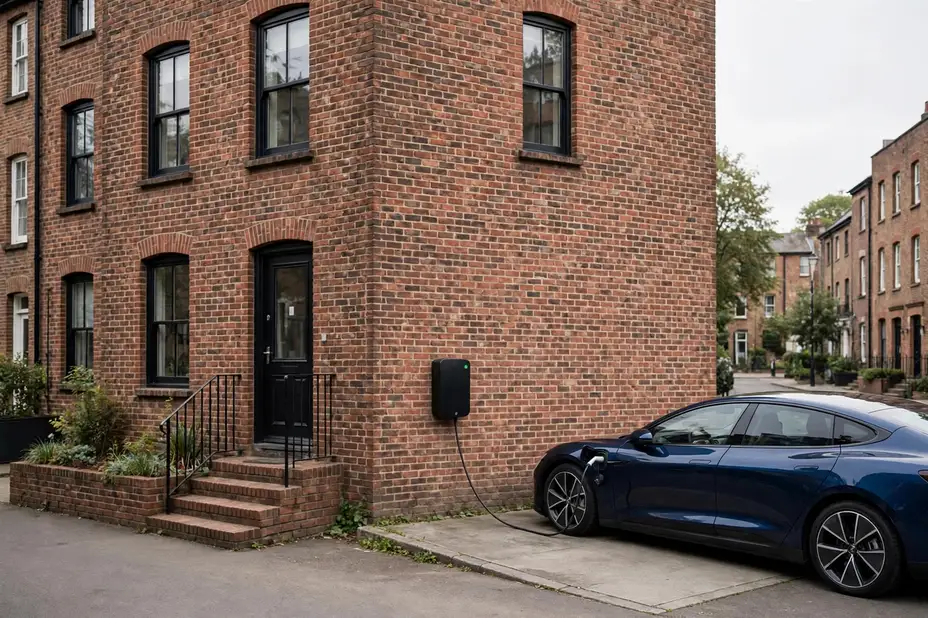
EV charging services in Fort Collins
An installer's work in Fort Collins usually starts with one of the three lead services below. The cards describe the job as it is actually scoped; the grid underneath carries the rest of the menu.
Home EV Charger Installation in Fort Collins
Think of it as plumbing for electrons, done once: capacity checked, circuit run, station mounted and configured, inspection passed. The households that report the smoothest projects describe the same shape — a visit that measured, a quote that itemised, and a car that simply charged from the first night.
In Fort Collins: usually the first job a new EV household in Fort Collins books, scoped to the panel the house already has.
Multifamily & Condo EV Charging in Fort Collins
In a multifamily building the charger is the easy half. The craft is the route to yes: a complete board application, a metering design that bills the right owner, load management that shares the building's capacity, and only then the circuit. Installers who do this work weekly carry the paperwork templates with them.
In Fort Collins: the approvals-plus-wiring job for Fort Collins's condos and HOA communities, where the process matters as much as the circuit.
Level 2 Charger Installation in Fort Collins
What is being bought is recovery rate. A Level 2 circuit returns in one overnight session what a household receptacle returns in a day and a half, and that margin is the difference between planning around the car and forgetting about it.
In Fort Collins: what most Fort Collins drivers mean when they say they want 'a real charger' — 240 volts, sized to the circuit.
Utility programs and electricity in Fort Collins
Electricity in Fort Collins comes from Public Service Co of Colorado. Parts of the wider metro are served by City of Fort Collins, Poudre Valley REA, Inc, City of Loveland. The utility matters twice over for a charger install: it sets the time-of-use rates that decide what overnight charging costs you, and it is the organisation that may — or may not — currently help pay for the equipment.
The honest incentive position in Fort Collins is: nothing verified to claim. The federal charger credit (30C) ended on September 30, 2025; Colorado runs no state replacement for typical home installs; and in the utility and state sources checked for this page, Public Service Co of Colorado had no active residential charger rebate to point to. Programs reopen — when one does, it will be on the utility's own site with terms and dates. Anything an installer describes without that paper trail should be treated as conversation, not money.
While you are in the tariff pages, look at how the plan values the evening ramp — the hours when cooking, cooling and charging would otherwise stack. A charger that starts after the ramp is the simplest scheduling decision in home charging, and it is set once.
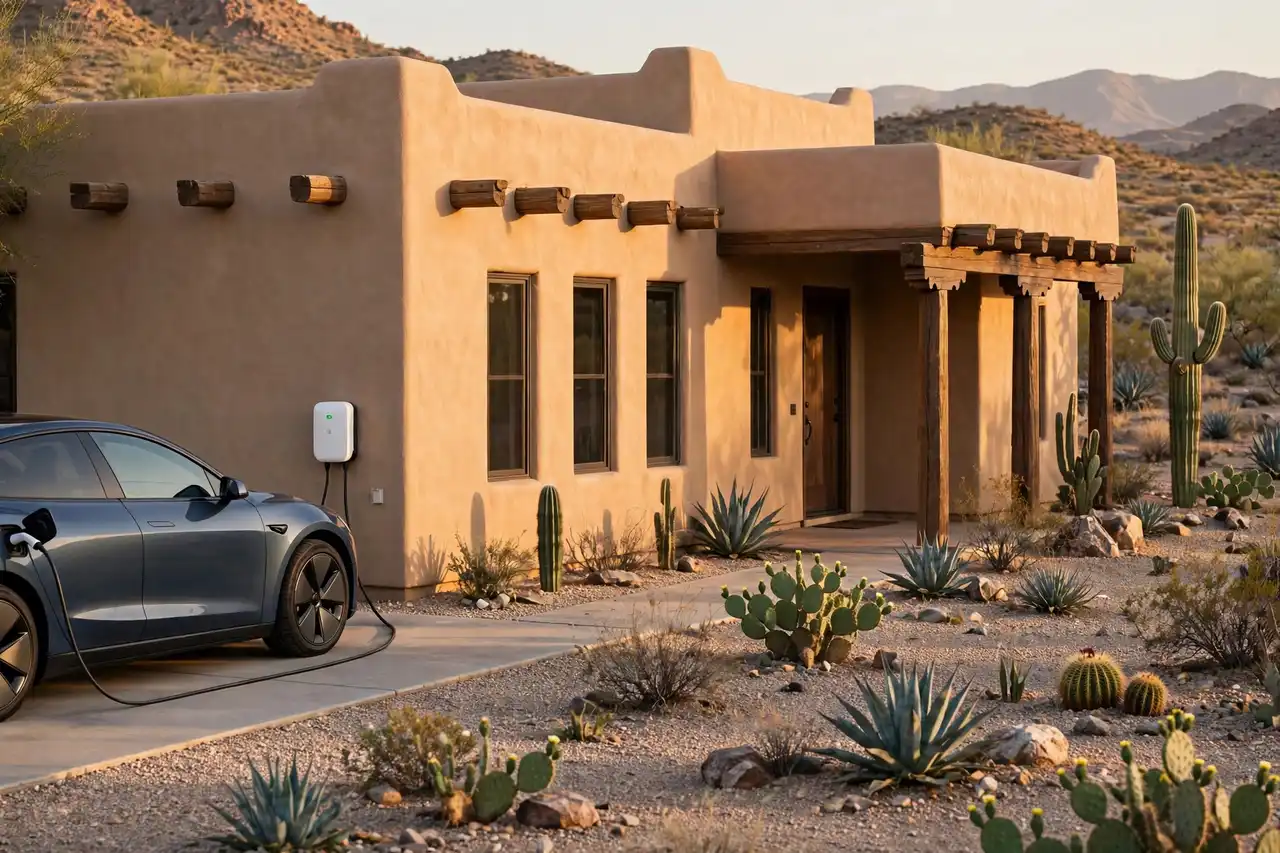
Condos, HOAs and the law in Colorado
Charging is a protected right for association owners in Colorado. The state's right-to-charge statute (CRS §38-33.3-106.8; §38-12-601 (landlord-tenant)) stops a homeowners association or condominium from banning an owner's charging station outright. Conditions still exist — placement, appearance, insurance and restoration can all be regulated, and the owner pays — yet the starting position is yes-with-rules rather than no-unless-persuaded, and that difference decides most applications before they are written.
Two practical corollaries follow for Fort Collins owners. First, assigned spaces are the clean case: the statute's protection is clearest where the parking is deeded or exclusively assigned. Second, insurance conditions are real but bounded — if a board's requirement looks invented, asking for its basis in the statute is a reasonable, usually decisive, question.
Read the full process in our guide to installing an EV charger in a condo or HOA community, and the multifamily and condo charging service page for how shared and assigned-space installs are designed.
Climate, garages and charger placement
Garage temperature is a charging feature here. An insulated garage that holds even a modest margin over the street's cold shortens the battery's warm-up and steadies winter range; a carport install accepts the full season and plans the circuit's headroom accordingly. Either works — they are simply different designs, and the site visit should name which one you own.
Preconditioning is the cold-climate feature owners actually use: the car warms its battery and cabin from the wall while it is still plugged in, leaving with a full battery instead of spending the first miles on heat. It only works if the car is connected overnight — which is the whole argument for a home circuit that is effortless to use in gloves, in the dark, in February.

Permits and inspection in Fort Collins
The permit trail also protects the next transaction: a charger circuit on the inspection record is an asset a buyer's inspector reads in one line, while an undocumented circuit is a question that follows the sale. Installers who work this metro treat the filing as part of the deliverable, not an errand.

Neighbourhoods and ZIP codes served
The page covers 9 ZIP codes in and around Fort Collins — including 80521, 80522, 80523, 80524, 80525, 80526, 80527, 80528, 80553 — across Larimer. If your ZIP is not in the first set shown, ask anyway: installer coverage follows the metro, not a postcode fence.
The same working area takes in the neighbouring localities of Laporte, Timnath, Masonville, Bellvue, Wellington, Loveland, Drake, Berthoud, Glen Haven, Livermore, Estes Park, Red Feather Lakes — the county ring an installer based in Fort Collins actually drives. Requests from those communities route exactly as city requests do: same services, same permit discipline, same local facts where they differ.
Larimer County accounts for 24 of the ZIP codes and 13 named postal localities in the research file, the nearest of them Laporte, Timnath, Masonville, Bellvue, Wellington. The survey counts 367,368 residents in the county, with a median household income of $93,765 and a median home value of $569,100. Measured across its ZIP codes, the Fort Collins footprint runs about 10 miles north to south and 6 east to west, from ZIP 80521 to 80553 — the ground an installer based here actually covers in a working week.
Beyond the county seats, the working area takes in Laporte, Timnath, Masonville, Bellvue, Wellington, Loveland, Windsor, Severance, Drake, Pierce, Johnstown, Nunn, Ault, Glen Haven, Eaton, Milliken, Greeley, Lucerne, Livermore, Estes Park, Evans, Gilcrest, La Salle, Gill, Kersey, Galeton, Red Feather Lakes — the named localities for which Fort Collins is the nearest metro in the network (neighbouring metros' pages cover their own ground), each routing to the same installer-matching service.
The wider working area also reaches Berthoud, Carr, Mead, Lyons, Longmont, Hygiene, Platteville, Granite Canon, Niwot, Allenspark, Firestone, Frederick, Dacono, Jamestown, Erie, Boulder, Fort Lupton, Tie Siding, Buford, Cheyenne, Lafayette, Fe Warren Afb, Ward, Louisville, Broomfield, Hudson, Brighton — ground shared with neighbouring metros, where installers cross the same county lines in both directions.
ZIP codes in that shared ground include 80023, 80026, 80027, 80301, 80302, 80303, 80304, 80305, 80306, 80308, 80309, 80310, 80314, 80455, 80481, 80501, 80502, 80503, 80504, 80510, 80513, 80514, 80520, 80530, 80533, 80540, 80542, 80544, 80602, 80612, 80621, 80642, 80651, 82001, 82005, 82006, 82010, 82052, 82059, 82084.
The largest communities in that working area after Fort Collins itself, by the GeoNames populated-place file: Greeley (population 108,795), Loveland (population 75,182), Windsor (population 32,716), Evans (population 21,383), Johnstown (population 14,896), Wellington (population 7,807), Milliken (population 6,388), Estes Park (population 6,257), Berthoud (population 6,031), Eaton (population 4,928), Severance (population 3,697), Laporte (population 2,450), La Salle (population 2,052), Campion (population 1,839), Ault (population 1,622), Kersey (population 1,577), Gilcrest (population 1,083), Pierce (population 873), Timnath (population 625), Walden (population 584). Charging demand follows those populations — the subdivisions and town centres where the next driveways, and the next panels, are.
Weld County reaches into the working area with 350,396 residents, a median household income of $97,097 and a median home value of $471,700; its localities on this page include Windsor, Severance, Pierce, Johnstown.
| ZIP | Locality | County |
|---|---|---|
| 80521 | Fort Collins | Larimer |
| 80523 | Fort Collins | Larimer |
| 80527 | Fort Collins | Larimer |
| 80553 | Fort Collins | Larimer |
| 80526 | Fort Collins | Larimer |
| 80524 | Fort Collins | Larimer |
| 80525 | Fort Collins | Larimer |
| 80535 | Laporte | Larimer |
| 80522 | Fort Collins | Larimer |
| 80547 | Timnath | Larimer |
| 80528 | Fort Collins | Larimer |
| 80541 | Masonville | Larimer |
| 80512 | Bellvue | Larimer |
| 80549 | Wellington | Larimer |
| 80538 | Loveland | Larimer |
| 80539 | Loveland | Larimer |
| 80550 | Windsor | Weld |
| 80551 | Windsor | Weld |
| 80537 | Loveland | Larimer |
| 80546 | Severance | Weld |
| 80515 | Drake | Larimer |
| 80650 | Pierce | Weld |
| 80534 | Johnstown | Weld |
| 80648 | Nunn | Weld |
| 80610 | Ault | Weld |
| 80532 | Glen Haven | Larimer |
| 80615 | Eaton | Weld |
| 80543 | Milliken | Weld |
| 80634 | Greeley | Weld |
| 80646 | Lucerne | Weld |
| 80632 | Greeley | Weld |
| 80633 | Greeley | Weld |
| 80638 | Greeley | Weld |
| 80536 | Livermore | Larimer |
| 80639 | Greeley | Weld |
| 80511 | Estes Park | Larimer |
| 80620 | Evans | Weld |
| 80631 | Greeley | Weld |
| 80623 | Gilcrest | Weld |
| 80517 | Estes Park | Larimer |
| 80645 | La Salle | Weld |
| 80624 | Gill | Weld |
| 80644 | Kersey | Weld |
| 80622 | Galeton | Weld |
| 80545 | Red Feather Lakes | Larimer |

Planning the install: from panel to parking
Consider the two households inside every Fort Collins install. The first owns the panel, the parking and the decision; the second — a partner, a teenager with the next car, a future buyer — inherits all three. Designing for the second household is the difference between an install and an asset: capacity reserved, conduit honest, paperwork filed. The first conversation with an installer should name both households explicitly.
One more piece of sequencing advice Fort Collins installers give consistently: if the panel is being opened anyway, settle the other electrical maybes in the same visit — the circuit you will want next year costs least while the permit and the electrician are already in the house.
Home charging know-how for Fort Collins households
Breakers: the household's safety switches
A breaker is a switch that watches current and opens when the current stops being safe — heat in a conductor is the thing it exists to prevent. Two household rules follow. First, a tripping breaker is reporting, not malfunctioning by default: reset once, and if it repeats, the circuit gets an electrician, not another reset. Second, the forbidden fix: never answer a trip by fitting a larger breaker. The breaker protects the wire in the wall; upsizing the guard without upsizing the wire removes the protection and keeps the problem.
HOA rules and the single-family exterior
Owning the house does not always settle the charger's exterior chapter: architectural-approval clauses in many communities reach visible equipment, conduit runs on front elevations, and anything mounted streetside. The practical route is a five-minute check of the covenants before the install, and, where approval applies to exterior work, a small application — equipment photo, mounting position, conduit path — that reads as a courtesy because it is one. Interior garage installs in most single-family communities are entirely the owner's affair; it is the visible fraction that earns the paperwork.
The landlord's side of the charger
For a landlord, a charger circuit is an amenity with unusual arithmetic: it is visible in listings, filterable in searches, and durable across tenancies in a way paint is not. The questions that decide it are practical rather than visionary — whose meter the circuit hangs from, how the cost is recovered, what the end-of-tenancy position is — and each has a standard answer the multifamily sections of this site describe. Landlords who run the numbers tenant by tenant usually conclude the circuit earns its wall space.
The charger among workshop loads
Garages that double as workshops put the charger in interesting company: welders, compressors, dust collectors — loads with appetites and opinions. The load calculation for such a house reads the whole tenancy, and the honest conversation includes which loads genuinely coincide. A station scheduled into the workshop's quiet hours lives peacefully; one competing with the table saw's startup surge teaches the household about breaker curves the experiential way.

Frequently asked questions
Is the federal charger tax credit still available in Fort Collins, CO?
That credit is finished: 30C ended on September 30, 2025. What about locally? In the utility and state sources checked for this page, nothing verified was running for Fort Collins homeowners — no Public Service Co of Colorado rebate, no state scheme. If one opens, it will appear on the utility's site with dates; plan your install without it meanwhile.
Can my HOA or condo board in Fort Collins, CO refuse my charger?
Not outright. Under CRS §38-33.3-106.8; §38-12-601 (landlord-tenant), Colorado associations cannot prohibit an owner's charger; they can condition it — reasonably — on placement, insurance and restoration, with the owner funding the work. The disputes that do arise are usually about conditions, and they settle fastest when the application answers them in advance.
Does a Level 2 charger mean a panel upgrade for a Fort Collins, CO home?
The answer lives in your panel's directory and its arithmetic, not in the car's requirements. With 31% of Fort Collins's homes predating 1980 (median build 1992), local installers see both situations weekly: the 200-amp panel that takes the circuit directly, and the full 100-amp service that needs capacity work first. The site visit exists to sort your house into one of those two piles, on numbers.
How quickly will a Level 2 charger fill my car in Fort Collins, CO?
Level 1 — the cord in the boot, on a normal outlet — returns about 3–5 miles of range an hour. Level 2 on its own 240-volt circuit returns roughly 25–40. A Fort Collins commuter who parks at seven and leaves at seven stops doing battery arithmetic entirely.
What happens next after I send a request?
Three steps: the request routes to installers who work Fort Collins, Colorado; one contacts you to walk the property; the walk produces the written quote. Everything on this page — the utility position, the law, the housing data — is yours to check that quote against.
Do installers cover the communities around Fort Collins, CO?
Yes — an installer's working area is the county ring, not the city limit. From this page the same request flow covers Laporte, Timnath, Masonville, Bellvue, Wellington and the rest of Fort Collins's surrounding localities, under the same permit discipline and the same local facts where they differ.
Nearby cities in Colorado
- EV charger installation in Boulder — about 37 miles from Fort Collins, metro population 330,000
- EV charger installation in Denver — about 61 miles from Fort Collins, metro population 3,000,000
- EV charger installation in Grand Junction — about 216 miles from Fort Collins, metro population 160,000
- EV charger installation in Cheyenne, WY — about 42 miles from Fort Collins, metro population 100,000
- EV charger installation in Casper, WY — about 170 miles from Fort Collins, metro population 80,000
- EV charger installation in Rapid City, SD — about 267 miles from Fort Collins, metro population 145,000
Ready to charge at home in Fort Collins?
Two minutes of form, and the request is in front of licensed installers who cover this city — quotes follow site visits, in writing.