EV Charger Installation in San Diego, CA
Charging where you park, in San Diego: the utility programs, state law, permit process and housing facts behind a home charger install, gathered in one place.
There is a short list of things that never change about a charger install — it needs capacity, a route, a position and a permit — and a longer list of things that change with the ZIP code. This page is the longer list, for San Diego. San Diego itself is home to about 1,404,461 people. California's registered electric fleet reached 1,843,100 battery-electric vehicles and 490,900 plug-in hybrids through 2025, and the installers working this metro have local habits worth borrowing. The utility section states what is verified and what is not; the law section quotes the position as it stands; the housing section works from survey data rather than vibes.
How PlugReady USA works, in one breath: you describe the job once, licensed local installers who cover San Diego receive it, and the conversations happen with them directly. The rest of this page exists so those conversations start from facts — yours about the house, ours about the metro — rather than from a sales script.
The demand picture for the San Diego–Chula Vista–Carlsbad metro, from the registration data this site is built on: Experian used-EV top 10; SDG&E territory; CA stock. Registration counts are the honest way to size a charging market — they count households, not headlines — and they are why San Diego sits where it does in our build order (rank 6 of 300 metros, Tier A).
Three survey lines do most of the predictive work on this page. Income — a median of $111,032 per household — tracks the pace at which San Diego households adopt EVs at all. Tenure — 46% owner-occupied — decides whose signature the work needs. And structure — 43% single-unit detached — decides how often the answer is a simple garage circuit rather than a building negotiation.

Put the survey together and San Diego's charging profile reads like this: an older housing fabric, where panel archaeology is a normal part of the first visit; a genuinely mixed city — houses, townhouses and larger buildings all carry weight; buildings of five or more units hold a substantial share of homes, which keeps the multifamily sections of this page in daily use; and renters form a large share of households, so the landlord conversation is a first-class topic here. That combination — more than any single number — is what the installers working here plan around, and it is the lens for everything on this page.
The counts behind the percentages, for the record: San Diego has 588,866 housing units on the survey's count, 542,590 of them occupied, and 252,195 owner-occupied households making their own electrical decisions. Detached houses number 250,408; homes built before 1980 number 293,444; units in buildings of five or more number 224,695. An installer's week in this city is a walk through exactly that distribution. The page's geography is equally concrete: 76 ZIP codes across San Diego, centred near 32.72 degrees north latitude. The city anchors the San Diego–Chula Vista–Carlsbad metropolitan area, home to roughly 3,300,000 people on the research file's metro estimate — the wider labour and housing market this page's installers work across.
The same survey release fills in the household economics around the housing stock: a median home value of $980,700, median gross rent of $2,414, per-capita income of $58,812, and a median resident age of 37. The movement data matters as much as the money data: 65% of San Diego workers drive to work alone — the commute pattern home charging is built around; 18% work from home, a population whose cars charge on daytime and overnight schedules alike; 3% commute by public transit; 54% of adults hold a bachelor's degree or higher. The survey's vehicle table is the one an EV page should quote first: 38,114 of San Diego's households have no vehicle at all, while 317,888 have two or more — the multi-car households for whom the second circuit is a when, not an if.
Household structure, from the same release: 58% of San Diego households are family households. The burden shares behind the housing stock: 53% of renting households are cost-burdened at the 30%-of-income line, as are 0% of mortgaged owners — context for why the overnight rate window, once set, is treated here as a household fixture rather than a hobby.
What follows is the city read as an electrical place rather than a dot on a map. Where so much of the stock predates modern code cycles, the site visit doubles as a survey — grounding electrode, service entrance, panel provenance — before it is ever a quote. Shared form means shared infrastructure decisions: a building that solves charging solves it for a generation of residents, which raises the stakes of the first design and the value of getting the metering right.
Renter weight gives this metro's charging story a negotiation at its centre: the circuit is easy, the permission is the project, and the paperwork patterns in the guides matter as much as any load calculation. The income profile also bends the housing conversation: larger homes, three-car garages, gates and long driveways — runs measured in tens of metres and trenches dug accordingly. The commission's calendar quietly schedules the market: when a new time-of-use design is approved, installer phones ring in a pattern the docket predicted months earlier.
A mature fleet also means a mature used market — households buying their first EV second-hand arrive at this page with the same install questions the pioneers asked, minus the pioneers' uncertainty. Scale also brings the full menu of property types at full volume: towers, garden complexes, brownstones or bungalows by the thousand, each with an established local playbook. Where the state's statute speaks, the local conversation changes register: installers quote the framework, boards keep counsel's template, and approvals become administrative.
The electrical reality in San Diego homes
Read the stock the way a panel schedule reads it. Median build year 1980 means half of San Diego's homes were wired to codes of that era or earlier; 50% predate 1980 entirely. 43% of units are detached houses, and 46% of occupied homes are owned by their occupants — so most charger conversations here happen between a homeowner and an electrician, with no third party at the table. Age shows up electrically before it shows up anywhere else: services sized for a house with a third of today's appliances. Expect the first conversation to be about capacity — what the panel is, what it already feeds, and which of the three routes (circuit, management, upgrade) your numbers support. Owner-occupiers can plan on their own timeline; renters and condo owners have an extra approval layer, which the law section below covers for this state.
The fuel table adds one more local fact: 204,766 San Diego homes — 38% of the stock — heat with electricity. Those households already think in kilowatts through the winter, their panels carry the load to prove it, and a charger's overnight appetite joins a system that is, in the useful sense, already electrified.
The tenure split cuts the other way too: roughly 290,395 occupied homes in San Diego are rented. For those households the charger question is a negotiation with a property owner — written proposal, licensed installer, metering clarity — and it succeeds often enough that installers here keep the pattern ready.
The city's stock is not all houses: 38% of units are in structures of five or more. Shared buildings mean shared panels, assigned parking and association process — the substance of the multifamily sections below.
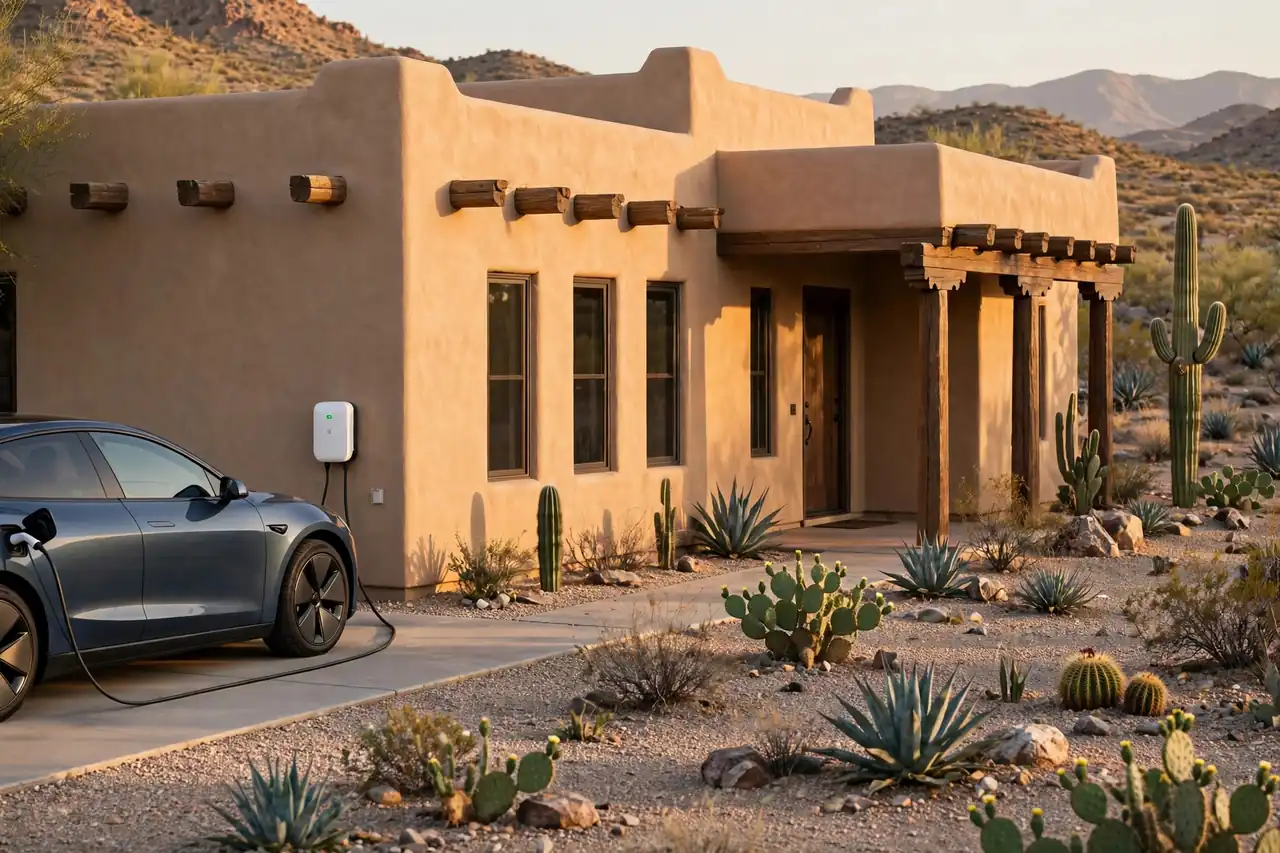
EV charging services in San Diego
The services below are ordered by what San Diego households most often need first, judged from the housing and fleet facts on this page. The full menu follows in the grid — every service is offered in this metro.
Home EV Charger Installation in San Diego
Start to finish, the domestic install is a half-day of electrical work wrapped in a week of scheduling: the survey, the circuit, the mounting, the configuration, the inspection. What the household experiences is simpler — a car that is full every morning and a cable that lives where the car does.
In San Diego: the install San Diego's new EV households book first, and the one the rest of this page keeps returning to.
Dedicated Circuit & Electrical Panel Upgrade in San Diego
When the arithmetic says the service is full, this is the enabling job: a larger panel, or a new dedicated circuit with capacity planned in, done under the same permit umbrella as the charger it feeds. It is also the upgrade the rest of the house quietly benefits from for decades.
In San Diego: relevant in San Diego wherever a 100-amp panel already carries cooking, heating and hot water before a charger asks for room.
Multifamily & Condo EV Charging in San Diego
The building version of the home job, with a governance layer on top. Boards approve complete applications; residents pay for their own energy through the metering design; the building's capacity is shared by management rather than by argument. That system is what this service installs.
In San Diego: the service behind the law section below — boards, applications and shared electrical capacity in San Diego buildings.
Utility programs and electricity in San Diego
Electricity in San Diego comes from Pacific Gas & Electric Co.. Parts of the wider metro are served by Southern California Edison Co, San Diego Gas & Electric Co, Imperial Irrigation District. The utility matters twice over for a charger install: it sets the time-of-use rates that decide what overnight charging costs you, and it is the organisation that may — or may not — currently help pay for the equipment.
Do not budget for a rebate in San Diego right now. As of the sources checked for this page, Pacific Gas & Electric Co. publishes no residential charger rebate, California offers no state program for typical home installs, and the federal 30C credit ended on September 30, 2025. If that changes, the utility's program page will say so with an as-of date — and this page will be updated to match. Until then, judge quotes on the work itself.
Before the install, it is worth a two-minute look at your tariff. Many Pacific Gas & Electric Co. customers can move to a time-of-use plan where overnight energy is charged at a lower rate, and a scheduled charger makes that saving automatic.
Condos, HOAs and the law in California
An association in California cannot simply say no. The right-to-charge law recorded for this state (Civ. Code §4745; §1947.6 (renters)) entitles an owner to install charging equipment for their own vehicle in their own parking space, subject to reasonable association conditions on placement, insurance and eventual restoration. For a San Diego owner, the practical consequence is that the application is a compliance exercise — equipment, circuit, paperwork — rather than a popularity contest at a board meeting.
Two practical corollaries follow for San Diego owners. First, assigned spaces are the clean case: the statute's protection is clearest where the parking is deeded or exclusively assigned. Second, insurance conditions are real but bounded — if a board's requirement looks invented, asking for its basis in the statute is a reasonable, usually decisive, question.
The step-by-step version lives in our guide to installing an EV charger in a condo or HOA community — the application sequence, the metering designs and the questions boards ask, in order.
Climate, garages and charger placement
Storm seasons punctuate the year here, and the installation's weather manners are set at mounting time: enclosures sealed as listed, exterior runs pitched so water travels away from entries, and a station position that the roof's drip line does not cross. Five minutes of the site visit, decades of consequence.
Garages in this region do double duty across the year — summer's workshop, winter's storage — and the charger competes for wall space with all of it. Mounting height, cable reach and a holster placed for the car's real parking position decide whether the station is used daily or negotiated with. The installer who measures the car in place is designing for the household you actually are.

Permits and inspection in San Diego
What the inspector is checking, in plain terms: conductor size against breaker size, the continuous-load calculation, terminations torqued, protection where the code wants it, and a station whose settings match the circuit it landed on. It is a short visit that validates everything you cannot see.
Neighbourhoods and ZIP codes served
The page covers 76 ZIP codes in and around San Diego — including 92101, 92102, 92103, 92104, 92105, 92106, 92107, 92108, 92109, 92110, 92111, 92112, 92113, 92114, 92115, 92116, 92117, 92119, 92120, 92121, 92122, 92123, 92124, 92126, 92127, 92128, 92129, 92130, 92131, 92132, 92134, 92135, 92136, 92137, 92138, 92139, 92140, 92142, 92145, 92147, 92149, 92150, 92152, 92153, 92154, 92155, 92158, 92159, 92160, 92161, 92163, 92165, 92166, 92167, 92168, 92169, 92170, 92171, 92172, 92174 — across San Diego. If your ZIP is not in the first set shown, ask anyway: installer coverage follows the metro, not a postcode fence.
The same working area takes in the neighbouring localities of Coronado, National City, Chula Vista, Lemon Grove, La Mesa, Bonita, Spring Valley, Imperial Beach, La Jolla, El Cajon, San Ysidro, Santee, Lakeside, Del Mar — the county ring an installer based in San Diego actually drives. Requests from those communities route exactly as city requests do: same services, same permit discipline, same local facts where they differ.
San Diego County accounts for 182 of the ZIP codes and 51 named postal localities in the research file, the nearest of them Coronado, National City, Chula Vista, Lemon Grove, La Mesa. The survey counts 3,288,774 residents in the county, with a median household income of $106,268 and a median home value of $854,700. Measured across its ZIP codes, the San Diego footprint runs about 31 miles north to south and 13 east to west, from ZIP 92101 to 92199 — the ground an installer based here actually covers in a working week.
Beyond the county seats, the working area takes in Coronado, National City, Chula Vista, Lemon Grove, La Mesa, Bonita, Spring Valley, Imperial Beach, La Jolla, El Cajon, San Ysidro, Santee, Lakeside, Del Mar, Rancho Santa Fe, Jamul, Poway, Solana Beach, Cardiff By The Sea, Encinitas, Alpine, Dulzura, Escondido, Carlsbad, Ramona, San Marcos, Tecate, Vista, Potrero, Descanso, Oceanside, Guatay, San Luis Rey, Pine Valley, Campo, Valley Center, Camp Pendleton, Santa Ysabel, Bonsall, Julian, Pauma Valley, Mount Laguna, Palomar Mountain — the named localities for which San Diego is the nearest metro in the network (neighbouring metros' pages cover their own ground), each routing to the same installer-matching service.
The largest communities in that working area after San Diego itself, by the GeoNames populated-place file: Chula Vista (population 265,757), Oceanside (population 175,691), Escondido (population 151,038), Carlsbad (population 114,746), El Cajon (population 103,679), Vista (population 100,890), San Marcos (population 92,931), Mira Mesa (population 70,000), Encinitas (population 62,930), National City (population 61,060), La Mesa (population 60,089), Rancho Penasquitos (population 60,000), Santee (population 57,787), Poway (population 50,157), La Jolla (population 42,808), La Presa (population 34,169), Spring Valley (population 28,205), Imperial Beach (population 27,408), Lemon Grove (population 26,709), Coronado (population 24,812). Charging demand follows those populations — the subdivisions and town centres where the next driveways, and the next panels, are.
| ZIP | Locality | County |
|---|---|---|
| 92101 | San Diego | San Diego |
| 92112 | San Diego | San Diego |
| 92135 | San Diego | San Diego |
| 92138 | San Diego | San Diego |
| 92142 | San Diego | San Diego |
| 92147 | San Diego | San Diego |
| 92149 | San Diego | San Diego |
| 92150 | San Diego | San Diego |
| 92152 | San Diego | San Diego |
| 92153 | San Diego | San Diego |
| 92158 | San Diego | San Diego |
| 92159 | San Diego | San Diego |
| 92160 | San Diego | San Diego |
| 92163 | San Diego | San Diego |
| 92165 | San Diego | San Diego |
| 92166 | San Diego | San Diego |
| 92167 | San Diego | San Diego |
| 92168 | San Diego | San Diego |
| 92169 | San Diego | San Diego |
| 92170 | San Diego | San Diego |
| 92171 | San Diego | San Diego |
| 92172 | San Diego | San Diego |
| 92174 | San Diego | San Diego |
| 92175 | San Diego | San Diego |
| 92176 | San Diego | San Diego |
| 92177 | San Diego | San Diego |
| 92179 | San Diego | San Diego |
| 92186 | San Diego | San Diego |
| 92187 | San Diego | San Diego |
| 92190 | San Diego | San Diego |
| 92191 | San Diego | San Diego |
| 92192 | San Diego | San Diego |
| 92193 | San Diego | San Diego |
| 92195 | San Diego | San Diego |
| 92196 | San Diego | San Diego |
| 92197 | San Diego | San Diego |
| 92198 | San Diego | San Diego |
| 92134 | San Diego | San Diego |
| 92103 | San Diego | San Diego |
| 92102 | San Diego | San Diego |
| 92104 | San Diego | San Diego |
| 92178 | Coronado | San Diego |
| 92118 | Coronado | San Diego |
| 92140 | San Diego | San Diego |
| 92113 | San Diego | San Diego |
| 92199 | San Diego | San Diego |
| 92136 | San Diego | San Diego |
| 92155 | San Diego | San Diego |
| 92116 | San Diego | San Diego |
| 92106 | San Diego | San Diego |
| 92110 | San Diego | San Diego |
| 92105 | San Diego | San Diego |
| 91951 | National City | San Diego |
| 92108 | San Diego | San Diego |
| 91950 | National City | San Diego |
| 92107 | San Diego | San Diego |
| 92132 | San Diego | San Diego |
| 92111 | San Diego | San Diego |
| 92123 | San Diego | San Diego |
| 92115 | San Diego | San Diego |
| 92114 | San Diego | San Diego |
| 92182 | San Diego | San Diego |
| 92139 | San Diego | San Diego |
| 91909 | Chula Vista | San Diego |
| 91912 | Chula Vista | San Diego |
| 91921 | Chula Vista | San Diego |
| 92109 | San Diego | San Diego |
| 91945 | Lemon Grove | San Diego |
| 92120 | San Diego | San Diego |
| 91946 | Lemon Grove | San Diego |
| 92117 | San Diego | San Diego |
| 91910 | Chula Vista | San Diego |
| 92124 | San Diego | San Diego |
| 91943 | La Mesa | San Diego |
| 91944 | La Mesa | San Diego |
| 91908 | Bonita | San Diego |
| 91902 | Bonita | San Diego |
| 91941 | La Mesa | San Diego |
| 91977 | Spring Valley | San Diego |
| 91942 | La Mesa | San Diego |
| 91976 | Spring Valley | San Diego |
| 91979 | Spring Valley | San Diego |
| 92119 | San Diego | San Diego |
| 91911 | Chula Vista | San Diego |
| 92137 | San Diego | San Diego |
| 91933 | Imperial Beach | San Diego |
| 91932 | Imperial Beach | San Diego |
| 92122 | San Diego | San Diego |
| 92037 | La Jolla | San Diego |
| 91913 | Chula Vista | San Diego |

Planning the install: from panel to parking
A useful way to read any San Diego quote is to ask which of three jobs it describes. Job one: the panel has room and the run is short — a circuit and a station. Job two: the panel is full — capacity work joins the quote, as an upgrade or as load management. Job three: the property adds people — an HOA, a landlord, a building's shared service — and the approvals timeline joins the electrical one. None of the three is a bad job; they are simply different scopes, and a clear quote says which one you are in.
Finally, photograph the finished work — station, nameplate, panel directory with the new breaker labelled — and file it with the inspection record. When the car changes, the house sells or a second station joins the first, that folder is the difference between a five-minute answer and an archaeological dig.
Home charging know-how for San Diego households
Looking after a charging station
A wall charger asks little: a connector kept holstered and clean, a cable un-kinked, an enclosure whose seals survive, and an owner who notices change — a new hum, a warmer plug, a trip that was not happening last season. Firmware updates arrive through the station's connection where it has one. Once a year, a glance at the connector's contacts for wear or discolouration covers most of the rest. It is infrastructure, not a pet: the correct amount of attention is small, regular, and mostly visual.
What commissioning actually includes
Commissioning is the install's final examination, and it has a syllabus: torque verified on the terminations, the station's output configured to the circuit rather than the nameplate, the network connection and schedule set with the household present, a test session run and observed, the paperwork handed over. Households sometimes mistake it for ceremony. It is the opposite — it is the moment latent errors cost least to fix, with the installer still in the driveway and the tools still out.
Single-phase, three-phase, and your house
Home charging runs on the same single-phase service as the rest of the house — the 240 volts between the two legs of a standard residential service — and everything in the domestic sections of this site assumes exactly that. Three-phase power belongs to commercial and industrial buildings, where it changes the design of larger installations and the arithmetic of their load management. The distinction matters only when a quote crosses the two worlds: a household needs no three-phase anything, and a depot cannot plan without it. Knowing which world your property lives in keeps the conversation honest in both directions.
The driveway is shared infrastructure
In households where the charger serves a shared driveway, the install acquires a social protocol alongside its electrical one: whose night, which side, how the cable crosses, what happens when guests park across the route. The designs that work settle the protocol physically — a station reachable from both bays, a cable path that crosses no one's door swing — rather than relying on nightly negotiation. Infrastructure that requires diplomacy every evening was under-designed in the morning.
Cable discipline: the daily five seconds
The connector and cable are the parts of the installation you touch twice a day, and they age by handling rather than by electricity. The habits that matter are small: the connector returns to its holster rather than the floor, the cable hangs in a loose loop rather than a kinked coil, the run never crosses the path of the other car's door swing or the bins' weekly journey. Drive-over is the cable's particular enemy — route so that tyres never cross it. Five seconds of discipline per park is the whole maintenance philosophy of the visible half of the system.

Frequently asked questions
What happened to the federal home-charger credit in San Diego, CA?
Checked and dated: in the sources reviewed for this page, Pacific Gas & Electric Co. runs no residential charger rebate, California runs no home-charger programme, and the federal credit that once filled the gap ended on September 30, 2025. If a salesperson's spreadsheet shows a rebate line for a San Diego install, the published programme page is the only acceptable evidence.
What can my HOA in San Diego, CA do about a charger install?
California law (Civ. Code §4745; §1947.6 (renters)) limits that: associations cannot prohibit an owner's charger outright, though they can impose reasonable conditions on placement, insurance and restoration, and the owner pays for the installation. The process section above walks through it.
Will my San Diego, CA home need a panel upgrade for a Level 2 charger?
It depends on the panel, and San Diego's housing makes the question common: the median home here was built in 1980, and about 50% of housing units predate 1980. Homes with 100-amp service that is already well used often need an upgrade or a load-management device; homes with 200-amp service and spare breaker space usually do not. A load calculation during the site visit settles it — ask to see it.
How much faster is Level 2 charging at home in San Diego, CA?
Level 1 — the cord in the boot, on a normal outlet — returns about 3–5 miles of range an hour. Level 2 on its own 240-volt circuit returns roughly 25–40. A San Diego commuter who parks at seven and leaves at seven stops doing battery arithmetic entirely.
What happens next after I send a request?
Send the request and it is matched against installers covering San Diego — your service, ZIP, property type and timing travel with it. An installer then arranges the site visit and quotes in writing. Our role ends at the introduction; your contract, permit and paperwork are with the installer.
Do installers cover the communities around San Diego, CA?
They do. Coverage follows the metro: Coronado, National City, Chula Vista, Lemon Grove, La Mesa and their neighbouring communities are worked by the same installers who cover San Diego itself, and a request from those ZIP codes routes identically — service, property type and timing are all the form asks for.
Nearby cities in California
- EV charger installation in El Centro — about 88 miles from San Diego, metro population 180,000
- EV charger installation in Riverside — about 89 miles from San Diego, metro population 4,700,000
- EV charger installation in Los Angeles — about 105 miles from San Diego, metro population 13,200,000
- EV charger installation in Oxnard — about 152 miles from San Diego, metro population 850,000
- EV charger installation in Santa Barbara — about 183 miles from San Diego, metro population 450,000
- EV charger installation in Bakersfield — about 211 miles from San Diego, metro population 925,000
- EV charger installation in Yuma, AZ — about 139 miles from San Diego, metro population 205,000
- EV charger installation in Lake Havasu City, AZ — about 197 miles from San Diego, metro population 215,000
- EV charger installation in Las Vegas, NV — about 263 miles from San Diego, metro population 2,300,000
Ready to charge at home in San Diego?
Send the essentials — what you need, where, and what kind of property — and a licensed local installer will pick it up from there.