EV Charger Installation in Los Angeles, CA
Everything a Los Angeles homeowner needs before booking a charger install — the panel question, the utility's current programs, the HOA law and the permit — sourced, dated and local.
Start from the meter. Every home charger in Los Angeles is, underneath the hardware, an arrangement between a car, a panel and California's electricity supply — and the households that arrange it well do so in that order. Los Angeles itself is home to about 3,878,718 people, in a state whose registered fleet reached 1,843,100 battery-electric vehicles and 490,900 plug-in hybrids by the end of 2025. This page works outward from the meter: the utility that serves your street and whether it currently funds charger installs, the association law that governs shared buildings, the permit counter's expectations, and the housing numbers that predict your panel's mood. Read it before the quotes, and the quotes get shorter.
A note on what PlugReady USA is and is not: we publish the local research and run the matching; the installation itself belongs to licensed electricians and installer companies working in Los Angeles. Everything below is written so you can hold your own in that conversation — numbers first, sales language nowhere.
Measured demand, not enthusiasm, put Los Angeles in Tier A of this network: Experian No. 1: 164K+ new EV registrations 2025; CA = 1.84M BEVs; right-to-charge state. For a homeowner the useful translation is simpler — installers here do this work weekly, know the local permit counter, and have seen your housing stock before.
Read the survey numbers as an installer reads them. A median household income of $82,263 and an owner-occupation rate of 36% describe a city where most charger decisions are made by the person who owns the panel — no landlord layer, no board layer for the typical job. The 36% of homes that are single-unit detached are the straightforward installs: garage or driveway, one owner, one circuit.

Put the survey together and Los Angeles's charging profile reads like this: an older housing fabric, where panel archaeology is a normal part of the first visit; a genuinely mixed city — houses, townhouses and larger buildings all carry weight; buildings of five or more units hold a substantial share of homes, which keeps the multifamily sections of this page in daily use; and renters form a large share of households, so the landlord conversation is a first-class topic here. That combination — more than any single number — is what the installers working here plan around, and it is the lens for everything on this page.
In absolute terms, the survey counts 1,587,311 housing units in Los Angeles — 1,480,869 occupied, 531,430 of them by their owners. The stock resolves into 565,981 single-unit detached houses, 1,092,749 homes standing since before 1980, and 770,531 units in larger buildings. Those six counts are the city's charging map drawn without percentages, and every section of this page is a consequence of one of them. The page's geography is equally concrete: 94 ZIP codes across Los Angeles, centred near 33.97 degrees north latitude. The city anchors the Los Angeles–Long Beach–Anaheim metropolitan area, home to roughly 13,200,000 people on the research file's metro estimate — the wider labour and housing market this page's installers work across.
The same survey release fills in the household economics around the housing stock: a median home value of $947,900, median gross rent of $1,958, per-capita income of $48,230, and a median resident age of 38. How the city moves completes the picture: 62% of Los Angeles workers drive to work alone — the commute pattern home charging is built around; 16% work from home, a population whose cars charge on daytime and overnight schedules alike; 6% commute by public transit; 40% of adults hold a bachelor's degree or higher. And the fleet in the driveways: 590,846 households in Los Angeles have exactly one vehicle, 711,877 have two or more, and 178,146 have none.
Two burden statistics frame the economics: in Los Angeles, 56% of renters and 0% of mortgage-holding owners are housing-cost burdened at the standard 30% threshold. And 57% of households are family households, the segment most likely to run the two-vehicle, two-schedule pattern the second-vehicle planning notes address.
This is the context an installer works against, whether it is written down or not. A stock this old wires its history into the walls: cloth-wrapped conductors in the deepest streets, fuse boxes that outlived their century, panels added in layers by generations of electricians each solving their own decade's problem. The renter-and-condo share makes the law section of this page load-bearing: statutory rights, application windows and metering rules are not fine print here, they are the project's first phase.
Where renting dominates, the successful install is a document before it is a device — installer licence, insurance, metering clarity, end-of-tenancy position — assembled to make a landlord's yes the path of least resistance. Here the tariff conversation is a budget conversation: the overnight window's arithmetic, done honestly once, pays out every night of the car's life without further attention. A municipal utility changes the texture of local charging politics: the programme office, the rate design and the permit counter all answer, ultimately, to the same public — and public meetings are where charging programmes here are born and funded.
At this fleet volume the questions mature: not whether to install, but how the second circuit shares capacity, how buildings retrofit at scale, how the grid's evening ramp is managed street by street. In a market this size the matching problem inverts: not finding an installer, but filtering — licence, charging specialism, diary, and references from your own quadrant of the metro. Where the state's statute speaks, the local conversation changes register: installers quote the framework, boards keep counsel's template, and approvals become administrative.
The electrical reality in Los Angeles homes
The Census Bureau's latest American Community Survey puts the median Los Angeles home's build year at 1965: about 69% of the city's housing units were built before 1980, 36% are single-unit detached houses, and 36% of occupied homes are owner-occupied. Those three numbers predict most of what an installer will find. Age shows up electrically before it shows up anywhere else: services sized for a house with a third of today's appliances. Expect the first conversation to be about capacity — what the panel is, what it already feeds, and which of the three routes (circuit, management, upgrade) your numbers support. Attics, basements and interior panel locations are common in this vintage of stock, which is why the run's route gets its own line in any serious quote: distance and finish decide labour more than the charger does.
The fuel table adds one more local fact: 513,365 Los Angeles homes — 35% of the stock — heat with electricity. Those households already think in kilowatts through the winter, their panels carry the load to prove it, and a charger's overnight appetite joins a system that is, in the useful sense, already electrified.
One further split matters for how this page is organised: about 949,439 of Los Angeles's occupied homes are renter-occupied. Everything above assumes you can approve your own electrical work; where you cannot, the approval layer — landlord or association — becomes part of the job, which is why the law section carries unusual weight here.
The city's stock is not all houses: 49% of units are in structures of five or more. Shared buildings mean shared panels, assigned parking and association process — the substance of the multifamily sections below.
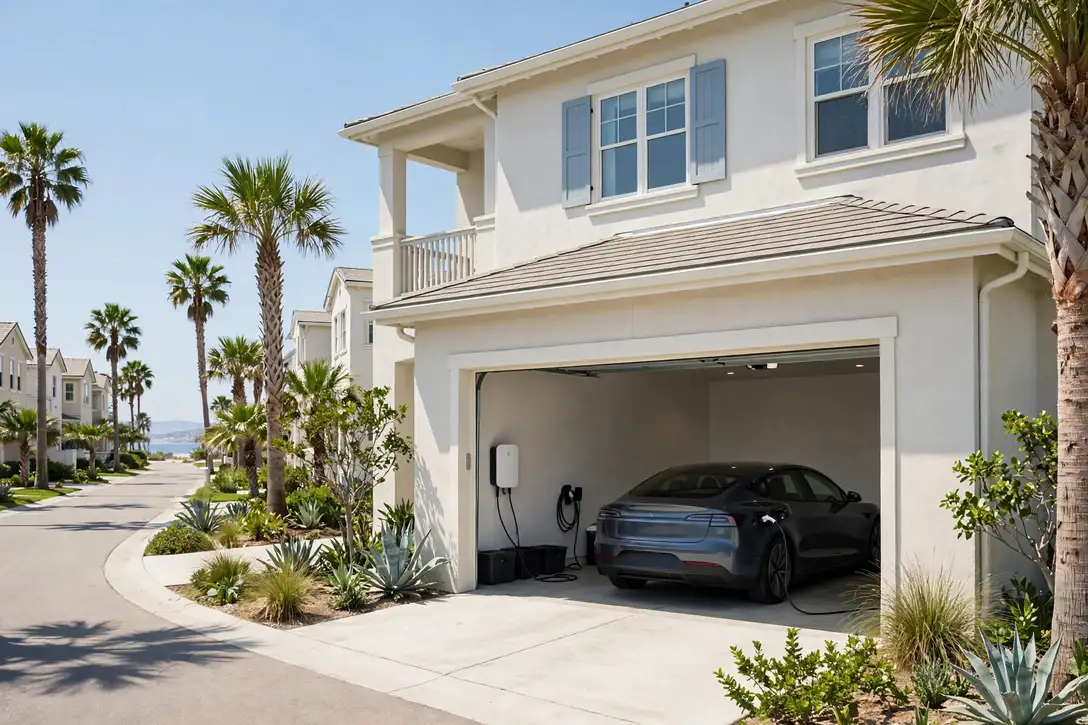
EV charging services in Los Angeles
Installers in Los Angeles book the same ten services as everywhere — but not in the same proportions. The three leading cards below are this city's pattern, set by its panels, its buildings and its statute book.
Home EV Charger Installation in Los Angeles
For most households this is the whole project: a Level 2 station mounted where the car sleeps, fed by its own 240-volt circuit. The visit pattern is consistent — load calculation, route the run, mount and configure, inspect — and the variables are your panel, your parking and your permit office.
In Los Angeles: the default first install for Los Angeles's EV households — a station where the car already parks.
Dedicated Circuit & Electrical Panel Upgrade in Los Angeles
The capacity project behind the charger project. A load calculation decides whether the answer is a service increase, a panel replacement, a subpanel or load management — and the work is sequenced with the utility and the inspector so the house is live again the same day in most cases.
In Los Angeles: service work that turns 'no room' into a circuit with headroom in Los Angeles homes.
Multifamily & Condo EV Charging in Los Angeles
In a multifamily building the charger is the easy half. The craft is the route to yes: a complete board application, a metering design that bills the right owner, load management that shares the building's capacity, and only then the circuit. Installers who do this work weekly carry the paperwork templates with them.
In Los Angeles: constitutions for shared charging in Los Angeles buildings: metering, load and approvals.
Utility programs and electricity in Los Angeles
Electricity in Los Angeles comes from Los Angeles Department of Water and Power (LADWP). Parts of the wider metro are served by Southern California Edison Co, Los Angeles Department of Water & Power, City of Glendale. The utility matters twice over for a charger install: it sets the time-of-use rates that decide what overnight charging costs you, and it is the organisation that may — or may not — currently help pay for the equipment.
Current program (verified 2026-10-26): Los Angeles Department of Water and Power (LADWP) runs the LADWP Residential EV Charger Rebate Program (Charge Up LA!) — Up to $1,000 toward the purchase and installation of a qualified Level 2 home charger for LADWP residential account holders; income-qualified Lifeline and EZ-SAVE customers receive an additional $500 (up to $1,500 total); a further $250 rebate applies when a dedicated EV meter is installed. Program terms and funding status are published by the utility; check the current status before you plan around it, because funded programs close when their budgets run out. Source: LADWP's published program terms on ladwp.com, read in October 2026.
While you are reading your tariff, check how your plan treats the evening peak. A charger scheduled to start after the peak window is the single easiest saving in home charging, and it is set once, in the car or the station, then forgotten.
Condos, HOAs and the law in California
Charging is a protected right for association owners in California. The state's right-to-charge statute (Civ. Code §4745; §1947.6 (renters)) stops a homeowners association or condominium from banning an owner's charging station outright. Conditions still exist — placement, appearance, insurance and restoration can all be regulated, and the owner pays — yet the starting position is yes-with-rules rather than no-unless-persuaded, and that difference decides most applications before they are written.
Owners in Los Angeles should also know the statute travels with the space, not the car: a documented installation, permitted and recorded, stays an asset of the unit when it sells — one more reason the paperwork deserves the same care as the wiring.
Start with the condo and HOA guide for the application itself, and the multifamily service page for how the electrical design is usually laid out in California buildings.
Climate, garages and charger placement
Los Angeles pairs a mild coastal basin with inland valleys that run far hotter in summer, so garage ventilation and charger placement differ sharply between neighbourhoods a few miles apart.
The basin's older housing stock — a large share of Los Angeles homes predate 1980 — frequently has 100-amp or smaller electrical service, which makes the panel the deciding factor in many installs.
Local notes: charging in Los Angeles
Los Angeles is really several charging markets wearing one name. The coastal basin's mild weather is kind to batteries and equipment; the San Fernando and San Gabriel valleys run hotter, denser and older in their housing; and the city's sheer spread means installer coverage is organised by district, not by the city limit. When this page says Los Angeles, it means the city and its neighbourhoods — the metro beyond them has its own pages in this network.
The city's other local fact is its patchwork of utilities beyond LADWP's borders: neighbouring cities run their own municipal departments — Burbank, Glendale, Pasadena and Anaheim among them — each with its own program page. Homeowners near a city boundary should confirm which utility actually serves the address before assuming the program described here applies.

Permits and inspection in Los Angeles
In Los Angeles, the permitting authority for this work is the Los Angeles Department of Building and Safety (LADBS). A new dedicated 240-volt circuit for a charger requires an electrical permit from LADBS, with inspection after installation. Installations in condominiums and homeowners-association communities interact with California Civil Code §4745, summarised in the law section of this page.
Timelines are set by the city's counter, not the installer: the electrical work itself is typically a day, while permit issuance and the inspection visit follow the department's queue. A quote that promises a date should tell you which parts of that date the installer actually controls.
Los Angeles runs two counters for this work and homeowners meet both: LADBS for the building permit and inspection, and LADWP when the service itself needs attention — a panel upgrade that changes the service drop, for example, is coordinated with the utility, not just the city. Experienced local installers sequence the two so the inspection and any utility visit land in the right order, which is most of what 'knowing a city' means in practice.

Neighbourhoods and ZIP codes served
- Downtown Los Angeles
- Hollywood
- Silver Lake
- Los Feliz
- Highland Park
- Eagle Rock
- Sherman Oaks
- Studio City
- North Hollywood
- Encino
- Woodland Hills
- Westwood
- Brentwood
- Venice
- Mar Vista
- Koreatown
- Boyle Heights
- San Pedro
The page covers 94 ZIP codes in and around Los Angeles — including 90001, 90002, 90003, 90004, 90005, 90006, 90007, 90008, 90009, 90010, 90011, 90012, 90013, 90014, 90015, 90016, 90017, 90018, 90019, 90020, 90021, 90022, 90023, 90024, 90025, 90026, 90027, 90028, 90029, 90030, 90031, 90032, 90033, 90034, 90035, 90036, 90037, 90038, 90039, 90040, 90041, 90042, 90043, 90044, 90045, 90046, 90047, 90048, 90049, 90050, 90051, 90052, 90053, 90054, 90055, 90056, 90057, 90058, 90059, 90060 — across Los Angeles. If your ZIP is not in the first set shown, ask anyway: installer coverage follows the metro, not a postcode fence.
The same working area takes in the neighbouring localities of Huntington Park, South Gate, Bell, Maywood, Lynwood, Compton, Inglewood, Bell Gardens, Gardena, Downey, Dodgertown, Hawthorne, Paramount, Carson — the county ring an installer based in Los Angeles actually drives. Requests from those communities route exactly as city requests do: same services, same permit discipline, same local facts where they differ.
The City of Los Angeles is served by its municipal utility, the Los Angeles Department of Water and Power (LADWP). Parts of the wider metro — including much of the San Fernando Valley's neighbouring cities and the Inland Empire — are Southern California Edison territory.
Los Angeles County accounts for 508 of the ZIP codes and 133 named postal localities in the research file, the nearest of them Huntington Park, South Gate, Bell, Maywood, Lynwood. The survey counts 9,808,667 residents in the county, with a median household income of $90,112 and a median home value of $834,200. Measured across its ZIP codes, the Los Angeles footprint runs about 24 miles north to south and 18 east to west, from ZIP 90001 to 90189 — the ground an installer based here actually covers in a working week.
Beyond the county seats, the working area takes in Huntington Park, South Gate, Bell, Maywood, Lynwood, Compton, Inglewood, Bell Gardens, Gardena, Downey, Dodgertown, Hawthorne, Paramount, Carson, Montebello, Lawndale, Torrance, Pico Rivera, Long Beach, Culver City, Monterey Park, Bellflower, Alhambra, Santa Fe Springs, El Segundo, Beverly Hills, Redondo Beach, Playa Vista, Whittier, Lakewood, Manhattan Beach, Norwalk, Playa Del Rey, South Pasadena, West Hollywood, Rosemead, Hermosa Beach, Marina Del Rey, Glendale, San Gabriel, Artesia, Venice, Pasadena, Cerritos, Harbor City, Signal Hill, South El Monte, Santa Monica, San Marino, Universal City, Lomita, Wilmington, San Pedro, Toluca Lake, La Mirada, El Monte, Hawaiian Gardens, North Hollywood, Temple City, Studio City, Burbank, La Palma, Arcadia, La Puente, Los Alamitos, Valley Village, Buena Park, Hacienda Heights, Cypress, La Canada Flintridge, Palos Verdes Peninsula, Sherman Oaks, Montrose, Altadena, Pacific Palisades, City Of Industry, Verdugo City, Rancho Palos Verdes, La Habra, Sierra Madre, La Crescenta, Seal Beach, Fullerton, Garden Grove, Van Nuys, Baldwin Park, Monrovia, Encino, Sun Valley, West Covina, Stanton, Anaheim, Duarte, Surfside, Rowland Heights, Tujunga, Westminster, Mount Wilson, Brea, Sunset Beach, Sunland, Panorama City, Covina, Huntington Beach, Tarzana, Walnut, Midway City, Topanga, Pacoima, Azusa, North Hills, Reseda, Placentia, Mission Hills, Woodland Hills, Northridge, San Fernando, Orange, Atwood, Yorba Linda, Glendora, Diamond Bar, Winnetka, Santa Ana, Fountain Valley, Canoga Park, Calabasas, Sylmar, Granada Hills, San Dimas, Villa Park, West Hills, Porter Ranch, Chatsworth, Costa Mesa, Tustin, Newport Beach, Irvine, Aliso Viejo, Palmdale, Newhall, Canyon Country, Corona Del Mar, Santa Clarita, Valencia, Newport Coast, Acton, Pearblossom, Littlerock, Avalon — the named localities for which Los Angeles is the nearest metro in the network (neighbouring metros' pages cover their own ground), each routing to the same installer-matching service.
The wider working area also reaches Pomona, Malibu, La Verne, Chino Hills, Agoura Hills, Claremont, Chino, Oak Park, Brandeis, Ontario, Westlake Village, Simi Valley, Upland, Thousand Oaks, Corona, Guasti, Rancho Cucamonga, Laguna Woods, Foothill Ranch, Silverado, Lake Forest, El Toro, Laguna Beach, Newbury Park, Valyermo, Mira Loma, Moorpark, Castaic, Trabuco Canyon, Riverside, Rancho Santa Margarita, Laguna Niguel, Fontana, Wrightwood, Camarillo — ground shared with neighbouring metros, where installers cross the same county lines in both directions.
ZIP codes in that shared ground include 91301, 91319, 91320, 91360, 91361, 91377, 91709, 91729, 91737, 91750, 91761, 91763, 91764, 91769, 91784, 92331, 92397, 92602, 92603, 92652, 92653, 92654, 92656, 92678, 92690, 92691, 92692, 92823, 92862, 92869, 92879, 92881, 92882, 92886, 92887, 93020, 93021, 93064, 93099, 93563.
The largest communities in that working area after Los Angeles itself, by the GeoNames populated-place file: Long Beach (population 474,140), Anaheim (population 350,742), Santa Ana (population 310,227), Irvine (population 256,927), Huntington Beach (population 201,899), Glendale (population 201,020), Santa Clarita (population 182,371), Garden Grove (population 175,393). Charging demand follows those populations — the subdivisions and town centres where the next driveways, and the next panels, are.
| ZIP | Locality | County |
|---|---|---|
| 90001 | Los Angeles | Los Angeles |
| 90003 | Los Angeles | Los Angeles |
| 90002 | Los Angeles | Los Angeles |
| 90255 | Huntington Park | Los Angeles |
| 90011 | Los Angeles | Los Angeles |
| 90058 | Los Angeles | Los Angeles |
| 90044 | Los Angeles | Los Angeles |
| 90037 | Los Angeles | Los Angeles |
| 90059 | Los Angeles | Los Angeles |
| 90280 | South Gate | Los Angeles |
| 90202 | Bell | Los Angeles |
| 90047 | Los Angeles | Los Angeles |
| 90270 | Maywood | Los Angeles |
| 90061 | Los Angeles | Los Angeles |
| 90062 | Los Angeles | Los Angeles |
| 90021 | Los Angeles | Los Angeles |
| 90262 | Lynwood | Los Angeles |
| 90222 | Compton | Los Angeles |
| 90305 | Inglewood | Los Angeles |
| 90007 | Los Angeles | Los Angeles |
| 90023 | Los Angeles | Los Angeles |
| 90043 | Los Angeles | Los Angeles |
| 90014 | Los Angeles | Los Angeles |
| 90013 | Los Angeles | Los Angeles |
| 90015 | Los Angeles | Los Angeles |
| 90303 | Inglewood | Los Angeles |
| 90201 | Bell Gardens | Los Angeles |
| 90018 | Los Angeles | Los Angeles |
| 90040 | Los Angeles | Los Angeles |
| 90189 | Los Angeles | Los Angeles |
| 90009 | Los Angeles | Los Angeles |
| 90030 | Los Angeles | Los Angeles |
| 90050 | Los Angeles | Los Angeles |
| 90051 | Los Angeles | Los Angeles |
| 90052 | Los Angeles | Los Angeles |
| 90053 | Los Angeles | Los Angeles |
| 90054 | Los Angeles | Los Angeles |
| 90055 | Los Angeles | Los Angeles |
| 90060 | Los Angeles | Los Angeles |
| 90070 | Los Angeles | Los Angeles |
| 90072 | Los Angeles | Los Angeles |
| 90074 | Los Angeles | Los Angeles |
| 90075 | Los Angeles | Los Angeles |
| 90076 | Los Angeles | Los Angeles |
| 90078 | Los Angeles | Los Angeles |
| 90080 | Los Angeles | Los Angeles |
| 90081 | Los Angeles | Los Angeles |
| 90082 | Los Angeles | Los Angeles |
| 90083 | Los Angeles | Los Angeles |
| 90084 | Los Angeles | Los Angeles |
| 90086 | Los Angeles | Los Angeles |
| 90087 | Los Angeles | Los Angeles |
| 90088 | Los Angeles | Los Angeles |
| 90091 | Los Angeles | Los Angeles |
| 90093 | Los Angeles | Los Angeles |
| 90096 | Los Angeles | Los Angeles |
| 90099 | Los Angeles | Los Angeles |
| 90134 | Los Angeles | Los Angeles |
| 90071 | Los Angeles | Los Angeles |
| 90223 | Compton | Los Angeles |
| 90033 | Los Angeles | Los Angeles |
| 90006 | Los Angeles | Los Angeles |
| 90008 | Los Angeles | Los Angeles |
| 90017 | Los Angeles | Los Angeles |
| 90306 | Inglewood | Los Angeles |
| 90308 | Inglewood | Los Angeles |
| 90311 | Inglewood | Los Angeles |
| 90312 | Inglewood | Los Angeles |
| 90302 | Inglewood | Los Angeles |
| 90063 | Los Angeles | Los Angeles |
| 90301 | Inglewood | Los Angeles |
| 90012 | Los Angeles | Los Angeles |
| 90247 | Gardena | Los Angeles |
| 90022 | Los Angeles | Los Angeles |
| 90057 | Los Angeles | Los Angeles |
| 90249 | Gardena | Los Angeles |
| 90304 | Inglewood | Los Angeles |
| 90005 | Los Angeles | Los Angeles |
| 90221 | Compton | Los Angeles |
| 90010 | Los Angeles | Los Angeles |
| 90239 | Downey | Los Angeles |
| 90220 | Compton | Los Angeles |
| 90241 | Downey | Los Angeles |
| 90056 | Los Angeles | Los Angeles |
| 90090 | Dodgertown | Los Angeles |
| 90250 | Hawthorne | Los Angeles |
| 90248 | Gardena | Los Angeles |
| 90242 | Downey | Los Angeles |
| 90251 | Hawthorne | Los Angeles |
| 90016 | Los Angeles | Los Angeles |

Planning the install: from panel to parking
Walk the route before anyone quotes the route. Between Los Angeles's panels and its parking spaces lie the job's real variables: a finished ceiling or an open one, a straight shot through a shared wall or a tour of the attic, forty feet of conductor or a hundred and forty. Installers who quote from photographs quote the average of all routes; installers who walk yours quote the one you actually have. The site visit is where the quote stops being a genre and becomes a document.
One more piece of sequencing advice Los Angeles installers give consistently: if the panel is being opened anyway, settle the other electrical maybes in the same visit — the circuit you will want next year costs least while the permit and the electrician are already in the house.
Home charging know-how for Los Angeles households
Two-storey houses and the vertical run
In a two-storey house the panel often lives in a utility room, a laundry or a ground-floor wall far from the garage, and the circuit's path becomes a vertical problem: chases, soffits and floor cavities are the route's vocabulary. Experienced installers read a house's structure the way a plumber does — where the stacked walls are, which cavities run uninterrupted — and the quote follows that reading. Expect the site visit to include a look upstairs; the ceiling above the garage is part of the job.
Charging with an accessory dwelling
Houses with a second unit — a garage apartment, a granny flat, a rented studio — add a cast member to the charging design: another household. The questions multiply politely. Whose panel carries the circuit? Whose meter records the energy? Does the tenancy agreement mention the charger at all? None are hard questions, and all are cheaper answered at design time than at the first shared bill. Where the second unit has its own meter and panel, the design is simply two small domestic installs sharing an address.
Charging for guests
A home charger quietly becomes hospitality infrastructure: the visiting family's EV, the friend's road-trip top-up, the neighbour mid-renovation. Households handle it with varying ceremony — a standing offer, a holster left accessible, a note in the guest room. The electrical system does not care; the point is social. The charger joins the spare bed and the good coffee in the category of things a house offers the people it likes.
Household safety habits around the charger
A charging setup joins a household's ordinary safety landscape — the same category as the stove and the water heater: respected, listed, and left to do its job. The household habits are few. The cable lives off the floor where small feet and wheels travel; the connector is docked, not dangled; children learn the house rule that the charger is an appliance, not a toy, the way they learn the oven's. Nothing about a properly installed station asks for anxiety — just the standard respect electricity has always been owed.
Chargers and the flood line
Some garages flood — not catastrophically, just historically: the spring inch, the storm drain's bad day. The charger belongs above the line the water has actually reached, a fact the house knows and the install conversation should ask about. Mounting height, conduit entry points and the station's own listing all have flood-aware versions, and in the streets that need them, local installers raise the subject before the homeowner does.

Frequently asked questions
Is there a rebate for installing a home EV charger in Los Angeles, CA?
Yes — Los Angeles Department of Water and Power (LADWP)'s LADWP Residential EV Charger Rebate Program (Charge Up LA!) currently offers Up to $1,000 toward the purchase and installation of a qualified Level 2 home charger for LADWP residential account holders; income-qualified Lifeline and EZ-SAVE customers receive an additional $500 (up to $1,500 total); a further $250 rebate applies when a dedicated EV meter is installed (program details verified 2026-10-26; funded programs can close, so confirm current status when you book). The old federal 30C charger credit ended on September 30, 2025, and is not part of any current offer.
Can my HOA or condo board in Los Angeles, CA refuse my charger?
Not outright. Under Civ. Code §4745; §1947.6 (renters), California associations cannot prohibit an owner's charger; they can condition it — reasonably — on placement, insurance and restoration, with the owner funding the work. The disputes that do arise are usually about conditions, and they settle fastest when the application answers them in advance.
Does a Level 2 charger mean a panel upgrade for a Los Angeles, CA home?
Start from the median, then verify: the median Los Angeles home was built in 1965, and 69% of the stock predates 1980, so 100-amp panels are a normal sight here — and a normal candidate for either an upgrade or a load-management device. The load calculation distinguishes the two in one visit, and any quote that skips it is guessing with your money.
Do I need a permit to install an EV charger in Los Angeles, CA?
You do. The circuit is the permit: a dedicated 240-volt run is electrical work the Los Angeles Department of Building and Safety (LADBS) wants on file, with an inspection once the station is in. Expect your installer to handle the filing as a routine part of the install — and expect to keep the passed paperwork.
Level 1 or Level 2 in Los Angeles, CA — what is the real difference?
Think of it in parked hours. Level 1 gives you back 3–5 miles for each of them; Level 2 gives back about 25–40, set by the circuit's amperage and what the car can accept. Overnight, that is the gap between 'enough for tomorrow' and 'full, every morning'.
What happens next after I send a request?
Three things happen, in order. Your request is routed to licensed installers who work in Los Angeles; one of them contacts you to book a site visit; and the visit produces a written quote based on your actual panel and parking. PlugReady USA runs the matching, not the tools — the contractor on the job is the installer who visits.
Nearby cities in California
- EV charger installation in Riverside — about 49 miles from Los Angeles, metro population 4,700,000
- EV charger installation in Oxnard — about 54 miles from Los Angeles, metro population 850,000
- EV charger installation in Santa Barbara — about 86 miles from Los Angeles, metro population 450,000
- EV charger installation in San Diego — about 105 miles from Los Angeles, metro population 3,300,000
- EV charger installation in Bakersfield — about 106 miles from Los Angeles, metro population 925,000
- EV charger installation in San Luis Obispo — about 160 miles from Los Angeles, metro population 285,000
- EV charger installation in Yuma, AZ — about 218 miles from Los Angeles, metro population 205,000
- EV charger installation in Lake Havasu City, AZ — about 218 miles from Los Angeles, metro population 215,000
- EV charger installation in Las Vegas, NV — about 230 miles from Los Angeles, metro population 2,300,000
Ready to charge at home in Los Angeles?
Send the essentials — what you need, where, and what kind of property — and a licensed local installer will pick it up from there.