EV Charger Installation in Topeka, KS
Home Level 2 charging, panel upgrades and condo installs in Topeka — matched to licensed local installers, with the local facts that shape the job set out below.
Start from the meter. Every home charger in Topeka is, underneath the hardware, an arrangement between a car, a panel and Kansas's electricity supply — and the households that arrange it well do so in that order. Topeka itself is home to about 125,475 people, in a state whose registered fleet reached 18,700 battery-electric vehicles and 7,800 plug-in hybrids by the end of 2025. This page works outward from the meter: the utility that serves your street and whether it currently funds charger installs, the association law that governs shared buildings, the permit counter's expectations, and the housing numbers that predict your panel's mood. Read it before the quotes, and the quotes get shorter.
How PlugReady USA works, in one breath: you describe the job once, licensed local installers who cover Topeka receive it, and the conversations happen with them directly. The rest of this page exists so those conversations start from facts — yours about the house, ours about the metro — rather than from a sales script.
Measured demand, not enthusiasm, put Topeka in Tier C of this network: KS capital. For a homeowner the useful translation is simpler — installers here do this work weekly, know the local permit counter, and have seen your housing stock before.
The Census Bureau's portrait of Topeka — median household income $61,030, 57% of occupied homes owner-occupied, 64% of units in single-unit detached houses — is, read correctly, a charging forecast. Owners approve their own work; detached houses host their own circuits; the remaining share is where the interesting projects live.

The composite picture matters more than any single statistic. In Topeka: an older housing fabric, where panel archaeology is a normal part of the first visit; a detached-house majority with a real attached and multifamily minority; buildings of five or more units are a visible minority of the stock; meanwhile, owners hold a working majority, with renters a significant minority. A page that ignored that profile would give the same advice everywhere; this one is ordered by it.
In absolute terms, the survey counts 60,213 housing units in Topeka — 57,797 occupied, 32,869 of them by their owners. The stock resolves into 38,408 single-unit detached houses, 38,100 homes standing since before 1980, and 11,661 units in larger buildings. Those six counts are the city's charging map drawn without percentages, and every section of this page is a consequence of one of them. The page's geography is equally concrete: 31 ZIP codes across Shawnee, centred near 39.05 degrees north latitude. The city anchors the Topeka metropolitan area, home to roughly 230,000 people on the research file's metro estimate — the wider labour and housing market this page's installers work across.
The same survey release fills in the household economics around the housing stock: a median home value of $144,200, median gross rent of $979, per-capita income of $34,089, and a median resident age of 38. How the city moves completes the picture: 76% of Topeka workers drive to work alone — the commute pattern home charging is built around; 11% work from home, a population whose cars charge on daytime and overnight schedules alike; 0% commute by public transit; 29% of adults hold a bachelor's degree or higher. The survey's vehicle table is the one an EV page should quote first: 4,881 of Topeka's households have no vehicle at all, while 30,681 have two or more — the multi-car households for whom the second circuit is a when, not an if.
Two burden statistics frame the economics: in Topeka, 41% of renters and 0% of mortgage-holding owners are housing-cost burdened at the standard 30% threshold. And 55% of households are family households, the segment most likely to run the two-vehicle, two-schedule pattern the second-vehicle planning notes address.
What follows is the city read as an electrical place rather than a dot on a map. Where so much of the stock predates modern code cycles, the site visit doubles as a survey — grounding electrode, service entrance, panel provenance — before it is ever a quote. Variety is the installer's training programme here: no two days alike, the van stocked for houses and buildings alike, and a diary that reads like the housing survey performed live.
The balance of tenure keeps both crafts alive locally: firms that run domestic circuits all week, and firms whose week is landlord letters and board packs — with the good ones fluent in both. Households here run the numbers — which is why the honest sections of this page, the ones that say what is verified and what is not, earn their keep. The commission's calendar quietly schedules the market: when a new time-of-use design is approved, installer phones ring in a pattern the docket predicted months earlier.
Youth in the fleet also means the used-EV wave has not arrived; adoption here is new-car led, and charging installs follow the dealer map more than the classifieds. The permit counter in a smaller city is a conversation, not a queue: applications are read by people who may know the street, and complete paperwork is remembered kindly. The association dimension here runs on persuasion rather than statute — no state charging law frames the application, so the complete, professional proposal carries the whole argument, as the law section above explains.
The electrical reality in Topeka homes
Topeka's housing, in Census Bureau survey numbers: a median build year of 1969, 63% of units predating 1980, a stock that is 64% single-unit detached, and 57% of occupied homes owned by their occupants. Everything in this section is commentary on those four facts. A housing stock this age leans on smaller electrical services — 100-amp panels are common, and fuse-era equipment still turns up in the oldest streets. For many of those homes the honest answer is a panel upgrade or a load-management device before the charger circuit goes in, and a good installer will show you the load calculation rather than asking you to take it on faith. Attics, basements and interior panel locations are common in this vintage of stock, which is why the run's route gets its own line in any serious quote: distance and finish decide labour more than the charger does.
One further survey line belongs in any Topeka install conversation: 26% of the city's homes heat with electricity — 14,135 households whose panels already carry a major winter load before a charger is contemplated. Electric heat and EV charging are the two largest discretionary loads a house can host, and where they coincide, the load calculation stops being a formality.
One further split matters for how this page is organised: about 24,928 of Topeka's occupied homes are renter-occupied. Everything above assumes you can approve your own electrical work; where you cannot, the approval layer — landlord or association — becomes part of the job, which is why the law section carries unusual weight here.
And 19% of Topeka's homes are in buildings with five or more units — apartments and condominiums where charging is a building decision before it is an electrical one. If that is your situation, the law and multifamily sections of this page are the ones written for you.
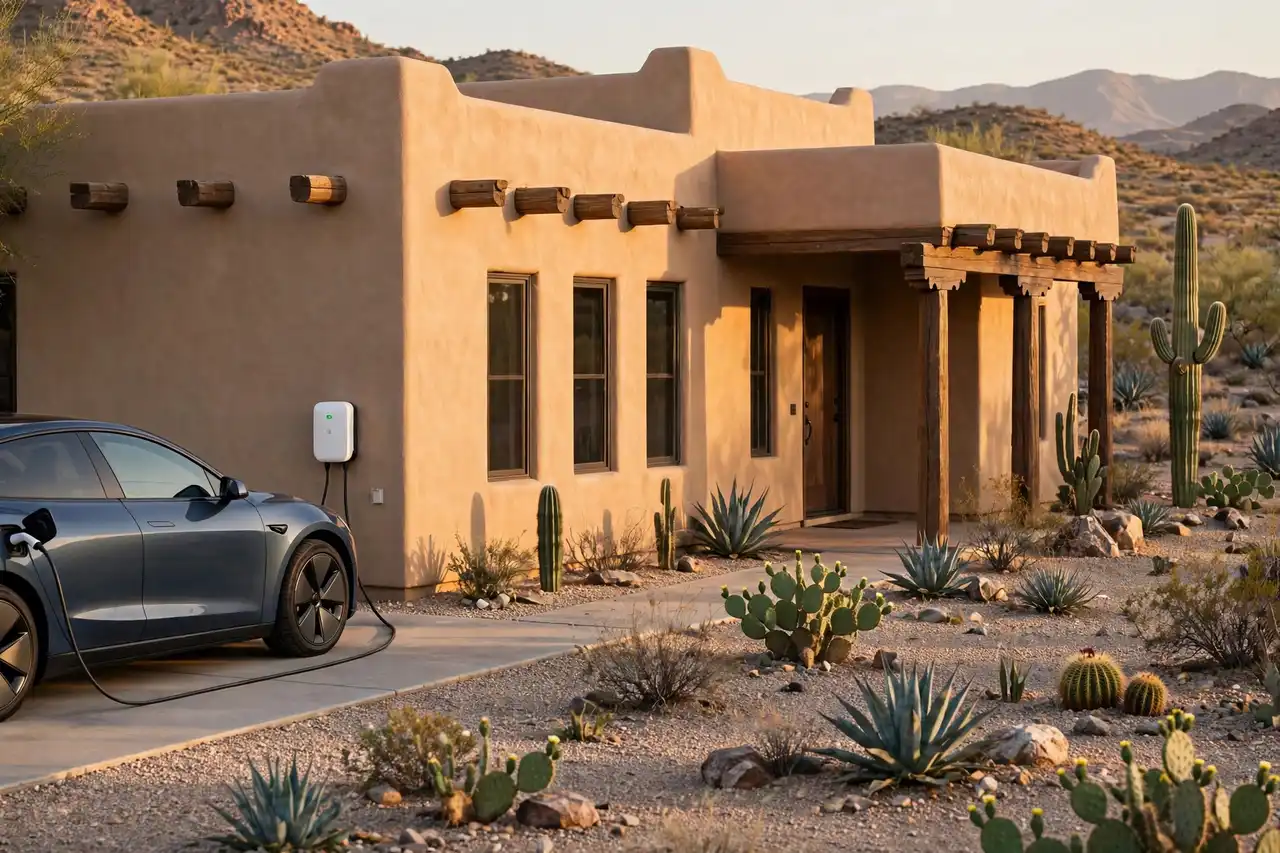
EV charging services in Topeka
Installers in Topeka book the same ten services as everywhere — but not in the same proportions. The three leading cards below are this city's pattern, set by its panels, its buildings and its statute book.
Home EV Charger Installation in Topeka
Think of it as plumbing for electrons, done once: capacity checked, circuit run, station mounted and configured, inspection passed. The households that report the smoothest projects describe the same shape — a visit that measured, a quote that itemised, and a car that simply charged from the first night.
In Topeka: usually the first job a new EV household in Topeka books, scoped to the panel the house already has.
Dedicated Circuit & Electrical Panel Upgrade in Topeka
When the arithmetic says the service is full, this is the enabling job: a larger panel, or a new dedicated circuit with capacity planned in, done under the same permit umbrella as the charger it feeds. It is also the upgrade the rest of the house quietly benefits from for decades.
In Topeka: the capacity answer when Topeka's older panels meet a continuous load.
Level 2 Charger Installation in Topeka
A Level 2 circuit turns charging from a ration into a routine. The job is electrical rather than electronic — breaker and conductor sized at the continuous-load factor, the run routed to the parking position, and the station dialled to the circuit rather than to its own headline maximum.
In Topeka: what most Topeka drivers mean when they say they want 'a real charger' — 240 volts, sized to the circuit.
Utility programs and electricity in Topeka
Electricity in Topeka comes from Evergy Kansas Central, Inc. Parts of the wider metro are served by FreeState Electric Coop. The utility matters twice over for a charger install: it sets the time-of-use rates that decide what overnight charging costs you, and it is the organisation that may — or may not — currently help pay for the equipment.
Do not budget for a rebate in Topeka right now. As of the sources checked for this page, Evergy Kansas Central, Inc publishes no residential charger rebate, Kansas offers no state program for typical home installs, and the federal 30C credit ended on September 30, 2025. If that changes, the utility's program page will say so with an as-of date — and this page will be updated to match. Until then, judge quotes on the work itself.
Before the install, it is worth a two-minute look at your tariff. Many Evergy Kansas Central, Inc customers can move to a time-of-use plan where overnight energy is charged at a lower rate, and a scheduled charger makes that saving automatic.
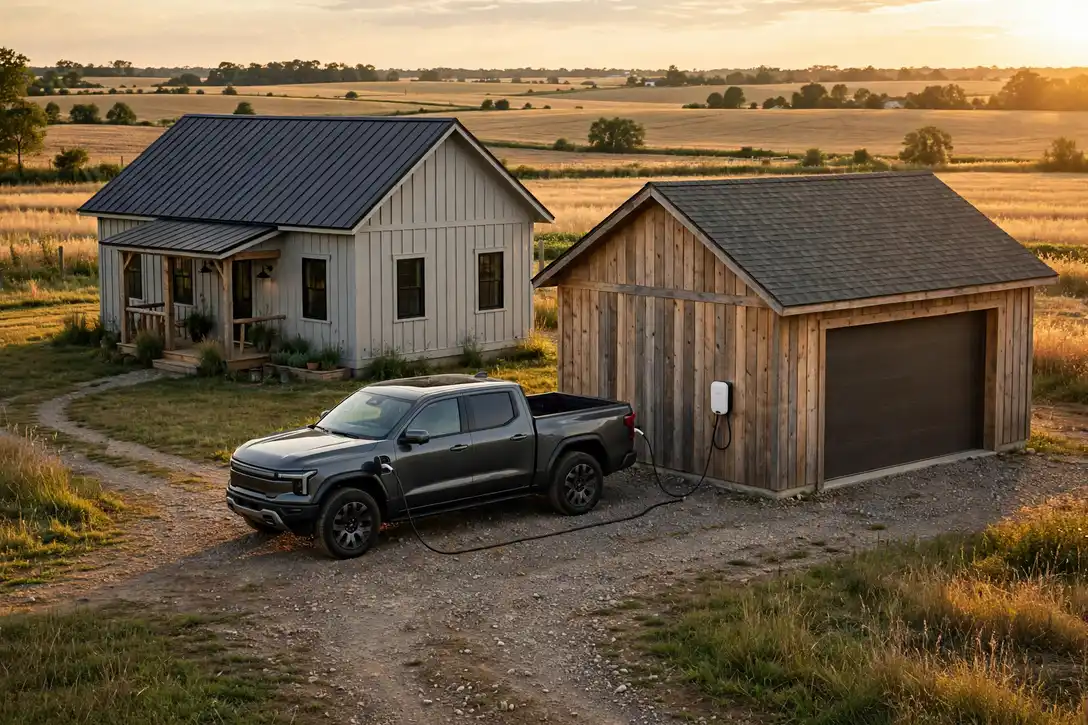
Condos, HOAs and the law in Kansas
There is no Kansas right-to-charge statute to lean on. Some national roundups list protection that does not exist in this state's code; the statute indexes checked for this page are clear. In Topeka, a condo or HOA charger is approved — or not — under the community's own documents, which makes the quality of your application the whole ballgame.
No law does not mean no path. Boards approve chargers every week when the proposal answers their real concerns in advance: a licensed installer, a dedicated circuit that touches nothing shared, metering that keeps the electricity cost on the owner, insurance, and a commitment to restore the space on removal. Bring that package, in writing, before the meeting — not during it.
Our condo and HOA guide was written for both kinds of state; the chapters on application packages, metering and cost allocation are the ones that matter in Topeka, where no statute does the persuading for you.
Climate, garages and charger placement
The shoulder seasons deserve a mention: freeze-thaw cycles work on exterior conduit and enclosures, and the connector that was easy in October can be stiff company in February. Equipment listed for the exposure, mounted where the melt does not drip across it, is the whole answer — local installers apply it without being asked.
Garage temperature is a charging feature here. An insulated garage that holds even a modest margin over the street's cold shortens the battery's warm-up and steadies winter range; a carport install accepts the full season and plans the circuit's headroom accordingly. Either works — they are simply different designs, and the site visit should name which one you own.

Permits and inspection in Topeka
Timelines are set by the city's counter, not the installer: the electrical work itself is typically a day, while permit issuance and the inspection visit follow the department's queue. A quote that promises a date should tell you which parts of that date the installer actually controls.

Neighbourhoods and ZIP codes served
The page covers 31 ZIP codes in and around Topeka — including 66601, 66603, 66604, 66605, 66606, 66607, 66608, 66609, 66610, 66611, 66612, 66614, 66615, 66616, 66617, 66618, 66619, 66620, 66621, 66622, 66624, 66625, 66626, 66629, 66630, 66636, 66647, 66667, 66675, 66683, 66699 — across Shawnee. If your ZIP is not in the first set shown, ask anyway: installer coverage follows the metro, not a postcode fence.
The same working area takes in the neighbouring localities of Tecumseh, Berryton, Wakarusa, Silver Lake, Auburn, Dover, Rossville — the county ring an installer based in Topeka actually drives. Requests from those communities route exactly as city requests do: same services, same permit discipline, same local facts where they differ.
Shawnee County accounts for 38 of the ZIP codes and 8 named postal localities in the research file, the nearest of them Tecumseh, Berryton, Wakarusa, Silver Lake, Auburn. The survey counts 178,025 residents in the county, with a median household income of $67,104 and a median home value of $180,900. Measured across its ZIP codes, the Topeka footprint runs about 12 miles north to south and 8 east to west, from ZIP 66601 to 66699 — the ground an installer based here actually covers in a working week.
Beyond the county seats, the working area takes in Tecumseh, Grantville, Berryton, Wakarusa, Silver Lake, Auburn, Meriden, Hoyt, Dover, Carbondale, Rossville, Ozawkie, Scranton, Overbrook, Maple Hill, Mayetta, Denison, Burlingame, Delia, Harveyville, Valley Falls, Saint Marys, Eskridge, Emmett, Holton, Vassar, Lyndon, Osage City, Quenemo, Circleville, Muscotah, Soldier, Admire, Melvern, Whiting, Netawaka, Allen, Reading, Wetmore, Lebo — the named localities for which Topeka is the nearest metro in the network (neighbouring metros' pages cover their own ground), each routing to the same installer-matching service.
The wider working area also reaches Lecompton, Perry, Lawrence, Oskaloosa, Mc Louth, Paxico, Lacygne, Winchester, Baldwin City, Belvue, Mc Farland, Nortonville, Tonganoxie, Pomona, Eudora, Alma, Linwood, Effingham, Wamego, Cummings, Ottawa, Easton, Havensville, De Soto, Wellsville, Basehor, Onaga, Williamsburg, Edgerton, Bonner Springs, Lancaster, Saint George, Horton, Leavenworth, Princeton — ground shared with neighbouring metros, where installers cross the same county lines in both directions.
ZIP codes in that shared ground include 66006, 66007, 66012, 66016, 66018, 66020, 66021, 66023, 66025, 66040, 66041, 66044, 66045, 66046, 66047, 66048, 66049, 66050, 66052, 66054, 66060, 66066, 66067, 66073, 66076, 66078, 66086, 66092, 66095, 66097, 66401, 66407, 66432, 66439, 66501, 66521, 66526, 66535, 66547.
The largest communities in that working area after Topeka itself, by the GeoNames populated-place file: Emporia (population 24,649), Holton (population 3,263), Osage City (population 2,844), Saint Marys (population 2,627), Burlington (population 2,615), Silver Lake (population 1,430), Carbondale (population 1,396), Yates Center (population 1,331), Auburn (population 1,218), Valley Falls (population 1,157), Rossville (population 1,137), Overbrook (population 1,024), Lyndon (population 1,023), Lebo (population 905), Burlingame (population 892), Americus (population 884), Meriden (population 790), Scranton (population 687), Hoyt (population 653), Madison (population 652). Charging demand follows those populations — the subdivisions and town centres where the next driveways, and the next panels, are.
Jackson County reaches into the working area with 13,341 residents, a median household income of $75,215 and a median home value of $207,300; its localities on this page include Hoyt, Mayetta, Denison, Delia, Holton. Osage County reaches into the working area with 15,744 residents, a median household income of $74,467 and a median home value of $156,800; its localities on this page include Carbondale, Scranton, Overbrook, Burlingame, Vassar. Jefferson County reaches into the working area with 18,349 residents, a median household income of $81,278 and a median home value of $216,900; its localities on this page include Grantville, Meriden, Ozawkie, Valley Falls. Wabaunsee County reaches into the working area with 7,009 residents, a median household income of $76,908 and a median home value of $177,300; its localities on this page include Maple Hill, Harveyville, Eskridge. Lyon County reaches into the working area with 32,186 residents, a median household income of $59,912 and a median home value of $150,600; its localities on this page include Admire, Allen, Reading.
| ZIP | Locality | County |
|---|---|---|
| 66601 | Topeka | Shawnee |
| 66625 | Topeka | Shawnee |
| 66626 | Topeka | Shawnee |
| 66629 | Topeka | Shawnee |
| 66630 | Topeka | Shawnee |
| 66636 | Topeka | Shawnee |
| 66683 | Topeka | Shawnee |
| 66699 | Topeka | Shawnee |
| 66612 | Topeka | Shawnee |
| 66603 | Topeka | Shawnee |
| 66621 | Topeka | Shawnee |
| 66606 | Topeka | Shawnee |
| 66607 | Topeka | Shawnee |
| 66604 | Topeka | Shawnee |
| 66616 | Topeka | Shawnee |
| 66611 | Topeka | Shawnee |
| 66608 | Topeka | Shawnee |
| 66605 | Topeka | Shawnee |
| 66609 | Topeka | Shawnee |
| 66614 | Topeka | Shawnee |
| 66620 | Topeka | Shawnee |
| 66622 | Topeka | Shawnee |
| 66624 | Topeka | Shawnee |
| 66647 | Topeka | Shawnee |
| 66667 | Topeka | Shawnee |
| 66675 | Topeka | Shawnee |
| 66617 | Topeka | Shawnee |
| 66610 | Topeka | Shawnee |
| 66618 | Topeka | Shawnee |
| 66615 | Topeka | Shawnee |
| 66619 | Topeka | Shawnee |
| 66542 | Tecumseh | Shawnee |
| 66429 | Grantville | Jefferson |
| 66409 | Berryton | Shawnee |
| 66546 | Wakarusa | Shawnee |
| 66539 | Silver Lake | Shawnee |
| 66402 | Auburn | Shawnee |
| 66512 | Meriden | Jefferson |
| 66440 | Hoyt | Jackson |
| 66420 | Dover | Shawnee |
| 66414 | Carbondale | Osage |
| 66533 | Rossville | Shawnee |
| 66070 | Ozawkie | Jefferson |
| 66537 | Scranton | Osage |
| 66524 | Overbrook | Osage |
| 66507 | Maple Hill | Wabaunsee |
| 66509 | Mayetta | Jackson |
| 66419 | Denison | Jackson |
| 66413 | Burlingame | Osage |
| 66418 | Delia | Jackson |
| 66431 | Harveyville | Wabaunsee |
| 66088 | Valley Falls | Jefferson |
| 66536 | Saint Marys | Pottawatomie |
| 66423 | Eskridge | Wabaunsee |
| 66422 | Emmett | Pottawatomie |
| 66436 | Holton | Jackson |
| 66543 | Vassar | Osage |
| 66451 | Lyndon | Osage |
| 66523 | Osage City | Osage |
| 66528 | Quenemo | Osage |
| 66416 | Circleville | Jackson |
| 66058 | Muscotah | Atchison |
| 66540 | Soldier | Jackson |
| 66830 | Admire | Lyon |
| 66510 | Melvern | Osage |
| 66552 | Whiting | Jackson |
| 66516 | Netawaka | Jackson |
| 66833 | Allen | Lyon |
| 66868 | Reading | Lyon |
| 66550 | Wetmore | Nemaha |
| 66856 | Lebo | Coffey |

Planning the install: from panel to parking
Think of the project as a chain with four links: capacity, route, placement, paperwork. Capacity is the load calculation. Route is the path copper takes from panel to parking — through a shared wall if you are lucky, across a ceiling or a trench if you are not. Placement is the unglamorous decision that governs daily life with the car for a decade: reach, cable slack, and which side the port is on. Paperwork is the permit and the passed inspection, the proof that outlives the installer's visit.
Finally, photograph the finished work — station, nameplate, panel directory with the new breaker labelled — and file it with the inspection record. When the car changes, the house sells or a second station joins the first, that folder is the difference between a five-minute answer and an archaeological dig.
Home charging know-how for Topeka households
Garage layout: the unglamorous decider
More charging routines are decided by garage geography than by equipment. Which bay the EV takes, which side its port sits on, where the freezer, bikes and workbench have permanent tenure — the station belongs at the intersection of those facts, with a cable that reaches the port without crossing the walking line to the door. Installers who walk the layout with the car in place are not being thorough for its own sake; they are preventing the daily, decade-long annoyance of a station mounted for a parking pattern nobody uses.
Assigned spaces and the waitlist problem
In established communities the first charger is the easy one; the design question is the tenth. Assigned-space installs should be planned as a system from the beginning — a shared capacity backbone, a metering pattern that repeats, conduit routes that serve a row rather than a single bay — so each new arrival plugs into a decision already made. Communities that improvise charger by charger eventually own a patchwork of circuits fighting over a service never designed for them. The board conversation that prevents it is short, and it happens once.
Charging alongside rooftop solar
A house that generates as well as consumes plans its charging differently. The naive pattern — charge at night, export by day — is often fine; the refined pattern shifts some charging into the solar hours on home-working days, stores the commute in the car when the panels are producing, and leans on the overnight window only for the balance. None of this changes the circuit; it changes the schedule, and occasionally the case for a station whose output can follow the house's generation. Tell the installer the array exists — it belongs in the first conversation.
Whose schedule? The car's or the station's
Two schedulers can govern a charging session — the vehicle's own charge timer and the station's app — and households inherit confusion when both are set at once. The discipline is simple: choose one governor. The car's timer travels with the car and knows its departure settings; the station's knows the tariff windows and the household's other loads. Either works; both together produce the 6 am mystery of the half-charged battery and a debugging session nobody enjoys.

Frequently asked questions
Can I still get the federal tax credit for a home charger in Topeka, KS?
You cannot — it no longer exists. The 30C credit closed to equipment placed in service after September 30, 2025, and no Kansas program replaced it for home installs. Nor did the sources checked for this page show a live Evergy Kansas Central, Inc residential rebate. Treat any 'credit' mentioned in a quote as a request for paperwork.
Can my HOA or condo board in Topeka, KS refuse my charger?
They hold the stronger hand in Kansas: with no right-to-charge statute on the books, a Topeka association's covenants are the law of the car park. The applications that succeed anyway share a shape — owner-funded, licensed installer, metered energy, insured, reversible — because they answer the board's risk questions in advance and in writing.
Will my Topeka, KS home need a panel upgrade for a Level 2 charger?
Sometimes — and Topeka's housing stock is exactly why the question is worth asking properly. With a median build year of 1969 and roughly 63% of homes predating 1980, plenty of local panels are 100-amp units already carrying a full modern load. Those homes choose between an upgrade and load management; newer 200-amp homes usually just add the circuit. The site visit's load calculation is the decider.
How quickly will a Level 2 charger fill my car in Topeka, KS?
Think of it in parked hours. Level 1 gives you back 3–5 miles for each of them; Level 2 gives back about 25–40, set by the circuit's amperage and what the car can accept. Overnight, that is the gap between 'enough for tomorrow' and 'full, every morning'.
What happens after I request an installer through this page?
Your request — service, Topeka ZIP, property type and timing — goes to licensed local installers who cover Topeka. They contact you directly to arrange a site visit and quote. PlugReady USA is the matching service, not the installer, and the sections above exist so you can judge any quote against the local facts.
How long does a typical home charger installation take in Topeka, KS?
Plan on a day of electrical work for the standard layout, plus the permit and inspection appointments that bracket it on the city's calendar. Capacity work — an upgrade or a subpanel — extends the electrical day; approvals in a condo or HOA extend the calendar, not the tools. Your site visit ends with all three durations stated separately.
Nearby cities in Kansas
- EV charger installation in Lawrence — about 26 miles from Topeka, metro population 120,000
- EV charger installation in Manhattan — about 51 miles from Topeka, metro population 135,000
- EV charger installation in Wichita — about 131 miles from Topeka, metro population 650,000
- EV charger installation in Kansas City, MO — about 60 miles from Topeka, metro population 2,200,000
- EV charger installation in St. Joseph, MO — about 68 miles from Topeka, metro population 125,000
- EV charger installation in Lincoln, NE — about 140 miles from Topeka, metro population 345,000
Ready to charge at home in Topeka?
Two minutes of form, and the request is in front of licensed installers who cover this city — quotes follow site visits, in writing.