EV Charger Installation in Lawrence, KS
Home Level 2 charging, panel upgrades and condo installs in Lawrence — matched to licensed local installers, with the local facts that shape the job set out below.
Consider what a home charger actually replaces: the weekly detour, the public station's queue, the arithmetic of arriving home low. In Lawrence, the replacement project is well understood because the fleet is already here — 18,700 battery-electric vehicles and 7,800 plug-in hybrids registered across Kansas through 2025. Lawrence itself is home to about 97,265 people. This page is the project's local brief: your utility and its programs, your state's law, your city's permit process, and your housing stock's electrical character, each stated with its source.
How PlugReady USA works, in one breath: you describe the job once, licensed local installers who cover Lawrence receive it, and the conversations happen with them directly. The rest of this page exists so those conversations start from facts — yours about the house, ours about the metro — rather than from a sales script.
What the Experian and AFDC registration data say about Lawrence: KU market. Translated out of market language: your neighbours are already charging at home, the permit office already knows the paperwork, and the installers already know the housing stock.
Context from the Census Bureau's survey of Lawrence: median household income $67,129; 43% of occupied homes are owner-occupied; 43% of housing units are single-unit detached houses. It is the profile of a city where the typical charger job is a homeowner job — scoped by the panel and the wire run, not by permissions.

The composite picture matters more than any single statistic. In Lawrence: a housing stock of mixed vintages, where both electrical eras appear on the same street; a genuinely mixed city — houses, townhouses and larger buildings all carry weight; buildings of five or more units hold a substantial share of homes, which keeps the multifamily sections of this page in daily use; meanwhile, renters form a large share of households, so the landlord conversation is a first-class topic here. A page that ignored that profile would give the same advice everywhere; this one is ordered by it.
The counts behind the percentages, for the record: Lawrence has 43,511 housing units on the survey's count, 41,014 of them occupied, and 17,739 owner-occupied households making their own electrical decisions. Detached houses number 18,581; homes built before 1980 number 17,660; units in buildings of five or more number 14,771. An installer's week in this city is a walk through exactly that distribution. The page's geography is equally concrete: 5 ZIP codes across Douglas, centred near 39.03 degrees north latitude. The city anchors the Lawrence metropolitan area, home to roughly 120,000 people on the research file's metro estimate — the wider labour and housing market this page's installers work across.
The same survey release fills in the household economics around the housing stock: a median home value of $315,100, median gross rent of $1,106, per-capita income of $37,968, and a median resident age of 30. And the daily rhythms behind the housing numbers: 71% of Lawrence workers drive to work alone — the commute pattern home charging is built around; 14% work from home, a population whose cars charge on daytime and overnight schedules alike; 2% commute by public transit; 58% of adults hold a bachelor's degree or higher. And the fleet in the driveways: 16,212 households in Lawrence have exactly one vehicle, 21,902 have two or more, and 2,900 have none.
The cost-burden lines say who feels housing costs most in Lawrence: 50% of renters spend 30% or more of income on rent, and 0% of owners with mortgages spend the same share on housing costs. Family households are 49% of all households — the two-car, school-run demographic whose charging patterns this page's planning sections keep circling back to.
This is the context an installer works against, whether it is written down or not. The stock reads in strata: a pre-war core, a ranch-era ring, subdivisions from the nineties, infill from the last decade — four electrical eras sharing one permit office and one installer workforce. With this much of the stock in shared buildings, the city's charging map is drawn in boardrooms as much as in electrical rooms: deeded spaces, common services, metering subplots in every application.
High renter share also means charging follows the lease cycle: applications cluster at move-in, installations at renewal leverage, and the whole market breathes on the rental calendar. Value engineering is the local dialect: load management weighed against panel work on merit, quotes compared line by line, the site visit treated as the moment the scope becomes honest. Tariff design is the quiet policy: the shape of the overnight window, the demand charges commercial customers face, the interconnection queue's pace — all set in dockets the diligent can read.
Early-market conditions have their own economics: fewer specialist installers, general electricians carrying the work, and a premium on the household arriving informed — which is the gap this page exists to close. At this scale the page's role sharpens — in a market without a crowd of specialists to interview, the household's own preparation carries more of the project's quality. Without a state charging statute, shared-property approvals in this metro are won on paper quality: metering clarity, licensed installers, insurance, reversibility — the complete package the guides set out.
The electrical reality in Lawrence homes
Start with the survey's three operative figures for Lawrence: median build year 1988; 41% of housing units standing since before 1980; 43% of the stock in single-unit detached houses, with 43% of occupied homes owner-occupied. Between them, they sketch the electrical city an installer works in. The metro's building booms left two electrical eras side by side. Post-1990s subdivisions were wired for modern loads and usually take a charger circuit directly; the established in-town stock asks harder questions of its panels. Knowing which era your street belongs to tells you most of what your site visit will conclude. Garages here earn their keep across the year — workshop, storage and storm shelter by turns — so a station position that survives the household's real parking pattern matters more than the technically neatest wall.
Heating fuel is the survey's quiet clue to panel life: in Lawrence, 35% of homes heat electrically (14,413 households), against 64% heating with gas. A house already heating electrically has a service sized with that load in its history; a gas-heated house may have capacity to spare — either way the fuel mix is part of what the installer is reading.
The tenure split cuts the other way too: roughly 23,275 occupied homes in Lawrence are rented. For those households the charger question is a negotiation with a property owner — written proposal, licensed installer, metering clarity — and it succeeds often enough that installers here keep the pattern ready.
The city's stock is not all houses: 34% of units are in structures of five or more. Shared buildings mean shared panels, assigned parking and association process — the substance of the multifamily sections below.
EV charging services in Lawrence
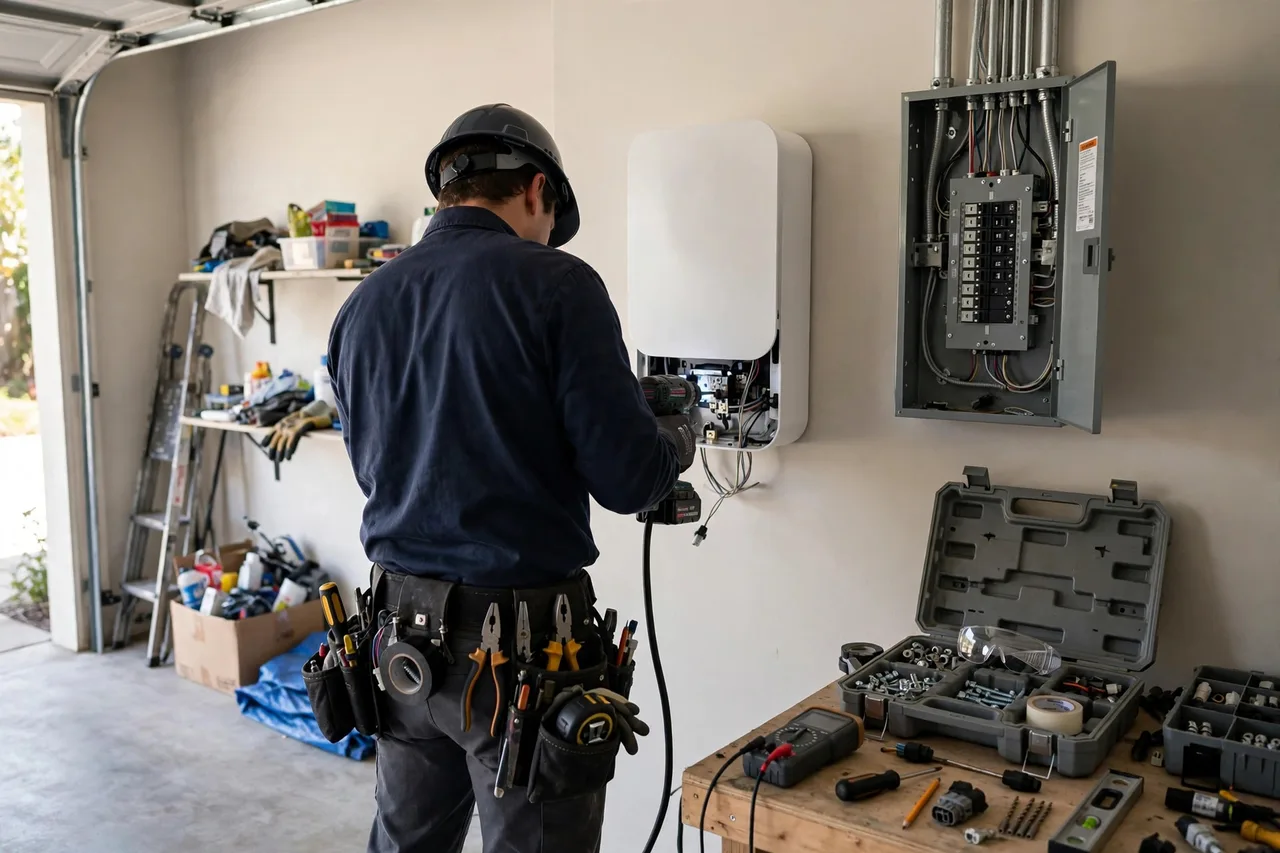
Installers in Lawrence book the same ten services as everywhere — but not in the same proportions. The three leading cards below are this city's pattern, set by its panels, its buildings and its statute book.
Home EV Charger Installation in Lawrence
Start to finish, the domestic install is a half-day of electrical work wrapped in a week of scheduling: the survey, the circuit, the mounting, the configuration, the inspection. What the household experiences is simpler — a car that is full every morning and a cable that lives where the car does.
In Lawrence: the default first install for Lawrence's EV households — a station where the car already parks.
Dedicated Circuit & Electrical Panel Upgrade in Lawrence
Capacity work wears three costumes — more amps, a fresh panel, or management electronics that make the existing amps behave like more. The load calculation is the fitting room: it shows which costume your house actually needs, and a trustworthy quote names the calculation before the costume.
In Lawrence: relevant in Lawrence wherever a 100-amp panel already carries cooking, heating and hot water before a charger asks for room.
Level 2 Charger Installation in Lawrence
The step from a household receptacle to a Level 2 circuit is the step from sipping to drinking: the car takes energy at the rate family life actually consumes it. The work is a breaker, a run of appropriately gauged conductor, and a connection made to torque — modest materials, permanent consequences.
In Lawrence: the circuit class behind nearly every home install in Lawrence, from first car to second.
Utility programs and electricity in Lawrence
Electricity in Lawrence comes from Evergy Kansas Central, Inc. Parts of the wider metro are served by Evergy Metro, FreeState Electric Coop, City of Eudora. The utility matters twice over for a charger install: it sets the time-of-use rates that decide what overnight charging costs you, and it is the organisation that may — or may not — currently help pay for the equipment.
Why does this page labour the absence of a rebate? Because in Lawrence the phantom rebate is the most common distortion in charger quotes: a figure justified by money that is not, at present, claimable. The verified position: federal 30C ended September 30, 2025; no Kansas replacement for typical home installs; no Evergy Kansas Central, Inc residential charger rebate in the sources checked. If someone quotes you a rebate, the follow-up is one sentence — show me the program page — and its answer decides the quote's credibility.
Renters and condo owners should note the metering question early: whose meter the charger hangs off decides who pays for the energy, and Evergy Kansas Central, Inc's options for submetering are part of the multifamily conversation below.
Condos, HOAs and the law in Kansas
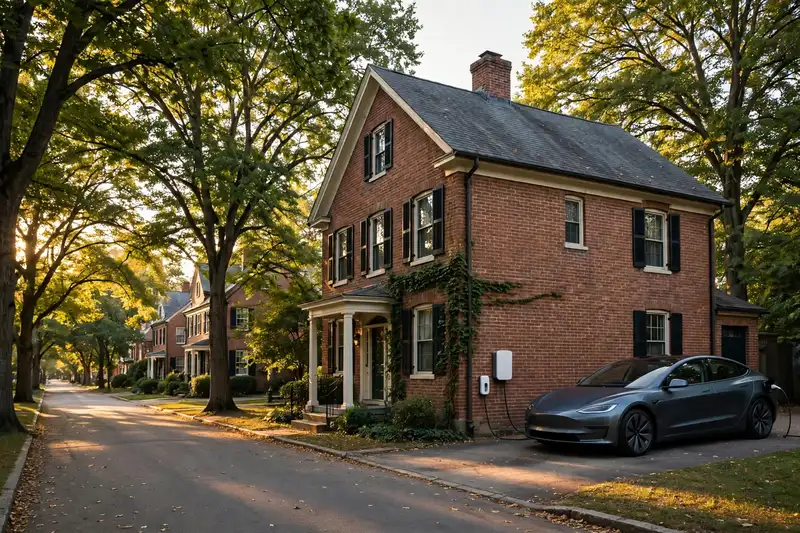
There is no Kansas right-to-charge statute to lean on. Some national roundups list protection that does not exist in this state's code; the statute indexes checked for this page are clear. In Lawrence, a condo or HOA charger is approved — or not — under the community's own documents, which makes the quality of your application the whole ballgame.
Metering is the objection that sinks more applications than any other, and it is the easiest to pre-empt: propose, in the application itself, how the electricity will be measured and paid for by you — a submeter, a separately metered circuit, or a flat arrangement the board can audit. Boards refuse ambiguity far more often than they refuse chargers.
The general process, minus the statute, is still covered in our guide to installing an EV charger in a condo or HOA community — most of its application-package advice applies in Lawrence exactly as written.
Climate, garages and charger placement
Winter hardware habits are simple and worth copying: a holster the connector returns to every night (a connector left in a snowbank is a connector full of ice), a cable route that survives the snow-clearing line, and a station position the plough's output does not bury. Installers here raise all three without being asked.
Snow management decides charger geography in cold metros more than any electrical factor: the station out of the plough's throw, the parking position out of the drift line, the cable route off the shovelled path. Walk the site in your head in February before signing the layout in June.

Permits and inspection in Lawrence
Inspection day itself is undramatic by design: access to the panel and the station, the calculation on hand, the equipment's settings matching the circuit. Jobs fail inspection on paperwork mismatches far more often than on wiring — a fact that quietly grades installers.

Neighbourhoods and ZIP codes served
The page covers 5 ZIP codes in and around Lawrence — including 66044, 66045, 66046, 66047, 66049 — across Douglas. If your ZIP is not in the first set shown, ask anyway: installer coverage follows the metro, not a postcode fence.
The same working area takes in the neighbouring localities of Eudora, Lecompton, Baldwin City — the county ring an installer based in Lawrence actually drives. Requests from those communities route exactly as city requests do: same services, same permit discipline, same local facts where they differ.
Douglas County accounts for 8 of the ZIP codes and 4 named postal localities in the research file, the nearest of them Eudora, Lecompton, Baldwin City. The survey counts 120,302 residents in the county, with a median household income of $69,746 and a median home value of $309,400. Measured across its ZIP codes, the Lawrence footprint runs about 6 miles north to south and 4 east to west, from ZIP 66044 to 66049 — the ground an installer based here actually covers in a working week.
Beyond the county seats, the working area takes in Lacygne, Tonganoxie, Eudora, Mc Louth, Linwood, Perry, Lecompton, Oskaloosa, De Soto, Basehor, Bonner Springs, Baldwin City, Edgerton, Winchester, New Century, Easton, Gardner, Wellsville, Nortonville, Ottawa, Pomona, Rantoul, Hillsdale, Paola, Princeton, Williamsburg, Osawatomie, Lane, Richmond — the named localities for which Lawrence is the nearest metro in the network (neighbouring metros' pages cover their own ground), each routing to the same installer-matching service.
The wider working area also reaches Grantville, Meriden, Overland Park, Lansing, Topeka, Overbrook, Waldron, Valley Falls, Edwardsville, Farley, Spring Hill, Wakarusa, Carbondale, Cummings, Prairie Village, Platte City, Weston, Riverside, Scranton, Vassar, Auburn, Mayetta, Bucyrus, Rushville, Burlingame, Lancaster, Holton, Independence, Dearborn, Rossville, Cleveland, Melvern, Osage City, Lees Summit, Harveyville — ground shared with neighbouring metros, where installers cross the same county lines in both directions.
ZIP codes in that shared ground include 64052, 64092, 64102, 64109, 64111, 64114, 64121, 64129, 64131, 64132, 64141, 64147, 64153, 64154, 64155, 64157, 64165, 64167, 64171, 64184, 64187, 64190, 64195, 64439, 64734, 66058, 66063, 66103, 66105, 66109, 66112, 66207, 66208, 66209, 66210, 66213, 66214, 66217, 66221, 66223.
The largest communities in that working area after Lawrence itself, by the GeoNames populated-place file: Gardner (population 20,868), Ottawa (population 12,387), Eudora (population 6,378), De Soto (population 6,074), Paola (population 5,527), Basehor (population 5,402), Tonganoxie (population 5,248), Baldwin City (population 4,669), Osawatomie (population 4,297), Garnett (population 3,258), Wellsville (population 1,818), Edgerton (population 1,736), Oskaloosa (population 1,086), New Century (population 1,072), Pomona (population 969), Perry (population 909), McLouth (population 854), Pomona (population 803), Mound City (population 680), Lecompton (population 640). Charging demand follows those populations — the subdivisions and town centres where the next driveways, and the next panels, are.
Franklin County reaches into the working area with 26,106 residents, a median household income of $77,207 and a median home value of $198,700; its localities on this page include Wellsville, Ottawa, Pomona, Rantoul, Princeton. Jefferson County reaches into the working area with 18,349 residents, a median household income of $81,278 and a median home value of $216,900; its localities on this page include Mc Louth, Perry, Oskaloosa, Winchester, Nortonville. Leavenworth County reaches into the working area with 83,123 residents, a median household income of $89,218 and a median home value of $282,900; its localities on this page include Tonganoxie, Linwood, Basehor, Easton. Johnson County reaches into the working area with 620,631 residents, a median household income of $109,208 and a median home value of $391,200; its localities on this page include De Soto, Edgerton, New Century, Gardner. Linn County reaches into the working area with 9,767 residents, a median household income of $59,069 and a median home value of $173,600; its localities on this page include Lacygne.
| ZIP | Locality | County |
|---|---|---|
| 66044 | Lawrence | Douglas |
| 66040 | Lacygne | Linn |
| 66045 | Lawrence | Douglas |
| 66049 | Lawrence | Douglas |
| 66046 | Lawrence | Douglas |
| 66047 | Lawrence | Douglas |
| 66086 | Tonganoxie | Leavenworth |
| 66025 | Eudora | Douglas |
| 66054 | Mc Louth | Jefferson |
| 66052 | Linwood | Leavenworth |
| 66073 | Perry | Jefferson |
| 66050 | Lecompton | Douglas |
| 66066 | Oskaloosa | Jefferson |
| 66018 | De Soto | Johnson |
| 66007 | Basehor | Leavenworth |
| 66012 | Bonner Springs | Wyandotte |
| 66006 | Baldwin City | Douglas |
| 66021 | Edgerton | Johnson |
| 66097 | Winchester | Jefferson |
| 66031 | New Century | Johnson |
| 66020 | Easton | Leavenworth |
| 66030 | Gardner | Johnson |
| 66092 | Wellsville | Franklin |
| 66060 | Nortonville | Jefferson |
| 66067 | Ottawa | Franklin |
| 66076 | Pomona | Franklin |
| 66079 | Rantoul | Franklin |
| 66036 | Hillsdale | Miami |
| 66071 | Paola | Miami |
| 66078 | Princeton | Franklin |
| 66095 | Williamsburg | Franklin |
| 66064 | Osawatomie | Miami |
| 66042 | Lane | Franklin |
| 66080 | Richmond | Franklin |

Planning the install: from panel to parking
Consider the two households inside every Lawrence install. The first owns the panel, the parking and the decision; the second — a partner, a teenager with the next car, a future buyer — inherits all three. Designing for the second household is the difference between an install and an asset: capacity reserved, conduit honest, paperwork filed. The first conversation with an installer should name both households explicitly.
One more piece of sequencing advice Lawrence installers give consistently: if the panel is being opened anyway, settle the other electrical maybes in the same visit — the circuit you will want next year costs least while the permit and the electrician are already in the house.
Home charging know-how for Lawrence households
Outdoor and carport positions
Plenty of charging happens without a garage at all — on driveway walls, posts and carports. The outdoor version of the job adds its own discipline: equipment listed for the exposure, an enclosure that sheds rather than traps water, cable reach checked against the car's real nose-in position, and protection from the ordinary impacts of a working driveway. A pedestal adds a foundation and a conduit approach below grade. None of it is exotic, and all of it is cheaper decided on paper than corrected in concrete.
Light, reach and the midnight plug-in
Most charging happens in the dark, in winter clothes, carrying something. The installations that feel effortless share three traits: light where the connector lives, a mounting height that asks no stretching or crouching, and a cable path with nothing to trip over between the car door and the wall. Households with mobility limits in the family should say so at the site visit — height, reach and holster style are all adjustable at install time and awkward afterwards. Design for the worst trip, not the easiest one.
Charging while you travel
Cars left for weeks prefer a middle state of charge and a quiet life: plugged in, scheduled modestly, neither brimmed nor starved. The home station makes this effortless — the car sips as it wants, the household returns to a vehicle that is ready rather than recovered. Tell a housesitter nothing at all; there is nothing to do. It is one of home charging's under-sold virtues: the car manages its own storage, from your wall, while the house is empty.
Home as the road-trip base
A home charger changes road trips at both ends. Departure: the car leaves full, on the household's lowest-cost energy, at the household's chosen hour. Return: it arrives home low without anxiety, because the recovery is the driveway rather than a detour. The middle belongs to the public networks; the ends — the parts travellers actually remember — belong to the wall at home. Households that tour often find this, quietly, is the feature they would surrender last.

Frequently asked questions
What happened to the federal home-charger credit in Lawrence, KS?
That credit is finished: 30C ended on September 30, 2025. What about locally? In the utility and state sources checked for this page, nothing verified was running for Lawrence homeowners — no Evergy Kansas Central, Inc rebate, no state scheme. If one opens, it will appear on the utility's site with dates; plan your install without it meanwhile.
Can my association in Lawrence, KS say no to a home charger?
They hold the stronger hand, and it is better to plan with that admitted. Kansas has enacted no right-to-charge law, so in Lawrence the covenants and the board govern. Owners who treat the application as a design submission — circuit, metering, insurance, restoration — rather than a request for a favour are the ones charging by the following quarter.
Does a Level 2 charger mean a panel upgrade for a Lawrence, KS home?
The question has a correct instrument: the load calculation. It totals what your service already carries — with the code's demand factors, not nameplate panic — and sets the charger's continuous load against the remainder. In Lawrence, where the median home dates to 1988 and about 41% of units predate 1980, the answer splits by street: post-war and newer 200-amp homes usually proceed; older 100-amp homes choose between capacity work and load management. Anyone answering without the calculation is guessing in a uniform.
How quickly will a Level 2 charger fill my car in Lawrence, KS?
Level 2 is several-fold faster in the only unit that matters — miles back per hour parked: roughly 25–40 against Level 1's 3–5. The exact figure follows the circuit: a 40-amp circuit and a 60-amp circuit are both Level 2, and the car's onboard limit may sit below either. Your installer matches the three numbers at the site visit.
How does the installer matching on this page work?
Three steps: the request routes to installers who work Lawrence, Kansas; one contacts you to walk the property; the walk produces the written quote. Everything on this page — the utility position, the law, the housing data — is yours to check that quote against.
I live in a Lawrence apartment or condo building — can I charge at home?
Yes, with the building as a partner rather than an obstacle. In Lawrence, about 34% of homes sit in buildings of five or more units, so the pattern is established: a written proposal, a licensed installer, a metering design that charges the energy to you, and the association or landlord approving a package rather than a request. The law section above gives Kansas's position; the multifamily service designs the rest.
Nearby cities in Kansas
- EV charger installation in Topeka — about 26 miles from Lawrence, metro population 230,000
- EV charger installation in Manhattan — about 77 miles from Lawrence, metro population 135,000
- EV charger installation in Wichita — about 149 miles from Lawrence, metro population 650,000
- EV charger installation in Kansas City, MO — about 34 miles from Lawrence, metro population 2,200,000
- EV charger installation in St. Joseph, MO — about 55 miles from Lawrence, metro population 125,000
- EV charger installation in Joplin, MO — about 139 miles from Lawrence, metro population 185,000
Ready to charge at home in Lawrence?
Send the essentials — what you need, where, and what kind of property — and a licensed local installer will pick it up from there.