EV Charger Installation in Manhattan, KS
Charging where you park, in Manhattan: the utility programs, state law, permit process and housing facts behind a home charger install, gathered in one place.
Every home charger installation is the same four decisions wearing local clothes: capacity in the panel, a route for the circuit, a position for the station, and paperwork that proves it was done properly. What changes from city to city is the content of those decisions — and in Manhattan the content is specific. Manhattan itself is home to about 54,239 people. Kansas's registered fleet stood at 18,700 battery-electric vehicles and 7,800 plug-in hybrids at the end of 2025, and this page works through the local version of each decision: your utility and its programs, your state's association law, your permit counter, and your housing stock's electrical habits.
A note on what PlugReady USA is and is not: we publish the local research and run the matching; the installation itself belongs to licensed electricians and installer companies working in Manhattan. Everything below is written so you can hold your own in that conversation — numbers first, sales language nowhere.
The registration ledger for the Manhattan metro reads: K-State / Fort Riley. Ledgers like this are what installer rounds are built from — they show where the cars already are, which is where the circuits get requested, permitted and inspected week after week.
Survey context for Manhattan, in the three lines installers actually use: median household income $60,172; owner-occupation at 43%; single-unit detached homes at 48%. Income tracks adoption pace, tenure decides whose signature a job needs, and structure decides whether the answer is a garage circuit or a building negotiation.

Every city charges differently, and Manhattan's difference is legible in the data: an older housing fabric, where panel archaeology is a normal part of the first visit; a genuinely mixed city — houses, townhouses and larger buildings all carry weight; buildings of five or more units hold a substantial share of homes, which keeps the multifamily sections of this page in daily use; renters form a large share of households, so the landlord conversation is a first-class topic here. Read the sections below through that profile and the local advice resolves into specifics — which questions are routine here, and which are rare.
Keep six figures and you keep Manhattan's whole electrical character: 24,403 housing units; 22,266 occupied homes; 9,682 owner-occupied; 11,769 detached houses; 11,377 pre-1980 homes; 7,489 homes in buildings of five or more units. Percentages elsewhere on this page are these numbers in disguise — the counts are the originals, and they are the numbers a local installer's experience is actually made of. The page's geography is equally concrete: 4 ZIP codes across Riley, centred near 39.19 degrees north latitude. The city anchors the Manhattan metropolitan area, home to roughly 135,000 people on the research file's metro estimate — the wider labour and housing market this page's installers work across.
The same survey release fills in the household economics around the housing stock: a median home value of $246,700, median gross rent of $1,003, per-capita income of $36,557, and a median resident age of 26. The movement data matters as much as the money data: 68% of Manhattan workers drive to work alone — the commute pattern home charging is built around; 13% work from home, a population whose cars charge on daytime and overnight schedules alike; 0% commute by public transit; 53% of adults hold a bachelor's degree or higher. And the fleet in the driveways: 8,466 households in Manhattan have exactly one vehicle, 12,849 have two or more, and 951 have none.
The cost-burden lines say who feels housing costs most in Manhattan: 50% of renters spend 30% or more of income on rent, and 0% of owners with mortgages spend the same share on housing costs. Family households are 46% of all households — the two-car, school-run demographic whose charging patterns this page's planning sections keep circling back to.
The signature matters because installs follow it, street by street. Where so much of the stock predates modern code cycles, the site visit doubles as a survey — grounding electrode, service entrance, panel provenance — before it is ever a quote. Shared form means shared infrastructure decisions: a building that solves charging solves it for a generation of residents, which raises the stakes of the first design and the value of getting the metering right.
Where renting dominates, the successful install is a document before it is a device — installer licence, insurance, metering clarity, end-of-tenancy position — assembled to make a landlord's yes the path of least resistance. Households here run the numbers — which is why the honest sections of this page, the ones that say what is verified and what is not, earn their keep. The commission's calendar quietly schedules the market: when a new time-of-use design is approved, installer phones ring in a pattern the docket predicted months earlier.
Early-market conditions have their own economics: fewer specialist installers, general electricians carrying the work, and a premium on the household arriving informed — which is the gap this page exists to close. At this scale the page's role sharpens — in a market without a crowd of specialists to interview, the household's own preparation carries more of the project's quality. Boards here decide without a statutory script, which makes precedent the currency: the first well-built application in a community quietly writes the policy for everyone after it.
The electrical reality in Manhattan homes
Start with the survey's three operative figures for Manhattan: median build year 1983; 47% of housing units standing since before 1980; 48% of the stock in single-unit detached houses, with 43% of occupied homes owner-occupied. Between them, they sketch the electrical city an installer works in. A housing stock this age leans on smaller electrical services — 100-amp panels are common, and fuse-era equipment still turns up in the oldest streets. For many of those homes the honest answer is a panel upgrade or a load-management device before the charger circuit goes in, and a good installer will show you the load calculation rather than asking you to take it on faith. Garages here earn their keep across the year — workshop, storage and storm shelter by turns — so a station position that survives the household's real parking pattern matters more than the technically neatest wall.
One further survey line belongs in any Manhattan install conversation: 42% of the city's homes heat with electricity — 9,279 households whose panels already carry a major winter load before a charger is contemplated. Electric heat and EV charging are the two largest discretionary loads a house can host, and where they coincide, the load calculation stops being a formality.
One further split matters for how this page is organised: about 12,584 of Manhattan's occupied homes are renter-occupied. Everything above assumes you can approve your own electrical work; where you cannot, the approval layer — landlord or association — becomes part of the job, which is why the law section carries unusual weight here.
And 31% of Manhattan's homes are in buildings with five or more units — apartments and condominiums where charging is a building decision before it is an electrical one. If that is your situation, the law and multifamily sections of this page are the ones written for you.
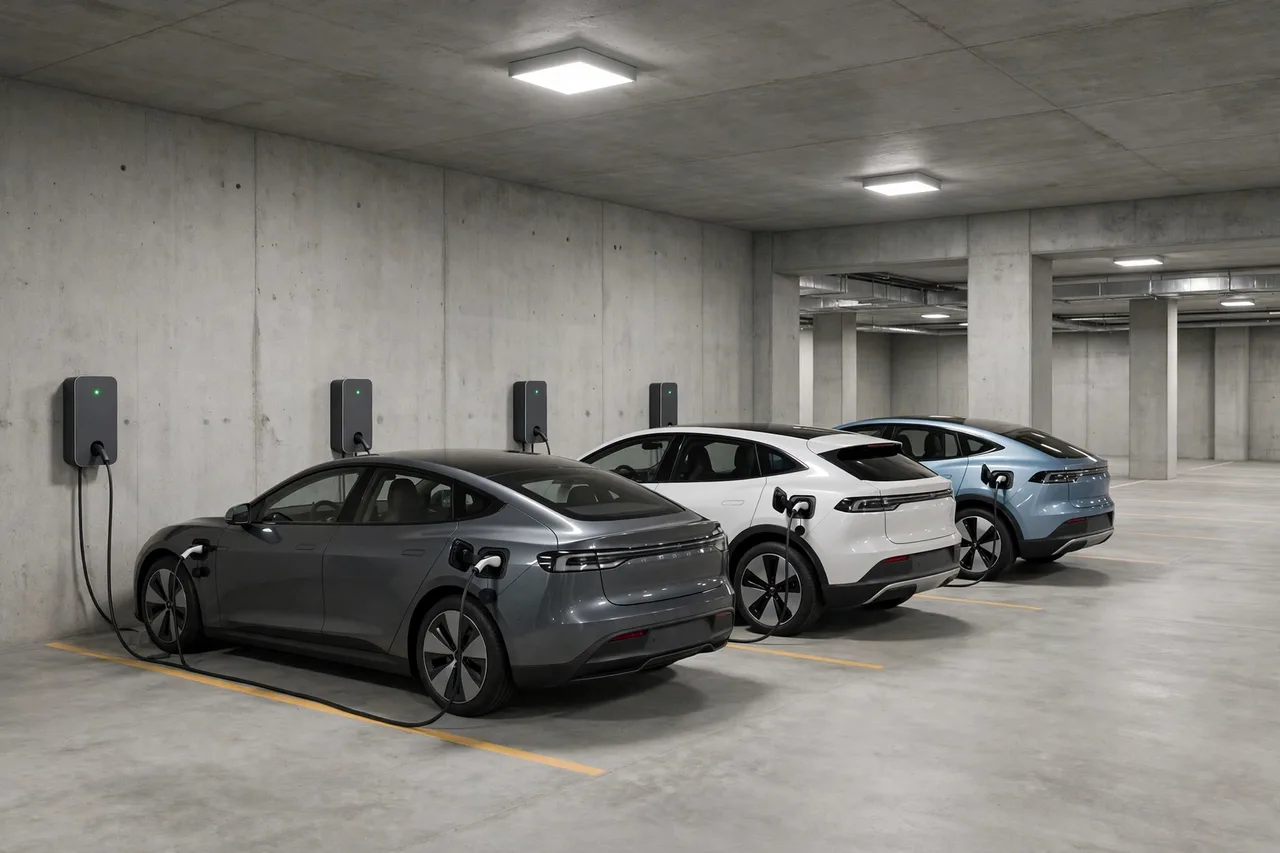
EV charging services in Manhattan
Three of the network's services lead this page because local conditions put them first; the remaining seven are one click away and equally available here. Each card states what the service involves — the matching itself is free of obligation until you accept an installer's quote.
Home EV Charger Installation in Manhattan
For most households this is the whole project: a Level 2 station mounted where the car sleeps, fed by its own 240-volt circuit. The visit pattern is consistent — load calculation, route the run, mount and configure, inspect — and the variables are your panel, your parking and your permit office.
In Manhattan: the core residential job in Manhattan: circuit, mounting, configuration and inspection in one visit pattern.
Dedicated Circuit & Electrical Panel Upgrade in Manhattan
The upgrade is unglamorous and transformative: a modern panel with honest capacity, labelled circuits, and room for the decade's next three electrical ideas after the charger. Houses rarely regret capacity; they regret its absence annually.
In Manhattan: the capacity answer when Manhattan's older panels meet a continuous load.
Level 2 Charger Installation in Manhattan
What is being bought is recovery rate. A Level 2 circuit returns in one overnight session what a household receptacle returns in a day and a half, and that margin is the difference between planning around the car and forgetting about it.
In Manhattan: 240 volts, sized honestly — the working definition of home charging in Manhattan.
Utility programs and electricity in Manhattan
Electricity in Manhattan comes from Evergy Kansas Central, Inc. Parts of the wider metro are served by Bluestem Electric Coop Inc, Flint Hills Rural E C A, Inc. The utility matters twice over for a charger install: it sets the time-of-use rates that decide what overnight charging costs you, and it is the organisation that may — or may not — currently help pay for the equipment.
Frame the Manhattan incentive question correctly and it answers itself. Three pots could in principle fund part of a home charger: a federal credit, a Kansas program, a Evergy Kansas Central, Inc rebate. The first ended on September 30, 2025. The second does not exist for typical home installs. The third, in the sources checked for this page, is not currently offered for residential customers. Zero plus zero plus zero is the honest budget line — and any future change will arrive through the utility's own program page, with dates, which is where this page will take it from.
Before the install, it is worth a two-minute look at your tariff. Many Evergy Kansas Central, Inc customers can move to a time-of-use plan where overnight energy is charged at a lower rate, and a scheduled charger makes that saving automatic.
Condos, HOAs and the law in Kansas
Kansas has no statewide right-to-charge law. That needs saying plainly, because roundups on the internet sometimes claim otherwise: in the authoritative statute indexes checked for this page, no Kansas law prevents a homeowners association or condominium from refusing a charger in a common or assigned space. Your community's own covenants and board govern the question in Manhattan.
No law does not mean no path. Boards approve chargers every week when the proposal answers their real concerns in advance: a licensed installer, a dedicated circuit that touches nothing shared, metering that keeps the electricity cost on the owner, insurance, and a commitment to restore the space on removal. Bring that package, in writing, before the meeting — not during it.
Our condo and HOA guide covers both kinds of state; in Manhattan the chapters on complete applications and cost allocation are the operative ones.
Climate, garages and charger placement
Garage doors and cold air negotiate all winter. A door seal in good order, the station mounted on an interior wall rather than the door's own wall, and a cable that never crosses the threshold — small decisions that keep the charging corner of a cold garage closer to the house's climate than the street's.
Winter hardware habits are simple and worth copying: a holster the connector returns to every night (a connector left in a snowbank is a connector full of ice), a cable route that survives the snow-clearing line, and a station position the plough's output does not bury. Installers here raise all three without being asked.

Permits and inspection in Manhattan
Timelines are set by the city's counter, not the installer: the electrical work itself is typically a day, while permit issuance and the inspection visit follow the department's queue. A quote that promises a date should tell you which parts of that date the installer actually controls.

Neighbourhoods and ZIP codes served
The page covers 4 ZIP codes in and around Manhattan — including 66502, 66503, 66505, 66506 — across Riley. If your ZIP is not in the first set shown, ask anyway: installer coverage follows the metro, not a postcode fence.
The same working area takes in the neighbouring localities of Ogden, Riley, Leonardville, Randolph — the county ring an installer based in Manhattan actually drives. Requests from those communities route exactly as city requests do: same services, same permit discipline, same local facts where they differ.
Riley County accounts for 8 of the ZIP codes and 5 named postal localities in the research file, the nearest of them Ogden, Riley, Leonardville, Randolph. The survey counts 71,946 residents in the county, with a median household income of $61,098 and a median home value of $237,100. Measured across its ZIP codes, the Manhattan footprint runs about 8 miles north to south and 5 east to west, from ZIP 66502 to 66506 — the ground an installer based here actually covers in a working week.
Beyond the county seats, the working area takes in Saint George, Ogden, Fort Riley, Wamego, Riley, Olsburg, Westmoreland, Fostoria, Milford, Junction City, Leonardville, Alma, Mc Farland, Belvue, Randolph, Alta Vista, Paxico, Wakefield, Dwight, Chapman, White City, Onaga, Green, Clay Center, Blue Rapids, Woodbine, Council Grove, Havensville, Enterprise, Waterville, Longford, Barnes, Frankfort, Vermillion, Abilene, Wilsey, Talmage, Herington, Morganville, Palmer, Greenleaf, Linn, Corning, Centralia, Marysville — the named localities for which Manhattan is the nearest metro in the network (neighbouring metros' pages cover their own ground), each routing to the same installer-matching service.
The wider working area also reaches Saint Marys, Emmett, Maple Hill, Delia, Rossville, Eskridge, Dover, Soldier, Silver Lake, Allen, Harveyville — ground shared with neighbouring metros, where installers cross the same county lines in both directions.
ZIP codes in that shared ground include 66418, 66420, 66422, 66423, 66431, 66507, 66533, 66536, 66539, 66540, 66833.
The largest communities in that working area after Manhattan itself, by the GeoNames populated-place file: Salina (population 47,813), Junction City (population 24,621), Fort Riley North (population 7,761), Abilene (population 6,558), Concordia (population 5,218), Wamego (population 4,627), Clay Center (population 4,173), Beloit (population 3,790), Marysville (population 3,323), Herington (population 2,396), Ogden (population 2,104), Council Grove (population 2,086), Seneca (population 2,034), Minneapolis (population 2,002), Belleville (population 1,907), Grandview Plaza (population 1,662), Chapman (population 1,376), Lincoln (population 1,274), Washington (population 1,085), Solomon (population 1,054). Charging demand follows those populations — the subdivisions and town centres where the next driveways, and the next panels, are.
Pottawatomie County reaches into the working area with 26,204 residents, a median household income of $92,325 and a median home value of $245,900; its localities on this page include Saint George, Wamego, Olsburg, Westmoreland, Fostoria. Dickinson County reaches into the working area with 18,445 residents, a median household income of $68,417 and a median home value of $146,800; its localities on this page include Chapman, Woodbine, Enterprise, Abilene, Talmage. Clay County reaches into the working area with 8,048 residents, a median household income of $66,176 and a median home value of $155,900; its localities on this page include Wakefield, Green, Clay Center, Longford, Morganville. Marshall County reaches into the working area with 9,993 residents, a median household income of $68,419 and a median home value of $127,700; its localities on this page include Blue Rapids, Waterville, Frankfort, Vermillion, Marysville. Wabaunsee County reaches into the working area with 7,009 residents, a median household income of $76,908 and a median home value of $177,300; its localities on this page include Alma, Mc Farland, Alta Vista, Paxico.
| ZIP | Locality | County |
|---|---|---|
| 66502 | Manhattan | Riley |
| 66506 | Manhattan | Riley |
| 66503 | Manhattan | Riley |
| 66535 | Saint George | Pottawatomie |
| 66517 | Ogden | Riley |
| 66505 | Manhattan | Riley |
| 66442 | Fort Riley | Geary |
| 66547 | Wamego | Pottawatomie |
| 66531 | Riley | Riley |
| 66520 | Olsburg | Pottawatomie |
| 66549 | Westmoreland | Pottawatomie |
| 66426 | Fostoria | Pottawatomie |
| 66514 | Milford | Geary |
| 66441 | Junction City | Geary |
| 66449 | Leonardville | Riley |
| 66401 | Alma | Wabaunsee |
| 66501 | Mc Farland | Wabaunsee |
| 66407 | Belvue | Pottawatomie |
| 66554 | Randolph | Riley |
| 66834 | Alta Vista | Wabaunsee |
| 66526 | Paxico | Wabaunsee |
| 67487 | Wakefield | Clay |
| 66849 | Dwight | Morris |
| 67431 | Chapman | Dickinson |
| 66872 | White City | Morris |
| 66521 | Onaga | Pottawatomie |
| 67447 | Green | Clay |
| 67432 | Clay Center | Clay |
| 66411 | Blue Rapids | Marshall |
| 67492 | Woodbine | Dickinson |
| 66846 | Council Grove | Morris |
| 66432 | Havensville | Pottawatomie |
| 67441 | Enterprise | Dickinson |
| 66548 | Waterville | Marshall |
| 67458 | Longford | Clay |
| 66933 | Barnes | Washington |
| 66427 | Frankfort | Marshall |
| 66544 | Vermillion | Marshall |
| 67410 | Abilene | Dickinson |
| 66873 | Wilsey | Morris |
| 67482 | Talmage | Dickinson |
| 67449 | Herington | Dickinson |
| 67468 | Morganville | Clay |
| 66962 | Palmer | Washington |
| 66943 | Greenleaf | Washington |
| 66953 | Linn | Washington |
| 66417 | Corning | Nemaha |
| 66415 | Centralia | Nemaha |
| 66508 | Marysville | Marshall |

Planning the install: from panel to parking
Walk the route before anyone quotes the route. Between Manhattan's panels and its parking spaces lie the job's real variables: a finished ceiling or an open one, a straight shot through a shared wall or a tour of the attic, forty feet of conductor or a hundred and forty. Installers who quote from photographs quote the average of all routes; installers who walk yours quote the one you actually have. The site visit is where the quote stops being a genre and becomes a document.
Future-proofing, in this trade, is mostly conduit and capacity: an oversized conduit run costs little during the first install and everything later; a panel position reserved is a breaker that never has to move. If a second EV, a workshop or an electrified water heater is anywhere in your five-year picture, say so at the site visit.
Home charging know-how for Manhattan households
Bidirectional charging, honestly framed
Vehicles that can return energy to a house or the grid exist, and the standards enabling them are settling — but for most households today it is a horizon technology, not a purchase category: it needs a compatible vehicle, bidirectional equipment, utility interconnection approval and a tariff that rewards it. None of that changes today's installation advice, except in one detail: conduit and panel capacity installed generously now are the same provisions a future bidirectional setup would want. Buy for the car you have; leave room for the one the industry is promising.
What commissioning actually includes
Commissioning is the install's final examination, and it has a syllabus: torque verified on the terminations, the station's output configured to the circuit rather than the nameplate, the network connection and schedule set with the household present, a test session run and observed, the paperwork handed over. Households sometimes mistake it for ceremony. It is the opposite — it is the moment latent errors cost least to fix, with the installer still in the driveway and the tools still out.
Carports and the condensation line
A carport shelters the car from rain but not from air, and overnight condensation is its signature: cool surfaces, damp mornings, connectors beaded with moisture. Equipment listed for the exposure handles it as routine; the details are in drainage and holstering — a connector docked nose-down in its holder sheds water, one left coiled on the slab collects it. Small physics, daily consequences.
Vehicles that work from home
A growing class of households runs a business from the drive: trades vans, delivery vehicles, a car that is also the office. Their charging arithmetic differs from the commuter's — higher daily miles, tighter morning deadlines, and a vehicle whose readiness is revenue. The design answers scale accordingly: capacity with headroom, a schedule set against the working day rather than the night, and occasionally the second circuit sooner than a private household would need it. If the vehicle earns, say so at the site visit; it changes the specification.

Frequently asked questions
What happened to the federal home-charger credit in Manhattan, KS?
No. The federal Alternative Fuel Refueling Property Credit (30C) ended for equipment placed in service after September 30, 2025. In the sources checked for this page, Evergy Kansas Central, Inc had no verified residential charger rebate running either — if an installer names a current program, ask for its published terms.
Can my HOA or condo board in Manhattan, KS refuse my charger?
Legally, yes — and it is better to know that before you buy the car. Kansas has enacted no right-to-charge law, so an association in Manhattan may refuse, condition or delay a charger under its covenants. The counterweight is a complete, documented application and, if refused, a written refusal citing the covenant — the record a future board or a future statute works from.
Will my Manhattan, KS home need a panel upgrade for a Level 2 charger?
Sometimes — and Manhattan's housing stock is exactly why the question is worth asking properly. With a median build year of 1983 and roughly 47% of homes predating 1980, plenty of local panels are 100-amp units already carrying a full modern load. Those homes choose between an upgrade and load management; newer 200-amp homes usually just add the circuit. The site visit's load calculation is the decider.
How much faster is Level 2 charging at home in Manhattan, KS?
In parked hours: a Level 1 cord returns about 3–5 miles for each of them, and a Level 2 circuit returns roughly 25–40, set by its amperage and the car's acceptance. For a Manhattan household parking ten hours, that is the difference between recovering a short errand day and recovering any day the car can legally drive.
What happens next after I send a request?
Send the request and it is matched against installers covering Manhattan — your service, ZIP, property type and timing travel with it. An installer then arranges the site visit and quotes in writing. Our role ends at the introduction; your contract, permit and paperwork are with the installer.
How long does a typical home charger installation take in Manhattan, KS?
Plan on a day of electrical work for the standard layout, plus the permit and inspection appointments that bracket it on the city's calendar. Capacity work — an upgrade or a subpanel — extends the electrical day; approvals in a condo or HOA extend the calendar, not the tools. Your site visit ends with all three durations stated separately.
Nearby cities in Kansas
- EV charger installation in Topeka — about 51 miles from Manhattan, metro population 230,000
- EV charger installation in Lawrence — about 77 miles from Manhattan, metro population 120,000
- EV charger installation in Wichita — about 112 miles from Manhattan, metro population 650,000
- EV charger installation in St. Joseph, MO — about 104 miles from Manhattan, metro population 125,000
- EV charger installation in Kansas City, MO — about 110 miles from Manhattan, metro population 2,200,000
- EV charger installation in Lincoln, NE — about 116 miles from Manhattan, metro population 345,000
Ready to charge at home in Manhattan?
Tell us the job — service, ZIP and property type — and licensed local installers will take it from there.