EV Charger Installation in Lincoln, NE
Everything a Lincoln homeowner needs before booking a charger install — the panel question, the utility's current programs, the HOA law and the permit — sourced, dated and local.
There is a reason most charging happens at home: it is the most convenient fuelling an EV owner will ever use, and it happens while the car sits idle anyway. In Lincoln, getting set up means answering a handful of local questions first. Lincoln itself is home to about 300,626 people, inside a state that registered 11,800 battery-electric vehicles and 5,500 plug-in hybrids through 2025. Which utility serves your address, whether it currently funds part of a charger install, what your panel can carry, and what your HOA or condo board can and cannot say no to — this page covers each of them for Lincoln specifically.
A word on how to use the page: each section answers one of the questions an installer will ask you anyway — panel, utility, property rules, permits — with Lincoln's actual answers. Read the two that apply to your house and you will start the quoting conversation several steps ahead.
The demand picture for the Lincoln metro, from the registration data this site is built on: NE capital. Registration counts are the honest way to size a charging market — they count households, not headlines — and they are why Lincoln sits where it does in our build order (rank 149 of 300 metros, Tier C).
Survey context for Lincoln, in the three lines installers actually use: median household income $72,008; owner-occupation at 58%; single-unit detached homes at 57%. Income tracks adoption pace, tenure decides whose signature a job needs, and structure decides whether the answer is a garage circuit or a building negotiation.

Put the survey together and Lincoln's charging profile reads like this: an older housing fabric, where panel archaeology is a normal part of the first visit; a detached-house majority with a real attached and multifamily minority; buildings of five or more units hold a substantial share of homes, which keeps the multifamily sections of this page in daily use; and owners hold a working majority, with renters a significant minority. That combination — more than any single number — is what the installers working here plan around, and it is the lens for everything on this page.
The counts behind the percentages, for the record: Lincoln has 133,537 housing units on the survey's count, 127,640 of them occupied, and 73,544 owner-occupied households making their own electrical decisions. Detached houses number 75,486; homes built before 1980 number 60,614; units in buildings of five or more number 38,967. An installer's week in this city is a walk through exactly that distribution. The page's geography is equally concrete: 29 ZIP codes across Lancaster, centred near 40.87 degrees north latitude. The city anchors the Lincoln metropolitan area, home to roughly 345,000 people on the research file's metro estimate — the wider labour and housing market this page's installers work across.
The same survey release fills in the household economics around the housing stock: a median home value of $278,200, median gross rent of $1,122, per-capita income of $38,653, and a median resident age of 34. How the city moves completes the picture: 73% of Lincoln workers drive to work alone — the commute pattern home charging is built around; 10% work from home, a population whose cars charge on daytime and overnight schedules alike; 1% commute by public transit; 45% of adults hold a bachelor's degree or higher. Vehicle ownership, from the same release: 74,211 households in Lincoln run two or more vehicles, and 8,843 run none — the two ends of the market this page serves and does not serve.
Household structure, from the same release: 57% of Lincoln households are family households. The burden shares behind the housing stock: 49% of renting households are cost-burdened at the 30%-of-income line, as are 0% of mortgaged owners — context for why the overnight rate window, once set, is treated here as a household fixture rather than a hobby.
The signature matters because installs follow it, street by street. The oldest housing throws the longest shadows over an install: knob-and-tube remnants in the attic, ungrounded receptacles, services sized for iceboxes and radios that now feed induction ranges and heat pumps. The renter-and-condo share makes the law section of this page load-bearing: statutory rights, application windows and metering rules are not fine print here, they are the project's first phase.
A balanced tenure map makes the landlord conversation a standard local genre — proposal letters, metering arrangements, restoration clauses — familiar to installers and property managers alike. Households here run the numbers — which is why the honest sections of this page, the ones that say what is verified and what is not, earn their keep. A municipal utility changes the texture of local charging politics: the programme office, the rate design and the permit counter all answer, ultimately, to the same public — and public meetings are where charging programmes here are born and funded.
The state fleet is young, and Lincoln's charging story is being written by its first draft of households — the ones whose installs will be the precedents boards and neighbours cite for a decade. The permit counter in a smaller city is a conversation, not a queue: applications are read by people who may know the street, and complete paperwork is remembered kindly. The association dimension here runs on persuasion rather than statute — no state charging law frames the application, so the complete, professional proposal carries the whole argument, as the law section above explains.
The electrical reality in Lincoln homes
The Census Bureau counts Lincoln's housing in ways that turn out to be an installer's briefing: the median home dates to 1984, 45% of units stood before 1980, 57% are detached single-unit houses, and 58% of occupied homes belong to their occupants. Panel sizes, wire routes and even permit histories track those proportions street by street. A housing stock this age leans on smaller electrical services — 100-amp panels are common, and fuse-era equipment still turns up in the oldest streets. For many of those homes the honest answer is a panel upgrade or a load-management device before the charger circuit goes in, and a good installer will show you the load calculation rather than asking you to take it on faith. Housing age also tracks wire-run reality: older homes more often place the panel in a basement or interior wall far from the garage, and distance is copper, conduit and labour.
Heating fuel is the survey's quiet clue to panel life: in Lincoln, 35% of homes heat electrically (45,216 households), against 64% heating with gas. A house already heating electrically has a service sized with that load in its history; a gas-heated house may have capacity to spare — either way the fuel mix is part of what the installer is reading.
The tenure split cuts the other way too: roughly 54,096 occupied homes in Lincoln are rented. For those households the charger question is a negotiation with a property owner — written proposal, licensed installer, metering clarity — and it succeeds often enough that installers here keep the pattern ready.
And 29% of Lincoln's homes are in buildings with five or more units — apartments and condominiums where charging is a building decision before it is an electrical one. If that is your situation, the law and multifamily sections of this page are the ones written for you.
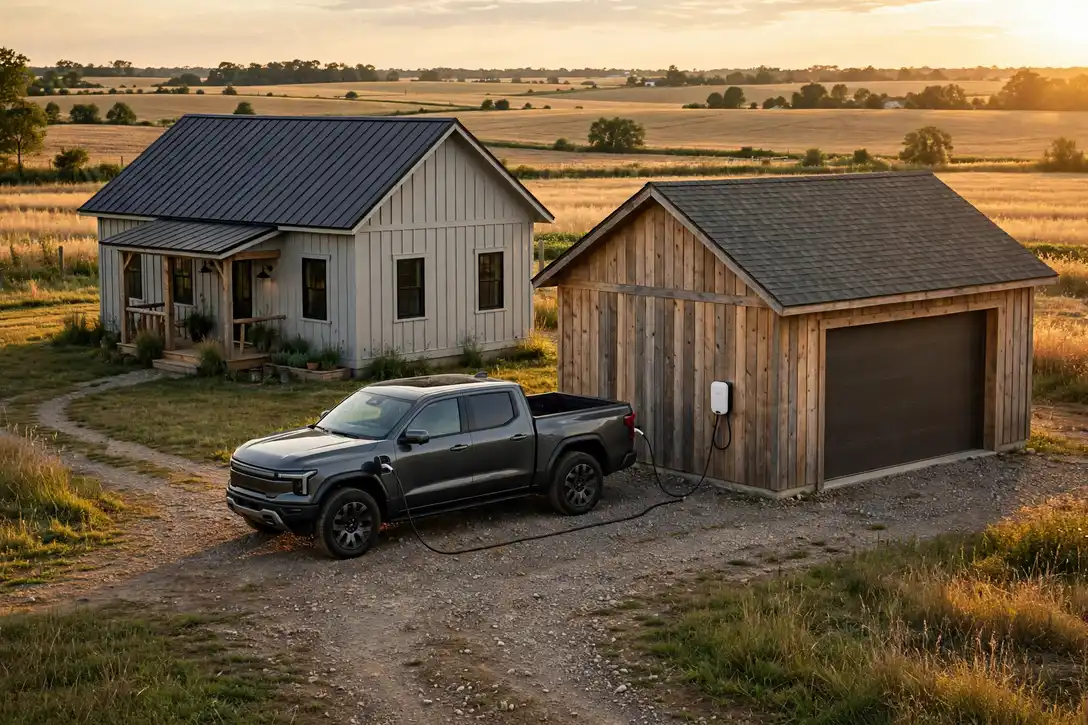
EV charging services in Lincoln
The services below are ordered by what Lincoln households most often need first, judged from the housing and fleet facts on this page. The full menu follows in the grid — every service is offered in this metro.
Home EV Charger Installation in Lincoln
The residential standard: a station where the car sleeps, on a circuit of its own, installed under permit. Variations are all local — the panel's spare room, the run's route through the house's fabric, and the parking pattern the cable has to serve.
In Lincoln: where most Lincoln projects start and finish: one circuit, one station, one inspection.
Dedicated Circuit & Electrical Panel Upgrade in Lincoln
Capacity work wears three costumes — more amps, a fresh panel, or management electronics that make the existing amps behave like more. The load calculation is the fitting room: it shows which costume your house actually needs, and a trustworthy quote names the calculation before the costume.
In Lincoln: the capacity answer when Lincoln's older panels meet a continuous load.
Level 2 Charger Installation in Lincoln
Level 2 earns its keep on the worst week of the year: the cold snap, the back-to-back long days, the evening the car comes home empty with a dawn departure. A circuit sized for those weeks makes the ordinary ones invisible.
In Lincoln: the circuit class behind nearly every home install in Lincoln, from first car to second.
Utility programs and electricity in Lincoln
Electricity in Lincoln comes from Omaha Public Power District. Parts of the wider metro are served by Lincoln Electric System, Nebraska Public Power District, Norris Public Power District. The utility matters twice over for a charger install: it sets the time-of-use rates that decide what overnight charging costs you, and it is the organisation that may — or may not — currently help pay for the equipment.
Plan on no rebate in Lincoln at the moment. In the sources checked for this page, Omaha Public Power District publishes no residential charger rebate, Nebraska runs no state scheme for typical home installs, and the federal credit that once filled this gap closed on September 30, 2025. Installers quote the work; utilities fund programs; the second list is currently empty here, and any quote that implies otherwise should come with the program's published terms attached.
While you are in the tariff pages, look at how the plan values the evening ramp — the hours when cooking, cooling and charging would otherwise stack. A charger that starts after the ramp is the simplest scheduling decision in home charging, and it is set once.
Condos, HOAs and the law in Nebraska
There is no Nebraska right-to-charge statute to lean on. Some national roundups list protection that does not exist in this state's code; the statute indexes checked for this page are clear. In Lincoln, a condo or HOA charger is approved — or not — under the community's own documents, which makes the quality of your application the whole ballgame.
Owners of single-family homes in HOA communities should also check the covenants before assuming the driveway is uncomplicated: exterior-equipment and architectural-approval clauses can apply to a visible wall-mounted station even where the garage interior is entirely the owner's business.
The negotiation playbook — application contents, metering options, the wording that answers boards' standard objections — is set out in our condo and HOA guide, read here as a persuasion manual rather than a rights manual.
Climate, garages and charger placement
Garage temperature is a charging feature here. An insulated garage that holds even a modest margin over the street's cold shortens the battery's warm-up and steadies winter range; a carport install accepts the full season and plans the circuit's headroom accordingly. Either works — they are simply different designs, and the site visit should name which one you own.
Garage doors and cold air negotiate all winter. A door seal in good order, the station mounted on an interior wall rather than the door's own wall, and a cable that never crosses the threshold — small decisions that keep the charging corner of a cold garage closer to the house's climate than the street's.

Permits and inspection in Lincoln
What the inspector is checking, in plain terms: conductor size against breaker size, the continuous-load calculation, terminations torqued, protection where the code wants it, and a station whose settings match the circuit it landed on. It is a short visit that validates everything you cannot see.

Neighbourhoods and ZIP codes served
The page covers 29 ZIP codes in and around Lincoln — including 68501, 68502, 68503, 68504, 68505, 68506, 68507, 68508, 68509, 68510, 68512, 68514, 68516, 68517, 68520, 68521, 68522, 68523, 68524, 68526, 68527, 68528, 68529, 68531, 68532, 68542, 68544, 68583, 68588 — across Lancaster. If your ZIP is not in the first set shown, ask anyway: installer coverage follows the metro, not a postcode fence.
The same working area takes in the neighbouring localities of Malcolm, Raymond, Denton, Davey, Martell, Walton, Roca, Waverly, Sprague, Hallam, Hickman, Bennet, Firth, Panama — the county ring an installer based in Lincoln actually drives. Requests from those communities route exactly as city requests do: same services, same permit discipline, same local facts where they differ.
Lancaster County accounts for 43 of the ZIP codes and 15 named postal localities in the research file, the nearest of them Malcolm, Raymond, Denton, Davey, Martell. The survey counts 326,696 residents in the county, with a median household income of $74,793 and a median home value of $275,200. Measured across its ZIP codes, the Lincoln footprint runs about 14 miles north to south and 16 east to west, from ZIP 68501 to 68588 — the ground an installer based here actually covers in a working week.
Beyond the county seats, the working area takes in Malcolm, Raymond, Pleasant Dale, Denton, Garland, Davey, Milford, Valparaiso, Seward, Martell, Walton, Bee, Roca, Waverly, Sprague, Ceresco, Dwight, Crete, Hallam, Hickman, Dorchester, Bennet, Staplehurst, Weston, Eagle, Goehner, Greenwood, Alvo, Brainard, Firth, Panama, Ulysses, Palmyra, Cortland, Wahoo, Beaver Crossing, Ithaca, Memphis, Clatonia, Ashland, Wilber, Utica, Bruno, Elmwood, Friend, Murdock, Prague, Cordova, Malmo, Douglas, Colon, David City, Surprise, Unadilla, Adams, De Witt, Pickrell, Gresham, Abie, Waco, Rising City, Swanton, Sterling, Western, Exeter, Syracuse, Morse Bluff, Linwood, Burr, Plymouth, Shelby, Milligan, Tobias, Beatrice, Bellwood, Rogers, North Bend, York, Filley, Schuyler, Mc Cool Junction, Benedict, Crab Orchard, Stromsburg, Cook, Fairmont — the named localities for which Lincoln is the nearest metro in the network (neighbouring metros' pages cover their own ground), each routing to the same installer-matching service.
The wider working area also reaches Mead, South Bend, Yutan, Louisville, Manley, Gretna, Weeping Water, Cedar Bluffs, Otoe, Omaha, Waterloo, Springfield, Avoca, Valley, Cedar Creek, Ames, Elkhorn, Fremont, St Columbans — ground shared with neighbouring metros, where installers cross the same county lines in both directions.
ZIP codes in that shared ground include 68015, 68016, 68022, 68025, 68026, 68028, 68037, 68041, 68056, 68058, 68059, 68064, 68069, 68073, 68130, 68135, 68136, 68138, 68307, 68403, 68417, 68463, 68621.
The largest communities in that working area after Lincoln itself, by the GeoNames populated-place file: Grand Island (population 51,440), Hastings (population 24,924), Columbus (population 22,797), Beatrice (population 12,388), York (population 7,864), Seward (population 7,167), Crete (population 7,037), Schuyler (population 6,171). Charging demand follows those populations — the subdivisions and town centres where the next driveways, and the next panels, are.
Seward County reaches into the working area with 17,641 residents, a median household income of $82,444 and a median home value of $241,300; its localities on this page include Pleasant Dale, Garland, Milford, Seward, Bee. Saunders County reaches into the working area with 23,048 residents, a median household income of $94,066 and a median home value of $271,700; its localities on this page include Valparaiso, Ceresco, Weston, Wahoo, Ithaca. Butler County reaches into the working area with 8,424 residents, a median household income of $79,268 and a median home value of $184,200; its localities on this page include Dwight, Brainard, Ulysses, Bruno, David City.
| ZIP | Locality | County |
|---|---|---|
| 68501 | Lincoln | Lancaster |
| 68524 | Lincoln | Lancaster |
| 68529 | Lincoln | Lancaster |
| 68402 | Malcolm | Lancaster |
| 68528 | Lincoln | Lancaster |
| 68428 | Raymond | Lancaster |
| 68532 | Lincoln | Lancaster |
| 68531 | Lincoln | Lancaster |
| 68521 | Lincoln | Lancaster |
| 68522 | Lincoln | Lancaster |
| 68508 | Lincoln | Lancaster |
| 68588 | Lincoln | Lancaster |
| 68423 | Pleasant Dale | Seward |
| 68503 | Lincoln | Lancaster |
| 68502 | Lincoln | Lancaster |
| 68339 | Denton | Lancaster |
| 68509 | Lincoln | Lancaster |
| 68542 | Lincoln | Lancaster |
| 68544 | Lincoln | Lancaster |
| 68583 | Lincoln | Lancaster |
| 68523 | Lincoln | Lancaster |
| 68504 | Lincoln | Lancaster |
| 68360 | Garland | Seward |
| 68336 | Davey | Lancaster |
| 68510 | Lincoln | Lancaster |
| 68514 | Lincoln | Lancaster |
| 68512 | Lincoln | Lancaster |
| 68507 | Lincoln | Lancaster |
| 68505 | Lincoln | Lancaster |
| 68506 | Lincoln | Lancaster |
| 68516 | Lincoln | Lancaster |
| 68517 | Lincoln | Lancaster |
| 68405 | Milford | Seward |
| 68065 | Valparaiso | Saunders |
| 68520 | Lincoln | Lancaster |
| 68434 | Seward | Seward |
| 68404 | Martell | Lancaster |
| 68527 | Lincoln | Lancaster |
| 68526 | Lincoln | Lancaster |
| 68461 | Walton | Lancaster |
| 68314 | Bee | Seward |
| 68430 | Roca | Lancaster |
| 68462 | Waverly | Lancaster |
| 68438 | Sprague | Lancaster |
| 68017 | Ceresco | Saunders |
| 68635 | Dwight | Butler |
| 68333 | Crete | Saline |
| 68368 | Hallam | Lancaster |
| 68372 | Hickman | Lancaster |
| 68343 | Dorchester | Saline |
| 68317 | Bennet | Lancaster |
| 68439 | Staplehurst | Seward |
| 68070 | Weston | Saunders |
| 68347 | Eagle | Cass |
| 68364 | Goehner | Seward |
| 68366 | Greenwood | Cass |
| 68304 | Alvo | Cass |
| 68626 | Brainard | Butler |
| 68358 | Firth | Lancaster |
| 68419 | Panama | Lancaster |
| 68669 | Ulysses | Butler |
| 68418 | Palmyra | Otoe |
| 68331 | Cortland | Gage |
| 68066 | Wahoo | Saunders |
| 68313 | Beaver Crossing | Seward |
| 68033 | Ithaca | Saunders |
| 68042 | Memphis | Saunders |
| 68328 | Clatonia | Gage |
| 68003 | Ashland | Saunders |
| 68465 | Wilber | Saline |
| 68456 | Utica | Seward |
| 68014 | Bruno | Butler |
| 68349 | Elmwood | Cass |
| 68359 | Friend | Saline |
| 68407 | Murdock | Cass |
| 68050 | Prague | Saunders |
| 68330 | Cordova | Seward |
| 68040 | Malmo | Saunders |
| 68344 | Douglas | Otoe |
| 68018 | Colon | Saunders |
| 68632 | David City | Butler |
| 68667 | Surprise | Butler |
| 68454 | Unadilla | Otoe |
| 68301 | Adams | Gage |
| 68341 | De Witt | Saline |
| 68422 | Pickrell | Gage |
| 68367 | Gresham | York |
| 68001 | Abie | Butler |
| 68460 | Waco | York |
| 68658 | Rising City | Butler |

Planning the install: from panel to parking
Two decisions shape every Lincoln install, and both are made before any equipment is ordered. The first is electrical: the load calculation that decides between a straight circuit, a panel upgrade and load management. The second is physical: where the station lives — which wall, which side of the car the charge port sits on, and whether the cable reaches a second vehicle or a future one. Installers in Lincoln see the same housing patterns repeat street by street, which is why a ten-minute site visit produces a firmer quote than any online form: the form starts the conversation, the visit settles it.
Plan for the household you will be, not just the car you have. A second EV is the most common reason a charger circuit gets revisited, and the cheap moment to prepare for it — conduit sized up, panel capacity reserved, station placement that serves two bays — is during the first install, while the permit is open and the electrician is already in the panel.
Home charging know-how for Lincoln households
Historic homes, modern loads
A house can be historically significant and electrically contemporary at once, but the marriage takes choreography: circuits routed through secondary spaces, equipment kept off protected fabric, the panel's growth planned where the preservation easement permits. The installers who do this work well treat the house's rules as a design brief rather than an obstacle, and the result — a period street front, a thoroughly modern garage — is the quiet norm in historic districts now.
The paperwork is part of the installation
A finished install leaves two legacies: a working charger and a file. The file — permit, passed inspection, the station's configuration recorded, the panel schedule updated, a photograph of the finished work — is what the future runs on. It answers the insurer's question, the buyer's question, the second installer's load calculation, and the warranty conversation, each in one page. Households that treat the paperwork as part of the deliverable never have to reconstruct it; households that do not, eventually do. Ask for the file at handover and keep it with the house documents.
Bidirectional charging, honestly framed
Vehicles that can return energy to a house or the grid exist, and the standards enabling them are settling — but for most households today it is a horizon technology, not a purchase category: it needs a compatible vehicle, bidirectional equipment, utility interconnection approval and a tariff that rewards it. None of that changes today's installation advice, except in one detail: conduit and panel capacity installed generously now are the same provisions a future bidirectional setup would want. Buy for the car you have; leave room for the one the industry is promising.
Whose schedule? The car's or the station's
Two schedulers can govern a charging session — the vehicle's own charge timer and the station's app — and households inherit confusion when both are set at once. The discipline is simple: choose one governor. The car's timer travels with the car and knows its departure settings; the station's knows the tariff windows and the household's other loads. Either works; both together produce the 6 am mystery of the half-charged battery and a debugging session nobody enjoys.

Frequently asked questions
Can I still get the federal tax credit for a home charger in Lincoln, NE?
The honest ledger for Lincoln reads: federal credit, ended September 30, 2025; state program, none for typical home installs; Omaha Public Power District residential rebate, none verified in the sources checked. If a salesperson's quote leans on any of the three, the correct response is a request for the program's published page.
Can my association in Lincoln, NE say no to a home charger?
In Lincoln, they can — there is no Nebraska statute stopping them. Right-to-charge protection simply has not been enacted here, so the board's own rules decide. Owners do still get approved regularly: the applications that succeed answer the board's concerns (metering, insurance, restoration, a licensed installer) before the meeting, in writing.
Does a Level 2 charger mean a panel upgrade for a Lincoln, NE home?
Sometimes, and the honest route to the answer is arithmetic rather than opinion. Lincoln's median home was built in 1984; roughly 45% of the stock predates 1980, which is where the 100-amp panels concentrate. If yours is one, expect the upgrade-or-management conversation; if it is a modern 200-amp service with spare spaces, expect a circuit. The site visit's calculation decides, and you are entitled to see it.
How much faster is Level 2 charging at home in Lincoln, NE?
A Level 1 cord on a household outlet adds roughly 3–5 miles of range per hour; a Level 2 station on a 240-volt circuit typically adds about 25–40 miles per hour depending on the circuit's amperage and the vehicle. For most drivers that is the difference between rationing the battery and never thinking about it.
What happens after I request an installer through this page?
Three things happen, in order. Your request is routed to licensed installers who work in Lincoln; one of them contacts you to book a site visit; and the visit produces a written quote based on your actual panel and parking. PlugReady USA runs the matching, not the tools — the contractor on the job is the installer who visits.
Can a charger be added to a detached garage in Lincoln?
Yes — the charger itself is the same; the route to it is the project. From the house panel, a buried conduit run reaches the garage, or a subpanel goes in out there where distance and future loads argue for it. In Lincoln, with about 57% of homes detached, local installers quote this shape routinely — the trench and the run, settled from a site walk, are the substance of it.
Nearby cities in Nebraska
- EV charger installation in Omaha — about 56 miles from Lincoln, metro population 1,000,000
- EV charger installation in Sioux City, IA — about 115 miles from Lincoln, metro population 170,000
- EV charger installation in Manhattan, KS — about 116 miles from Lincoln, metro population 135,000
- EV charger installation in St. Joseph, MO — about 133 miles from Lincoln, metro population 125,000
Ready to charge at home in Lincoln?
Two minutes of form, and the request is in front of licensed installers who cover this city — quotes follow site visits, in writing.