EV Charger Installation in Sioux City, IA
Everything a Sioux City homeowner needs before booking a charger install — the panel question, the utility's current programs, the HOA law and the permit — sourced, dated and local.
There is a reason most charging happens at home: it is the most convenient fuelling an EV owner will ever use, and it happens while the car sits idle anyway. In Sioux City, getting set up means answering a handful of local questions first. Sioux City itself is home to about 87,526 people, inside a state that registered 15,100 battery-electric vehicles and 8,800 plug-in hybrids through 2025. Which utility serves your address, whether it currently funds part of a charger install, what your panel can carry, and what your HOA or condo board can and cannot say no to — this page covers each of them for Sioux City specifically.
How to read this page in four minutes: the data band tells you what kind of housing city Sioux City is; the utility section tells you whether money is on the table; the law section tells you whether permission is a process or a negotiation; and the permit section tells you what proof the finished job leaves behind. The rest is elaboration.
Why Sioux City ranks 267 in this network's 300-metro build order: Tri-state. Those are registration figures, not projections, and they translate directly into installation work — every newly registered plug-in vehicle is a household deciding where it will charge.
Three percentages describe the working conditions for charging in Sioux City: 68% owner-occupied, 68% single-unit detached, and a median household income of $74,972 standing behind both. Everything in the sections below — panels, permissions, metering — is commentary on those proportions.

Put the survey together and Sioux City's charging profile reads like this: an older housing fabric, where panel archaeology is a normal part of the first visit; a detached-house majority with a real attached and multifamily minority; buildings of five or more units are a visible minority of the stock; and owner-occupiers dominate, so most readers can approve their own electrical work outright. That combination — more than any single number — is what the installers working here plan around, and it is the lens for everything on this page.
In absolute terms, the survey counts 34,965 housing units in Sioux City — 32,711 occupied, 22,242 of them by their owners. The stock resolves into 23,720 single-unit detached houses, 26,279 homes standing since before 1980, and 5,394 units in larger buildings. Those six counts are the city's charging map drawn without percentages, and every section of this page is a consequence of one of them. The page's geography is equally concrete: 9 ZIP codes across Woodbury, centred near 42.50 degrees north latitude. The city anchors the Sioux City metropolitan area, home to roughly 170,000 people on the research file's metro estimate — the wider labour and housing market this page's installers work across.
The same survey release fills in the household economics around the housing stock: a median home value of $173,600, median gross rent of $976, per-capita income of $33,795, and a median resident age of 35. How the city moves completes the picture: 80% of Sioux City workers drive to work alone — the commute pattern home charging is built around; 5% work from home, a population whose cars charge on daytime and overnight schedules alike; 1% commute by public transit; 23% of adults hold a bachelor's degree or higher. And the fleet in the driveways: 9,061 households in Sioux City have exactly one vehicle, 20,196 have two or more, and 3,454 have none.
The cost-burden lines say who feels housing costs most in Sioux City: 40% of renters spend 30% or more of income on rent, and 11% of owners with mortgages spend the same share on housing costs. Family households are 67% of all households — the two-car, school-run demographic whose charging patterns this page's planning sections keep circling back to.
What follows is the city read as an electrical place rather than a dot on a map. A stock this old wires its history into the walls: cloth-wrapped conductors in the deepest streets, fuse boxes that outlived their century, panels added in layers by generations of electricians each solving their own decade's problem. The built form refuses a single story: houses with garages on one side of the arterial, garden apartments and mid-rise condos on the other, each population charging by different rules.
Owner-occupation at this level makes the metro a decide-and-do market: the person who wants the charger owns the panel it hangs from, and the project's only committee is the household itself. Value engineering is the local dialect: load management weighed against panel work on merit, quotes compared line by line, the site visit treated as the moment the scope becomes honest. Filed tariffs and public dockets give this territory a paper trail most markets lack: the diligent household can read the utility's own electrification plan and know which programmes are funded, piloted or merely proposed.
Early-market conditions have their own economics: fewer specialist installers, general electricians carrying the work, and a premium on the household arriving informed — which is the gap this page exists to close. The permit counter in a smaller city is a conversation, not a queue: applications are read by people who may know the street, and complete paperwork is remembered kindly. Without a state charging statute, shared-property approvals in this metro are won on paper quality: metering clarity, licensed installers, insurance, reversibility — the complete package the guides set out.
The electrical reality in Sioux City homes
The Census Bureau counts Sioux City's housing in ways that turn out to be an installer's briefing: the median home dates to 1958, 75% of units stood before 1980, 68% are detached single-unit houses, and 68% of occupied homes belong to their occupants. Panel sizes, wire routes and even permit histories track those proportions street by street. Age shows up electrically before it shows up anywhere else: services sized for a house with a third of today's appliances. Expect the first conversation to be about capacity — what the panel is, what it already feeds, and which of the three routes (circuit, management, upgrade) your numbers support. Porches, carports and parking pads carry a real share of this city's charging, because the stock predates the two-car garage as a standard feature — outdoor-rated equipment is a local staple, not an edge case.
One further survey line belongs in any Sioux City install conversation: 32% of the city's homes heat with electricity — 10,457 households whose panels already carry a major winter load before a charger is contemplated. Electric heat and EV charging are the two largest discretionary loads a house can host, and where they coincide, the load calculation stops being a formality.
The tenure split cuts the other way too: roughly 10,469 occupied homes in Sioux City are rented. For those households the charger question is a negotiation with a property owner — written proposal, licensed installer, metering clarity — and it succeeds often enough that installers here keep the pattern ready.
One more structural fact shapes Sioux City's charging map: 15% of the city's housing units sit in buildings of five or more units. Those households cannot simply book a circuit — their charger runs through a building, a board and a shared electrical service, which is why the multifamily service and the law section below carry unusual weight on this page.
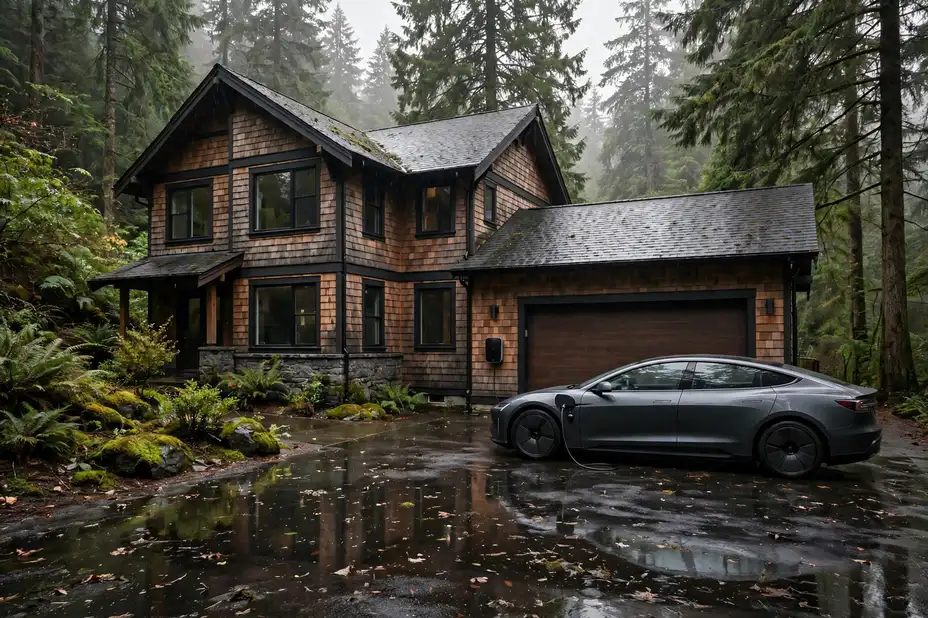
EV charging services in Sioux City
The services below are ordered by what Sioux City households most often need first, judged from the housing and fleet facts on this page. The full menu follows in the grid — every service is offered in this metro.
Home EV Charger Installation in Sioux City
For most households this is the whole project: a Level 2 station mounted where the car sleeps, fed by its own 240-volt circuit. The visit pattern is consistent — load calculation, route the run, mount and configure, inspect — and the variables are your panel, your parking and your permit office.
In Sioux City: where most Sioux City projects start and finish: one circuit, one station, one inspection.
Dedicated Circuit & Electrical Panel Upgrade in Sioux City
The capacity project behind the charger project. A load calculation decides whether the answer is a service increase, a panel replacement, a subpanel or load management — and the work is sequenced with the utility and the inspector so the house is live again the same day in most cases.
In Sioux City: relevant in Sioux City wherever a 100-amp panel already carries cooking, heating and hot water before a charger asks for room.
Level 2 Charger Installation in Sioux City
What is being bought is time: the hours between arriving home and leaving again, converted into range at 240 volts. The conversion hardware is ordinary — breaker, conductor, station — and the design work is matching the three to the household's miles and the panel's arithmetic.
In Sioux City: the circuit class behind nearly every home install in Sioux City, from first car to second.
Utility programs and electricity in Sioux City
Electricity in Sioux City comes from MidAmerican Energy Co. Parts of the wider metro are served by North West Rural Electric Coop, Western Iowa Power Coop, City of Anthon. The utility matters twice over for a charger install: it sets the time-of-use rates that decide what overnight charging costs you, and it is the organisation that may — or may not — currently help pay for the equipment.
Plan on no rebate in Sioux City at the moment. In the sources checked for this page, MidAmerican Energy Co publishes no residential charger rebate, Iowa runs no state scheme for typical home installs, and the federal credit that once filled this gap closed on September 30, 2025. Installers quote the work; utilities fund programs; the second list is currently empty here, and any quote that implies otherwise should come with the program's published terms attached.
If your service includes a demand component, the charger's start time matters more than its size: staggered against the house's other big loads, the same circuit costs noticeably less to run across a year.
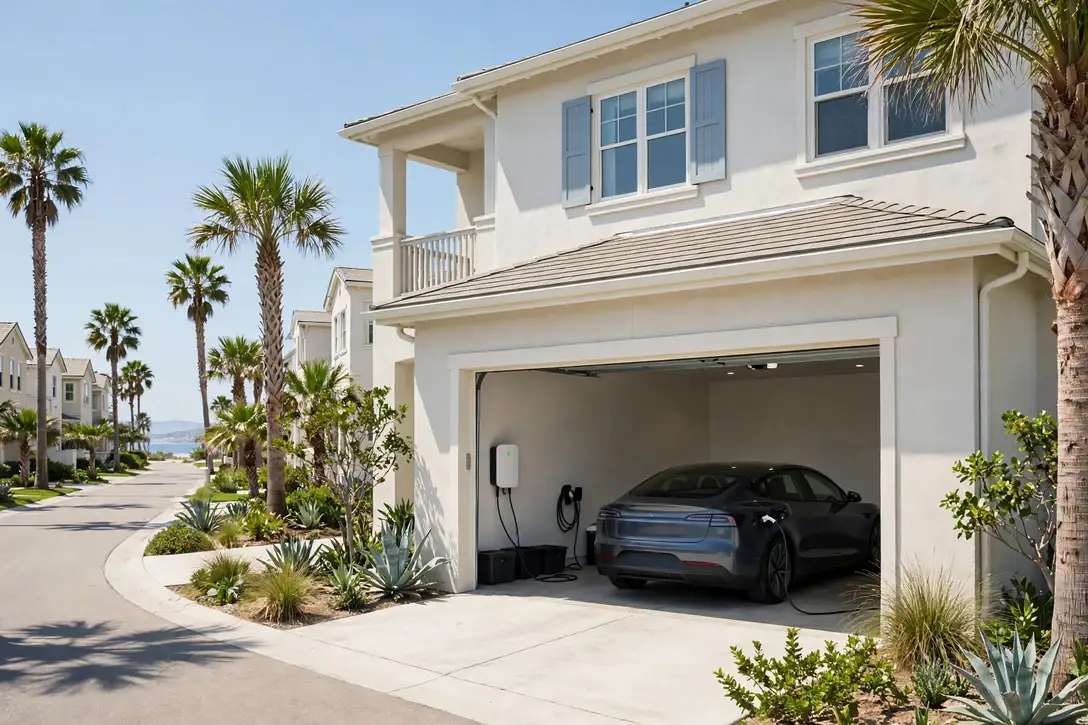
Condos, HOAs and the law in Iowa
Iowa has no statewide right-to-charge law. That needs saying plainly, because roundups on the internet sometimes claim otherwise: in the authoritative statute indexes checked for this page, no Iowa law prevents a homeowners association or condominium from refusing a charger in a common or assigned space. Your community's own covenants and board govern the question in Sioux City.
Owners of single-family homes in HOA communities should also check the covenants before assuming the driveway is uncomplicated: exterior-equipment and architectural-approval clauses can apply to a visible wall-mounted station even where the garage interior is entirely the owner's business.
Our condo and HOA guide covers both kinds of state; in Sioux City the chapters on complete applications and cost allocation are the operative ones.
Climate, garages and charger placement
The plugged-in car is the winter-ready car: battery held at a kinder temperature by the wall, cabin preconditioned without draining the pack, departure on schedule regardless of the night's low. Households in cold metros describe the home charger less as fuelling than as winter equipment outright.
Ice discipline is the third local habit: a cable route that never crosses the shovelled path's landing zone, a holster at a height the snowbank does not reach, and a station position the roof does not shed onto. Winter rewards the installs that were designed in it.

Permits and inspection in Sioux City
Expect the permit to name the circuit, the breaker and the equipment. An installer who suggests skipping it is saving an afternoon by spending your liability; the inspection is also your independent check that the continuous-load sizing was done properly.

Neighbourhoods and ZIP codes served
The page covers 9 ZIP codes in and around Sioux City — including 51101, 51102, 51103, 51104, 51105, 51106, 51108, 51109, 51111 — across Woodbury. If your ZIP is not in the first set shown, ask anyway: installer coverage follows the metro, not a postcode fence.
The same working area takes in the neighbouring localities of Sergeant Bluff, Lawton, Bronson, Salix, Moville, Sloan, Climbing Hill, Hornick, Pierson, Anthon, Smithland, Oto, Correctionville, Cushing — the county ring an installer based in Sioux City actually drives. Requests from those communities route exactly as city requests do: same services, same permit discipline, same local facts where they differ.
Woodbury County accounts for 24 of the ZIP codes and 16 named postal localities in the research file, the nearest of them Sergeant Bluff, Lawton, Bronson, Salix, Moville. The survey counts 106,247 residents in the county, with a median household income of $73,658 and a median home value of $183,200. Measured across its ZIP codes, the Sioux City footprint runs about 12 miles north to south and 8 east to west, from ZIP 51101 to 51111 — the ground an installer based here actually covers in a working week.
Beyond the county seats, the working area takes in South Sioux City, North Sioux City, Sergeant Bluff, Dakota City, Hinton, Jackson, Lawton, Homer, Jefferson, Bronson, Salix, Westfield, Hubbard, Merrill, Ponca, Winnebago, Moville, Waterbury, Sloan, Climbing Hill, Emerson, Elk Point, Hornick, Brunsville, Akron, Le Mars, Walthill, Kingsley, Allen, Macy, Thurston, Whiting, Newcastle, Pierson, Anthon, Oyens, Chatsworth, Wakefield, Burbank, Smithland, Rosalie, Rodney, Pender, Dixon, Ireton, Concord, Remsen, Oto, Correctionville, Bancroft, Maskell, Maurice, Hawarden, Vermillion, Decatur, Onawa, Alcester, Washta, Laurel, Lyons, Wayne, Alton, Marcus, Castana, Cushing, Danbury, Orange City, Mapleton, Sioux Center, Granville, Quimby, Blencoe, Cleghorn, Coleridge, Belden, Wisner, Beemer — the named localities for which Sioux City is the nearest metro in the network (neighbouring metros' pages cover their own ground), each routing to the same installer-matching service.
The largest communities in that working area after Sioux City itself, by the GeoNames populated-place file: Norfolk (population 24,366), Yankton (population 14,557), South Sioux City (population 13,319), Spencer (population 11,212), Storm Lake (population 10,910), Vermillion (population 10,738), Le Mars (population 9,761), Sioux Center (population 7,461). Charging demand follows those populations — the subdivisions and town centres where the next driveways, and the next panels, are.
Plymouth County reaches into the working area with 25,747 residents, a median household income of $83,251 and a median home value of $228,900; its localities on this page include Hinton, Westfield, Merrill, Brunsville, Akron. Sioux County reaches into the working area with 36,212 residents, a median household income of $86,098 and a median home value of $250,100; its localities on this page include Chatsworth, Ireton, Maurice, Hawarden, Alton. Monona County reaches into the working area with 8,557 residents, a median household income of $68,377 and a median home value of $142,900; its localities on this page include Whiting, Rodney, Onawa, Castana, Mapleton.
| ZIP | Locality | County |
|---|---|---|
| 51101 | Sioux City | Woodbury |
| 51105 | Sioux City | Woodbury |
| 51103 | Sioux City | Woodbury |
| 51104 | Sioux City | Woodbury |
| 68776 | South Sioux City | Dakota |
| 51106 | Sioux City | Woodbury |
| 51108 | Sioux City | Woodbury |
| 51109 | Sioux City | Woodbury |
| 57049 | North Sioux City | Union |
| 51111 | Sioux City | Woodbury |
| 51054 | Sergeant Bluff | Woodbury |
| 68731 | Dakota City | Dakota |
| 51024 | Hinton | Plymouth |
| 68743 | Jackson | Dakota |
| 51102 | Sioux City | Woodbury |
| 51030 | Lawton | Woodbury |
| 68030 | Homer | Dakota |
| 57038 | Jefferson | Union |
| 51007 | Bronson | Woodbury |
| 51052 | Salix | Woodbury |
| 51062 | Westfield | Plymouth |
| 68741 | Hubbard | Dakota |
| 51038 | Merrill | Plymouth |
| 68770 | Ponca | Dixon |
| 68071 | Winnebago | Thurston |
| 51039 | Moville | Woodbury |
| 68785 | Waterbury | Dixon |
| 51055 | Sloan | Woodbury |
| 51015 | Climbing Hill | Woodbury |
| 68733 | Emerson | Dakota |
| 57025 | Elk Point | Union |
| 51026 | Hornick | Woodbury |
| 51008 | Brunsville | Plymouth |
| 51001 | Akron | Plymouth |
| 51031 | Le Mars | Plymouth |
| 68067 | Walthill | Thurston |
| 51028 | Kingsley | Plymouth |
| 68710 | Allen | Dixon |
| 68039 | Macy | Thurston |
| 68062 | Thurston | Thurston |
| 51063 | Whiting | Monona |
| 68757 | Newcastle | Dixon |
| 51048 | Pierson | Woodbury |
| 51004 | Anthon | Woodbury |
| 51045 | Oyens | Plymouth |
| 51011 | Chatsworth | Sioux |
| 68784 | Wakefield | Dixon |
| 57010 | Burbank | Clay |
| 51056 | Smithland | Woodbury |
| 68055 | Rosalie | Thurston |
| 51051 | Rodney | Monona |
| 68047 | Pender | Thurston |
| 68732 | Dixon | Dixon |
| 51027 | Ireton | Sioux |
| 68728 | Concord | Dixon |
| 51050 | Remsen | Plymouth |
| 51044 | Oto | Woodbury |
| 51016 | Correctionville | Woodbury |
| 68004 | Bancroft | Cuming |
| 68751 | Maskell | Dixon |
| 51036 | Maurice | Sioux |
| 51023 | Hawarden | Sioux |
| 57069 | Vermillion | Clay |
| 68020 | Decatur | Burt |
| 51040 | Onawa | Monona |
| 57001 | Alcester | Union |
| 51061 | Washta | Cherokee |
| 68745 | Laurel | Cedar |
| 68038 | Lyons | Burt |
| 68787 | Wayne | Wayne |
| 51003 | Alton | Sioux |
| 51035 | Marcus | Cherokee |
| 51010 | Castana | Monona |
| 51018 | Cushing | Woodbury |
| 51019 | Danbury | Woodbury |
| 51041 | Orange City | Sioux |
| 51034 | Mapleton | Monona |
| 51250 | Sioux Center | Sioux |
| 51022 | Granville | Sioux |
| 51049 | Quimby | Cherokee |
| 51523 | Blencoe | Monona |
| 51014 | Cleghorn | Cherokee |
| 68727 | Coleridge | Cedar |
| 68717 | Belden | Cedar |
| 68791 | Wisner | Cuming |
| 68716 | Beemer | Cuming |
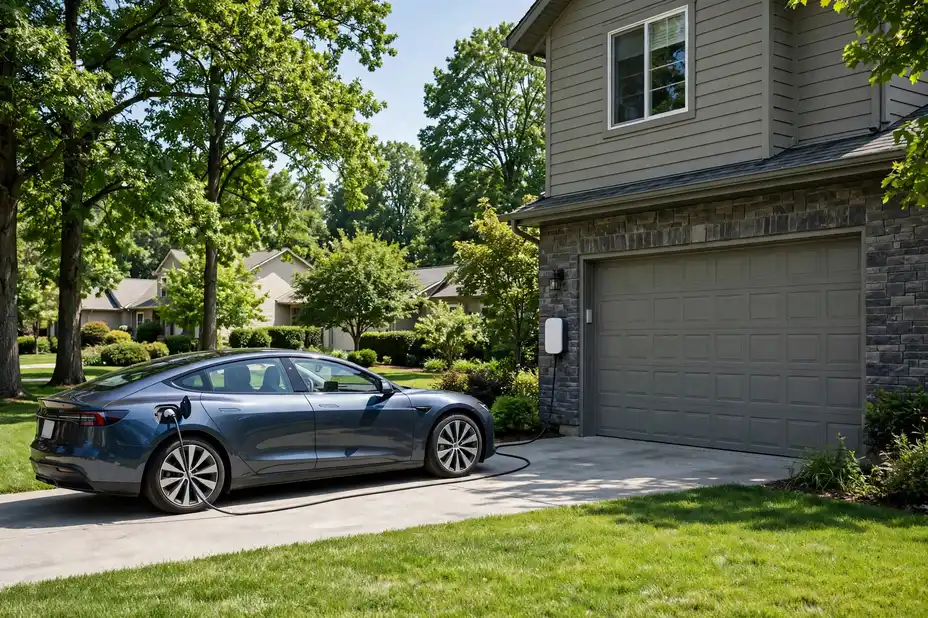
Planning the install: from panel to parking
Think of the project as a chain with four links: capacity, route, placement, paperwork. Capacity is the load calculation. Route is the path copper takes from panel to parking — through a shared wall if you are lucky, across a ceiling or a trench if you are not. Placement is the unglamorous decision that governs daily life with the car for a decade: reach, cable slack, and which side the port is on. Paperwork is the permit and the passed inspection, the proof that outlives the installer's visit.
Future-proofing, in this trade, is mostly conduit and capacity: an oversized conduit run costs little during the first install and everything later; a panel position reserved is a breaker that never has to move. If a second EV, a workshop or an electrified water heater is anywhere in your five-year picture, say so at the site visit.
Home charging know-how for Sioux City households
Planning the second visit on the first
Nearly every install leaves a known future: a second car, a workshop circuit, a battery or a heat pump queuing for capacity. The first visit is when that future costs least to serve — conduit runs made while walls are open, panel positions reserved, the load study documented so the next calculation starts from evidence. Installers call it roughing in the future; households experience it, years later, as the second project that was mysteriously half done already.
Surge protection and the connected house
A charging station is a computer that drinks from the service entrance, and it shares that entrance with everything else the house owns. Whole-home surge protection at the panel — increasingly a code expectation in new work — is the standard companion recommendation when a panel is opened for a charger circuit: one device, guarding the charger, the appliances and the electronics alike. In regions with serious lightning seasons the conversation is routine; everywhere, it is a small line item riding on work already happening, and installers raise it in that spirit.
Breakers: the household's safety switches
A breaker is a switch that watches current and opens when the current stops being safe — heat in a conductor is the thing it exists to prevent. Two household rules follow. First, a tripping breaker is reporting, not malfunctioning by default: reset once, and if it repeats, the circuit gets an electrician, not another reset. Second, the forbidden fix: never answer a trip by fitting a larger breaker. The breaker protects the wire in the wall; upsizing the guard without upsizing the wire removes the protection and keeps the problem.
The charger among the electrification stack
Few households electrify one appliance at a time for long. The charger arrives, then the heat pump conversation starts, then the induction range. Each addition is a load-calculation event, and the households that fare well treat them as one programme: capacity planned once, circuits sequenced, the panel schedule telling the whole story. If your five-year list includes more than the car, hand the list to the installer at the first visit — the most economical capacity is the capacity planned before it is needed.

Frequently asked questions
Is the federal charger tax credit still available in Sioux City, IA?
You cannot — it no longer exists. The 30C credit closed to equipment placed in service after September 30, 2025, and no Iowa program replaced it for home installs. Nor did the sources checked for this page show a live MidAmerican Energy Co residential rebate. Treat any 'credit' mentioned in a quote as a request for paperwork.
Can my HOA or condo board in Sioux City, IA refuse my charger?
Possibly, yes. Iowa has no statewide right-to-charge law in the authoritative indexes checked for this page, so your community's covenants govern. A complete written application — licensed installer, dedicated circuit, owner-paid metering and insurance — is the approach that gets approvals here.
Panel upgrade or not — how do Sioux City, IA homeowners find out?
Nobody can answer that from a photograph of your panel's door, and you should be suspicious of anyone who tries. In a city where the median home dates to 1958 and about 75% of units predate 1980, the honest answer is a load calculation: what your service is, what it already carries, and what a continuous charger load does to the total. Then the options — circuit, load management, or upgrade — compare on paper.
How much faster is Level 2 charging at home in Sioux City, IA?
Level 2 is several-fold faster in the only unit that matters — miles back per hour parked: roughly 25–40 against Level 1's 3–5. The exact figure follows the circuit: a 40-amp circuit and a 60-amp circuit are both Level 2, and the car's onboard limit may sit below either. Your installer matches the three numbers at the site visit.
What happens next after I send a request?
Your request — service, Sioux City ZIP, property type and timing — goes to licensed local installers who cover Sioux City. They contact you directly to arrange a site visit and quote. PlugReady USA is the matching service, not the installer, and the sections above exist so you can judge any quote against the local facts.
Can a charger be added to a detached garage in Sioux City?
Yes — and detached garages are common in Sioux City, where about 68% of homes are single-unit detached. The run out to the building is the substance of the job: a buried conduit from the house panel, or a subpanel in the garage where the distance and future loads justify it. The station itself then behaves like any garage install.
Nearby cities in Iowa
- EV charger installation in Ames — about 158 miles from Sioux City, metro population 125,000
- EV charger installation in Des Moines — about 166 miles from Sioux City, metro population 725,000
- EV charger installation in Waterloo — about 223 miles from Sioux City, metro population 170,000
- EV charger installation in Cedar Rapids — about 265 miles from Sioux City, metro population 280,000
- EV charger installation in Iowa City — about 277 miles from Sioux City, metro population 175,000
- EV charger installation in Dubuque — about 316 miles from Sioux City, metro population 100,000
- EV charger installation in Sioux Falls, SD — about 74 miles from Sioux City, metro population 295,000
- EV charger installation in Omaha, NE — about 89 miles from Sioux City, metro population 1,000,000
- EV charger installation in Lincoln, NE — about 115 miles from Sioux City, metro population 345,000
Ready to charge at home in Sioux City?
Two minutes of form, and the request is in front of licensed installers who cover this city — quotes follow site visits, in writing.