EV Charger Installation in Waterloo, IA
Charging where you park, in Waterloo: the utility programs, state law, permit process and housing facts behind a home charger install, gathered in one place.
Start with the vehicle you already own and the driveway it already sleeps in: home charging succeeds when the electrical side is treated as a small building project rather than an accessory purchase. In Waterloo that project has local coordinates. Waterloo itself is home to about 67,471 people, inside a state counting 15,100 battery-electric vehicles and 8,800 plug-in hybrids through 2025. The utility serving your street, the vintage of your panel, the rules of your community and the habits of your permit office are the four coordinates — this page fixes each one for Waterloo.
How PlugReady USA works, in one breath: you describe the job once, licensed local installers who cover Waterloo receive it, and the conversations happen with them directly. The rest of this page exists so those conversations start from facts — yours about the house, ours about the metro — rather than from a sales script.
The demand picture for the Waterloo–Cedar Falls metro, from the registration data this site is built on: IA coverage. Registration counts are the honest way to size a charging market — they count households, not headlines — and they are why Waterloo sits where it does in our build order (rank 268 of 300 metros, Tier C).
Survey context for Waterloo, in the three lines installers actually use: median household income $61,737; owner-occupation at 65%; single-unit detached homes at 67%. Income tracks adoption pace, tenure decides whose signature a job needs, and structure decides whether the answer is a garage circuit or a building negotiation.

Every city charges differently, and Waterloo's difference is legible in the data: an older housing fabric, where panel archaeology is a normal part of the first visit; a detached-house majority with a real attached and multifamily minority; buildings of five or more units are a visible minority of the stock; owner-occupiers dominate, so most readers can approve their own electrical work outright. Read the sections below through that profile and the local advice resolves into specifics — which questions are routine here, and which are rare.
In absolute terms, the survey counts 32,083 housing units in Waterloo — 29,630 occupied, 19,338 of them by their owners. The stock resolves into 21,394 single-unit detached houses, 24,006 homes standing since before 1980, and 5,926 units in larger buildings. Those six counts are the city's charging map drawn without percentages, and every section of this page is a consequence of one of them. The page's geography is equally concrete: 4 ZIP codes across Black Hawk, centred near 42.48 degrees north latitude. The city anchors the Waterloo–Cedar Falls metropolitan area, home to roughly 170,000 people on the research file's metro estimate — the wider labour and housing market this page's installers work across.
The same survey release fills in the household economics around the housing stock: a median home value of $152,600, median gross rent of $923, per-capita income of $32,837, and a median resident age of 37. The movement data matters as much as the money data: 78% of Waterloo workers drive to work alone — the commute pattern home charging is built around; 8% work from home, a population whose cars charge on daytime and overnight schedules alike; 0% commute by public transit; 22% of adults hold a bachelor's degree or higher. The survey's vehicle table is the one an EV page should quote first: 3,396 of Waterloo's households have no vehicle at all, while 16,333 have two or more — the multi-car households for whom the second circuit is a when, not an if.
Two burden statistics frame the economics: in Waterloo, 48% of renters and 0% of mortgage-holding owners are housing-cost burdened at the standard 30% threshold. And 57% of households are family households, the segment most likely to run the two-vehicle, two-schedule pattern the second-vehicle planning notes address.
Taken as one portrait, the numbers describe a specific charging market. Where so much of the stock predates modern code cycles, the site visit doubles as a survey — grounding electrode, service entrance, panel provenance — before it is ever a quote. Variety is the installer's training programme here: no two days alike, the van stocked for houses and buildings alike, and a diary that reads like the housing survey performed live.
Owner-occupation at this level makes the metro a decide-and-do market: the person who wants the charger owns the panel it hangs from, and the project's only committee is the household itself. Households at this band comparison-shop on scope rather than on slogans, which rewards the installer whose quote shows its working — the load study, the route, the permit, itemised. Tariff design is the quiet policy: the shape of the overnight window, the demand charges commercial customers face, the interconnection queue's pace — all set in dockets the diligent can read.
In an early market every install is disproportionately instructive: the permit counter learns, the association learns, the street learns, and the second install on any street is always easier than the first. The permit counter in a smaller city is a conversation, not a queue: applications are read by people who may know the street, and complete paperwork is remembered kindly. Boards here decide without a statutory script, which makes precedent the currency: the first well-built application in a community quietly writes the policy for everyone after it.
The electrical reality in Waterloo homes
Four numbers organise everything an installer expects in Waterloo: median build year 1965; 75% of units built before 1980; 67% of the stock detached; 65% of occupied homes owner-occupied. Capacity, circuit routes and approval layers all correlate with those four. The paragraphs below are their commentary. Age shows up electrically before it shows up anywhere else: services sized for a house with a third of today's appliances. Expect the first conversation to be about capacity — what the panel is, what it already feeds, and which of the three routes (circuit, management, upgrade) your numbers support. Detached houses matter for a practical reason: a garage or driveway on your own lot means the charger, the car and the circuit are all under one roof and one owner's control, which is the simplest configuration there is.
Heating fuel is the survey's quiet clue to panel life: in Waterloo, 30% of homes heat electrically (8,728 households), against 69% heating with gas. A house already heating electrically has a service sized with that load in its history; a gas-heated house may have capacity to spare — either way the fuel mix is part of what the installer is reading.
The tenure split cuts the other way too: roughly 10,292 occupied homes in Waterloo are rented. For those households the charger question is a negotiation with a property owner — written proposal, licensed installer, metering clarity — and it succeeds often enough that installers here keep the pattern ready.
The city's stock is not all houses: 18% of units are in structures of five or more. Shared buildings mean shared panels, assigned parking and association process — the substance of the multifamily sections below.
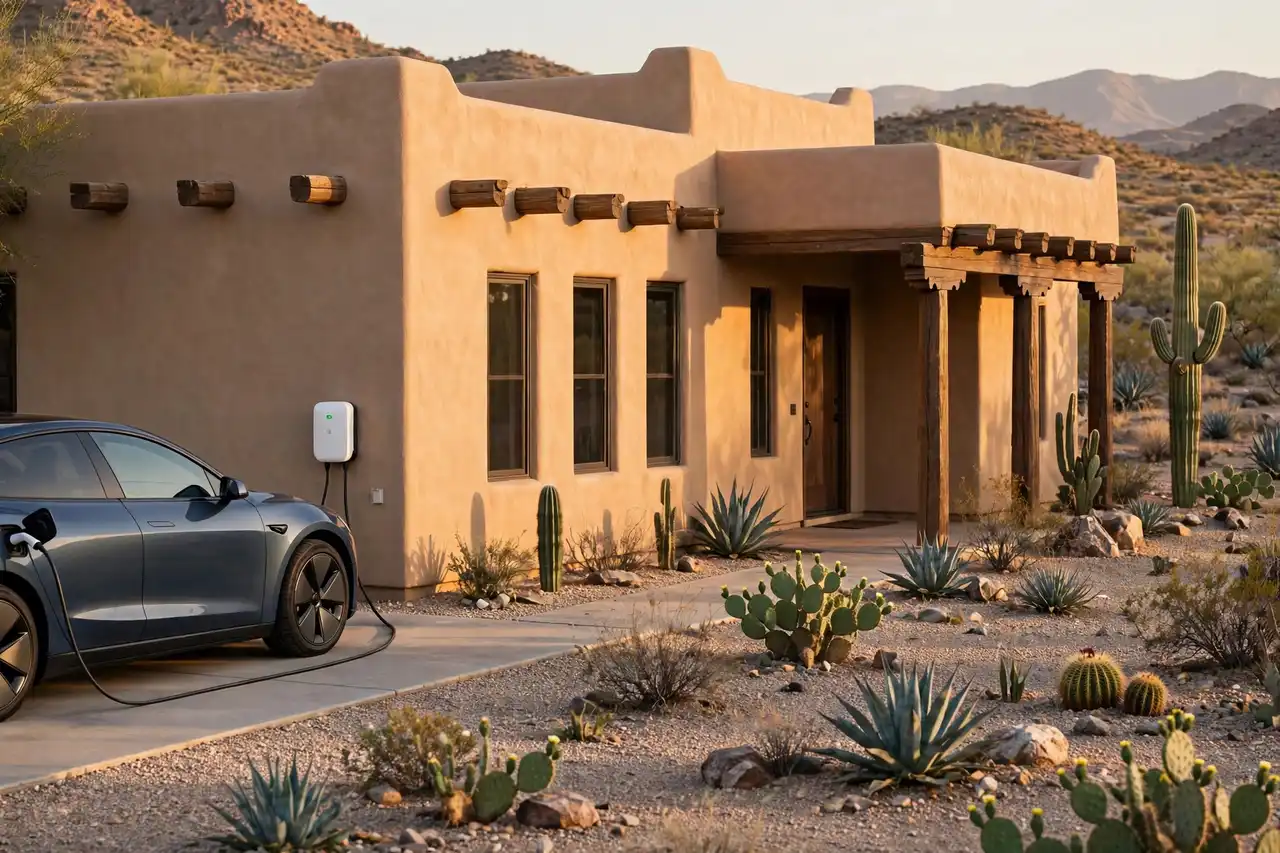
EV charging services in Waterloo
Ten services cover the work installers do in Waterloo. Three lead the list here because of what this city's housing and law actually look like — each links to its national service page, where scope and process are set out in full.
Home EV Charger Installation in Waterloo
The core service, stated plainly: a dedicated 240-volt circuit run from your panel to your parking place, a station mounted and configured to that circuit, and the paperwork closed out with the permit office. Everything else in this section of the site exists to support or unblock this one job.
In Waterloo: the install Waterloo's new EV households book first, and the one the rest of this page keeps returning to.
Dedicated Circuit & Electrical Panel Upgrade in Waterloo
Where the load calculation fails the existing service, the upgrade is not an upsell — it is the finding. Done under permit with the utility's meter work coordinated, it converts the charger project into the house's electrical reset, and every later project inherits the headroom.
In Waterloo: relevant in Waterloo wherever a 100-amp panel already carries cooking, heating and hot water before a charger asks for room.
Level 2 Charger Installation in Waterloo
Level 2's numbers explain its dominance: several times the overnight recovery of a wall outlet, on equipment sized to the circuit by a factor the code fixes. The install is a circuit project with a station at the end of it, and it is quoted that way by anyone who does it weekly.
In Waterloo: the circuit class behind nearly every home install in Waterloo, from first car to second.
Utility programs and electricity in Waterloo
Electricity in Waterloo comes from MidAmerican Energy Co. Parts of the wider metro are served by Interstate Power and Light Co, Cedar Falls Utilities, East-Central Iowa Rural Elec Coop. The utility matters twice over for a charger install: it sets the time-of-use rates that decide what overnight charging costs you, and it is the organisation that may — or may not — currently help pay for the equipment.
There is a strategic consequence to the empty incentive shelf in Waterloo: the install decision reduces to the work itself and the tariff it runs on. With no rebate distorting the comparison, quotes compete on scope, licensing and the load calculation's honesty — which is the competition homeowners should want. And the overnight rate window, where MidAmerican Energy Co offers one, quietly returns more over the car's life than most one-off rebates ever did.
Renters and condo owners should note the metering question early: whose meter the charger hangs off decides who pays for the energy, and MidAmerican Energy Co's options for submetering are part of the multifamily conversation below.
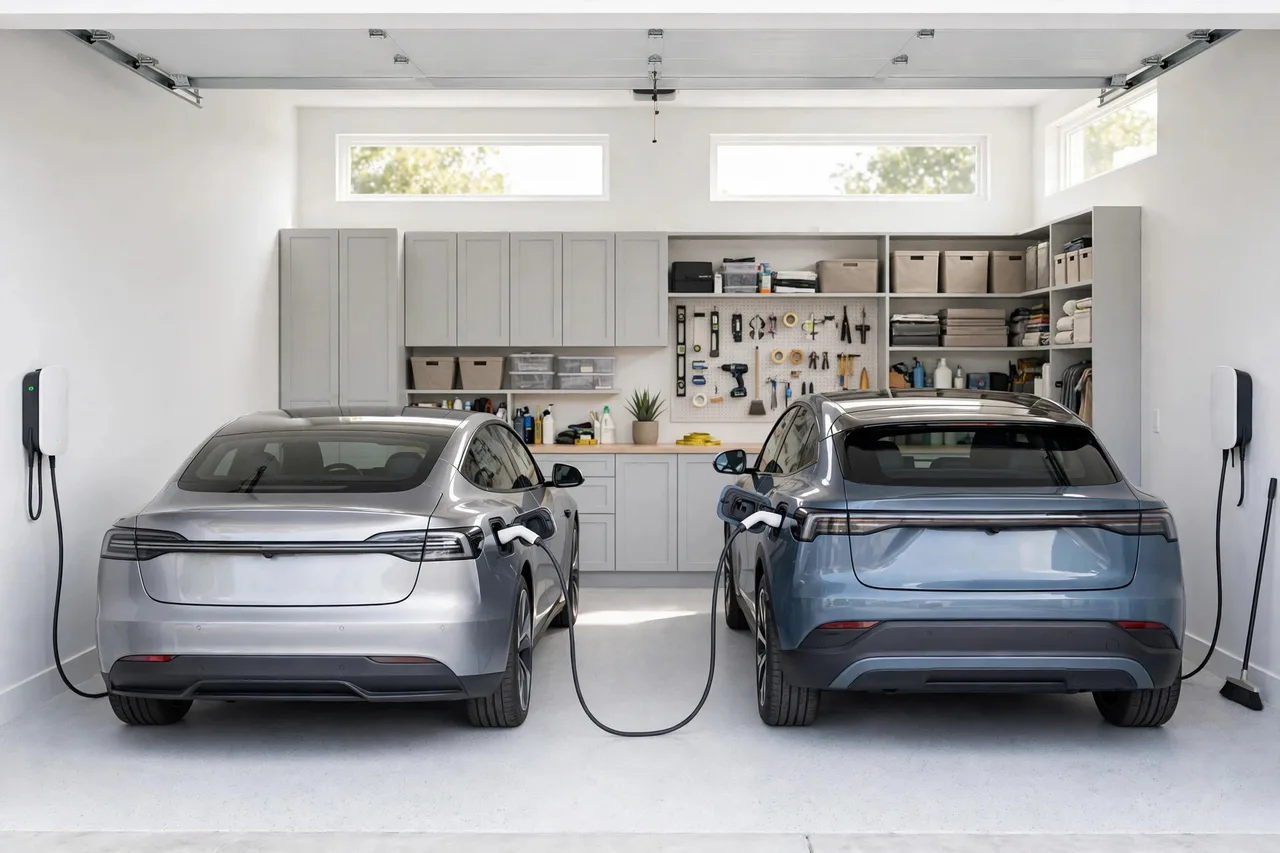
Condos, HOAs and the law in Iowa
No statute promises a charger approval in Iowa. Unlike the states that have enacted right-to-charge laws, Iowa leaves the question entirely to each community's covenants and board discretion. For Waterloo owners that is not the end of the road — it is a sign that the negotiation, the metering design and the written application carry the weight a statute would otherwise carry.
If the board says no, ask for the refusal in writing with the covenant cited. Rules change — several states added right-to-charge laws in 2025 alone — and a documented refusal is what a future rule change, or a future board, works from.
For the full playbook — application contents, metering designs, the questions boards ask — see the condo and HOA charging guide. In Waterloo it should be read as a negotiation manual, because negotiation is what the absence of a statute leaves you.
Climate, garages and charger placement
Garage doors and cold air negotiate all winter. A door seal in good order, the station mounted on an interior wall rather than the door's own wall, and a cable that never crosses the threshold — small decisions that keep the charging corner of a cold garage closer to the house's climate than the street's.
Preconditioning is the cold-climate feature owners actually use: the car warms its battery and cabin from the wall while it is still plugged in, leaving with a full battery instead of spending the first miles on heat. It only works if the car is connected overnight — which is the whole argument for a home circuit that is effortless to use in gloves, in the dark, in February.

Permits and inspection in Waterloo
What the inspector is checking, in plain terms: conductor size against breaker size, the continuous-load calculation, terminations torqued, protection where the code wants it, and a station whose settings match the circuit it landed on. It is a short visit that validates everything you cannot see.

Neighbourhoods and ZIP codes served
The page covers 4 ZIP codes in and around Waterloo — including 50701, 50702, 50703, 50704 — across Black Hawk. If your ZIP is not in the first set shown, ask anyway: installer coverage follows the metro, not a postcode fence.
The same working area takes in the neighbouring localities of Cedar Falls, Evansdale, Hudson, Raymond, Dewar, Gilbertville, Dunkerton, La Porte City — the county ring an installer based in Waterloo actually drives. Requests from those communities route exactly as city requests do: same services, same permit discipline, same local facts where they differ.
Black Hawk County accounts for 13 of the ZIP codes and 9 named postal localities in the research file, the nearest of them Cedar Falls, Evansdale, Hudson, Raymond, Dewar. The survey counts 131,049 residents in the county, with a median household income of $66,417 and a median home value of $188,900. Measured across its ZIP codes, the Waterloo footprint runs about 3 miles north to south and 3 east to west, from ZIP 50701 to 50704 — the ground an installer based here actually covers in a working week.
Beyond the county seats, the working area takes in Cedar Falls, Evansdale, Hudson, Raymond, Dewar, Gilbertville, Janesville, Dunkerton, Denver, Dike, La Porte City, Buckingham, New Hartford, Reinbeck, Readlyn, Jesup, Morrison, Stout, Shell Rock, Waverly, Fairbank, Traer, Dysart, Mount Auburn, Oran, Brandon, Parkersburg, Lincoln, Tripoli, Grundy Center, Holland, Garrison, Hazleton, Independence, Plainfield, Clutier, Clarksville, Frederika, Gladbrook, Sumner, Westgate, Oelwein, Aplington, Beaman, Allison, Wellsburg, Garwin, Elberon, Stanley, Kesley, Conrad, Maynard, Austinville, Vining, Nashua, Toledo, Fredericksburg, Winthrop, Bristow, Aurora, Tama, Randalia, Greene, Dumont, Steamboat Rock, Ackley, Chelsea, Lamont, Ionia, Hawkeye, Montour, Le Grand, Fayette, New Hampton, Arlington, Waucoma, West Union, Aredale, Charles City, Lawler, North Washington, Geneva, Marble Rock — the named localities for which Waterloo is the nearest metro in the network (neighbouring metros' pages cover their own ground), each routing to the same installer-matching service.
The wider working area also reaches Vinton, Rowley, Urbana, Keystone, Quasqueton, Van Horne, Walker, Center Point, Shellsburg, Whitten, Liscomb, Newhall, Troy Mills, Belle Plaine, Luzerne, Union, Eldora, Blairstown, Albion, Marshalltown, Masonville, Atkins, Toddville, Palo, Watkins — ground shared with neighbouring metros, where installers cross the same county lines in both directions.
ZIP codes in that shared ground include 50005, 50148, 50158, 50258, 50269, 50627, 50654, 52206, 52208, 52209, 52213, 52249, 52257, 52315, 52324, 52326, 52329, 52332, 52341, 52344, 52345, 52346, 52349, 52352, 52354.
The largest communities in that working area after Waterloo itself, by the GeoNames populated-place file: Cedar Falls (population 41,255), Mason City (population 27,366), Waverly (population 10,066), Clear Lake (population 7,590), Charles City (population 7,455), Oelwein (population 6,153), Independence (population 6,028), Evansdale (population 4,812), Hampton (population 4,290), New Hampton (population 3,452), Tama (population 2,819), Grundy Center (population 2,714), Jesup (population 2,671), West Union (population 2,409), Hudson (population 2,381), La Porte City (population 2,290), Toledo (population 2,202), Sumner (population 2,009), Parkersburg (population 1,960), Denver (population 1,835). Charging demand follows those populations — the subdivisions and town centres where the next driveways, and the next panels, are.
Tama County reaches into the working area with 16,868 residents, a median household income of $70,781 and a median home value of $148,600; its localities on this page include Buckingham, Traer, Dysart, Lincoln, Clutier. Butler County reaches into the working area with 14,268 residents, a median household income of $73,715 and a median home value of $165,400; its localities on this page include New Hartford, Shell Rock, Parkersburg, Clarksville, Aplington. Fayette County reaches into the working area with 19,288 residents, a median household income of $60,165 and a median home value of $136,800; its localities on this page include Oran, Westgate, Oelwein, Maynard, Randalia. Grundy County reaches into the working area with 12,384 residents, a median household income of $87,205 and a median home value of $198,800; its localities on this page include Dike, Reinbeck, Morrison, Stout, Grundy Center. Buchanan County reaches into the working area with 20,694 residents, a median household income of $78,236 and a median home value of $176,000; its localities on this page include Jesup, Fairbank, Brandon, Hazleton, Independence.
| ZIP | Locality | County |
|---|---|---|
| 50701 | Waterloo | Black Hawk |
| 50702 | Waterloo | Black Hawk |
| 50614 | Cedar Falls | Black Hawk |
| 50704 | Waterloo | Black Hawk |
| 50703 | Waterloo | Black Hawk |
| 50707 | Evansdale | Black Hawk |
| 50613 | Cedar Falls | Black Hawk |
| 50643 | Hudson | Black Hawk |
| 50667 | Raymond | Black Hawk |
| 50623 | Dewar | Black Hawk |
| 50634 | Gilbertville | Black Hawk |
| 50647 | Janesville | Bremer |
| 50626 | Dunkerton | Black Hawk |
| 50622 | Denver | Bremer |
| 50624 | Dike | Grundy |
| 50651 | La Porte City | Black Hawk |
| 50612 | Buckingham | Tama |
| 50660 | New Hartford | Butler |
| 50669 | Reinbeck | Grundy |
| 50668 | Readlyn | Bremer |
| 50648 | Jesup | Buchanan |
| 50657 | Morrison | Grundy |
| 50673 | Stout | Grundy |
| 50670 | Shell Rock | Butler |
| 50677 | Waverly | Bremer |
| 50629 | Fairbank | Buchanan |
| 50675 | Traer | Tama |
| 52224 | Dysart | Tama |
| 52313 | Mount Auburn | Benton |
| 50664 | Oran | Fayette |
| 52210 | Brandon | Buchanan |
| 50665 | Parkersburg | Butler |
| 50652 | Lincoln | Tama |
| 50676 | Tripoli | Bremer |
| 50638 | Grundy Center | Grundy |
| 50642 | Holland | Grundy |
| 52229 | Garrison | Benton |
| 50641 | Hazleton | Buchanan |
| 50644 | Independence | Buchanan |
| 50666 | Plainfield | Bremer |
| 52217 | Clutier | Tama |
| 50619 | Clarksville | Butler |
| 50631 | Frederika | Bremer |
| 50635 | Gladbrook | Tama |
| 50674 | Sumner | Bremer |
| 50681 | Westgate | Fayette |
| 50662 | Oelwein | Fayette |
| 50604 | Aplington | Butler |
| 50609 | Beaman | Grundy |
| 50602 | Allison | Butler |
| 50680 | Wellsburg | Grundy |
| 50632 | Garwin | Tama |
| 52225 | Elberon | Tama |
| 50671 | Stanley | Buchanan |
| 50649 | Kesley | Butler |
| 50621 | Conrad | Grundy |
| 50655 | Maynard | Fayette |
| 50608 | Austinville | Butler |
| 52348 | Vining | Tama |
| 50658 | Nashua | Chickasaw |
| 52342 | Toledo | Tama |
| 50630 | Fredericksburg | Chickasaw |
| 50682 | Winthrop | Buchanan |
| 50611 | Bristow | Butler |
| 50607 | Aurora | Buchanan |
| 52339 | Tama | Tama |
| 52164 | Randalia | Fayette |
| 50636 | Greene | Butler |
| 50625 | Dumont | Butler |
| 50672 | Steamboat Rock | Hardin |
| 50601 | Ackley | Hardin |
| 52215 | Chelsea | Tama |
| 50650 | Lamont | Buchanan |
| 50645 | Ionia | Chickasaw |
| 52147 | Hawkeye | Fayette |
| 50173 | Montour | Tama |
| 50142 | Le Grand | Marshall |
| 52142 | Fayette | Fayette |
| 50659 | New Hampton | Chickasaw |
| 50606 | Arlington | Fayette |
| 52171 | Waucoma | Fayette |
| 52175 | West Union | Fayette |
| 50605 | Aredale | Butler |
| 50616 | Charles City | Floyd |
| 52154 | Lawler | Chickasaw |
| 50661 | North Washington | Chickasaw |
| 50633 | Geneva | Franklin |
| 50653 | Marble Rock | Floyd |
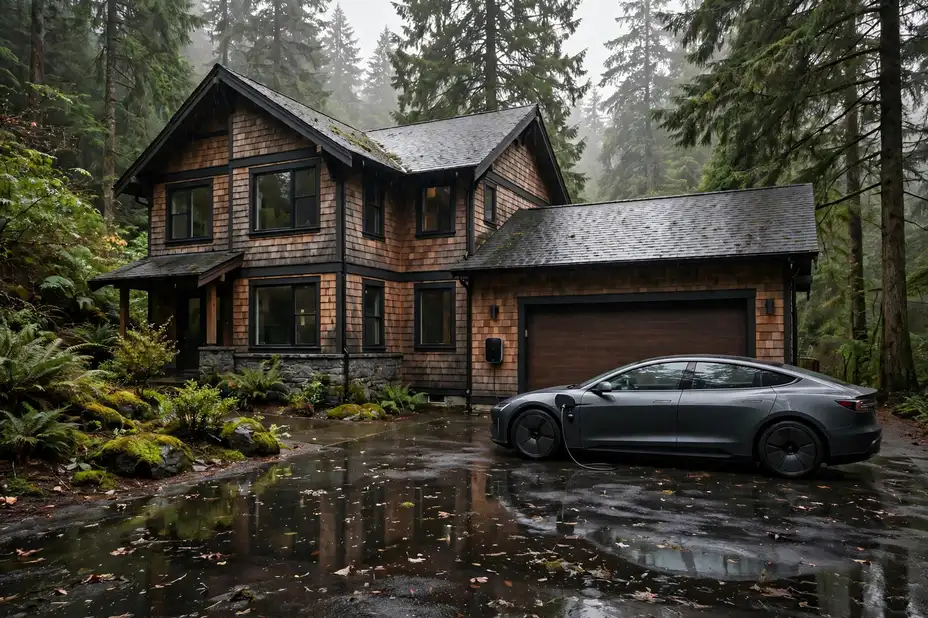
Planning the install: from panel to parking
Think of the project as a chain with four links: capacity, route, placement, paperwork. Capacity is the load calculation. Route is the path copper takes from panel to parking — through a shared wall if you are lucky, across a ceiling or a trench if you are not. Placement is the unglamorous decision that governs daily life with the car for a decade: reach, cable slack, and which side the port is on. Paperwork is the permit and the passed inspection, the proof that outlives the installer's visit.
Plan for the household you will be, not just the car you have. A second EV is the most common reason a charger circuit gets revisited, and the cheap moment to prepare for it — conduit sized up, panel capacity reserved, station placement that serves two bays — is during the first install, while the permit is open and the electrician is already in the panel.
Home charging know-how for Waterloo households
How rebate paperwork usually works
Where a utility program does exist, its money moves on paperwork rails: pre-approval before purchase in some programmes, photographs and the inspection record after installation, deadlines measured in weeks. The practical lesson travels even to cities without a current program — keep everything. The permit, the passed inspection, the equipment invoice with model and serial, photographs of the finished work: filed together, they are the application for any programme that opens later, and the file costs nothing to keep.
Making the rate window automatic
Time-of-use tariffs reward households whose charging happens while the grid sleeps, and the reward compounds silently: every night, for the life of the car. The mechanism is trivial — a schedule set in the vehicle or the station — but the details decide whether it survives contact with real life: the window must fit the household's latest departure, the schedule must yield gracefully on the nights the car comes home empty, and the settings must live somewhere the household can find them again. Set it up at commissioning, with the installer, and the saving becomes infrastructure rather than intention.
Amps, volts and kilowatts without tears
Three numbers describe every charging session. Volts are the pressure — 240 of them on a Level 2 circuit. Amps are the flow — the circuit's rating, of which the car may continuously use eighty percent. Kilowatts are the product of the two and the speedometer of charging: volts times amps, divided by a thousand. A 40-amp circuit at 240 volts delivers 9.6 kilowatts; over a ten-hour night that is roughly 96 kilowatt-hours before losses — more than most batteries hold. Once the multiplication is familiar, every quote and specification sheet becomes readable.
Outdoor and carport positions
Plenty of charging happens without a garage at all — on driveway walls, posts and carports. The outdoor version of the job adds its own discipline: equipment listed for the exposure, an enclosure that sheds rather than traps water, cable reach checked against the car's real nose-in position, and protection from the ordinary impacts of a working driveway. A pedestal adds a foundation and a conduit approach below grade. None of it is exotic, and all of it is cheaper decided on paper than corrected in concrete.

Frequently asked questions
What happened to the federal home-charger credit in Waterloo, IA?
Treat the answer as a standing no with a watching brief. The 30C credit is finished, Iowa has not replaced it for homeowners, and no verified MidAmerican Energy Co rebate was running in the sources checked for this page. Should that change, the utility's program page will say so first — and this page will be updated to match.
Can my HOA or condo board in Waterloo, IA refuse my charger?
In Waterloo the honest answer is yes, they can refuse: Iowa gives owners no statutory charging right, so the board's discretion governs. What changes outcomes is the quality of the file in front of them — drawings, metering, insurance, a named licensed installer — and a growing number of boards here approve exactly that file.
Will my Waterloo, IA home need a panel upgrade for a Level 2 charger?
Sometimes, and the honest route to the answer is arithmetic rather than opinion. Waterloo's median home was built in 1965; roughly 75% of the stock predates 1980, which is where the 100-amp panels concentrate. If yours is one, expect the upgrade-or-management conversation; if it is a modern 200-amp service with spare spaces, expect a circuit. The site visit's calculation decides, and you are entitled to see it.
Level 1 or Level 2 in Waterloo, IA — what is the real difference?
In parked hours: a Level 1 cord returns about 3–5 miles for each of them, and a Level 2 circuit returns roughly 25–40, set by its amperage and the car's acceptance. For a Waterloo household parking ten hours, that is the difference between recovering a short errand day and recovering any day the car can legally drive.
What happens next after I send a request?
Three steps: the request routes to installers who work Waterloo, Iowa; one contacts you to walk the property; the walk produces the written quote. Everything on this page — the utility position, the law, the housing data — is yours to check that quote against.
Do installers cover the communities around Waterloo, IA?
They do. Coverage follows the metro: Cedar Falls, Evansdale, Hudson, Raymond, Dewar and their neighbouring communities are worked by the same installers who cover Waterloo itself, and a request from those ZIP codes routes identically — service, property type and timing are all the form asks for.
Nearby cities in Iowa
- EV charger installation in Cedar Rapids — about 52 miles from Waterloo, metro population 280,000
- EV charger installation in Ames — about 75 miles from Waterloo, metro population 125,000
- EV charger installation in Iowa City — about 75 miles from Waterloo, metro population 175,000
- EV charger installation in Des Moines — about 87 miles from Waterloo, metro population 725,000
- EV charger installation in Dubuque — about 93 miles from Waterloo, metro population 100,000
- EV charger installation in Davenport — about 119 miles from Waterloo, metro population 470,000
- EV charger installation in Rochester, MN — about 109 miles from Waterloo, metro population 230,000
- EV charger installation in La Crosse, WI — about 111 miles from Waterloo, metro population 140,000
- EV charger installation in Eau Claire, WI — about 166 miles from Waterloo, metro population 175,000
Ready to charge at home in Waterloo?
Tell us the job — service, ZIP and property type — and licensed local installers will take it from there.