EV Charger Installation in Dubuque, IA
Charging where you park, in Dubuque: the utility programs, state law, permit process and housing facts behind a home charger install, gathered in one place.
Consider what a home charger actually replaces: the weekly detour, the public station's queue, the arithmetic of arriving home low. In Dubuque, the replacement project is well understood because the fleet is already here — 15,100 battery-electric vehicles and 8,800 plug-in hybrids registered across Iowa through 2025. Dubuque itself is home to about 59,174 people. This page is the project's local brief: your utility and its programs, your state's law, your city's permit process, and your housing stock's electrical character, each stated with its source.
How to read this page in four minutes: the data band tells you what kind of housing city Dubuque is; the utility section tells you whether money is on the table; the law section tells you whether permission is a process or a negotiation; and the permit section tells you what proof the finished job leaves behind. The rest is elaboration.
The registration ledger for the Dubuque metro reads: IA coverage. Ledgers like this are what installer rounds are built from — they show where the cars already are, which is where the circuits get requested, permitted and inspected week after week.
The Census Bureau's portrait of Dubuque — median household income $65,845, 66% of occupied homes owner-occupied, 63% of units in single-unit detached houses — is, read correctly, a charging forecast. Owners approve their own work; detached houses host their own circuits; the remaining share is where the interesting projects live.

The composite picture matters more than any single statistic. In Dubuque: an older housing fabric, where panel archaeology is a normal part of the first visit; a detached-house majority with a real attached and multifamily minority; buildings of five or more units are a visible minority of the stock; meanwhile, owner-occupiers dominate, so most readers can approve their own electrical work outright. A page that ignored that profile would give the same advice everywhere; this one is ordered by it.
Keep six figures and you keep Dubuque's whole electrical character: 27,832 housing units; 26,131 occupied homes; 17,203 owner-occupied; 17,470 detached houses; 20,180 pre-1980 homes; 4,964 homes in buildings of five or more units. Percentages elsewhere on this page are these numbers in disguise — the counts are the originals, and they are the numbers a local installer's experience is actually made of. The page's geography is equally concrete: 5 ZIP codes across Dubuque, centred near 42.52 degrees north latitude. The city anchors the Dubuque metropolitan area, home to roughly 100,000 people on the research file's metro estimate — the wider labour and housing market this page's installers work across.
The same survey release fills in the household economics around the housing stock: a median home value of $204,800, median gross rent of $948, per-capita income of $38,244, and a median resident age of 38. How the city moves completes the picture: 77% of Dubuque workers drive to work alone — the commute pattern home charging is built around; 12% work from home, a population whose cars charge on daytime and overnight schedules alike; 1% commute by public transit; 34% of adults hold a bachelor's degree or higher. The survey's vehicle table is the one an EV page should quote first: 2,114 of Dubuque's households have no vehicle at all, while 14,052 have two or more — the multi-car households for whom the second circuit is a when, not an if.
Two burden statistics frame the economics: in Dubuque, 46% of renters and 0% of mortgage-holding owners are housing-cost burdened at the standard 30% threshold. And 55% of households are family households, the segment most likely to run the two-vehicle, two-schedule pattern the second-vehicle planning notes address.
None of these facts is trivia; each one moves a real decision in the project. Where so much of the stock predates modern code cycles, the site visit doubles as a survey — grounding electrode, service entrance, panel provenance — before it is ever a quote. Variety is the installer's training programme here: no two days alike, the van stocked for houses and buildings alike, and a diary that reads like the housing survey performed live.
Ownership depth shows in the streetscape: driveways improved, garages converted and converted back, the visible sediment of households investing in houses they intend to keep — charger circuits are simply the newest sediment layer. Here the tariff conversation is a budget conversation: the overnight window's arithmetic, done honestly once, pays out every night of the car's life without further attention. Filed tariffs and public dockets give this territory a paper trail most markets lack: the diligent household can read the utility's own electrification plan and know which programmes are funded, piloted or merely proposed.
Early-market conditions have their own economics: fewer specialist installers, general electricians carrying the work, and a premium on the household arriving informed — which is the gap this page exists to close. A smaller metro runs on relationships: the electrical firms are few, known, and booked through reputations maintained across decades of local work. Without a state charging statute, shared-property approvals in this metro are won on paper quality: metering clarity, licensed installers, insurance, reversibility — the complete package the guides set out.
The electrical reality in Dubuque homes
The Census Bureau counts Dubuque's housing in ways that turn out to be an installer's briefing: the median home dates to 1963, 73% of units stood before 1980, 63% are detached single-unit houses, and 66% of occupied homes belong to their occupants. Panel sizes, wire routes and even permit histories track those proportions street by street. Age shows up electrically before it shows up anywhere else: services sized for a house with a third of today's appliances. Expect the first conversation to be about capacity — what the panel is, what it already feeds, and which of the three routes (circuit, management, upgrade) your numbers support. Owner-occupiers can plan on their own timeline; renters and condo owners have an extra approval layer, which the law section below covers for this state.
Heating fuel is the survey's quiet clue to panel life: in Dubuque, 16% of homes heat electrically (4,140 households), against 83% heating with gas. A house already heating electrically has a service sized with that load in its history; a gas-heated house may have capacity to spare — either way the fuel mix is part of what the installer is reading.
One further split matters for how this page is organised: about 8,928 of Dubuque's occupied homes are renter-occupied. Everything above assumes you can approve your own electrical work; where you cannot, the approval layer — landlord or association — becomes part of the job, which is why the law section carries unusual weight here.
One more structural fact shapes Dubuque's charging map: 18% of the city's housing units sit in buildings of five or more units. Those households cannot simply book a circuit — their charger runs through a building, a board and a shared electrical service, which is why the multifamily service and the law section below carry unusual weight on this page.
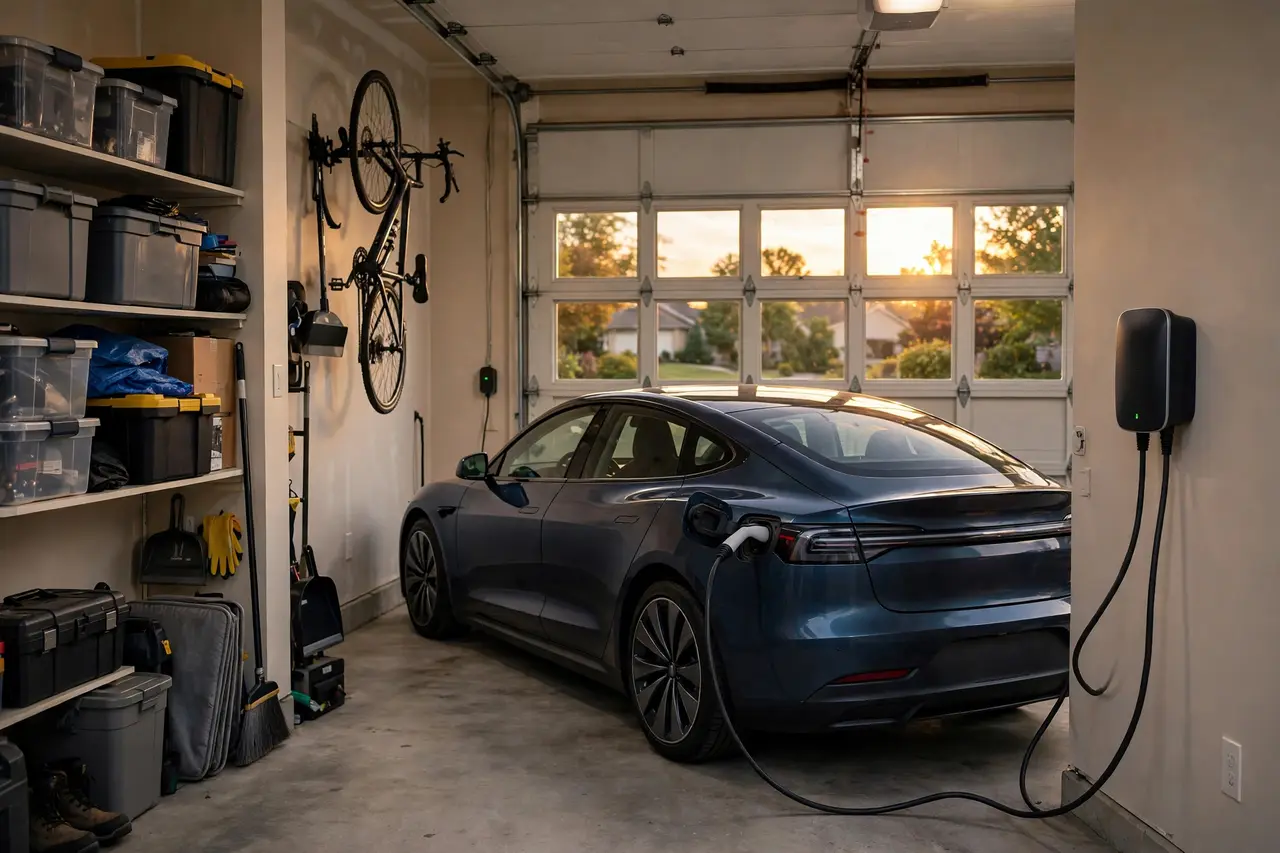
EV charging services in Dubuque
The full menu runs to ten services; the three cards at the top are the ones Dubuque's housing stock and state law push to the front. Everything links to its national service page for scope and process in full.
Home EV Charger Installation in Dubuque
For most households this is the whole project: a Level 2 station mounted where the car sleeps, fed by its own 240-volt circuit. The visit pattern is consistent — load calculation, route the run, mount and configure, inspect — and the variables are your panel, your parking and your permit office.
In Dubuque: the install Dubuque's new EV households book first, and the one the rest of this page keeps returning to.
Dedicated Circuit & Electrical Panel Upgrade in Dubuque
Where the load calculation fails the existing service, the upgrade is not an upsell — it is the finding. Done under permit with the utility's meter work coordinated, it converts the charger project into the house's electrical reset, and every later project inherits the headroom.
In Dubuque: the job that surfaces wherever housing is older — and Dubuque's stock makes it a routine conversation, settled by a load calculation.
Level 2 Charger Installation in Dubuque
What is being bought is time: the hours between arriving home and leaving again, converted into range at 240 volts. The conversion hardware is ordinary — breaker, conductor, station — and the design work is matching the three to the household's miles and the panel's arithmetic.
In Dubuque: what most Dubuque drivers mean when they say they want 'a real charger' — 240 volts, sized to the circuit.
Utility programs and electricity in Dubuque
Electricity in Dubuque comes from Interstate Power and Light Co. Parts of the wider metro are served by Maquoketa Valley Rrl Elec Coop, Allamakee-Clayton El Coop, Inc, Cascade Municipal Utilities. The utility matters twice over for a charger install: it sets the time-of-use rates that decide what overnight charging costs you, and it is the organisation that may — or may not — currently help pay for the equipment.
Why does this page labour the absence of a rebate? Because in Dubuque the phantom rebate is the most common distortion in charger quotes: a figure justified by money that is not, at present, claimable. The verified position: federal 30C ended September 30, 2025; no Iowa replacement for typical home installs; no Interstate Power and Light Co residential charger rebate in the sources checked. If someone quotes you a rebate, the follow-up is one sentence — show me the program page — and its answer decides the quote's credibility.
Before the install, it is worth a two-minute look at your tariff. Many Interstate Power and Light Co customers can move to a time-of-use plan where overnight energy is charged at a lower rate, and a scheduled charger makes that saving automatic.
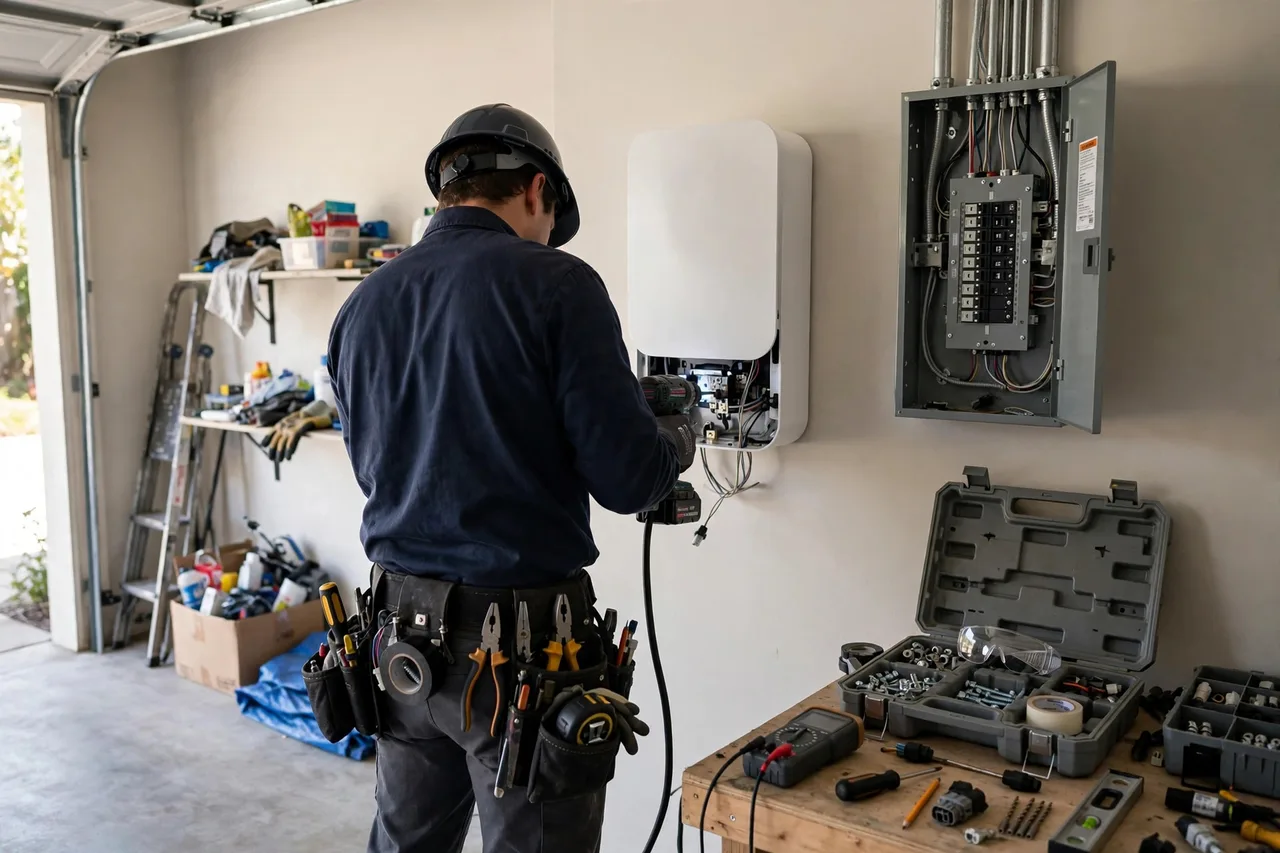
Condos, HOAs and the law in Iowa
Iowa has no statewide right-to-charge law. That needs saying plainly, because roundups on the internet sometimes claim otherwise: in the authoritative statute indexes checked for this page, no Iowa law prevents a homeowners association or condominium from refusing a charger in a common or assigned space. Your community's own covenants and board govern the question in Dubuque.
Owners of single-family homes in HOA communities should also check the covenants before assuming the driveway is uncomplicated: exterior-equipment and architectural-approval clauses can apply to a visible wall-mounted station even where the garage interior is entirely the owner's business.
The general process, minus the statute, is still covered in our guide to installing an EV charger in a condo or HOA community — most of its application-package advice applies in Dubuque exactly as written.
Climate, garages and charger placement
Winter hardware habits are simple and worth copying: a holster the connector returns to every night (a connector left in a snowbank is a connector full of ice), a cable route that survives the snow-clearing line, and a station position the plough's output does not bury. Installers here raise all three without being asked.
Garage temperature is a charging feature here. An insulated garage that holds even a modest margin over the street's cold shortens the battery's warm-up and steadies winter range; a carport install accepts the full season and plans the circuit's headroom accordingly. Either works — they are simply different designs, and the site visit should name which one you own.

Permits and inspection in Dubuque
If your install is part of a larger job — a panel upgrade, a garage build — the charger usually rides on the same permit set. Ask for the charger circuit to be listed explicitly so the inspection record shows it.

Neighbourhoods and ZIP codes served
The page covers 5 ZIP codes in and around Dubuque — including 52001, 52002, 52003, 52004, 52099 — across Dubuque. If your ZIP is not in the first set shown, ask anyway: installer coverage follows the metro, not a postcode fence.
The same working area takes in the neighbouring localities of Peosta, Sherrill, Durango, Epworth, Bernard, Holy Cross, Zwingle, Farley, Luxemburg, New Vienna, Cascade, Dyersville, Worthington — the county ring an installer based in Dubuque actually drives. Requests from those communities route exactly as city requests do: same services, same permit discipline, same local facts where they differ.
Dubuque County accounts for 18 of the ZIP codes and 14 named postal localities in the research file, the nearest of them Peosta, Sherrill, Durango, Epworth, Bernard. The survey counts 99,030 residents in the county, with a median household income of $77,630 and a median home value of $237,300. Measured across its ZIP codes, the Dubuque footprint runs about 3 miles north to south and 4 east to west, from ZIP 52001 to 52099 — the ground an installer based here actually covers in a working week.
Beyond the county seats, the working area takes in East Dubuque, Kieler, Sinsinawa, Peosta, Dickeyville, Hazel Green, Sherrill, Durango, Potosi, Cuba City, Epworth, La Motte, Galena, Bernard, Holy Cross, Zwingle, Saint Donatus, Benton, Farley, North Buena Vista, Platteville, Cassville, Luxemburg, Bellevue, Beetown, Lancaster, New Vienna, Scales Mound, Cascade, Dyersville, Belmont, Worthington, Andrew, Shullsburg, Springbrook, Glen Haven, Bloomington, Hanover, Stitzer, Rewey, Guttenberg, Colesburg, Livingston, Maquoketa, Elizabeth, Apple River, Baldwin, Earlville, Monmouth, Spragueville, Fennimore, Mount Hope, Hopkinton, Patch Grove, Onslow, Darlington, Miles, Montfort, Delaware, Bagley, Preston, Linden, Garber, Wyoming, Greeley, Gratiot, Cobb, Mineral Point, Woodman, Stockton, Warren, Garnavillo, Edmund, Elkport, Edgewood, Sabula, Nora, Highland, Savanna, Boscobel, Wauzeka, Prairie Du Chien, Kent, Mc Gregor — the named localities for which Dubuque is the nearest metro in the network (neighbouring metros' pages cover their own ground), each routing to the same installer-matching service.
The wider working area also reaches Monticello, Center Junction, Delmar, Delhi, Langworthy, Lost Nation, Charlotte, Oxford Junction, Goose Lake, Welton, Manchester, Bryant, Dodgeville, Anamosa, Teeds Grove, Olin, Andover, South Wayne — ground shared with neighbouring metros, where installers cross the same county lines in both directions.
ZIP codes in that shared ground include 52037, 52057, 52205, 52212, 52223, 52252, 52254, 52310, 52320, 52323, 52701, 52727, 52731, 52750, 52771, 52774, 53533, 53587, 53595.
The largest communities in that working area after Dubuque itself, by the GeoNames populated-place file: Platteville (population 12,572), Maquoketa (population 5,989), Prairie du Chien (population 5,757), Asbury (population 5,291), Dyersville (population 4,204), Lancaster (population 3,778), Galena (population 3,299), Boscobel (population 3,189), Savanna (population 2,880), Mineral Point (population 2,494), Fennimore (population 2,488), Darlington (population 2,405), Cascade (population 2,271), Bellevue (population 2,176), Cuba City (population 2,055), Epworth (population 1,955), Guttenberg (population 1,861), Stockton (population 1,792), Farley (population 1,691), East Dubuque (population 1,658). Charging demand follows those populations — the subdivisions and town centres where the next driveways, and the next panels, are.
Jackson County reaches into the working area with 19,390 residents, a median household income of $74,186 and a median home value of $175,000; its localities on this page include La Motte, Saint Donatus, Bellevue, Andrew, Springbrook. Clayton County reaches into the working area with 17,013 residents, a median household income of $67,242 and a median home value of $168,500; its localities on this page include North Buena Vista, Guttenberg, Garber, Garnavillo, Elkport. Iowa County reaches into the working area with 16,507 residents, a median household income of $71,223 and a median home value of $193,900; its localities on this page include Rewey, Linden, Cobb, Mineral Point, Edmund. Delaware County reaches into the working area with 17,558 residents, a median household income of $74,989 and a median home value of $177,900; its localities on this page include Colesburg, Earlville, Hopkinton, Delaware, Greeley. Jones County reaches into the working area with 20,896 residents, a median household income of $73,531 and a median home value of $184,800; its localities on this page include Onslow, Wyoming.
| ZIP | Locality | County |
|---|---|---|
| 52001 | Dubuque | Dubuque |
| 52004 | Dubuque | Dubuque |
| 52099 | Dubuque | Dubuque |
| 52002 | Dubuque | Dubuque |
| 52003 | Dubuque | Dubuque |
| 61025 | East Dubuque | Jo Daviess |
| 53812 | Kieler | Grant |
| 53824 | Sinsinawa | Grant |
| 52068 | Peosta | Dubuque |
| 53808 | Dickeyville | Grant |
| 53811 | Hazel Green | Grant |
| 52073 | Sherrill | Dubuque |
| 52039 | Durango | Dubuque |
| 53820 | Potosi | Grant |
| 53807 | Cuba City | Grant |
| 52045 | Epworth | Dubuque |
| 52054 | La Motte | Jackson |
| 61036 | Galena | Jo Daviess |
| 52032 | Bernard | Dubuque |
| 52053 | Holy Cross | Dubuque |
| 52079 | Zwingle | Dubuque |
| 52071 | Saint Donatus | Jackson |
| 53803 | Benton | Lafayette |
| 52046 | Farley | Dubuque |
| 52066 | North Buena Vista | Clayton |
| 53818 | Platteville | Grant |
| 53806 | Cassville | Grant |
| 52056 | Luxemburg | Dubuque |
| 52031 | Bellevue | Jackson |
| 53802 | Beetown | Grant |
| 53813 | Lancaster | Grant |
| 52065 | New Vienna | Dubuque |
| 61075 | Scales Mound | Jo Daviess |
| 52033 | Cascade | Dubuque |
| 52040 | Dyersville | Dubuque |
| 53510 | Belmont | Lafayette |
| 52078 | Worthington | Dubuque |
| 52030 | Andrew | Jackson |
| 53586 | Shullsburg | Lafayette |
| 52075 | Springbrook | Jackson |
| 53810 | Glen Haven | Grant |
| 53804 | Bloomington | Grant |
| 61041 | Hanover | Jo Daviess |
| 53825 | Stitzer | Grant |
| 53580 | Rewey | Iowa |
| 52052 | Guttenberg | Clayton |
| 52035 | Colesburg | Delaware |
| 53554 | Livingston | Grant |
| 52060 | Maquoketa | Jackson |
| 61028 | Elizabeth | Jo Daviess |
| 61001 | Apple River | Jo Daviess |
| 52207 | Baldwin | Jackson |
| 52041 | Earlville | Delaware |
| 52309 | Monmouth | Jackson |
| 52074 | Spragueville | Jackson |
| 53809 | Fennimore | Grant |
| 53816 | Mount Hope | Grant |
| 52237 | Hopkinton | Delaware |
| 53817 | Patch Grove | Grant |
| 52321 | Onslow | Jones |
| 53530 | Darlington | Lafayette |
| 52064 | Miles | Jackson |
| 53569 | Montfort | Grant |
| 52036 | Delaware | Delaware |
| 53801 | Bagley | Grant |
| 52069 | Preston | Jackson |
| 53553 | Linden | Iowa |
| 52048 | Garber | Clayton |
| 52362 | Wyoming | Jones |
| 52050 | Greeley | Delaware |
| 53541 | Gratiot | Lafayette |
| 53526 | Cobb | Iowa |
| 53565 | Mineral Point | Iowa |
| 53827 | Woodman | Grant |
| 61085 | Stockton | Jo Daviess |
| 61087 | Warren | Jo Daviess |
| 52049 | Garnavillo | Clayton |
| 53535 | Edmund | Iowa |
| 52044 | Elkport | Clayton |
| 52042 | Edgewood | Clayton |
| 52070 | Sabula | Jackson |
| 61059 | Nora | Jo Daviess |
| 53543 | Highland | Iowa |
| 61074 | Savanna | Carroll |
| 53805 | Boscobel | Grant |
| 53826 | Wauzeka | Crawford |
| 53821 | Prairie Du Chien | Crawford |
| 61044 | Kent | Stephenson |
| 52157 | Mc Gregor | Clayton |

Planning the install: from panel to parking
A useful way to read any Dubuque quote is to ask which of three jobs it describes. Job one: the panel has room and the run is short — a circuit and a station. Job two: the panel is full — capacity work joins the quote, as an upgrade or as load management. Job three: the property adds people — an HOA, a landlord, a building's shared service — and the approvals timeline joins the electrical one. None of the three is a bad job; they are simply different scopes, and a clear quote says which one you are in.
Finally, photograph the finished work — station, nameplate, panel directory with the new breaker labelled — and file it with the inspection record. When the car changes, the house sells or a second station joins the first, that folder is the difference between a five-minute answer and an archaeological dig.
Home charging know-how for Dubuque households
The school-run charge window
Households organised around school runs live on a distinctive charge curve: two short hops, a long parked day, an afternoon of activities. The car sits at home for the middle of the day — which, for solar households, is precisely the generation window, and for everyone else makes the overnight session almost an afterthought. Scheduling follows the family's actual day, not the tariff's assumption of one, and the installer who asks about the school run is designing, not chatting.
Long runs and voltage drop
Distance taxes a circuit twice: in materials, and in voltage. A long run at charging currents loses voltage along its length, and the code's remedy is conductor sized a step beyond the minimum so the station at the far end still receives what it expects. This is one of the reasons a detached structure or a far-corner panel turns a simple circuit into a designed one — the arithmetic is easy, but it has to be done, and it is invisible in any quote that scopes the job from the charger box alone. The site visit is where the tape measure settles it.
Whose meter? The metering designs
Every shared-parking install eventually asks the same question: whose electricity is this? The designs that answer it cleanly are few and known — a circuit from the owner's own meter where the geometry allows, a submeter on a shared supply with readings the association can audit, a networked station billing each user directly, or a flat arrangement the community's documents permit. The right choice is the one the building's wiring and its paperwork both support. What never works is leaving the question open: energy without an owner is the objection that sinks applications, so the metering design travels with the application, not after it.
Reading the bill after the charger arrives
The first bills after an install reward a careful read. Charging appears as consumption, not as a line item — the household's kilowatt-hours rise by roughly the car's appetite, and the rate applied to the new hours depends on when they happened. Owners who check the schedule actually ran — that the car charged inside the intended window — catch the one configuration mistake that costs money monthly. After that, the bill becomes the household's quietest document: the car simply costs what the overnight rate says it should.

Frequently asked questions
Can I still get the federal tax credit for a home charger in Dubuque, IA?
Nothing is currently on offer that you should plan around. The federal 30C credit ended on September 30, 2025; Iowa operates no replacement for typical home installs; and the sources checked for this page showed no live residential rebate from Interstate Power and Light Co. Programs do reopen — on the utility's own pages, with dates. Until one does, the install stands or falls on its own merits.
What can my HOA in Dubuque, IA do about a charger install?
They hold the stronger hand, and it is better to plan with that admitted. Iowa has enacted no right-to-charge law, so in Dubuque the covenants and the board govern. Owners who treat the application as a design submission — circuit, metering, insurance, restoration — rather than a request for a favour are the ones charging by the following quarter.
Will my Dubuque, IA home need a panel upgrade for a Level 2 charger?
Nobody can answer that from a photograph of your panel's door, and you should be suspicious of anyone who tries. In a city where the median home dates to 1963 and about 73% of units predate 1980, the honest answer is a load calculation: what your service is, what it already carries, and what a continuous charger load does to the total. Then the options — circuit, load management, or upgrade — compare on paper.
Level 1 or Level 2 in Dubuque, IA — what is the real difference?
In parked hours: a Level 1 cord returns about 3–5 miles for each of them, and a Level 2 circuit returns roughly 25–40, set by its amperage and the car's acceptance. For a Dubuque household parking ten hours, that is the difference between recovering a short errand day and recovering any day the car can legally drive.
What happens next after I send a request?
Your request is matched to licensed installers covering Dubuque, Iowa — service, ZIP, property type and timing travel with it. The installer who takes it arranges the site visit and quotes in writing; PlugReady USA's part is the research on this page and the introduction, and your contract is with the installer throughout.
Can a charger be added to a detached garage in Dubuque?
Yes — the charger itself is the same; the route to it is the project. From the house panel, a buried conduit run reaches the garage, or a subpanel goes in out there where distance and future loads argue for it. In Dubuque, with about 63% of homes detached, local installers quote this shape routinely — the trench and the run, settled from a site walk, are the substance of it.
Nearby cities in Iowa
- EV charger installation in Cedar Rapids — about 65 miles from Dubuque, metro population 280,000
- EV charger installation in Davenport — about 69 miles from Dubuque, metro population 470,000
- EV charger installation in Iowa City — about 76 miles from Dubuque, metro population 175,000
- EV charger installation in Waterloo — about 93 miles from Dubuque, metro population 170,000
- EV charger installation in Ames — about 164 miles from Dubuque, metro population 125,000
- EV charger installation in Des Moines — about 170 miles from Dubuque, metro population 725,000
- EV charger installation in Madison, WI — about 79 miles from Dubuque, metro population 700,000
- EV charger installation in Rockford, IL — about 88 miles from Dubuque, metro population 340,000
- EV charger installation in La Crosse, WI — about 93 miles from Dubuque, metro population 140,000
Ready to charge at home in Dubuque?
Tell us the job — service, ZIP and property type — and licensed local installers will take it from there.