EV Charger Installation in Omaha, NE
Home Level 2 charging, panel upgrades and condo installs in Omaha — matched to licensed local installers, with the local facts that shape the job set out below.
Start from the meter. Every home charger in Omaha is, underneath the hardware, an arrangement between a car, a panel and Nebraska's electricity supply — and the households that arrange it well do so in that order. Omaha itself is home to about 489,263 people, in a state whose registered fleet reached 11,800 battery-electric vehicles and 5,500 plug-in hybrids by the end of 2025. This page works outward from the meter: the utility that serves your street and whether it currently funds charger installs, the association law that governs shared buildings, the permit counter's expectations, and the housing numbers that predict your panel's mood. Read it before the quotes, and the quotes get shorter.
How PlugReady USA works, in one breath: you describe the job once, licensed local installers who cover Omaha receive it, and the conversations happen with them directly. The rest of this page exists so those conversations start from facts — yours about the house, ours about the metro — rather than from a sales script.
Measured demand, not enthusiasm, put Omaha in Tier B of this network: NE 11.8K BEVs, metro-concentrated. For a homeowner the useful translation is simpler — installers here do this work weekly, know the local permit counter, and have seen your housing stock before.
The Census Bureau's portrait of Omaha — median household income $71,640, 57% of occupied homes owner-occupied, 61% of units in single-unit detached houses — is, read correctly, a charging forecast. Owners approve their own work; detached houses host their own circuits; the remaining share is where the interesting projects live.

The composite picture matters more than any single statistic. In Omaha: an older housing fabric, where panel archaeology is a normal part of the first visit; a detached-house majority with a real attached and multifamily minority; buildings of five or more units hold a substantial share of homes, which keeps the multifamily sections of this page in daily use; meanwhile, owners hold a working majority, with renters a significant minority. A page that ignored that profile would give the same advice everywhere; this one is ordered by it.
In absolute terms, the survey counts 214,685 housing units in Omaha — 202,635 occupied, 115,172 of them by their owners. The stock resolves into 131,517 single-unit detached houses, 129,039 homes standing since before 1980, and 66,284 units in larger buildings. Those six counts are the city's charging map drawn without percentages, and every section of this page is a consequence of one of them. The page's geography is equally concrete: 48 ZIP codes across Douglas, Sarpy, centred near 41.26 degrees north latitude. The city anchors the Omaha–Council Bluffs metropolitan area, home to roughly 1,000,000 people on the research file's metro estimate — the wider labour and housing market this page's installers work across.
The same survey release fills in the household economics around the housing stock: a median home value of $269,500, median gross rent of $1,229, per-capita income of $40,776, and a median resident age of 35. And the daily rhythms behind the housing numbers: 72% of Omaha workers drive to work alone — the commute pattern home charging is built around; 12% work from home, a population whose cars charge on daytime and overnight schedules alike; 1% commute by public transit; 40% of adults hold a bachelor's degree or higher. Vehicle ownership, from the same release: 108,001 households in Omaha run two or more vehicles, and 16,225 run none — the two ends of the market this page serves and does not serve.
Household structure, from the same release: 57% of Omaha households are family households. The burden shares behind the housing stock: 49% of renting households are cost-burdened at the 30%-of-income line, as are 0% of mortgaged owners — context for why the overnight rate window, once set, is treated here as a household fixture rather than a hobby.
What follows is the city read as an electrical place rather than a dot on a map. Where so much of the stock predates modern code cycles, the site visit doubles as a survey — grounding electrode, service entrance, panel provenance — before it is ever a quote. Multifamily weight changes the installer market too — the firms that thrive here carry association paperwork fluency alongside their licences, and their references are buildings, not just households.
The balance also shapes the housing-turnover effect: chargers installed by owners stay as amenities, chargers negotiated by tenants test what the tenancy paperwork said, and both patterns are live here. Value engineering is the local dialect: load management weighed against panel work on merit, quotes compared line by line, the site visit treated as the moment the scope becomes honest. City-owned power tends to publish its intentions plainly: programme pages, board minutes, rate cases on the record. Households who read them know what is coming a season before it arrives.
Youth in the fleet also means the used-EV wave has not arrived; adoption here is new-car led, and charging installs follow the dealer map more than the classifieds. Mid-sized metros feel fleet growth personally: each year's registrations are visible in the school car park and the permit statistics, and the installer market grows in step rather than in surges. The association dimension here runs on persuasion rather than statute — no state charging law frames the application, so the complete, professional proposal carries the whole argument, as the law section above explains.
The electrical reality in Omaha homes
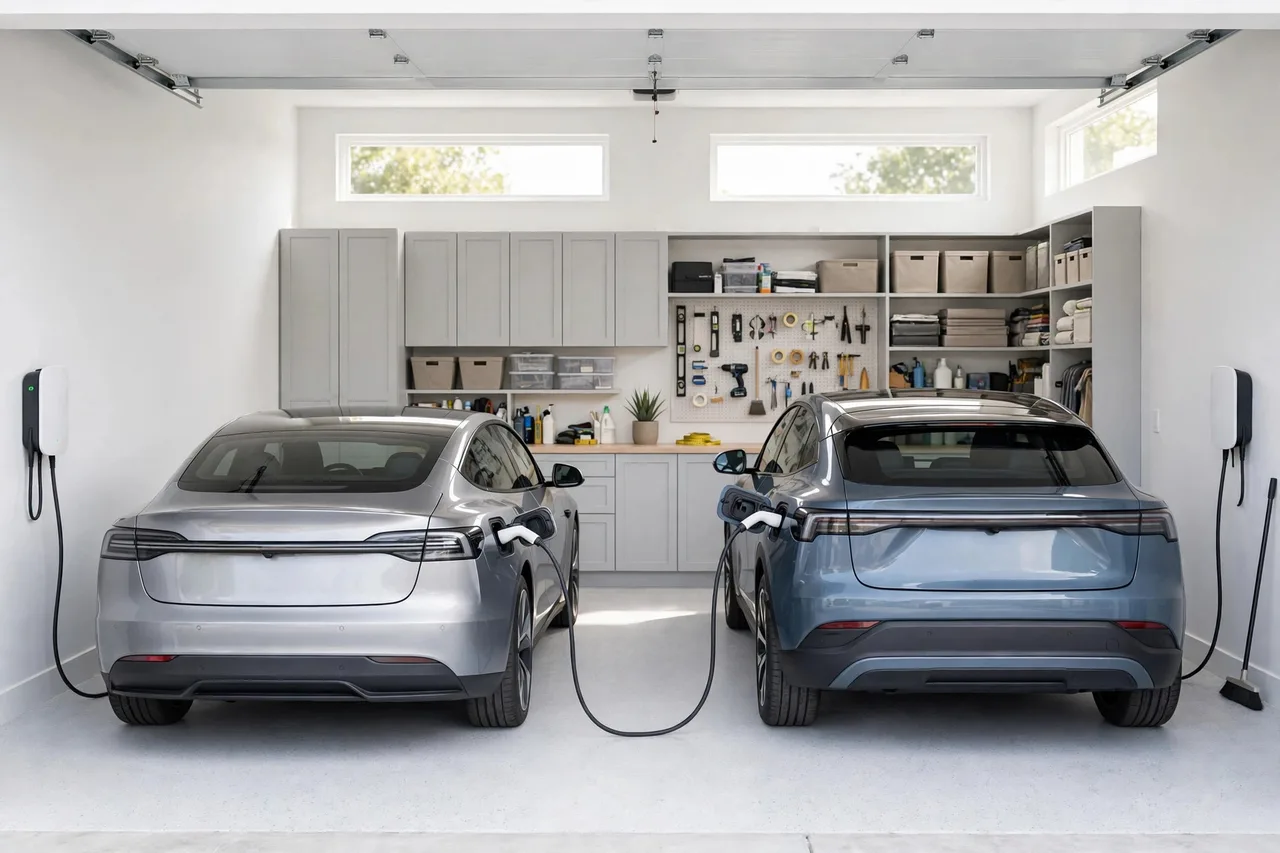
Four numbers organise everything an installer expects in Omaha: median build year 1974; 60% of units built before 1980; 61% of the stock detached; 57% of occupied homes owner-occupied. Capacity, circuit routes and approval layers all correlate with those four. The paragraphs below are their commentary. Age shows up electrically before it shows up anywhere else: services sized for a house with a third of today's appliances. Expect the first conversation to be about capacity — what the panel is, what it already feeds, and which of the three routes (circuit, management, upgrade) your numbers support. Porches, carports and parking pads carry a real share of this city's charging, because the stock predates the two-car garage as a standard feature — outdoor-rated equipment is a local staple, not an edge case.
One further survey line belongs in any Omaha install conversation: 26% of the city's homes heat with electricity — 52,569 households whose panels already carry a major winter load before a charger is contemplated. Electric heat and EV charging are the two largest discretionary loads a house can host, and where they coincide, the load calculation stops being a formality.
One further split matters for how this page is organised: about 87,463 of Omaha's occupied homes are renter-occupied. Everything above assumes you can approve your own electrical work; where you cannot, the approval layer — landlord or association — becomes part of the job, which is why the law section carries unusual weight here.
And 31% of Omaha's homes are in buildings with five or more units — apartments and condominiums where charging is a building decision before it is an electrical one. If that is your situation, the law and multifamily sections of this page are the ones written for you.
EV charging services in Omaha
Installers in Omaha book the same ten services as everywhere — but not in the same proportions. The three leading cards below are this city's pattern, set by its panels, its buildings and its statute book.
Home EV Charger Installation in Omaha
The residential standard: a station where the car sleeps, on a circuit of its own, installed under permit. Variations are all local — the panel's spare room, the run's route through the house's fabric, and the parking pattern the cable has to serve.
In Omaha: the core residential job in Omaha: circuit, mounting, configuration and inspection in one visit pattern.
Dedicated Circuit & Electrical Panel Upgrade in Omaha
The upgrade is unglamorous and transformative: a modern panel with honest capacity, labelled circuits, and room for the decade's next three electrical ideas after the charger. Houses rarely regret capacity; they regret its absence annually.
In Omaha: the capacity fix that lets the charger circuit go in without the rest of the house living at its limit.
Level 2 Charger Installation in Omaha
Level 2's numbers explain its dominance: several times the overnight recovery of a wall outlet, on equipment sized to the circuit by a factor the code fixes. The install is a circuit project with a station at the end of it, and it is quoted that way by anyone who does it weekly.
In Omaha: what most Omaha drivers mean when they say they want 'a real charger' — 240 volts, sized to the circuit.
Utility programs and electricity in Omaha
Electricity in Omaha comes from Omaha Public Power District. The utility matters twice over for a charger install: it sets the time-of-use rates that decide what overnight charging costs you, and it is the organisation that may — or may not — currently help pay for the equipment.
Frame the Omaha incentive question correctly and it answers itself. Three pots could in principle fund part of a home charger: a federal credit, a Nebraska program, a Omaha Public Power District rebate. The first ended on September 30, 2025. The second does not exist for typical home installs. The third, in the sources checked for this page, is not currently offered for residential customers. Zero plus zero plus zero is the honest budget line — and any future change will arrive through the utility's own program page, with dates, which is where this page will take it from.
Before the install, it is worth a two-minute look at your tariff. Many Omaha Public Power District customers can move to a time-of-use plan where overnight energy is charged at a lower rate, and a scheduled charger makes that saving automatic.
Condos, HOAs and the law in Nebraska
No statute promises a charger approval in Nebraska. Unlike the states that have enacted right-to-charge laws, Nebraska leaves the question entirely to each community's covenants and board discretion. For Omaha owners that is not the end of the road — it is a sign that the negotiation, the metering design and the written application carry the weight a statute would otherwise carry.
Strategy, then, is the local substitute for statute. In Omaha the applications that succeed tend to share a shape: they arrive before the meeting rather than at it, they answer metering and insurance in the first paragraph, and they offer the board a design it can approve once and reuse for the next owner who asks.
The general process, minus the statute, is still covered in our guide to installing an EV charger in a condo or HOA community — most of its application-package advice applies in Omaha exactly as written.
Climate, garages and charger placement
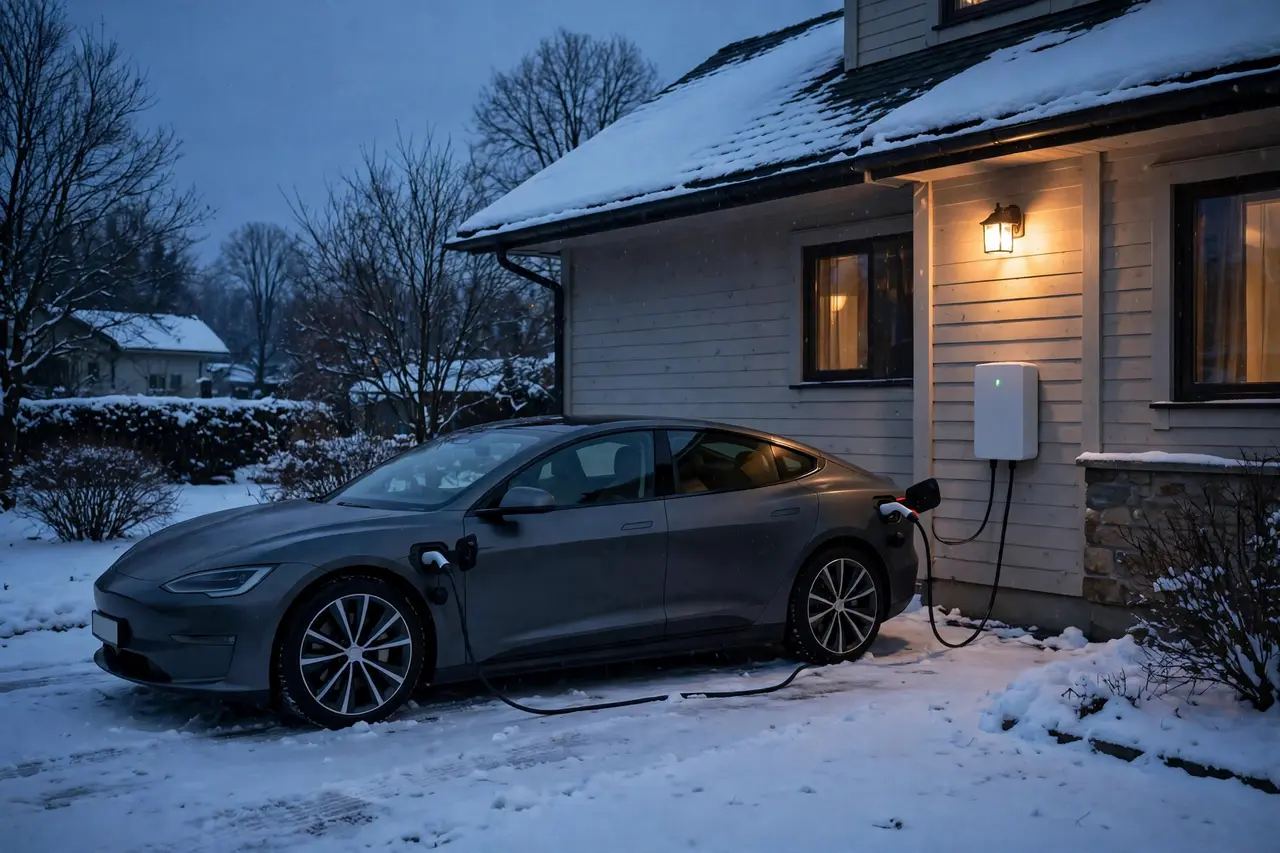
Cold rewrites the charging routine in this part of the country. Batteries accept charge more slowly when they are cold, range falls, and the car's own systems spend energy on warmth — so the overnight window matters more, not less. A Level 2 circuit sized generously is the household's answer: it restores the day's driving with hours to spare even in the slow weeks of January.
Ice discipline is the third local habit: a cable route that never crosses the shovelled path's landing zone, a holster at a height the snowbank does not reach, and a station position the roof does not shed onto. Winter rewards the installs that were designed in it.

Permits and inspection in Omaha
Inspection day itself is undramatic by design: access to the panel and the station, the calculation on hand, the equipment's settings matching the circuit. Jobs fail inspection on paperwork mismatches far more often than on wiring — a fact that quietly grades installers.

Neighbourhoods and ZIP codes served
The page covers 48 ZIP codes in and around Omaha — including 68101, 68102, 68103, 68104, 68105, 68106, 68107, 68108, 68109, 68110, 68111, 68112, 68114, 68116, 68117, 68118, 68119, 68120, 68122, 68124, 68127, 68130, 68131, 68132, 68134, 68135, 68136, 68137, 68138, 68139, 68142, 68144, 68145, 68152, 68154, 68155, 68157, 68164, 68172, 68175, 68176, 68178, 68179, 68180, 68182, 68183, 68197, 68198 — across Douglas, Sarpy. If your ZIP is not in the first set shown, ask anyway: installer coverage follows the metro, not a postcode fence.
The same working area takes in the neighbouring localities of Offutt Afb, Bellevue, La Vista, Papillion, Boys Town, Bennington, St Columbans, Elkhorn, Springfield, Gretna, Waterloo, Valley — the county ring an installer based in Omaha actually drives. Requests from those communities route exactly as city requests do: same services, same permit discipline, same local facts where they differ.
Douglas County accounts for 50 of the ZIP codes and 6 named postal localities in the research file, the nearest of them Boys Town, Bennington, Elkhorn, Waterloo, Valley. The survey counts 590,736 residents in the county, with a median household income of $80,391 and a median home value of $266,100. Sarpy County accounts for 13 of the ZIP codes and 8 named postal localities in the research file, the nearest of them Offutt Afb, Bellevue, La Vista, Papillion, St Columbans. The survey counts 197,389 residents in the county, with a median household income of $103,321 and a median home value of $314,100. Measured across its ZIP codes, the Omaha footprint runs about 12 miles north to south and 14 east to west, from ZIP 68101 to 68198 — the ground an installer based here actually covers in a working week.
Beyond the county seats, the working area takes in Offutt Afb, Carter Lake, Council Bluffs, Bellevue, La Vista, Papillion, Crescent, Boys Town, Fort Calhoun, Bennington, St Columbans, Mc Clelland, Honey Creek, Mineola, Elkhorn, Springfield, Cedar Creek, Pacific Junction, Washington, Plattsmouth, Glenwood, Treynor, Underwood, Gretna, Kennard, Neola, Silver City, Waterloo, Missouri Valley, Valley, Louisville, Blair, Murray, Arlington, South Bend, Yutan, Minden, Malvern, Modale, Manley, Logan, Henderson, Macedonia, Tabor, Carson, Weeping Water, Persia, Hastings, Nehawka, Union, Magnolia, Thurman, Mead, Oakland, Mondamin, Avoca, Shelby, Emerson, Fremont, Herman, Hancock, Randolph, Nickerson, Woodbine, Harlan, Portsmouth, Cedar Bluffs, Percival, Otoe, Little Sioux, Sidney, Pisgah, Imogene, Tekamah, Winslow, Nebraska City, Panama, Ames, Dunbar, Hooper, Walnut, Red Oak, Craig, Westphalia, Elliott, Griswold, Farragut, Dunlap — the named localities for which Omaha is the nearest metro in the network (neighbouring metros' pages cover their own ground), each routing to the same installer-matching service.
The wider working area also reaches Ashland, Memphis, Murdock, Ithaca, Greenwood, Elmwood, Alvo, Colon, Wahoo, Waverly, Eagle, Ceresco, Lincoln, Syracuse, Unadilla, Malmo — ground shared with neighbouring metros, where installers cross the same county lines in both directions.
ZIP codes in that shared ground include 68003, 68017, 68018, 68033, 68040, 68042, 68066, 68304, 68347, 68349, 68366, 68407, 68446, 68454, 68462, 68517, 68527.
The largest communities in that working area after Omaha itself, by the GeoNames populated-place file: Council Bluffs (population 62,597), Bellevue (population 55,510), Fremont (population 26,474), Papillion (population 19,510), La Vista (population 16,921), Chalco (population 10,994), Denison (population 8,334), Elkhorn (population 8,251), Blair (population 7,975), Nebraska City (population 7,335), Hillsborough (population 7,290), Atlantic (population 6,833), Plattsmouth (population 6,462), Ralston (population 5,994), Red Oak (population 5,472), Clarinda (population 5,418), Glenwood (population 5,253), Gretna (population 5,046), Shenandoah (population 5,021), Harlan (population 5,002). Charging demand follows those populations — the subdivisions and town centres where the next driveways, and the next panels, are.
Washington County reaches into the working area with 21,106 residents, a median household income of $94,396 and a median home value of $297,600; its localities on this page include Fort Calhoun, Washington, Kennard, Blair. Cass County reaches into the working area with 27,161 residents, a median household income of $91,836 and a median home value of $254,900; its localities on this page include Cedar Creek, Plattsmouth, Louisville, Murray, South Bend. Saunders County reaches into the working area with 23,048 residents, a median household income of $94,066 and a median home value of $271,700; its localities on this page include Yutan.
| ZIP | Locality | County |
|---|---|---|
| 68101 | Omaha | Douglas |
| 68103 | Omaha | Douglas |
| 68109 | Omaha | Douglas |
| 68119 | Omaha | Douglas |
| 68120 | Omaha | Douglas |
| 68139 | Omaha | Douglas |
| 68145 | Omaha | Douglas |
| 68155 | Omaha | Douglas |
| 68172 | Omaha | Douglas |
| 68175 | Omaha | Douglas |
| 68176 | Omaha | Douglas |
| 68179 | Omaha | Douglas |
| 68180 | Omaha | Douglas |
| 68182 | Omaha | Douglas |
| 68183 | Omaha | Douglas |
| 68198 | Omaha | Douglas |
| 68102 | Omaha | Douglas |
| 68197 | Omaha | Douglas |
| 68113 | Offutt Afb | Sarpy |
| 68178 | Omaha | Douglas |
| 68108 | Omaha | Douglas |
| 68131 | Omaha | Douglas |
| 68105 | Omaha | Douglas |
| 68110 | Omaha | Douglas |
| 51510 | Carter Lake | Pottawattamie |
| 68111 | Omaha | Douglas |
| 68132 | Omaha | Douglas |
| 68106 | Omaha | Douglas |
| 68107 | Omaha | Douglas |
| 51501 | Council Bluffs | Pottawattamie |
| 68104 | Omaha | Douglas |
| 51502 | Council Bluffs | Pottawattamie |
| 68117 | Omaha | Douglas |
| 68112 | Omaha | Douglas |
| 68147 | Bellevue | Sarpy |
| 68157 | Omaha | Sarpy |
| 68114 | Omaha | Douglas |
| 51503 | Council Bluffs | Pottawattamie |
| 68152 | Omaha | Douglas |
| 68124 | Omaha | Douglas |
| 68134 | Omaha | Douglas |
| 68005 | Bellevue | Sarpy |
| 68127 | Omaha | Douglas |
| 68122 | Omaha | Douglas |
| 68128 | La Vista | Sarpy |
| 68133 | Papillion | Sarpy |
| 68046 | Papillion | Sarpy |
| 68164 | Omaha | Douglas |
| 51526 | Crescent | Pottawattamie |
| 68123 | Bellevue | Sarpy |
| 68142 | Omaha | Douglas |
| 68154 | Omaha | Douglas |
| 68144 | Omaha | Douglas |
| 68137 | Omaha | Douglas |
| 68010 | Boys Town | Douglas |
| 68116 | Omaha | Douglas |
| 68118 | Omaha | Douglas |
| 68130 | Omaha | Douglas |
| 68138 | Omaha | Sarpy |
| 68135 | Omaha | Douglas |
| 68023 | Fort Calhoun | Washington |
| 68007 | Bennington | Douglas |
| 68056 | St Columbans | Sarpy |
| 51548 | Mc Clelland | Pottawattamie |
| 51542 | Honey Creek | Pottawattamie |
| 51554 | Mineola | Mills |
| 68136 | Omaha | Sarpy |
| 68022 | Elkhorn | Douglas |
| 68059 | Springfield | Sarpy |
| 68016 | Cedar Creek | Cass |
| 51561 | Pacific Junction | Mills |
| 68068 | Washington | Washington |
| 68048 | Plattsmouth | Cass |
| 51534 | Glenwood | Mills |
| 51575 | Treynor | Pottawattamie |
| 51576 | Underwood | Pottawattamie |
| 68028 | Gretna | Sarpy |
| 68034 | Kennard | Washington |
| 51559 | Neola | Pottawattamie |
| 51571 | Silver City | Mills |
| 68069 | Waterloo | Douglas |
| 51555 | Missouri Valley | Harrison |
| 68064 | Valley | Douglas |
| 68037 | Louisville | Cass |
| 68008 | Blair | Washington |
| 68409 | Murray | Cass |
| 68009 | Blair | Washington |
| 68002 | Arlington | Washington |
| 68058 | South Bend | Cass |
| 68073 | Yutan | Saunders |

Planning the install: from panel to parking
Experienced Omaha installers talk about 'the tell': the small observation that predicts the job. A panel directory in pencil with three generations of handwriting. A garage converted, then converted back. A charger-shaped hole in the household's plans — the second car already ordered. Mention your own tells at the visit; they are scope information, and scope named early is scope settled fairly.
Finally, photograph the finished work — station, nameplate, panel directory with the new breaker labelled — and file it with the inspection record. When the car changes, the house sells or a second station joins the first, that folder is the difference between a five-minute answer and an archaeological dig.
Home charging know-how for Omaha households
Shutoffs and sensible safety
Every charger installation contains its own off switch: the breaker in the panel, and, on larger circuits, a disconnect within sight of the equipment that the code requires. Knowing where both are — and that the station itself stops the session when the connector is unlatched — is the whole safety briefing, and a good installer gives it unprompted at handover. The equipment is listed, protected and designed to be operated daily by non-electricians; the homeowner's part is simply to know the two switches and to treat any change in behaviour — heat, noise, repeated trips — as a reason to call rather than to reset.
Single-phase, three-phase, and your house
Home charging runs on the same single-phase service as the rest of the house — the 240 volts between the two legs of a standard residential service — and everything in the domestic sections of this site assumes exactly that. Three-phase power belongs to commercial and industrial buildings, where it changes the design of larger installations and the arithmetic of their load management. The distinction matters only when a quote crosses the two worlds: a household needs no three-phase anything, and a depot cannot plan without it. Knowing which world your property lives in keeps the conversation honest in both directions.
Whose meter? The metering designs
Every shared-parking install eventually asks the same question: whose electricity is this? The designs that answer it cleanly are few and known — a circuit from the owner's own meter where the geometry allows, a submeter on a shared supply with readings the association can audit, a networked station billing each user directly, or a flat arrangement the community's documents permit. The right choice is the one the building's wiring and its paperwork both support. What never works is leaving the question open: energy without an owner is the objection that sinks applications, so the metering design travels with the application, not after it.
Whose schedule? The car's or the station's
Two schedulers can govern a charging session — the vehicle's own charge timer and the station's app — and households inherit confusion when both are set at once. The discipline is simple: choose one governor. The car's timer travels with the car and knows its departure settings; the station's knows the tariff windows and the household's other loads. Either works; both together produce the 6 am mystery of the half-charged battery and a debugging session nobody enjoys.
How rebate paperwork usually works
Where a utility program does exist, its money moves on paperwork rails: pre-approval before purchase in some programmes, photographs and the inspection record after installation, deadlines measured in weeks. The practical lesson travels even to cities without a current program — keep everything. The permit, the passed inspection, the equipment invoice with model and serial, photographs of the finished work: filed together, they are the application for any programme that opens later, and the file costs nothing to keep.
Frequently asked questions
Is the federal charger tax credit still available in Omaha, NE?
That credit is finished: 30C ended on September 30, 2025. What about locally? In the utility and state sources checked for this page, nothing verified was running for Omaha homeowners — no Omaha Public Power District rebate, no state scheme. If one opens, it will appear on the utility's site with dates; plan your install without it meanwhile.
What can my HOA in Omaha, NE do about a charger install?
Legally, yes — and it is better to know that before you buy the car. Nebraska has enacted no right-to-charge law, so an association in Omaha may refuse, condition or delay a charger under its covenants. The counterweight is a complete, documented application and, if refused, a written refusal citing the covenant — the record a future board or a future statute works from.
Panel upgrade or not — how do Omaha, NE homeowners find out?
It depends on the panel, and Omaha's housing makes the question common: the median home here was built in 1974, and about 60% of housing units predate 1980. Homes with 100-amp service that is already well used often need an upgrade or a load-management device; homes with 200-amp service and spare breaker space usually do not. A load calculation during the site visit settles it — ask to see it.
How much faster is Level 2 charging at home in Omaha, NE?
In parked hours: a Level 1 cord returns about 3–5 miles for each of them, and a Level 2 circuit returns roughly 25–40, set by its amperage and the car's acceptance. For a Omaha household parking ten hours, that is the difference between recovering a short errand day and recovering any day the car can legally drive.
What happens after I request an installer through this page?
Three things happen, in order. Your request is routed to licensed installers who work in Omaha; one of them contacts you to book a site visit; and the visit produces a written quote based on your actual panel and parking. PlugReady USA runs the matching, not the tools — the contractor on the job is the installer who visits.
Can a charger be added to a detached garage in Omaha?
It can. With roughly 61% of Omaha's stock in detached houses, the detached-garage run is a routine local job: conduit buried at code depth from the panel, or a subpanel that also serves the workshop. The trench, not the charger, is what the quote is really about.
Nearby cities in Nebraska
- EV charger installation in Lincoln — about 56 miles from Omaha, metro population 345,000
- EV charger installation in Sioux City, IA — about 89 miles from Omaha, metro population 170,000
- EV charger installation in St. Joseph, MO — about 119 miles from Omaha, metro population 125,000
- EV charger installation in Des Moines, IA — about 134 miles from Omaha, metro population 725,000
Ready to charge at home in Omaha?
Two minutes of form, and the request is in front of licensed installers who cover this city — quotes follow site visits, in writing.