EV Charger Installation in Port St. Lucie, FL
Everything a Port St. Lucie homeowner needs before booking a charger install — the panel question, the utility's current programs, the HOA law and the permit — sourced, dated and local.
Ask EV owners in Port St. Lucie what changed their routine and most give the same answer: the car charges where it parks. Port St. Lucie itself is home to about 258,578 people. Statewide, Florida counted 450,400 battery-electric vehicles and 88,400 plug-in hybrids on the road through 2025, and the metro's share of that fleet keeps growing. A home charger installation is not complicated, but it is local — the utility that serves your street, the age of your panel, your community's rules and your city's permit office all shape the job. This page pulls those Port St. Lucie specifics together in one place, with the numbers sourced rather than rounded into slogans.
Treat what follows as the site visit in written form. Each section is one of the stops a thorough installer makes — panel, tariff, property rules, permit — written out with Port St. Lucie's facts in place, so that when the visit happens for real you can follow the reasoning and question it where it matters.
Measured demand, not enthusiasm, put Port St. Lucie in Tier C of this network: Treasure Coast growth. For a homeowner the useful translation is simpler — installers here do this work weekly, know the local permit counter, and have seen your housing stock before.
Three percentages describe the working conditions for charging in Port St. Lucie: 82% owner-occupied, 87% single-unit detached, and a median household income of $86,241 standing behind both. Everything in the sections below — panels, permissions, metering — is commentary on those proportions.

Put the survey together and Port St. Lucie's charging profile reads like this: a comparatively young housing fabric, where modern services are the default; overwhelmingly a detached-house city, so most installs are the simple garage pattern; larger buildings are a small share, so the multifamily route matters to a minority of readers; and owner-occupiers dominate, so most readers can approve their own electrical work outright. That combination — more than any single number — is what the installers working here plan around, and it is the lens for everything on this page.
In absolute terms, the survey counts 99,750 housing units in Port St. Lucie — 94,324 occupied, 77,663 of them by their owners. The stock resolves into 86,291 single-unit detached houses, 7,574 homes standing since before 1980, and 6,003 units in larger buildings. Those six counts are the city's charging map drawn without percentages, and every section of this page is a consequence of one of them. The page's geography is equally concrete: 8 ZIP codes across St. Lucie, centred near 27.29 degrees north latitude. The city anchors the Port St. Lucie metropolitan area, home to roughly 520,000 people on the research file's metro estimate — the wider labour and housing market this page's installers work across.
The same survey release fills in the household economics around the housing stock: a median home value of $420,600, median gross rent of $2,133, per-capita income of $37,990, and a median resident age of 44. How the city moves completes the picture: 72% of Port St. Lucie workers drive to work alone — the commute pattern home charging is built around; 17% work from home, a population whose cars charge on daytime and overnight schedules alike; 0% commute by public transit; 29% of adults hold a bachelor's degree or higher. And the fleet in the driveways: 29,438 households in Port St. Lucie have exactly one vehicle, 61,727 have two or more, and 3,159 have none.
The cost-burden lines say who feels housing costs most in Port St. Lucie: 54% of renters spend 30% or more of income on rent, and 0% of owners with mortgages spend the same share on housing costs. Family households are 74% of all households — the two-car, school-run demographic whose charging patterns this page's planning sections keep circling back to.
The signature matters because installs follow it, street by street. A young stock standardises the install conversation — the variables narrow to run length, station position and the household's second-car horizon, because the capacity question was answered by the builder years ago. House-by-house urbanism gives the metro a house-by-house charging pattern — no building-scale projects, just thousands of individual circuits appearing one permit at a time.
High ownership also means the install base compounds visibly — circuits stay with houses, houses sell with circuits documented, and the stock of charging-ready homes grows one transaction at a time. Here the tariff conversation is a budget conversation: the overnight window's arithmetic, done honestly once, pays out every night of the car's life without further attention. The commission's calendar quietly schedules the market: when a new time-of-use design is approved, installer phones ring in a pattern the docket predicted months earlier.
A mature fleet also means a mature used market — households buying their first EV second-hand arrive at this page with the same install questions the pioneers asked, minus the pioneers' uncertainty. The permit counter in a smaller city is a conversation, not a queue: applications are read by people who may know the street, and complete paperwork is remembered kindly. Where the state's statute speaks, the local conversation changes register: installers quote the framework, boards keep counsel's template, and approvals become administrative.
The electrical reality in Port St. Lucie homes
The Census Bureau counts Port St. Lucie's housing in ways that turn out to be an installer's briefing: the median home dates to 2003, 8% of units stood before 1980, 87% are detached single-unit houses, and 82% of occupied homes belong to their occupants. Panel sizes, wire routes and even permit histories track those proportions street by street. A comparatively young housing stock works in a charger's favour: most homes here were built with 200-amp service and modern panels, so the circuit itself is usually the whole job. The questions that remain are placement, wire-run length and whether the garage layout suits a wall-mounted station or a pedestal. Housing age also tracks wire-run reality: older homes more often place the panel in a basement or interior wall far from the garage, and distance is copper, conduit and labour.
Heating fuel is the survey's quiet clue to panel life: in Port St. Lucie, 91% of homes heat electrically (76,370 households), against 5% heating with gas. A house already heating electrically has a service sized with that load in its history; a gas-heated house may have capacity to spare — either way the fuel mix is part of what the installer is reading.
The tenure split cuts the other way too: roughly 16,661 occupied homes in Port St. Lucie are rented. For those households the charger question is a negotiation with a property owner — written proposal, licensed installer, metering clarity — and it succeeds often enough that installers here keep the pattern ready.
One more structural fact shapes Port St. Lucie's charging map: 6% of the city's housing units sit in buildings of five or more units. Those households cannot simply book a circuit — their charger runs through a building, a board and a shared electrical service, which is why the multifamily service and the law section below carry unusual weight on this page.
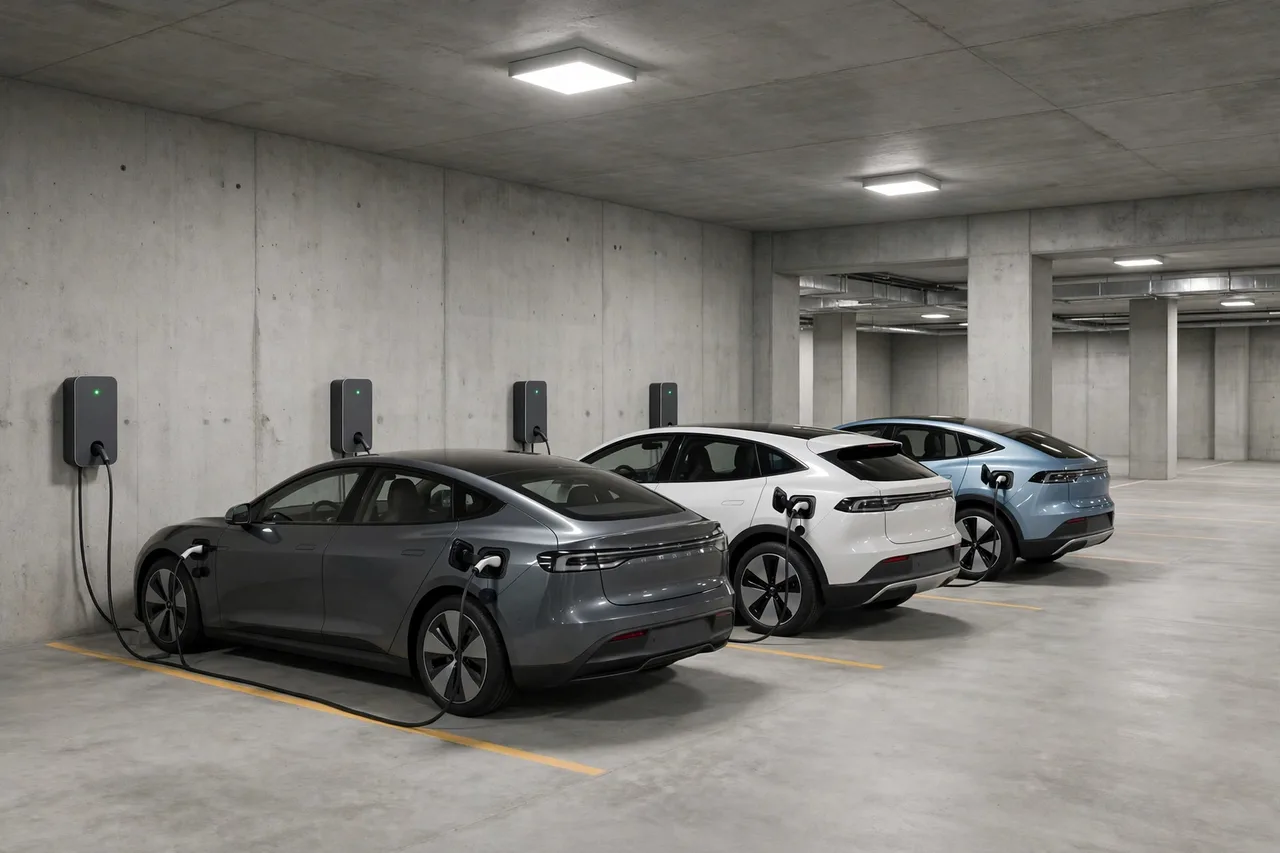
EV charging services in Port St. Lucie
An installer's work in Port St. Lucie usually starts with one of the three lead services below. The cards describe the job as it is actually scoped; the grid underneath carries the rest of the menu.
Home EV Charger Installation in Port St. Lucie
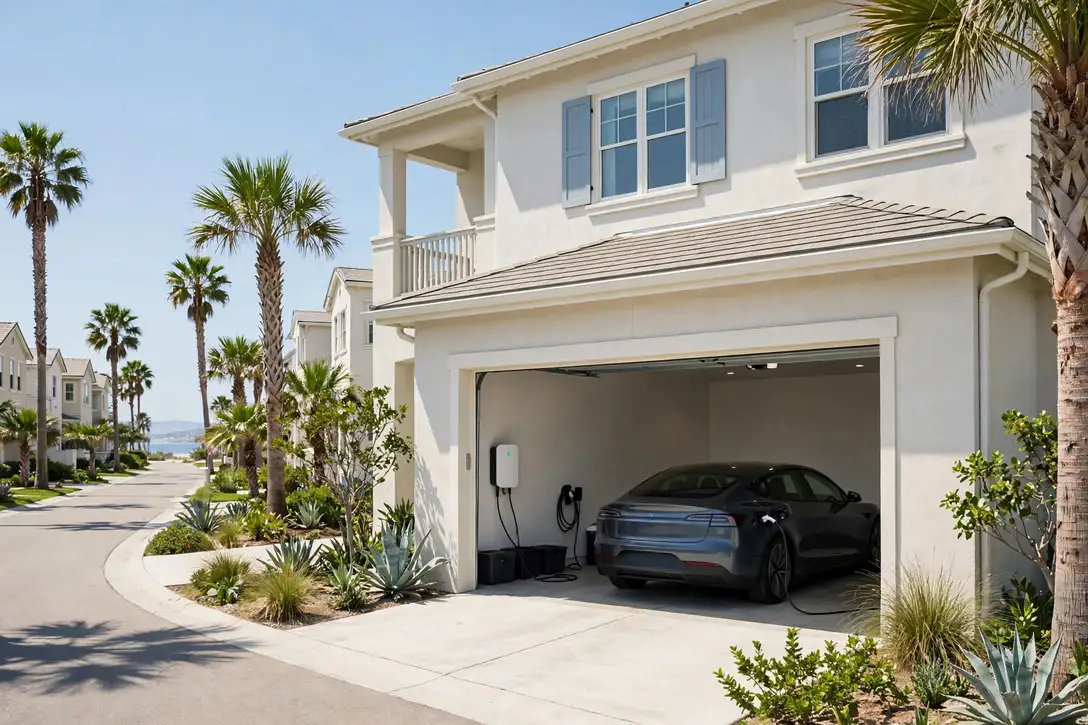
Think of it as plumbing for electrons, done once: capacity checked, circuit run, station mounted and configured, inspection passed. The households that report the smoothest projects describe the same shape — a visit that measured, a quote that itemised, and a car that simply charged from the first night.
In Port St. Lucie: where most Port St. Lucie projects start and finish: one circuit, one station, one inspection.
Multifamily & Condo EV Charging in Port St. Lucie
Shared buildings convert charging from a purchase into a policy, and the installers fluent here speak both languages — amperage and agenda items. The electrical design that wins approval is the one whose metering and load answers arrive attached to the application.
In Port St. Lucie: the route from board agenda to working charger in Port St. Lucie's communities.
Level 2 Charger Installation in Port St. Lucie
What is being bought is recovery rate. A Level 2 circuit returns in one overnight session what a household receptacle returns in a day and a half, and that margin is the difference between planning around the car and forgetting about it.
In Port St. Lucie: the 240-volt step that turns overnight charging in Port St. Lucie from a trickle into a full battery by morning.
Utility programs and electricity in Port St. Lucie
Electricity in Port St. Lucie comes from Florida Power & Light Co. Parts of the wider metro are served by Fort Pierce Utilities Authority. The utility matters twice over for a charger install: it sets the time-of-use rates that decide what overnight charging costs you, and it is the organisation that may — or may not — currently help pay for the equipment.
There is a strategic consequence to the empty incentive shelf in Port St. Lucie: the install decision reduces to the work itself and the tariff it runs on. With no rebate distorting the comparison, quotes compete on scope, licensing and the load calculation's honesty — which is the competition homeowners should want. And the overnight rate window, where Florida Power & Light Co offers one, quietly returns more over the car's life than most one-off rebates ever did.
While you are in the tariff pages, look at how the plan values the evening ramp — the hours when cooking, cooling and charging would otherwise stack. A charger that starts after the ramp is the simplest scheduling decision in home charging, and it is set once.
Condos, HOAs and the law in Florida
An association in Florida cannot simply say no. The right-to-charge law recorded for this state (Fla. Stat. §718.113(8)) entitles an owner to install charging equipment for their own vehicle in their own parking space, subject to reasonable association conditions on placement, insurance and eventual restoration. For a Port St. Lucie owner, the practical consequence is that the application is a compliance exercise — equipment, circuit, paperwork — rather than a popularity contest at a board meeting.
For renters, coverage in Florida is recorded as: Owners (condo). If you rent in Port St. Lucie, the practical route is still a written proposal to the landlord — dedicated circuit, licensed installer, your name on the permit — because a charger-ready space is an asset most landlords keep when you leave.
Start with the condo and HOA guide for the application itself, and the multifamily service page for how the electrical design is usually laid out in Florida buildings.
Climate, garages and charger placement
Humidity does quiet electrical work of its own: connections in damp garages live harder lives than their desert counterparts, which is one more reason the installer's torque and the enclosure's seal deserve their moment at commissioning. The charger itself is sealed and rated for this climate; the discipline is in the joints.
In this climate the overnight window does double duty — rates are kinder and so are temperatures. Scheduling the charge for the small hours lets the car and the station work in the coolest air the day offers, which is easier on both. An installer who raises scheduling unprompted during the site visit is telling you they install in this heat regularly.

Permits and inspection in Port St. Lucie
What the inspector is checking, in plain terms: conductor size against breaker size, the continuous-load calculation, terminations torqued, protection where the code wants it, and a station whose settings match the circuit it landed on. It is a short visit that validates everything you cannot see.

Neighbourhoods and ZIP codes served
The page covers 8 ZIP codes in and around Port St. Lucie — including 34952, 34953, 34983, 34984, 34985, 34986, 34987, 34988 — across St. Lucie. If your ZIP is not in the first set shown, ask anyway: installer coverage follows the metro, not a postcode fence.
St. Lucie County accounts for 19 of the ZIP codes and 2 named postal localities in the research file, the nearest of them Port Saint Lucie, Fort Pierce. The survey counts 360,500 residents in the county, with a median household income of $71,457 and a median home value of $347,300. Measured across its ZIP codes, the Port St. Lucie footprint runs about 9 miles north to south and 13 east to west, from ZIP 34952 to 34988 — the ground an installer based here actually covers in a working week.
Beyond the county seats, the working area takes in Jensen Beach, Stuart, Fort Pierce, Palm City, Port Salerno, Hobe Sound, Indiantown, Jupiter, Okeechobee, Palm Beach Gardens, West Palm Beach, North Palm Beach, Canal Point, Loxahatchee, Pahokee, Royal Palm Beach, Palm Beach, Wellington — the named localities for which Port St. Lucie is the nearest metro in the network (neighbouring metros' pages cover their own ground), each routing to the same installer-matching service.
The wider working area also reaches Vero Beach, Winter Beach, Wabasso, Sebastian, Fellsmere, Roseland — ground shared with neighbouring metros, where installers cross the same county lines in both directions.
ZIP codes in that shared ground include 32948, 32957, 32958, 32960, 32961, 32962, 32963, 32964, 32965, 32966, 32967, 32968, 32969, 32970, 32971, 32976, 32978, 34951, 34972.
The largest communities in that working area after Port St. Lucie itself, by the GeoNames populated-place file: Port Saint Lucie (population 164,603), West Palm Beach (population 120,932), Jupiter (population 62,707), Wellington (population 62,560), Palm Beach Gardens (population 52,923), Fort Pierce (population 44,484), The Acreage (population 38,704), Royal Palm Beach (population 37,633), Lake Worth Beach (population 37,498), Riviera Beach (population 34,005), Greenacres City (population 32,963), Palm City (population 23,120), Palm Springs (population 22,341), Lake Worth Corridor (population 20,635), Belle Glade (population 18,251), Stuart (population 16,462), North Palm Beach (population 12,015), Jensen Beach (population 11,707), Hobe Sound (population 11,521), Lantana (population 11,136). Charging demand follows those populations — the subdivisions and town centres where the next driveways, and the next panels, are.
Palm Beach County reaches into the working area with 1,533,806 residents, a median household income of $83,581 and a median home value of $447,300; its localities on this page include Jupiter. Martin County reaches into the working area with 162,176 residents, a median household income of $82,943 and a median home value of $432,200; its localities on this page include Jensen Beach, Stuart. Okeechobee County reaches into the working area with 40,816 residents, a median household income of $57,984 and a median home value of $193,000; its localities on this page include Okeechobee.
| ZIP | Locality | County |
|---|---|---|
| 34952 | Port Saint Lucie | St. Lucie |
| 34984 | Port Saint Lucie | St. Lucie |
| 34985 | Port Saint Lucie | St. Lucie |
| 34983 | Port Saint Lucie | St. Lucie |
| 34953 | Port Saint Lucie | St. Lucie |
| 34958 | Jensen Beach | Martin |
| 34957 | Jensen Beach | Martin |
| 34986 | Port Saint Lucie | St. Lucie |
| 34994 | Stuart | Martin |
| 34982 | Fort Pierce | St. Lucie |
| 34949 | Fort Pierce | St. Lucie |
| 34996 | Stuart | Martin |
| 34995 | Stuart | Martin |
| 34990 | Palm City | Martin |
| 34991 | Palm City | Martin |
| 34981 | Fort Pierce | St. Lucie |
| 34948 | Fort Pierce | St. Lucie |
| 34954 | Fort Pierce | St. Lucie |
| 34979 | Fort Pierce | St. Lucie |
| 34987 | Port Saint Lucie | St. Lucie |
| 34950 | Fort Pierce | St. Lucie |
| 34997 | Stuart | Martin |
| 34992 | Port Salerno | Martin |
| 34947 | Fort Pierce | St. Lucie |
| 34945 | Fort Pierce | St. Lucie |
| 34988 | Port Saint Lucie | St. Lucie |
| 34946 | Fort Pierce | St. Lucie |
| 33455 | Hobe Sound | Martin |
| 33475 | Hobe Sound | Martin |
| 34956 | Indiantown | Martin |
| 33469 | Jupiter | Palm Beach |
| 33478 | Jupiter | Palm Beach |
| 33458 | Jupiter | Palm Beach |
| 33468 | Jupiter | Palm Beach |
| 33477 | Jupiter | Palm Beach |
| 34973 | Okeechobee | Okeechobee |
| 34974 | Okeechobee | Okeechobee |
| 33410 | Palm Beach Gardens | Palm Beach |
| 33418 | Palm Beach Gardens | Palm Beach |
| 33412 | West Palm Beach | Palm Beach |
| 33408 | North Palm Beach | Palm Beach |
| 33438 | Canal Point | Palm Beach |
| 33403 | West Palm Beach | Palm Beach |
| 33404 | West Palm Beach | Palm Beach |
| 33470 | Loxahatchee | Palm Beach |
| 33476 | Pahokee | Palm Beach |
| 33407 | West Palm Beach | Palm Beach |
| 33421 | Royal Palm Beach | Palm Beach |
| 33417 | West Palm Beach | Palm Beach |
| 33409 | West Palm Beach | Palm Beach |
| 33401 | West Palm Beach | Palm Beach |
| 33480 | Palm Beach | Palm Beach |
| 33402 | West Palm Beach | Palm Beach |
| 33419 | West Palm Beach | Palm Beach |
| 33420 | West Palm Beach | Palm Beach |
| 33422 | West Palm Beach | Palm Beach |
| 33414 | Wellington | Palm Beach |
| 33411 | West Palm Beach | Palm Beach |
| 33413 | West Palm Beach | Palm Beach |
| 33416 | West Palm Beach | Palm Beach |
| 33415 | West Palm Beach | Palm Beach |
| 33405 | West Palm Beach | Palm Beach |

Planning the install: from panel to parking
Consider the two households inside every Port St. Lucie install. The first owns the panel, the parking and the decision; the second — a partner, a teenager with the next car, a future buyer — inherits all three. Designing for the second household is the difference between an install and an asset: capacity reserved, conduit honest, paperwork filed. The first conversation with an installer should name both households explicitly.
Finally, photograph the finished work — station, nameplate, panel directory with the new breaker labelled — and file it with the inspection record. When the car changes, the house sells or a second station joins the first, that folder is the difference between a five-minute answer and an archaeological dig.
Home charging know-how for Port St. Lucie households
Retrofitting the older apartment building
Older multifamily buildings meet charging with a capacity question before any other: the service was sized for another era's loads. The professional answer is a load study — what the building actually draws across its day — followed by a managed design that fits charging into the valleys, with make-ready capacity for the applicants who have not yet appeared. It is slower than a house install and more deliberate, and it is the reason experienced multifamily installers start with the building's electrical room rather than its car park.
Depots and small fleets
A business running a handful of vehicles meets charging as an operations problem: vehicles dwell overnight, leave together, and must all be ready — while the building's service also runs the business. The design answers are load management across the pool, scheduling aligned to departure rather than arrival, and make-ready capacity for the vehicles not yet bought. It is the domestic pattern scaled by consequence, and it is planned from the load curve of the site rather than from the count of vehicles on day one.
Three cars, one driveway
Households with more vehicles than bays run a small nightly logistics operation, and charging joins the rotation. The patterns that work: the station positioned to serve two parking spots in sequence, a household habit about whose night it is, and — where two of the fleet are electric — power sharing that removes the rotation entirely. The design conversation should start from the household's actual parking choreography, observed on a normal evening, because the charger serves the pattern that exists, not the one the driveway promised.
Breakers: the household's safety switches
A breaker is a switch that watches current and opens when the current stops being safe — heat in a conductor is the thing it exists to prevent. Two household rules follow. First, a tripping breaker is reporting, not malfunctioning by default: reset once, and if it repeats, the circuit gets an electrician, not another reset. Second, the forbidden fix: never answer a trip by fitting a larger breaker. The breaker protects the wire in the wall; upsizing the guard without upsizing the wire removes the protection and keeps the problem.

Frequently asked questions
Can I still get the federal tax credit for a home charger in Port St. Lucie, FL?
The three possible pots are all, at present, empty for a Port St. Lucie homeowner: no Florida Power & Light Co residential rebate in current published sources, no Florida home programme, and a federal credit that closed on September 30, 2025. Programmes do relaunch — on the utility's site, with dates — and until one does, the honest quote is the one with no rebate line at all.
Can my association in Port St. Lucie, FL say no to a home charger?
Only within limits the statute sets. Florida law (Fla. Stat. §718.113(8)) protects an owner's right to install in their own space; associations may regulate placement, appearance and insurance and require restoration on removal, but a blanket refusal is not theirs to give. If a board stalls, a complete written application citing the statute is the standard remedy.
Will my Port St. Lucie, FL home need a panel upgrade for a Level 2 charger?
It depends on the panel, and Port St. Lucie's housing makes the question common: the median home here was built in 2003, and about 8% of housing units predate 1980. Homes with 100-amp service that is already well used often need an upgrade or a load-management device; homes with 200-amp service and spare breaker space usually do not. A load calculation during the site visit settles it — ask to see it.
Level 1 or Level 2 in Port St. Lucie, FL — what is the real difference?
In parked hours: a Level 1 cord returns about 3–5 miles for each of them, and a Level 2 circuit returns roughly 25–40, set by its amperage and the car's acceptance. For a Port St. Lucie household parking ten hours, that is the difference between recovering a short errand day and recovering any day the car can legally drive.
What happens after I request an installer through this page?
Your request is matched to licensed installers covering Port St. Lucie, Florida — service, ZIP, property type and timing travel with it. The installer who takes it arranges the site visit and quotes in writing; PlugReady USA's part is the research on this page and the introduction, and your contract is with the installer throughout.
How long does a typical home charger installation take in Port St. Lucie, FL?
The electrical work itself is usually a half day to a day for a straightforward house — panel near the parking, one circuit, one station. Around it sit two calendars the installer does not control: the permit's issuance and the inspection visit, which follow the local department's queue. Ask any quote to separate the three timelines; a blended promise hides which part might slip.
Nearby cities in Florida
- EV charger installation in Sebastian — about 36 miles from Port St. Lucie, metro population 165,000
- EV charger installation in Palm Bay — about 54 miles from Port St. Lucie, metro population 625,000
- EV charger installation in Punta Gorda — about 100 miles from Port St. Lucie, metro population 195,000
- EV charger installation in Cape Coral — about 103 miles from Port St. Lucie, metro population 800,000
- EV charger installation in Lakeland — about 104 miles from Port St. Lucie, metro population 725,000
- EV charger installation in Miami — about 104 miles from Port St. Lucie, metro population 6,150,000
- EV charger installation in Brunswick, GA — about 277 miles from Port St. Lucie, metro population 115,000
- EV charger installation in Valdosta, GA — about 292 miles from Port St. Lucie, metro population 150,000
- EV charger installation in Savannah, GA — about 333 miles from Port St. Lucie, metro population 425,000
Ready to charge at home in Port St. Lucie?
Two minutes of form, and the request is in front of licensed installers who cover this city — quotes follow site visits, in writing.