EV Charger Installation in Savannah, GA
Everything a Savannah homeowner needs before booking a charger install — the panel question, the utility's current programs, the HOA law and the permit — sourced, dated and local.
Charging at home is the version of EV ownership that actually works day to day, and in Savannah it starts with a straightforward question: where will the car sleep, and what can the electrical panel behind that wall honestly support? Savannah itself is home to about 148,809 people, and 161,200 battery-electric vehicles plus 32,900 plug-in hybrids were registered across Georgia by the end of 2025 — every one of them a household that charges somewhere. This page gathers what a homeowner in Savannah needs to know before booking an installer: the local utility and its current charger programs, the state law that applies in condos and HOA communities, the permit process, and the housing realities that decide how simple or involved an installation will be.
Nothing on this page is decorative. The statutes are quoted because boards respect them, the survey numbers are shown because quotes should follow them, and the program status is stated plainly — including when the plain statement is that no verified program currently exists for Savannah. Informed homeowners get better installs; this page is the informing.
Measured demand, not enthusiasm, put Savannah in Tier C of this network: Georgia Power; port-city growth. For a homeowner the useful translation is simpler — installers here do this work weekly, know the local permit counter, and have seen your housing stock before.
Three survey lines do most of the predictive work on this page. Income — a median of $55,907 per household — tracks the pace at which Savannah households adopt EVs at all. Tenure — 48% owner-occupied — decides whose signature the work needs. And structure — 57% single-unit detached — decides how often the answer is a simple garage circuit rather than a building negotiation.

Put the survey together and Savannah's charging profile reads like this: an older housing fabric, where panel archaeology is a normal part of the first visit; a detached-house majority with a real attached and multifamily minority; buildings of five or more units hold a substantial share of homes, which keeps the multifamily sections of this page in daily use; and renters form a large share of households, so the landlord conversation is a first-class topic here. That combination — more than any single number — is what the installers working here plan around, and it is the lens for everything on this page.
The counts behind the percentages, for the record: Savannah has 67,733 housing units on the survey's count, 54,740 of them occupied, and 26,099 owner-occupied households making their own electrical decisions. Detached houses number 38,715; homes built before 1980 number 40,191; units in buildings of five or more number 15,515. An installer's week in this city is a walk through exactly that distribution. The page's geography is equally concrete: 18 ZIP codes across Chatham, centred near 32.07 degrees north latitude. The city anchors the Savannah metropolitan area, home to roughly 425,000 people on the research file's metro estimate — the wider labour and housing market this page's installers work across.
The same survey release fills in the household economics around the housing stock: a median home value of $302,200, median gross rent of $1,519, per-capita income of $33,531, and a median resident age of 34. The movement data matters as much as the money data: 68% of Savannah workers drive to work alone — the commute pattern home charging is built around; 11% work from home, a population whose cars charge on daytime and overnight schedules alike; 4% commute by public transit; 34% of adults hold a bachelor's degree or higher. And the fleet in the driveways: 22,711 households in Savannah have exactly one vehicle, 24,748 have two or more, and 7,281 have none.
Household structure, from the same release: 52% of Savannah households are family households. The burden shares behind the housing stock: 55% of renting households are cost-burdened at the 30%-of-income line, as are 0% of mortgaged owners — context for why the overnight rate window, once set, is treated here as a household fixture rather than a hobby.
This is the context an installer works against, whether it is written down or not. Where so much of the stock predates modern code cycles, the site visit doubles as a survey — grounding electrode, service entrance, panel provenance — before it is ever a quote. Where form is mixed, advice must be conditional — the honest page, like the honest installer, keeps asking which housing the reader actually lives in before prescribing.
Property managers are the metro's charging gatekeepers at this tenure mix, and the installers who thrive are the ones whose proposals arrive manager-shaped: standardised, insured, reversible on paper. Modest incomes make the overnight tariff the headline act: the difference between peak and off-peak charging, compounded nightly for years, is the largest single number in the ownership equation. Tariff design is the quiet policy: the shape of the overnight window, the demand charges commercial customers face, the interconnection queue's pace — all set in dockets the diligent can read.
The used-EV wave has arrived at this fleet scale, and it democratises the install question: households that bought electric second-hand, at family-car money, asking the same panel questions as the pioneers — with better local answers available. Smaller metros adopt on their own clock: the fleet follows the dealers and the demographics, and each install is a visible event a street notices. The association dimension here runs on persuasion rather than statute — no state charging law frames the application, so the complete, professional proposal carries the whole argument, as the law section above explains.
The electrical reality in Savannah homes
The Census Bureau counts Savannah's housing in ways that turn out to be an installer's briefing: the median home dates to 1971, 59% of units stood before 1980, 57% are detached single-unit houses, and 48% of occupied homes belong to their occupants. Panel sizes, wire routes and even permit histories track those proportions street by street. A housing stock this age leans on smaller electrical services — 100-amp panels are common, and fuse-era equipment still turns up in the oldest streets. For many of those homes the honest answer is a panel upgrade or a load-management device before the charger circuit goes in, and a good installer will show you the load calculation rather than asking you to take it on faith. Detached houses matter for a practical reason: a garage or driveway on your own lot means the charger, the car and the circuit are all under one roof and one owner's control, which is the simplest configuration there is.
One further survey line belongs in any Savannah install conversation: 68% of the city's homes heat with electricity — 39,305 households whose panels already carry a major winter load before a charger is contemplated. Electric heat and EV charging are the two largest discretionary loads a house can host, and where they coincide, the load calculation stops being a formality.
One further split matters for how this page is organised: about 28,641 of Savannah's occupied homes are renter-occupied. Everything above assumes you can approve your own electrical work; where you cannot, the approval layer — landlord or association — becomes part of the job, which is why the law section carries unusual weight here.
And 23% of Savannah's homes are in buildings with five or more units — apartments and condominiums where charging is a building decision before it is an electrical one. If that is your situation, the law and multifamily sections of this page are the ones written for you.
EV charging services in Savannah
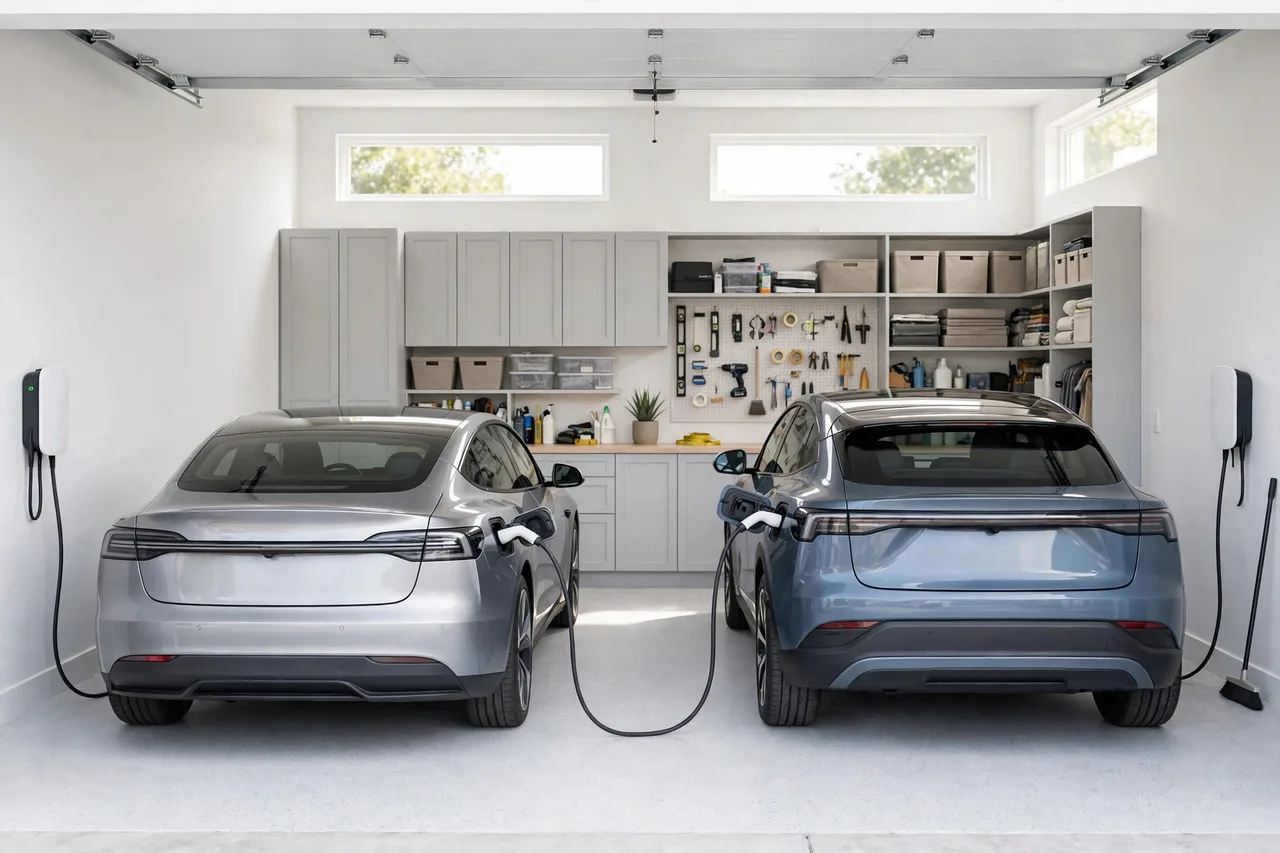
Ten services cover the work installers do in Savannah. Three lead the list here because of what this city's housing and law actually look like — each links to its national service page, where scope and process are set out in full.
Home EV Charger Installation in Savannah
The residential standard: a station where the car sleeps, on a circuit of its own, installed under permit. Variations are all local — the panel's spare room, the run's route through the house's fabric, and the parking pattern the cable has to serve.
In Savannah: where most Savannah projects start and finish: one circuit, one station, one inspection.
Dedicated Circuit & Electrical Panel Upgrade in Savannah
The capacity project behind the charger project. A load calculation decides whether the answer is a service increase, a panel replacement, a subpanel or load management — and the work is sequenced with the utility and the inspector so the house is live again the same day in most cases.
In Savannah: the capacity fix that lets the charger circuit go in without the rest of the house living at its limit.
Level 2 Charger Installation in Savannah
The step up from a household outlet to a real circuit: 240 volts, sized as a continuous load, delivering several times the overnight range of a Level 1 cord. The craft is in matching circuit, station configuration and vehicle acceptance so the three agree.
In Savannah: the 240-volt step that turns overnight charging in Savannah from a trickle into a full battery by morning.
Utility programs and electricity in Savannah
Electricity in Savannah comes from Canoochee Electric Member Corp. The utility matters twice over for a charger install: it sets the time-of-use rates that decide what overnight charging costs you, and it is the organisation that may — or may not — currently help pay for the equipment.
No verified residential charger rebate was in place for Canoochee Electric Member Corp in the sources checked for this page (the federal Alternative Fuel Refueling Property Credit ended on September 30, 2025, and no Georgia state program replaced it for typical home installs). That can change — utilities open and close funded rounds — so an installer quoting you today should be able to name any current program precisely, with its published terms. If they cannot name it, it is not part of your job.
Renters and condo owners should note the metering question early: whose meter the charger hangs off decides who pays for the energy, and Canoochee Electric Member Corp's options for submetering are part of the multifamily conversation below.
Condos, HOAs and the law in Georgia
No statute promises a charger approval in Georgia. Unlike the states that have enacted right-to-charge laws, Georgia leaves the question entirely to each community's covenants and board discretion. For Savannah owners that is not the end of the road — it is a sign that the negotiation, the metering design and the written application carry the weight a statute would otherwise carry.
Timing helps too. Boards plan capital work annually; an application that arrives with the community's budget cycle, offering to coordinate with any planned electrical or repaving work, reads as a contribution rather than a demand.
The general process, minus the statute, is still covered in our guide to installing an EV charger in a condo or HOA community — most of its application-package advice applies in Savannah exactly as written.
Climate, garages and charger placement
Thermal habits separate durable installs from tired ones in this region: connectors holstered out of the sun, enclosures with room to breathe, and charge sessions pushed past midnight when the air gives the equipment its easiest working conditions of the day.
Hurricane-season thinking reaches the garage in coastal hot metros: the station mounted above any plausible water line, the circuit's breaker labelled for fast isolation, the cable holstered high. None of it appears in the equipment brochure, and all of it belongs in a local install conversation.

Permits and inspection in Savannah
Expect the permit to name the circuit, the breaker and the equipment. An installer who suggests skipping it is saving an afternoon by spending your liability; the inspection is also your independent check that the continuous-load sizing was done properly.

Neighbourhoods and ZIP codes served
The page covers 18 ZIP codes in and around Savannah — including 31401, 31402, 31403, 31404, 31405, 31406, 31408, 31409, 31410, 31411, 31412, 31414, 31415, 31416, 31418, 31419, 31420, 31421 — across Chatham. If your ZIP is not in the first set shown, ask anyway: installer coverage follows the metro, not a postcode fence.
The same working area takes in the neighbouring localities of Port Wentworth, Pooler, Bloomingdale, Tybee Island — the county ring an installer based in Savannah actually drives. Requests from those communities route exactly as city requests do: same services, same permit discipline, same local facts where they differ.
Chatham County accounts for 22 of the ZIP codes and 5 named postal localities in the research file, the nearest of them Port Wentworth, Pooler, Bloomingdale, Tybee Island. The survey counts 300,879 residents in the county, with a median household income of $71,097 and a median home value of $302,700. Measured across its ZIP codes, the Savannah footprint runs about 13 miles north to south and 14 east to west, from ZIP 31401 to 31421 — the ground an installer based here actually covers in a working week.
Beyond the county seats, the working area takes in Port Wentworth, Pooler, Bloomingdale, Hardeeville, Tybee Island, Meldrim, Richmond Hill, Rincon, Eden, Ellabell, Guyton, Fleming, Midway, Springfield, Hinesville, Fort Stewart, Riceboro, Clyo, Pembroke, Brooklet, Allenhurst, Walthourville, Oliver, Newington, Daisy, Ludowici, Statesboro — the named localities for which Savannah is the nearest metro in the network (neighbouring metros' pages cover their own ground), each routing to the same installer-matching service.
The wider working area also reaches Daufuskie Island, Bluffton, Hilton Head Island, Okatie, Tillman, Beaufort, Parris Island, Ridgeland, Port Royal, Sheldon, Pineland, Coosawhatchie, Saint Helena Island, Garnett, Lobeco, Townsend, Seabrook, Dale, Crescent, Yemassee, Furman, Scotia — ground shared with neighbouring metros, where installers cross the same county lines in both directions.
ZIP codes in that shared ground include 29901, 29902, 29903, 29904, 29905, 29906, 29907, 29909, 29910, 29912, 29914, 29915, 29920, 29921, 29922, 29925, 29926, 29928, 29931, 29934, 29935, 29936, 29938, 29939, 29940, 29941, 29943, 29945, 31304, 31331.
The largest communities in that working area after Savannah itself, by the GeoNames populated-place file: Hinesville (population 33,398), Statesboro (population 30,721), Pooler (population 23,133), Wilmington Island (population 15,138), Richmond Hill (population 11,935), Georgetown (population 11,823), Rincon (population 9,843), Garden City (population 8,999), Skidaway Island (population 8,341), Port Wentworth (population 7,637), Whitemarsh Island (population 6,792), Hardeeville (population 5,301), Glennville (population 5,086), Fort Stewart (population 4,924), Montgomery (population 4,523), Lyons (population 4,375), Metter (population 4,111), Walthourville (population 3,974), Tybee Island (population 3,102), Springfield (population 2,889). Charging demand follows those populations — the subdivisions and town centres where the next driveways, and the next panels, are.
Liberty County reaches into the working area with 67,397 residents, a median household income of $60,456 and a median home value of $201,500; its localities on this page include Fleming, Midway, Hinesville, Fort Stewart, Riceboro. Effingham County reaches into the working area with 69,143 residents, a median household income of $88,438 and a median home value of $276,000; its localities on this page include Meldrim, Rincon, Eden, Guyton, Springfield. Bryan County reaches into the working area with 48,263 residents, a median household income of $103,408 and a median home value of $343,200; its localities on this page include Richmond Hill, Ellabell, Pembroke. Bulloch County reaches into the working area with 82,683 residents, a median household income of $58,810 and a median home value of $222,500; its localities on this page include Brooklet, Statesboro. Screven County reaches into the working area with 14,130 residents, a median household income of $52,792 and a median home value of $124,300; its localities on this page include Oliver, Newington.
| ZIP | Locality | County |
|---|---|---|
| 31401 | Savannah | Chatham |
| 31402 | Savannah | Chatham |
| 31412 | Savannah | Chatham |
| 31415 | Savannah | Chatham |
| 31404 | Savannah | Chatham |
| 31405 | Savannah | Chatham |
| 31408 | Savannah | Chatham |
| 31416 | Savannah | Chatham |
| 31409 | Savannah | Chatham |
| 31406 | Savannah | Chatham |
| 31410 | Savannah | Chatham |
| 31407 | Port Wentworth | Chatham |
| 31403 | Savannah | Chatham |
| 31414 | Savannah | Chatham |
| 31418 | Savannah | Chatham |
| 31420 | Savannah | Chatham |
| 31421 | Savannah | Chatham |
| 31322 | Pooler | Chatham |
| 31419 | Savannah | Chatham |
| 31411 | Savannah | Chatham |
| 31302 | Bloomingdale | Chatham |
| 29927 | Hardeeville | Jasper |
| 31328 | Tybee Island | Chatham |
| 31318 | Meldrim | Effingham |
| 31324 | Richmond Hill | Bryan |
| 31326 | Rincon | Effingham |
| 31307 | Eden | Effingham |
| 31308 | Ellabell | Bryan |
| 31312 | Guyton | Effingham |
| 31309 | Fleming | Liberty |
| 31320 | Midway | Liberty |
| 31329 | Springfield | Effingham |
| 31310 | Hinesville | Liberty |
| 31315 | Fort Stewart | Liberty |
| 31323 | Riceboro | Liberty |
| 31313 | Hinesville | Liberty |
| 31303 | Clyo | Effingham |
| 31321 | Pembroke | Bryan |
| 31314 | Fort Stewart | Liberty |
| 30415 | Brooklet | Bulloch |
| 31301 | Allenhurst | Liberty |
| 31333 | Walthourville | Liberty |
| 30449 | Oliver | Screven |
| 30446 | Newington | Screven |
| 30423 | Daisy | Evans |
| 31316 | Ludowici | Long |
| 30461 | Statesboro | Bulloch |
Planning the install: from panel to parking
Consider the two households inside every Savannah install. The first owns the panel, the parking and the decision; the second — a partner, a teenager with the next car, a future buyer — inherits all three. Designing for the second household is the difference between an install and an asset: capacity reserved, conduit honest, paperwork filed. The first conversation with an installer should name both households explicitly.
One more piece of sequencing advice Savannah installers give consistently: if the panel is being opened anyway, settle the other electrical maybes in the same visit — the circuit you will want next year costs least while the permit and the electrician are already in the house.
Home charging know-how for Savannah households
Planning the second visit on the first
Nearly every install leaves a known future: a second car, a workshop circuit, a battery or a heat pump queuing for capacity. The first visit is when that future costs least to serve — conduit runs made while walls are open, panel positions reserved, the load study documented so the next calculation starts from evidence. Installers call it roughing in the future; households experience it, years later, as the second project that was mysteriously half done already.
Light, reach and the midnight plug-in
Most charging happens in the dark, in winter clothes, carrying something. The installations that feel effortless share three traits: light where the connector lives, a mounting height that asks no stretching or crouching, and a cable path with nothing to trip over between the car door and the wall. Households with mobility limits in the family should say so at the site visit — height, reach and holster style are all adjustable at install time and awkward afterwards. Design for the worst trip, not the easiest one.
Chargers and the flood line
Some garages flood — not catastrophically, just historically: the spring inch, the storm drain's bad day. The charger belongs above the line the water has actually reached, a fact the house knows and the install conversation should ask about. Mounting height, conduit entry points and the station's own listing all have flood-aware versions, and in the streets that need them, local installers raise the subject before the homeowner does.
The sounds a station makes
A charging station is mostly silent, but not entirely: a contactor's clunk when a session starts, a faint hum under load, occasionally a small fan in warm weather. These are the sounds of switching and cooling, and they are normal. The sounds that earn attention are changes — buzzing that was not there last month, clicking cycles, a hum that grows. Electricity should be boring to listen to; when it stops being boring, that is information, and the correct response is an electrician rather than a search engine.

Frequently asked questions
Is the federal charger tax credit still available in Savannah, GA?
The honest ledger for Savannah reads: federal credit, ended September 30, 2025; state program, none for typical home installs; Canoochee Electric Member Corp residential rebate, none verified in the sources checked. If a salesperson's quote leans on any of the three, the correct response is a request for the program's published page.
What can my HOA in Savannah, GA do about a charger install?
In Savannah the honest answer is yes, they can refuse: Georgia gives owners no statutory charging right, so the board's discretion governs. What changes outcomes is the quality of the file in front of them — drawings, metering, insurance, a named licensed installer — and a growing number of boards here approve exactly that file.
Panel upgrade or not — how do Savannah, GA homeowners find out?
Start from the median, then verify: the median Savannah home was built in 1971, and 59% of the stock predates 1980, so 100-amp panels are a normal sight here — and a normal candidate for either an upgrade or a load-management device. The load calculation distinguishes the two in one visit, and any quote that skips it is guessing with your money.
Level 1 or Level 2 in Savannah, GA — what is the real difference?
Level 1 — the cord in the boot, on a normal outlet — returns about 3–5 miles of range an hour. Level 2 on its own 240-volt circuit returns roughly 25–40. A Savannah commuter who parks at seven and leaves at seven stops doing battery arithmetic entirely.
What happens next after I send a request?
Three steps: the request routes to installers who work Savannah, Georgia; one contacts you to walk the property; the walk produces the written quote. Everything on this page — the utility position, the law, the housing data — is yours to check that quote against.
Does Canoochee Electric Member Corp offer a time-of-use rate for EV charging in Savannah?
Check your tariff before the install rather than after: time-of-use plans are common, and an overnight window changes nothing about the circuit but everything about what charging costs across a year. Your installer can set the station's schedule to the window during commissioning — after that the habit is automatic.
Nearby cities in Georgia
- EV charger installation in Brunswick — about 66 miles from Savannah, metro population 115,000
- EV charger installation in Augusta — about 107 miles from Savannah, metro population 625,000
- EV charger installation in Warner Robins — about 145 miles from Savannah, metro population 190,000
- EV charger installation in Macon — about 148 miles from Savannah, metro population 235,000
- EV charger installation in Valdosta — about 154 miles from Savannah, metro population 150,000
- EV charger installation in Albany — about 173 miles from Savannah, metro population 145,000
- EV charger installation in Hilton Head Island, SC — about 19 miles from Savannah, metro population 225,000
- EV charger installation in Charleston, SC — about 80 miles from Savannah, metro population 825,000
- EV charger installation in Jacksonville, FL — about 126 miles from Savannah, metro population 1,650,000
Ready to charge at home in Savannah?
Tell us the job — service, ZIP and property type — and licensed local installers will take it from there.