EV Charger Installation in Warner Robins, GA
Charging where you park, in Warner Robins: the utility programs, state law, permit process and housing facts behind a home charger install, gathered in one place.
Consider what a home charger actually replaces: the weekly detour, the public station's queue, the arithmetic of arriving home low. In Warner Robins, the replacement project is well understood because the fleet is already here — 161,200 battery-electric vehicles and 32,900 plug-in hybrids registered across Georgia through 2025. Warner Robins itself is home to about 85,856 people. This page is the project's local brief: your utility and its programs, your state's law, your city's permit process, and your housing stock's electrical character, each stated with its source.
How PlugReady USA works, in one breath: you describe the job once, licensed local installers who cover Warner Robins receive it, and the conversations happen with them directly. The rest of this page exists so those conversations start from facts — yours about the house, ours about the metro — rather than from a sales script.
Measured demand, not enthusiasm, put Warner Robins in Tier C of this network: RAFB workforce. For a homeowner the useful translation is simpler — installers here do this work weekly, know the local permit counter, and have seen your housing stock before.
Three percentages describe the working conditions for charging in Warner Robins: 55% owner-occupied, 68% single-unit detached, and a median household income of $69,011 standing behind both. Everything in the sections below — panels, permissions, metering — is commentary on those proportions.

Put the survey together and Warner Robins's charging profile reads like this: a housing stock of mixed vintages, where both electrical eras appear on the same street; a detached-house majority with a real attached and multifamily minority; buildings of five or more units are a visible minority of the stock; and owners hold a working majority, with renters a significant minority. That combination — more than any single number — is what the installers working here plan around, and it is the lens for everything on this page.
In absolute terms, the survey counts 37,268 housing units in Warner Robins — 33,639 occupied, 18,436 of them by their owners. The stock resolves into 25,383 single-unit detached houses, 11,928 homes standing since before 1980, and 7,305 units in larger buildings. Those six counts are the city's charging map drawn without percentages, and every section of this page is a consequence of one of them. The page's geography is equally concrete: 5 ZIP codes across Houston, centred near 32.59 degrees north latitude. The city anchors the Warner Robins metropolitan area, home to roughly 190,000 people on the research file's metro estimate — the wider labour and housing market this page's installers work across.
The same survey release fills in the household economics around the housing stock: a median home value of $185,700, median gross rent of $1,212, per-capita income of $33,172, and a median resident age of 32. And the daily rhythms behind the housing numbers: 78% of Warner Robins workers drive to work alone — the commute pattern home charging is built around; 10% work from home, a population whose cars charge on daytime and overnight schedules alike; 0% commute by public transit; 31% of adults hold a bachelor's degree or higher. And the fleet in the driveways: 10,860 households in Warner Robins have exactly one vehicle, 20,403 have two or more, and 2,376 have none.
Two burden statistics frame the economics: in Warner Robins, 40% of renters and 0% of mortgage-holding owners are housing-cost burdened at the standard 30% threshold. And 66% of households are family households, the segment most likely to run the two-vehicle, two-schedule pattern the second-vehicle planning notes address.
Read together, the local facts draw a recognisable picture. Growth rings are the city's autobiography: each decade's standard — service size, wiring method, garage provision — survives intact in its ring, and the charger wave is now writing the next ring's standard. The built form refuses a single story: houses with garages on one side of the arterial, garden apartments and mid-rise condos on the other, each population charging by different rules.
Where renting dominates, the successful install is a document before it is a device — installer licence, insurance, metering clarity, end-of-tenancy position — assembled to make a landlord's yes the path of least resistance. Value engineering is the local dialect: load management weighed against panel work on merit, quotes compared line by line, the site visit treated as the moment the scope becomes honest. The regulatory calendar is the programme calendar: rate cases, electrification plans and pilot approvals move through the commission on public timetables, and installers plan their marketing around them.
The state fleet is well past the early-adopter chapter: dealer lots, workplace car parks and school runs all show it, and the installer market has professionalised in response. Smaller metros adopt on their own clock: the fleet follows the dealers and the demographics, and each install is a visible event a street notices. Without a state charging statute, shared-property approvals in this metro are won on paper quality: metering clarity, licensed installers, insurance, reversibility — the complete package the guides set out.
The electrical reality in Warner Robins homes
Four numbers organise everything an installer expects in Warner Robins: median build year 1993; 32% of units built before 1980; 68% of the stock detached; 55% of occupied homes owner-occupied. Capacity, circuit routes and approval layers all correlate with those four. The paragraphs below are their commentary. A mixed-age stock like this splits installs into two camps: newer subdivisions where a 200-amp panel usually has planned capacity, and established neighbourhoods where the panel conversation comes first. Neither is a problem — but they are different jobs, and the estimate you get should say which camp your home falls into and why. Garages here earn their keep across the year — workshop, storage and storm shelter by turns — so a station position that survives the household's real parking pattern matters more than the technically neatest wall.
One further survey line belongs in any Warner Robins install conversation: 85% of the city's homes heat with electricity — 27,254 households whose panels already carry a major winter load before a charger is contemplated. Electric heat and EV charging are the two largest discretionary loads a house can host, and where they coincide, the load calculation stops being a formality.
Renters are the other constituency in these numbers: about 15,203 of Warner Robins's occupied homes are rented rather than owned. Their charging route runs through a landlord conversation instead of a panel they control — a different project, covered by the rentals guide and the law section below, but a routine one in a city with this many renting households.
And 20% of Warner Robins's homes are in buildings with five or more units — apartments and condominiums where charging is a building decision before it is an electrical one. If that is your situation, the law and multifamily sections of this page are the ones written for you.
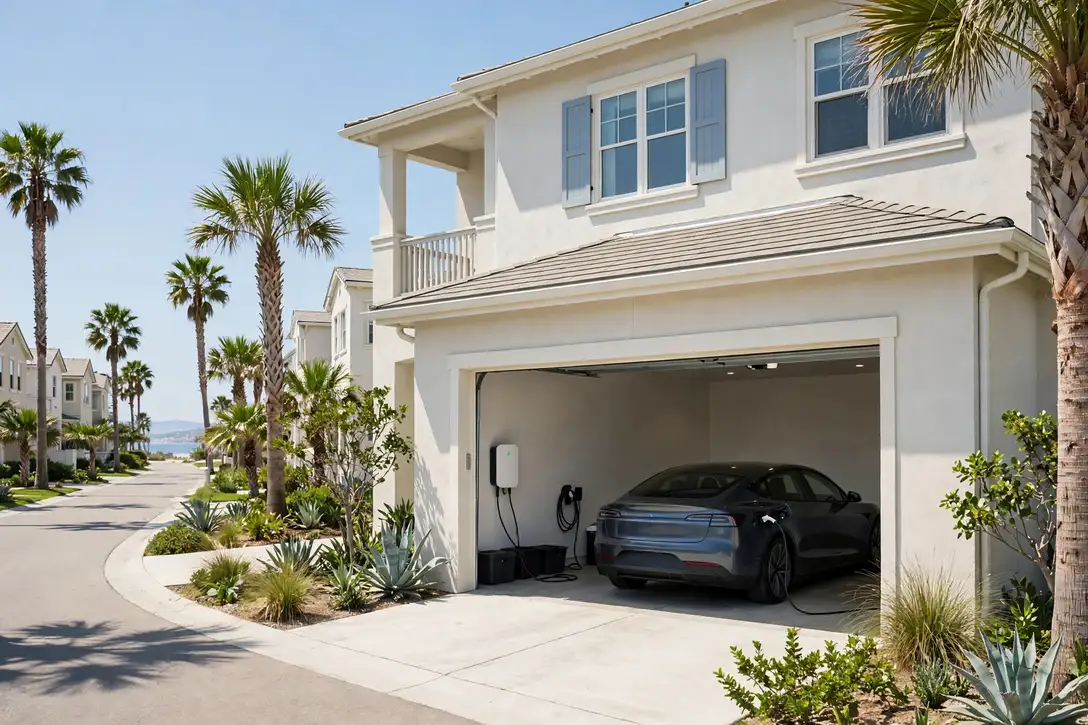
EV charging services in Warner Robins
The services below are ordered by what Warner Robins households most often need first, judged from the housing and fleet facts on this page. The full menu follows in the grid — every service is offered in this metro.
Home EV Charger Installation in Warner Robins
Think of it as plumbing for electrons, with the same virtues: correct sizing, honest materials, tidy runs, tested joints. The installers who do it weekly follow a pattern — assess, calculate, route, mount, configure, document — and the pattern is why their installs rarely make news afterwards.
In Warner Robins: usually the first job a new EV household in Warner Robins books, scoped to the panel the house already has.
Level 2 Charger Installation in Warner Robins
Level 2 is where home charging becomes effortless: a dedicated 240-volt circuit returning a full battery overnight instead of a partial one by morning. The installer's work is the circuit itself — breaker, conductor, connection type — and the station's settings matched to it.
In Warner Robins: 240 volts, sized honestly — the working definition of home charging in Warner Robins.
Load Management & Smart Charging Setup in Warner Robins
The device watches, the charger adapts, the house notices nothing. For homes whose arithmetic fails by a little — the common case — management converts an upgrade conversation into an equipment line, and the panel stays closed.
In Warner Robins: the managed-charger route around Warner Robins's capacity limits.
Utility programs and electricity in Warner Robins
Electricity in Warner Robins comes from Georgia Power Co. Parts of the wider metro are served by Flint Electric Membership Corp, Middle Georgia El Member Corp. The utility matters twice over for a charger install: it sets the time-of-use rates that decide what overnight charging costs you, and it is the organisation that may — or may not — currently help pay for the equipment.
Current program (verified 2026-10-25): Georgia Power Co runs the Georgia Power EV Charger Rebate (residential) — Up to $150 toward a qualifying Level 2 home charger installation (installations Jan 1 - Dec 31, 2026). Program terms and funding status are published by the utility; check the current status before you plan around it, because funded programs close when their budgets run out. Source: Georgia Power's published program terms, cross-checked against a national incentive listing in October 2026.
For businesses and multifamily properties in the metro, the same utility has also published: $250/kW Level 2 and $150/kW DC fast charging for business/multifamily, up to $30,000 per project / $60,000 per year.
Before the install, it is worth a two-minute look at your tariff. Many Georgia Power Co customers can move to a time-of-use plan where overnight energy is charged at a lower rate, and a scheduled charger makes that saving automatic.
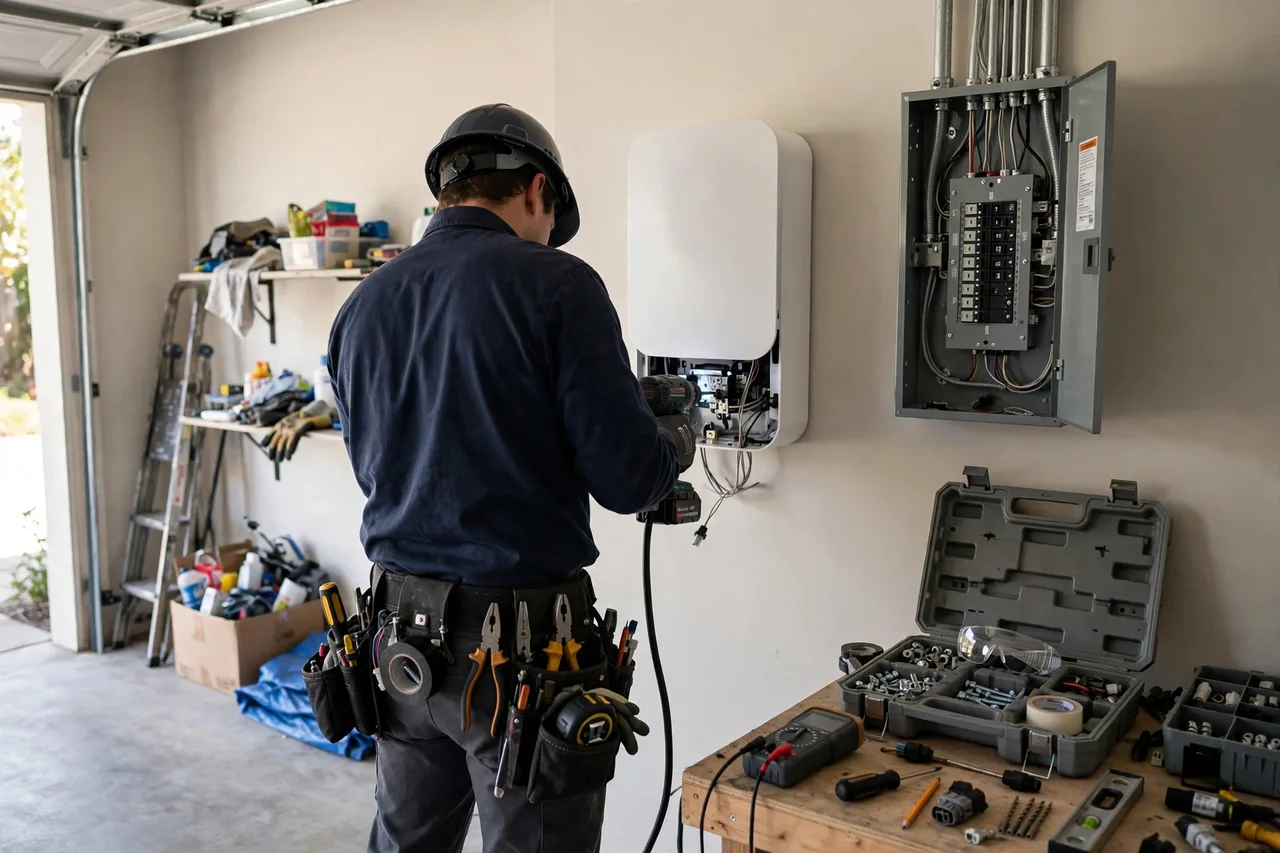
Condos, HOAs and the law in Georgia
There is no Georgia right-to-charge statute to lean on. Some national roundups list protection that does not exist in this state's code; the statute indexes checked for this page are clear. In Warner Robins, a condo or HOA charger is approved — or not — under the community's own documents, which makes the quality of your application the whole ballgame.
Timing helps too. Boards plan capital work annually; an application that arrives with the community's budget cycle, offering to coordinate with any planned electrical or repaving work, reads as a contribution rather than a demand.
The negotiation playbook — application contents, metering options, the wording that answers boards' standard objections — is set out in our condo and HOA guide, read here as a persuasion manual rather than a rights manual.
Climate, garages and charger placement
In this climate the overnight window does double duty — rates are kinder and so are temperatures. Scheduling the charge for the small hours lets the car and the station work in the coolest air the day offers, which is easier on both. An installer who raises scheduling unprompted during the site visit is telling you they install in this heat regularly.
Thermal habits separate durable installs from tired ones in this region: connectors holstered out of the sun, enclosures with room to breathe, and charge sessions pushed past midnight when the air gives the equipment its easiest working conditions of the day.

Permits and inspection in Warner Robins
Timelines are set by the city's counter, not the installer: the electrical work itself is typically a day, while permit issuance and the inspection visit follow the department's queue. A quote that promises a date should tell you which parts of that date the installer actually controls.

Neighbourhoods and ZIP codes served
The page covers 5 ZIP codes in and around Warner Robins — including 31088, 31093, 31095, 31098, 31099 — across Houston. If your ZIP is not in the first set shown, ask anyway: installer coverage follows the metro, not a postcode fence.
The same working area takes in the neighbouring localities of Centerville, Bonaire, Kathleen, Perry, Clinchfield, Elko — the county ring an installer based in Warner Robins actually drives. Requests from those communities route exactly as city requests do: same services, same permit discipline, same local facts where they differ.
Houston County accounts for 11 of the ZIP codes and 7 named postal localities in the research file, the nearest of them Centerville, Bonaire, Kathleen, Perry, Clinchfield. The survey counts 169,649 residents in the county, with a median household income of $80,698 and a median home value of $219,800. Measured across its ZIP codes, the Warner Robins footprint runs about 11 miles north to south and 6 east to west, from ZIP 31088 to 31099 — the ground an installer based here actually covers in a working week.
Beyond the county seats, the working area takes in Centerville, Bonaire, Macon, Byron, Kathleen, Perry, Fort Valley, Clinchfield, Elko, Marshallville, Knoxville, Danville, Cochran, Hawkinsville, Allentown, Unadilla, Roberta, Reynolds, Montrose, Pinehurst, Montezuma, Chester, Dudley, Byromville, Oglethorpe, Butler, Lilly, Ideal, Dexter, Pineview, Vienna, Eastman, Rupert, Cadwell, Dublin, Rentz, East Dublin — the named localities for which Warner Robins is the nearest metro in the network (neighbouring metros' pages cover their own ground), each routing to the same installer-matching service.
The wider working area also reaches Dry Branch, Lizella, Jeffersonville, Bolingbroke, Musella, Gordon, Gray, Irwinton, Mc Intyre, Smarr, Culloden, Haddock, Toomsboro, Forsyth, Yatesville, Hardwick, Juliette, Hillsboro, Milledgeville, Howard, Andersonville, Barnesville, The Rock, Oconee, Mauk, Thomaston, Seville, Ellaville, Cordele — ground shared with neighbouring metros, where installers cross the same county lines in both directions.
ZIP codes in that shared ground include 30204, 30286, 31004, 31015, 31016, 31020, 31031, 31032, 31033, 31034, 31038, 31039, 31042, 31044, 31046, 31052, 31054, 31058, 31059, 31066, 31067, 31084, 31086, 31090, 31201, 31202, 31203, 31204, 31205, 31207, 31208, 31209, 31211, 31213, 31216, 31220, 31294, 31296, 31711, 31806.
The largest communities in that working area after Warner Robins itself, by the GeoNames populated-place file: Dublin (population 16,197), Perry (population 15,457), Vidalia (population 10,679), Fort Valley (population 8,597), Centerville (population 7,575), McRae (population 5,740), Hawkinsville (population 5,471), Eastman (population 5,285), Byron (population 5,105), Cochran (population 4,363), Hazlehurst (population 4,196), Vienna (population 3,777), Unadilla (population 3,666), Alamo (population 3,330), Montezuma (population 3,189), Soperton (population 3,087), Helena (population 2,883), Abbeville (population 2,815), East Dublin (population 2,392), Mount Vernon (population 2,276). Charging demand follows those populations — the subdivisions and town centres where the next driveways, and the next panels, are.
Laurens County reaches into the working area with 49,798 residents, a median household income of $55,010 and a median home value of $154,500; its localities on this page include Montrose, Dudley, Dexter, Cadwell, Dublin. Dooly County reaches into the working area with 10,984 residents, a median household income of $60,987 and a median home value of $107,400; its localities on this page include Unadilla, Pinehurst, Montezuma, Byromville, Lilly. Macon County reaches into the working area with 11,864 residents, a median household income of $41,031 and a median home value of $97,300; its localities on this page include Marshallville, Oglethorpe, Ideal. Taylor County reaches into the working area with 7,786 residents, a median household income of $41,788 and a median home value of $87,700; its localities on this page include Reynolds, Butler, Rupert. Peach County reaches into the working area with 28,560 residents, a median household income of $71,293 and a median home value of $207,800; its localities on this page include Byron, Fort Valley.
| ZIP | Locality | County |
|---|---|---|
| 31088 | Warner Robins | Houston |
| 31093 | Warner Robins | Houston |
| 31028 | Centerville | Houston |
| 31099 | Warner Robins | Houston |
| 31005 | Bonaire | Houston |
| 31098 | Warner Robins | Houston |
| 31297 | Macon | Bibb |
| 31095 | Warner Robins | Houston |
| 31008 | Byron | Peach |
| 31047 | Kathleen | Houston |
| 31069 | Perry | Houston |
| 31030 | Fort Valley | Peach |
| 31013 | Clinchfield | Houston |
| 31025 | Elko | Houston |
| 31057 | Marshallville | Macon |
| 31050 | Knoxville | Crawford |
| 31017 | Danville | Twiggs |
| 31014 | Cochran | Bleckley |
| 31036 | Hawkinsville | Pulaski |
| 31003 | Allentown | Wilkinson |
| 31091 | Unadilla | Dooly |
| 31078 | Roberta | Crawford |
| 31076 | Reynolds | Taylor |
| 31065 | Montrose | Laurens |
| 31070 | Pinehurst | Dooly |
| 31063 | Montezuma | Dooly |
| 31012 | Chester | Dodge |
| 31022 | Dudley | Laurens |
| 31007 | Byromville | Dooly |
| 31068 | Oglethorpe | Macon |
| 31006 | Butler | Taylor |
| 31051 | Lilly | Dooly |
| 31041 | Ideal | Macon |
| 31019 | Dexter | Laurens |
| 31071 | Pineview | Wilcox |
| 31092 | Vienna | Dooly |
| 31023 | Eastman | Dodge |
| 31081 | Rupert | Taylor |
| 31009 | Cadwell | Laurens |
| 31021 | Dublin | Laurens |
| 31075 | Rentz | Laurens |
| 31040 | Dublin | Laurens |
| 31027 | East Dublin | Laurens |

Planning the install: from panel to parking
Consider the two households inside every Warner Robins install. The first owns the panel, the parking and the decision; the second — a partner, a teenager with the next car, a future buyer — inherits all three. Designing for the second household is the difference between an install and an asset: capacity reserved, conduit honest, paperwork filed. The first conversation with an installer should name both households explicitly.
Finally, photograph the finished work — station, nameplate, panel directory with the new breaker labelled — and file it with the inspection record. When the car changes, the house sells or a second station joins the first, that folder is the difference between a five-minute answer and an archaeological dig.
Home charging know-how for Warner Robins households
Getting onto the board's agenda
Association decisions happen inside a procedure, and the procedure has a door: the agenda. Applications that miss the submission deadline wait a full cycle regardless of merit, so the first question for any board is clerical — when do items close for the next meeting, and in what format. Arrive inside the procedure with a complete package and the discussion is about your design; arrive outside it and the discussion is about process, and process always wins the evening. Property managers, asked politely, will tell you the format they prefer applications in.
The labelled breaker
Panel directories are autobiographies written in pencil, and a charger install adds a chapter. The new breaker gets labelled — circuit, station, date — in the directory and, in thorough households, on the panel schedule taped inside the door. It reads as pedantry until the night something trips at 11 pm and the labelled directory turns a flashlight search into a ten-second answer. It also serves the future: the next electrician, the inspector, the buyer, each reads the panel's story faster when the latest chapter is legible.
The charger among workshop loads
Garages that double as workshops put the charger in interesting company: welders, compressors, dust collectors — loads with appetites and opinions. The load calculation for such a house reads the whole tenancy, and the honest conversation includes which loads genuinely coincide. A station scheduled into the workshop's quiet hours lives peacefully; one competing with the table saw's startup surge teaches the household about breaker curves the experiential way.
Two-storey houses and the vertical run
In a two-storey house the panel often lives in a utility room, a laundry or a ground-floor wall far from the garage, and the circuit's path becomes a vertical problem: chases, soffits and floor cavities are the route's vocabulary. Experienced installers read a house's structure the way a plumber does — where the stacked walls are, which cavities run uninterrupted — and the quote follows that reading. Expect the site visit to include a look upstairs; the ceiling above the garage is part of the job.

Frequently asked questions
Does Georgia Power Co help pay for a home charger in Warner Robins, GA?
Yes — Georgia Power Co's Georgia Power EV Charger Rebate (residential) currently offers Up to $150 toward a qualifying Level 2 home charger installation (installations Jan 1 - Dec 31, 2026) (program details verified 2026-10-25; funded programs can close, so confirm current status when you book). The old federal 30C charger credit ended on September 30, 2025, and is not part of any current offer.
Can my HOA or condo board in Warner Robins, GA refuse my charger?
Legally, yes — and it is better to know that before you buy the car. Georgia has enacted no right-to-charge law, so an association in Warner Robins may refuse, condition or delay a charger under its covenants. The counterweight is a complete, documented application and, if refused, a written refusal citing the covenant — the record a future board or a future statute works from.
Will my Warner Robins, GA home need a panel upgrade for a Level 2 charger?
The question has a correct instrument: the load calculation. It totals what your service already carries — with the code's demand factors, not nameplate panic — and sets the charger's continuous load against the remainder. In Warner Robins, where the median home dates to 1993 and about 32% of units predate 1980, the answer splits by street: post-war and newer 200-amp homes usually proceed; older 100-amp homes choose between capacity work and load management. Anyone answering without the calculation is guessing in a uniform.
Level 1 or Level 2 in Warner Robins, GA — what is the real difference?
In parked hours: a Level 1 cord returns about 3–5 miles for each of them, and a Level 2 circuit returns roughly 25–40, set by its amperage and the car's acceptance. For a Warner Robins household parking ten hours, that is the difference between recovering a short errand day and recovering any day the car can legally drive.
What happens after I request an installer through this page?
Your request — service, Warner Robins ZIP, property type and timing — goes to licensed local installers who cover Warner Robins. They contact you directly to arrange a site visit and quote. PlugReady USA is the matching service, not the installer, and the sections above exist so you can judge any quote against the local facts.
Can a charger be added to a detached garage in Warner Robins?
Yes — the charger itself is the same; the route to it is the project. From the house panel, a buried conduit run reaches the garage, or a subpanel goes in out there where distance and future loads argue for it. In Warner Robins, with about 68% of homes detached, local installers quote this shape routinely — the trench and the run, settled from a site walk, are the substance of it.
Nearby cities in Georgia
- EV charger installation in Macon — about 15 miles from Warner Robins, metro population 235,000
- EV charger installation in Columbus — about 74 miles from Warner Robins, metro population 335,000
- EV charger installation in Albany — about 76 miles from Warner Robins, metro population 145,000
- EV charger installation in Athens — about 97 miles from Warner Robins, metro population 215,000
- EV charger installation in Atlanta — about 98 miles from Warner Robins, metro population 6,100,000
- EV charger installation in Augusta — about 110 miles from Warner Robins, metro population 625,000
- EV charger installation in Auburn, AL — about 101 miles from Warner Robins, metro population 185,000
- EV charger installation in Dothan, AL — about 138 miles from Warner Robins, metro population 155,000
- EV charger installation in Anniston, AL — about 142 miles from Warner Robins, metro population 115,000
Ready to charge at home in Warner Robins?
Send the essentials — what you need, where, and what kind of property — and a licensed local installer will pick it up from there.