EV Charger Installation in Macon, GA
Everything a Macon homeowner needs before booking a charger install — the panel question, the utility's current programs, the HOA law and the permit — sourced, dated and local.
The overnight plug is the least glamorous and most consequential part of owning an electric car, and Macon households have been adopting it at pace: 161,200 battery-electric vehicles and 32,900 plug-in hybrids were registered across Georgia by the end of 2025. Macon itself is home to about 156,578 people. What follows is the local field guide — utility programs as they actually stand, the association law as it actually reads, the permit as it is actually filed, and the housing numbers that predict your install before anyone opens the panel.
The sections that follow are deliberately unglamorous: statutes, survey data, permit counters, tariff habits. That is what a good install is made of. The car is the exciting part; this page is about the wall it plugs into.
Measured demand, not enthusiasm, put Macon in Tier C of this network: Central GA. For a homeowner the useful translation is simpler — installers here do this work weekly, know the local permit counter, and have seen your housing stock before.
Survey context for Macon, in the three lines installers actually use: median household income $51,234; owner-occupation at 51%; single-unit detached homes at 64%. Income tracks adoption pace, tenure decides whose signature a job needs, and structure decides whether the answer is a garage circuit or a building negotiation.

Every city charges differently, and Macon's difference is legible in the data: an older housing fabric, where panel archaeology is a normal part of the first visit; a detached-house majority with a real attached and multifamily minority; buildings of five or more units hold a substantial share of homes, which keeps the multifamily sections of this page in daily use; owners hold a working majority, with renters a significant minority. Read the sections below through that profile and the local advice resolves into specifics — which questions are routine here, and which are rare.
The counts behind the percentages, for the record: Macon has 71,962 housing units on the survey's count, 59,921 of them occupied, and 30,802 owner-occupied households making their own electrical decisions. Detached houses number 46,156; homes built before 1980 number 39,584; units in buildings of five or more number 14,462. An installer's week in this city is a walk through exactly that distribution. The page's geography is equally concrete: 20 ZIP codes across Bibb, centred near 32.81 degrees north latitude. The city anchors the Macon–Bibb County metropolitan area, home to roughly 235,000 people on the research file's metro estimate — the wider labour and housing market this page's installers work across.
The same survey release fills in the household economics around the housing stock: a median home value of $207,100, median gross rent of $1,132, per-capita income of $31,186, and a median resident age of 37. And the daily rhythms behind the housing numbers: 72% of Macon workers drive to work alone — the commute pattern home charging is built around; 8% work from home, a population whose cars charge on daytime and overnight schedules alike; 1% commute by public transit; 27% of adults hold a bachelor's degree or higher. And the fleet in the driveways: 24,142 households in Macon have exactly one vehicle, 29,245 have two or more, and 6,999 have none.
Two burden statistics frame the economics: in Macon, 50% of renters and 0% of mortgage-holding owners are housing-cost burdened at the standard 30% threshold. And 60% of households are family households, the segment most likely to run the two-vehicle, two-schedule pattern the second-vehicle planning notes address.
What follows is the city read as an electrical place rather than a dot on a map. The oldest housing throws the longest shadows over an install: knob-and-tube remnants in the attic, ungrounded receptacles, services sized for iceboxes and radios that now feed induction ranges and heat pumps. The housing variety shows up in the permit data as variety: single-family circuits in volume, building projects in ones and twos, each teaching the local workforce a different half of the trade.
High renter share also means charging follows the lease cycle: applications cluster at move-in, installations at renewal leverage, and the whole market breathes on the rental calendar. At this income band the phantom-rebate problem bites hardest, which is why this page states the verified incentive position in plain terms and dates it. A large utility's scale cuts both ways — programme budgets that dwarf a small co-op's, and call-centre distance between a household and anyone who can decide anything. The published page rules; keep it bookmarked.
Households here are rarely the first on their street; the local knowledge pool — which installer, which tariff, which board precedent — is deep and shared freely. At this scale the page's role sharpens — in a market without a crowd of specialists to interview, the household's own preparation carries more of the project's quality. The association dimension here runs on persuasion rather than statute — no state charging law frames the application, so the complete, professional proposal carries the whole argument, as the law section above explains.
The electrical reality in Macon homes
Four numbers organise everything an installer expects in Macon: median build year 1977; 55% of units built before 1980; 64% of the stock detached; 51% of occupied homes owner-occupied. Capacity, circuit routes and approval layers all correlate with those four. The paragraphs below are their commentary. Age shows up electrically before it shows up anywhere else: services sized for a house with a third of today's appliances. Expect the first conversation to be about capacity — what the panel is, what it already feeds, and which of the three routes (circuit, management, upgrade) your numbers support. Housing age also tracks wire-run reality: older homes more often place the panel in a basement or interior wall far from the garage, and distance is copper, conduit and labour.
One further survey line belongs in any Macon install conversation: 65% of the city's homes heat with electricity — 38,863 households whose panels already carry a major winter load before a charger is contemplated. Electric heat and EV charging are the two largest discretionary loads a house can host, and where they coincide, the load calculation stops being a formality.
Renters are the other constituency in these numbers: about 29,119 of Macon's occupied homes are rented rather than owned. Their charging route runs through a landlord conversation instead of a panel they control — a different project, covered by the rentals guide and the law section below, but a routine one in a city with this many renting households.
And 20% of Macon's homes are in buildings with five or more units — apartments and condominiums where charging is a building decision before it is an electrical one. If that is your situation, the law and multifamily sections of this page are the ones written for you.
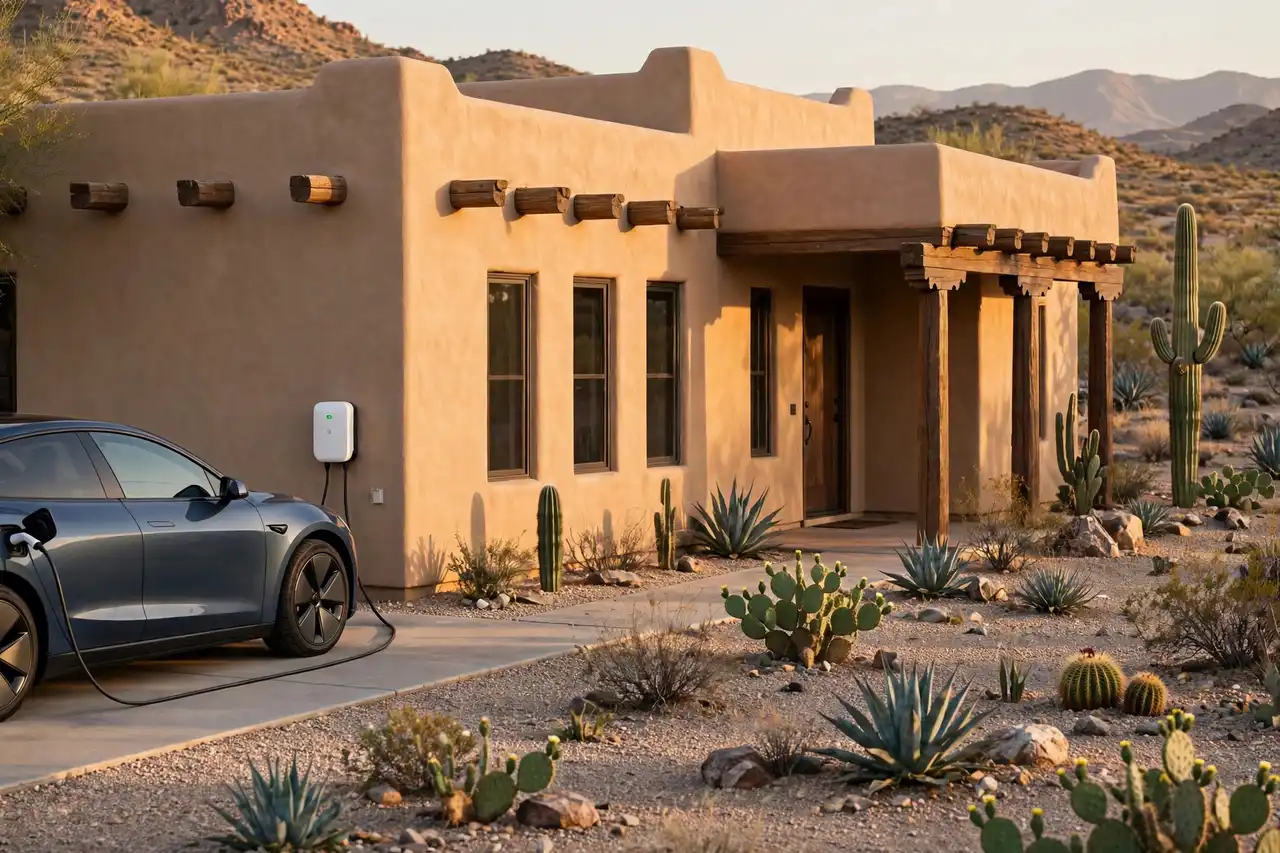
EV charging services in Macon
The services below are ordered by what Macon households most often need first, judged from the housing and fleet facts on this page. The full menu follows in the grid — every service is offered in this metro.
Home EV Charger Installation in Macon
Start to finish, the domestic install is a half-day of electrical work wrapped in a week of scheduling: the survey, the circuit, the mounting, the configuration, the inspection. What the household experiences is simpler — a car that is full every morning and a cable that lives where the car does.
In Macon: the install Macon's new EV households book first, and the one the rest of this page keeps returning to.
Dedicated Circuit & Electrical Panel Upgrade in Macon
A service change is the least reversible and most enabling job on this page: it re-bases the whole house's electrical life. Done inside the charger project, it shares the permit, the utility visit and the electrician's day with the circuit it makes room for.
In Macon: the job that surfaces wherever housing is older — and Macon's stock makes it a routine conversation, settled by a load calculation.
Level 2 Charger Installation in Macon
The step up from a household outlet to a real circuit: 240 volts, sized as a continuous load, delivering several times the overnight range of a Level 1 cord. The craft is in matching circuit, station configuration and vehicle acceptance so the three agree.
In Macon: the 240-volt step that turns overnight charging in Macon from a trickle into a full battery by morning.
Utility programs and electricity in Macon
Electricity in Macon comes from Georgia Power Co. Parts of the wider metro are served by Flint Electric Membership Corp, Central Georgia El Member Corp, Tri-County Elec Member Corp (GA). The utility matters twice over for a charger install: it sets the time-of-use rates that decide what overnight charging costs you, and it is the organisation that may — or may not — currently help pay for the equipment.
Current program (verified 2026-10-25): Georgia Power Co runs the Georgia Power EV Charger Rebate (residential) — Up to $150 toward a qualifying Level 2 home charger installation (installations Jan 1 - Dec 31, 2026). Program terms and funding status are published by the utility; check the current status before you plan around it, because funded programs close when their budgets run out. Source: Georgia Power's published program terms, cross-checked against a national incentive listing in October 2026.
For businesses and multifamily properties in the metro, the same utility has also published: $250/kW Level 2 and $150/kW DC fast charging for business/multifamily, up to $30,000 per project / $60,000 per year.
Net-metering households — rooftop solar is common across the metro — should tell the installer: charging schedules and load management are planned differently when the house generates as well as consumes.
Condos, HOAs and the law in Georgia
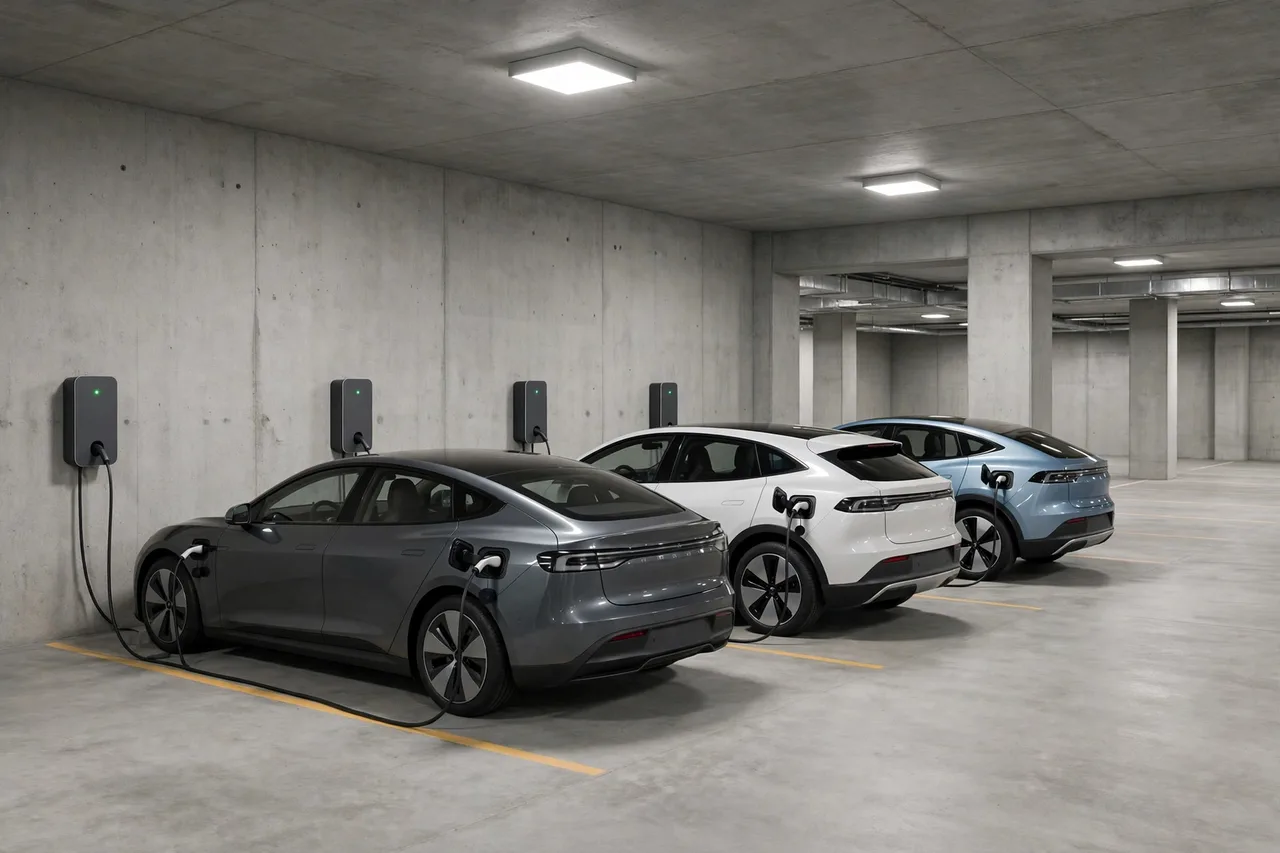
There is no Georgia right-to-charge statute to lean on. Some national roundups list protection that does not exist in this state's code; the statute indexes checked for this page are clear. In Macon, a condo or HOA charger is approved — or not — under the community's own documents, which makes the quality of your application the whole ballgame.
Timing helps too. Boards plan capital work annually; an application that arrives with the community's budget cycle, offering to coordinate with any planned electrical or repaving work, reads as a contribution rather than a demand.
The negotiation playbook — application contents, metering options, the wording that answers boards' standard objections — is set out in our condo and HOA guide, read here as a persuasion manual rather than a rights manual.
Climate, garages and charger placement
Parking orientation is a thermal decision in this metro: a car that bakes in western sun all afternoon starts its session hot, and both the car and the station manage heat before they manage charging. The overnight schedule is partly a shade strategy executed by clock.
Shade is a specification here, not a nicety. Outdoor stations belong under eaves or on the wall that escapes the afternoon sun; connectors left baking in a holder weather faster, and cables stiffen and crack on a shorter clock. The site walk should include a look at where the sun actually lands at four in the afternoon — that is the hour the equipment has to survive.

Permits and inspection in Macon
The permit trail also protects the next transaction: a charger circuit on the inspection record is an asset a buyer's inspector reads in one line, while an undocumented circuit is a question that follows the sale. Installers who work this metro treat the filing as part of the deliverable, not an errand.

Neighbourhoods and ZIP codes served
The page covers 20 ZIP codes in and around Macon — including 31201, 31202, 31203, 31204, 31205, 31206, 31207, 31208, 31209, 31210, 31211, 31213, 31216, 31217, 31220, 31221, 31294, 31295, 31296, 31297 — across Bibb. If your ZIP is not in the first set shown, ask anyway: installer coverage follows the metro, not a postcode fence.
Bibb County accounts for 21 of the ZIP codes and 2 named postal localities in the research file, the nearest of them Lizella. The survey counts 156,578 residents in the county, with a median household income of $51,234 and a median home value of $174,500. Measured across its ZIP codes, the Macon footprint runs about 13 miles north to south and 14 east to west, from ZIP 31201 to 31297 — the ground an installer based here actually covers in a working week.
Beyond the county seats, the working area takes in Dry Branch, Lizella, Jeffersonville, Bolingbroke, Gray, Gordon, Smarr, Haddock, Mc Intyre, Hillsboro, Musella, Juliette, Forsyth, Irwinton, Hardwick, Culloden, Milledgeville, Toomsboro, Yatesville, Barnesville, Flovilla, Monticello, The Rock, Oconee, Eatonton, Jackson, Milner, Thomaston, Meansville, Jenkinsburg, Sparta, Zebulon, Tennille, Mansfield, Sandersville — the named localities for which Macon is the nearest metro in the network (neighbouring metros' pages cover their own ground), each routing to the same installer-matching service.
The wider working area also reaches Warner Robins, Centerville, Byron, Bonaire, Knoxville, Fort Valley, Kathleen, Roberta, Perry, Danville, Allentown, Montrose, Marshallville, Reynolds, Cochran, Clinchfield, Elko, Dudley, Hawkinsville, Chester, Butler, Unadilla, Dexter, Montezuma, Pinehurst, Dublin, Shady Dale, Ideal, Oglethorpe, Rupert, Howard, East Dublin — ground shared with neighbouring metros, where installers cross the same county lines in both directions.
ZIP codes in that shared ground include 31003, 31005, 31006, 31008, 31012, 31013, 31014, 31017, 31019, 31021, 31022, 31025, 31027, 31028, 31030, 31036, 31039, 31040, 31041, 31047, 31050, 31057, 31063, 31065, 31068, 31069, 31070, 31076, 31078, 31081, 31085, 31088, 31091, 31093, 31095, 31098, 31099, 31297.
The largest communities in that working area after Macon itself, by the GeoNames populated-place file: Milledgeville (population 18,931), Thomaston (population 9,032), Barnesville (population 6,625), Eatonton (population 6,520), Sandersville (population 5,752), Jackson (population 4,983), Forsyth (population 4,013), Hardwick (population 3,930), Wrightsville (population 3,642), Hannahs Mill (population 3,298), Gray (population 3,269), West Point (population 3,238), Monticello (population 2,615), Indian Springs (population 2,413), Gordon (population 1,956), Tennille (population 1,773), Sparta (population 1,293), Zebulon (population 1,153), Jeffersonville (population 1,050), Ivey (population 926). Charging demand follows those populations — the subdivisions and town centres where the next driveways, and the next panels, are.
Monroe County reaches into the working area with 29,664 residents, a median household income of $83,183 and a median home value of $271,200; its localities on this page include Bolingbroke, Smarr, Juliette, Forsyth, Culloden. Wilkinson County reaches into the working area with 8,747 residents, a median household income of $45,465 and a median home value of $86,300; its localities on this page include Gordon, Mc Intyre, Irwinton, Toomsboro. Baldwin County reaches into the working area with 43,642 residents, a median household income of $54,403 and a median home value of $181,900; its localities on this page include Hardwick, Milledgeville. Jasper County reaches into the working area with 15,929 residents, a median household income of $60,134 and a median home value of $243,400; its localities on this page include Hillsboro, Monticello, Mansfield. Upson County reaches into the working area with 28,029 residents, a median household income of $55,429 and a median home value of $168,700; its localities on this page include Yatesville, The Rock, Thomaston.
| ZIP | Locality | County |
|---|---|---|
| 31201 | Macon | Bibb |
| 31207 | Macon | Bibb |
| 31202 | Macon | Bibb |
| 31221 | Macon | Bibb |
| 31294 | Macon | Bibb |
| 31213 | Macon | Bibb |
| 31295 | Macon | Bibb |
| 31217 | Macon | Bibb |
| 31206 | Macon | Bibb |
| 31204 | Macon | Bibb |
| 31203 | Macon | Bibb |
| 31205 | Macon | Bibb |
| 31208 | Macon | Bibb |
| 31209 | Macon | Bibb |
| 31296 | Macon | Bibb |
| 31211 | Macon | Bibb |
| 31216 | Macon | Bibb |
| 31210 | Macon | Bibb |
| 31220 | Macon | Bibb |
| 31020 | Dry Branch | Twiggs |
| 31052 | Lizella | Bibb |
| 31044 | Jeffersonville | Twiggs |
| 31004 | Bolingbroke | Monroe |
| 31032 | Gray | Jones |
| 31031 | Gordon | Wilkinson |
| 31086 | Smarr | Monroe |
| 31033 | Haddock | Jones |
| 31054 | Mc Intyre | Wilkinson |
| 31038 | Hillsboro | Jasper |
| 31066 | Musella | Crawford |
| 31046 | Juliette | Monroe |
| 31029 | Forsyth | Monroe |
| 31042 | Irwinton | Wilkinson |
| 31034 | Hardwick | Baldwin |
| 31016 | Culloden | Monroe |
| 31062 | Milledgeville | Baldwin |
| 31061 | Milledgeville | Baldwin |
| 31059 | Milledgeville | Baldwin |
| 31090 | Toomsboro | Wilkinson |
| 31097 | Yatesville | Upson |
| 30204 | Barnesville | Lamar |
| 30216 | Flovilla | Butts |
| 31064 | Monticello | Jasper |
| 30285 | The Rock | Upson |
| 31067 | Oconee | Washington |
| 31024 | Eatonton | Putnam |
| 30233 | Jackson | Butts |
| 31026 | Eatonton | Putnam |
| 30257 | Milner | Lamar |
| 30286 | Thomaston | Upson |
| 30256 | Meansville | Pike |
| 30234 | Jenkinsburg | Butts |
| 31087 | Sparta | Hancock |
| 30295 | Zebulon | Pike |
| 31089 | Tennille | Washington |
| 30055 | Mansfield | Jasper |
| 31082 | Sandersville | Washington |

Planning the install: from panel to parking
Think of the project as a chain with four links: capacity, route, placement, paperwork. Capacity is the load calculation. Route is the path copper takes from panel to parking — through a shared wall if you are lucky, across a ceiling or a trench if you are not. Placement is the unglamorous decision that governs daily life with the car for a decade: reach, cable slack, and which side the port is on. Paperwork is the permit and the passed inspection, the proof that outlives the installer's visit.
Finally, photograph the finished work — station, nameplate, panel directory with the new breaker labelled — and file it with the inspection record. When the car changes, the house sells or a second station joins the first, that folder is the difference between a five-minute answer and an archaeological dig.
Home charging know-how for Macon households
Retrofitting the older apartment building
Older multifamily buildings meet charging with a capacity question before any other: the service was sized for another era's loads. The professional answer is a load study — what the building actually draws across its day — followed by a managed design that fits charging into the valleys, with make-ready capacity for the applicants who have not yet appeared. It is slower than a house install and more deliberate, and it is the reason experienced multifamily installers start with the building's electrical room rather than its car park.
Chargers and the flood line
Some garages flood — not catastrophically, just historically: the spring inch, the storm drain's bad day. The charger belongs above the line the water has actually reached, a fact the house knows and the install conversation should ask about. Mounting height, conduit entry points and the station's own listing all have flood-aware versions, and in the streets that need them, local installers raise the subject before the homeowner does.
The landlord's side of the charger
For a landlord, a charger circuit is an amenity with unusual arithmetic: it is visible in listings, filterable in searches, and durable across tenancies in a way paint is not. The questions that decide it are practical rather than visionary — whose meter the circuit hangs from, how the cost is recovered, what the end-of-tenancy position is — and each has a standard answer the multifamily sections of this site describe. Landlords who run the numbers tenant by tenant usually conclude the circuit earns its wall space.
Charging for guests
A home charger quietly becomes hospitality infrastructure: the visiting family's EV, the friend's road-trip top-up, the neighbour mid-renovation. Households handle it with varying ceremony — a standing offer, a holster left accessible, a note in the guest room. The electrical system does not care; the point is social. The charger joins the spare bed and the good coffee in the category of things a house offers the people it likes.

Frequently asked questions
Is there a rebate for installing a home EV charger in Macon, GA?
Yes — Georgia Power Co's Georgia Power EV Charger Rebate (residential) currently offers Up to $150 toward a qualifying Level 2 home charger installation (installations Jan 1 - Dec 31, 2026) (program details verified 2026-10-25; funded programs can close, so confirm current status when you book). The old federal 30C charger credit ended on September 30, 2025, and is not part of any current offer.
Can my HOA or condo board in Macon, GA refuse my charger?
Possibly, yes. Georgia has no statewide right-to-charge law in the authoritative indexes checked for this page, so your community's covenants govern. A complete written application — licensed installer, dedicated circuit, owner-paid metering and insurance — is the approach that gets approvals here.
Will my Macon, GA home need a panel upgrade for a Level 2 charger?
It hinges on two numbers you cannot read off the panel door: the service's rating, and what the load calculation says it already carries. The vintage of Macon's stock — median build year 1977, about 55% of homes from before 1980 — means both answers are common here. The charger enters the arithmetic at 125% of its draw; whatever room survives that entry decides between a circuit, a management device, and an upgrade.
Level 1 or Level 2 in Macon, GA — what is the real difference?
A Level 1 cord on a household outlet adds roughly 3–5 miles of range per hour; a Level 2 station on a 240-volt circuit typically adds about 25–40 miles per hour depending on the circuit's amperage and the vehicle. For most drivers that is the difference between rationing the battery and never thinking about it.
What happens next after I send a request?
Your request is matched to licensed installers covering Macon, Georgia — service, ZIP, property type and timing travel with it. The installer who takes it arranges the site visit and quotes in writing; PlugReady USA's part is the research on this page and the introduction, and your contract is with the installer throughout.
I live in a Macon apartment or condo building — can I charge at home?
With about 20% of Macon's housing in buildings of five or more units, building charging is a mainstream question here. It is an approvals project before it is an electrical one — board or landlord, metering, load design — and the sections above walk through both the legal position in Georgia and the application package that works.
Nearby cities in Georgia
- EV charger installation in Warner Robins — about 15 miles from Macon, metro population 190,000
- EV charger installation in Columbus — about 79 miles from Macon, metro population 335,000
- EV charger installation in Athens — about 82 miles from Macon, metro population 215,000
- EV charger installation in Atlanta — about 86 miles from Macon, metro population 6,100,000
- EV charger installation in Albany — about 91 miles from Macon, metro population 145,000
- EV charger installation in Augusta — about 101 miles from Macon, metro population 625,000
- EV charger installation in Auburn, AL — about 104 miles from Macon, metro population 185,000
- EV charger installation in Anniston, AL — about 136 miles from Macon, metro population 115,000
- EV charger installation in Montgomery, AL — about 149 miles from Macon, metro population 375,000
Ready to charge at home in Macon?
Two minutes of form, and the request is in front of licensed installers who cover this city — quotes follow site visits, in writing.