EV Charger Installation in Decatur, AL
Home Level 2 charging, panel upgrades and condo installs in Decatur — matched to licensed local installers, with the local facts that shape the job set out below.
The economics of home charging are made in two places: the tariff you charge on, and the circuit you charge through. Both are decided locally, and both are decided before the hardware is chosen. Decatur itself is home to about 57,361 people; Alabama counted 24,400 battery-electric vehicles and 8,300 plug-in hybrids by the end of 2025, and the metro's households are making these two decisions every week. Below: the utility position for Decatur as verified, the state law on association charging, the permit route, and the housing-stock numbers that tell you how much panel conversation to expect at your own address.
A word on how to use the page: each section answers one of the questions an installer will ask you anyway — panel, utility, property rules, permits — with Decatur's actual answers. Read the two that apply to your house and you will start the quoting conversation several steps ahead.
The registration ledger for the Decatur metro reads: Tennessee Valley. Ledgers like this are what installer rounds are built from — they show where the cars already are, which is where the circuits get requested, permitted and inspected week after week.
Three survey lines do most of the predictive work on this page. Income — a median of $61,563 per household — tracks the pace at which Decatur households adopt EVs at all. Tenure — 63% owner-occupied — decides whose signature the work needs. And structure — 70% single-unit detached — decides how often the answer is a simple garage circuit rather than a building negotiation.

Put the survey together and Decatur's charging profile reads like this: an older housing fabric, where panel archaeology is a normal part of the first visit; a detached-house majority with a real attached and multifamily minority; buildings of five or more units are a visible minority of the stock; and owners hold a working majority, with renters a significant minority. That combination — more than any single number — is what the installers working here plan around, and it is the lens for everything on this page.
The counts behind the percentages, for the record: Decatur has 25,467 housing units on the survey's count, 23,722 of them occupied, and 15,009 owner-occupied households making their own electrical decisions. Detached houses number 17,801; homes built before 1980 number 14,132; units in buildings of five or more number 4,397. An installer's week in this city is a walk through exactly that distribution. The page's geography is equally concrete: 5 ZIP codes across Morgan, centred near 34.59 degrees north latitude. The city anchors the Decatur metropolitan area, home to roughly 155,000 people on the research file's metro estimate — the wider labour and housing market this page's installers work across.
The same survey release fills in the household economics around the housing stock: a median home value of $210,200, median gross rent of $896, per-capita income of $34,685, and a median resident age of 40. And the daily rhythms behind the housing numbers: 80% of Decatur workers drive to work alone — the commute pattern home charging is built around; 7% work from home, a population whose cars charge on daytime and overnight schedules alike; 0% commute by public transit; 22% of adults hold a bachelor's degree or higher. And the fleet in the driveways: 8,474 households in Decatur have exactly one vehicle, 13,862 have two or more, and 1,386 have none.
Two burden statistics frame the economics: in Decatur, 42% of renters and 0% of mortgage-holding owners are housing-cost burdened at the standard 30% threshold. And 58% of households are family households, the segment most likely to run the two-vehicle, two-schedule pattern the second-vehicle planning notes address.
This is the context an installer works against, whether it is written down or not. Where so much of the stock predates modern code cycles, the site visit doubles as a survey — grounding electrode, service entrance, panel provenance — before it is ever a quote. Installers here run two trades in one van — domestic circuits in the morning, a building's shared-service design in the afternoon — and the city's pages, this one included, have to serve both readers.
Neither side dominates, so neither side's pattern sets the norm: the local market's standard documents include both the homeowner work order and the tenant proposal, kept in the same drawer. The specification pattern at this income band is disciplined: capacity for today's car and a conduit sized for tomorrow's, the upgrade deferred until the load calculation insists. Filed tariffs and public dockets give this territory a paper trail most markets lack: the diligent household can read the utility's own electrification plan and know which programmes are funded, piloted or merely proposed.
Early-market conditions have their own economics: fewer specialist installers, general electricians carrying the work, and a premium on the household arriving informed — which is the gap this page exists to close. Smaller metros adopt on their own clock: the fleet follows the dealers and the demographics, and each install is a visible event a street notices. Boards here decide without a statutory script, which makes precedent the currency: the first well-built application in a community quietly writes the policy for everyone after it.
The electrical reality in Decatur homes
Read the stock the way a panel schedule reads it. Median build year 1977 means half of Decatur's homes were wired to codes of that era or earlier; 55% predate 1980 entirely. 70% of units are detached houses, and 63% of occupied homes are owned by their occupants — so most charger conversations here happen between a homeowner and an electrician, with no third party at the table. A housing stock this age leans on smaller electrical services — 100-amp panels are common, and fuse-era equipment still turns up in the oldest streets. For many of those homes the honest answer is a panel upgrade or a load-management device before the charger circuit goes in, and a good installer will show you the load calculation rather than asking you to take it on faith. Garages here earn their keep across the year — workshop, storage and storm shelter by turns — so a station position that survives the household's real parking pattern matters more than the technically neatest wall.
One further survey line belongs in any Decatur install conversation: 72% of the city's homes heat with electricity — 17,185 households whose panels already carry a major winter load before a charger is contemplated. Electric heat and EV charging are the two largest discretionary loads a house can host, and where they coincide, the load calculation stops being a formality.
One further split matters for how this page is organised: about 8,713 of Decatur's occupied homes are renter-occupied. Everything above assumes you can approve your own electrical work; where you cannot, the approval layer — landlord or association — becomes part of the job, which is why the law section carries unusual weight here.
And 17% of Decatur's homes are in buildings with five or more units — apartments and condominiums where charging is a building decision before it is an electrical one. If that is your situation, the law and multifamily sections of this page are the ones written for you.
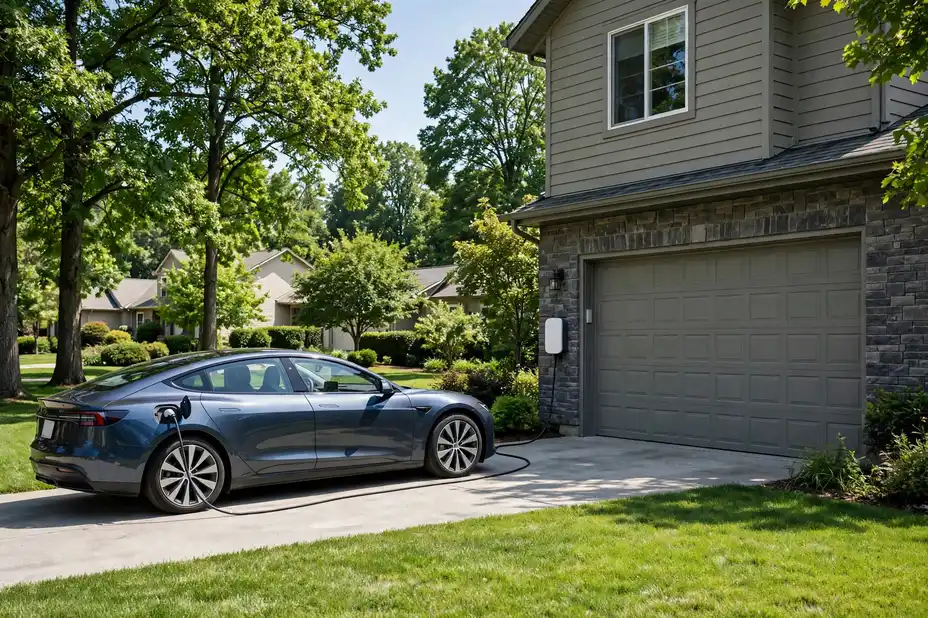
EV charging services in Decatur
An installer's work in Decatur usually starts with one of the three lead services below. The cards describe the job as it is actually scoped; the grid underneath carries the rest of the menu.
Home EV Charger Installation in Decatur
The core service, stated plainly: a dedicated 240-volt circuit run from your panel to your parking place, a station mounted and configured to that circuit, and the paperwork closed out with the permit office. Everything else in this section of the site exists to support or unblock this one job.
In Decatur: the default first install for Decatur's EV households — a station where the car already parks.
Dedicated Circuit & Electrical Panel Upgrade in Decatur
Where the load calculation fails the existing service, the upgrade is not an upsell — it is the finding. Done under permit with the utility's meter work coordinated, it converts the charger project into the house's electrical reset, and every later project inherits the headroom.
In Decatur: the capacity answer when Decatur's older panels meet a continuous load.
Level 2 Charger Installation in Decatur
The step from a household receptacle to a Level 2 circuit is the step from sipping to drinking: the car takes energy at the rate family life actually consumes it. The work is a breaker, a run of appropriately gauged conductor, and a connection made to torque — modest materials, permanent consequences.
In Decatur: 240 volts, sized honestly — the working definition of home charging in Decatur.
Utility programs and electricity in Decatur
Electricity in Decatur comes from Cullman Electric Coop, Inc. Parts of the wider metro are served by Joe Wheeler Elec Member Corp, Decatur Utilities, City of Hartselle. The utility matters twice over for a charger install: it sets the time-of-use rates that decide what overnight charging costs you, and it is the organisation that may — or may not — currently help pay for the equipment.
There is a strategic consequence to the empty incentive shelf in Decatur: the install decision reduces to the work itself and the tariff it runs on. With no rebate distorting the comparison, quotes compete on scope, licensing and the load calculation's honesty — which is the competition homeowners should want. And the overnight rate window, where Cullman Electric Coop, Inc offers one, quietly returns more over the car's life than most one-off rebates ever did.
Before the install, it is worth a two-minute look at your tariff. Many Cullman Electric Coop, Inc customers can move to a time-of-use plan where overnight energy is charged at a lower rate, and a scheduled charger makes that saving automatic.
Condos, HOAs and the law in Alabama
No statute promises a charger approval in Alabama. Unlike the states that have enacted right-to-charge laws, Alabama leaves the question entirely to each community's covenants and board discretion. For Decatur owners that is not the end of the road — it is a sign that the negotiation, the metering design and the written application carry the weight a statute would otherwise carry.
Strategy, then, is the local substitute for statute. In Decatur the applications that succeed tend to share a shape: they arrive before the meeting rather than at it, they answer metering and insurance in the first paragraph, and they offer the board a design it can approve once and reuse for the next owner who asks.
For the full playbook — application contents, metering designs, the questions boards ask — see the condo and HOA charging guide. In Decatur it should be read as a negotiation manual, because negotiation is what the absence of a statute leaves you.
Climate, garages and charger placement
Heat is the local design variable. A garage that bakes all afternoon asks more of a charging station than the nameplate assumes: electronics age faster, and a car that arrives hot from the road charges under the management of its own thermal system. Sensible installs here keep the station out of the direct sun line, favour walls with airflow, and leave the cable where it will not lie across sun-heated concrete all day.
The overnight window in a hot metro is a thermal decision before it is a tariff one. Air that has given up the day's heat asks less of the car's cooling, less of the garage, less of the equipment — the schedule that saves money is the same schedule that is kind to hardware, and both point after midnight.

Permits and inspection in Decatur
What the inspector is checking, in plain terms: conductor size against breaker size, the continuous-load calculation, terminations torqued, protection where the code wants it, and a station whose settings match the circuit it landed on. It is a short visit that validates everything you cannot see.

Neighbourhoods and ZIP codes served
The page covers 5 ZIP codes in and around Decatur — including 35601, 35602, 35603, 35609, 35699 — across Morgan. If your ZIP is not in the first set shown, ask anyway: installer coverage follows the metro, not a postcode fence.
The same working area takes in the neighbouring localities of Trinity, Hartselle, Somerville, Danville, Valhermoso Springs, Falkville, Laceys Spring, Eva — the county ring an installer based in Decatur actually drives. Requests from those communities route exactly as city requests do: same services, same permit discipline, same local facts where they differ.
Morgan County accounts for 13 of the ZIP codes and 9 named postal localities in the research file, the nearest of them Trinity, Hartselle, Somerville, Danville, Valhermoso Springs. The survey counts 124,471 residents in the county, with a median household income of $68,845 and a median home value of $212,000. Measured across its ZIP codes, the Decatur footprint runs about 4 miles north to south and 1 east to west, from ZIP 35601 to 35699 — the ground an installer based here actually covers in a working week.
Beyond the county seats, the working area takes in Trinity, Tanner, Mooresville, Belle Mina, Madison, Hartselle, Hillsboro, Somerville, Athens, Moulton, Danville, Falkville, Courtland, Eva, Vinemont, Elkmont, Lester, Addison, Cullman, Baileyton, Logan, Prospect, Holly Pond, Crane Hill, Houston, Arley, Double Springs, Delmar — the named localities for which Decatur is the nearest metro in the network (neighbouring metros' pages cover their own ground), each routing to the same installer-matching service.
The wider working area also reaches Capshaw, Harvest, Laceys Spring, Rogersville, Normal, Toney, Mount Hope, Anderson, Owens Cross Roads, Meridianville, Brownsboro, Union Grove, Joppa, Elkton, Arab, Minor Hill, Gurley, Five Points, Killen, New Market, Taft, Goodspring, Muscle Shoals, Dellrose, Paint Rock, Hanceville, Sheffield, Grant, Frankewing, Hollytree, Leoma, Woodville, Garden City, Bremen, Trenton — ground shared with neighbouring metros, where installers cross the same county lines in both directions.
ZIP codes in that shared ground include 35031, 35033, 35070, 35565, 35630, 35634, 35646, 35651, 35653, 35654, 35660, 35742, 35747, 35748, 35758, 35759, 35761, 35762, 35775, 35776, 35801, 35802, 35804, 35807, 35808, 35809, 35811, 35813, 35815, 35824, 35895, 35897, 35976, 38449, 38453, 38455, 38460, 38468, 38473, 38481.
The largest communities in that working area after Decatur itself, by the GeoNames populated-place file: Athens (population 24,966), Cullman (population 15,350), Hartselle (population 14,493), Danville (population 6,242), Moulton (population 3,337), Priceville (population 3,179), Good Hope (population 2,281), Trinity (population 2,157), Falkville (population 1,268), Double Springs (population 1,056), Flint City (population 1,033), Littleville (population 939), Holly Pond (population 812), South Vinemont (population 757), Addison (population 741), Somerville (population 716), Lynn (population 641), North Courtland (population 632), Baileyton (population 625), Courtland (population 597). Charging demand follows those populations — the subdivisions and town centres where the next driveways, and the next panels, are.
Limestone County reaches into the working area with 111,233 residents, a median household income of $83,629 and a median home value of $281,000; its localities on this page include Tanner, Mooresville, Belle Mina, Athens. Cullman County reaches into the working area with 90,566 residents, a median household income of $62,656 and a median home value of $199,100; its localities on this page include Vinemont, Cullman, Baileyton. Winston County reaches into the working area with 23,682 residents, a median household income of $57,256 and a median home value of $118,900; its localities on this page include Addison, Houston, Arley, Double Springs, Delmar. Lawrence County reaches into the working area with 33,276 residents, a median household income of $66,071 and a median home value of $172,300; its localities on this page include Hillsboro, Moulton, Courtland. Madison County reaches into the working area with 405,718 residents, a median household income of $86,499 and a median home value of $299,200; its localities on this page include Madison.
| ZIP | Locality | County |
|---|---|---|
| 35601 | Decatur | Morgan |
| 35602 | Decatur | Morgan |
| 35609 | Decatur | Morgan |
| 35699 | Decatur | Morgan |
| 35603 | Decatur | Morgan |
| 35673 | Trinity | Morgan |
| 35671 | Tanner | Limestone |
| 35649 | Mooresville | Limestone |
| 35615 | Belle Mina | Limestone |
| 35756 | Madison | Madison |
| 35640 | Hartselle | Morgan |
| 35643 | Hillsboro | Lawrence |
| 35670 | Somerville | Morgan |
| 35612 | Athens | Limestone |
| 35650 | Moulton | Lawrence |
| 35611 | Athens | Limestone |
| 35619 | Danville | Morgan |
| 35622 | Falkville | Morgan |
| 35613 | Athens | Limestone |
| 35614 | Athens | Limestone |
| 35618 | Courtland | Lawrence |
| 35621 | Eva | Morgan |
| 35179 | Vinemont | Cullman |
| 35620 | Elkmont | Limestone |
| 35647 | Lester | Limestone |
| 35540 | Addison | Winston |
| 35058 | Cullman | Cullman |
| 35056 | Cullman | Cullman |
| 35055 | Cullman | Cullman |
| 35019 | Baileyton | Cullman |
| 35098 | Logan | Cullman |
| 38477 | Prospect | Giles |
| 35083 | Holly Pond | Cullman |
| 35057 | Cullman | Cullman |
| 35053 | Crane Hill | Cullman |
| 35572 | Houston | Winston |
| 35541 | Arley | Winston |
| 35553 | Double Springs | Winston |
| 35551 | Delmar | Winston |

Planning the install: from panel to parking
Homeowners sometimes ask why a job that looks like 'one outlet' needs a site visit at all. The visit exists because the three variables that set the scope — spare capacity, the run's route, and the property's approval layer — are all invisible from a photograph. In Decatur an experienced installer reads them in minutes, in the panel's directory card, the garage's geometry and the community's documents. The quote that follows a visit is a different species from the quote that precedes one: it can be held to.
Future-proofing, in this trade, is mostly conduit and capacity: an oversized conduit run costs little during the first install and everything later; a panel position reserved is a breaker that never has to move. If a second EV, a workshop or an electrified water heater is anywhere in your five-year picture, say so at the site visit.
Home charging know-how for Decatur households
Charging while you travel
Cars left for weeks prefer a middle state of charge and a quiet life: plugged in, scheduled modestly, neither brimmed nor starved. The home station makes this effortless — the car sips as it wants, the household returns to a vehicle that is ready rather than recovered. Tell a housesitter nothing at all; there is nothing to do. It is one of home charging's under-sold virtues: the car manages its own storage, from your wall, while the house is empty.
Adapters and other false economies
Continuous loads forgive nothing, and adapters are where charging setups go to be forgiven anyway: a chain of plugs between the wall and a device that draws near its circuit's limit for eight hours is a chain of warm connections. The standing rule from installers is plain — the station connects as its listing intends, hardwired or into a receptacle rated and installed for the duty, and borrowed dryer outlets and travel adapters are emergency expedients, not a charging system. Households that need the car charged nightly should own the boring version of the setup: one circuit, one connection, no improvisation.
Homework that sharpens the site visit
You can cut a site visit's uncertainty in half with a phone camera. Photograph the panel — door open, directory card legible, the rating label in frame — plus the wall where the station would go and the car's parking position with the port side visible. Send them with the request. The installer arrives already knowing the panel's make and spare spaces, the run's likely route, and which questions remain live ones. Quotes get firmer, visits get shorter, and nobody discovers the decisive fact at the door.
When you move: take it or leave it
The station is portable in a way the circuit is not. A plug-in unit unplugs and travels; a hardwired one leaves with an electrician's half hour. The circuit — the larger share of the original project — stays with the house, where the paperwork decides what it is worth: documented as a permitted charger circuit, it is a listing feature for the next EV household; undocumented, it is a mystery outlet in the garage. Owners planning a move inside a few years can say so at install time; the plug-in-versus-hardwired choice reads differently with a departure date attached.

Frequently asked questions
Can I still get the federal tax credit for a home charger in Decatur, AL?
That credit is finished: 30C ended on September 30, 2025. What about locally? In the utility and state sources checked for this page, nothing verified was running for Decatur homeowners — no Cullman Electric Coop, Inc rebate, no state scheme. If one opens, it will appear on the utility's site with dates; plan your install without it meanwhile.
What can my HOA in Decatur, AL do about a charger install?
Legally, yes — and it is better to know that before you buy the car. Alabama has enacted no right-to-charge law, so an association in Decatur may refuse, condition or delay a charger under its covenants. The counterweight is a complete, documented application and, if refused, a written refusal citing the covenant — the record a future board or a future statute works from.
Will my Decatur, AL home need a panel upgrade for a Level 2 charger?
Start from the median, then verify: the median Decatur home was built in 1977, and 55% of the stock predates 1980, so 100-amp panels are a normal sight here — and a normal candidate for either an upgrade or a load-management device. The load calculation distinguishes the two in one visit, and any quote that skips it is guessing with your money.
Level 1 or Level 2 in Decatur, AL — what is the real difference?
A Level 1 cord on a household outlet adds roughly 3–5 miles of range per hour; a Level 2 station on a 240-volt circuit typically adds about 25–40 miles per hour depending on the circuit's amperage and the vehicle. For most drivers that is the difference between rationing the battery and never thinking about it.
How does the installer matching on this page work?
Your request is matched to licensed installers covering Decatur, Alabama — service, ZIP, property type and timing travel with it. The installer who takes it arranges the site visit and quotes in writing; PlugReady USA's part is the research on this page and the introduction, and your contract is with the installer throughout.
Does Cullman Electric Coop, Inc offer a time-of-use rate for EV charging in Decatur?
Many Cullman Electric Coop, Inc customers can choose a time-of-use tariff; whether yours is one, and where its cheap window sits, decides how the charger should be scheduled from night one. Two minutes with your tariff sheet during the planning stage is the whole task — the installer sets the schedule to match while commissioning the station.
Nearby cities in Alabama
- EV charger installation in Huntsville — about 25 miles from Decatur, metro population 525,000
- EV charger installation in Florence — about 40 miles from Decatur, metro population 150,000
- EV charger installation in Gadsden — about 70 miles from Decatur, metro population 105,000
- EV charger installation in Birmingham — about 74 miles from Decatur, metro population 1,150,000
- EV charger installation in Anniston — about 91 miles from Decatur, metro population 115,000
- EV charger installation in Tuscaloosa — about 101 miles from Decatur, metro population 250,000
- EV charger installation in Chattanooga, TN — about 98 miles from Decatur, metro population 575,000
- EV charger installation in Tupelo, MS — about 98 miles from Decatur, metro population 140,000
- EV charger installation in Rome, GA — about 104 miles from Decatur, metro population 100,000
Ready to charge at home in Decatur?
Tell us the job — service, ZIP and property type — and licensed local installers will take it from there.